Samaaro + Your CRM: Zero Integration Fee for Annual Sign-Ups Until 30 June, 2025
- 00Days
- 00Hrs
- 00Min
ROI for events is often reduced to a cost-versus-revenue analysis. This strategy is supported by pressure from the leadership to defend spending. The visibility of closed agreements becomes the default metric of success as finance teams concentrate on quick returns. Although this framework is practical and simple to report, it ignores the more comprehensive ways that events add value.
Even though events have an impact that is difficult to measure right away, event ROI is frequently approached as a mathematical problem. Long before money is made, deals might move forward, connections could get stronger, and decision confidence could rise. Strictly looking at ROI through a spreadsheet lens misses these dynamics and runs the danger of undervaluing significant business-shaping events.
This blog explains what Event ROI truly measures, why spreadsheets and immediate revenue understate its value, and how to interpret business impact, pipeline influence, deal acceleration, and strategic outcomes correctly.
Event ROI evaluates business value relative to cost. The focus is on outcomes, not activity, meaning that simply hosting or attending an event does not equate to return.
Value includes more than closed revenue. It encompasses pipeline influence, accelerated deals, increased account engagement, and strategic positioning. ROI measures whether the investment produced a meaningful business impact, not whether an event occurred efficiently.
ROI explains what happened, not why it happened. This requires interpretation beyond raw numbers. It contextualizes the financial and strategic effect of events while avoiding simplistic cost-versus-revenue calculations.
Narrow ROI thinking assumes immediate revenue signals event effectiveness. Events rarely work this way. Many influence deals already in motion, contribute to multi-touch account engagement, or affect outcomes indirectly.
The time lag between the event and measurable outcomes reduces the visibility of ROI in the short term. Revenue contribution may be distributed across several events, sales interactions, and other initiatives, making single-event attribution difficult.
If ROI counts only immediate revenue, it ignores the most common ways events actually create value: influencing probability, accelerating decisions, and expanding account engagement. Spreadsheet-only ROI does not reflect these effects and underestimates true business impact.
Event ROI extends beyond immediate revenue. To understand the full business impact, it is important to recognize the different ways events create value. These effects often influence deals, accounts, and relationships in ways that are not captured by spreadsheets. The following categories clarify how ROI manifests across business dimensions:
Events move opportunities forward rather than create them. They increase deal seriousness and shape decision confidence across accounts.
Events reduce friction and shorten cycles. They shift timelines without guaranteeing immediate closure, affecting velocity rather than creation.
Events broaden stakeholder participation and strengthen relationships. Influence spreads beyond the attendees directly involved.
Events can contribute directly or indirectly. Some outcomes are measurable in closed revenue, others only in influenced pipeline or delayed wins.
Strategic events often prioritize influence over immediate revenue. Executive alignment, relationship building, and long-term positioning create value that spreadsheets cannot capture.
Small events can produce an outsized impact. A single meeting, conversation, or engagement may shape multi-stakeholder decisions. Measuring only visible revenue ignores this reality.
Spreadsheet-only ROI assumes impact is linear and immediate. It treats influence as optional and timelines as uniform. Events that create directional change across accounts or accelerate deals appear weak on paper.
Ignoring strategic value leads to misallocation of resources. Teams may cancel high-impact events because short-term ROI looks low.
Low visible ROI does not equal low business impact. It reflects the limits of calculation. Strategic events require judgment, not simple math. Treating the spreadsheet as the final word undervalues what actually drives business outcomes.
ROI numbers alone are incomplete. They show what happened financially, not why it happened.
Events influence deals, accounts, and relationships in ways that raw revenue cannot reflect. Attribution provides the context necessary to interpret ROI correctly.
Without context, ROI can mislead. A strong number may overstate the contribution. A weak number may understate real strategic impact.
Interpreting ROI requires understanding the environment, the pipeline, and the multi-touch influences at play. Numbers without explanation create false certainty and encourage poor decision-making.
ROI answers what happened. Attribution explains why. Ignoring this distinction reduces events to short-term cost centers, rather than strategic instruments.
Event ROI is often misunderstood. Misreading the numbers leads to flawed decisions and misallocated resources.
Event ROI requires judgment, context, and interpretation. Relying on metrics alone blinds leadership to the real value events create.
ROI for events cannot be calculated on a spreadsheet. It serves as a prism through which to assess actual business impact. Low value does not equate to low immediate revenue. Even when they are not immediately apparent, pipeline movement, transaction acceleration, and account engagement are significant.
Ignoring these elements distorts decision-making and lowers ROI to a meaningless figure.
By treating ROI as a formula, strategic events are undervalued, and false certainty is produced. Read the number alone, and you are blind to what the event actually achieved. ROI is about impact, not arithmetic. Misinterpret it, and you misjudge the business itself.
Most Sales Kickoffs fail at the one outcome they are trusted to deliver: better sales performance.
They create energy, alignment, and confidence in the moment. The room is focused. Messaging feels clear. Leadership sees a unified team ready to execute. It looks like readiness.
It is not.
This is perceived readiness, not actual selling readiness. The difference is where performance breaks. Once sellers return to live deals, complexity takes over. Pressure rises, habits resurface, and new messaging struggles to survive.
This is the SKO Performance Gap. Alignment created inside the event does not translate into consistent execution outside it.
Sales teams do not fail because they lack clarity. They fail because clarity was never converted into behavior.
This blog explains why that gap exists and why it continues to undermine sales performance.

You assume that once the team understands the strategy, execution will follow. It doesn’t.
Clarity in a room does not survive pressure in a deal.
During a sales alignment event, positioning sounds sharp, differentiation feels obvious, and messaging appears easy to apply. Sellers can repeat it. Leadership hears consistency. It feels like progress.
Then real conversations begin.
Buyers challenge assumptions. Deals stall. Objections force deviation. In those moments, sellers do not rely on what they just learned. They fall back on what they have used repeatedly.
Understanding is passive. Execution is conditioned.
If a new approach has not been tested across multiple deal scenarios, it does not become usable. It stays theoretical, disconnected from actual selling environments.
This is where most organizations miscalculate.
They believe communication drives change. It does not.
Behavior changes only when the strategy is applied, refined, and repeated until it becomes the default. Without that, nothing about execution shifts.

Sales launch events are dense information environments. In a short span of time, teams absorb product updates, new messaging, competitive insights, and revised frameworks. The assumption is simple: more knowledge leads to better performance.
It does not.
Knowledge without repetition decays faster than teams realize.
What feels clear during the event begins to fade within days. Not because the content was weak, but because it was not embedded in execution. The brain prioritizes what is used, not what is heard.
Sellers return to active pipelines where:
New knowledge has to fight for relevance. And most of the time, it loses.
This is the uncomfortable reality behind the SKO Performance Gap. Sales teams may know what to say, but they do not know how to apply it consistently across different deal situations.
Performance requires operational capability. That means:
None of this happens through exposure alone.
Launch events deliver knowledge. Performance requires integration. Without a system that forces knowledge into repeated use, the majority of what was learned remains unused.
And unused knowledge has zero impact on revenue.

The breakdown is not sudden. It follows a predictable chain that most organizations ignore.
Alignment inside the event creates confidence. But what happens next determines whether that confidence translates into performance.
The moment sellers return to the field, the environment shifts. The structured clarity of the kickoff is replaced by fragmented deal realities. Competing priorities take over. Focus disappears.
Sales behavior is not driven by recent learning. It is driven by repeated habits. Years of selling patterns do not disappear after a single event. When pressure rises, sellers fall back to what feels natural.
As habits take over, new messaging begins to fragment. Some sellers try to apply it. Others partially adapt. Many revert entirely. The result is inconsistency across deals.
When messaging is inconsistent, execution weakens. Differentiation becomes unclear. Deals progress unevenly. Win rates do not improve. Sales cycles remain unchanged.
This is the full expression of the SKO Performance Gap:
alignment → return to field → habit dominance → message inconsistency → performance stagnation
The critical insight is this. Sales-aligned events do not fail because they lack quality. They fail because their impact ends when execution begins.
Once the event ends, the system that created the alignment disappears. Nothing replaces it.
And without a system to sustain execution, alignment has no chance of becoming performance.

Most organizations still evaluate these events based on what happens inside the room. Engagement looks strong. Messaging lands cleanly. Leadership alignment feels complete. It creates the impression that the objective was achieved.
It wasn’t.
An internal sales launch event is not successful because information was not delivered effectively. It is successful only if selling behavior changes afterward. That is the only outcome that impacts revenue.
This is where most teams get it wrong. They confuse communication quality with performance impact. Clear messaging does not matter if it is not used in live deals. High participation does not matter if execution remains unchanged.
The real test begins after the event ends.
If sellers are not running conversations differently, handling objections with new positioning, and progressing deals with more consistency, nothing has improved.
Execution is the only metric that counts. Everything else is a distraction that makes failure look like success.
Performance improves through repetition and reinforcement, not one-time exposure.
This is not a suggestion. It is a requirement.
Sales behavior changes only when new approaches are used repeatedly in real situations. That repetition builds confidence. It reduces friction. It turns conscious effort into instinct.
A single Sales kickoff cannot achieve this.
Sellers need to:
Without reinforcement, none of this happens.
The SKO Performance Gap persists because organizations treat the event as the endpoint. In reality, it should be the starting point of execution.
What happens after the kickoff determines whether performance changes. If there is no structured reinforcement, the system collapses.
Sellers revert. Messaging fades. Habits return.
Leadership often underestimates how quickly this happens. Within weeks, most of the alignment created during the event is diluted. Within months, it is largely gone.
Performance does not improve because nothing sustained it.
A launch event can introduce change. Only reinforcement can sustain it.

When the SKO Performance Gap is left unaddressed, the consequences are not theoretical. They show up directly in revenue outcomes.
The organization invests heavily in alignment. But execution remains unchanged. The result is a disconnect between strategy and performance.
The impact is measurable:
This is not a minor inefficiency. It is a systemic failure.
Sales launch events are positioned as strategic investments. But when they fail to influence execution, they become isolated events with no revenue return.
The cost is not just the event itself. It is the missed opportunity to improve performance at scale.
Organizations believe they have aligned the team. In reality, they have created temporary clarity without lasting impact.
Revenue does not respond to clarity. It responds to execution.
And execution has not changed.
You already know the gap exists. Yet these events continue to be designed the same way.
Because alignment is easy to prove. Execution is not.
A sales strategy summit can show participation, engagement, and feedback within days. Leadership gets clean reports, visible activity, and a narrative of success. It feels controlled.
Execution tells a different story. It exposes whether sellers actually changed how they run discovery, handle objections, and move deals forward. That takes time. It is harder to measure. And more importantly, it is harder to defend when results do not improve.
So the system defaults to what is visible.
You are not optimizing for performance. You are optimizing for optics.
This is why the gap persists. Not because the organization lacks awareness, but because it continues to reward alignment signals over execution outcomes.
And as long as that continues, nothing about sales performance will change.
Sales Kickoffs play an important role. They align teams, communicate priorities, and create shared understanding. That value is real.
But it is incomplete.
Performance improves only when strategy becomes behavior. And behavior changes only when it is applied, reinforced, and repeated in real-life situations.
The SKO Performance Gap is not a failure of events. It is a failure of translation.
Organizations assume that alignment will naturally evolve into execution. It does not. It requires a system that extends beyond the event, forces application, and sustains change.
Without that system, nothing shifts.
Sales teams don’t underperform because they lack strategy. They underperform because strategy never becomes behavior.
Most training events look successful for the wrong reasons. Customers attend, engage, ask questions, and leave with confidence. The environment is controlled, explanations are guided, and answers are immediate. Everything feels clear in the moment.
This is where the Customer Clarity Gap begins.
The confidence built during these sessions is situational, not transferable. It depends on structured guidance, not independent understanding. Remove that structure, and the clarity collapses. Customers return to real workflows and realize they cannot interpret, apply, or navigate the product without support.
Organizations mistake in-session confidence for real comprehension. They measure engagement and assume understanding. But what customers experienced was assisted clarity, not owned clarity.
Training events create the appearance of understanding. They rarely ensure it.
This blog explores why this gap exists, how it forms, and why it continues to undermine real product understanding.

You are overestimating what your customers actually take away from training events.
Exposure feels like progress. Features are demonstrated, workflows are explained, and best practices are presented. Customers see everything. They follow along. It looks like learning is happening.
It is not.
Seeing a feature explained is not the same as knowing how to use it.
Understanding requires customers to connect concepts, interpret situations, and make decisions without guidance. That does not happen at the pace most training events operate. When information is delivered faster than it can be processed, the brain does not build understanding. It stores fragments.
Customers leave with scattered knowledge, not a working model of the product.
If your training is optimized for how much you show rather than how much they can apply, you are not educating. You are overwhelming.
And the moment customers try to use the product alone, that gap becomes impossible to ignore.

Cognitive overload is not an edge case in training events. It is the default condition you are creating.
You introduce multiple modules, layered workflows, new terminology, and rapid demonstrations in a compressed window, then expect customers to walk away with clarity. They will not. The brain does not process volume into understanding. It filters, shortcuts, and settles for surface recognition.
That is where the real damage happens.
Cognitive overload does not just reduce learning. It creates false confidence. Customers feel they understand because everything looked familiar during the session. But familiarity collapses the moment they try to act without guidance.
This is not a minor gap. It is a structural failure.
If customers leave your training recognizing features but are unable to use them, the overload has already done its job. You did not just fail to create clarity. You actively replaced it with the illusion of understanding.

Customer confusion does not appear immediately after training. It unfolds in a predictable chain of breakdowns that most organizations fail to recognize until it is too late.
During training, concepts are presented with structured guidance. Examples are explained step by step. The logic behind workflows is made explicit. Customers rely on this context to make sense of what they see.
Once the event ends, that context disappears.
Customers are left to interpret product concepts on their own. Without reinforcement, the connections between ideas weaken. What once seemed clear becomes ambiguous. The absence of guided context exposes how fragile the initial understanding was.
Training events concentrate learning into a short burst of activity. This creates temporary momentum. Customers are immersed, attentive, and focused.
But comprehension does not develop in bursts. It requires repetition and reinforcement.
When the learning environment stops, the momentum collapses. Without continued exposure, retention declines rapidly. Customers lose access to the mental pathways they briefly formed during training.
Application is where understanding is tested. And this is where the breakdown becomes visible.
Applying product knowledge requires:
Customers who have only experienced guided learning are not prepared for this shift. They hesitate. They second-guess. They avoid using features they are unsure about.
This is the full breakdown chain:
Guided learning → Independent usage → Confusion → Support dependency
The Customer Clarity Gap is not theoretical. It becomes operational at this stage, where customers move from passive learning to active usage and realize they were never truly prepared.

Most training events are not designed to create clarity. They are designed to prove coverage. More features explained, more sessions delivered, more content completed. It feels productive. It is not.
Every additional layer of information without resolution increases ambiguity. Customers leave with more to remember but less ability to decide. They recognize more, but understand less. And that confusion does not stay contained. It shows up the moment they try to use the product without guidance.
If your training is increasing information faster than it is reducing uncertainty, you are actively widening the Customer Clarity Gap.
This is the uncomfortable truth. Your training is not neutral. It is either simplifying the product in the customer’s mind or making it harder to use.
If customers still hesitate after training, the problem is not them. It is the ambiguity you left unresolved.
Customer confidence is often treated as a byproduct of training exposure. This is incorrect.
Confidence is a direct outcome of clarity, not exposure.
Customers feel confident when they understand the logic of the product. When they know how features connect, when to use them, and what outcomes to expect. This clarity allows them to act without hesitation.
Without it, behavior changes immediately:
This is not a capability issue. It is a clarity issue.
Training events directly influence this outcome. If the event builds clear mental models, customers leave ready to act. If it only delivers information, customers leave uncertain.
The Customer Clarity Gap translates directly into confidence gaps.
Organizations that ignore this connection misdiagnose the problem. They assume customers need more training, more sessions, more exposure. In reality, customers need a clearer understanding, not more information.
Confidence does not come from seeing more. It comes from understanding deeply enough to act independently.

Customer confusion is not just a learning problem. It is a revenue problem.
When training events fail to close the Customer Clarity Gap, the consequences extend across the entire customer lifecycle.
Onboarding timelines extend because customers take longer to reach functional proficiency. Support costs increase as customers rely on assistance for tasks they should be able to perform independently. Product usage remains shallow because uncertainty limits exploration.
This is the hidden cost of ineffective customer training events.
Organizations often focus on the cost of delivering training. They rarely measure the cost of confusion that follows it.
Clarity accelerates adoption. Confusion delays it.
Every unresolved gap in understanding translates into delayed value realization and lost revenue potential. Training events are not just educational touchpoints. They are economic levers that directly influence customer lifetime value.
If the problem is so clear, why do organizations continue to design training events that overload customers?
The answer is uncomfortable.
Organizations reward what is measurable, not what is effective.
Training success is often defined by metrics such as the number of sessions delivered, the features covered, and the completion rates. These metrics are easy to track, easy to report, and easy to scale.
But they do not measure understanding.
As a result, training programs evolve in the wrong direction. More content is added to demonstrate value. More features are included to justify the program. More sessions are created to increase engagement.
Each addition increases information density but does nothing to improve clarity.
The system reinforces the behavior because it produces visible outputs. Content delivery becomes the goal, not customer comprehension.
This is why the Customer Clarity Gap persists. Not because organizations are unaware of the problem, but because their measurement systems reward the wrong outcomes.
Until success is redefined around customer understanding, training events will continue to expand in volume while failing in impact.
Training events are not failing because customers are disengaged. They are failing because organizations confuse exposure with understanding. High attendance and engagement only prove that information was delivered, not that it was absorbed, connected, or applied.
The Customer Clarity Gap persists because training environments create temporary confidence that collapses under real-world usage. When customers cannot act independently, training has not succeeded, regardless of metrics.
Customers don’t struggle because they weren’t trained. They struggle because they never truly understood.
Until clarity becomes the measure, training will continue to underdeliver where it matters most.
For teams trying to understand whether customer education is actually driving product clarity, the approach must shift from tracking participation to interpreting how customers engage, process, and retain learning beyond the event.
Because customer education is not complete when the session ends. It is complete when clarity translates into confident product usage.
Event ROI is often judged too quickly. Leadership asks for immediate answers, dashboards produce early signals, and conclusions form before outcomes fully unfold. In many cases, events are evaluated within narrow measurement windows that capture activity but miss delayed business effects. ROI then appears fixed, even though it is time-dependent.
Event ROI doesn’t change because the event changes; it changes because time reveals different outcomes.
This blog covers how short-term and long-term event ROI differ, what each time horizon actually reveals, what early measurement misses, and why judging events too soon leads to distorted conclusions about their true contribution.
Short-term event ROI captures visible, immediate outcomes. It reflects early engagement signals, rapid follow-ups, and initial pipeline activity that emerges soon after the event concludes.
In shorter measurement windows, teams can observe quick deal movement, new conversations initiated, and early-stage opportunities influenced. These indicators provide tactical validation. They show whether the event generated immediate commercial momentum.
Short-term event ROI is especially relevant in fast sales cycles or high-velocity environments where decisions move quickly. It can signal whether messaging resonated and whether the right audience was present.
Short-term ROI is useful but incomplete.
It reflects what materializes within the initial measurement window. It does not account for delayed decision-making, complex buying processes, or influence accumulation. Its strength lies in clarity and immediacy. Its limitation lies in temporal scope.
Short-term event ROI often overlooks outcomes already in motion before the event occurred. Deals that were progressing may accelerate quietly, without being recognized within narrow measurement windows.
It also misses relationship-building effects. Events frequently influence internal buyer discussions that unfold weeks or months later. Consensus-building, budget alignment, and stakeholder validation rarely happen instantly.
Sales follow-ups may take time to convert into visible revenue. Conversations initiated at events can reappear later in the pipeline without being directly tied back to the original interaction.
The absence of immediate revenue is not evidence of low impact.
Short-term measurement windows privilege speed over depth. They highlight rapid conversions while obscuring delayed outcomes. When ROI is judged only within these early windows, the interpretation skews toward immediacy rather than influence.
Long-term event ROI expands the measurement window and changes what becomes visible. It does not invent impact, it uncovers influence that requires time to surface. When evaluation moves beyond immediate outcomes, different patterns emerge.
Opportunities already in motion may close faster after meaningful event interactions. The event may not create the deal, but it can reduce friction and move decisions forward.
Extended timelines reveal whether stakeholders gained clarity, alignment, or conviction. Confidence is rarely instant, but it can materially affect final outcomes.
Events often shape how key accounts perceive a brand across multiple touchpoints. Over time, this influence becomes visible in decision quality and depth of engagement.
Repeated exposure builds familiarity and trust. Long-term ROI captures this accumulation, which short-term measurement windows typically overlook.
Long-term event ROI is harder to isolate because attribution clarity decreases over time. Multiple influences overlap. Marketing campaigns, sales outreach, peer conversations, and market shifts intersect.
As time passes, attribution decay sets in. Systems struggle to connect delayed outcomes back to earlier interactions. Measurement windows close before the influence fully materializes.
System limitations amplify this challenge. Most reporting structures prioritize recent activity and immediate conversion. Delayed outcomes often appear disconnected from their original triggers.
Difficulty of measurement does not reduce the importance of the impact.
Long-term ROI may be less visible, but it often reflects deeper strategic influence. Its opacity stems from structural complexity, not diminished value.
When event ROI is judged too early, strategic errors follow. High-impact programs may be cut because immediate revenue appears modest.
At the same time, easily measured but shallow tactics can receive disproportionate investment. Activities that convert quickly look efficient, even if their long-term influence is limited.
Premature evaluation misreads strategic events as failures. It favors speed over depth and visibility over substance.
Leadership decisions made within narrow measurement windows reshape budgets and priorities. If the time horizon is ignored, ROI conclusions become biased toward immediacy. That bias alters strategy.
The event itself does not evolve after it ends. What evolves is outcome visibility.
ROI is a moving picture, not a snapshot. Early measurement answers one set of questions: Did immediate momentum follow? Later measurement answers different questions: Did influence accumulate? Did decisions shift?
Short-term and long-term event ROI reflect different layers of impact. They are not competing truths. They are temporally distinct interpretations of the same investment.
Context matters more than immediacy. Without specifying a time horizon, ROI becomes ambiguous. With time defined, interpretation becomes clearer.
Short-term event ROI matters more for tactical, volume-driven formats where revenue velocity is high, and buying cycles are brief. In these contexts, immediate outcomes provide meaningful evaluation signals.
Long-term event ROI matters more for strategic, relationship-driven formats where deal size is larger, and decision processes are complex. Here, influence unfolds gradually and compounds over time.
Revenue velocity and deal size shape which measurement window carries greater interpretive weight. Neither short-term nor long-term ROI is inherently superior. Their relevance depends on event intent and sales dynamics.
Clarity about format and objective determines which time horizon should anchor the evaluation.
Event ROI changes with time because outcome visibility changes with time. Early signals and long-term outcomes serve different purposes.
Short-term event ROI captures immediacy. Long-term event ROI captures accumulation and strategic influence. Neither invalidates the other.
Judging too early leads to incomplete conclusions. Judging too late without context can distort attribution.
Event ROI is not a single number fixed at one moment. It is time-dependent by nature. When the time horizon is defined clearly, ROI interpretation becomes more accurate. When it is ignored, conclusions collapse into snapshots that cannot represent the full impact of events.
Events generate abundant data. Attendance counts, engagement rates, participation levels, and interaction signals appear immediately. Dashboards update quickly. Reports are circulated within days.
Under pressure to demonstrate success, these visible metrics often become shorthand for impact. The speed and clarity of activity data create a sense of conclusion. When leaders ask whether an event worked, performance metrics are frequently presented as the answer.
This is where confusion begins. Metrics describe activity. ROI evaluates impact. One captures what happened within the event environment. The other evaluates what changed in the business afterward.
Because metrics arrive first and are easier to display, they are often treated as outcomes. The distinction blurs in reporting conversations. Over time, indicators and outcomes are collapsed into a single narrative, even though they serve fundamentally different roles in the measurement hierarchy.
Event performance metrics describe execution and participation. They capture attendance volume, engagement levels, session interaction, and on-site activity. These indicators reveal whether the event was delivered effectively and whether participants were responsive in the moment.
Attendance reflects reach. Engagement reflects involvement. Participation reflects interaction. Each of these metrics provides insight into how the event functioned as an experience. They are leading signals about audience interest and relevance.
However, these metrics stop at the boundary of the event itself. They do not measure business outcomes beyond the event. They do not confirm revenue contribution, deal progression, or strategic influence.
Event performance metrics describe activity within the environment. They do not evaluate business return outside of it. Treating them as proof of impact extends their meaning beyond what they were designed to measure.
Event ROI evaluates business value relative to cost. It examines whether outcomes that followed justify the investment made. Unlike performance metrics, ROI extends beyond the event environment and into subsequent business results.
ROI considers revenue contribution, pipeline influence, deal progression, and broader strategic impact. It focuses on outcomes rather than activity. It is not concerned with how engaging the event felt, but with what changed afterward.
Event ROI is therefore a lagging evaluation. It requires observing post-event effects over time. It involves financial and strategic judgment rather than immediate participation signals.
Where performance metrics ask whether the event ran well, ROI asks whether the event mattered to the business. Conflating the two shifts’ evaluation from impact to activity distorts how event success is understood.
Performance metrics are indicators. They are signals that suggest potential future impact. ROI is an outcome evaluation. It assesses whether that impact materialized in business terms.
Indicators point. Outcomes confirm.
A well-attended, highly engaging event produces strong signals. Those signals may increase the likelihood of future business movement. But they do not guarantee it. Conversely, modest participation does not automatically imply limited strategic influence.
Strong performance metrics do not guarantee strong ROI—and weak metrics do not guarantee failure.
Indicators exist at the top of the measurement hierarchy. They provide early visibility into activity. ROI sits further downstream. It interprets what those activities ultimately produced.
When indicators are treated as outcomes, interpretation risk increases. Activity is mistaken for value. Confidence rises or falls based on proxy metrics rather than verified business impact. The separation is not semantic. It determines whether decisions are grounded in evidence or inference.
Performance metrics are immediate. ROI takes time. This timing gap encourages substitution.
Because activity data is available quickly, it becomes the easiest way to respond to leadership questions. Engagement dashboards are clear and visually persuasive. Revenue influence is slower to surface and more complex to interpret.
This creates a structural reporting shortcut. Metrics are presented as conclusions because they are convenient, not because they represent business outcomes. The misuse is rarely intentional. It is a byproduct of reporting pressure and data availability.
Over time, this shortcut reshapes expectations. Activity levels become proxies for value. When participation is high, success is assumed. When engagement dips, failure is declared.
The misuse does not stem from a misunderstanding of metrics. It stems from elevating indicators to the status of outcomes.
Performance metrics can signal potential. High engagement may indicate strong relevance. Broad attendance may suggest market interest. These indicators help interpret whether conditions for impact were present.
However, they cannot confirm that the impact occurred. Engagement does not automatically translate into pipeline contribution. Attendance does not guarantee revenue influence. Participation does not ensure deal progression.
Indicators must be contextualized within business outcomes. Without that context, they become proxy metrics for value rather than components of a broader evaluation.
Performance metrics can inform ROI discussions, but they cannot replace them. When used without outcome analysis, they provide partial visibility. When interpreted alongside ROI, they clarify how activity may have contributed to impact.
An event can perform strongly on engagement and still fail to generate a meaningful business impact. Activity does not equal alignment.
Audience mismatch can limit downstream outcomes even if participation is high. Strategic misalignment between event content and business objectives can weaken revenue influence. Timing can also disrupt impact if buying cycles are not aligned with the event.
In such cases, performance metrics remain strong indicators of execution quality. ROI remains low because outcomes did not follow.
This discomfort is necessary. Execution excellence does not guarantee business return. When high-performing events produce limited ROI, the issue lies in alignment and context, not necessarily delivery quality.
Performance metrics function as inputs. ROI delivers judgment.
Indicators help explain what occurred during the event. ROI evaluates what those activities ultimately produced. When interpreted together, they create a narrative of cause and effect without collapsing into one another.
Metrics provide leading visibility. ROI provides lagging confirmation. Neither is sufficient alone. Without metrics, ROI lacks context about event execution. Without ROI, metrics lack validation of business value.
The distinction protects interpretation. Metrics describe activity patterns. ROI assesses business impact. When these roles remain separate yet connected, evaluation becomes more disciplined and less reactive.
Event performance metrics and ROI serve different purposes. Metrics indicate activity. ROI evaluates outcomes. Indicators are not outcomes.
Both matter within a coherent measurement hierarchy. Metrics help interpret how an event performed operationally. ROI determines whether that performance translates into business impact.
When activity is reported as a value, decisions rest on proxy metrics. When ROI is interpreted without context, judgment becomes detached from execution reality.
Metrics show what happened. ROI judges what it means. Confusing the two turns measurement into an assumption.
Event ROI reports often look decisive. Costs are clear. Revenue totals appear objective. Spreadsheets balance. This visual clarity creates confidence.
But clarity does not guarantee completeness. A clean calculation can still rest on narrow assumptions about what qualifies as return. When ROI is reduced to visible revenue within a limited timeframe, influence that unfolds more gradually is excluded. The math may be accurate. The interpretation may not be.
Most event ROI mistakes come from what gets excluded, not what gets calculated. Timing windows are shortened. Attribution is simplified. Revenue is isolated from the progression that enabled it. These exclusions introduce measurement bias without appearing to do so.
The result is not incorrect arithmetic. It is incomplete visibility. When context is stripped away, ROI becomes a partial view presented as a final verdict.
If revenue does not appear immediately after an event, many teams assume the event underperformed. That assumption is flawed.
B2B revenue does not materialize on demand. Long sales cycles separate influence from outcome. Events often shape deals that are already in progress. They clarify concerns, strengthen positioning, and increase internal confidence. None of this produces instant revenue entries.
When ROI is restricted to short-term closed revenue, timing mismatch becomes a distortion. The event’s influence is absorbed into the deal long before the revenue is recorded. By the time money shows up, the causal thread is no longer visible.
This is not a conservative measurement. It is an incomplete measurement.
Impact: You will systematically undervalue events that materially improved deal outcomes simply because revenue arrived on a different timeline.
ROI discussions often center on pipeline creation. If no new opportunities are generated, the event is judged weak.
This ignores progression. Events frequently strengthen existing opportunities rather than create new ones. They increase deal seriousness, align stakeholders, and remove friction. These movements change probability and velocity. They rarely show up as new revenue lines.
Deal acceleration is treated as secondary because it is harder to isolate. Yet reduced delay directly affects revenue realization and competitive positioning. Movement is more complex to interpret than conversion, so it gets overlooked.
When progression is excluded from ROI logic, only entry points are counted. Momentum disappears from the analysis.
Impact: You misjudge the event’s contribution to closing deals faster and with greater certainty, weakening future investment decisions.
Lead-based models prioritize individual acquisition signals. Events do not operate that way.
Multiple stakeholders attend. Influence spreads across conversations and internal discussions. Not every participant becomes a lead. Some are already in the pipeline. Others influence decisions without ever converting individually.
When ROI depends on lead creation, event value is filtered through a narrow lens. Outcomes that do not produce new leads are excluded by default. The influence that shapes internal alignment or strengthens advocacy becomes invisible.
This is not evidence of poor event performance. It is evidence of model mismatch.
Impact: You will declare high-impact events ineffective because your measurement model was designed for campaigns, not complex buying environments.
Uniform ROI expectations flatten meaningful differences between event types.
Some events are transactional. Others are strategic. Some aim to generate volume. Others aim to influence high-value decisions over time. Evaluating all formats against the same immediate revenue benchmark introduces structural bias.
Strategic events may appear weak when judged by short-term revenue alone. Transactional events may appear stronger because their outcomes are easier to label. This creates distorted comparisons.
Context defines meaning. Objective, audience, and deal size change what “return” should represent. Ignoring these differences makes ROI look standardized when it is not.
Impact: You redirect investment toward visible short-term returns while quietly undermining long-term strategic influence.
Events generate influence in places systems cannot fully see. Conversations happen offline. Trust deepens informally. Internal buyer discussions unfold without tracking.
These factors shape decisions, yet they rarely appear in structured revenue reports. When ROI includes only system-recorded signals, incomplete visibility is mistaken for the absence of impact.
Relationship strength, executive confidence, and internal advocacy do not produce immediate data entries. Excluding them does not make them irrelevant. It simply narrows the evaluation to what is convenient to count.
Structural blind spots are not a measurement discipline. They are measurement limits.
Impact: You will base budget decisions on partial data and mistake missing visibility for missing value.
When Event ROI is miscalculated, the consequences extend beyond reporting. High-impact events may be undervalued because their influence does not fit narrow revenue criteria.
Budget allocation decisions may shift away from strategically important formats toward those that generate more immediate, visible signals. Over time, this distorts investment priorities.
Confidence in the event strategy can erode. Teams may question effectiveness not because impact is absent, but because influence is missed in evaluation.
Measurement bias creates false hierarchies of value. Events that contribute to deal progression or executive alignment appear weaker than those that generate rapid conversions. The result is not just inaccurate reporting. It is misinformed decision-making that compounds over time.
Event ROI becomes more reliable when interpreted directionally rather than treated as definitive proof. Patterns over time reveal more than isolated revenue spikes.
Attribution gaps and timing mismatches should be acknowledged as structural constraints. Influence often precedes visible outcomes. Recognizing this reduces the risk of mistaking delay for absence.
Contextual evaluation matters. Event goals, sales cycle length, and account complexity shape what return looks like. The same visible outcome may carry different implications in different environments.
Measuring event ROI accurately is less about adding more metrics and more about understanding what current numbers exclude. When interpretation expands to include missed influence, conclusions become more proportionate to reality.
Event ROI does not fail because finance is flawed or arithmetic is incorrect. It fails when interpretation is narrowed to what can be easily counted.
Miscalculation is rarely about incorrect totals. It is about missed context, overlooked progression, and structural blind spots. When revenue is isolated from influence, conclusions appear precise but become incomplete.
ROI needs interpretation, not abandonment. Treating it as a standalone math problem invites false certainty. When assumptions are examined alongside totals, Event ROI becomes a lens for business impact rather than a misleading verdict.
B2B transactions are structurally intricate. Decisions are made over long periods of time and frequently involve a number of stakeholders with varying internal influence, risk thresholds, and priorities. The flow of revenue is not linear. It moves forward by internal alignment, validation, and assessment.
Event ROI cannot be similar to campaign ROI in that setting. It is uncommon for B2B events to create demand from nothing and turn it into closed revenue right away. More often than not, they influence decisions that are already made. They increase buying committee engagement, strengthen belief, and lower perceived risk.
This makes B2B event effectiveness harder to interpret using simple cost-versus-revenue logic. The financial outcome may arrive months later, attached to conversations that no longer visibly reference the event.
In B2B, events rarely create demand from scratch; they shape decisions already in motion. That structural difference changes what ROI actually means.
Long sales cycles redefine what return looks like. Revenue often reflects accumulated influence rather than a single triggering moment. Event ROI in long sales cycles, therefore, depends on understanding progression, not just conversion.
Buying committees further complicate interpretation. Multiple stakeholders may attend an event, each absorbing different insights. Influence spreads internally after the event ends. A technical evaluator may gain confidence. A budget owner may reduce hesitation. A champion may feel better equipped to advocate. None of these signals instantly appear as revenue, yet they materially affect outcomes.
Non-linear attribution adds another layer. A deal may have originated months earlier through a separate interaction. The event did not create the opportunity, but it may have strengthened it. Judging ROI only by origin ignores contribution.
Event ROI in B2B reflects momentum, not momentary action. It reflects whether the event increased seriousness, alignment, and forward movement within accounts already navigating complex decisions.
Return in a B2B event ROI is rarely transactional. It appears as shifts in pipeline quality, progression speed, and account depth. These shifts signal business impact even when revenue is not immediate.
Events often strengthen existing opportunities rather than create new ones. Prospects become more informed, objections soften, and internal advocacy improves. Pipeline contribution reflects increased deal seriousness and clearer forward intent.
Complex B2B decisions stall easily. Events can reduce friction by clarifying value, answering strategic concerns, or aligning stakeholders. When progression speeds up after an event, that acceleration represents business impact, even if the opportunity predated the event.
B2B growth depends on multi-stakeholder alignment. Events frequently expand engagement beyond a single contact. Broader participation leads to stronger conversations and more stable decision paths. Engagement depth signals influence within buying committees.
Direct revenue impact occurs in some cases. More often, events influence revenue that closes later through sales-led processes. In most B2B environments, revenue is influenced rather than directly triggered. Recognizing this distinction is central to interpreting B2B event effectiveness accurately.
Immediate revenue assumes a short buying window and clear conversion triggers. B2B rarely operates that way. Decisions stretch across quarters. Evaluation phases overlap. Internal approvals delay visible outcomes.
By the time revenue shows up, the event’s influence is already absorbed into the deal. It appears as part of a broader progression, not as a discrete transaction. This timing mismatch creates a false disconnect between event activity and financial results.
Sales-led closes further complicate interpretation. A salesperson finalizes terms weeks or months after the event. Revenue is recorded under the close date, not the moment confidence increased.
Using immediate revenue as the benchmark for B2B event ROI ignores how influence accumulates. It measures only the endpoint, not the progression that enabled it. That benchmark reflects demand generation logic, not B2B decision reality.
Marketing often views Event ROI through pipeline influence and account engagement. The focus is on whether events strengthened opportunities, expanded stakeholder reach, and improved conversation quality.
Sales interprets ROI through deal progression and velocity. When opportunities move faster, or objections decrease after events, the return is visible in momentum rather than new lead creation.
Leadership evaluates ROI through strategic contribution. The question becomes whether events support priority accounts, reinforce positioning, and justify continued investment within a broader growth strategy.
These interpretations are not competing perspectives. They reflect different vantage points within the same buying ecosystem. Event ROI for B2B teams gains clarity when contribution is acknowledged across functions rather than reduced to a single revenue snapshot.
Outcomes alone do not define Event ROI in B2B. Context determines meaning.
Event goals shape interpretation. A strategic executive forum carries different expectations than a broad awareness event. The same visible revenue result can imply very different business impact depending on intent.
Audience seniority matters. Influence within a buying committee varies by role. Engagement from decision-makers signals deeper progression than surface-level participation.
Deal size also reframes evaluation. In high-value environments, a single accelerated opportunity may represent significant revenue influence. In lower-value contexts, volume may matter more.
The same outcome can signal a strong ROI in one setting and a weak ROI in another. Without context, interpretation becomes misleading.
One common misread is declaring events ineffective because immediate revenue is low. In long sales cycles, that judgment ignores delayed progression and internal influence.
Another is comparing B2B events directly to demand generation campaigns. Campaigns often aim for rapid conversion. Events frequently aim for strategic influence within the existing pipeline.
A third misinterpretation treats all events as pipeline creation engines. Many B2B events are designed to strengthen and accelerate, not originate.
These errors reflect misalignment between expectations and operating reality. They are not failures of discipline. They are failures of interpretation.
Event ROI in B2B does not hinge on instant revenue. It hinges on contributions to complex, multi-stakeholder decisions. Influence often precedes visible outcomes.
Conversion is an endpoint. Contribution is the process that makes the endpoint possible.
When ROI is interpreted through progression, engagement, and revenue influence, events align with B2B reality. When judged only by immediate financial return, their impact appears smaller than it is.
ROI in B2B needs different expectations. Without them, evaluation distorts value rather than revealing it.

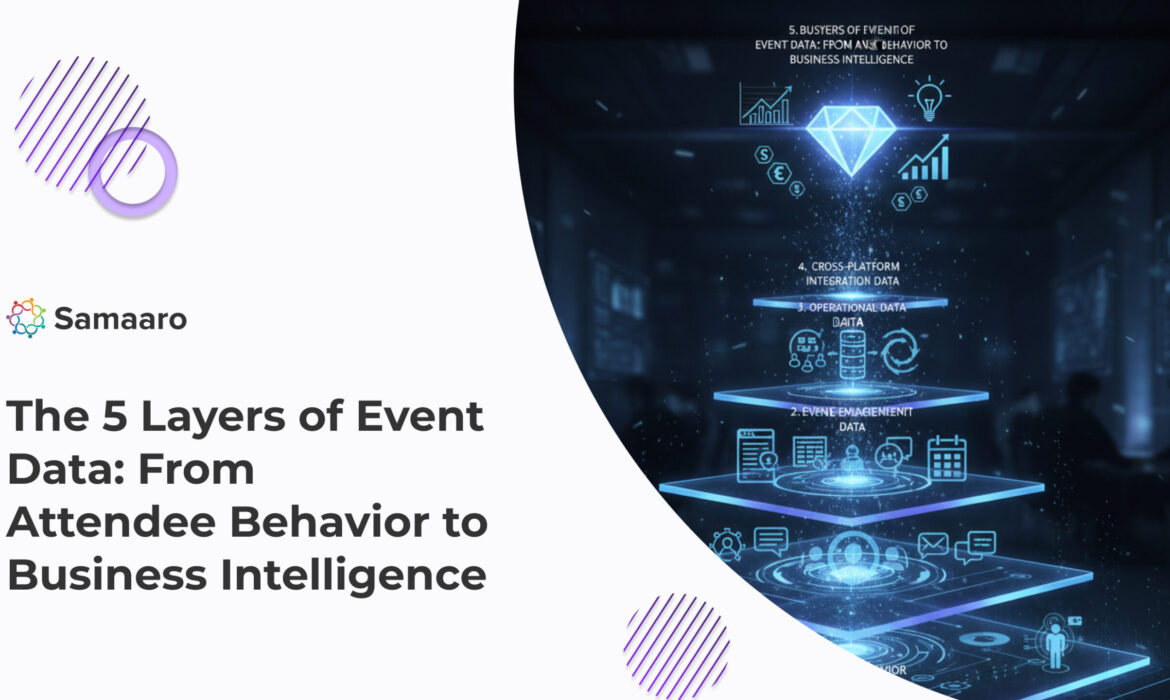
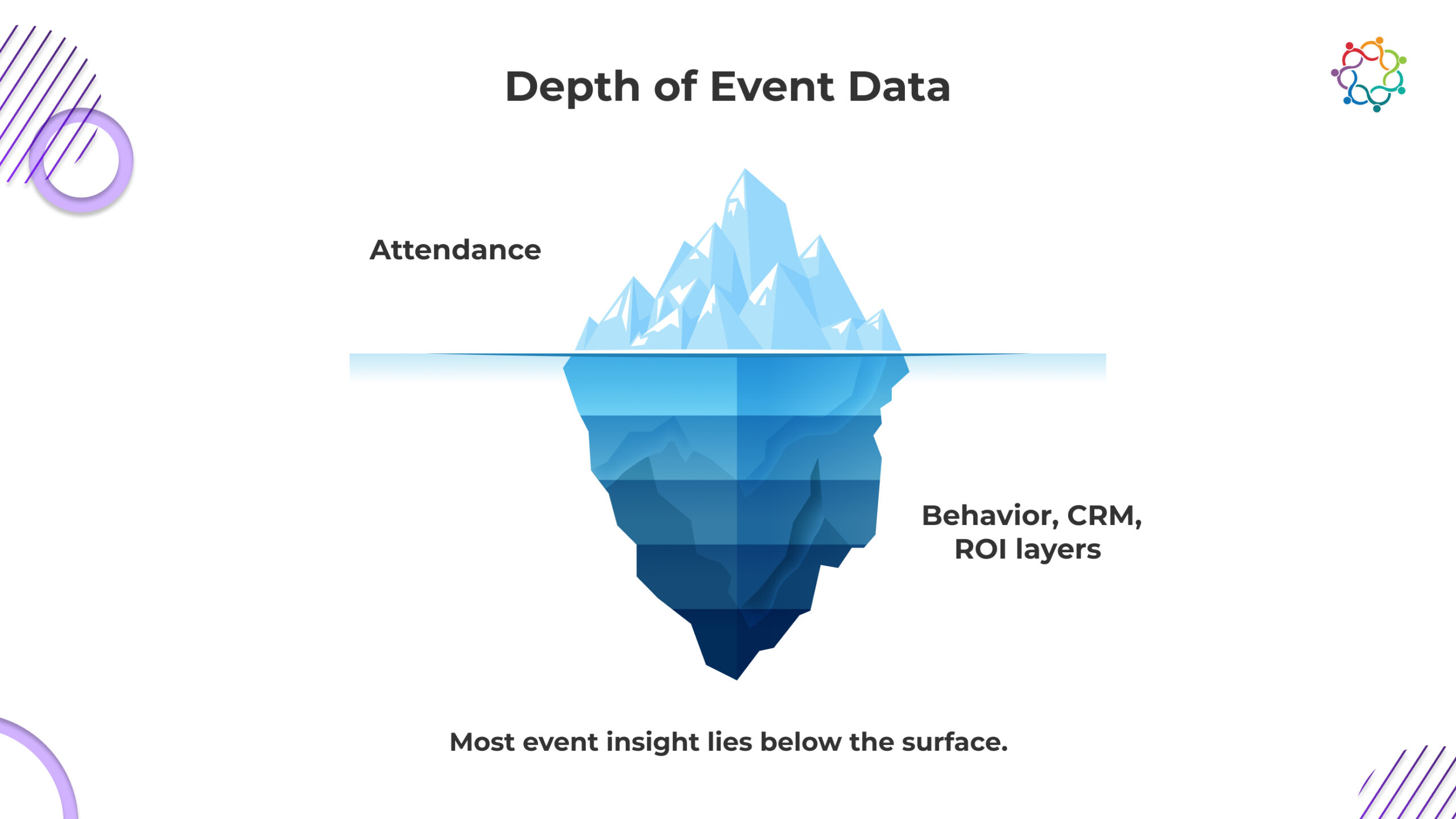
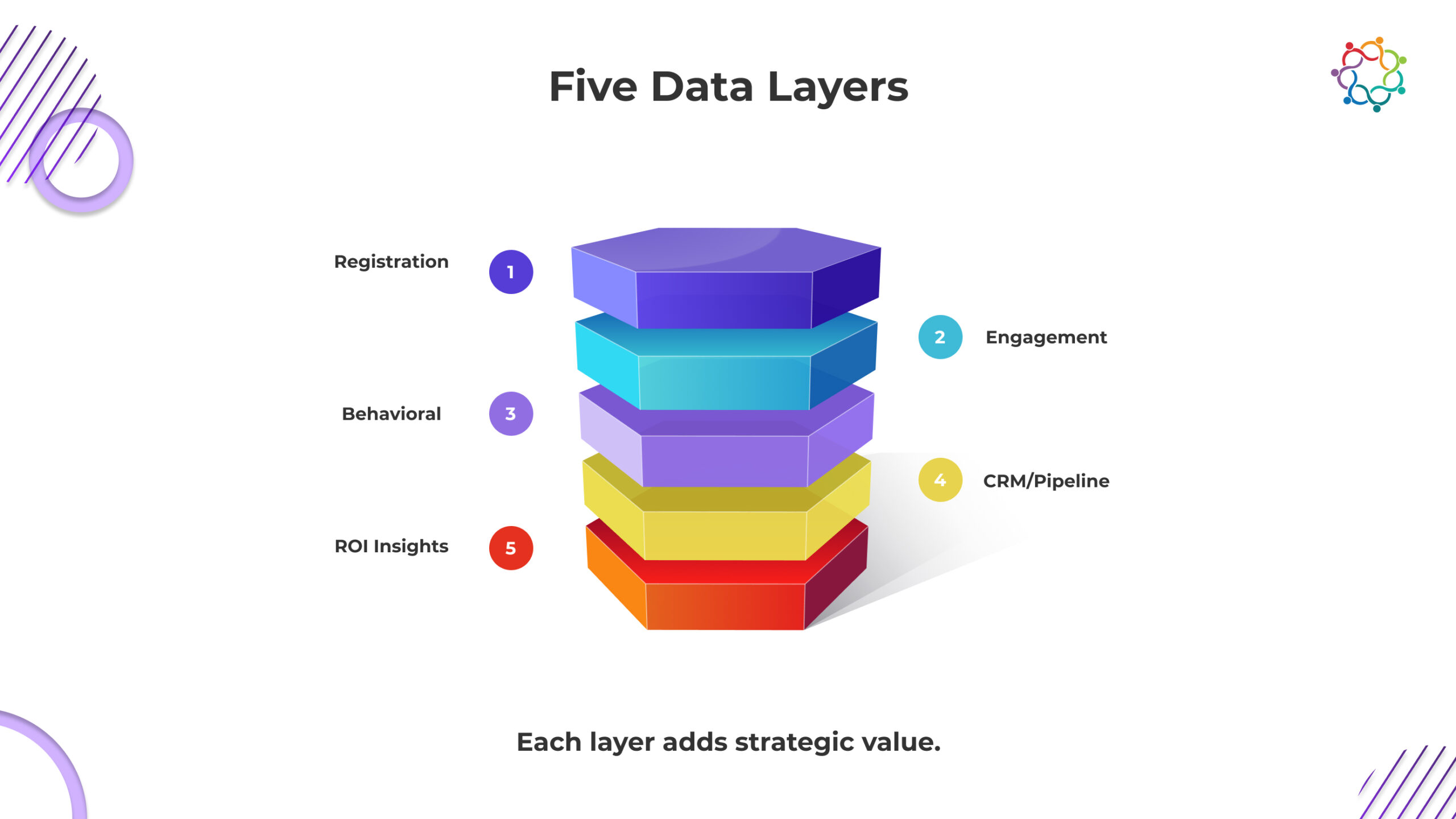
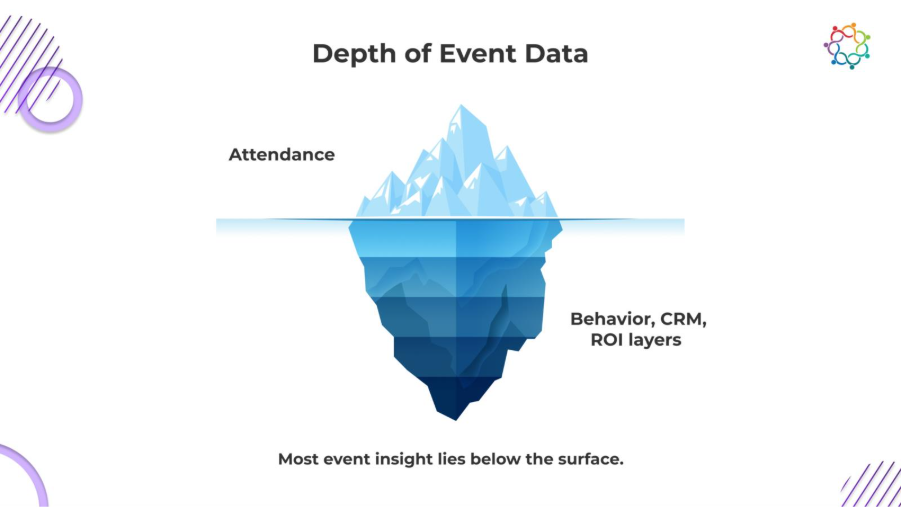
Event data has evolved into one of the most valuable strategic assets for modern marketing teams. Yet many organisations still view it through a narrow lens, focusing only on surface-level indicators such as attendance or registrations. In reality, every click, dwell, check-in, or content interaction reveals intent, readiness, and the true quality of audience engagement. When analysed as a unified system instead of isolated data points, these signals form a powerful intelligence model that can shape content strategy, optimise resource allocation, and directly influence pipeline outcomes. This blog explores the five layers of event data and how each contributes to enterprise decision-making.

The first layer of event intelligence starts long before your event begins. Registrant data reveals audience intent, discovery channels, and potential for segmentation. As a marketer, you are identifying which campaigns brought in the most registrations, which industries are the most interested in your event, and which regions are generating the most early engagement. The speed at which registrants are adding their names also reveals some insight into how your audiences behave, so you can understand if they are exhibiting the behaviors of planners, last-minute decision-makers, or both.
This layer shapes strategic decisions regarding messaging, outreach, and resource allocation. If you notice a high percentage of registrants are coming from a specific sector, the content of the sessions can be modified to reflect the registrants. Likewise, if there are geographic areas that are lagging behind in registrations, campaigns can be initiated in those regions to drive registrants. Registration data is relatively basic at first glance, but is foundational to forecasting demand, prioritizing the audience, and strategizing for the event in its early stages.
Once participants enter the event environment, engagement data is the next critical indicator of value offered. Engagement informs us where participants went, and how they engaged. This may include session join rates, poll answers, questions and answers, booth attendance, networking engagement, content downloads, etc. The aim of engagement data is to evaluate how well value was offered, and what sessions or activities provided that value.
Engagement data can also give insight into periods of the event that had the highest energy levels, and the topics that highlighted the most alignment with attendee interests. For example, if a session had low engagement, but high registration, this may indicate a timing issue. Or, if a workshop had high dwell time, and a second engagement, this may indicate a good content-community fit. Engagement data will also allow you to evaluate the speaker’s performance as well as the efficiency of the event format and content relevancy; however, engagement data will always be a primary action if you are committed to investing in optimising your event, long-term.
Behavioral data extends beyond direct engagement actions and uncovers the “why” behind attendee movement and attention patterns. It tracks elements such as page views, dwell time in different event areas, navigational flow, mobile app usage, and repeated visits to certain zones or links. This type of data provides deep qualitative insight into intent.
For example, an attendee repeatedly viewing a product page or revisiting a specific session recording signals interest and potential readiness for a sales conversation. Long dwell time at knowledge hubs or exhibitor sections may indicate a need for more personalised content follow-up. Behavioral data gives marketers a richer narrative about what the attendee actually cares about, enabling highly targeted post-event communication, refined content strategies, and more precise audience segmentation.
While behavioral and engagement data indicate intent, CRM and pipeline data connect that intent to business outcomes. This is the point where event intelligence (like an exit questionnaire) begins to be tied to revenue. Connecting event analytics to CRM visibility allows teams to see which breakout sessions led to booked meetings, which attendee actions helped accelerate the deal, and which sessions moved the pipeline.
This is especially important for CMOs and revenue leaders. It is clear after an event whether they succeeded in attracting their intended audience, whether engagement led into sales conversations, and where marketing and sales alignment need adjustments. When event data is linked to a CRM, the team no longer relies on subjective feedback after the event, instead uses solid proof to assess whether the event had an impact. The team is also equipped to see which cohort they truly value, how to nurture that cohort more strategically, and measure the actual impact of each event in growing the business.
In the final phase, you’ll translate raw data into macro-level intelligence that will support your organisation to improve long-term event strategy. ROI and strategic insight are made up of the costs of engagement, pipeline contribution, audience retention and brand lift to support a true retrospective view of an event’s overall impact. Rather than to simply look at singular parameters such as attendance, this phase will support evaluating which format, topics or engagement led to a higher return on investment.
This level of event intelligence supports leaders to make better informed decisions around budgets allocation, prioritisation of channels and event design. For example, if data shows that thought-leadership sessions positively influence pipeline better than product demos consistently, teams can focus their attention for the next event in a similar way. Similarly, retention insight suggests how the event performed in influencing community building or loyalty. Strategic intelligence takes us from the tactical execution of event marketing to upon enterprise plan for growth.

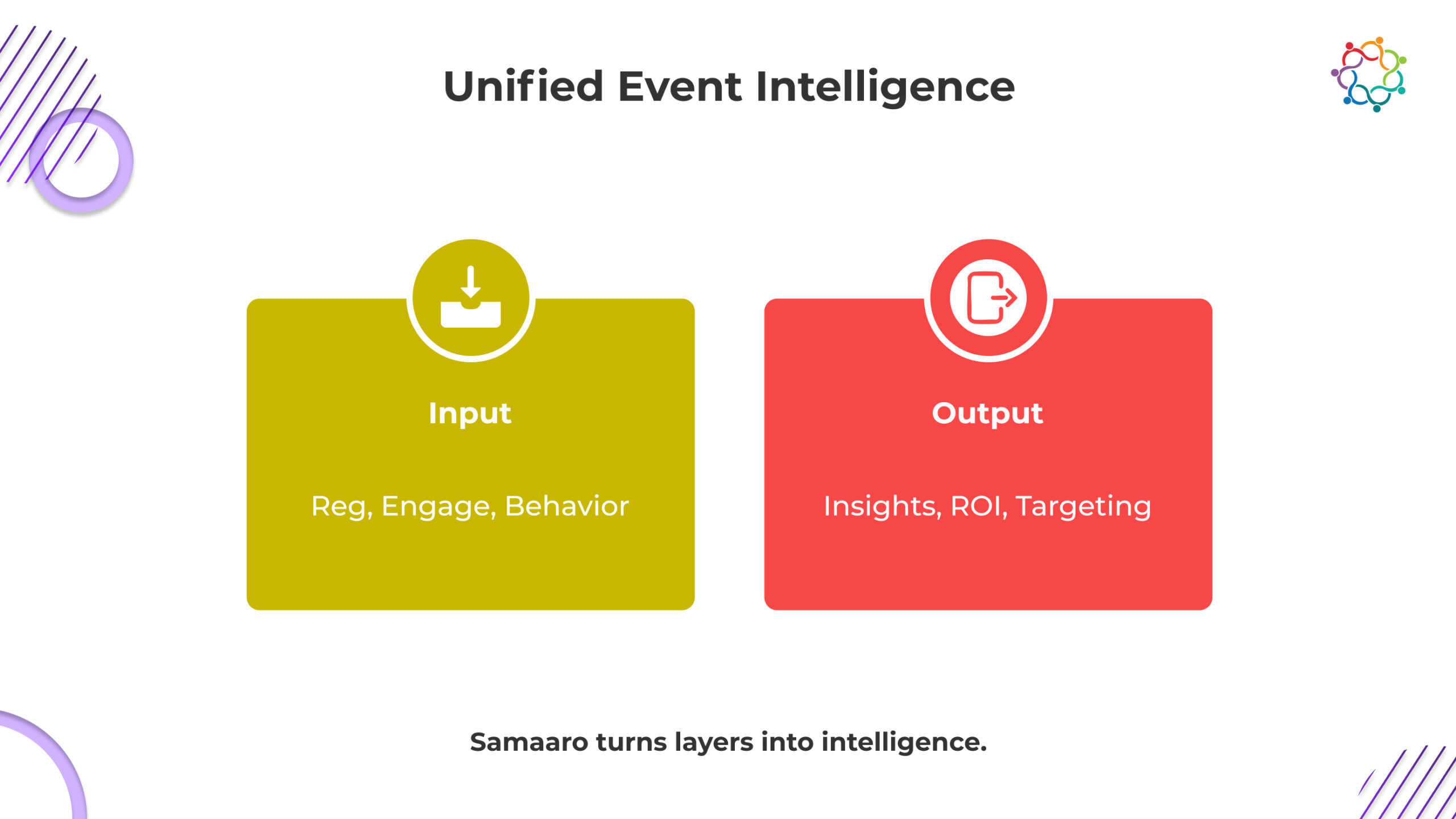
Most organisations handle registration data in one tool, engagement analytics in another, behavioural signals in a third, and CRM outcomes in a fourth. Samaaro removes that fragmentation by unifying all five layers of event data into a single analytics engine designed for enterprise decision-making.
Samaaro captures acquisition channels, sector mix, regional distribution, and signup velocity, then connects these patterns to actual behaviour and pipeline outcomes. This turns registration data from a vanity metric into an early predictor of demand and audience quality.
Session join rates, poll responses, engagement hotspots, and content downloads flow into a real-time dashboard. Samaaro highlights what delivered value and what underperformed, giving teams immediate clarity on content relevance and speaker impact.
Heatmaps, dwell time, navigation flow, repeat visits, and mobile usage patterns are merged with engagement data to reveal intent, not just participation. Samaaro shows who is exploring deeply, who is circling high-value content, and who is signalling readiness for a sales conversation.
Samaaro connects every interaction to CRM records to surface account-level impact: which sessions accelerated deals, which content triggered meetings, and which behaviours correlate with pipeline movement. This creates a verifiable bridge between marketing activity and revenue outcomes.
The platform consolidates depth, influence, sentiment, and pipeline contribution into a single ROI layer. Leaders can see which formats produce the highest ROI, which audiences convert, which topics create momentum, and which events deserve future investment.
Instead of isolated metrics, Samaaro produces a connected narrative, from the first registration signal to the last pipeline movement. This gives enterprises the ability to design sharper events, predict behaviour, and allocate budgets based on evidence, not instinct.
Samaaro transforms event data from scattered numbers into a unified intelligence system built for enterprise growth.
Event data is more intricate and significant than most organisations might think. Users’ interactions, when connected, represent a fuller picture of who your audience is, what is important to them, and how they view your event or event experience as part of a larger business result. Every click, tap or interaction contributes to a cohesive narrative that provides teams with the insights to make more informed decisions and to create purposefully curated event experiences that are valuable, interesting, and engaging. As in many cases the enterprise ecosystem supports a movement to predictive event strategy, adding integrated event intelligence to try insights well not only support this evolution but is essential to modern experience design and event success.

Most event teams at enterprises still lean on top-line metrics to determine success. They are enthusiastic about high registration numbers, a crowded venue, and other superficial benchmarks, like the number of unique badge scans at the door, but none of these numbers reflect what business leaders care about during the planning process and afterward. The question is not how many people were there, but did the event move prospects further along to purchasing, influence key accounts, or did the event create a deeper long-term affinity for the brand?
This is where the event ROI blind spot comes into play. By focusing exclusively on traditionally grounded key performance indicators (KPIs), teams feel good about the marketing metrics and how many people attended and experienced the event. However, their KPI focus shields them from determining what actually moves the business needles. As a result of selective audiences, rising costs, and closer scrutiny on event lift, teams need a modern ROI framework that goes beyond vanity metrics while capturing an aggregate impact.
For a long time, the success of an event has hinged on things that could be easily measured. We’ve celebrated total registrations, how many people walked by the booth, how many leads we collected, how many people we actively engaged in sessions, how many social impressions we had, etc. But measuring things like these provides too narrow of a view.
For example,
Limitations become obvious when we try to prove the impact of an event throughout the sales cycle. A campaign that generated thousands of leads could have otherwise had no impact on pipeline velocity. Conversely, an event that only had 10 people in the audience could open more quality conversations and yield counterparts that progress qualified accounts.
Traditional measures and context, such as registrations, foot traffic, and leads collected have never addressed the difference between engagement and true business value.

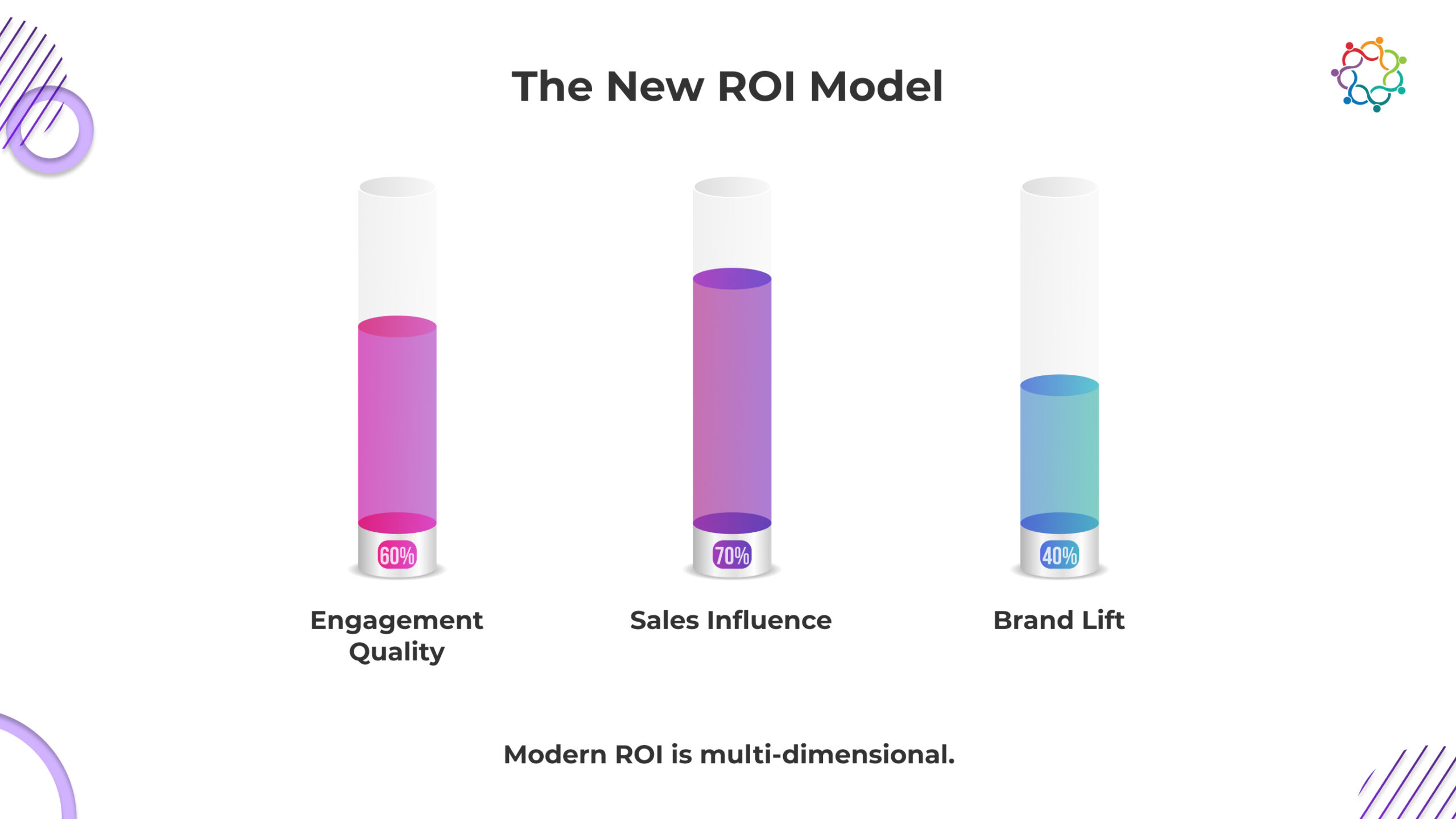
Modern event strategies require a measurement framework that captures depth, influence, and value over time. The new ROI equation is shifting away from tracking what happened to understanding why it mattered. It combines three primary dimensions.
Metrics that focus on depth quantify how much time and how much of the audience’s attention is spent with your content. These metrics include session dwell time, minutes spent interacting with a booth, repeated touchpoints, and consumption of content across digital channels. In-depth engagement suggests that there is a real interest and intent.
Metrics that represent sales influence indicate how events accelerate deals. The metrics include pipeline sourced, pipeline influenced, opportunity conversion and velocity, and account-based interaction scoring. Instead of tracking leads, this is tracking how well event touchpoints nurture momentum for sales.
Events also create impressions of the brand in a way that also ultimately impacts long-term revenue. The qualitative metrics include sentiment analysis, post-event NPS, message recall, and social advocates. All of these are representative of how the event builds trust and awareness.
Together these three dimensions create an overall measure of business impact. The new ROI equation recognizes that events impact customers on three levels: creating an emotional connection, creating educational value, and creating confidence for purchase. And it is a real representation of the role events play in enterprise growth.
A contemporary ROI framework is not feasible without a data connection across systems. Often event teams function in silos; marketing owns lead capture while sales own outcomes – limiting visibility. Meaningful insights into ROI only occur when event data is combined with records of CRM insights, behavioural analytics, and sales progress.
By tracking which accounts attended, what they engaged with and how those engagements impacted deal stages – teams can home in on which interactions truly promote motion and velocity in the pipeline.
Patterns across channels demonstrate buyer engagement and interest beyond the event venue. If attendees engage with post-event emails, resources, demos, etc. – this indicates a higher likelihood of conversion.
Sales teams can also measure whether accounts that experienced event activity progress more quickly than those that did not – which is a much stronger indicator of influence.
Changing the conversation on measuring data improves conversation over raw numbers to understand how an event or events contributed to conversions, renewals, or upsell opportunities.
When organizations adopt a new investment return equation, decisions are made quickly, and decisions become tactical and deliberate. Event strategies go from being intuition-driven to insight-determined.
Teams can determine what types of events create the most engagement depth or sales influence to determine the format to allocate the budget to that will deliver results time and again.
By determining what sessions, delivered content in what topics had the greatest business outcome, the marketing teams can shift strategies for messaging to their event and campaigns.
Depth of engagement is signalling to teams who to present their events this first who are worth even more or in a segment that should be explored due to high intent potential. Teams now have the ability to focus on high-intent, high-potential buyers with no concern to the headcount to attend.
Marketing and sales teams are more visible and coordinated with being able to plan follow up easier. The high intent attendees will take action right away increasing conversion rate.
These insights will elevate events from cost centres to predictable growing engines. Event leaders will gain the confidence to back spending, and defend a event decision with evidence, data formalities and details with context.

Most tools stop at attendance numbers. Samaaro is built to measure what actually moves revenue, aligning directly with the new ROI equation you’ve outlined.
Samaaro captures engagement depth at a granular level:
These signals differentiate passive attendance from real intent, the foundation of depth-based ROI.
It also tracks sales influence through direct CRM alignment. Every interaction feeds into the account record: who engaged with which session, how deeply, which assets they consumed, and how that behaviour affected opportunity stages, velocity, or deal size. Samaaro shows which touchpoints accelerated movement, and which didn’t matter.
For brand amplification, Samaaro layers qualitative intelligence on top of behavioural and CRM data. Sentiment trends, open-text insights, NPS drift, and message recall indicators sit alongside quantitative metrics so teams can understand how the event changed perception, not just activity.
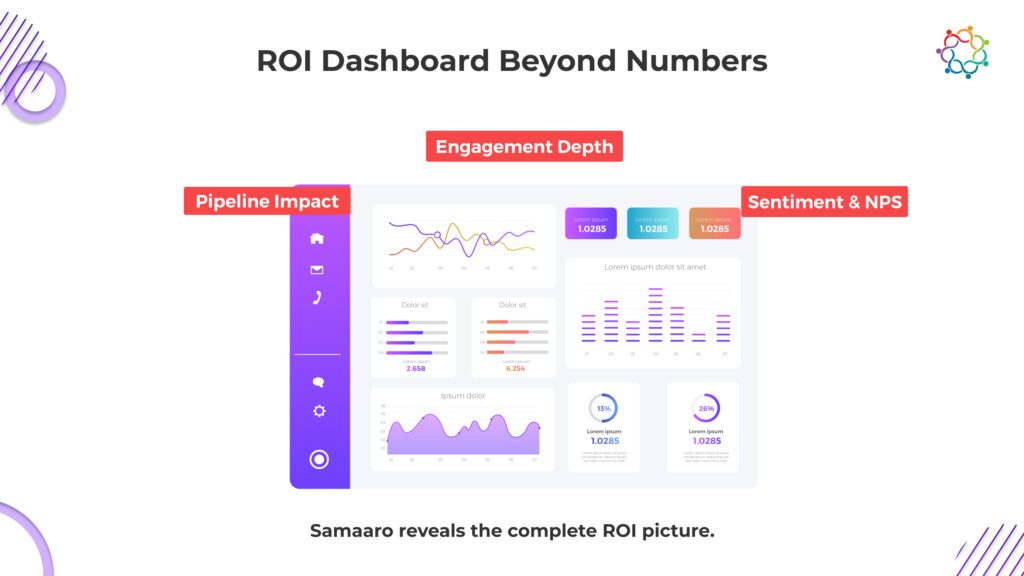
The ROI dashboard does not present disconnected metrics. It produces a coherent influence map:
Instead of guessing what mattered, teams see precisely why an event drove revenue, or where value was lost. Samaaro turns ROI from a retrospective report into a forward-planning engine that guides investment, content, formats, and audience strategy.
Samaaro isn’t just reporting events; it’s measuring business impact.
Events have outgrown traditional KPIs. To understand their true impact, organisations need to measure depth, influence, and long-term value. Vanity metrics can show activity, but only modern ROI metrics can show meaningful progress toward enterprise goals.
The future of event measurement lies in smarter analytics that integrate sales, marketing, and behavioural data. By adopting the new ROI equation, leaders can finally answer the question that matters most: did the event move the business forward?
Unlock the complete ROI picture with Samaaro’s analytics suite.

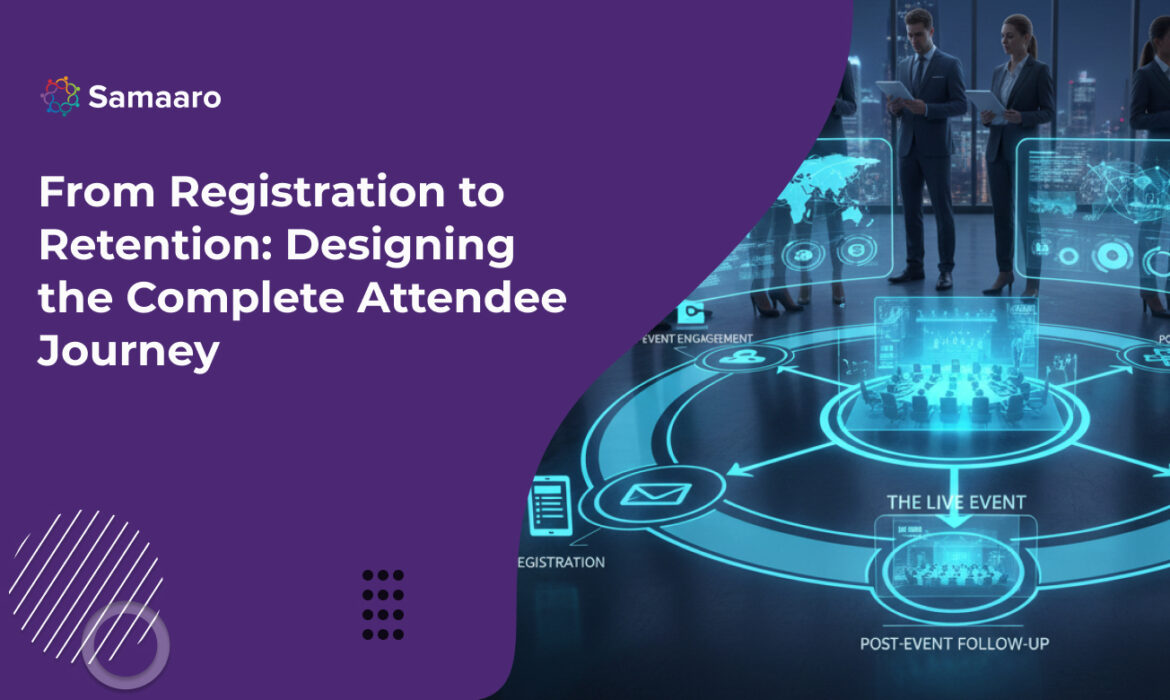
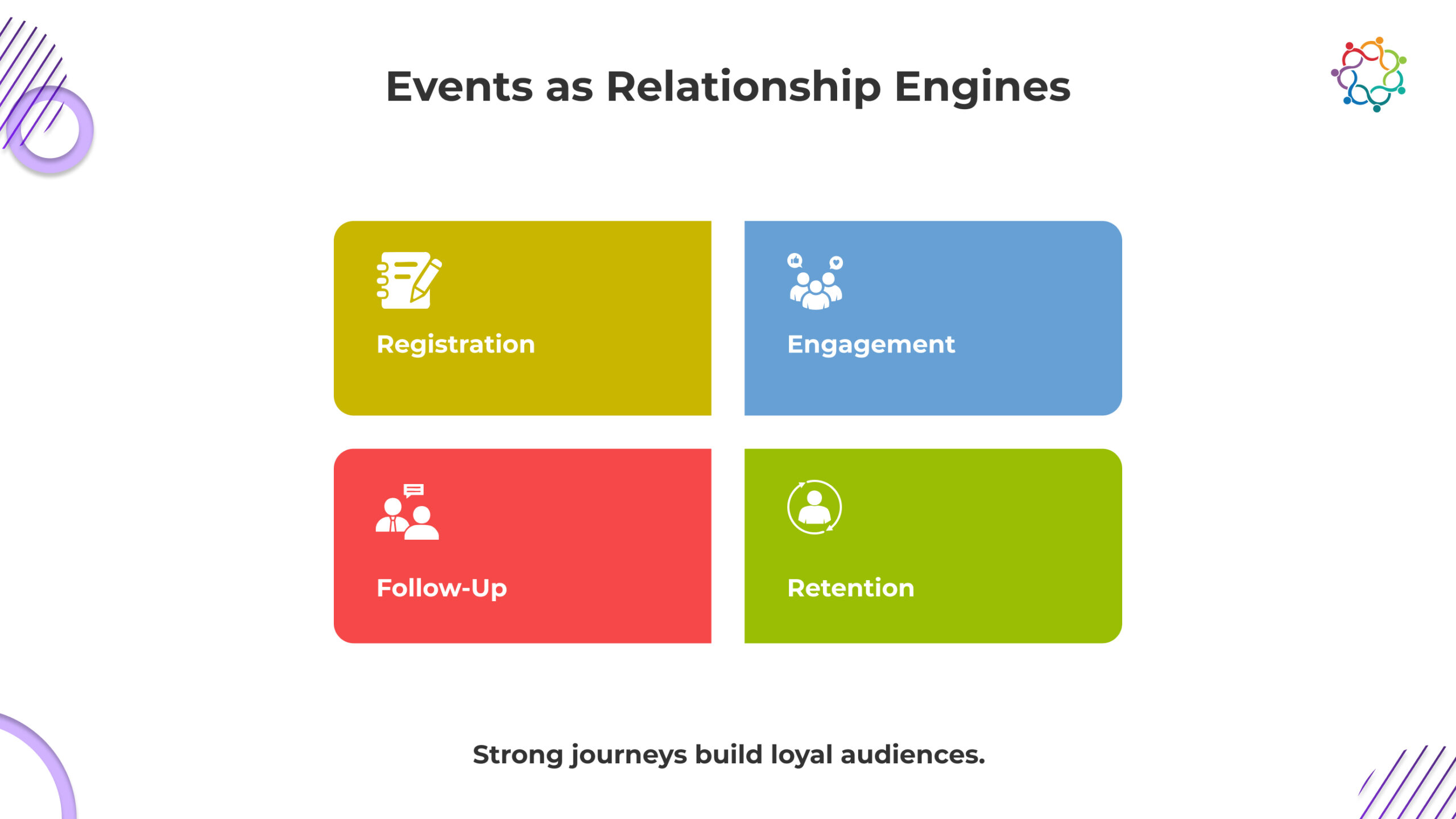
Most event teams consider events as stand-alone campaigns rather than as long-term relationship builders. However, attendees are not leads, or simply numbers on a dashboard. Like a customer journey, attendees go through a lifecycle shaped by their expectations, experiences, and emotions, before, during, and after the event. When this lifecycle aspect is purposely designed, this one of the strongest drivers of brand loyalty.
A well-planned attendee journey will provide added value to every touchpoint, reinforce intent, and move people closer to your long-term ecosystem. This shift from thinking about a single event, to thinking about a lifecycle, gives modern event marketers the ability to increase attendee satisfaction, reduce drop-off, and improve retention through a series of events.

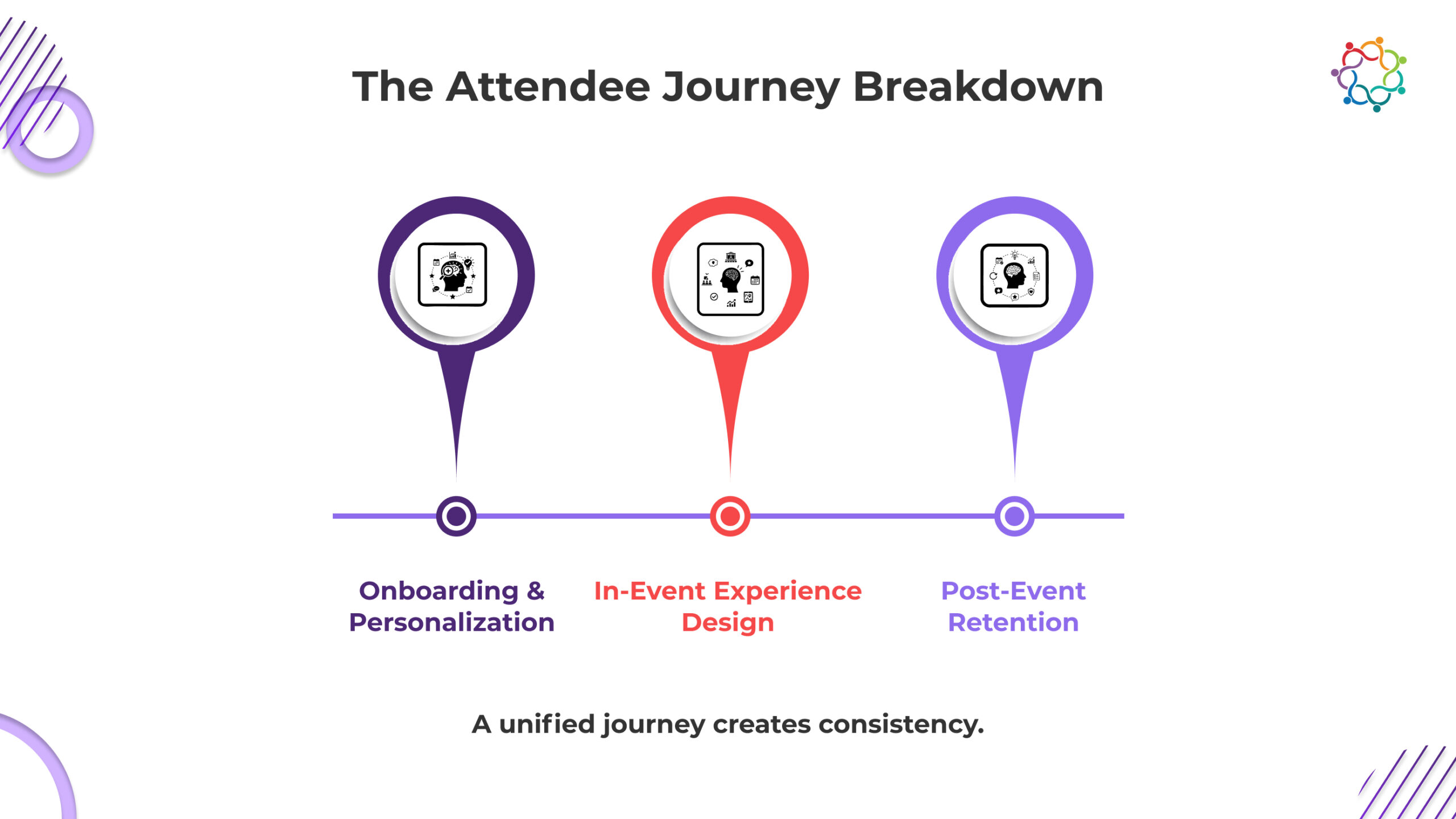
The process of an attendee starts long before they ever step foot inside a venue. It begins the moment they register. An overwhelming registration form or convoluted onboarding process can kill interest before the experience ever begins, so onboarding needs to be simple, quick, and tailored to the attendee.
Personalized registration forms can help set the tone immediately. Asking relevant questions instead of generalized questions, helps capture information that can fuel tailored content, personalized agendas, and session recommendations. Attendees are likely to remain engaged during the event lifecycle when they feel seen from the beginning.
AI-driven agenda recommendations factor in here as well. With the right software, attendee responses, recorded participation, engagement, and professional interests could merge to create a curated event experience. Instead of giving attendees a complicated agenda and forcing them to figure out which session they will attend, you can guide them along to sessions and engagement that met their needs or goals.
A clear onboarding path brings closure to phase one of the attendee journey. There is much that could introduced into the welcome emails, downloading the app, previewing speakers, or readiness information that would prepare the attendee. Every touchpoint should eliminate friction and build excitement. An attendee that arrives to the event feeling confident, informed, and excited is set up for deeper engagement throughout the event.
Once the event is underway, the strategies will steer the event from onboarding to engagement – experience design is critical to the success of driving attendees through the active engagement continuum vs. becoming passive observers. Expectations of audience experiences have evolved and event producers have to design community experiences that are interactive, social and self-rewarding.
Gamified engagement is among the most effective ways to propel sustained participation. When executed properly, challenges, rewards, scavenger hunts or leaderboard options promote exploration. It can inspire participants to get up, speak with and connect with other attendees, expand their scope and, when possible, raise their hands to participate. The promise of gamified engagements can increase attendance in a session, enhance networking, and increase the visibility of sponsors, advertisers and exhibitors – without the registration form filling experience.
Smart matchmaking is equally important. Attendees want to meet people, they do not generally want idle small talk. Letting AI matchmaking do the work to connect people with common interests based on professional goals and behavioral indicators is smart. Attendees that are introduced to each other based on their similarities are more likely to have deeper conversations and find high levels of satisfaction and future potential relationship than those without any relations to the reason for a meeting.
Moreover, “live analytics” opens another layer of the event experience, allowing your team to see in-the-moment attendee behavior. Event organizer can have data on tedious things like the dwell time in a session & traffic flow in a venue, and the cumulative sessions attendee interaction captured over a time. That timing might spark shuffling to some other popular areas, note want to disrupt the current offerings. If an event segment is failing as the interactive audience they wanted, the data could prompt them to act before the interest naturally drops.
Finally, a thoughtfully designed the in-event experience is what takes attendee curiosity to an emotional experience. When attendees feel engaged, included and a have intrinsic motivation throughout the experience, they will be far more likely to engage in a post-event activity and certainly returning for a future event.
The attendee experience does not finish once the event is over. In fact, the most essential piece of the attendee experience begins after the event. The post-event follow-up will determine whether attendees ‘just liked’ the experience or if they become a part of your community.
It is key to collect feedback timely. Well-designed surveys, sentiment polls, and rapid rating questions give attendees a voice, engaging them, while also capturing data to support ongoing improvement. Feedback gives indication to the attendee that you care about their experience. Feedback increases trust and openness.
Recapping content extends the life of the content. Recap options include short highlight reels, quotes from speakers, downloadable slides, or recordings of sessions – all these options keep attendees engaged long after the event experience is over. Recaps keep messages top of mind and also allow you to remain visible in the weeks following the event.
Community groups are yet another effective retention tool. When attendees join dedicated channels on WhatsApp, LinkedIn, or inside your event app, now they have a dedicated space to develop these conversations, announcements, collaborations, or connections. These micro-communities foster ongoing participation and a sense of belonging that continues after the event is over.
When people feel connected to the experience and brand, they will come back again. A good post-event plan makes sure that decisions and momentum are not lost after the event experience, but it translate it into continued participation.
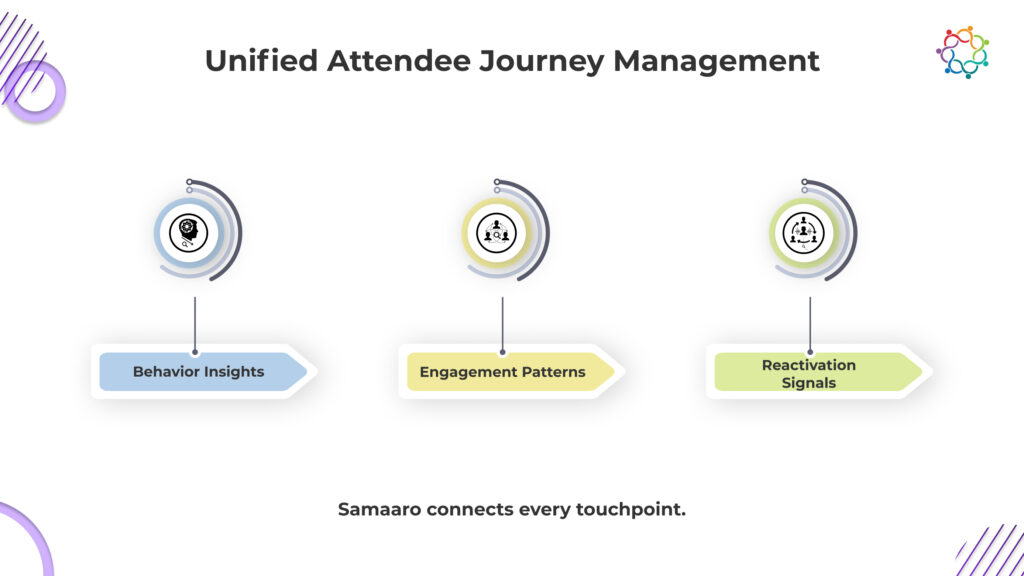
Events are no longer solely evaluated on attendance or NPS, the future is about understanding the full journey viewed through multiple touch points and over multiple events. Once teams start analyzing attendance journeys overtime patterns will emerge. These patterns will inform marketers for better segmenting, customizing communications within every segment, and creating improved experiences for every touchpoint.
Immediately, understanding how people traverse a registration page, to taking action by process of attending sessions, and what actions they take after the event provides insight into conversion roadblocks. Additionally, Knowing which formats of content worked well overtime (or which segments dropped off early) will provide the team data to make informed decisions about what is working or not working. Over time this type of visibility at the level of the journey transforms events from being reactive experiences, to automated growth engines.
Retention becomes at least possible with behavior measured in a more holistic way. Instead of guessing or working on assumptions event marketers can make adjustments or create strategy based on actual audience signals. This becomes a winner because every new (and old) event becomes sharper, custom, and aligned with what the audience expectation was.

The attendee journey only works when every phase, registration, onboarding, in-event participation, and post-event retention, is connected by intelligence, not isolated tools. Samaaro unifies these touchpoints so event teams can design journeys based on real behaviour, not surface-level assumptions.
Samaaro captures every interaction from the moment someone lands on a registration page: the questions they answer, the sessions they favour, dwell time across content, networking patterns, and the signals they generate before, during, and after the event. These signals drive three core outcomes:
1. Personalised onboarding without friction
Registration data automatically shapes recommended agendas, session paths, meeting suggestions, and pre-event communication. No manual mapping, no bloated forms.
2. In-event engagement that reacts to behaviour
Live analytics show movement, interest spikes, session fatigue, and interaction patterns. Teams can intervene in real time, reroute footfall, promote under-attended sessions, or activate nudges for high-intent attendees.
3. Post-event retention driven by measurable signals
Every action feeds into a unified attendee profile: content consumed, connections made, feedback given, follow-up engagement, CRM progression. Samaaro uses this history to automate personalised follow-up, re-engagement, and multi-event nurture paths.
Where most platforms report attendance, Samaaro reports journeys.
Where most tools end at check-in, Samaaro continues through the entire lifecycle, surfacing the insight needed to build long-term communities and repeat participation.
Samaaro turns attendee management into a continuous, intelligence-led cycle, so every event gets sharper, more personalised, and more predictable over time.
Retention does not happen by accident. It’s the result of thoughtful communication, intentional experience design, and continuous improvement across the entire attendee lifecycle. When event marketers treat events as relationship engines rather than one-time activations, every touchpoint becomes an opportunity to build trust and loyalty.
Design a continuous attendee journey with Samaaro’s connected engagement platform.

Samaaro is an AI-powered event marketing platform that enables marketing teams to turn events into a measurable growth channel by planning, promoting, executing, and measuring their business impact.
Location


© 2026 — Samaaro. All Rights Reserved.