Samaaro + Your CRM: Zero Integration Fee for Annual Sign-Ups Until 30 June, 2025
- 00Days
- 00Hrs
- 00Min

Key Takeaways (TL;DR)
Bottom Line: Trade show social media works only when it captures intent and supports pipeline conversations if sales teams can’t use it, it becomes noise.
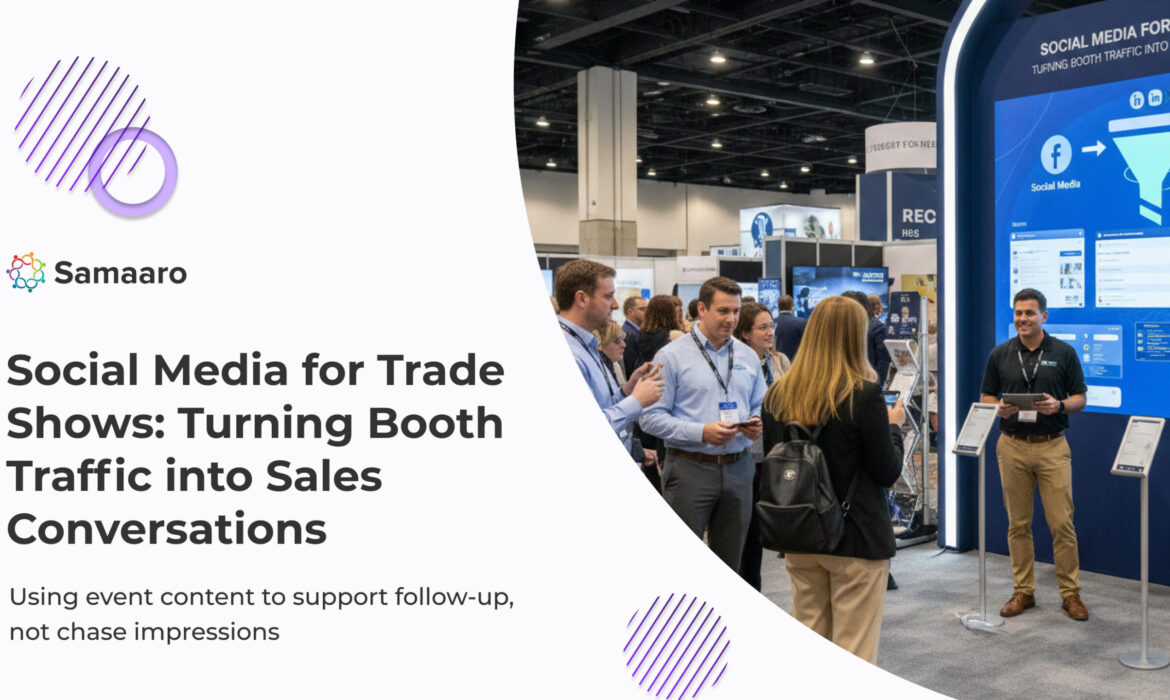
Trade shows create intense bursts of activity. Booths are staffed, calendars are full, and marketing teams post constantly across LinkedIn, X, and Instagram. Photos go up. Hashtags trend within small circles. Engagement numbers climb. On the surface, it looks like momentum. Inside the organization, however, sales teams rarely touch this content once the show ends.
The disconnect is not about effort. It is about purpose. Most event social media is built to prove presence rather than to support revenue conversations. Posts are designed to show that the brand was there, that the booth looked busy, and that something exciting happened. None of that helps a sales rep decide who to follow up with or how to continue a conversation that started on the show floor.
Sales leaders do not ask how many impressions a post received. They ask which accounts showed intent, which problems came up repeatedly, and which conversations are worth prioritizing. When social media does not answer those questions, it becomes invisible to revenue teams.
This is where a trade show social media strategy needs reframing. The goal is not to amplify noise during the event. The goal is to capture context, signal relevance, and extend real conversations beyond the booth. When social content is created with follow-up in mind, it becomes a sales asset instead of a marketing report.
This blog explains how to make that shift without turning social media into a tactical checklist. It focuses on intent, conversation capture, and post-event momentum because that is where pipeline influence actually shows up.
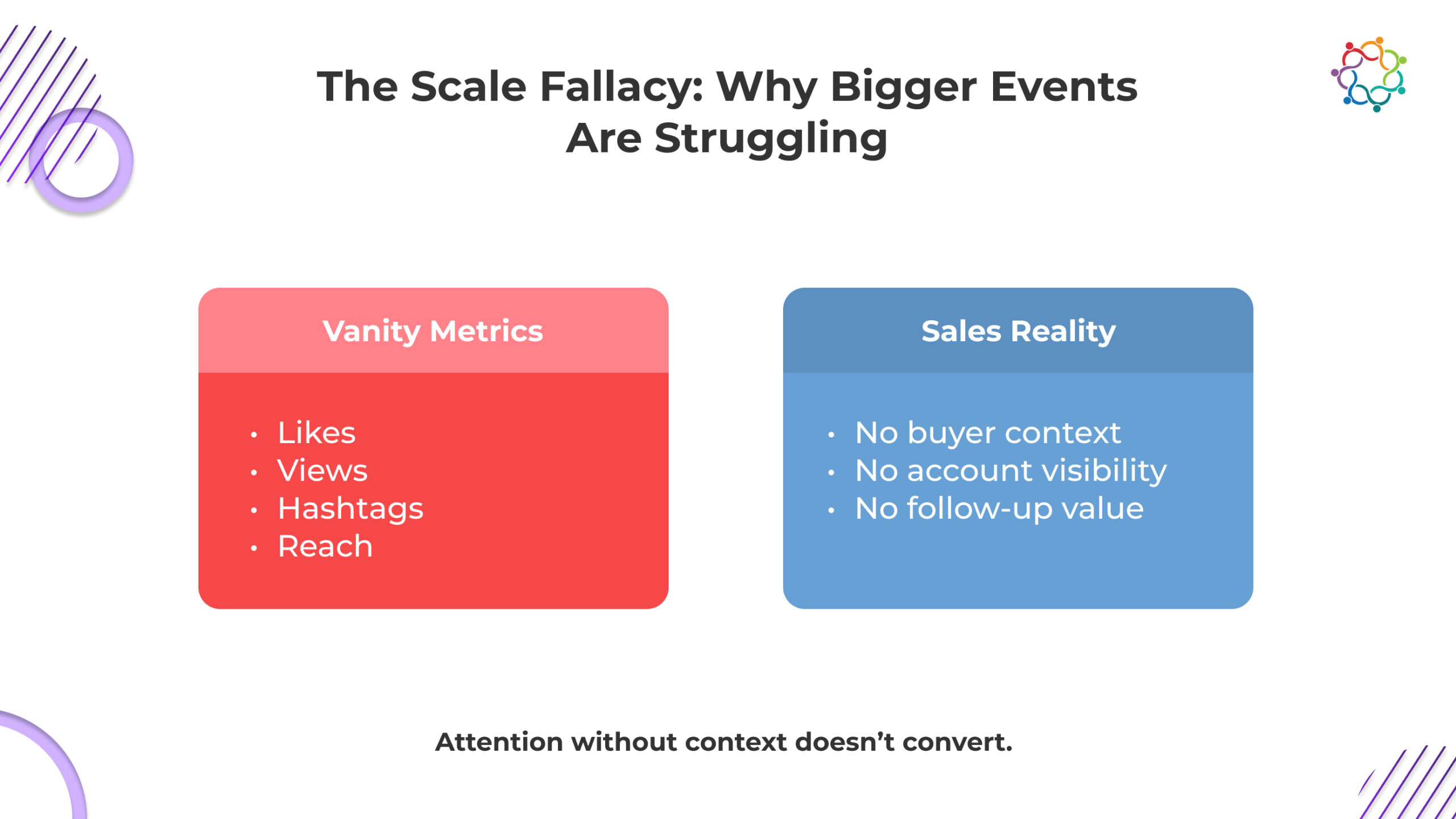
Impressions, likes, and views dominate post-event reports because they are easy to collect and easy to explain. Unfortunately, they are also easy to misinterpret. High engagement during a trade show often reflects algorithmic amplification rather than buying interest. A crowded hashtag attracts peers, competitors, vendors, and people who were never close to the booth.
The problem is not that these metrics are useless. The problem is that they are incomplete. They describe attention without context. Sales teams cannot act on a lead if they do not know who engaged, why they engaged, or whether that engagement connects to a real business problem.
Trade shows amplify this issue because social platforms reward volume and immediacy. Fast posts with generic captions often perform better than thoughtful content. That performance creates a false sense of success, even when none of the engagement maps to target accounts.
Common vanity metrics fall short because they fail to answer sales questions such as who showed repeat interest or which roles interacted with problem-specific content.
Sales teams need signals, not applause. Without intent signaling, social media becomes performative. A trade show social media strategy built on vanity metrics may look active, but it leaves no usable trail for follow-up.
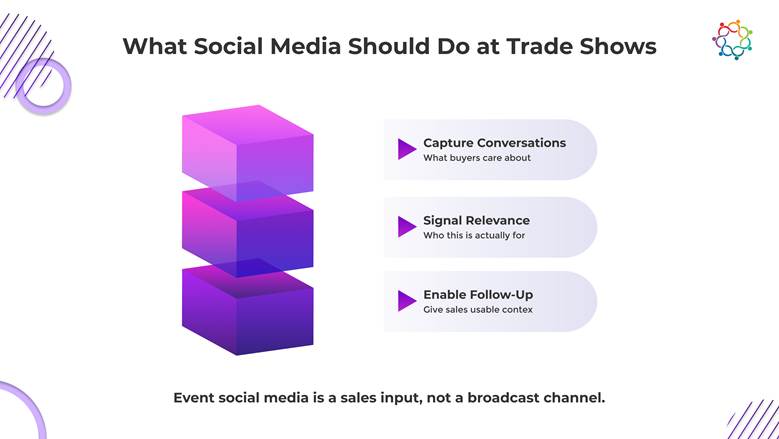
Social media at trade shows is often treated as a live broadcast channel. Posts go out quickly, reactions are tracked, and activity peaks during the event. What is usually missing is intent. When social content is not designed to support sales conversations, it becomes disconnected from pipeline impact.
To be effective, trade show social media must shift from promotion to enablement. Its role is not to narrate the event, but to capture substance and create continuity between the booth and post-event follow-up. This requires a clear understanding of what sales teams actually need once the show ends.
Social content should reflect the questions prospects ask, the objections they raise, and the problems they describe. When posts mirror real discussions happening at the booth, they become reference points that sales can use later to re-open conversations with context.
Trade show content should demonstrate how your team thinks, not just where it shows up. Specific insights, frameworks, or trade-offs signal relevance to the right audience and naturally filter out casual viewers who are not a fit.
Every post should be usable after the event. If a sales rep cannot share it in a follow-up message to reinforce a conversation, it likely does not capture meaningful value.
Social media should help continue discussions that started in person. Thoughtful content allows prospects to engage again, ask questions, or share internally, keeping momentum alive after the booth interaction ends.
When social media serves these functions, it stops being an awareness channel and starts supporting pipeline movement. This is the foundation of a revenue-aligned trade show social media strategy.
(Also Read: How To Craft Engaging Social Media Content for Your Events)
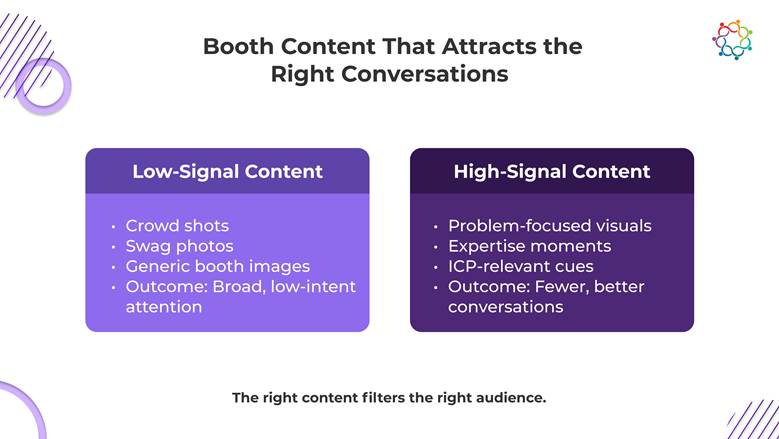
Most booth content optimizes for visibility. Crowded aisles and smiling teams signal activity, not expertise. For sales alignment, content must make one thing immediately clear: who the booth is for and what problem it exists to solve.
Effective booth content emphasizes moments of explanation, not celebration. A focused discussion around a real use case communicates relevance far better than a packed booth with no context. Short video clips work when they reveal how your team thinks, not how busy they are.
Visual cues act as filters. The language on screens, the diagrams shared, and even the props used signal whether someone belongs in the conversation. When content reflects specific challenges and trade-offs, it attracts people who recognize them and quietly repels those who do not.
Strong booth content is designed to start conversations, not document presence. Posts that invite responses from a defined role or industry segment create a natural quality signal. When the right people engage, that interaction is more valuable than raw reach.
High-performing booth content typically includes:
The goal is not more traffic. It is better conversations.
From a sales perspective, this changes follow-up priority immediately. Reps should ignore generic booth scans and focus on conversations triggered by specific content; people who commented on a framework, asked about a failed approach, or referenced a use case shown at the booth. Those signals indicate problem recognition, not casual interest. Everything else can wait.
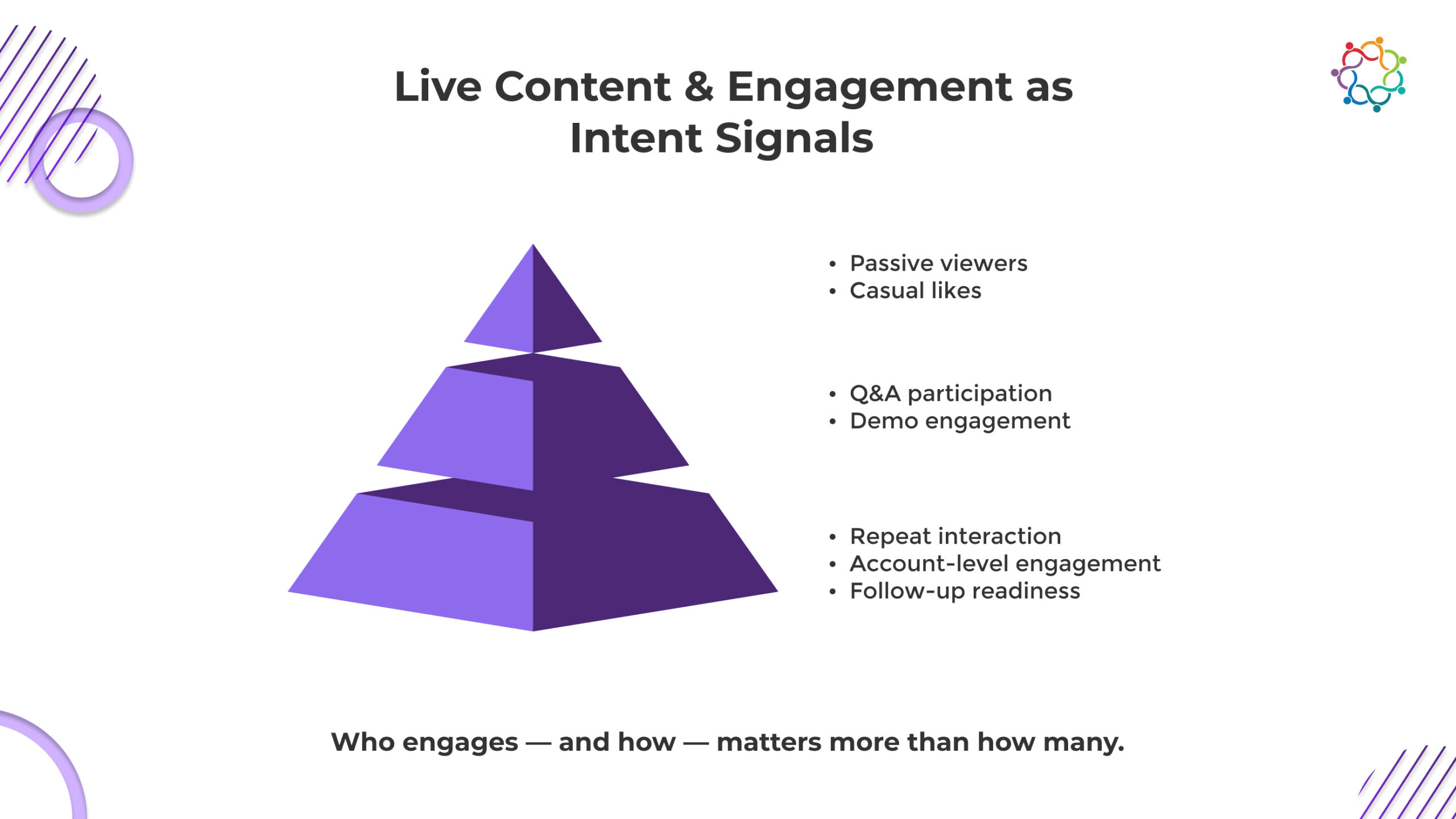
Most live trade show content prioritizes energy over usefulness. Walk-throughs and quick interviews attract attention, but they rarely surface intent. To matter commercially, live content must function as a filter, not entertainment.
Live formats should intentionally narrow the audience. When sessions focus on real problems, constraints, and trade-offs, only relevant viewers stay engaged. That self-selection is where intent begins.
Expert-led Q&A works when it targets specific ICP challenges. The questions asked and how they are framed reveal urgency, problem awareness, and buying maturity. These are stronger signals than view counts.
Demos should be anchored in real use cases, not feature tours. When viewers recognize their own scenario, they stay. When they don’t, they leave. That drop-off is a feature, not a failure.
Depth is the filter. Assuming a baseline level of domain knowledge discourages casual viewers and surfaces serious prospects. Fewer, better viewers produce more sales value than broad visibility.
When live content filters effectively, social selling becomes practical rather than performative.
For sales teams, live engagement should determine who gets called first and how the conversation starts. Reps should prioritize viewers who asked questions, stayed through deeper segments, or attended multiple sessions, and lead with the same problem framing used in the live content. Viewers who dropped in briefly or reacted passively should not receive immediate outreach or demo-heavy follow-ups.
Social engagement at trade shows is often misread. Likes and views do not equal intent. Used carefully, however, engagement can add context that improves follow-up quality.
The key is restraint. Social signals should support sales activity, not replace it.
Who engages matters more than how many. A single interaction from a relevant decision-maker outweighs dozens of passive reactions.
Patterns matter more than moments. Repeat engagement, participation across related topics, or follow-up questions signal deeper interest and help sales prioritize outreach.
Role context matters. Engagement from practitioners, influencers, or decision-makers requires different responses and different next steps.
Social engagement should be treated as supporting evidence, never attribution. Its value lies in sharpening conversations, not claiming revenue impact.
Used correctly, social signals improve event lead quality without inflating expectations. They reinforce a trade show social media strategy built on intent, not vanity.
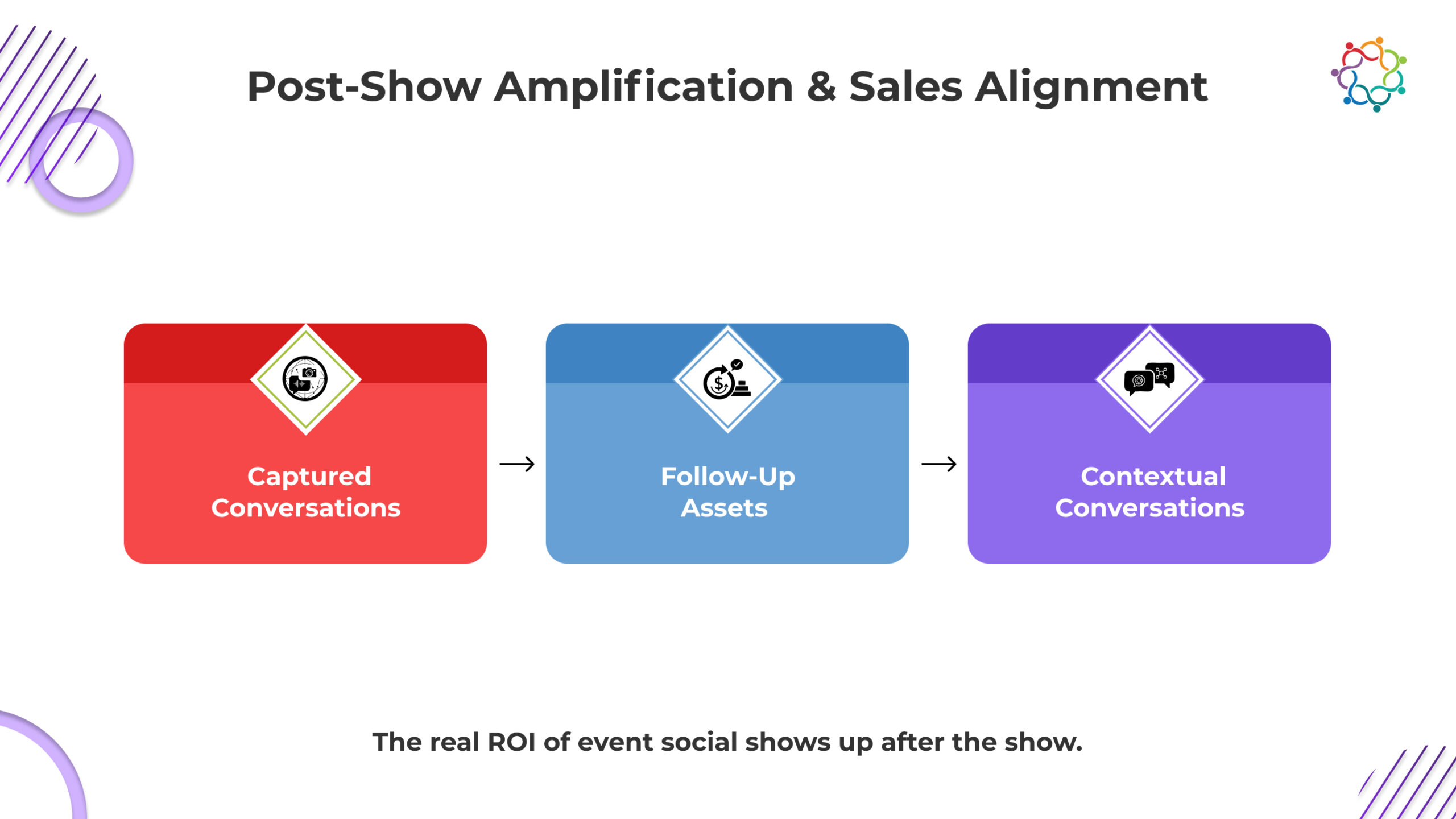
The most important phase of trade show social media begins after the event ends. This is when sales follow up, momentum fades or accelerates, and pipeline outcomes are decided. Content created during the show should be optimized for this moment.
Post-show amplification is not about recapping what happened. It is about reinforcing why conversations started and helping sales continue them with relevance.
Short clips, visuals, or insights captured during the event should be reused in follow-up messages. These assets help prospects recall discussions and reconnect quickly.
Sales teams need content that fits naturally into one-to-one communication. Lightweight, focused assets outperform long recaps or highlight reels.
Post-event content should align with themes discussed at the booth. This continuity strengthens credibility and keeps the dialogue moving forward.
Timely post-show content keeps your brand present while interest is still high. This sustained visibility supports deal acceleration rather than starting from zero.
This is where event content amplification drives results. By focusing on post-event momentum, teams realize the revenue potential embedded in a disciplined trade show social media strategy.
Misalignment between social, events, and sales teams often shows up during follow-up. Marketing hands over a folder of content. Sales does not know what to use or when. The result is generic outreach that ignores context.
Sales teams need clarity, not volume. They want to know which content connects to which conversation and why it matters. Marketing can help by packaging content around themes rather than channels.
Shared visibility is critical. When sales understands what was posted, who engaged, and what questions surfaced, follow-up becomes more relevant. This requires simple processes, not complex tools.
Avoiding content dumps means curating selectively. A few well-chosen assets tied to specific problems outperform broad recaps.
This operational clarity ensures that social media efforts translate into better conversations, strengthening the overall trade show social media strategy.
Rethinking trade show social media starts before the event. Teams should ask strategic questions about purpose and audience rather than platforms and formats. This mindset shift leads to restraint, which often improves results.
Choosing fewer content moments forces clarity. When every post must justify how it helps sales follow up, unnecessary content falls away. What remains is more focused and more useful.
Measurement should evolve as well. Instead of reporting impressions alone, teams should evaluate how often content is used in follow-up and whether it advances conversations.
By prioritizing usefulness over volume, teams build a sustainable approach. Restraint is not a limitation. It is a focus. This perspective makes sure that the ROI strategies remain aligned with revenue goals.
Trade show social media is not about being everywhere or posting constantly. It is about relevance and continuity. When content captures real conversations and supports intelligent follow-up, it earns a place in the revenue process.
If sales cannot use the content, it did not work. If engagement does not reveal intent, it is just noise. The true measure of success appears after the booths are packed up and the follow-up begins.
A disciplined approach turns social media into a conversation extender rather than an event highlight reel. That shift is what makes social media matter in the context of trade shows.
Trade show social media should fuel sales conversations, not distract from them.
(If you’re thinking about how these ideas translate into real-world events, you can explore how teams use Samaaro to plan and run data-driven events.)