Samaaro + Your CRM: Zero Integration Fee for Annual Sign-Ups Until 30 June, 2025
- 00Days
- 00Hrs
- 00Min

Key Takeaways (TL;DR)
Field marketing sits in an uncomfortable spotlight. It is one of the most visible investments a B2B company makes, involving executive time, travel, venues, sponsorships, and direct sales participation. It is also one of the hardest channels to explain with clean attribution. In 2026, that tension is sharper than ever. Budgets are tighter, scrutiny is constant, and events are routinely compared to digital channels that promise clearer tracking and faster optimization.
Events do not behave like paid media or lifecycle email. They do not operate in isolation or convert on demand. They shape perception, strengthen relationships, and accelerate decisions that may close months later. Yet when leadership asks for proof, field marketing teams often default to attendance numbers, badge scans, or anecdotal sales praise. These signals describe effort, not business impact.
This creates a familiar standoff. Leadership wants confidence that events are worth continued investment. Field teams know the influence is real but struggle to present it in a way that survives scrutiny. This article resolves that tension by redefining how field marketing ROI should be measured, explained, and trusted in 2026.
ROI vs Impact. A Critical Distinction Most Teams Miss
Many event ROI conversations fail before they start because ROI and impact are treated as the same thing. ROI is a financial ratio: revenue divided by cost. It works best in channels with short feedback loops and direct conversion paths. Events rarely fit that model.
Impact measures influence. It captures how events affect pipeline creation, opportunity progression, and deal outcomes over time. Most field marketing events create impact first and revenue later. When teams force events into narrow ROI math, they underrepresent their true contribution.
Why this matters to leadership is simple. Executives are not demanding perfect attribution. They are deciding where to allocate future spend. They want to know whether events are pushing the business forward in ways that justify their cost.
This distinction reshapes measurement. ROI answers financial efficiency. Impact explains business movement. Credible field marketing teams in 2026 hold both at once. They acknowledge attribution limits once, then move forward with authority while presenting impact through multiple reinforcing lenses instead of false precision.
Field marketing teams often mistake reporting volume for clarity. Dashboards are dense, meetings are long, and uncertainty remains. The problem is misaligned intent.
When executives ask about event ROI, they are not asking for more charts. They are asking questions that guide decisions:
Metrics matter only if they answer these questions. Attendance, engagement scores, and lead volume are irrelevant unless they support trade-offs. Leadership does not want to debate attribution models. They want confidence to act.
This is why ROI reporting must function as decision support, not performance defense. Strong teams lead with interpretation, not raw numbers. They explain what the data suggests, where confidence is high, and what choices it implies. This signals strategic maturity and builds trust.
The Core Pillars of Field Marketing Event ROI
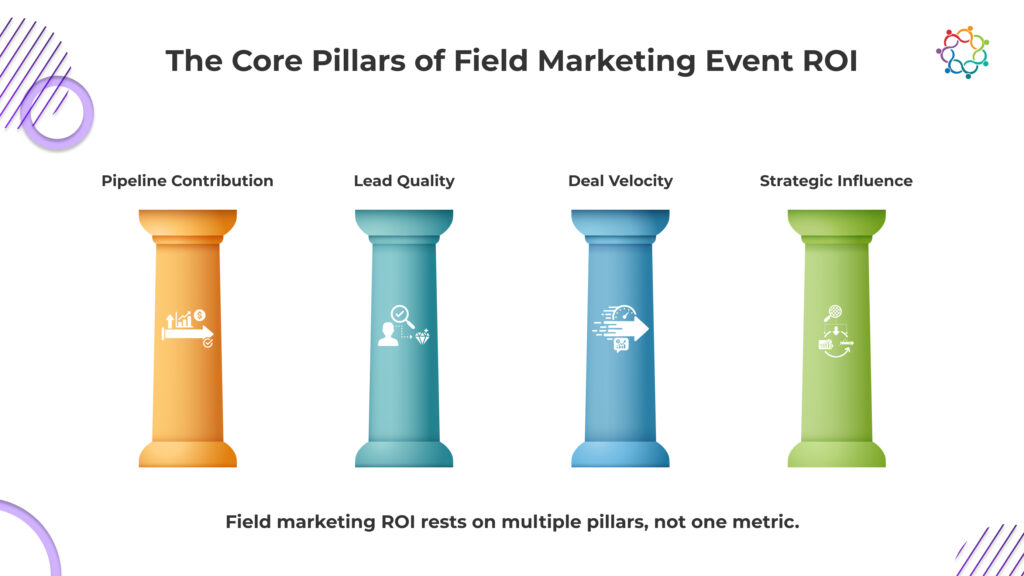
Before diving into individual metrics, it is important to establish a unifying framework. Field marketing event ROI cannot be reduced to a single number without losing meaning. Instead, it should be understood as a set of connected value pillars that reflect how events actually drive growth. Some events create new pipeline, others accelerate active opportunities, and others deliver strategic influence that supports long-term revenue. Measured together, these pillars provide leadership with a balanced, credible view of event performance in 2026.
Pipeline contribution is the most direct bridge between events and revenue, yet it is often misunderstood. Many teams stop at lead counts or marketing qualified leads, assuming volume equates to value. In reality, the pipeline tells a much richer story.
There are two primary ways events contribute to the pipeline. Sourced pipeline refers to opportunities that originate from event engagement. Influenced pipeline captures opportunities that already existed but progressed meaningfully after the event. Both matter, and leadership increasingly cares about the combined picture.
Account-level analysis is particularly important. Events often move entire buying groups, not just individuals. Tracking how target accounts advance through stages after event participation provides stronger evidence of impact than isolated lead metrics.
A mature approach to pipeline contribution includes:
By focusing on directional contribution rather than last-touch credit, teams present a more honest and useful view of how events shape revenue potential.
Particularly when costs are being scrutinized, a high lead volume can be alluring. Leadership has discovered that not all leads are made equal, though. In terms of downstream revenue, events that provide fewer but better-quality leads frequently outperform high-volume events.
Sales alignment should be used to evaluate lead quality instead of marketing assumptions. Compared to demographic match alone, indicators like opportunity conversion, follow-up rates, and sales acceptance offer clearer insights. Events that attract the right roles from the right accounts consistently outperform those that optimize for footfall.
Quality-focused measurement shifts the conversation away from raw counts and toward efficiency. It answers whether event-generated leads are worth sales time, not just whether they exist.
Key signals of strong lead quality include:
When field marketing teams emphasize lead quality, they align their reporting with revenue outcomes, not vanity metrics.
One of the most undervalued contributions of events is their ability to accelerate deals. A single conversation at the right moment can shorten sales cycles dramatically. Yet this impact is often invisible in traditional ROI models.
Deal velocity measures how quickly opportunities move from stage to stage. Events influence velocity by building trust, addressing objections, and aligning stakeholders. Faster deals reduce the cost of sale and improve forecast reliability. This is valued by leadership on a deeper level.
Measuring acceleration requires comparing similar opportunities with and without event engagement. Directional trends are frequently obvious enough to guide judgments, even though this analysis is not entirely accurate.
Important velocity indicators include:
By highlighting acceleration, field teams demonstrate value beyond simple deal creation, reinforcing a more sophisticated view of ROI.
Not all event value shows up neatly in pipeline reports. Some of the most important outcomes are strategic in nature. Account reactivation, executive relationship building, and expansion conversations often begin at events long before revenue is booked.
These outcomes should not be ignored simply because they are harder to quantify. Instead, they should be tracked through qualitative and semi-quantitative indicators that leadership can contextualize.
Examples of strategic influence include:
When reported responsibly, these signals complement revenue metrics rather than replace them. They help leadership understand the full scope of event impact without overstating financial claims.
(Also Read: The Complete Guide to Field Marketing for Impactful Events)
Attribution Models. What Works, What Fails, What to Accept
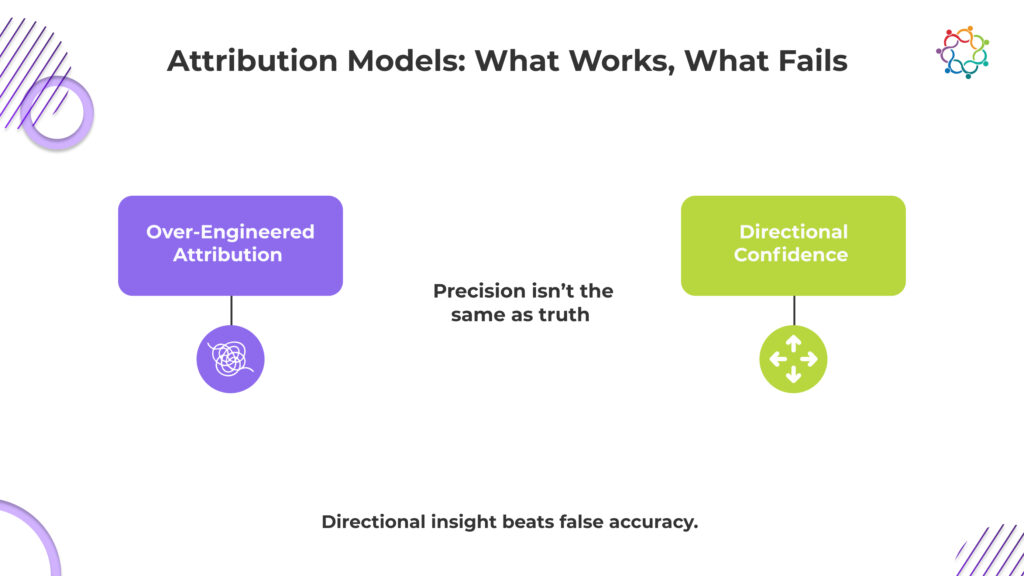
Attribution is where many ROI discussions break down. Last-touch attribution fails events almost by definition, as deals rarely close directly from a booth scan or session attendance. Multi-touch models offer improvement, but they introduce complexity that can obscure insight if overused.
The key is to accept attribution as directional, not definitive. Multi-touch attribution can help identify patterns, such as consistent event influence across successful deals. It cannot assign perfect credit.
Over-modeling is a common trap. When teams invest excessive effort into attribution logic, they often lose the narrative. Leadership cares less about the model than about what it reveals.
A pragmatic attribution stance includes:
Directional truth builds more confidence than false precision. In 2026, credibility matters more than complexity.
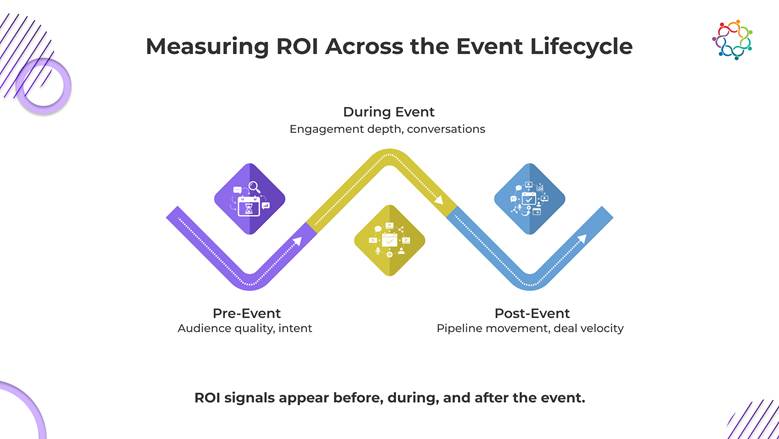
Events should not be evaluated only after they end. Measurement must span the full lifecycle, aligning signals with decision points. Pre-event, during-event, and post-event metrics each serve different purposes.
Pre-event indicators assess readiness and audience quality. Intent data, registration composition, and account alignment signal whether an event is likely to perform. During the event, engagement depth matters more than raw attendance. Session participation, meaningful conversations, and meeting quality provide real-time feedback.
Post-event outcomes connect activity to business results. Pipeline creation, opportunity acceleration, and revenue influence emerge over time and should be tracked accordingly.
A lifecycle approach ensures that ROI measurement supports both optimization and accountability, rather than serving as a retrospective justification exercise.
Turning ROI Data Into Leadership-Ready Reporting
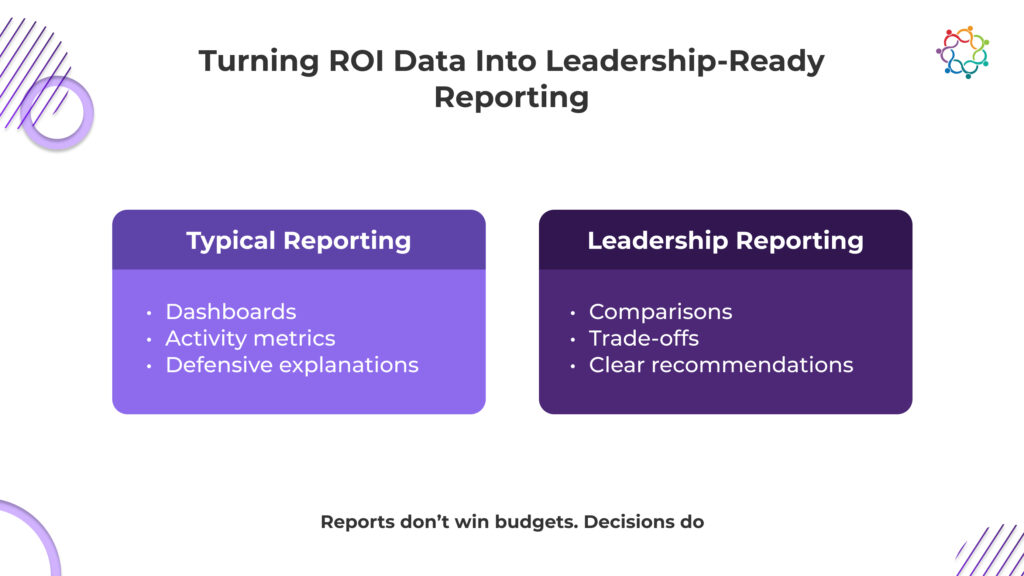
Most ROI reporting fails because it overwhelms instead of clarifying. Leadership-ready reporting compares options, highlights trade-offs, and ends with recommendations. In weak ROI reporting, numbers are presented without interpretation.
Effective ROI narratives typically include:
This shifts ROI discussions from defense to direction.
Despite years of experience, many teams repeat the same mistakes. They defend events emotionally, relying on anecdotal sales praise. They hide behind vanity metrics that feel impressive but answer no real questions. They over-attribute success, undermining trust when claims are scrutinized.
Another frequent error is reporting activity instead of outcomes. Activity describes effort. Outcomes describe value. Leadership cares about the latter.
Avoiding these mistakes requires discipline and honesty. Teams that surface uncomfortable truths earn more credibility than those that overstate success.
Field marketing ROI in 2026 is not about proving that every dollar returned ten. It is about earning leadership’s confidence to keep investing. Events should be evaluated on whether they move the business forward by supporting sales, accelerating deals, and opening the right conversations.
(If you’re thinking about how these ideas translate into real-world events, you can explore how teams use Samaaro to plan and run data-driven events.)