Samaaro + Your CRM: Zero Integration Fee for Annual Sign-Ups Until 30 June, 2025
- 00Days
- 00Hrs
- 00Min


Key Takeaways (TL;DR)
Field marketing dashboards often look impressive at first glance. Charts are full, numbers are moving, and reports arrive on time. Yet when leadership asks a simple question, such as whether events helped move the pipeline or accelerate deals, the answers are often vague. This gap is not caused by a lack of effort or skill. It is caused by tracking the wrong things for the wrong reasons.
Most teams rely on Field marketing KPIs that are easy to capture rather than metrics that explain business impact. Registrations, attendance percentages, and badge scans feel concrete, but they rarely guide decisions. Over time, this creates KPI overload, where teams spend more time reporting than learning. Dashboards become collections of activity proof instead of tools for direction.
The result is predictable. Leadership stops trusting event reports. Finance questions budgets. Sales teams disengage because metrics do not reflect their reality. None of this means field marketing is underperforming. It means measurement has drifted away from outcomes.
This blog reframes KPIs as decision tools, not performance theater. The goal is to track fewer that actually explain pipeline movement, deal progression, and revenue influence. When KPIs are aligned to these outcomes, field marketing regains credibility and clarity.
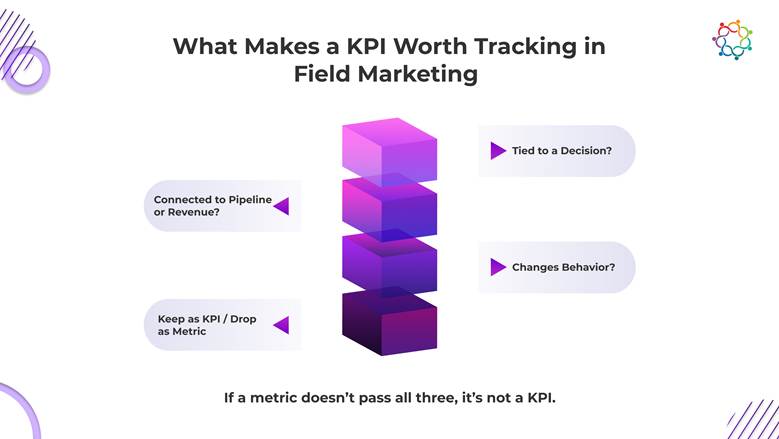
Before listing any metric, teams need a filter. Without one, every measurable action starts to look like a KPI. A meaningful KPI is not defined by how commonly it is used or how good it looks in a dashboard. It is defined by the decision it enables.
A KPI worth tracking in field marketing must meet three conditions. First, it must inform a specific decision. If a number changes and no action follows, it is not a KPI. Second, it must connect directly or indirectly to the pipeline or revenue. This connection does not need perfect attribution, but it must show influence. Third, it must change behavior. Good KPIs shape planning, prioritization, and execution.
Many teams confuse metrics with KPIs. Metrics describe activity. KPIs guide choices. This distinction is critical because leadership expects KPIs to explain why resources should be allocated, scaled, or reduced.
A simple evaluation checklist helps teams prune aggressively:
If the answer is no, the metric may still be useful operationally, but it does not deserve KPI status. Applying this filter early prevents noise and keeps reporting focused on business outcomes rather than internal validation.
Vanity KPIs Field Marketing Teams Still Rely On
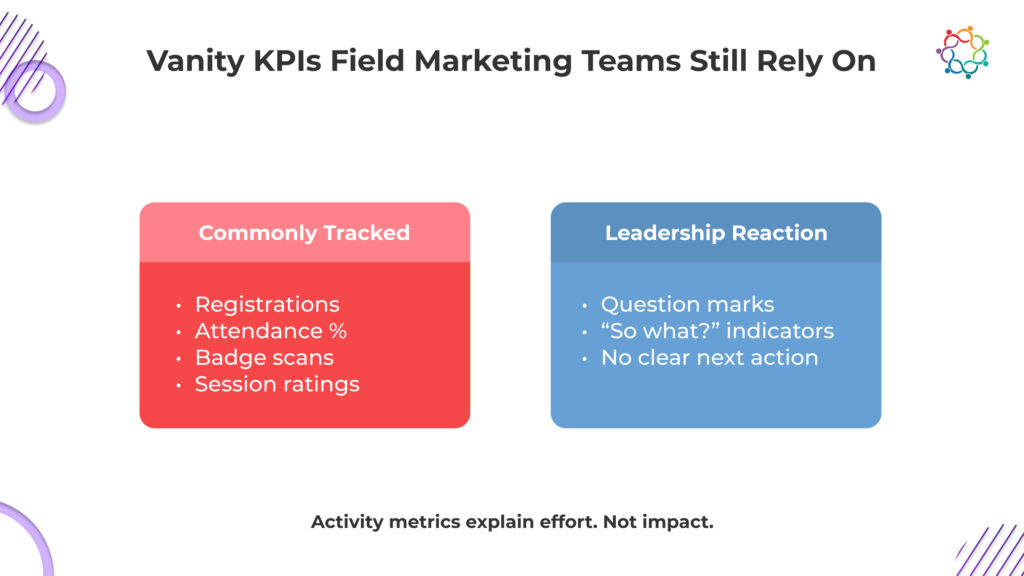
Some KPIs persist not because they are useful, but because they are familiar. These vanity KPIs often dominate event marketing reports and create a false sense of performance. They are not useless, but they are incomplete and easily misinterpreted.
Registrations are a classic example. They indicate initial interest but say nothing about intent quality or pipeline relevance. Attendance percentage adds a layer of engagement, yet it still does not reveal whether the right accounts showed up. Badge scans measure activity at a booth, not meaningful conversations or follow-up outcomes.
Session rating averages and feedback scores are also widely reported. They reflect attendee satisfaction but not business impact. A highly rated session can still attract accounts that never enter the pipeline. Leadership has grown skeptical of these metrics because they answer the wrong questions.
What these KPIs can tell you is limited:
What they cannot tell you is whether the pipeline moved, deals progressed, or revenue was influenced. When these metrics are presented as proof of success, trust erodes. Used carefully, they can support context. Used alone, they mislead and distract from outcomes that matter.
The KPIs That Actually Influence Pipeline
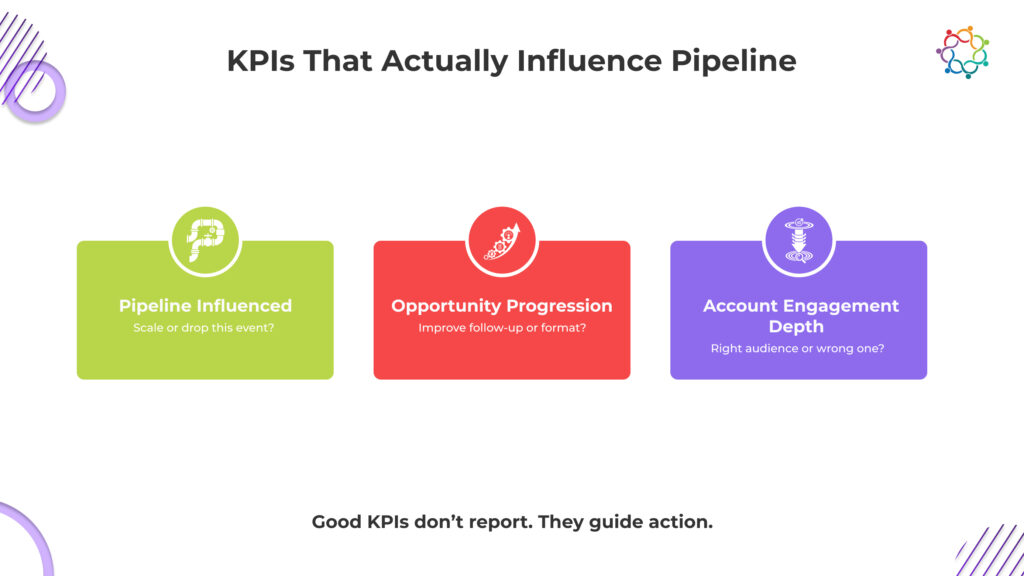
Pipeline-centric KPIs focus on what happened to opportunities and accounts after the event. These are the metrics leadership looks for, even if they do not always articulate it clearly.
Pipeline influenced by events measures whether opportunities associated with event-engaged accounts changed in meaningful ways. Influence does not mean claiming full credit. It means demonstrating directional impact. The key is consistency in definition, not perfection in attribution.
This KPI answers whether events are touching the active pipeline and whether that pipeline grows, progresses, or accelerates afterward. Direction matters more than precision because field marketing operates alongside sales and other channels.
Use this KPI to decide investment priorities:
When tracked over time, pipeline influence builds a credible narrative that events support revenue generation rather than existing as isolated activities.
Opportunity progression focuses on stage movement after an event. Instead of asking how many people attended, this KPI asks how many opportunities moved forward because of event engagement. Meeting-to-opportunity conversion and post-event stage advancement are strong signals of sales relevance.
This KPI helps identify whether events support sales momentum. If opportunities stall despite high attendance, the issue is not promotion but relevance or follow-up alignment. Tracking progression forces tighter coordination with sales and reinforces shared accountability.
It also informs tactical decisions about agenda design, audience targeting, and sales involvement. When progression improves, teams know they are attracting and engaging the right buyers at the right time.
(Also read: The Complete Guide to Field Marketing for Impactful Events)
Account coverage shifts the focus from volume to relevance. It asks whether priority accounts are engaging and how deeply. Depth matters more than reach because revenue comes from specific accounts, not anonymous audiences.
This KPI evaluates whether field marketing is aligned with the account strategy. Engagement depth might include multiple contacts from the same account or repeat interactions across events.
Use account coverage to guide decisions such as:
Together, these pipeline KPIs replace surface metrics with evidence of business impact.
Revenue impact from field marketing is rarely immediate, which is why many teams avoid revenue-linked KPIs. This avoidance creates a credibility gap. While events may not close deals directly, they often influence how quickly and successfully deals close.
Deal velocity changes are one of the most revealing KPIs. Comparing time to close for event-engaged opportunities versus non-engaged ones highlights acceleration effects. Even modest improvements matter at scale.
Win-rate lift is another underused metric. When accounts that engage with field marketing convert at higher rates, it demonstrates value beyond awareness. Expansion and cross-sell signals further extend this view by showing how events support existing customers.
These KPIs answer leadership-level questions:
Revenue-linked KPIs require collaboration with revenue operations, but the payoff is trust. They show that Field marketing KPIs can explain not just activity, but economic impact.
Leading Indicators vs Lagging Indicators
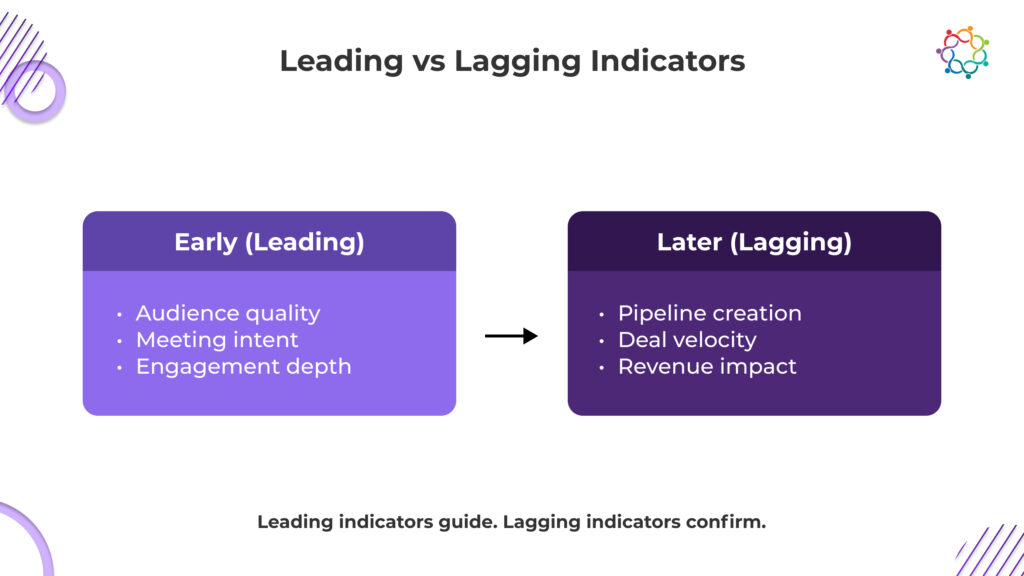
A mature KPI framework balances leading and lagging indicators. Lagging indicators such as revenue and closed-won deals confirm impact, but they arrive late. Leading indicators provide earlier signals that help teams adjust before quarters are lost.
In field marketing, leading indicators might include post-event meetings booked with priority accounts or opportunity creation within a defined window. These indicators do not guarantee revenue, but they predict it.
Lagging indicators remain essential because they validate the strategy. The mistake is relying on only one type. Teams that focus solely on lagging indicators wait too long to learn. Teams that focus only on leading indicators risk celebrating activity without outcomes.
A balanced approach enables smarter sequencing:
This balance elevates Field marketing KPIs from reporting tools to management instruments.
KPIs fail when ownership is unclear. Field marketing cannot own every metric, nor should it. Clear ownership prevents metric theater where teams report numbers they cannot influence.
Field marketing should own KPIs related to audience relevance, pipeline influence, and engagement depth. Sales owns opportunity progression and deal outcomes. Leadership cares about summarized views that connect investment to results.
Alignment requires agreement on definitions and expectations. When ownership is clear, KPIs become shared reference points rather than sources of conflict.
This clarity helps teams focus on what they can control while contributing to broader revenue goals. It also reinforces accountability without blame.
How to Build a KPI Set That Leadership Trusts
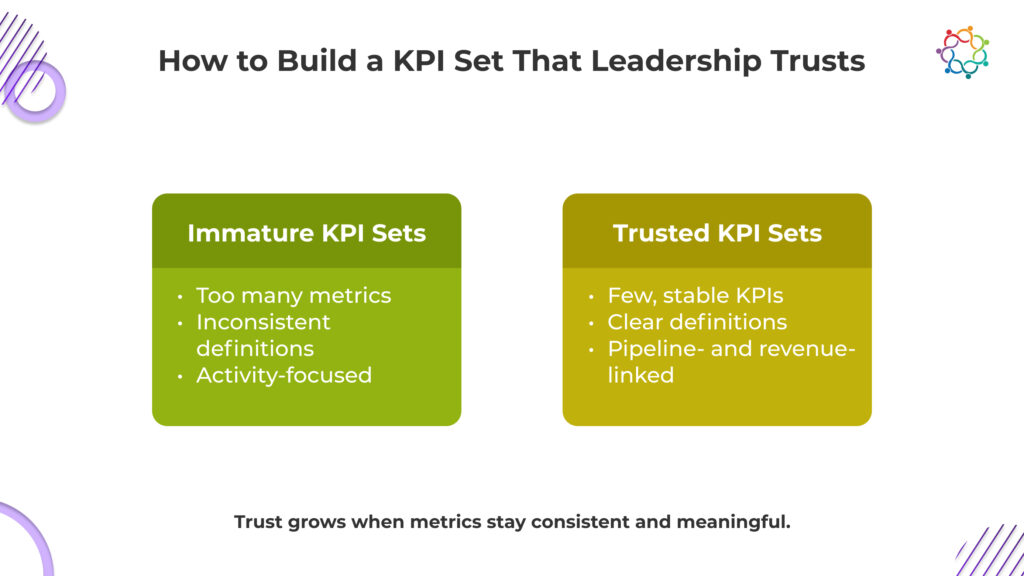
Trust comes from restraint. Leadership trusts teams that present fewer KPIs with clear explanations over those that present many without context. Consistency matters more than novelty. Comparing performance over time builds confidence.
A trusted KPI set is stable, decision-oriented, and clearly tied to business questions. Each KPI should answer why an event mattered or did not. Key principles include:
When KPIs are framed this way, Field marketing KPIs become strategic assets rather than reporting obligations.
Mature field marketing teams approach KPI tracking as coordination, not data collection. They integrate event measurements, pipeline reports, and account insights into an integrated performance narrative rather than handling them separately. Teams are better able to comprehend how an event affected accounts, opportunities, and revenue over time thanks to this alignment.
Although technology can aid in this process, mindset is more important than technology. The real shift happens when teams agree on consistent KPI definitions and apply them uniformly across events, regions, and quarters. In some organizations, platforms like Samaaro make this alignment easier by connecting event engagement data with pipeline visibility, but the value lies in consistency, not the tool itself.
Operational maturity becomes visible when leadership questions can be answered quickly, clearly, and with confidence. At that stage, reporting is no longer a separate task. It becomes a natural output of decision-making, not its primary goal.
KPIs are meant to drive decisions. When a metric does not lead to a clear action, it stops being useful and starts adding noise. This is where many field marketing teams lose credibility. Tracking everything may look thorough, but it rarely helps leadership understand what is actually working.
High-performing teams take a different approach. They focus on KPIs that show real movement in pipeline, clear progression of deals, and measurable influence on revenue. They understand that not every measurable activity deserves attention and that simplicity often delivers better insight than complexity. Clarity matters more than volume.
By deliberately removing weak or performative metrics, field marketing teams create space for sharper analysis and better decisions. Field marketing KPIs become tools for prioritization, not justification. When metrics are tightly aligned to business outcomes, field marketing moves beyond activity reporting and earns long-term trust as a revenue-relevant function.
(If you’re thinking about how these ideas translate into real-world events, you can explore how teams use Samaaro to plan and run data-driven events.)
Track five to eight focused KPIs. That covers pipeline, engagement, and efficiency without drowning the team in numbers nobody acts on.
A metric is any measurement. A KPI is one of the few metrics tied directly to your goals, the ones that actually change decisions and prove field marketing value.
Tag event-engaged accounts in your CRM and report the opportunities those accounts touched afterward. Claim influence, not sole credit, and the number stays credible with sales leadership.
You need event registration and engagement data, CRM opportunity stages, and marketing automation records, all connected at the account level to link events with pipeline movement.
Expect measurable deal velocity differences within one to two quarters, roughly one sales cycle after the event. Comparing engaged accounts against non-engaged ones reveals the lift.