Samaaro + Your CRM: Zero Integration Fee for Annual Sign-Ups Until 30 June, 2025
- 00Days
- 00Hrs
- 00Min

Key Takeaways (TL;DR)
1
2
3
4
→
Bottom Line:If event analytics don’t reduce uncertainty and accelerate decisions, they aren’t insight, they’re decoration.
There is an abundance of information available to modern CMOs. Spreadsheets, dashboards, and post-event reports containing registrations, attendance rates, engagement scores, and satisfaction indicators are generated for each event. On paper, visibility has never been higher. Yet in practice, event budgets are still defended reactively, often after questions are raised by finance or leadership. The contradiction is hard to ignore. If marketing leaders have more data than ever, why do decisions still feel uncertain?
The problem is not a lack of reporting. It is a misplaced belief that dashboards naturally lead to better judgment. Most dashboards are designed to describe what happened instead of guiding what should happen next. They excel at summarizing activity but struggle to explain impact. As a result, CMOs are surrounded by numbers while remaining unclear on trade-offs, prioritization, and opportunity costs.
This is where event analytics begins to fail at the executive level. The failure is subtle and systemic, not technical. Dashboards were never meant to answer questions such as which events deserve increased investment, which formats should be retired, or how event strategy should evolve quarter over quarter. Instead, they provide reassurance through volume and visibility.
The dashboard delusion is the assumption that more metrics equal better decisions. In reality, clarity comes from relevance, context, and direction. Until analytics are designed with decision-making as the primary outcome, CMOs will continue to feel informed yet unsupported when it matters most.
Event ROI is usually treated as a measurement problem. It isn’t. It’s a timing problem. Post-event metrics are lagging indicators; they explain what happened, not why it happened. Senior marketers are often evaluated on results that were determined weeks earlier, long before the first attendee walked into a session.
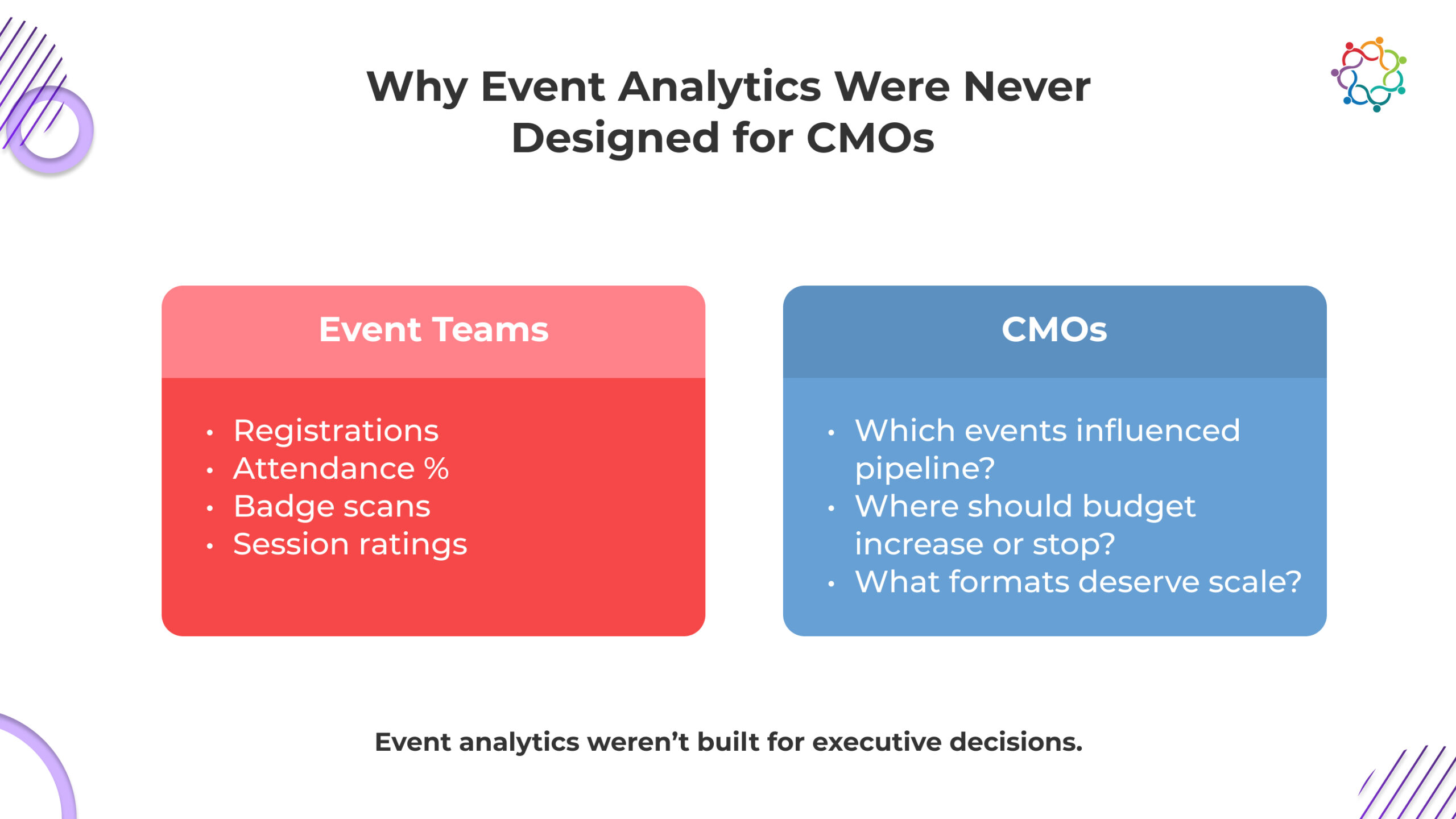
Dashboards feel confusing to executives because they were not built for them in the first place. Most event reports were created to help teams run events day to day, like tracking registrations, attendance, and logistics. They were not meant to help leaders decide where to spend money or what to change next. Because of this, executives often see a lot of numbers but still struggle to make clear decisions.
Event reports typically optimize for the following audiences:
These stakeholders care deeply about completeness, accuracy, and operational efficiency. CMOs care about something very different. Their questions are comparative and forward-looking. They want to understand trade-offs, risk, and return across an entire portfolio of activity.
The result is an audience mismatch. CMOs are handed reports that answer operational questions while they are expected to make strategic decisions. Metrics are presented without interpretation, context, or prioritization. Numbers appear precise but lack relevance to executive choices.
This structural gap is why event analytics often feel busy rather than useful at the leadership level. The data itself is not wrong. It is simply optimized for the wrong layer of the organization. Until analytics are reframed around executive decisions, dashboards will continue to underperform for the people who control budgets.
Data Collection Is Not the Same as Intelligence
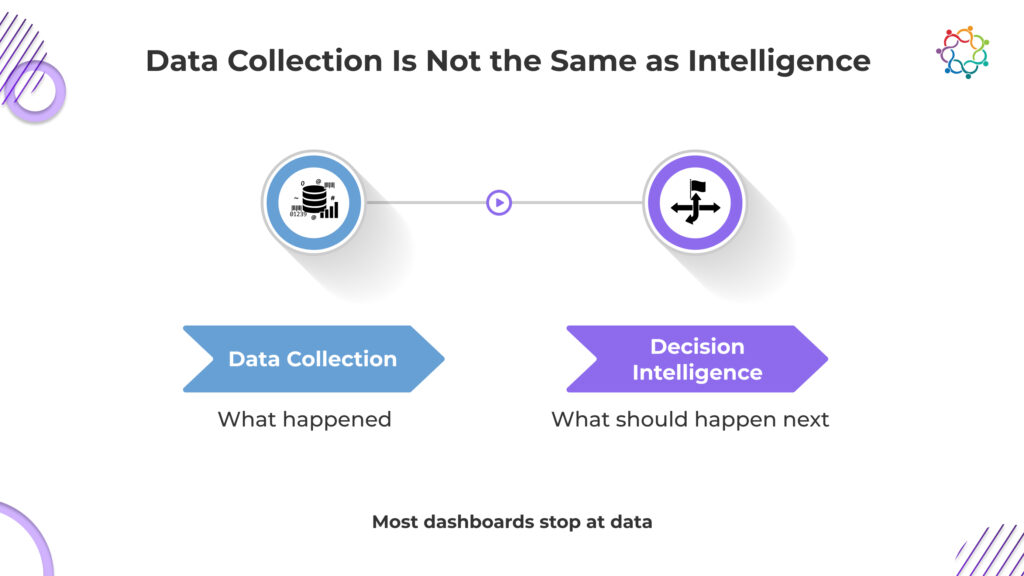
One of the most persistent misunderstandings in marketing measurement is the assumption that collecting more data automatically creates insight. Data collection answers what happened. Intelligence explains what it means and what should change as a result. The difference is not semantic. It is foundational.
Most event reporting stops at description. It tells you how many people registered, how many attended, and how they rated the experience. These metrics are useful, but they are incomplete. They describe activity without diagnosing performance. Intelligence, by contrast, connects activity to outcomes and implications.
Consider the distinction:
This gap is where many event analytics initiatives stall. Teams invest heavily in tracking every interaction but fail to translate that information into executive guidance. Dashboards become repositories of facts rather than engines of decision-making.
The issue is not sophistication. It is intent. Intelligence requires framing data around business questions, such as pipeline influence, audience quality, and marginal return. Without that framing, reports remain descriptive. They tell a story of effort, not effectiveness.
For CMOs, the value of analytics lies in reducing uncertainty. Intelligence shortens decision latency by clarifying what matters now and what can be deprioritized. Data alone cannot do that. Until organizations acknowledge this distinction, analytics will continue to feel comprehensive yet inconclusive.
The 4 Reasons Event Dashboards Fail at Decision-Making
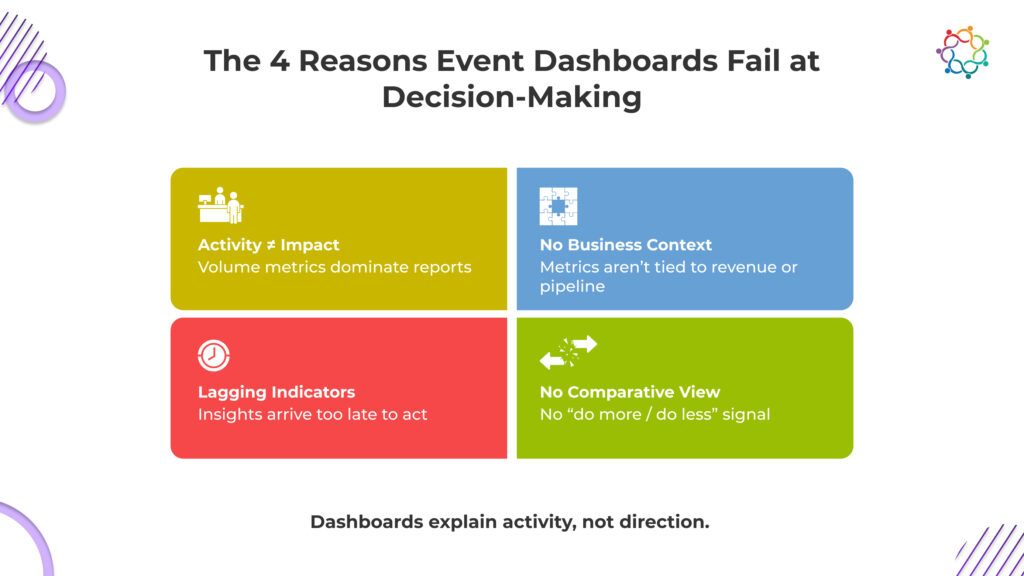
Event dashboards are ineffective because they are not in line with the actual decision-making process, not because they are lacking. The majority of reporting systems are designed to display activity and effort rather than to direct budgetary or prioritizing decisions. CMOs are thus left with a wealth of information but little guidance. The inability of dashboards to transition from reporting to actual decision support can be explained by the following four problems. Even though each issue can appear insignificant on its own, taken as a whole, they produce an impressive-looking but strategically flawed system.
Activity metrics predominate in most event dashboards due to their ease of collection and explanation. Reports are filled with numbers that are visible and instantaneous, such as registrations, attendance, booth scans, and session check-ins. These indicators give teams insight into how well an event went, but they don’t reveal much about whether the event truly advanced corporate objectives.
These dashboards answer the question of execution, not impact. An event can be well attended, well reviewed, and still have no meaningful effect on pipeline or revenue. When dashboards focus mainly on volume, they hide the connection between effort and outcome.
This creates a misleading picture of success. Leaders see rising numbers but cannot tell if those numbers justify continued investment.
Common signs of this problem include:
Without outcome-oriented measures, event analytics stay disconnected from the decisions executives are responsible for making.
Even when dashboards go beyond basic activity, they often fail to place metrics in a meaningful business context. Event performance is shown in isolation, without being tied back to revenue goals, pipeline stages, or cost considerations. This makes it difficult for leaders to judge whether results are good, bad, or simply expensive.
Context is what turns numbers into insight. Without it, comparisons become misleading. A high-performing event may appear successful until its cost is considered. A smaller event may look weak until its conversion quality is examined.
Typical context gaps include:
CMOs need to understand not only what worked, but why it worked and at what price. Without context, dashboards remain static summaries instead of strategic tools that guide allocation decisions.
Event dashboards’ excessive reliance on trailing indicators is one of the main reasons they struggle with decision-making. These analytics, which include post-event surveys, satisfaction scores, and engagement summaries, are only accessible after an event has concluded. Even while these figures might show how attendance felt, they come too late to have a significant impact. Budgets are frequently finalized, and future plans are in motion by the time this data is analyzed.
Lagging indicators describe the past rather than shape the future. They explain what happened but offer little guidance on what should change next. When dashboards treat these signals as primary measures of success, analytics become retrospective instead of directional. Leaders are left evaluating history rather than managing strategy.
Another limitation is that lagging metrics often focus on sentiment instead of outcomes. High satisfaction does not necessarily translate into pipeline progression or revenue influence. This creates a disconnect between perceived success and actual business impact.
Effective event analytics must surface signals early enough to guide decisions, not simply validate them afterward. Without stronger leading indicators, dashboards become reporting artifacts rather than strategic tools, documenting results instead of enabling smarter choices.
One of the biggest weaknesses in event dashboards is the lack of comparison. Events are often reported individually, each with its own set of metrics, but rarely evaluated against one another. This makes it nearly impossible to understand relative performance across formats, regions, or audiences.
Without comparison, there is no prioritization signal.
CMOs cannot see which events consistently outperform others or where returns are declining over time. Trends remain hidden, and decisions are made based on memory or intuition instead of evidence.
Common issues include:
Good decision-making depends on understanding relative value. When dashboards fail to provide that perspective, executives are forced to draw conclusions that analytics should have made obvious.
(Also Read: Decoding Event Analytics: Key Metrics Beyond Attendance)
What CMOs Actually Need From Event Analytics in 2026
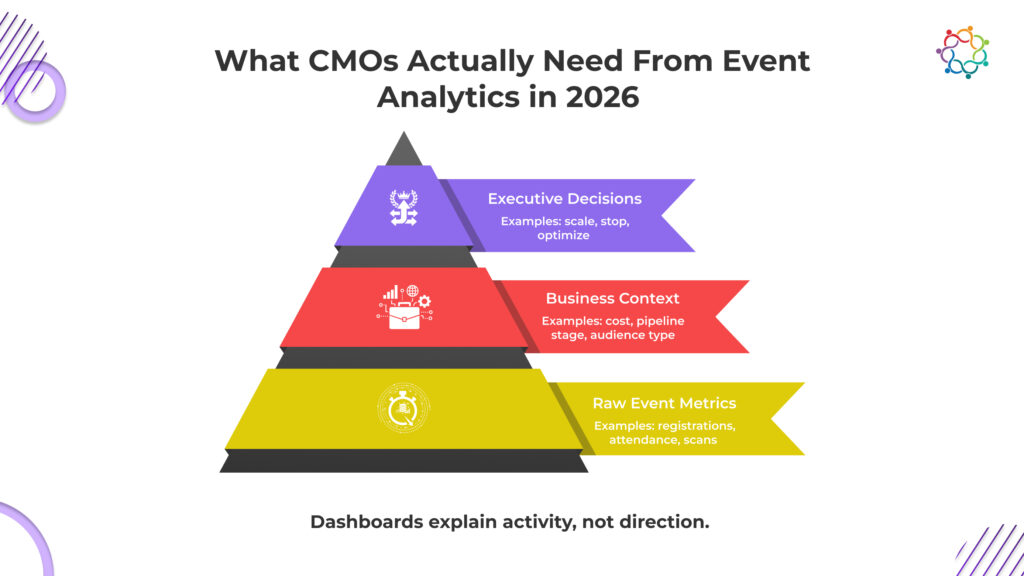
By 2026, CMOs will not be asking for more dashboards. They are asking for clarity. The volume of data is no longer the constraint. Attention and confidence are. Effective analytics must reduce noise and elevate the signal.
What executives need is a distilled view of performance that aligns with business outcomes. This means fewer metrics, not more. It means reports that answer strategic questions directly instead of inviting interpretation.
CMOs want event analytics that provide:
This shift feels liberating because it reframes analytics as a support system rather than a burden. Instead of defending past spending, leaders can focus on shaping future investment. Outcome-oriented reporting restores trust in measurement by making it actionable.
In this model, dashboards are not abandoned. They are elevated. Their role is to inform decisions, not to document activity. When analytics speaks the language of impact, CMOs can move from justification to leadership.
How Modern Teams Are Rebuilding Event Analytics
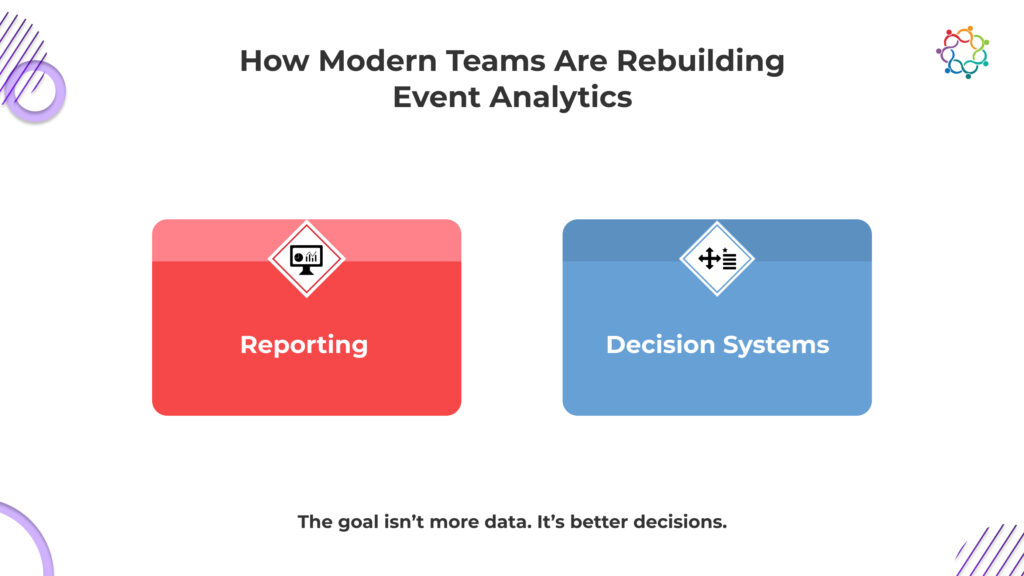
The transition from reporting to decision support requires a change in mindset. Dashboards are static by design. They present information at a point in time. Decision systems are dynamic. They evolve as questions change and strategy matures.
This shift involves moving from measurement to prioritization. Instead of asking whether an event performed well, leaders ask whether it deserves continued investment. Analytics becomes a mechanism for ranking options rather than summarizing results.
Key changes include:
Conclusion: Analytics That Don’t Drive Decisions Are Just Decoration
Analytics are only useful to senior leaders if they help them make better choices. When reports do not guide decisions, they become something people look at but do not act on. This is the core issue with most event reporting today. The problem is not that teams are missing data. It is that the data is not shaped around the decisions leaders actually need to make.
The majority of dashboards concentrate on outlining past events. They display engagement levels, attendance figures, and post-event comments. Even while this knowledge can be fascinating, a CMO is rarely told what to do next. A summary of activity is not what leaders are searching for. They’re looking for guidance. They want to know which projects are no longer worth the time or money, and where to make greater investments.
In 2026, the real value of event analytics will not be judged by how detailed or complex dashboards are. It will be judged by whether they reduce confusion and make choices easier. Good analytics should help leaders feel confident about trade-offs and future plans. If reporting does not lead to clearer decisions, it is not insight. It is just noise presented as information.
(If you’re thinking about how these ideas translate into real-world events, you can explore how teams use Samaaro to plan and run data-driven events.)