Samaaro + Your CRM: Zero Integration Fee for Annual Sign-Ups Until 30 June, 2025
- 00Days
- 00Hrs
- 00Min

Key Takeaways (TL;DR)
Event marketing reports often look reassuring at first glance. Registration numbers are healthy. Attendance percentages are within expectations. Post-event summaries show growth compared to the last program. On paper, everything appears to be moving in the right direction.
The gap appears when these numbers are expected to explain impact. Registrations and attendance describe activity, not outcomes.
Yet when leadership asks what changed because of the event, the answers tend to soften. Pipeline impact feels implied rather than proven. Sales feedback is mixed. Follow-up conversations don’t reflect the scale suggested by the numbers.
This disconnect is more common than most teams admit. The data exists, but confidence doesn’t. If event success were obvious from registrations and attendance alone, marketing leaders wouldn’t feel the need to defend or reframe their results so often. The tension exists because the numbers being reported describe activity, while the questions being asked are about outcomes.
Registrations and attendance didn’t become dominant metrics by accident. They’re easy to count, easy to compare across events, and easy to explain in executive updates. They also fit neatly into historical expectations. For a long time, simply showing that people showed up was enough to justify investment.
These metrics survived because they offered clarity in environments where events were hard to quantify. They created a sense of control. They made reports feel complete. And because they rarely faced resistance from leadership, they became habitual. Over time, convenience hardened into convention.
The problem is that these metrics were never designed to explain influence. They tell you how many people engaged at the surface level, not whether anything meaningful shifted beneath it.
At the heart of the issue is a conceptual mismatch. Registrations and attendance measure activity. Event marketing exists to influence intent, behavior, and decision-making. These are related, but they are not the same.
Activity answers the question of what happened. Outcomes answer the question of what changed. An event can be busy without being impactful. It can generate high attendance without generating momentum. When teams conflate activity with impact, they end up overestimating success and underexplaining results.
This doesn’t mean activity metrics are useless. It means they’re incomplete. Without context, they create false confidence and shallow insight. What happened is not the same as what mattered.
Measuring event marketing success isn’t about abandoning numbers. It’s about understanding what those numbers represent and what they leave out. At its core, better measurement means understanding how events influence intent, behavior, and downstream decisions.
In practice, this means measurement should clarify which accounts progressed, which sales conversations gained momentum, and where teams should focus next.
This reframing matters because it shifts focus from volume to meaning. It acknowledges that events operate across moments and that their value often emerges over time rather than at check-in. Measurement, in this sense, becomes interpretive rather than extractive. It seeks to explain contribution, not just record presence. This isn’t a call to replace metrics. It’s a call to contextualize them.
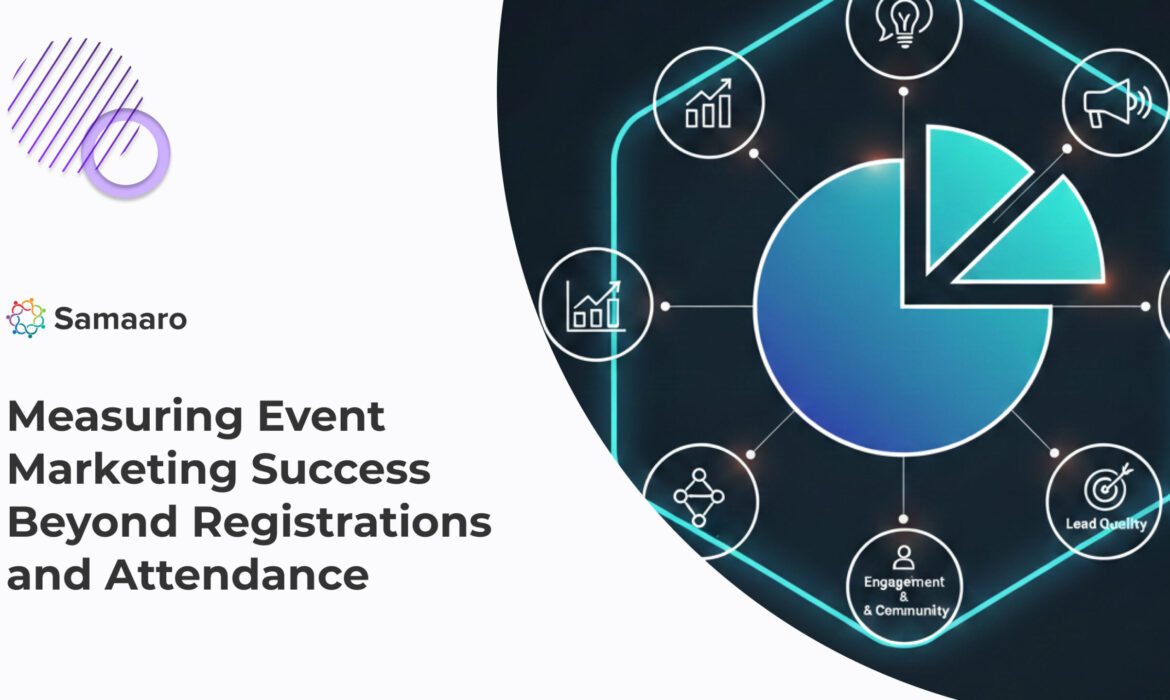
When teams move beyond surface-level metrics, they start looking for signals rather than counts. These signals fall into a few broad categories that help explain why an event mattered.
Each category matters because it adds dimension. Together, they tell a more honest story than any single metric can.
Signal-based measurement is uncomfortable by design. These signals are messier, less uniform, and harder to benchmark. They don’t always trend upward. They force teams to confront uneven performance and make trade-offs explicit.
Unlike registrations, these signals can’t always be summarized cleanly. They require interpretation. They expose weak spots. And sometimes they suggest that an event underperformed despite looking successful on paper.
That discomfort is often why teams resist this approach. But clarity often feels worse before it feels better. Honest measurement replaces optimism with insight, and insight is what enables improvement.
When teams optimize for the wrong metrics, the consequences compound quietly. Budgets get allocated to events that look good but don’t move the business. Programs repeat without learning. Sales grows skeptical of event data because it doesn’t match their lived experience.
Over time, events become harder to defend. They’re categorized as soft spend, justified by tradition rather than evidence. Marketing teams spend more energy explaining than improving. Over time, credibility becomes the cost that they end up paying for measuring the wrong things. These outcomes are caused by poor measurement framing.
Mature teams think differently about measurement. They anchor it in intent and behavior rather than vanity. They align marketing and sales around shared definitions of what “good” looks like. They treat post-event analysis as a learning loop, not a performance report.
Most importantly, they’re willing to say when something didn’t work. They understand that underperformance is a data point, not a failure. Measurement becomes a tool for iteration rather than validation. Maturity isn’t about having perfect numbers. It’s about being honest with imperfect ones.
When events are measured through outcomes and signals rather than surface metrics, measurement clarity changes how their impact is understood. Events stop being treated as one-off activities and start being interpreted as inputs into decision-making.
(Read: What is event marketing)
Leaders trust them more because they can trace influence through clearer signals, even when impact is not immediate or linear. The conversation shifts away from whether an event was “worth it” and toward what the measurement revealed about buyer intent, account readiness, or deal momentum.
That clarity reshapes planning and evaluation. Measurement-led insight begins to inform prioritization, sales focus, and future program design, and events are assessed alongside other go-to-market channels using comparable outcome-oriented questions. Not because events behave the same way as other channels, but because their contribution is now explainable. This is what moves events out of the “nice-to-have” category. Not scale or spectacle, but measurement that makes impact visible and defensible.
The most useful question isn’t how many people came. It’s what changed because they did. What shifted in buyer understanding? What moved forward internally? What became clearer for the business? These shifts are subtle, but they’re often the difference between stalled conversations and productive ones.
Internally, events should change things too. They should sharpen sales conversations, not just add names to a list. They should influence prioritization, clarify which accounts deserve focus, and surface insights that don’t show up in dashboards. Sometimes, the most valuable outcome of an event is alignment between marketing and sales.
For the business, clarity is the real win. Clarity about intent. Clarity about momentum. Clarity about where events are helping and where they aren’t. When teams start there, measurement stops being a reporting exercise and becomes a strategic one.
Show side-by-side data proving engaged attendees convert faster and larger than raw registrants. Pilot signal-based scoring on one event and let the conversion results make the argument.
A target account books a sales meeting, requests a demo, or replies to follow-up within 48 hours of attending. These momentum signals show genuine buying interest immediately.
Schedule structured retrospectives, document insights with clear owners, and bake changes into the next event brief. A learning loop is a process with accountability, not a report.
Agree on definitions for qualified lead, engagement threshold, influenced pipeline, and follow-up timelines before the event. Shared definitions prevent post-event arguments about what success meant.
Events start getting judged on pipeline and revenue like every other channel. When signals prove contribution, event budgets get planned around growth targets instead of tradition.