Samaaro + Your CRM: Zero Integration Fee for Annual Sign-Ups Until 30 June, 2025
- 00Days
- 00Hrs
- 00Min


1
2
3
→
Bottom Line:
Sales Kickoffs only impact revenue when alignment is reinforced into execution, not just communicated once
Most Sales Kickoffs fail at the one outcome they are trusted to deliver: better sales performance.
They create energy, alignment, and confidence in the moment. The room is focused. Messaging feels clear. Leadership sees a unified team ready to execute. It looks like readiness.
It is not.
This is perceived readiness, not actual selling readiness. The difference is where performance breaks. Once sellers return to live deals, complexity takes over. Pressure rises, habits resurface, and new messaging struggles to survive.
This is the SKO Performance Gap. Alignment created inside the event does not translate into consistent execution outside it.
Sales teams do not fail because they lack clarity. They fail because clarity was never converted into behavior.
This blog explains why that gap exists and why it continues to undermine sales performance.
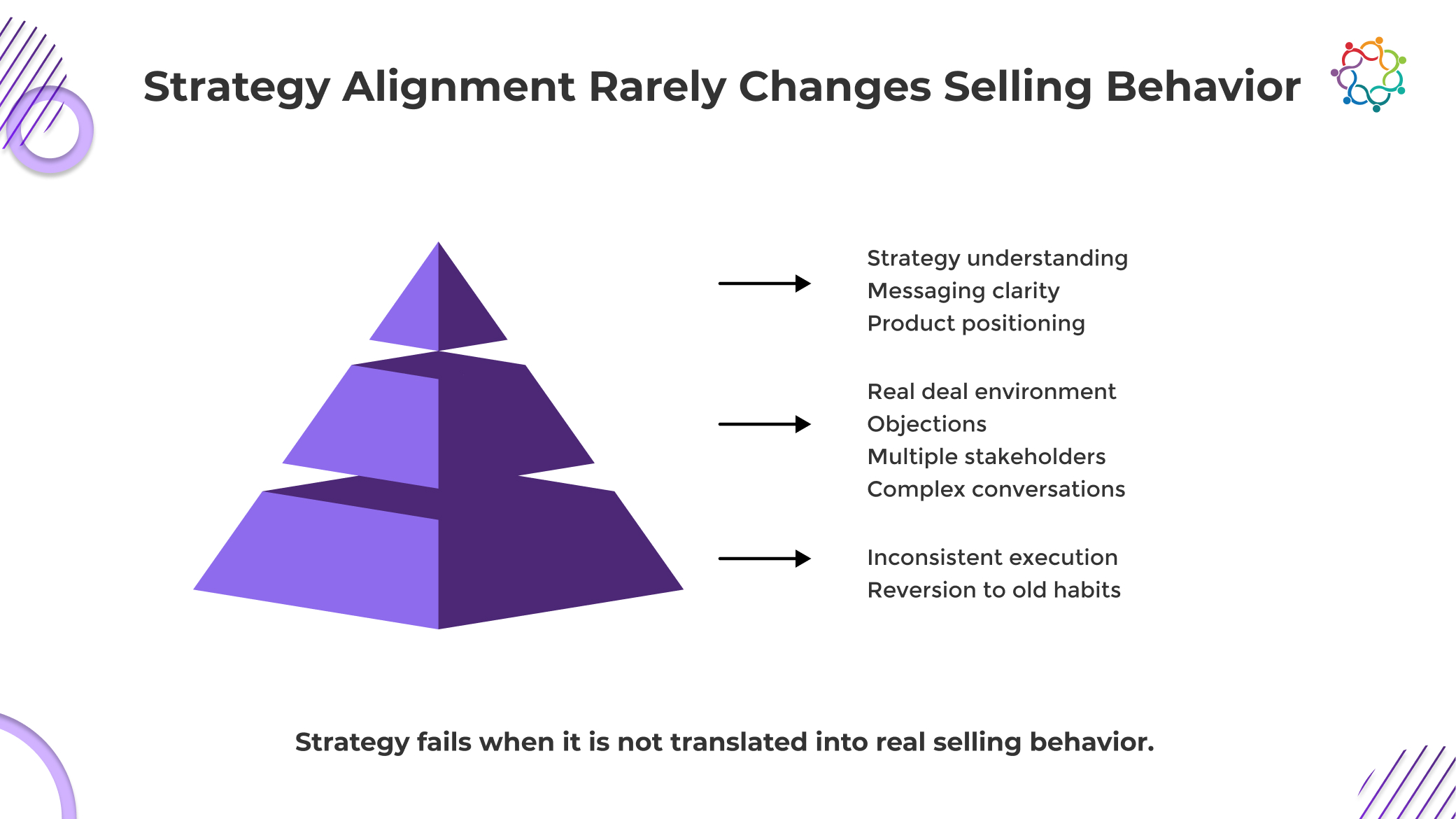
You assume that once the team understands the strategy, execution will follow. It doesn’t.
Clarity in a room does not survive pressure in a deal.
During a sales alignment event, positioning sounds sharp, differentiation feels obvious, and messaging appears easy to apply. Sellers can repeat it. Leadership hears consistency. It feels like progress.
Then real conversations begin.
Buyers challenge assumptions. Deals stall. Objections force deviation. In those moments, sellers do not rely on what they just learned. They fall back on what they have used repeatedly.
Understanding is passive. Execution is conditioned.
If a new approach has not been tested across multiple deal scenarios, it does not become usable. It stays theoretical, disconnected from actual selling environments.
This is where most organizations miscalculate.
They believe communication drives change. It does not.
Behavior changes only when the strategy is applied, refined, and repeated until it becomes the default. Without that, nothing about execution shifts.
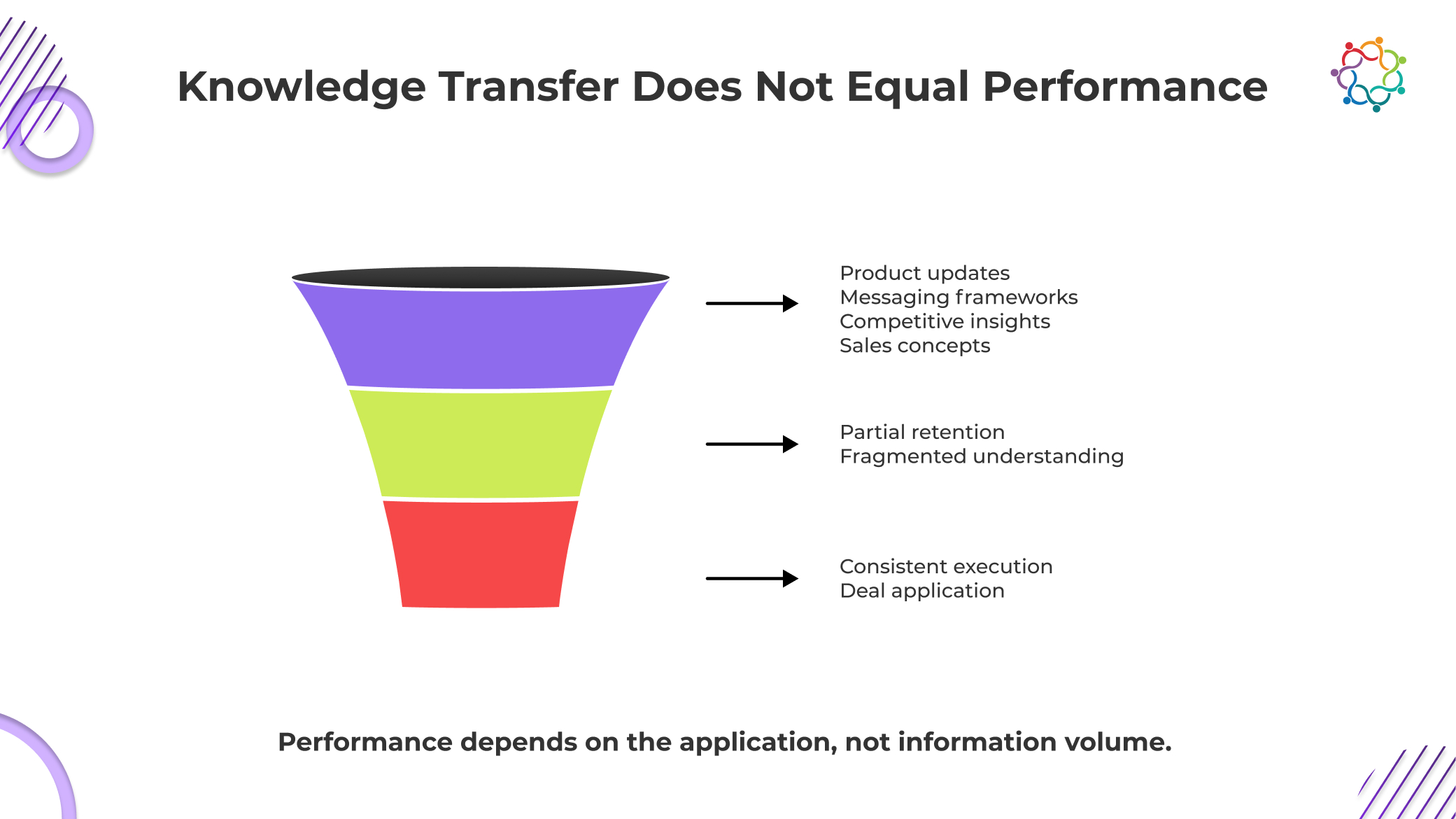
Sales launch events are dense information environments. In a short span of time, teams absorb product updates, new messaging, competitive insights, and revised frameworks. The assumption is simple: more knowledge leads to better performance.
It does not.
Knowledge without repetition decays faster than teams realize.
What feels clear during the event begins to fade within days. Not because the content was weak, but because it was not embedded in execution. The brain prioritizes what is used, not what is heard.
Sellers return to active pipelines where:
New knowledge has to fight for relevance. And most of the time, it loses.
This is the uncomfortable reality behind the SKO Performance Gap. Sales teams may know what to say, but they do not know how to apply it consistently across different deal situations.
Performance requires operational capability. That means:
None of this happens through exposure alone.
Launch events deliver knowledge. Performance requires integration. Without a system that forces knowledge into repeated use, the majority of what was learned remains unused.
And unused knowledge has zero impact on revenue.
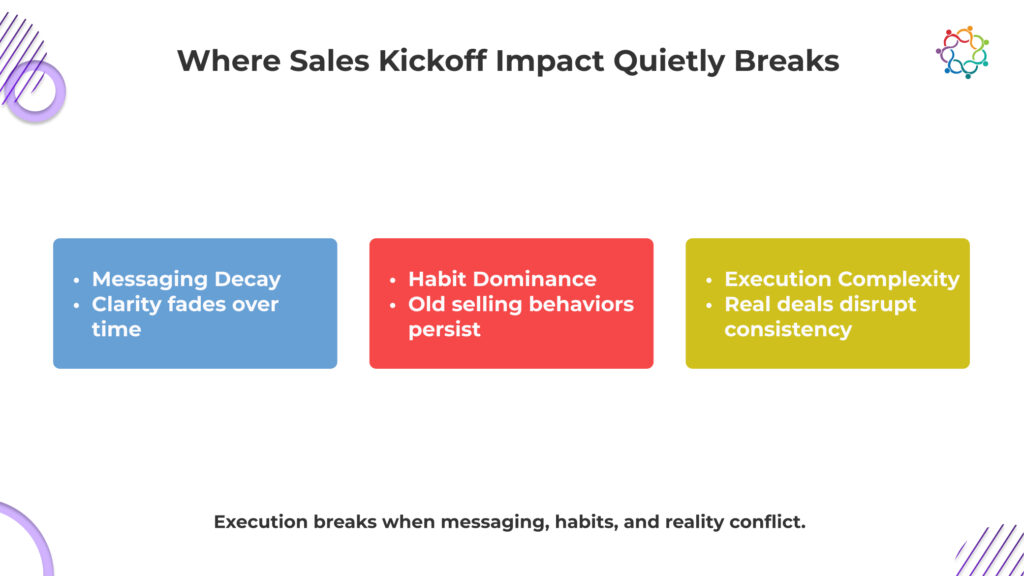
The breakdown is not sudden. It follows a predictable chain that most organizations ignore.
Alignment inside the event creates confidence. But what happens next determines whether that confidence translates into performance.
The moment sellers return to the field, the environment shifts. The structured clarity of the kickoff is replaced by fragmented deal realities. Competing priorities take over. Focus disappears.
Sales behavior is not driven by recent learning. It is driven by repeated habits. Years of selling patterns do not disappear after a single event. When pressure rises, sellers fall back to what feels natural.
As habits take over, new messaging begins to fragment. Some sellers try to apply it. Others partially adapt. Many revert entirely. The result is inconsistency across deals.
When messaging is inconsistent, execution weakens. Differentiation becomes unclear. Deals progress unevenly. Win rates do not improve. Sales cycles remain unchanged.
This is the full expression of the SKO Performance Gap:
alignment → return to field → habit dominance → message inconsistency → performance stagnation
The critical insight is this. Sales-aligned events do not fail because they lack quality. They fail because their impact ends when execution begins.
Once the event ends, the system that created the alignment disappears. Nothing replaces it.
And without a system to sustain execution, alignment has no chance of becoming performance.
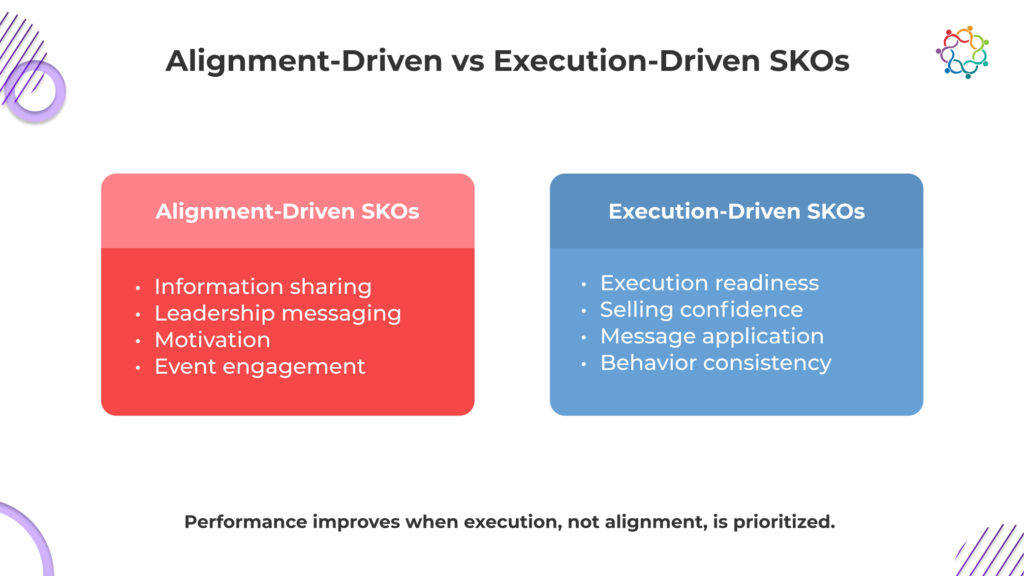
Most organizations still evaluate these events based on what happens inside the room. Engagement looks strong. Messaging lands cleanly. Leadership alignment feels complete. It creates the impression that the objective was achieved.
It wasn’t.
An internal sales launch event is not successful because information was not delivered effectively. It is successful only if selling behavior changes afterward. That is the only outcome that impacts revenue.
This is where most teams get it wrong. They confuse communication quality with performance impact. Clear messaging does not matter if it is not used in live deals. High participation does not matter if execution remains unchanged.
The real test begins after the event ends.
If sellers are not running conversations differently, handling objections with new positioning, and progressing deals with more consistency, nothing has improved.
Execution is the only metric that counts. Everything else is a distraction that makes failure look like success.
Performance improves through repetition and reinforcement, not one-time exposure.
This is not a suggestion. It is a requirement.
Sales behavior changes only when new approaches are used repeatedly in real situations. That repetition builds confidence. It reduces friction. It turns conscious effort into instinct.
A single Sales kickoff cannot achieve this.
Sellers need to:
Without reinforcement, none of this happens.
The SKO Performance Gap persists because organizations treat the event as the endpoint. In reality, it should be the starting point of execution.
What happens after the kickoff determines whether performance changes. If there is no structured reinforcement, the system collapses.
Sellers revert. Messaging fades. Habits return.
Leadership often underestimates how quickly this happens. Within weeks, most of the alignment created during the event is diluted. Within months, it is largely gone.
Performance does not improve because nothing sustained it.
A launch event can introduce change. Only reinforcement can sustain it.
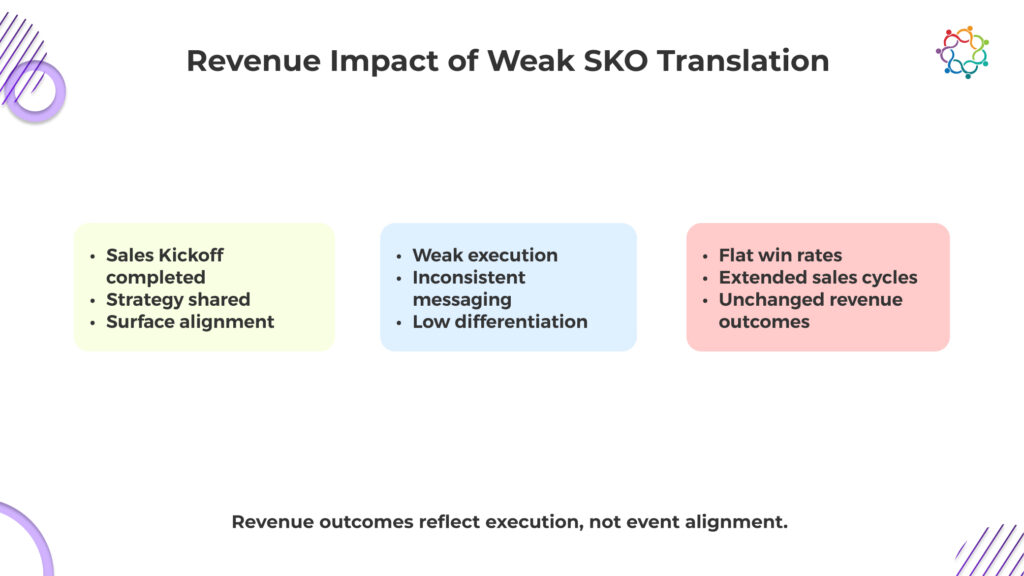
When the SKO Performance Gap is left unaddressed, the consequences are not theoretical. They show up directly in revenue outcomes.
The organization invests heavily in alignment. But execution remains unchanged. The result is a disconnect between strategy and performance.
The impact is measurable:
This is not a minor inefficiency. It is a systemic failure.
Sales launch events are positioned as strategic investments. But when they fail to influence execution, they become isolated events with no revenue return.
The cost is not just the event itself. It is the missed opportunity to improve performance at scale.
Organizations believe they have aligned the team. In reality, they have created temporary clarity without lasting impact.
Revenue does not respond to clarity. It responds to execution.
And execution has not changed.
You already know the gap exists. Yet these events continue to be designed the same way.
Because alignment is easy to prove. Execution is not.
A sales strategy summit can show participation, engagement, and feedback within days. Leadership gets clean reports, visible activity, and a narrative of success. It feels controlled.
Execution tells a different story. It exposes whether sellers actually changed how they run discovery, handle objections, and move deals forward. That takes time. It is harder to measure. And more importantly, it is harder to defend when results do not improve.
So the system defaults to what is visible.
You are not optimizing for performance. You are optimizing for optics.
This is why the gap persists. Not because the organization lacks awareness, but because it continues to reward alignment signals over execution outcomes.
And as long as that continues, nothing about sales performance will change.
Sales Kickoffs play an important role. They align teams, communicate priorities, and create shared understanding. That value is real.
But it is incomplete.
Performance improves only when strategy becomes behavior. And behavior changes only when it is applied, reinforced, and repeated in real-life situations.
The SKO Performance Gap is not a failure of events. It is a failure of translation.
Organizations assume that alignment will naturally evolve into execution. It does not. It requires a system that extends beyond the event, forces application, and sustains change.
Without that system, nothing shifts.
Sales teams don’t underperform because they lack strategy. They underperform because strategy never becomes behavior.