Samaaro + Your CRM: Zero Integration Fee for Annual Sign-Ups Until 30 June, 2025
- 00Days
- 00Hrs
- 00Min


Bottom Line:
Enterprise conferences do not lack intent. They lack systems that preserve it.
Enterprise conferences sit at the intersection of brand ambition and revenue accountability. CMOs defend them as strategic platforms. Field marketing leaders manage complex logistics and stakeholder expectations. Demand generation teams are expected to translate them into measurable pipeline impact.
Yet the uncomfortable reality remains: most enterprise conference marketing initiatives struggle to clearly demonstrate pipeline influence. Not because they lack scale, attendance, or production quality. But because the structure of how they are designed filters out commercial signal long before revenue discussions begin.
Most enterprise conferences look successful in scale and fail in revenue influence. That contradiction is structural.
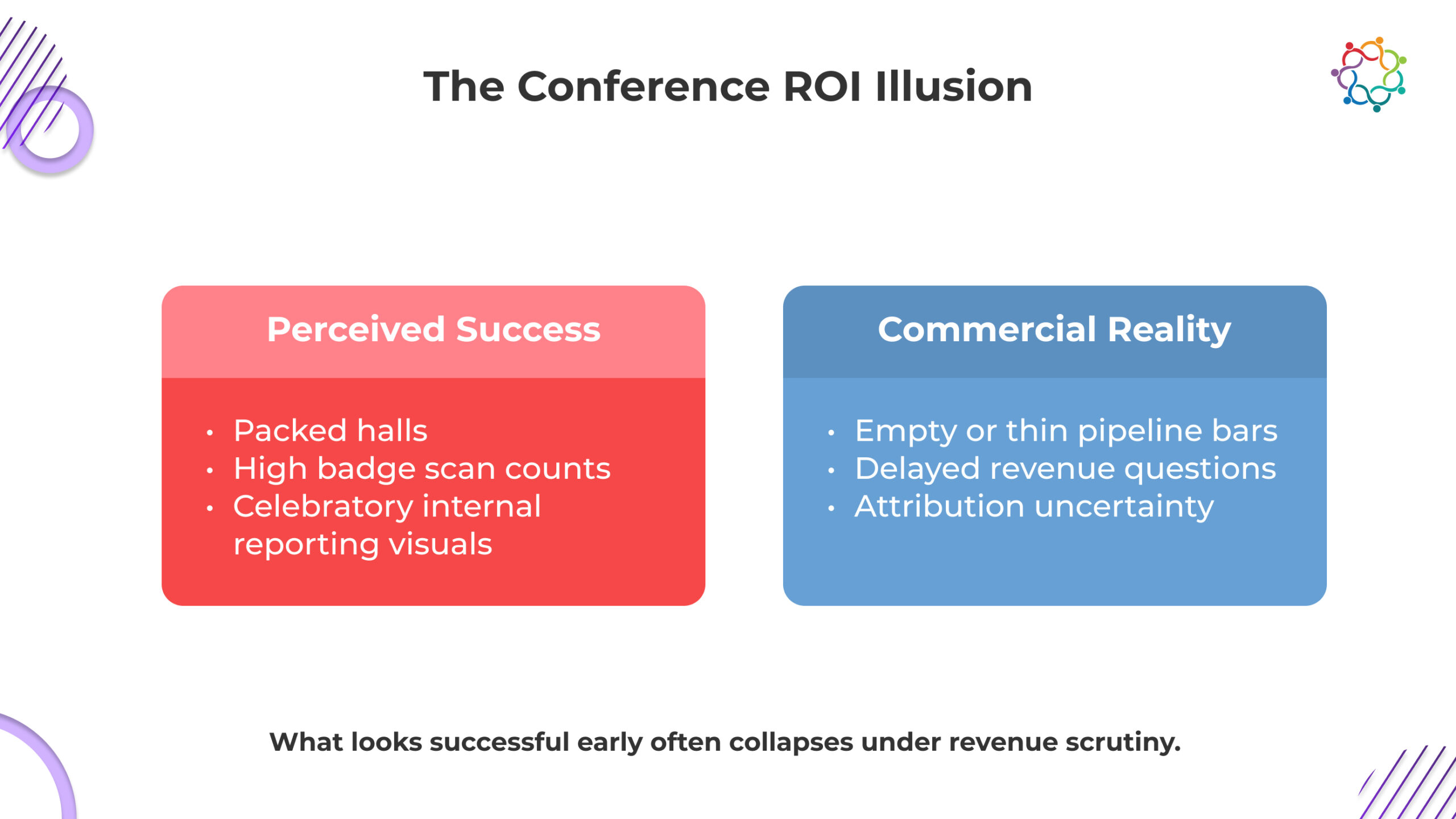
Large conferences often feel successful. Attendance numbers rise. Social engagement spikes. Leadership sees packed rooms and active booths. Internal dashboards glow with metrics that imply momentum. However, conference marketing ROI is often based on exposure signals rather than commercial clarity.
Consider what typically defines success:
These metrics show organizational effort, not pipeline influence. The illusion comes from visible scale, while true intent remains hidden. Only structured detection, deeper prioritization, and intent preservation turn visibility into revenue impact.
By the time leadership asks how the event influenced revenue, the influence window has already narrowed. Attribution ambiguity surfaces. Sales reports uneven follow-up outcomes. Teams rely on broad time-window models to prove a connection. The architecture assumed commercial relevance without engineering it.
Conferences rarely fail due to poor execution. They fail because exposure was prioritized over decision relevance from the start. That is why enterprise conference marketing can feel internally successful yet collapse under revenue scrutiny. Pipeline influence is not recovered after the event. It must be structurally protected before the first invitation is sent.
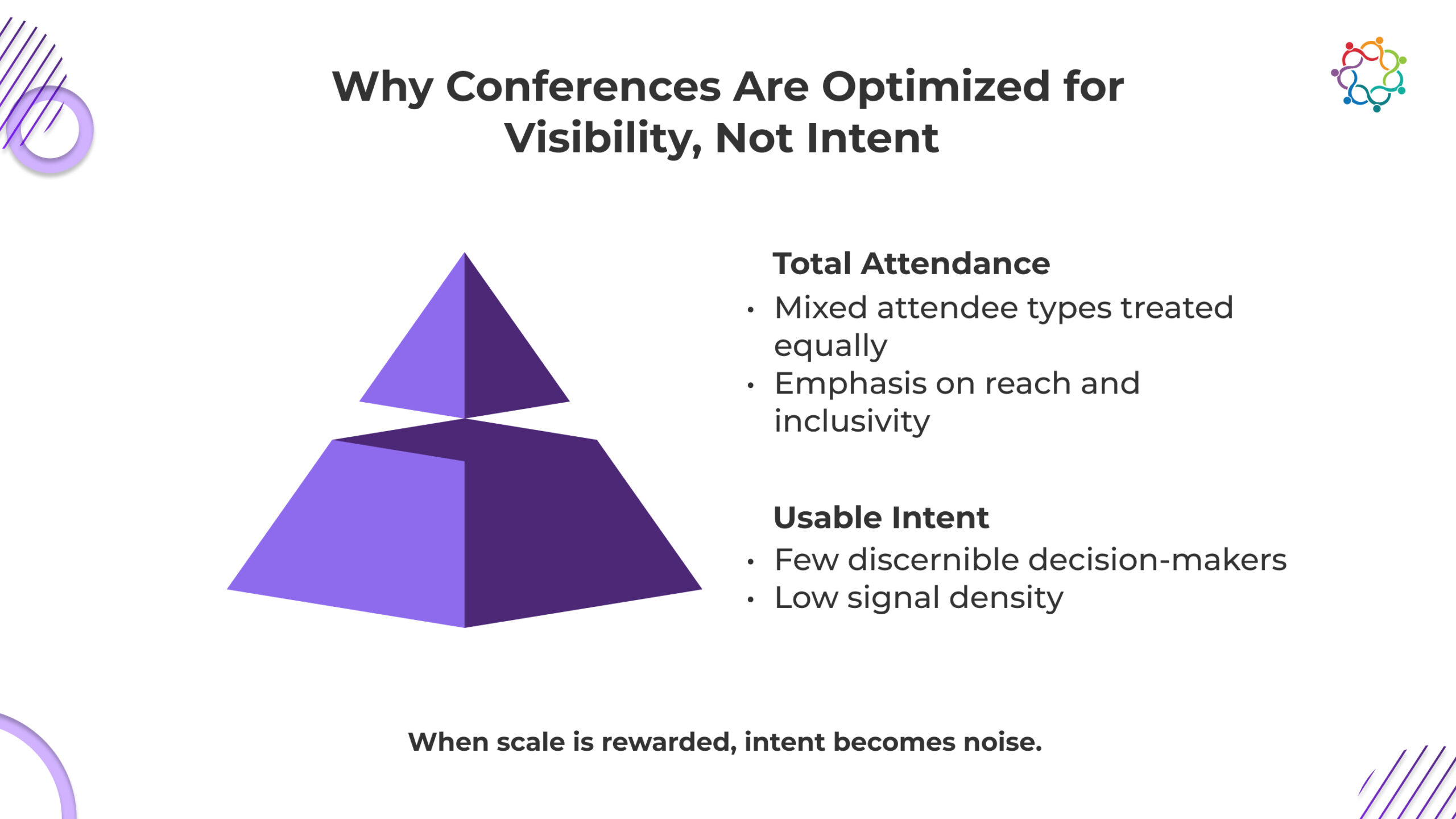
Conferences are not accidentally biased toward scale. They are built that way. Sponsors push for reach. Leadership asks for presence. Marketing reports brand amplification. Bigger audiences are celebrated, funded, and repeated. Intent density rarely appears in the approval deck. That preference shapes design decisions long before the first invitation goes out.
In many demand generation conferences, strategy centers on maximizing participation:
This is rewarded behavior. Larger rooms create easier narratives. Attendance growth signals momentum. Relevance requires exclusion, and exclusion reduces numbers. Most organizations choose scale.
Visibility scales because exposure does not require qualification. Intent does. Intent requires filtering and prioritization, which shrinks dashboards. So they are deprioritized.
When enterprise conference marketing is designed to maximize audience breadth, commercial density declines. Sales receive volume without clarity.
Demand generation teams wrestle with conference attribution challenges. CMOs are asked to explain revenue impact using exposure metrics that were never built to answer that question.
Pipeline visibility is mistaken for pipeline creation. Intent signals do not disappear by accident. They are buried by design. And that design is approved, funded, and repeated. What looks like growth is often signal dilution in disguise.
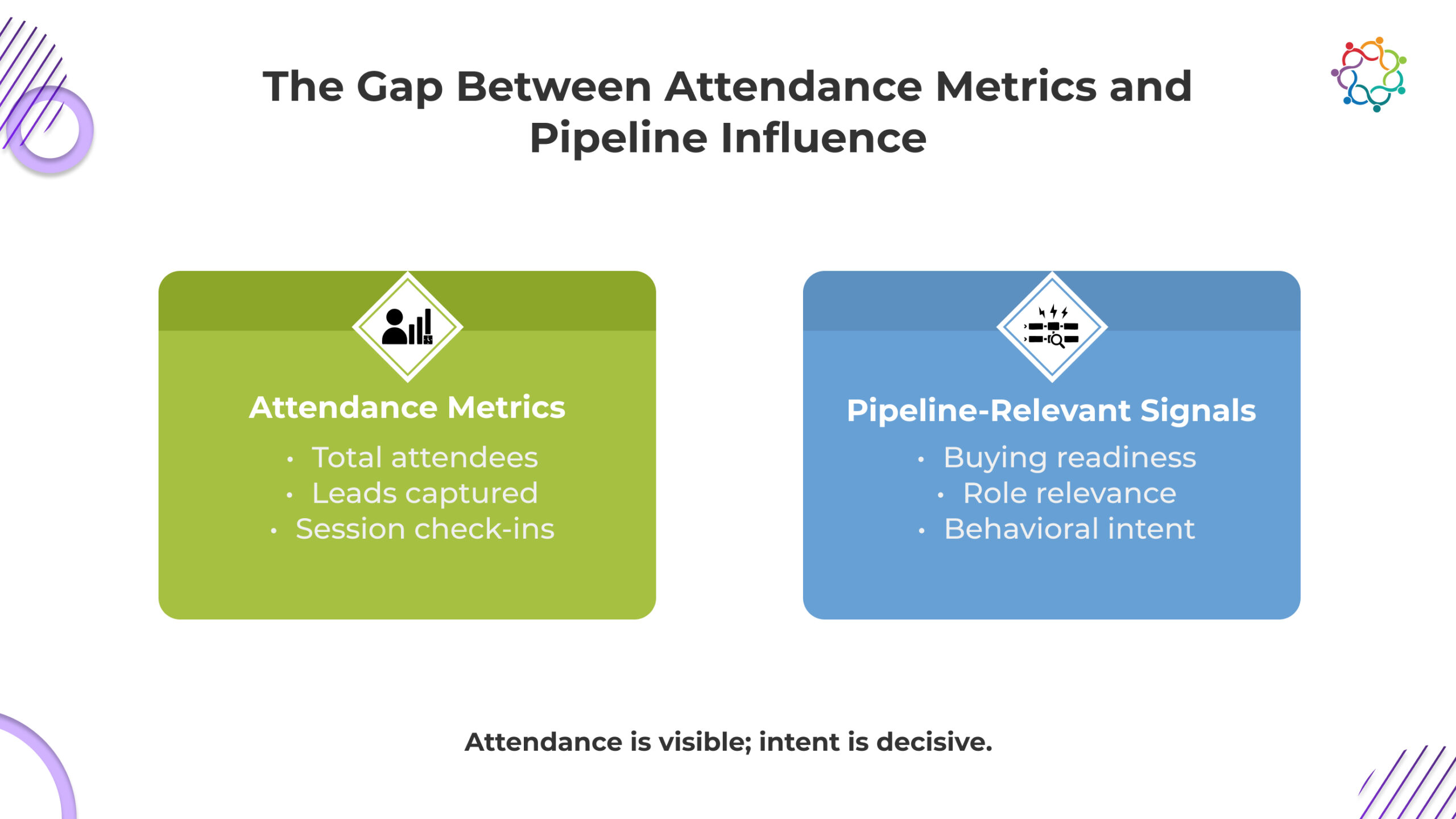
Most enterprise conferences report success using attendance-driven dashboards. Registration numbers, booth scans, and session turnout create an impression of momentum. However, these metrics rarely withstand leadership scrutiny when the conversation shifts from activity to revenue.
The core issue is not that attendance metrics are wrong. It is that they measure exposure, not intent. Pipeline influence depends on buying signals, decision readiness, and commercial prioritization.
A full venue signals interest in a topic, not intent to purchase. Conferences attract a mix of decision-makers, researchers, students, partners, and competitors. Attendance numbers flatten this distinction. Pipeline influence requires clarity on who is evaluating solutions now versus who is passively exploring.
High lead counts create internal confidence. Yet large volumes often dilute commercial quality. When everyone who interacts with the brand becomes a “lead,” intent density drops. This creates lead inflation, where the database grows but the concentration of revenue-relevant prospects shrinks.
Post-event reporting often relies on time-based attribution windows. If an opportunity is created within a certain period, the conference receives partial credit. But without clear behavioral indicators captured during the event, attribution becomes ambiguous. Leaders question whether the conference influenced the deal or merely coincided with it.
Attendance reflects what already happened. Pipeline influence depends on what happens next. Without structured insight into attendee behavior, follow-up lacks direction. When early intent clarity is missing, the pipeline conversation becomes reactive rather than predictive. That gap is where most enterprise conferences lose their commercial credibility.
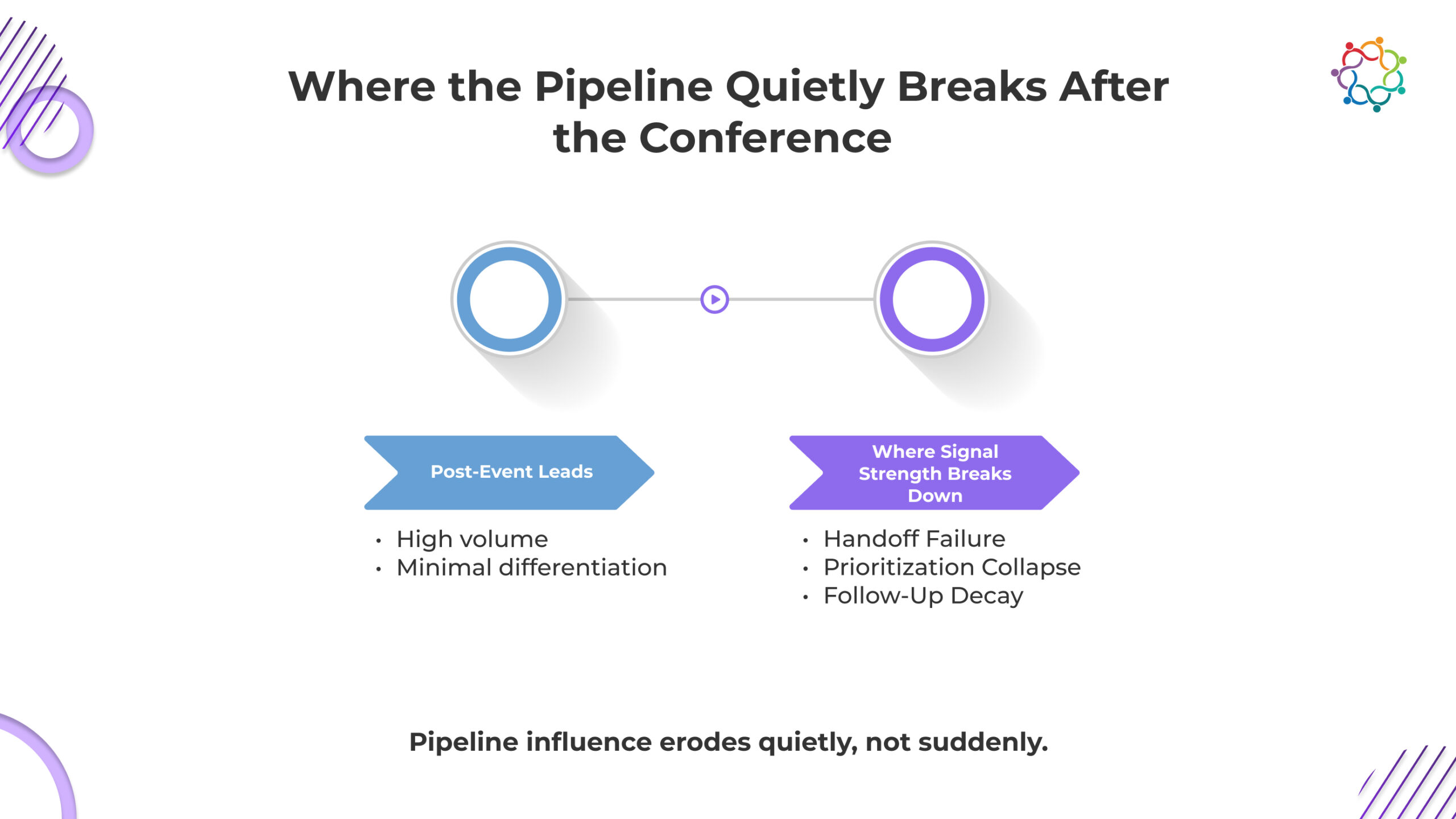
Pipeline failure rarely occurs in a single visible moment. It unfolds across a sequence of accepted weaknesses. The conference ends. Applause fades. Volume is reported. And then intent begins to erode inside the system that everyone agreed to use.
After most conferences, marketing transfers leads to sales in bulk. This is not a tooling limitation. It is a design choice. Context from sessions attended, conversations held, and behavioral signals collected is reduced to fields that fit cleanly into CRM. Depth is sacrificed for administrative efficiency.
What sales receive:
What they rarely receive is prioritization clarity. Which accounts showed repeated engagement? Which attendees consumed late-stage product content? Which interactions signaled evaluation urgency? Those answers often exist in fragments, but they are not operationalized.
Everyone knows this gap exists. It persists because the volume has already been counted as success.
When handoff fails, pipeline influence weakens immediately. Manual reconstruction replaces structured prioritization. Speed declines immediately. Friction increases. Speed declines. Intent fades.
In enterprise conference marketing, handoff is treated as an administrative closeout task rather than a strategic bridge. This is where intent either survives or dies. Most organizations accept its erosion as normal.
Once leads enter CRM, prioritization logic determines commercial reality. If conference leads are scored uniformly, high-intent signals disappear inside aggregate volume. Intent density becomes mathematically invisible.
Sales teams respond rationally. They pursue clearer inbound signals or known accounts. Large conference lead lists become background noise unless explicitly weighted.
This is not a sales discipline problem. It is an organizational decision to value quantity over clarity. When prioritization collapses, momentum stalls. Opportunities that could have accelerated remain dormant. Attribution becomes diffuse because the system never elevated what mattered.
The final erosion point is follow-up decay. Generic sequences replace contextual relevance. Messaging ignores session behavior and expressed interest. Response rates fall.
At this stage, attribution ambiguity intensifies. Revenue leadership questions impact. Demand generation struggles to defend its influence. Sales reports are inconsistent.
Pipeline does not fail loudly. It erodes quietly across handoffs, collapsed prioritization, and signal loss. And it erodes in ways the organization has repeatedly tolerated.
If the commercial narrative of enterprise conference marketing collapses after the event, it is not because intent was absent. It is because the system allowed it to disappear and move on once the attendance numbers were shared.
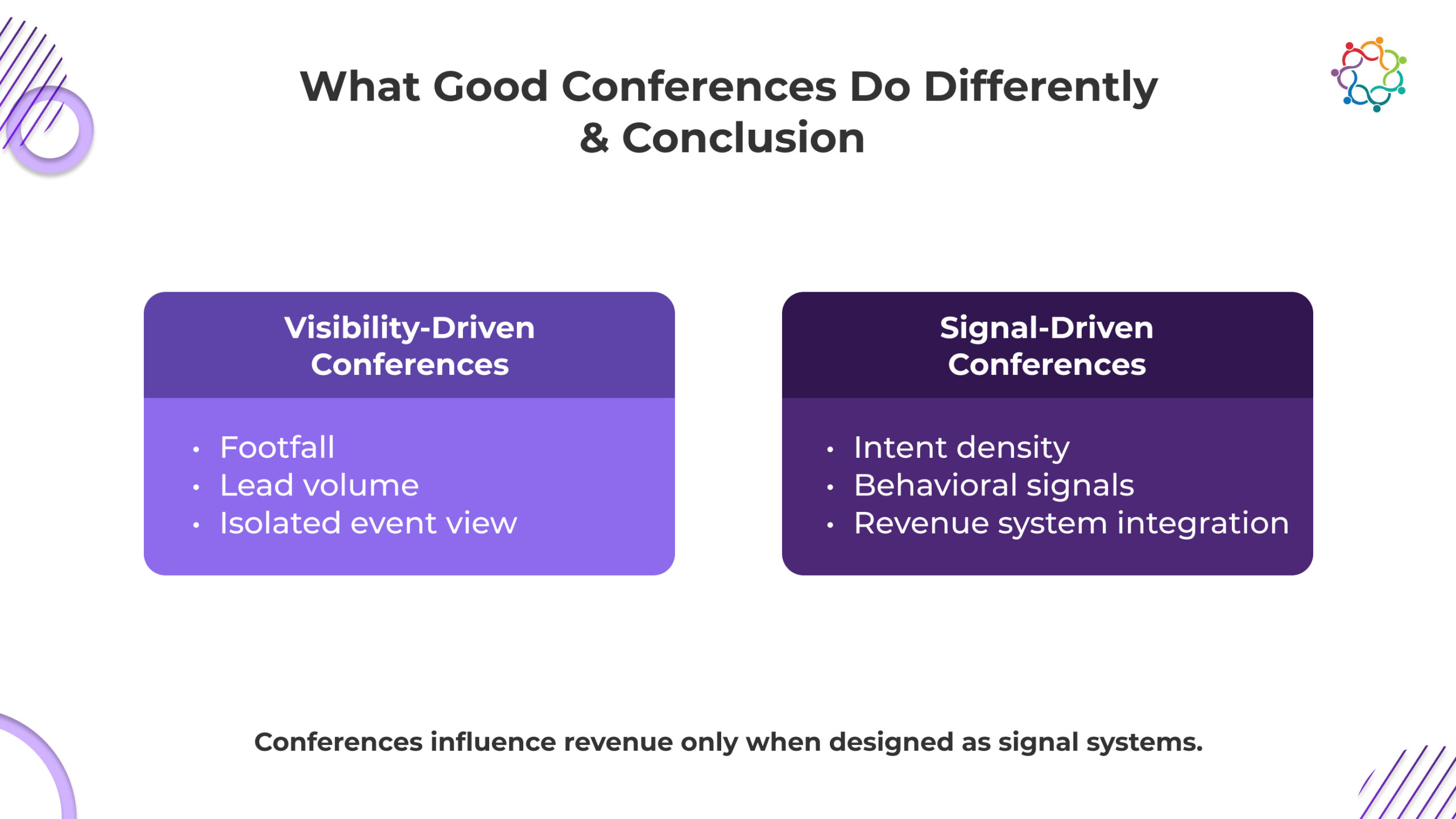
High-performing conferences do not look dramatically different on the surface. They may have similar scale and production value. The difference lies beneath the experience layer.
Poorly performing conferences optimize for:
High-performing conferences optimize for:
This distinction changes the operating model. High-performing conferences do not celebrate total attendance. They measure commercial concentration. They rank engagement by depth and buying relevance instead of treating every badge scan equally. They do not send raw lead lists to sales; rather, they transfer prioritized intelligence.
Conference marketing is designed backward from commercial action. The core question is simple: which accounts move next, and why?
Behavioral signals are structured, not stored. Session participation, repeat engagement, content consumption, and account-level activity are translated into ranked outputs. Sales receives context, not contacts. Demand generation tracks progression, not just response rates.
They consciously sacrifice vanity scale to protect commercial signal. Scale without intent clarity weakens pipeline influence. Signal protection, not spectacle, defines performance.
For conferences to influence the pipeline, they must be designed as part of the revenue system, not as standalone marketing moments. When events operate in isolation, any commercial signal generated on-site weakens once the experience ends.
Treating conferences as pipeline infrastructure shifts the focus from execution excellence to signal continuity. The value of the event is determined not by what happens during the conference, but by how effectively intent survives and travels into demand and sales systems.
In high-performing organizations, conferences function as structured input layers into the broader demand engine. They are designed to feed sales and marketing systems with prioritized intelligence. This means engagement data is captured in a way that directly supports downstream decision-making, rather than existing only as post-event reports.
Most conferences generate intent that disappears at the badge scan. Behavioral indicators such as session depth, repeat engagement, and content interaction are rarely preserved in usable form. Pipeline infrastructure ensures these signals survive the event and remain accessible for prioritization, follow-up, and attribution.
On-site energy creates confidence, but it does not guide action. Revenue impact depends on what the organization learns after the event. Post-event intelligence reveals which accounts progressed, which conversations indicated urgency, and where sales attention should focus. Without this layer, pipeline influence remains theoretical.
Conference data has value only when it informs action. If sales teams cannot use event insights to prioritize accounts and conversations, the data fails its commercial purpose. Pipeline influence emerges when conference intelligence directly shapes what happens next, not when it merely documents what already occurred.
If these weaknesses are visible, why do they persist?
Because the system rewards visibility and rarely punishes weak revenue linkage.
Large conferences signal authority. Full rooms validate spending. Attendance growth fits cleanly into board narratives. Exposure metrics are safe to report and difficult to challenge. Pipeline ambiguity, by contrast, can be explained away. The safer story wins.
Conference marketing ROI is usually defended after the event, when scale has already been celebrated. At that point:
No CMO is penalized for hosting a well-attended conference with unclear pipeline contribution. But a smaller event, even one with high intent density, raises immediate concern. The incentive is unmistakable. Looking successful carries less risk than being commercially precise.
Enterprise conference marketing becomes a reputational asset rather than a revenue system. It generates visibility, social proof, and internal momentum. Revenue linkage is treated as a bonus, not a requirement.
This pattern continues because leadership approves it.
Conferences perform exactly as they are funded and measured to perform. Until intent clarity becomes non-negotiable, scale will continue to overshadow pipeline influence.
Pipeline influence is rarely absent. It is filtered out. When conferences optimize for visibility, intent clarity is traded for attendance growth. When all attendees are treated equally, lead counts rise while commercial density falls. When structured handoff and prioritization are weak, signal decays quietly inside the system.
High-performing conferences operate as revenue infrastructure. They preserve behavioral signals, translate engagement into prioritization, and treat post-event intelligence as the true output. If a conference cannot clarify who matters next, it cannot influence the pipeline.
For teams examining conference lifecycle design more deeply, adjacent perspectives on end-to-end conference architecture expand on this systemic view. A useful reference point is Conference Marketing End-to-End: From Call for Speakers to On-Site Engagement, which explores how structured lifecycle thinking changes outcomes.
For teams rethinking conferences as pipeline infrastructure, this is a conversation worth having. The difference is not in execution polish but in the commercial survivability of data.