Samaaro + Your CRM: Zero Integration Fee for Annual Sign-Ups Until 30 June, 2025
- 00Days
- 00Hrs
- 00Min


Bottom Line:
Closed-door events fail when treated as awareness assets instead of engineered as decision-acceleration instruments inside the pipeline.
Private executive gatherings are often misunderstood because leaders approach them with assumptions shaped by large conferences. The moment an event becomes invite-only, expectations rise. Smaller room. Senior audience. Higher cost. Therefore, a higher visible return.
Closed-door events are not smaller conferences. They are a different revenue play. Yet teams apply conference logic to decision-stage environments. That assumption feels rational. It is not. This is not a scale issue. It is a revenue proximity issue.
These formats operate closer to active buying decisions than awareness programs. But they are measured using attendance volume, brand visibility, and post-event buzz. That mismatch distorts outcomes.
Teams expect exposure-stage signals from decision-stage conversations, then question the format when results feel inconsistent. These events fail not because they are small, but because leaders apply the wrong revenue lens.
This blog explains why misclassification quietly undermines deal acceleration.
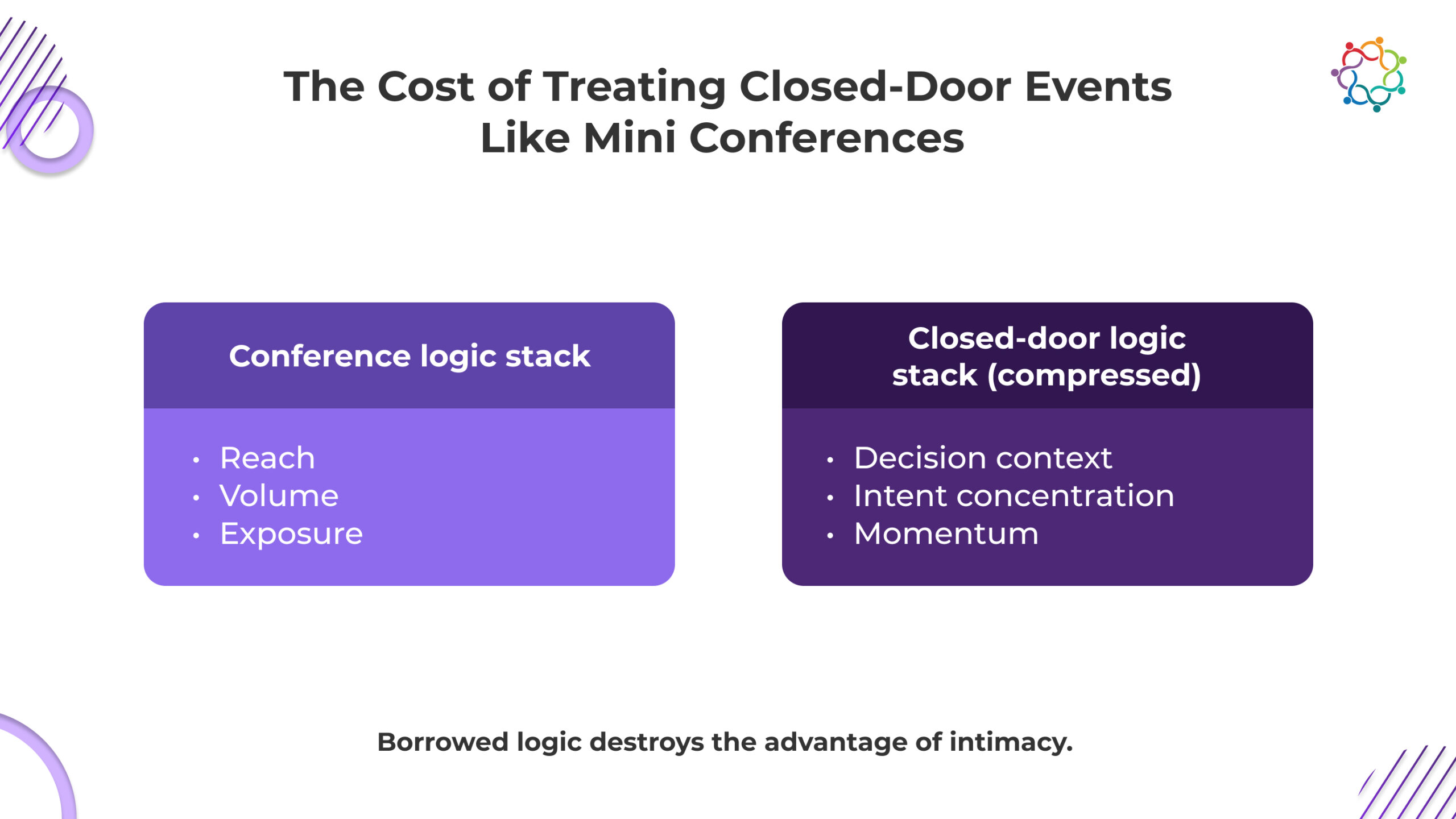
Many revenue teams undermine closed-door formats by applying conference logic. If scale drives awareness and pipeline, a smaller version should deliver proportionate returns. That assumption does not just miss nuance. It delays deals, wastes senior access, and creates false confidence in pipeline health.
Conferences optimise for reach. These formats optimise for decision compression. Treating them as scaled-down conferences shifts focus to the wrong variables and stalls decision velocity inside active accounts.
Conference strategy rewards audience expansion. In private formats, expanding reach weakens intent concentration. When invitations prioritise impressive titles instead of live buying context, conversation depth collapses. The room looks strong on paper, but lacks commercial density. Senior access is spent without moving a single deal forward.
Large events generate brand lift and social proof. That logic becomes dangerous here. Private executive environments operate near deal acceleration. Measuring visibility instead of decision-stage movement produces misleading success signals. Teams report momentum while opportunities quietly stall.
Conference agendas centre on broad industry themes. In decision-proximate rooms, broad narratives delay urgency. Executives engage when discussions surface real constraints, trade-offs, and internal resistance. When content drifts into generic thought leadership, decision energy drops and active deals slow.
Attendance volume, satisfaction scores, and lead quantity belong to conference dashboards. They do not measure buying committee alignment or shifts in deal velocity. Applying these metrics protects optics while hiding commercial reality. The format appears successful even as the revenue impact weakens.
When conference thinking dominates, intimacy becomes cosmetic. Revenue declines not because the format is flawed, but because it was forced to perform a job it was never built to do.
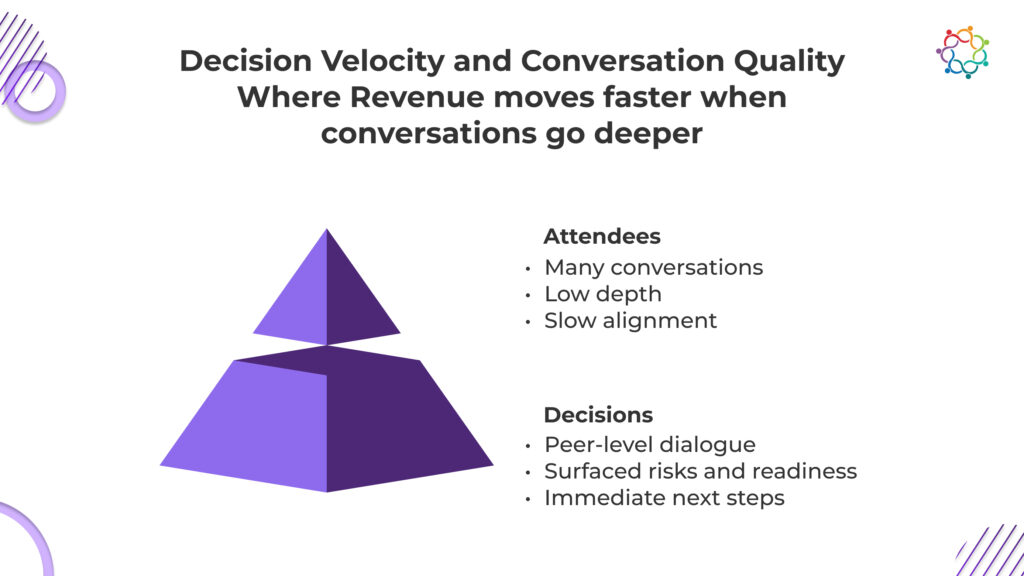
In revenue-proximate environments, speed is leverage. The primary advantage of private executive gatherings is not exclusivity or seniority. It is compression. When the right decision-makers are placed in a relevant context, alignment happens faster. That speed directly affects pipeline outcomes.
Attendance volume does not indicate commercial impact. Decision velocity does. The true question is whether the event shortens time-to-decision inside active accounts. When evaluated through this lens, smaller rooms frequently outperform larger conferences.
In smaller settings, buying committee dynamics surface naturally. Stakeholders voice constraints, trade-offs, and concerns in real time. This transparency reduces back-channel resistance that typically delays enterprise deals.
Executives move faster when uncertainty decreases. Hearing how peers are solving similar problems reduces perceived risk. This accelerates internal advocacy and strengthens executive conviction.
Decision energy is highest during and immediately after the gathering. When context is preserved, follow-up conversations are sharper and more action-oriented. Momentum does not need to be rebuilt because clarity was already established.
Closed-door formats succeed when they compress uncertainty. When that compression translates into shorter deal cycles, attendance becomes secondary to acceleration.
Most event discussions focus on networking. That framing is insufficient when revenue outcomes are at stake. What matters is not who met whom, but what surfaced during those conversations.
Conversation quality is a measurable revenue variable. Executive-level dialogue reveals readiness, resistance, and risk in ways no form can ever fill. The depth of discussion indicates where accounts actually sit in the buying journey.
High-quality conversations do three things:
Shallow conversations create false positives. They feel productive but generate weak commercial signals. Sales teams lose trust when follow-ups are based on surface-level engagement rather than real buying context.
Pipeline influence comes from what is said and surfaced, not who showed up. When conversations are structured around relevant business tension, they become diagnostic tools. They help teams understand which deals deserve acceleration and which require deeper work.
This is where executive engagement metrics matter. Not attendance counts, but conversation depth, relevance, and decision proximity.
Design is where closed-door events either protect or destroy revenue momentum. Not logistics. Not production quality. Design determines whether decision velocity increases or quietly stalls. Most teams do not have an execution problem. They have a structural one. Three failure patterns consistently surface.
The invite list determines intent concentration. Seniority is not intent. An impressive title does not equal an active decision.
When invitations prioritise prestige over live business tension, signal density collapses. The room looks credible but lacks revenue proximity. Deals do not move because the right buying context was never present.
Agendas are decision environments, whether teams admit it or not. When topics drift toward broad thought leadership, urgency fades.
Executives engage when discussions surface real constraints and trade-offs. When conversation stays theoretical, momentum slows. Active opportunities lose compression instead of gaining clarity.
Post-event engagement often restarts conversations instead of advancing them. Generic outreach erases context and weakens the alignment created in the room.
When follow-up fails to carry forward surfaced risks and implied next steps, velocity drops. Decision energy dissipates.
Every design choice compounds or corrodes momentum. In closed-door formats, there is no neutral ground.
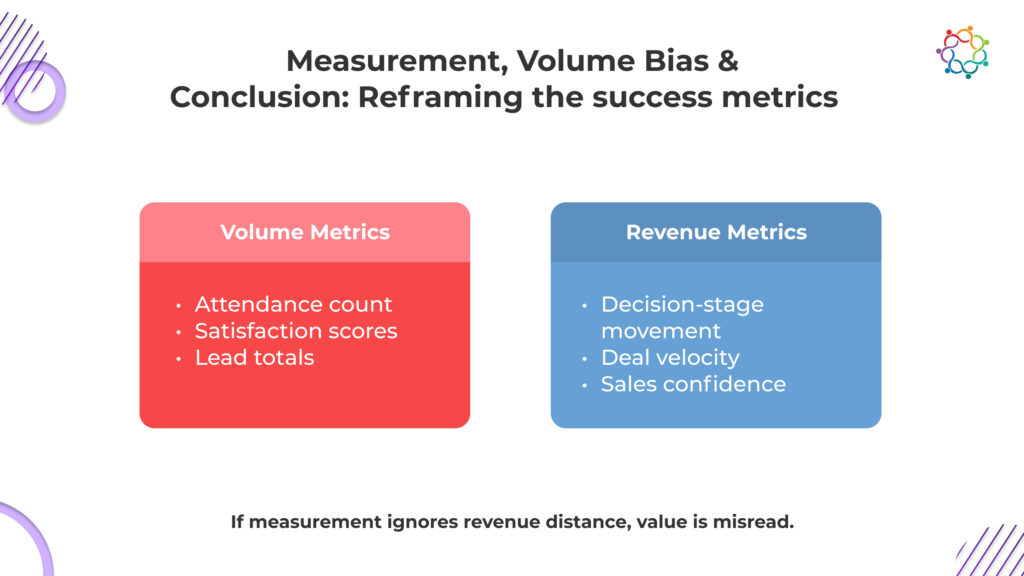
Volume bias is deeply ingrained in event marketing. Bigger audiences feel safer. They produce more data points. But revenue impact is not linear. In fact, it often moves in the opposite direction.
Closed-door events thrive on intent concentration. When audiences are small and relevant, clarity increases. Sales teams trust signals from these environments because they are grounded in real conversations, not inferred interest.
Fewer data points can offer higher clarity because:
Ambiguous engagement erodes sales confidence. Clear signals accelerate action. This is why ten right conversations consistently outperform a hundred unclear ones.
High-intent B2B events do not scale outcomes by adding people. They scale outcomes by removing noise. This is uncomfortable for teams conditioned to equate reach with success. But revenue does not care about comfort. It cares about movement.
Leadership teams that understand this stop asking for volume and start asking for velocity.
Measurement determines whether a closed-door event is treated as a revenue instrument or a marketing expense. These formats appear to underperform not because they lack impact, but because teams measure the wrong outcomes.
Traditional dashboards reward participation and sentiment. Decision-proximate environments demand evidence of commercial movement. If you cannot see deal progression, velocity shifts, or sharper next steps, you are not measuring impact. You are measuring activity.
Frameworks that rethink executive event ROI through a revenue lens, such as How To Host Closed-door Events For CXOs With Measurable ROI, connect conversation depth directly to pipeline movement.
If accounts did not advance to the next stage, hesitation was not reduced. If sales cycles did not compress, uncertainty was not removed. If follow-up conversations lack specificity, alignment did not occur.
If measurement does not reflect proximity to revenue, it misrepresents value. Closed-door environments should be judged by acceleration and clarity, not attendance and applause.
Closed-door formats operate under different economics. They reward precision, context, and speed. When designed and measured correctly, they influence outcomes disproportionately to their size.
They are not awareness plays. They are decision acceleration mechanisms. Their value lies in how effectively they compress time, surface risk, and move deals forward inside active accounts.
If an event does not accelerate decisions, intimacy alone will not save it. Teams that understand this stop chasing scale and start engineering clarity.
If this reframing feels uncomfortable, it is likely because your measurement system rewards optics over acceleration.
For organisations studying how high-intent engagement and contextual follow-up integrate into revenue systems, platforms like Samaaro illustrate how events can function as embedded decision environments rather than standalone marketing moments.