Samaaro + Your CRM: Zero Integration Fee for Annual Sign-Ups Until 30 June, 2025
- 00Days
- 00Hrs
- 00Min


1
2
3
→
Bottom Line:
If a B2B tech event cannot accelerate product usage readiness, it is an attention engine, not a growth lever.
Most B2B tech companies can track demo attendance within minutes. Very few can trace how many of those attendees become active users 30 days later. That measurement gap is where product growth quietly breaks.
Event dashboards show participation, ratings, and engagement spikes. Leadership reads those signals as momentum. But activation metrics often tell a different story. Usage does not scale. Onboarding does not accelerate. The product remains underutilized.
The disconnect is structural. Demos create guided confidence inside controlled environments. Real adoption requires independent capability under real-world friction. When users leave the event, the guidance disappears. What felt intuitive during the session becomes uncertain in practice.
Awareness expands. Adoption hesitates.
When enthusiasm is mistaken for readiness, growth forecasts inflate while activation stalls. Events generate attention. Product growth depends on behavioral commitment.
This blog examines why demo engagement does not translate into sustained usage, and why tech events must function as adoption infrastructure, not just interest generators.
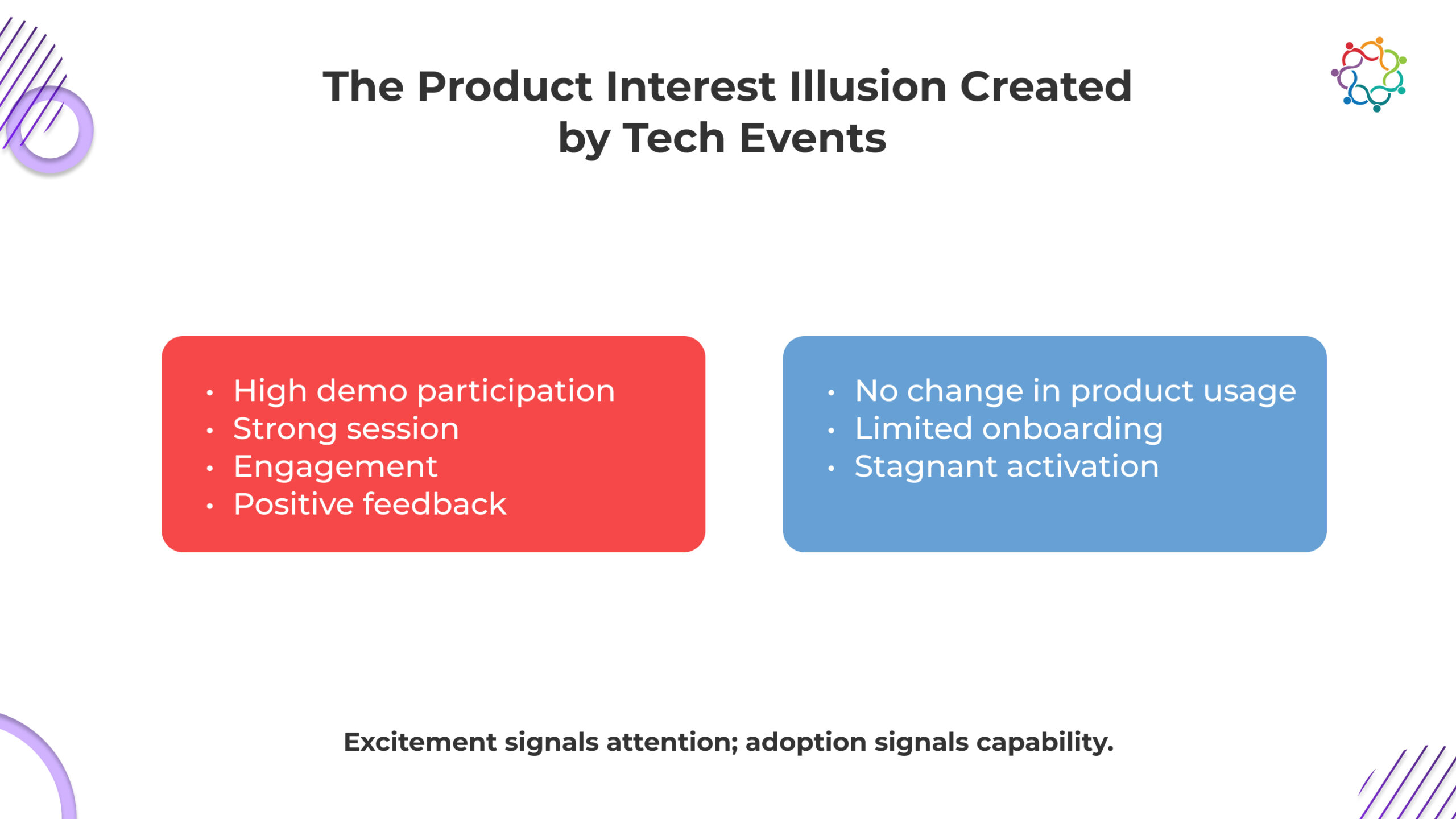
Tech events are designed to impress. They generate excitement, create a sense of product novelty, and showcase the capabilities of the technology in controlled environments. High demo participation and positive feedback signal internal success. On the surface, everything appears to be working. Leadership interprets these metrics as validation, while product teams quietly observe stagnant activation metrics post-event.
The problem is structural. Events optimize for attention, not adoption. Awareness alone cannot create behavioral change. Adoption requires independent product usage, confidence, and a commitment to integrate a tool into existing workflows. In controlled demo environments, users can follow scripted flows, guided steps, and supportive facilitators. Outside the event, these crutches disappear. Users struggle to replicate what seemed intuitive during the demo.
Key points:
Understanding this illusion is the first step in redesigning tech events to truly drive product growth. Events are not failing because attendees are unmotivated; they are failing because the system treats curiosity as adoption.
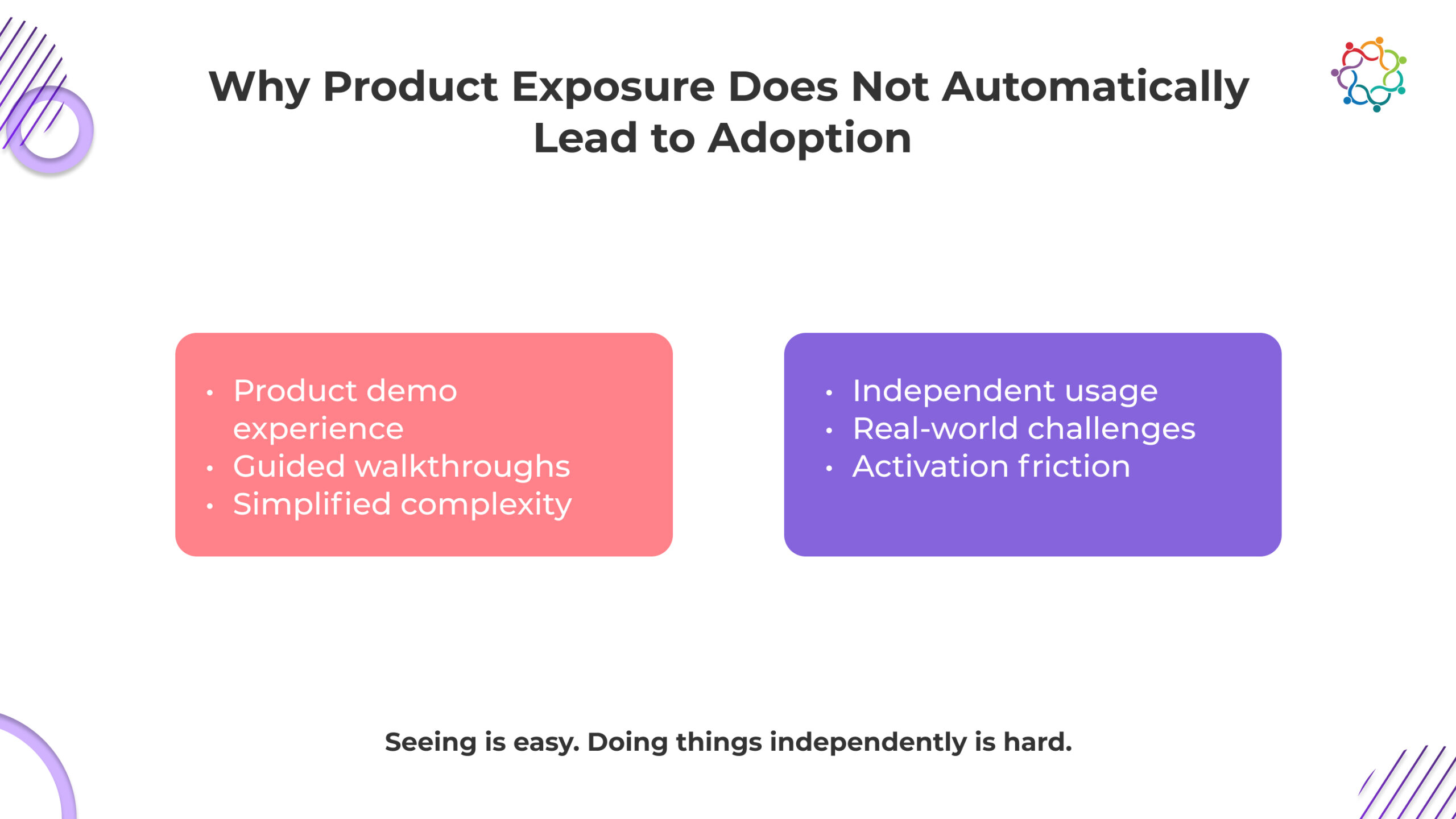
Seeing a product does not mean using it. Tech events are built to showcase, not to teach independent application. Demos reduce friction, simplify complexity, and walk participants through optimal situations. In a controlled setting, they instill confidence, but when the event is over, that confidence disintegrates.
Users deal with the product on their own, experience friction in the process, and find it difficult to duplicate what appeared simple during the demonstration. Exposure is a passive process. Adoption is in progress. Users are unprepared for real-world usage when events are created for visibility. This is not a short-term deficit; it is a fundamental issue.
Capability cannot be replaced by excitement, and the behavioural commitment that propels adoption is hidden by dashboards full of demo clicks.
Uncomfortable truths:
Events that do not confront this gap are silently setting up adoption failure.
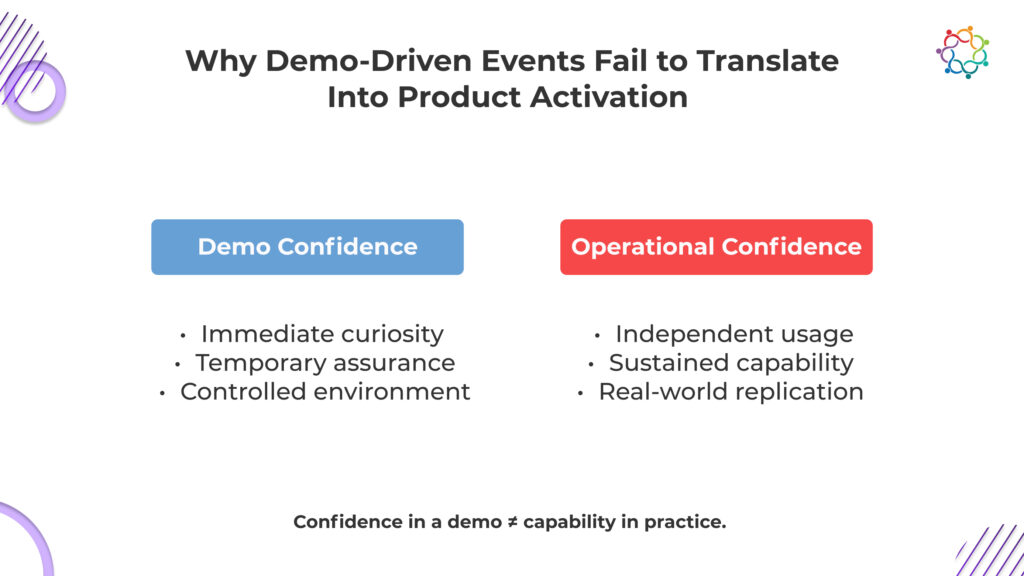
Demo-driven events create an illusion of success. Attendees leave feeling competent because the environment is controlled, scripted, and frictionless. Everything works perfectly when guided by event staff. Users can click, navigate, and follow instructions without encountering real challenges.
This is not confidence, it is convenience.
Operational reality is different. Once the event ends, the support, guidance, and simplified flows vanish. Users attempt to replicate what they observed, but real-world conditions expose gaps in knowledge, skill, and judgment.
The moment they face friction, hesitation sets in. The confidence they felt during the demo collapses. Product adoption does not grow from applause; it grows from repeated independent interaction under real conditions.
Demo engagement measures curiosity, not capability.
Leadership dashboards celebrate clicks and participation while adoption stalls quietly in the background. The uncomfortable truth is that most demo-driven events are designed to impress, not to equip. They optimize for visibility and attention, leaving product teams to deal with the predictable fallout: users inspired, but incapable of meaningful adoption.
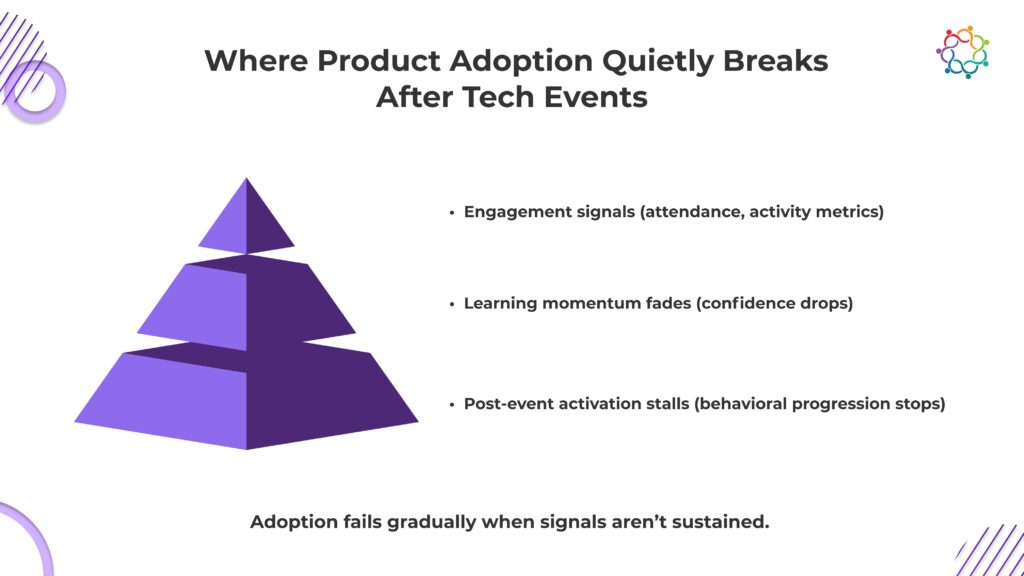
Adoption does not fail dramatically. It erodes quietly. Post-event, the signals that could sustain momentum are often absent, creating multiple friction points:
Attendance data, session participation, and demo clicks dominate post-event reporting. Yet these signals rarely translate into actionable adoption insights.
The challenge of distinguishing real adoption impact from surface engagement has been explored deeply in frameworks that help B2B marketers evaluate event success beyond attendance and clicks.
Product teams cannot gauge:
Without these insights, follow-up actions are misaligned. Adoption signals vanish into engagement dashboards, leaving product growth efforts blind.
Learning at tech events is fleeting. Attendees absorb concepts and complete demos under controlled conditions, but the moment they leave, structured guidance disappears. Users are left to navigate complexity alone, and confidence quickly erodes.
The knowledge gained at the event decays without reinforcement, creating hesitation and doubt. Most follow-ups focus on communication rather than building operational capability, leaving users stuck at the awareness stage.
Adoption slows not because the product is difficult, but because the event failed to embed lasting behavioral readiness. Without deliberate reinforcement, excitement collapses into disengagement, silently stalling product growth.
Follow-ups prioritize communication over behavioral progression:
As a result, adoption slows, users disengage, and the revenue potential tied to accelerated usage is lost. Adoption fails not because of user disinterest but because events were never designed to extend confidence beyond the experience.
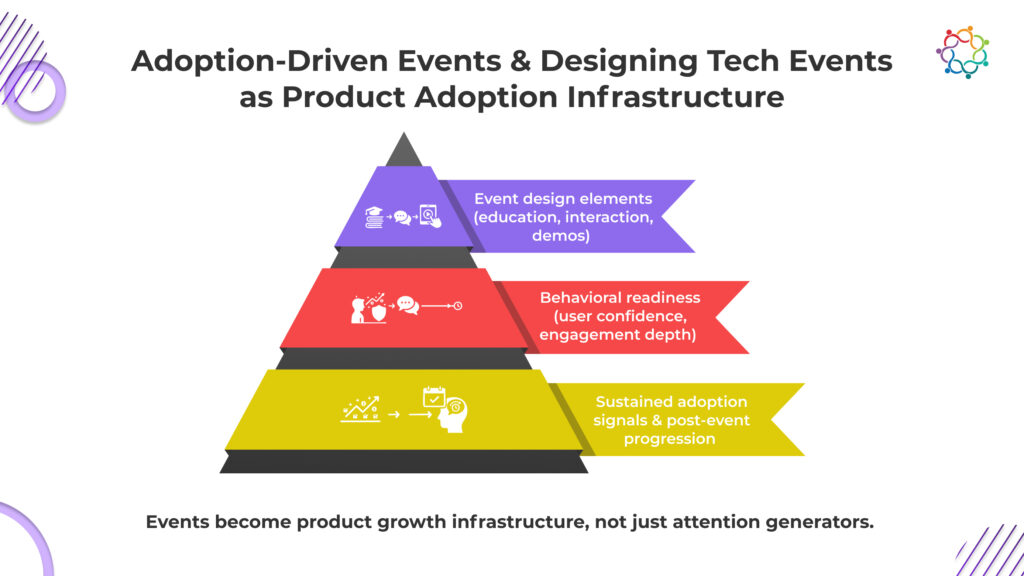
The majority of tech events aim for participation, visibility, and applause metrics that give leaders confidence. Events driven by adoption follow a different course. Capability, preparedness, and quantifiable behavioural commitment are their top priorities. Ignoring it costs money, and the difference is glaring.
Events that focus on adoption make sure that users leave ready to perform independently. Curiosity is replaced by competence. Without this, demos produce only fleeting enthusiasm.
Adoption-driven events do not chase large audiences. They cultivate engagement density, ensuring each attendee gains actionable knowledge and real-world application skills. Attention without depth is wasted.
Follow-ups are designed to extend learning, reinforce skills, and maintain momentum. Without reinforcement, the adoption gap widens immediately after the event.
Success is tracked through signals of operational readiness, not attendance numbers or click rates. Without these metrics, events remain vanity exercises that look successful but fail to move product usage.
Adoption-driven events expose the uncomfortable truth: high participation does not equal growth. Only deliberate design, reinforced learning, and capability measurement convert engagement into product adoption.
B2B tech events are rarely built for adoption. They are built for applause, attendance, and superficial engagement. This is why excitement spikes while real-world usage stagnates. If events cannot accelerate independent product confidence, they are meaningless to product growth.
More than just exposure is needed for adoption; intentional processes that incorporate behavioural preparedness before, during, and following the event are also necessary.
The friction users will experience after the incident must be taught, reinforced, and replicated in every contact. Events must question presumptions, replicate actual procedures, and develop operational capability in authentic settings. Follow-ups must maintain momentum and direct behavioural evolution; they cannot be general.
Adoption stalls in the absence of these institutions because the lessons learned from the incident disappear. Dashboards continue to demonstrate engagement success, but product teams are left to face consumers who are ill-prepared for real-world use.
Designing tech events as adoption infrastructure is uncomfortable because it forces organizations to measure capability, not clicks. Only by treating events as behavioral scaffolding can curiosity be converted into adoption and product growth.
B2B tech events are often categorized as marketing spend. That framing is strategically wrong. Events either compress or extend your product payback period.
Adoption speed determines revenue velocity. When users leave an event with operational confidence, activation accelerates. Faster activation shortens time-to-value. Shorter time-to-value improves retention probability. Retention stability increases lifetime value.
This is not branding. It is growth math.
When events fail to drive adoption readiness, the economic consequences compound:
Customer acquisition cost inflates because marketing-generated users fail to activate efficiently.
Payback periods stretch because revenue realization is delayed.
Expansion revenue shifts further into the future because usage depth never matures.
Churn risk increases because under-activated users disengage before experiencing core value.
Attendance metrics cannot offset these dynamics. A full room does not reduce CAC. Demo clicks do not improve retention. Only usage does.
Adoption-driven events operate differently. They influence:
Event ROI, therefore, cannot be measured by participation volume. It must be measured by incremental usage acceleration and its downstream revenue impact.
When events are treated as adoption infrastructure, they become levers inside the product growth engine. When they are treated as visibility campaigns, they consume budget while quietly extending payback timelines.
Growth does not follow excitement. It follows activation.
The adoption gap is not accidental. It is a measurement failure.
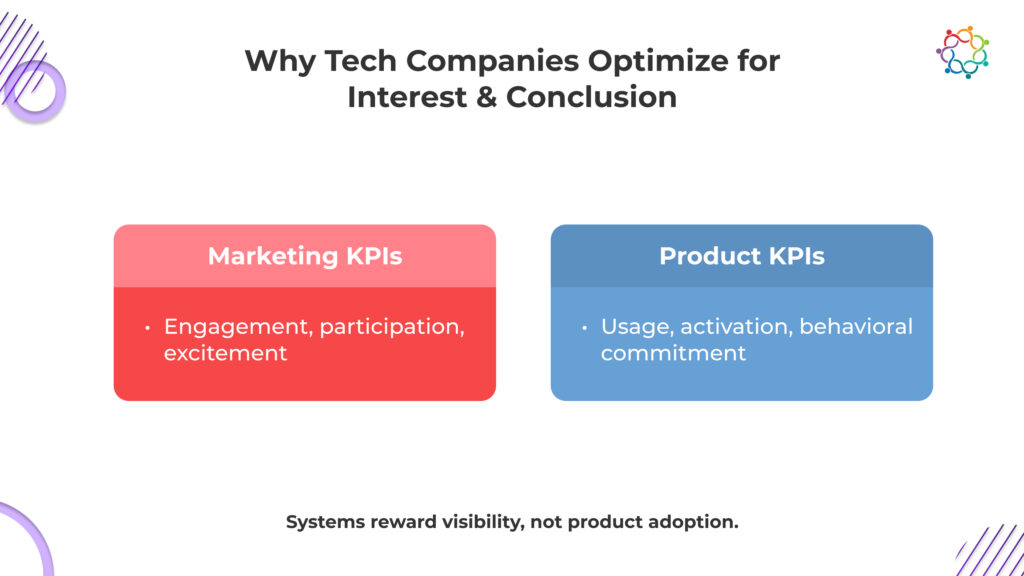
Marketing teams are rewarded for visible engagement: registrations, demo participation, session attendance. These metrics move immediately and report cleanly. They create the appearance of momentum.
Product teams are measured on activation, usage depth, and retention. These outcomes develop slowly and often outside the event environment. They require sustained behavioral change, not momentary enthusiasm.
The organization optimizes for what it can show quickly, not what compounds economically.
This creates a structural misalignment. Events are engineered to generate attention because attention is rewarded. Adoption readiness is underdesigned because it is harder to measure and slower to surface.
The result is predictable:
Dashboards improve.
Activation does not.
Growth stalls not because the product is weak, but because the system prioritizes interest over usage.
Until incentives shift from participation metrics to activation velocity, tech events will remain attention engines. And attention, without adoption, does not build product growth.
B2B tech events often appear successful because they generate visible engagement and demo participation. Executives see energy and dashboards that suggest traction. The uncomfortable truth is that excitement alone does not create product adoption.
Real growth requires sustained behavioral commitment, independent usage, and operational confidence that extends beyond the event. Interest without activation is meaningless. Events that cannot move users closer to adoption are not strategic investments; they are marketing exercises disguised as growth levers.
Forward-thinking leaders examine how structured support and expert guidance can bridge the gap between event engagement and real-world adoption, transforming participation into tangible growth.
If a tech event does not accelerate product usage readiness, it fails its fundamental purpose and contributes nothing to real product growth.