Samaaro + Your CRM: Zero Integration Fee for Annual Sign-Ups Until 30 June, 2025
- 00Days
- 00Hrs
- 00Min

Key Takeaways (TL;DR)
1
2
3
→
Bottom Line:
Six months of operational discipline across all four leaks outperforms one bigger booth, every program, every budget cycle.
380 names. No context. The post-show CSV from last quarter’s industry trade show lands in the AE’s inbox on Tuesday morning. He scrolls through. Company. Title. Email. That’s it. No notes on what each person said at the booth. No tier. No next step. He picks 20 names that look right by title and starts dialing. Three days later, he stops. None of them remember the booth conversation. None of them is interested.
This is what broken trade show ROI looks like on the ground. The 380 leads cost the company more than $400,000 to capture. The conversion rate to opportunities will round to zero. The money didn’t disappear. It leaked, in four predictable places, before it ever reached the AE’s screen.
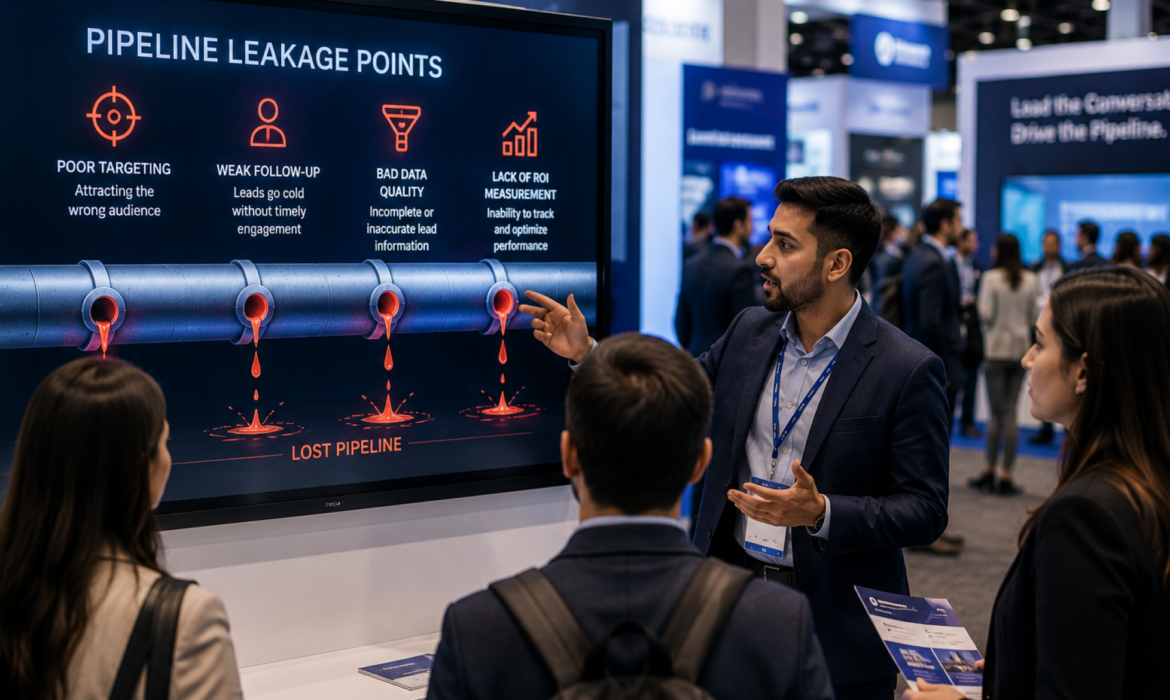
Trade show investments rarely convert to pipeline because of four operational leakage points: pre-show outreach, booth briefing, capture reliability, and post-show handoff. Each loses a meaningful share of the program’s potential, then compounds multiplicatively.
This guide names the four leaks: pre-show outreach, booth briefing, capture reliability, and post-show handoff. Each one drains a meaningful share of the program’s potential pipeline. Together, they collapse a six-figure investment into a four-figure return.
A trade show campaign isn’t one conversion event. It’s four, stacked in sequence. Each stage acts as a filter, passing some portion of the program’s pipeline potential through to the next. The damage isn’t in any single filter. It’s in what happens when four moderately leaky filters compound multiplicatively.
The math is simpler than it looks. Imagine a program where each of four stages loses half its potential value. The output retains 0.5 x 0.5 x 0.5 x 0.5, which is 6.25 percent of the pipeline ceiling. No single stage looks catastrophic, but the program ends with a 94 percent gap between what it could have produced and what it did. That is what trade show pipeline leakage looks like in arithmetic.
This is the optical-illusion problem. Leakage at any single stage rarely registers as “broken.” Each stage feels like a normal trade show. The damage is invisible until the post-show pipeline math runs.
The four stages map to four operational decisions: who you targeted before the show, how the booth team was prepared, what the booth captured during conversations, and what happened to those captures afterward. The previous post in this series, Trade Show Marketing Strategy: Pipeline Over Branding, argued the channel gets miscategorized at budget time. This one argues that even programs classified correctly still leak in four predictable places.
The instinct that breaks programs: looking for one obviously broken stage to fix. Programs almost never have a single broken stage. They have four moderately leaky ones that compound. Fixing one produces marginal improvement. Fixing all four produces an order-of-magnitude improvement.
The most expensive mistake at a trade show happens four weeks before the show opens. It’s the decision not to do anything yet.
The failure mode
The team treats the trade show as a discovery channel, relying on whoever walks past the booth. The registered attendee list, which most major B2B shows release 4 to 6 weeks pre-event, never gets pulled or segmented. No outbound goes out to existing prospects or target accounts who are registered. No meetings are pre-booked. The booth is staffed for ambient interaction only. Senior buyers from priority accounts walk past, never knew the company was exhibiting, and leave the show without a single conversation.
The cost
Pre-booked meetings convert at substantially higher rates than walk-up conversations, for one structural reason: the buyer has committed time and attention to the discussion in advance. A walk-up conversation competes with floor noise, fatigue, and a buyer who’s three booths away from their next meeting. A pre-booked meeting starts with mutual context already established. The pipeline gap between a show with strong pre-show outreach and one without isn’t incremental. It’s the difference between a program that returns its cost and one that doesn’t.
The fix
Pull the attendee list 4 to 6 weeks pre-show. Cross-reference it against the CRM. Segment into A-list (book a meeting), B-list (drive a booth visit), and C-list (capture if they walk by). AE-led personal outreach to the A-list begins 4 weeks pre-show, proposing specific meeting times. Marketing email to the B-list goes out 2 weeks pre-show with the booth number and a reason to stop by. Walk into the show with most high-value time slots already booked.
Common trap: treating the booth as the discovery mechanism. The booth is the venue, not the discovery engine. Discovery happens in the four weeks before the show.
Leak 2 isn’t about who shows up at the booth. It’s about what they were told before they got there.
The failure mode
The booth team isn’t trained for the show. Not in the abstract sense, but literally: no pre-show briefing happened. The team learns the qualification criteria from a one-page handout they read on the plane. The pitch script is whatever the rep said last week. The escalation protocol is improvised when a senior buyer shows up at the booth and the AE who owns the account is across the room. Conversations open with “tell me about your company,” which produces polite small talk and zero qualification.
The cost
A briefed team enters every conversation knowing which target accounts are attending, the three qualifying questions they’re asking, the next step they’re trying to close on, and which conversations escalate immediately. An unbriefed team improvises all four. The conversion gap between the two can double the pipeline output of the same booth traffic.
The fix: the pre-show briefing protocol
A real briefing happens 72 hours before the show opens, not the morning of, and covers four things:
Tell-tale sign: a booth team that can’t recite the three qualifying questions on Day 1 doesn’t have a briefing protocol. They have a handout.
Leak 3 isn’t about whether capture happens. It’s about whether capture holds up after the first 50 leads.
The failure mode
Capture works beautifully for the first morning. The booth is fresh, the network is responsive, the rep has time to write a clean summary, and every Hot lead gets tagged within minutes. By 3 PM on Day 1, the rep has had 40 conversations, the wifi is congested, and the capture app is hanging on every form submission. The rep starts batching for the end of the day. By Day 2 night, capture is happening from a hotel room while the rep tries to remember what 80 prospects said. By Day 3, reps have skipped capture entirely on at least 20 conversations.
The data tells the story. The first 50 leads in the post-show CSV have detailed summaries. The next 250 have a name and a company.
The cost
A lead with a conversation context can be worked. A lead without context goes into the SDR queue and gets a generic email. The conversations that disappeared into degraded capture were often the most expensive to generate, because they happened on Day 2 and Day 3 when fatigue had already filtered out casual visitors. Shows lose their best leads to capture fatigue, not booth quality.
The fix
Capture has to survive Day 2 afternoon, not just Day 1 morning:
Where this hides: in the gap between a CSV that shows 800 captures and one that shows 800 usable captures. The first number gets reported. The second determines whether the show earns its budget.
Leak 4 is where the largest pipeline value either converts or evaporates. Most of it evaporates.
The failure mode
All captured leads dump into the same SDR queue regardless of tier or fit. The Hot lead who said “we have budget approved and we’re picking a vendor in 60 days” gets the same outreach as the trade press attendee who picked up a t-shirt. No SLA on contact speed. Hot leads sit for 8 to 14 days before first touch. Outreach emails are generic, written by someone who wasn’t at the booth, with no reference to the conversation. No reporting tracks which leads were worked, converted, or abandoned. This is why trade show leads don’t close: not because the conversations were bad, but because the handoff broke.
The cost
Buyer intent decays fast after a trade show, and the decay is behavioral, not theoretical. The buyer returns to an inbox with 400 unread messages. The conversation context is overwritten by the next event, the next demo, the next internal meeting. The urgency that felt real on the show floor drops the moment they’re home, because the show was the urgency. A Hot lead contacted within 24 hours reaches a buyer who still remembers the conversation. A Hot lead contacted after Day 7 reaches someone who has moved on.
The fix
Tiered routing logic, written down and enforced:
Watch for this: when post-show is treated as marketing’s responsibility alone, the handoff fails by default. The handoff is shared infrastructure. Marketing builds the routing logic and the SLA. Sales commits to the speed and cadence.
Knowing the four leaks is the easy part. Finding the one killing your program decides what gets fixed first. Run these diagnostics on your last show.
Pre-show outreach. How many of your pre-booked meetings came from outbound to the registered attendee list, as opposed to inbound or existing relationships? If most came from other sources, Leak 1 is active.
Booth briefing. Did your booth team receive a structured pre-show briefing covering qualification, pitch, and escalation in the 72 hours before the show? If the briefing was a handout or a Day 1 morning walkthrough, Leak 2 is active.
Capture reliability. Pull a random 10 leads from your last show. Check how many have a conversation summary, qualification tier, and next step in the CRM. If fewer than half do, or if capture quality dropped between Day 1 and Day 3, Leak 3 is active.
Post-show handoff. Of the Hot leads tagged at your last show, how many were contacted by an AE within 4 hours? If fewer than half were, Leak 4 is active.
Where to start. The leaks compound, but Leak 1 is the highest-leverage fix because it determines the quality of every downstream conversation. Leak 4 is second, because it’s where the largest pipeline value either converts or evaporates. Leaks 2 and 3 amplify the value created by the bookends.
Pre-show outreach builds the shortlist. The briefing protocol turns conversations into qualifications. Capture reliability preserves intent. Routing and SLA convert intent into pipeline.
Four leaks. Four fixes. Run the diagnostic. Pick the one costing your program the most. Close it before the next show, then close the next one. Six months of operational discipline outperforms one bigger booth.
For the next layer of depth, the Trade Show Booth Strategy Toolkit covers on-floor execution, the 30-Point Trade Show Checklist covers operational sequence, and the Marketing-to-Sales Lead Handoff guide covers Leak 4 end-to-end.