Samaaro + Your CRM: Zero Integration Fee for Annual Sign-Ups Until 30 June, 2025
- 00Days
- 00Hrs
- 00Min


1
2
3
4
→
Bottom Line: Teams that win in 2026 design events backward from business outcomes; those that don’t spend their time explaining ROI instead of proving it.
Most conversations about event ROI begin after the event is already over. Teams pore over attendance numbers, engagement scores, survey results, and pipeline attribution, metrics that describe outcomes but cannot change them. By the time ROI is reviewed, it is already locked in.
Event ROI is usually treated as a measurement problem. It isn’t. It’s a timing problem. Post-event metrics are lagging indicators; they explain what happened, not why it happened. Senior marketers are often evaluated on results that were determined weeks earlier, long before the first attendee walked into a session.
This is why pre-event marketing matters more than most teams are willing to admit. It sits upstream of engagement quality, feedback depth, and pipeline influence. When those inputs are weak, no amount of post-event analysis can fix the damage. ROI conversations start too late because the real drivers of ROI are rarely treated as strategic decisions in the first place.
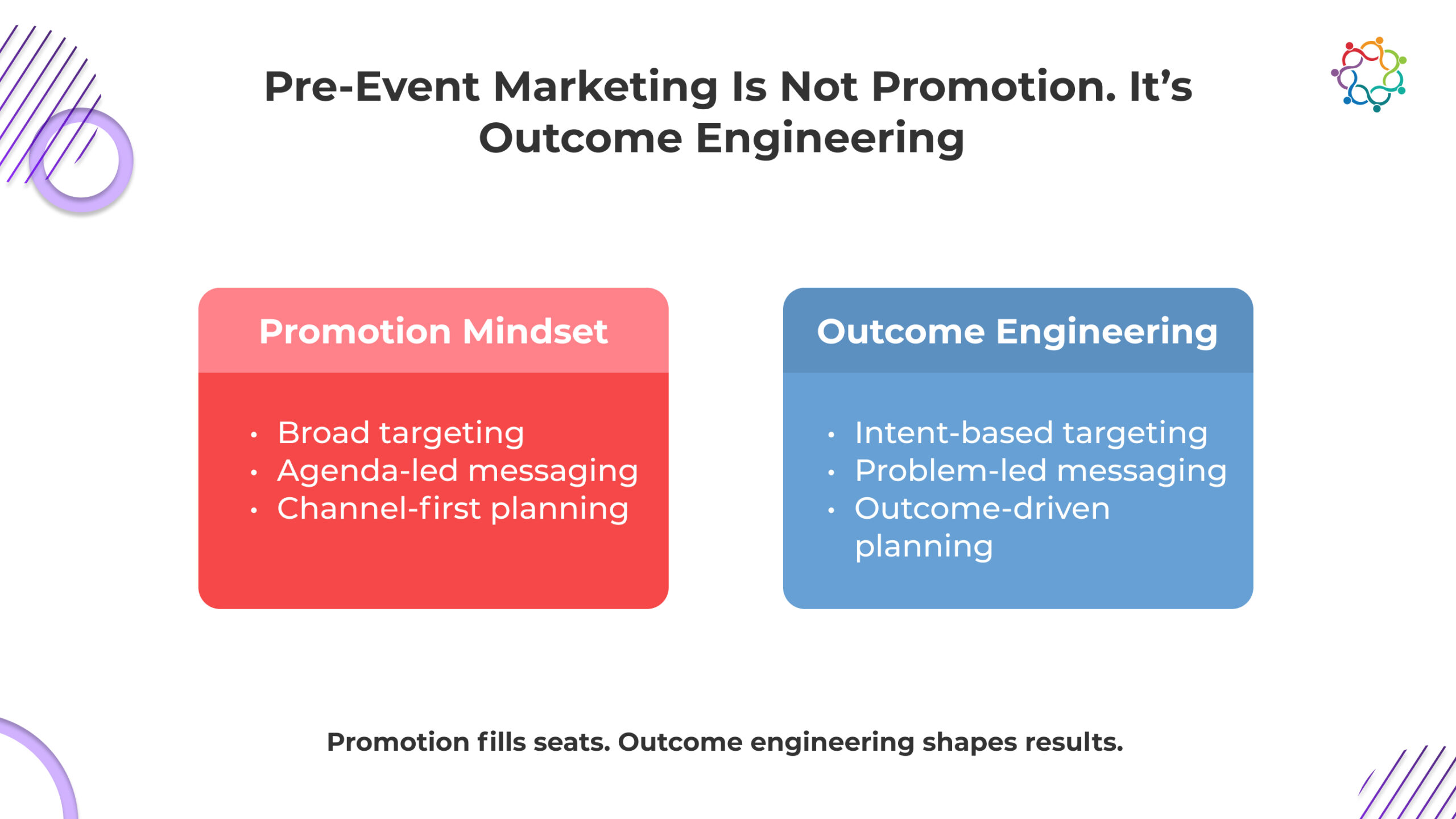
Many teams equate pre-event work with promotion. And the goal becomes driving registrations as efficiently as possible. Promotion focuses on volume. Outcome engineering focuses on intent.
Promotion asks how many people can be convinced to register. Outcome engineering asks who should attend and why their presence matters to the business. This distinction is critical. The quality of attendees determines the quality of engagement, feedback, and follow-up conversations.
Pre-event marketing is the phase where intent is filtered. Decisions about positioning, audience definition, and channel mix determine whether the event attracts decision-makers or not. High attendance numbers can coexist with weak ROI when the audience is misaligned with the event’s purpose.
This is where signal quality becomes more important than volume. A smaller audience with high intent produces clearer engagement metrics and more reliable post-event data. A larger audience with mixed intent produces noise. The difference is rarely visible in registration dashboards, but it becomes obvious when teams attempt to connect events to revenue outcomes.
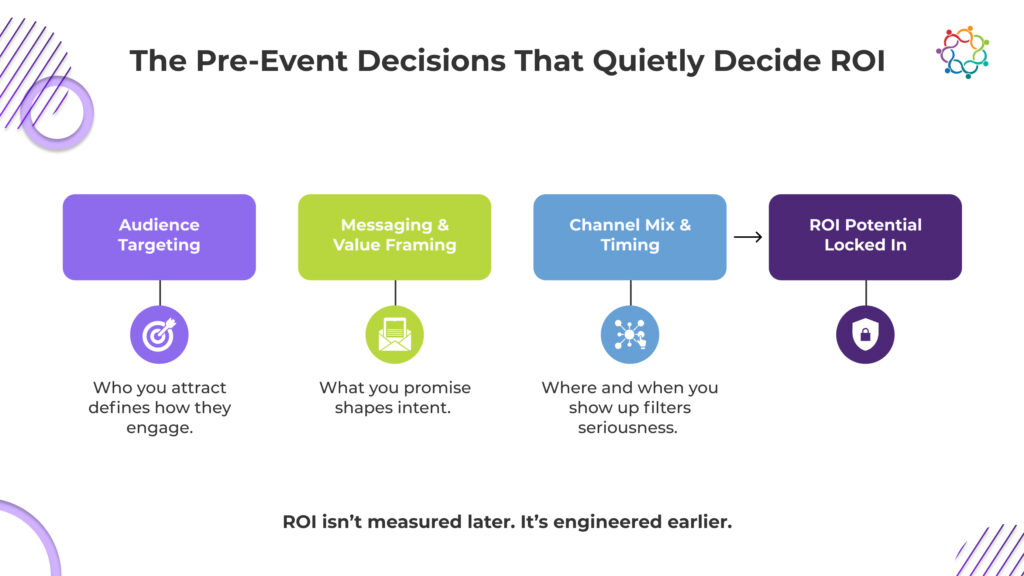
Event ROI rarely hinges on what happens during the event itself. It is shaped by a small set of upstream decisions that determine who shows up, why they attend, and how seriously they engage. These choices are often treated as execution details, but they quietly lock in the ceiling for post-event outcomes. Audience targeting, messaging, and channel strategy act as filters. They decide intent quality long before engagement is measured. When these inputs are weak, ROI erosion is already underway, even if registrations look healthy.
Audience targeting is often optimized for reach, but it quietly defines the quality of every downstream metric. Broad targeting may increase registrations, but it almost always dilutes relevance.
When targeting is too wide, intent density drops. Sessions fill with attendees who have casual interest rather than active problems. Engagement still occurs, but it lacks depth, questions trend generic, polls flatten, and feedback becomes non-specific. These are not engagement failures. They are targeting failures.
Misaligned audiences also distort how ROI is interpreted. Attendees outside buying or influence roles cannot realistically affect pipeline outcomes, yet they are still counted in engagement and attendance metrics. Follow-up conversations stall because intent was never present, and attribution becomes diluted, making events appear less effective than they actually were.
Effective audience targeting prioritizes relevance over volume. It narrows participation to people who can act on what the event delivers, producing clearer engagement signals and more reliable ROI outcomes.
Messaging determines who chooses to attend and with what mindset. It acts as a self-selection mechanism.
Many event invitations lead with speaker names, session titles, and schedules. This framing positions the event as content consumption. Attendees register without a clear expectation of value beyond learning. As a result, engagement remains passive.
When messaging is framed around specific problems, trade-offs, or decisions, it signals that the event is designed for the real audience. Decision-makers respond to relevance. This framing reduces registration volume but increases intent density, which directly affects engagement metrics and post-event follow-up responsiveness. This shift directly affects outcomes.
Value framing does not just influence attendance. It determines whether the event functions as a learning session or a decision catalyst.
Channel mix and timing shape intent, not just reach. They determine who shows up and how seriously they engage. Channels are not neutral distribution pipes; each one attracts a different level of commitment.
Awareness-heavy channels tend to drive curiosity. Relationship-driven channels include email to known accounts, partner outreach, direct sales invites, pull in attendees with context and a reason to care. When all channels are treated as interchangeable, registration volume increases but intent quality does not.
Timing sharpens this difference. Early registrants typically assess relevance before committing. They attend more sessions, engage more consistently, and are easier to follow up with. Late registrants often arrive due to urgency or reminders, not fit. As decision-making compresses, drop-off rises and engagement becomes uneven.
These patterns show up clearly in ROI signals: attendance volatility, inconsistent session participation, and stalled follow-ups. Channel mix and timing don’t just influence who attends. They influence how much intent enters the room, and intent is what ultimately converts engagement into impact.
(Also Read: Pre-Event Engagement Strategies: How to Warm Up Attendees Before Registration Opens)
How Pre-Event Inputs Shape Post-Event Outputs

Event ROI is often described as unpredictable, as if outcomes hinge on timing, market mood, or execution luck. In reality, ROI follows structure. It emerges from a chain of decisions that set conditions long before results are measured. What appears uncertain after the event is usually quite deterministic before it. Inputs define the boundaries within which outcomes can occur.
Audience targeting shapes session attendance depth. When attendees share a common context, sessions feel more relevant, discussions become richer, and drop-off rates decline. Broad audiences fragment attention and reduce perceived value.
Messaging influences feedback quality. Problem-led positioning produces feedback that reflects real constraints and priorities. Agenda-led positioning produces generic satisfaction scores that offer little strategic insight. Feedback bias increases when attendees lack a clear reason for attending.
Channels affect follow-up responsiveness. Attendees who register through high-intent channels are more likely to respond to post-event outreach. Those acquired through low-friction channels often disengage once the event ends, weakening the funnel beyond the event itself.
Registration intent shapes pipeline influence. When intent is high, events accelerate existing opportunities or trigger qualified conversations. When intent is low, attribution decay sets in quickly, making impact harder to trace even when activity appears strong.
This is where pre-event marketing functions as strategic infrastructure. It determines whether post-event metrics reflect genuine signal or statistical noise. When inputs are deliberate, outputs become interpretable, comparable, and useful for decision-making. When inputs are weak, post-event data may look complete but cannot be trusted to guide strategy.
Post-event metrics are often treated as the objective truth. In reality, they are heavily context-dependent. Without understanding pre-event decisions, these metrics can mislead.
High-performing teams approach events with a different mindset. They do not chase volume for reassurance or optics. They prioritize intent filtering, even when it means accepting lower registration numbers. This runs against leadership instincts that equate success with scale, but experienced teams value clear signals over crowded rooms.
Events are not treated as standalone campaigns. They are designed backward from business outcomes. The defining question is not how to drive registrations, but who must attend for the event to matter and what decision the event should enable. Everything upstream aligns to that answer.
Pre-event marketing, in this model, is a strategic phase rather than a promotional sprint. Assumptions about audience, intent, and value are made explicit. Trade-offs are chosen deliberately instead of being obscured by vanity metrics. As a result, post-event analysis becomes about learning, not justification. Outcomes can be traced to decisions rather than explained away.
High-ROI teams also recognize that events are decision environments. Attendees arrive to evaluate relevance, credibility, and next steps. The advantage is not better execution on the day. It is earlier, more deliberate thinking about what the event is meant to change.
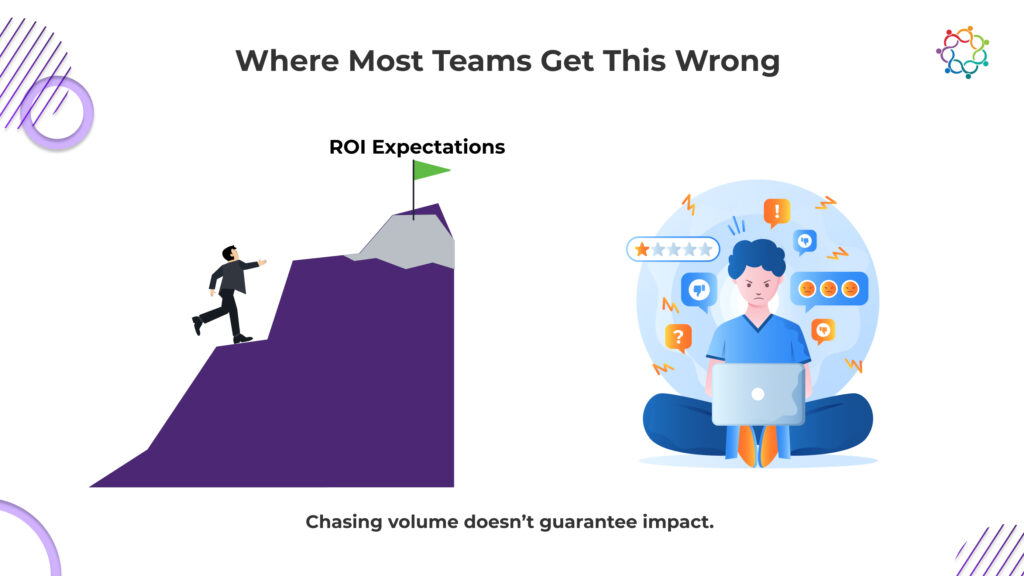
The most persistent breakdown in event ROI does not happen at the execution level. It happens upstream, driven by leadership pressure to prove momentum through registrations. Volume is visible, comparable, and easy to celebrate in reviews. Intent is abstract, slower to surface, and harder to defend when targets are looming. As a result, teams default to what can be shown quickly, even when it undermines long-term outcomes.
This behavior is reinforced by dashboards that prioritize optics over insight. Metrics such as total attendees, email open rates, and click-throughs create the illusion of progress without revealing whether the event is positioned to influence real decisions. When these numbers become the primary indicators of success, teams begin optimizing for what looks good rather than what matters.
At this point, structural mistakes start to compound:
Because the negative consequences surface later, the pattern persists. When ROI falls short, the instinct is to question reporting models or execution quality. Rarely does the conversation move upstream to examine pre-event strategy, even though it quietly set the limits for every downstream result.
Event ROI is often treated as something to diagnose after the event is over. Reports are reviewed, dashboards are questioned, and explanations are prepared. But this framing misses the real issue. ROI is not an after-event problem. It is a lifecycle problem. By the time metrics are analyzed, the most influential decisions have already been made, and they cannot be undone.
Pre-event marketing determines the conditions under which ROI is even possible. It decides who shows up, what level of intent they bring, and whether their engagement can translate into meaningful business outcomes. It shapes signal quality long before surveys are sent or attribution models are applied. Strong pre-event decisions reduce noise, limit feedback bias, and slow attribution decay. Weak ones do the opposite, no matter how polished the event execution may be.
Teams that consistently deliver event marketing ROI do not start with promotion or reporting. They start with outcomes. They work backward to define the audience, the problem framing, and the intent required for the event to matter. Everything upstream is designed with purpose, not urgency.
In 2026, the gap will widen between teams that spend time explaining ROI and teams that rarely need to. The difference will not be better dashboards. It will be earlier, clearer thinking about why the event exists in the first place.
(If you’re thinking about how these ideas translate into real-world events, you can explore how teams use Samaaro to plan and run data-driven events.)