Samaaro + Your CRM: Zero Integration Fee for Annual Sign-Ups Until 30 June, 2025
- 00Days
- 00Hrs
- 00Min

Bottom Line: For enterprise field marketing teams constrained by global platform limitations, Samaaro replaces manual workarounds with a CRM-native event engine that connects every touchpoint to pipeline, automatically, across 150+ events per year.
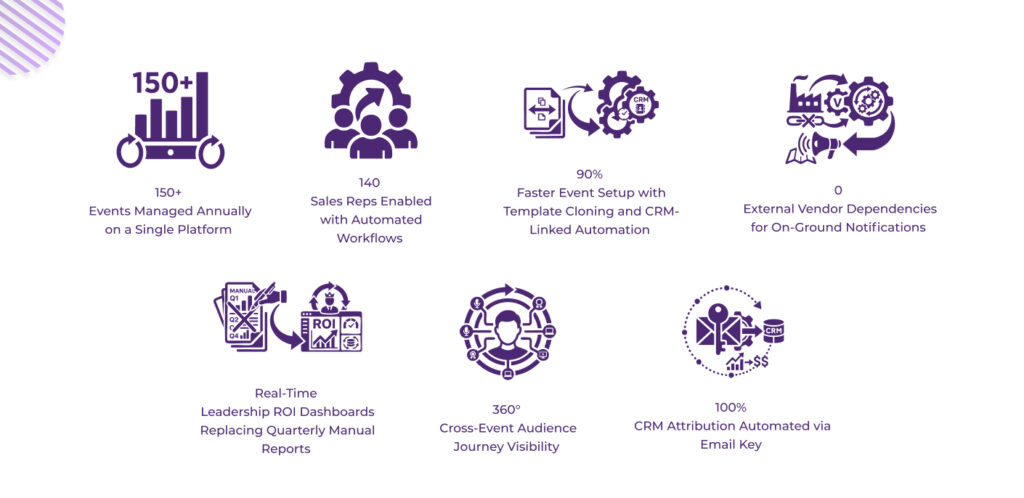
A US-headquartered global HR tech company, responsible for driving demand generation across the company’s HR technology and workforce solutions portfolio, the team runs 150+ owned events per year across the APAC region, serving a 140-member sales organization spread across multiple regions, segments, and business lines.
Enterprise Technology / HR & Talent Solutions
Event marketing platform, CRM integration (Salesforce), automated invitation workflows, real-time sales agent notifications, audience management, ROI dashboards, budget planner
When enterprise data governance constraints neutralize your event platform’s capabilities, the operational gap doesn’t disappear. It gets filled by manual workarounds, external vendors, and spreadsheet analytics. At 150+ events per year, that operational debt compounds.
The client’s event program spans multiple formats: large-scale pipeline generation events, invite-only CXO roundtables, and product launch events. Despite the program’s scale and strategic importance, the team had been operating on Splash, the company’s globally standardized event marketing platform used across its worldwide marketing operations, but enterprise data governance policies had constrained several of its deployment-level capabilities. The result was a growing layer of manual processes, external vendor dependencies, and disconnected data systems that compounded with every event.
When 500+ team members from six business units across India and Bangladesh converge at an international offsite, the experience cannot afford to feel fragmented. Every missed update, every inaccessible document, every disengaged attendee represents a lost opportunity to align the entire sales force for the year ahead.
That’s exactly what PepsiCo Foods set out to solve with their TSM Kickoff 2026.
The team’s globally mandated event marketing platform, Splash, handled the fundamentals well: landing page creation, template cloning, and basic registration. But as the program scaled from 15 events per quarter to 50, five specific operational ceilings became impossible to work around.
1. CRM-Disconnected Invitation Workflows
Enterprise security policies had disabled the platform’s campaign and list management features, preventing bulk audience imports or automated invitation sequences. Sales representatives had to individually send email invitations from outside the platform. This was a significant time burden across a 140-member team, each managing 50+ accounts. Every event required a manual coordination cycle between the field marketing lead and each sales rep, with no automated account-owner mapping or centralized send capability.
2. No Real-Time Sales Engagement at Events
When attendees checked in at event venues, the sales team had no visibility into who had arrived. Representatives would crowd the registration desk mid-event trying to identify their accounts. The field marketing team eventually introduced real-time check-in notifications through an external GDPR-approved event agency, a workaround that added incremental cost to every event and operated entirely outside the event marketing platform.
3. Revenue Attribution Required Manual Cross-Matching
The event platform was not properly integrated with the company’s CRM (Salesforce). Tracking event-influenced pipeline required the operations team to manually export registration data, pull closed-won deals from Salesforce, and cross-match records in spreadsheets. This process was further complicated by entity name mismatches: CRM records used legal entity names while registration forms captured short-form company names. Producing attribution reports for leadership was a multi-week effort each quarter.
4. No Cross-Event Audience Intelligence
With multiple touchpoints per account, a Head of HR attending a pipeline event, a CHRO joining a CXO roundtable, a talent leader at a product launch, the team needed to stitch together multi-event journeys to demonstrate cumulative engagement. But audience data lived in disconnected silos across individual events, making it impossible to build a longitudinal view of how field marketing touchpoints contributed to deal progression.
5. No Integrated ROI Reporting
With multiple touchpoints per account, a Head of HR attending a pipeline event, a CHRO joining a CXO roundtable, a talent leader at a product launch, the team needed to stitch together multi-event journeys to demonstrate cumulative engagement. But audience data lived in disconnected silos across individual events, making it impossible to build a longitudinal view of how field marketing touchpoints contributed to deal progression.
Samaaro was deployed as the team’s event marketing platform for the APAC field marketing programs, replacing the Splash-centered stack of disconnected tools, manual processes, and external vendor workarounds with a single, CRM-integrated system designed for high-volume, sales-aligned event operations.
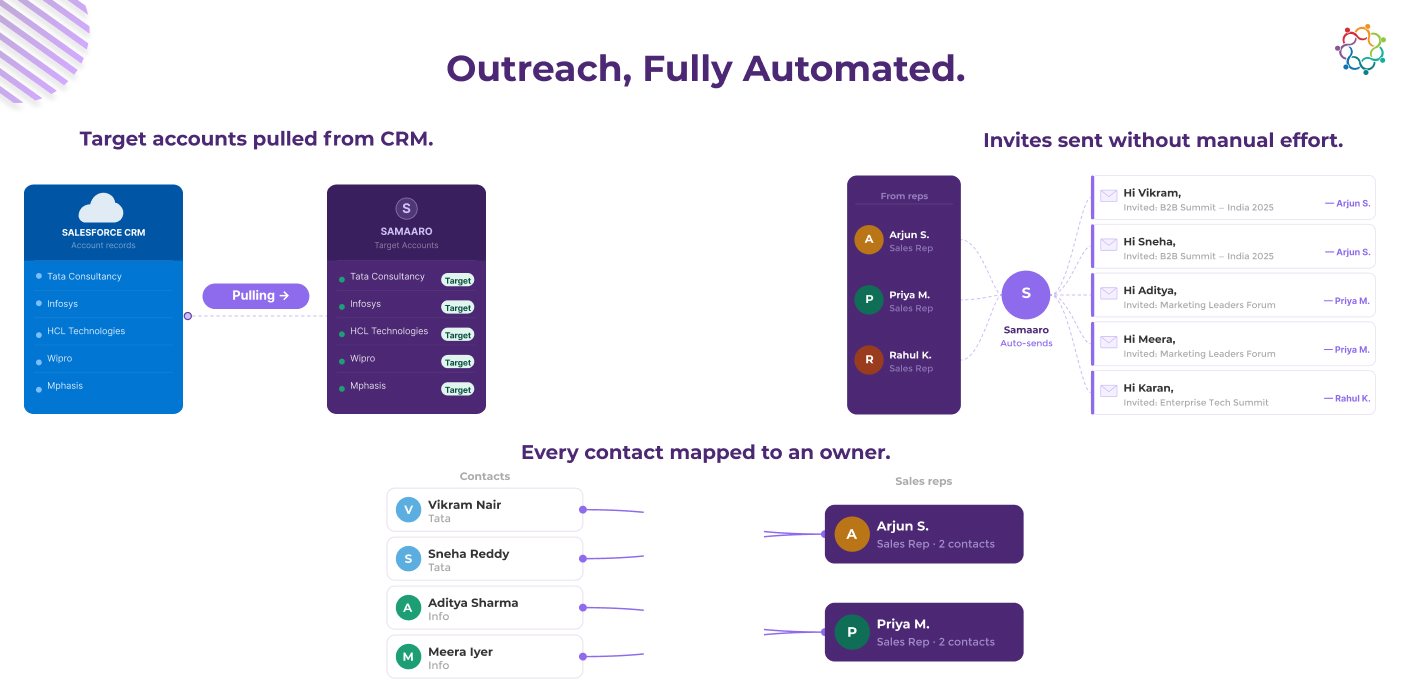
Automated Invitation Workflows with Account-Owner Mapping
Samaaro’s native integration with Salesforce enabled the team to pull target accounts directly from the CRM, automatically map each contact to their assigned account owner, and send personalized invitations from the relevant sales representative’s email. All of this without requiring sales reps to block time for manual outreach. What previously consumed hours of coordination per event across a 140-member sales team became a single, automated workflow managed by the field marketing lead.
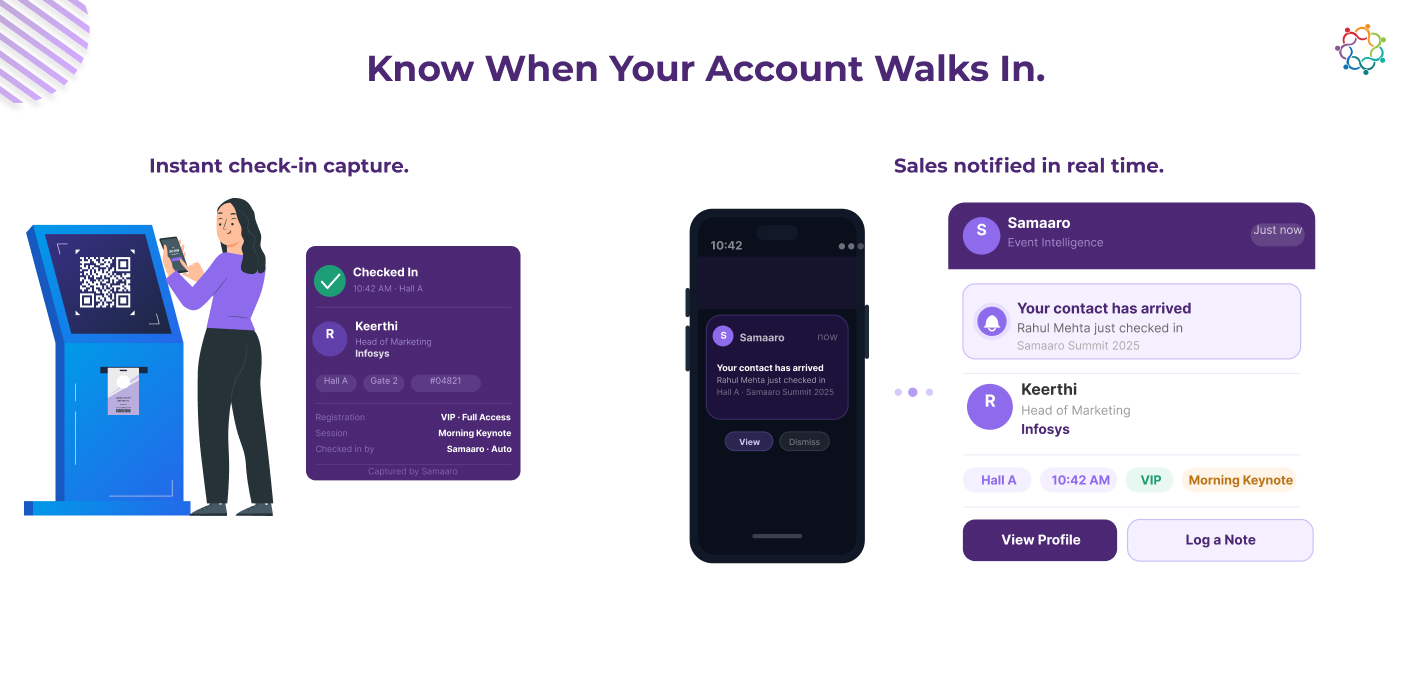
Real-Time Sales Agent Check-In Notifications
When an attendee checks in at an event venue via QR code scan, Samaaro instantly notifies the assigned sales representative, enabling account owners to find and engage their contacts on the floor rather than crowding the registration desk. A dedicated sales dashboard captures meeting notes and outcomes in real time, with all data syncing directly to the CRM. This replaced the external vendor workaround the team had been paying for separately at each event.
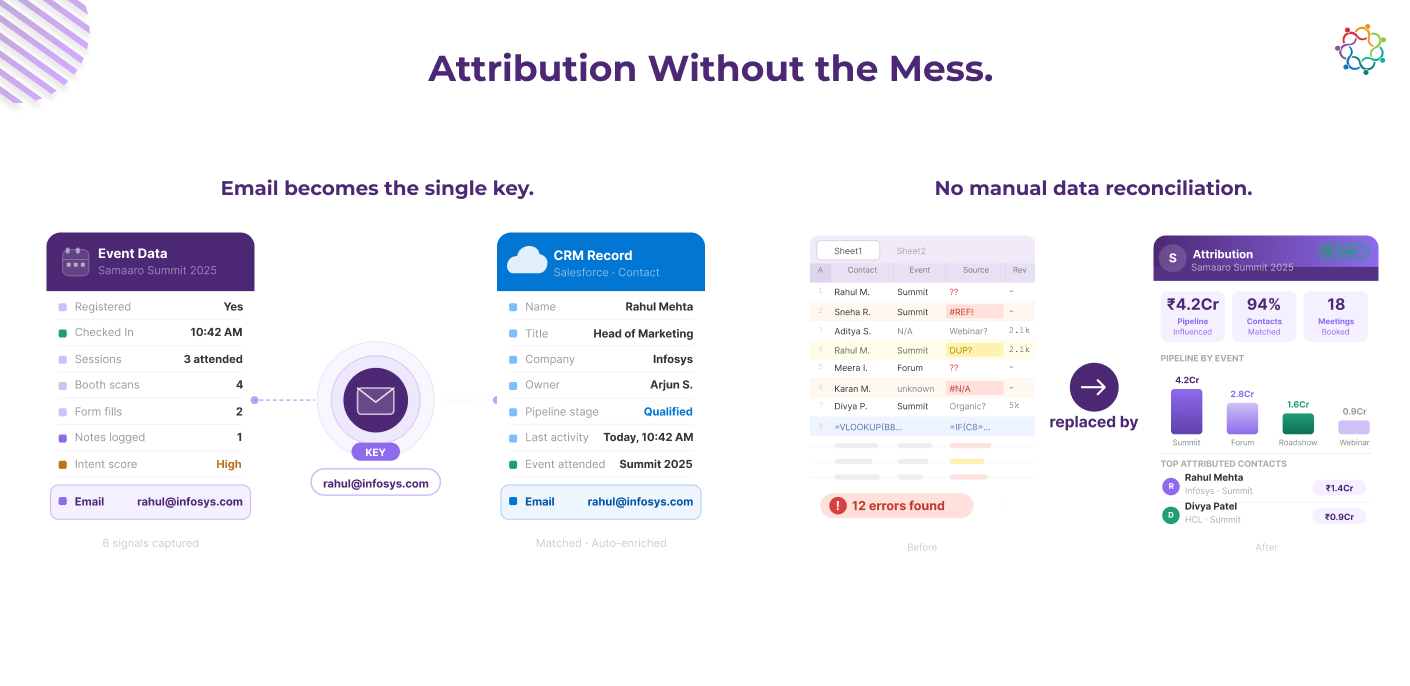
Email-Based CRM Matching for Clean Attribution
Samaaro uses email address as the unique key connecting event data to CRM records, eliminating the entity name mismatch problem that had made manual attribution so labor-intensive. Every registration, RSVP response, check-in, and follow-up interaction maps directly to the corresponding CRM record, enabling automated attribution reporting without spreadsheet cross-matching.
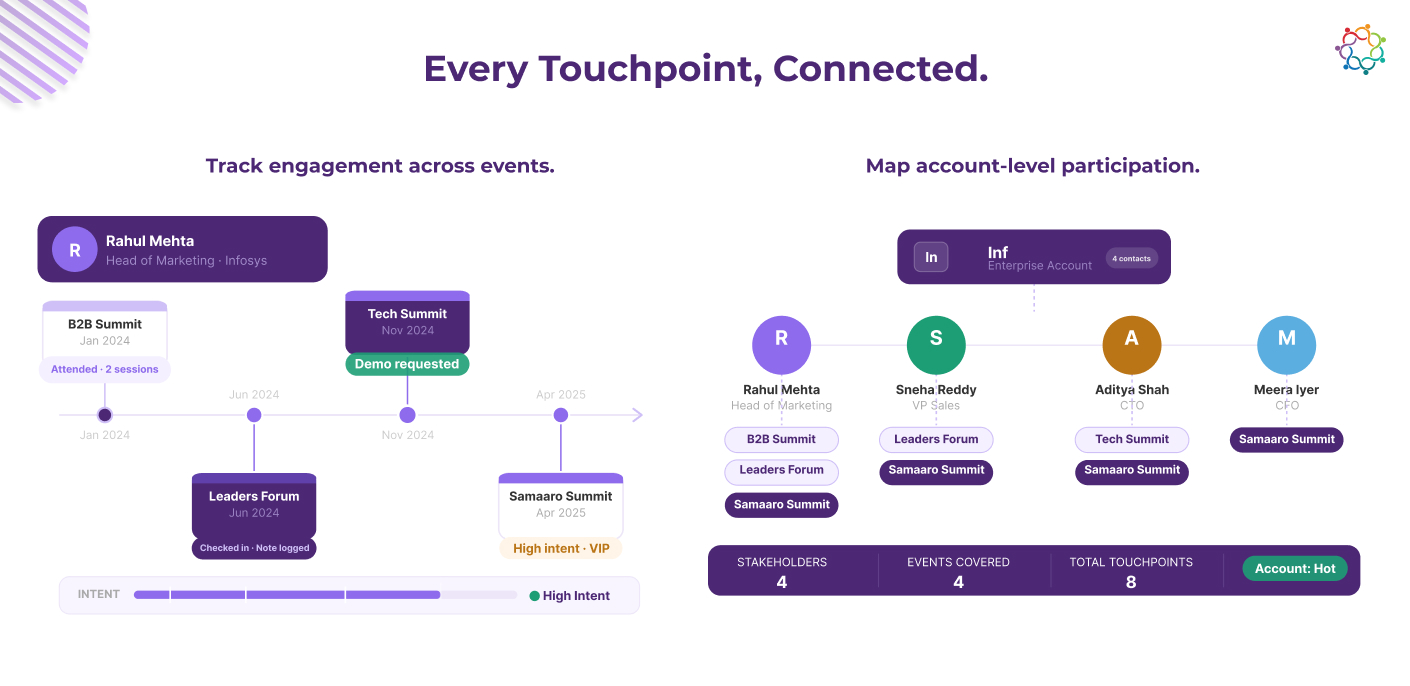
Cross-Event Audience Journey Tracking
Samaaro’s audience intelligence layer aggregates engagement data across every event in the program, building a longitudinal profile for each contact. The team can now see that a specific account was represented at three events across two quarters, which individuals attended, and how engagement depth evolved. This is exactly the multi-touchpoint narrative leadership needs to connect field marketing activity to deal outcomes.
Integrated Budget Planning and ROI Dashboards
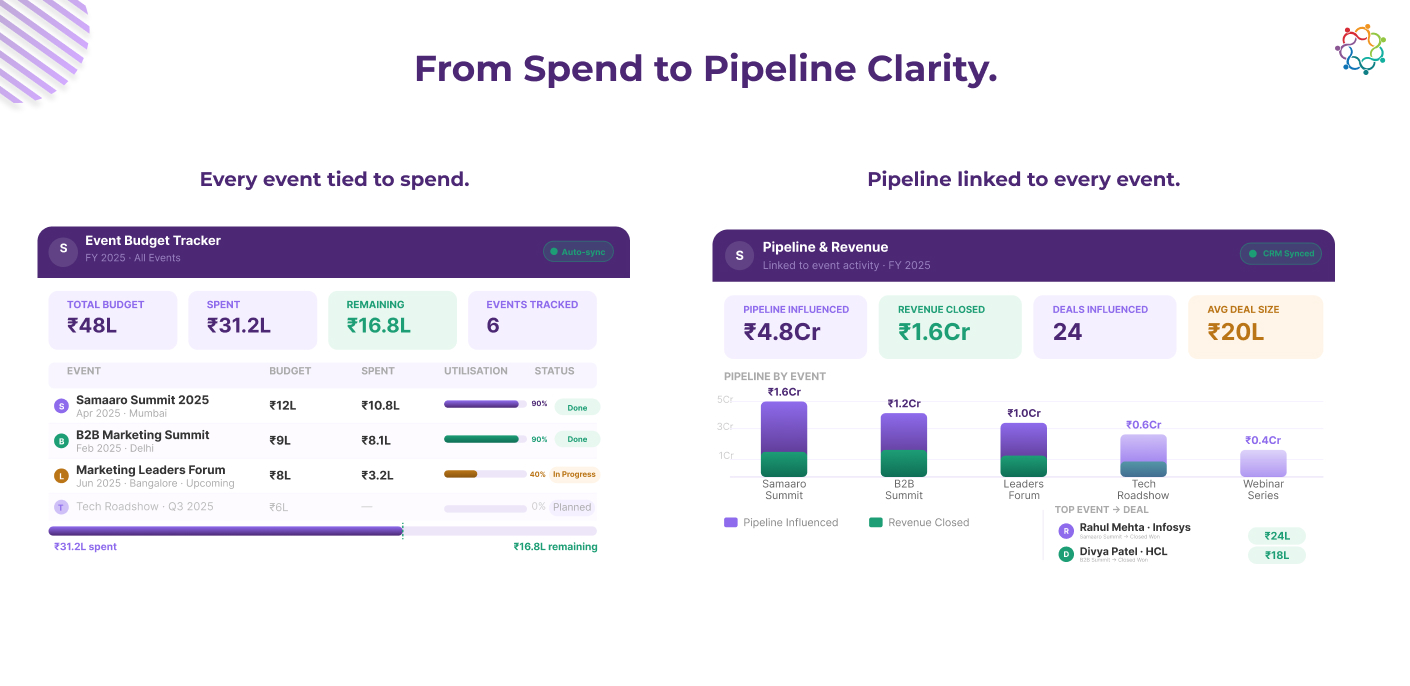
Every event’s expenses are logged within the platform and automatically connected to pipeline and revenue data through the CRM integration. Leadership-level dashboards show approved budget vs. actual spend, event-influenced pipeline, cost-per-attendee, and program-level ROI across any date range. The annual event analysis that previously required weeks of manual data assembly is now available on demand.

After a flagship trade show generating over a thousand leads, the marketing team prepared post-event follow-ups within days instead of weeks. Leads were already segmented by product interest, synced into Salesforce, and aligned with approved budgets and pipeline views.
Instead of assembling reports across multiple tools, leadership reviewed event performance through a single dashboard while sales teams moved directly into relevant, product-led conversations. The event closed with clarity, not cleanup.
For the first time, the field marketing team can present a unified narrative to leadership, connecting individual event touchpoints to account-level engagement and pipeline progression without weeks of manual data reconciliation. Sales representatives spend their time at events engaging prospects instead of checking registration lists, and the field marketing lead operates a 150+ event program with the operational efficiency of a platform-native workflow rather than a patchwork of spreadsheets, external agencies, and manual coordination.
Enterprise field marketing teams running high-volume event programs increasingly face a paradox: the very data governance and security frameworks that protect their organizations also constrain the tools those organizations have standardized on. When platform features are disabled at the policy level, the operational gaps don’t disappear. They migrate to manual workarounds that become invisible infrastructure, absorbing budget and headcount without appearing on any technology roadmap.
The shift from event management to event marketing demands platforms built around CRM-native architecture, where audience data, attribution, and ROI measurement are not add-ons but foundational capabilities. For teams accountable not just for event execution but for the pipeline those events generate, the ability to connect every touchpoint to a business outcome, automatically, in real time, across an entire program, is the difference between running events and running a measurable growth channel.
👉 Running a high-volume field marketing program? Let’s talk about how Samaaro can simplify it for you. Talk to our team

Samaaro is an AI-powered event marketing platform that enables marketing teams to turn events into a measurable growth channel by planning, promoting, executing, and measuring their business impact.
Location


© 2026 — Samaaro. All Rights Reserved.