Samaaro + Your CRM: Zero Integration Fee for Annual Sign-Ups Until 30 June, 2025
- 00Days
- 00Hrs
- 00Min

Paid promotion has become the default response when event registrations slow down. Budgets are unlocked, campaigns are rushed live, and performance is judged almost entirely on registration volume. When results disappoint, the conclusion is predictable. Paid ads do not work for events. This assumption misses the real issue. The problem is rarely the channel. It is the expectation placed on it.
In 2026, event advertising sits at the intersection of demand generation, brand positioning, and pipeline accountability. Treating it as a last-minute attendance booster ignores how paid media actually functions. Ads amplify whatever strategy already exists. If the event has unclear value, weak targeting, or mismatched goals, paid spend simply scales those flaws faster.
Many teams also collapse two very different objectives into one metric. Driving attendance is not the same as driving outcomes. High registration numbers can coexist with low engagement, poor follow-up, and zero pipeline influence. When success is defined narrowly, paid campaigns are set up to fail before they start.
This article reframes paid promotion as an investment decision. The goal is not to run more ads, but to run them with intent, discipline, and a realistic view of ROI.
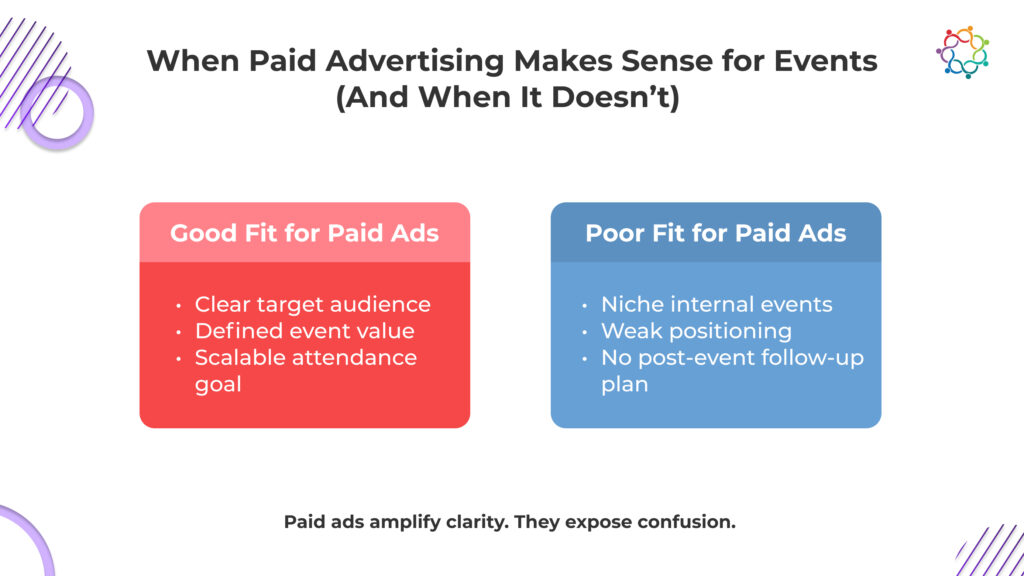
Paid promotion is powerful, but it is not universally appropriate. Knowing when to use it is the first act of responsible spending. Some events benefit significantly from paid support, while others perform better through owned, earned, or partner-driven channels.
When there are distinct purpose signals and a well-defined audience for the event, paid advertisements typically perform the best. This includes account-specific executive events, product-led workshops, and mid-funnel webinars. These formats allow targeting precision and message clarity to do real work.
By contrast, paid ads struggle when the event value is broad or ambiguous. Community meetups, early-stage brand events, or partner-heavy conferences often rely more on trust and relationships than on ad-driven discovery. In these cases, paid promotion may inflate registrations without improving attendance quality.
Teams should also recognize situations where paid spend creates false confidence. If internal alignment on audience, follow-up, or success metrics is missing, ads only mask deeper issues.
Before committing budget, ask:
Saying no to paid ads in the wrong context preserves budget and credibility.
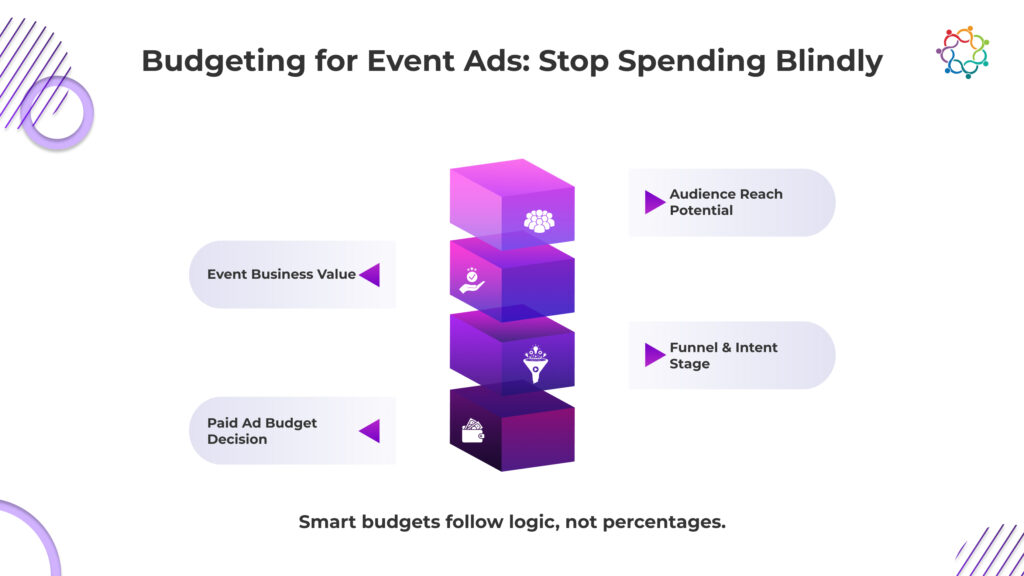
Event ad budgets often emerge from habit rather than strategy. A fixed percentage of the event budget is allocated to promotion, regardless of audience size, funnel stage, or event value. This approach feels structured, but it is not intellectual.
Effective budgeting starts with understanding what the event is meant to produce. A high-value executive roundtable with a narrow audience requires a different spend logic than a scalable product demo. Budget should reflect potential impact, not tradition.
Several factors should shape spending decisions. Audience size determines how quickly saturation occurs. The funnel stage influences how much education and reinforcement are needed. Timing matters as well. Early testing helps validate messaging and targeting, while late-stage pushes focus on conversion.
Instead of formulas, teams need guardrails. Define a maximum acceptable cost per qualified attendee. Decide in advance what signals justify scaling spend and what signals trigger a pause. This turns budgeting into a learning system rather than a gamble.
One disciplined approach is to separate the budget into two phases. An exploratory phase tests assumptions at low spend. A commitment phase scales only what proves capable of driving quality attendance. This structure protects ROI and forces accountability.
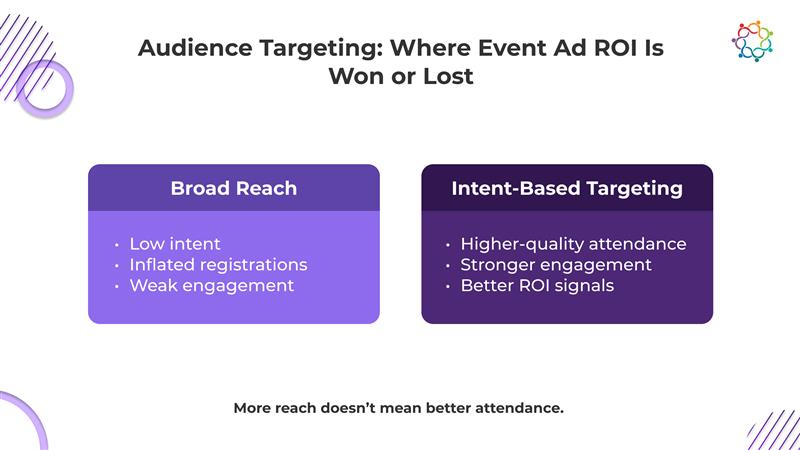
Before any discussion of platforms, budgets, or creative, audience targeting sets the ceiling for event ad ROI. Every downstream metric is shaped by who you choose to reach in the first place. When targeting is loose, paid spend buys attention without relevance. When it is precise, even modest budgets can drive high-quality attendance.
This section breaks down how targeting decisions create or destroy value, starting with the most common mistake teams make while prioritizing reach over intent.
Reach is seductive because it looks like momentum. Large audiences create the illusion of scale, but they also dilute relevance. Broad targeting inflates costs and attracts attendees with little connection to the event’s purpose.
Intent-based targeting shifts the focus from who could attend to who should attend. Signals such as prior engagement, relevant search behavior, or content consumption indicate readiness. These signals may reduce audience size, but they increase attendance quality.
In 2026, targeting decisions matter more than creative polish. Narrowing reach feels risky, yet it aligns spending with outcomes. When ads speak to an existing problem or active need, they function as confirmation rather than persuasion.
The trade-off is clear. Intent targeting limits volume but improves downstream metrics. Reach-based targeting boosts registrations while weakening ROI. Mature teams choose the former and accept lower top-line numbers in exchange for meaningful results.
First-party data remains one of the most underutilized advantages in event promotion, even as teams invest heavily in paid channels. CRM records, past attendee lists, account engagement history, and product usage signals provide a level of context that no platform-built audience can replicate. These data sources reflect real interactions, real intent, and real relationships, which makes them far more predictive of attendance quality than inferred interests.
Platform audiences and lookalikes still play an important role, but only when they are used with discipline. Left unchecked, they optimize for surface-level similarity rather than relevance. This is where many campaigns lose focus. Effective targeting anchors expansion to first-party data, using it as a benchmark rather than a replacement.
The objective is balance. First-party audiences establish quality thresholds. Platform audiences are then layered in carefully to extend reach without diluting intent. When this balance is missing, performance issues are often misattributed to channels instead of audience design.
Strong audience strategies typically include:
This approach protects ROI while still enabling growth.
Retargeting is frequently overused and poorly timed in event promotion. Many teams treat it as a discovery channel, assuming repeated exposure will create interest. In reality, retargeting only works when some level of intent already exists. Without prior awareness or relevance, impressions are wasted.
Effective retargeting is designed for audiences that are already warm. These individuals have signaled curiosity or consideration, and the role of ads is to reinforce value, reduce friction, and prompt action. When used earlier in the funnel, retargeting feels repetitive and increases fatigue without improving outcomes.
The effectiveness of retargeting depends on restraint and timing. It should have a narrow focus, not expand its reach. When applied correctly, it becomes one of the most efficient levers in event promotion because it improves conversion without inflating audience size.
Retargeting works best when it is limited to:
Used with intent, retargeting supports ROI rather than distorting it.
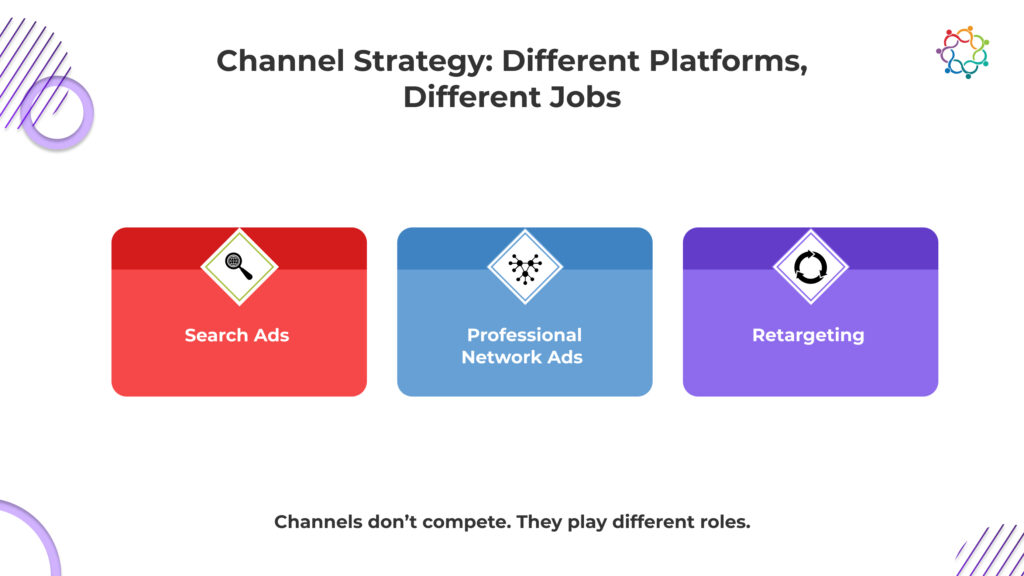
Running ads everywhere is not a strategy. Each channel exists for a reason, and confusing those roles leads to wasted spend and unclear results. Channel selection should follow intent, not habit.
Search platforms capture existing demand. When potential attendees actively look for solutions or events, ads meet them at the right moment. Scale is limited, but intent is high. This makes search valuable for focused, problem-driven events.
Professional networks offer contextual targeting. Role, industry, and account-level precision support complex B2B events. These platforms excel at shaping perception and filtering audiences, but costs rise quickly without message discipline.
Retargeting channels reinforce decisions already in motion. They remind, validate, and nudge. They should not carry the burden of initial discovery.
A balanced mix assigns each platform a clear job:
Clarity of role simplifies measurement and expectation setting.
(Also Read: How to Promote Your Event on a Limited Budget: High-Impact, Low-Cost Ideas)
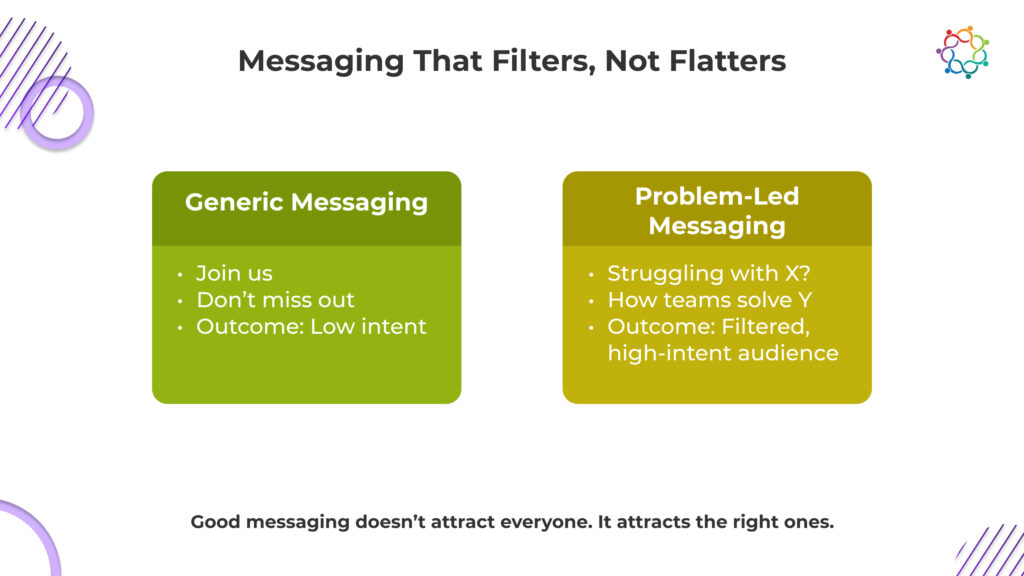
Most event ads fail because they try to please everyone. Generic invitations attract clicks, but they do not attract commitment. Messaging should function as a filter, not a compliment.
Problem-led messaging speaks to a specific challenge. It signals relevance and repels disinterest. Agenda-led messaging lists features, but often lacks urgency. In 2026, clarity outperforms enthusiasm.
Strong messaging sets expectations. It communicates who the event is for and what it will deliver. This may reduce registrations, but it improves attendance quality and engagement.
Filtering also protects post-event ROI. When attendees arrive aligned with the event’s purpose, follow-up conversations start at a higher level. Messaging choices upstream directly influence downstream outcomes.
One practical approach is to test exclusionary language. Phrases that clearly define role, maturity, or use case reduce noise. The goal is not maximum reach, but maximum alignment.

Measuring paid event performance is where many teams retreat to comfort metrics. Last-click attribution, cost per registration, and surface-level engagement feel objective, but they hide more than they reveal. Event advertising demands a more nuanced view of ROI.
Leading indicators matter before the event occurs. Registration source quality, role relevance, and pre-event engagement signal whether paid campaigns are attracting the right audience. These metrics guide optimization while there is still time to act.
Post-event measurement should focus on behavior, not just presence. Session participation, follow-up actions, and sales interactions provide directional insight into value creation. Pipeline influence is rarely perfect, but patterns emerge over time.
Teams must also accept limitations. Not every impact is attributable. Not every deal is traceable. The goal is not precision, but decision support. Tracking should inform future spend, not justify past choices.
Honest measurement builds credibility and improves learning cycles.
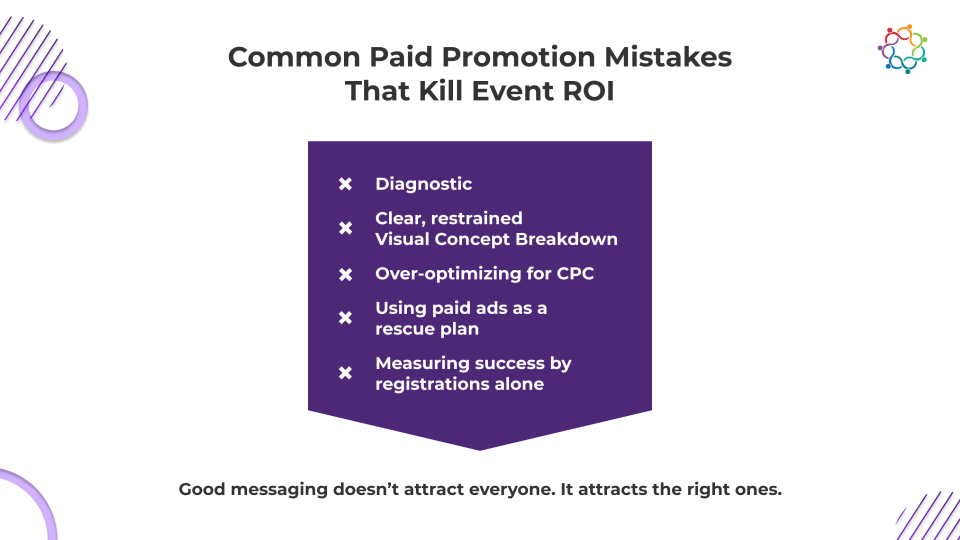
Certain mistakes appear repeatedly across organizations, regardless of budget size. Recognizing them early prevents costly repetition.
Over-optimizing for cost per click shifts focus away from quality. Scaling too late turns paid ads into a rescue plan instead of a growth lever. Treating registrations as the only success metric ignores the purpose of the event itself.
Another common error is separating paid teams from event strategy. When media execution operates without context, optimization favors easy wins over meaningful outcomes.
Avoiding these pitfalls requires discipline and alignment:
Mistakes are expensive for teachers. Learning from others is cheaper.
Paid promotion is often discussed in extremes. It is either positioned as the fastest way to fill an event or dismissed as an expensive disappointment. Both views miss the point. Paid ads are neither a silver bullet nor a necessary evil. They are a force multiplier. They amplify whatever strategic clarity or confusion already exists within an event program.
In 2026, event advertising consistently rewards teams that understand this dynamic. When targeting is intentional, budgets are set with discipline, and success is defined beyond raw registrations, paid promotion becomes a controllable growth lever. When those foundations are missing, ads simply accelerate waste. Spend increases, dashboards look busy, and post-event explanations become defensive.
The most important shift is recognizing that attendance itself is not the outcome. Attendance is an input. The real value of paid promotion shows up in who attends, how they engage, and what actions follow once the event concludes. Strong targeting protects quality. Thoughtful budgeting enforces prioritization. Honest measurement creates learning instead of justification.
Teams that treat paid ads as a last-minute fix rarely see sustained ROI. Those who treat them as an investment, planned early and evaluated rigorously, earn leverage and credibility over time. The difference is not how much is spent, but how strategically the spending is designed, governed, and judged.
(If you’re thinking about how these ideas translate into real-world events, you can explore how teams use Samaaro to plan and run data-driven events.)