Samaaro + Your CRM: Zero Integration Fee for Annual Sign-Ups Until 30 June, 2025
- 00Days
- 00Hrs
- 00Min

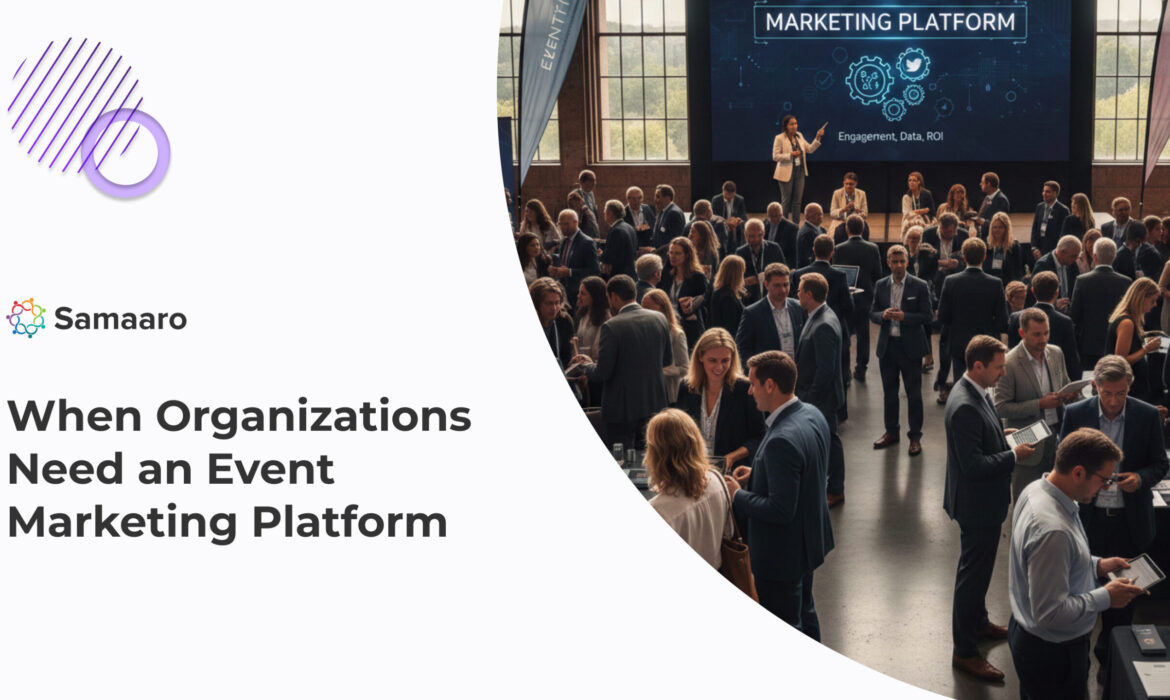
The majority of organizations do not begin their event journey by searching for an event marketing platform. Teams start with spreadsheets, simple registration systems, calendar invites, and basic CRM interfaces. Plans are made, people show up, and follow-ups are handled manually, but without friction at early scale.
At this stage, everything appears to be under control. There is no obvious need for a new system. Events run, teams stay busy, and leadership sees activity. From the outside, there is little reason to believe more structure is necessary.
The real question is not whether organizations can run events without an Event Marketing Platform. Most can, and many do so successfully for a long time. The more important question is how long that remains true as expectations, scale, and accountability evolve.
Event Marketing Platforms are not day-one tools. They emerge when scale and complexity quietly outgrow the systems that once felt sufficient.
There are clear scenarios where an Event Marketing Platform is not needed.
Organizations running a small number of events each year can often manage comfortably with basic tools. When there is a single event owner, limited stakeholder involvement, and minimal pressure to tie events to revenue outcomes, complexity remains low.
In early or brand-focused programs, events exist primarily to build awareness, foster community, or support thought leadership. Success is measured qualitatively, and expectations are aligned accordingly. Execution matters more than insight, and manual coordination is manageable.
Needing an Event Marketing Platform is not a badge of maturity. It is a response to changing demands. When those demands are absent, adding structure prematurely can create more friction than value.
The inflection point rarely arrives suddenly. It emerges as event programs expand. Growth introduces more events across more regions, formats, and audiences. Additional stakeholders like field teams, sales leaders, revenue operations, and executives, are also involved with different expectations.
At the same time, the role of events begins to shift. What once supported marketing now is marketing. Events move from being supplemental activities to becoming a core channel within the go-to-market strategy.
The critical moment occurs when events begin to influence the pipeline. Even if the tooling remains unchanged, expectations change immediately. Leadership starts by asking outcome-oriented questions. Sales looks for actionable insight. Marketing is asked not just to execute, but to explain.
This shift creates pressure that basic event marketing tools were never designed to absorb.
One of the earliest readiness signals appears when events stop standing alone.
Instead of one-off activations, organizations begin running roadshows, recurring series, regional programs, and global experiences. Events connect across time, audiences, and objectives. What happens at one event influences expectations for the next.
Managing each event individually begins to break down. Teams can still execute logistics, but insight becomes fragmented. Context from previous events is lost, and learning does not compound.
When events relate to each other, they require continuity of understanding, not just repeatable execution. This is often the first moment when organizations realize that treating events as isolated moments no longer reflects how they actually operate.
Signal #2: Leadership Asks Better Questions Than Tools Can Answer
As programs mature, leadership questions become more precise and more difficult to answer.
Which events actually drive momentum? What did we learn about buyer intent from these experiences? Why did one event outperform another, even though attendance looked similar?
Existing systems can produce activity metrics, but they struggle to explain outcomes without heavy interpretation. Answers require stitching together spreadsheets, anecdotal feedback, and manual analysis. Insights depend on who is asked, not on a shared source of truth.
This gap creates discomfort. Teams feel the pressure to justify decisions but lack the structure to do so confidently. The problem is that the questions being asked exceed what execution-focused systems were built to support.
Follow-up is where many event programs quietly lose momentum.
Sales teams receive attendance lists without context. They know who was present, but not why they attended, what engaged them, or how the interaction fits into an ongoing buyer journey. Outreach becomes generic, based on assumptions rather than insight.
Marketing teams struggle to guide next best actions. Without preserved engagement context, follow-up strategies default to broad campaigns instead of informed, personalized motion.
When context is lost, events stop compounding value. Each one resets the relationship rather than building on it. Over time, this inconsistency erodes confidence in events as a reliable growth lever.
This signal is often felt first by sales and revenue teams, even if marketing feels it later.
At scale, reporting becomes unavoidable. Teams begin tracking registrations, attendance, and high-level “influenced pipeline” metrics. These numbers are necessary, but they are not sufficient.
When ROI discussions arise, teams find themselves defending events rather than explaining them. They can show correlation but not contribution. They know events matter but struggle to articulate the impact of events beyond surface metrics.
This creates tension. Leadership wants understanding, not just numbers. Marketing wants recognition but lacks a clear narrative grounded in insight.
The need for an Event Marketing Platform at this stage is not about proving ROI. It is about understanding it and being able to explain what events are actually doing and how they shape buyer behavior over time.
When these signals converge, organizations are no longer just executing events; they are interpreting them.
At this stage, an Event Marketing Platform enables teams to capture intent across the full event lifecycle, from pre-event engagement through post-event behavior. It preserves context that would otherwise be lost and allows learning to accumulate across programs.
Instead of asking whether an event “worked,” teams can understand how it worked, for whom, and why. Insights inform future design, follow-up strategy, and resource allocation.
The platform does not replace execution tools. It complements them by addressing a different need: interpretation. It emerges when understanding becomes as important as delivery.
As organizations scale, CRM systems become more important. They remain the system of record for accounts, opportunities, and revenue outcomes.
The challenge is that CRM systems are not designed to generate event-specific insight on their own. They require structured, contextual signals to be meaningful.
Event Marketing Platforms provide that pre-pipeline intelligence. They translate event behavior into structured insight that CRM systems can use, enriching existing workflows rather than competing with them.
The growing need for a platform reflects the increasing centrality of CRM, not a limitation of it. As revenue systems become more critical, the need for event intelligence that can feed them grows alongside.
The decision point for organizations is rarely framed correctly.
The question is not, “Should we buy an Event Marketing Platform?” That framing assumes a product decision. The more important question is diagnostic.
Do we have a system that can explain how our events shape buyer intent over time?
(Also read: What Is an Event Marketing Platform?)
When the answer becomes unclear or requires excessive manual effort, organizations are often already at the stage where an Event Marketing Platform is needed. Not as a replacement for existing tools, but as the connective layer that allows events to scale with insight, consistency, and confidence.
As organizations grow, events are no longer just about execution or attendance. They are expected to influence demand, pipeline, and buyer decisions. This shift changes what events are responsible for delivering, not just how often they are run. Event Marketing Platforms emerge when teams need a clearer way to understand and manage this change.