Samaaro + Your CRM: Zero Integration Fee for Annual Sign-Ups Until 30 June, 2025
- 00Days
- 00Hrs
- 00Min

As events have become more central to modern marketing strategies, the language around them has become increasingly vague. Most teams assume that any tool used in the context of events qualifies as an “event platform.” Registration systems, event apps, CRMs, and even spreadsheets often get grouped under the same label.
This grouping made sense when events were prima
| Event Marketing Platform |
rily operational exercises. If the goal was to get people registered and checked in, any tool that supported that workflow felt sufficient. Over time, however, events moved closer to revenue conversations. They began to appear in pipeline reviews, account plans, and leadership discussions.
The label expanded, but clarity did not.
Using tools around events is not the same as having an Event Marketing Platform. The difference lies not in how many tools exist, but in whether there is a system designed to understand and compound the value events create.
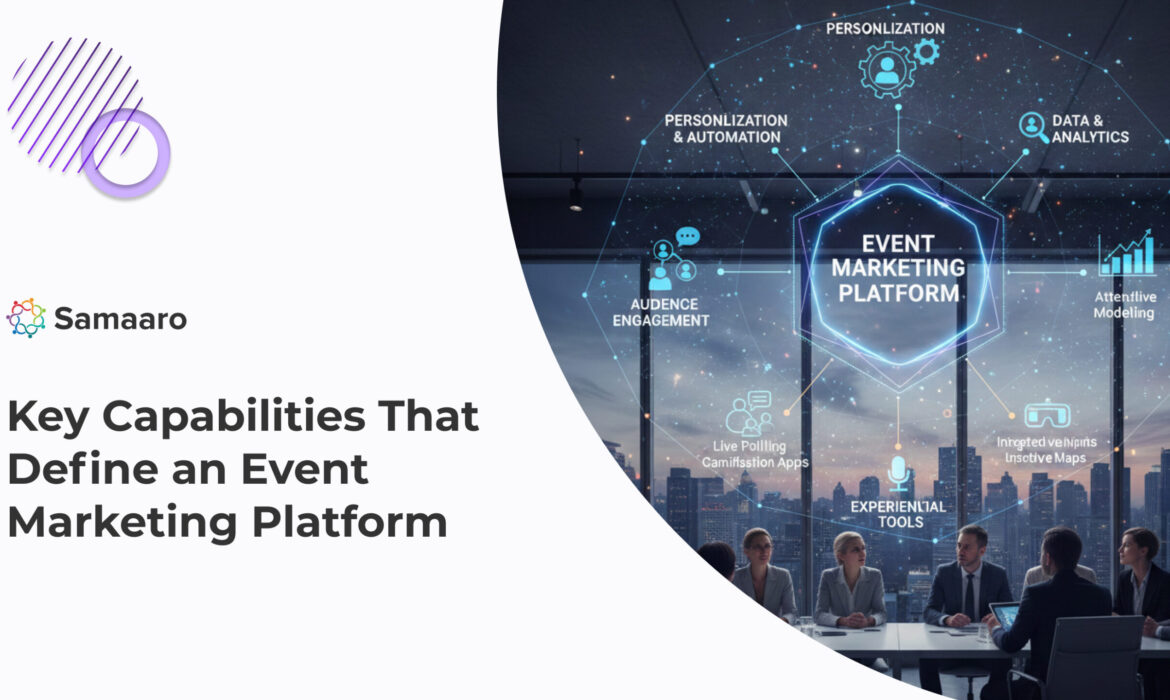
An Event Marketing Platform is designed to orchestrate events as a marketing channel, capture buyer intent generated through those events, and translate engagement into usable marketing and revenue intelligence.
(Also read: What Is an Event Marketing Platform?)
Its core job is not execution, but turning event interaction into usable marketing and revenue insight. Where logistics-focused systems ensure events happen, an Event Marketing Platform ensures events are understood. It treats events as intentional moments within a broader go-to-market strategy, not as isolated activities to be completed and forgotten.
At its foundation, this category exists to answer questions that execution tools cannot: why people engage, what that engagement signals, and how those signals should influence marketing and revenue decisions.
An Event Marketing Platform is designed around intent creation and interpretation. Logistics may still exist elsewhere, but the platform’s purpose is to make event-driven behavior legible, actionable, and comparable over time.
Most event tools are built to solve narrow, well-defined problems. One tool handles registration. Another support check-in. Another enables attendance. Each is optimized to execute a specific task within a single event.
These tools are effective at what they are designed to do. They help teams run events smoothly and consistently. But they are not designed to preserve context across events or across the buyer journey.
Event Marketing Platforms are built with a different scope in mind. They are designed to connect multiple events over time, understand how those events interact with one another, and support marketing strategy rather than just event execution.
The difference is structural. Tools help events happen. Platforms help events compound.
An Event Marketing Platform assumes that the value of an event is not contained within the event itself, but emerges over time as engagement signals are interpreted, acted upon, and compared across programs.
Events do not begin on the day they occur. They begin the moment someone chooses to engage.
One of the defining capabilities of an Event Marketing Platform is its ability to capture intent before the event takes place. This starts with understanding who the event is for and why different audiences choose to participate.
Pre-event intent capture goes beyond basic registration confirmation. It considers audience segmentation tied to marketing strategy, contextual signals around interest, and behavioral indicators that reveal motivation before attendance.
Someone attending to evaluate a solution carries a different signal than someone attending to learn about an industry trend. Treating both registrations as equal obscures valuable insight.
An Event Marketing Platform is built to preserve this context. It recognizes that understanding why someone shows up is often more important than knowing that they did. This capability ensures that events are anchored in intent from the very beginning.
Attendance is binary. Engagement is not.
Events generate rich, moment-based signals through questions, interactions, sessions attended, and shared experiences. These signals are inherently contextual and often collective, shaped by group dynamics and live interaction.
An Event Marketing Platform must be able to capture both qualitative and quantitative engagement in a way that preserves meaning. This includes session-level context, interaction depth, and behavioral patterns that unfold during the event itself.
Traditional systems often lose this data because they are not designed to handle temporal, experience-driven interactions. They flatten engagement into static records, stripping away nuance and relevance.
Engagement intelligence is a defining capability because it allows teams to distinguish between passive presence and meaningful participation. Without it, events appear successful on the surface but remain opaque in terms of actual buyer interest.
For many teams, events end when attendees leave. For Event Marketing Platforms, that is where their value begins to compound.
Events generate insights that should inform follow-up strategy, shape sales conversations, and influence how future events are designed. Capturing this learning requires structure and continuity.
An Event Marketing Platform enables post-event analysis that goes beyond recap metrics. It supports learning loops across events, allowing teams to identify what resonated, what drove engagement, and what patterns repeat over time.
This capability ensures that signals do not disappear once the event concludes. Instead, they are carried forward, connected to future interactions, and used to refine strategy.
The core idea is continuity. Events are not isolated moments; they are inputs into an ongoing system of learning and improvement.
Event ROI is often reduced to attribution metrics, such as “event-influenced pipeline.” While useful, these metrics are limited. They describe correlation without explaining contribution.
Event Marketing Platforms approach pipeline connection differently. Rather than asking whether an event touched a deal, they focus on how engagement reflects buyer intent and how that intent evolves as opportunities progress.
This capability preserves event context as deals move through pipeline stages. It allows marketing and revenue teams to tell coherent narratives about how events support momentum, accelerate conversations, or reinforce decisions.
The goal is not to produce more reports, but to support revenue understanding. Event-to-pipeline intelligence enables teams to explain impact in ways that align with how deals actually move forward.
Most marketing teams run portfolios of events across regions, formats, and audiences, not isolated one-offs.
A defining capability of an Event Marketing Platform is the ability to provide visibility across this portfolio. This includes comparing events meaningfully, identifying patterns, and understanding which types of experiences consistently create momentum. Without this capability, teams evaluate events in isolation. Success becomes subjective, driven by anecdotal feedback rather than comparative insight.
Event marketing maturity is measured across portfolios, not calendars. Platforms enable teams to move from one-off assessments to strategic understanding, revealing how different events contribute collectively to marketing and revenue goals.
CRM systems remain the system of record for revenue. They house accounts, opportunities, and forecasts. Event Marketing Platforms do not replace this role.
Instead, they act as the system of intent, engagement context, and event intelligence.
An Event Marketing Platform enriches CRM by translating event behavior into structured signals that revenue systems can understand. It provides context that CRM systems are not designed to capture on their own.
This balance is critical. The platform does not attempt to own revenue data or override sales judgment. Its role is to make event-driven insight legible and useful within existing go-to-market systems.
In this way, Event Marketing Platforms complement CRM rather than competing with it.
The defining question for modern teams is no longer, “Do we have event tools?”
It is: “Do we have a system designed to understand what our events are actually doing?”
Event Marketing Platforms exist because events now carry expectations that go beyond execution. As marketing teams are held accountable for impact, they need systems capable of capturing intent, interpreting engagement, and connecting experiences to outcomes.
The distinction is not about tools versus platforms. It is about whether events are merely run or truly understood.