Samaaro + Your CRM: Zero Integration Fee for Annual Sign-Ups Until 30 June, 2025
- 00Days
- 00Hrs
- 00Min

Events are uniquely powerful moments in the marketing mix. They bring people together, spark conversations, and create momentum that is difficult to replicate through other channels. Sales conversations begin. Relationships deepen. Interest feels tangible in a way that dashboards rarely capture. Yet once the event ends, that energy often dissipates into uncertainty.
Marketing teams are left asking what was actually captured, what actions followed, and which interactions truly mattered. Conversations happened, but where did they go? Engagement felt high, but how was it recorded? Momentum was real, but did it translate into anything measurable?
CRM systems promise visibility and structure, yet events rarely plug into them cleanly. Attendance lists are uploaded, notes are scattered, and follow-ups happen unevenly. Over time, the same frustration emerges: plenty of data exists, but clarity does not.
The problem is not that events fail to generate information. It’s that the information they generate lacks structure and meaning once it enters revenue systems. Without interpretation, the impact of events remains anecdotal rather than operational.
This gap exists because events generate human interaction, while CRM systems are designed to process structured revenue signals.
CRM systems are built around durable business objects. Accounts represent companies. Contacts represent people. Opportunities represent potential revenue. Everything in a CRM is designed to support tracking, progression, and forecasting over time.
Events do not naturally fit into this structure. By nature, events are moments. They are experiences that happen at specific points in time, defined by human interaction rather than transactional steps. A conversation at a roundtable, a question asked during a session, or a follow-up discussion after a keynote does not automatically map to an opportunity stage or a pipeline metric.
Without intentional design, events remain peripheral to CRM systems. They exist as activities or notes rather than as meaningful contributors to pipeline understanding. Manual syncs and post-event uploads attempt to bridge this gap, but they rarely solve the underlying issue.
The core challenge is not technical connectivity. It is conceptual. Events do not naturally map to pipeline logic; they must be interpreted before they can become meaningful within revenue systems.
Event management tools were created to solve a different problem. Their primary purpose is to support the planning and execution of events. They help teams manage registrations, coordinate attendees, and ensure events run smoothly. In logistics-heavy environments, they bring order and consistency to complex operational workflows.
Within that context, these tools perform well. They capture who registered, who attended, and whether the event took place as planned. Their focus is on execution reliability rather than downstream business interpretation.
Connecting events to CRM and pipeline outcomes is not their primary job. They were not designed to translate human interaction into revenue signals or to contextualize engagement within buyer journeys.
This limitation is not a flaw. It reflects the environment in which these tools were built, one where running the event successfully was the main objective, and where revenue attribution was handled elsewhere.
The disconnect becomes most visible after the event, when data begins to flow into CRM systems.
Attendance alone does not signal intent. Two people may attend the same event for entirely different reasons. One may be actively evaluating a solution, while the other is casually exploring an industry topic. Treating both interactions as equal creates noise rather than insight.
Engagement quality also varies dramatically. A brief appearance does not carry the same weight as sustained participation, meaningful questions, or post-event conversations. Yet raw data often captures these moments at the same level.
Sales teams do not need longer lists; they need context. They need to understand why an interaction matters, what it suggests about buyer intent, and how it should influence next steps.
When CRM fields fill up without improving understanding, frustration grows. Data volume increases, but decision-making does not improve. This is where many teams realize that simply connecting events to CRM is not enough.
The gap between events and pipeline exists because CRM systems and events operate on fundamentally different logics.
CRM systems require structured signals. They rely on consistent definitions, repeatable logic, and contextual meaning to support forecasting and reporting. Every field exists to answer a specific business question.
Events, by contrast, produce unstructured interactions. They generate behavioral signals that are rich but messy, valuable but ambiguous. These signals are temporal, contextual, and deeply human.
Bridging these two worlds requires more than integration. It requires interpretation.
The challenge is not syncing attendance data into a CRM. The challenge is translating what happened at an event into signals that revenue systems can understand and act on. Without this translation layer, events remain visible but not meaningful.
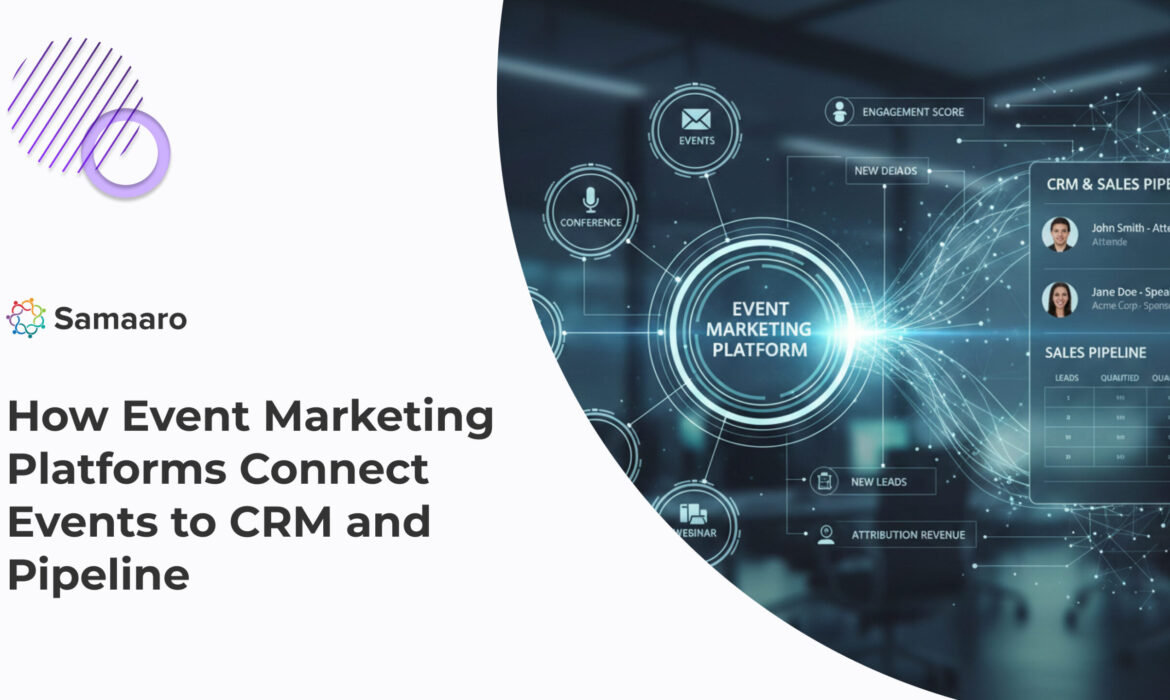
An event marketing platform is software that enables marketing teams to plan, promote, run, and measure events as a repeatable growth channel. It combines registrations, communication, engagement, lead capture, CRM integration, and analytics to connect events directly to pipeline and ROI.
(Read more: What Is an Event Marketing Platform?)
This category has emerged as marketing teams adopt CRM-centric go-to-market motions and face increasing accountability for pipeline and revenue impact. In this environment, events cannot be treated as isolated moments. They must be understood as contributors within a larger, multi-touch system.
Rather than treating CRM and pipeline as storage destinations for attendance data, an event marketing platform treats them as decision systems. It focuses on interpreting event behavior, structuring engagement in ways sales teams can act on, and enabling teams to learn from events over time instead of resetting insight after each execution.
The defining difference lies in how these platforms approach CRM connection, not as a technical task, but as a strategic one.
The CRM connection, in this model, becomes a way to make events legible to the systems that govern growth.
For some teams, the disconnect between events and the pipeline is an inconvenience. For others, it becomes a strategic risk.
When events are tied directly to opportunity creation or acceleration, unclear attribution creates blind spots. Account-based and sales-led go-to-market motions depend on understanding how multiple interactions influence the same accounts over time.
As event frequency increases, the cost of disconnected data compounds. Multiple events may influence the same deal, yet without interpretation, their collective impact remains invisible.
Leadership questions shift from whether events happened to how they influenced pipeline movement. At this stage, anecdotal answers are no longer sufficient.
At scale, disconnected events do not just reduce clarity; they undermine confidence in event investment.
Connecting events to CRM and pipeline does not mean turning events into lead-generation machines. It is not about flooding CRM systems with low-quality data or reducing complex interactions to simplistic scores. It does not replace CRM ownership, sales judgment, or human decision-making.
Event Marketing Platforms are not designed to automate revenue outcomes. They exist to support better decisions by providing structured insight where there was previously ambiguity.
Their role is to help teams understand what matters, not to dictate what to do.
Events only create pipeline impact when revenue systems can understand them.
Without structure and interpretation, even the most engaging events remain disconnected from the systems that guide growth decisions. Event Marketing Platforms exist to make that connection meaningful to translate moments into measurable contributions.
This evolution reflects a broader shift in modern marketing: from activity to impact, from isolated experiences to connected, accountable growth channels.
As expectations rise, events must do more than generate energy. They must generate clarity.