Samaaro + Your CRM: Zero Integration Fee for Annual Sign-Ups Until 30 June, 2025
- 00Days
- 00Hrs
- 00Min

Bottom Line: Track every lead, dollar, and deal in one place, and trade shows turn from a cost into a revenue channel.
The Client is a global leader in travel and hospitality technology, providing AI-powered SaaS solutions to hotels, airlines, and online travel agencies. The organization participates in a high volume of global events, with a primary focus on large-scale third-party trade shows.
Events are a fundamental revenue lever for the client, moving beyond brand awareness to serve as a critical engine for generating qualified leads and influencing pipeline conversion. With a complex global marketing operation, the company is focused on operationalizing events as repeatable, automated channels that can prove their direct impact on the bottom line.
Event Management Software, Event Marketing Automation, Event Marketing and Promotion, Lead Assignment Hub and Queue Manager, Event Budget Planner, Task Planner and Team Collaboration, Feedback and Surveys
In B2B SaaS, enterprise trade shows often account for 25–40% of the annual field marketing budget, yet a significant portion of the pipeline they influence remains poorly tracked or under-reported.
Thousands of leads are captured on the event floor, but fragmented systems, manual data handling, and delayed follow-ups make it difficult to connect spend with pipeline creation and revenue outcomes. As leadership scrutiny on event ROI increases, marketing teams are under pressure to prove not just activity, but measurable business impact from their largest event investments.
This challenge becomes more pronounced at scale, where even small inefficiencies multiply across thousands of interactions.
In high-volume pharmaceutical organisations, manual event operations can consume over 20,000 working hours annually, with most of that time spent on coordination, follow-ups, reconciliation, and reporting, activities that add no direct strategic value. When multiplied across hundreds of events, even small inefficiencies quietly compound into million dollar-level operational costs.
The client’s challenge was not participation or scale. Their flagship trade shows consistently delivered high engagement and a large volume of leads. The difficulty lay in operationalizing that scale into measurable, repeatable revenue outcomes.
As the size and importance of these events grew, several structural challenges emerged:
Fragmented systems across the event lifecycle
Pre-event planning, on-ground lead capture, post-event communication, and CRM updates were handled across multiple platforms. While each tool served a purpose, the lack of a unifying event layer led to manual data transfers, repeated clean-ups, and heavy dependence on spreadsheets to stitch information together.
Manual effort dominating post-event workflows
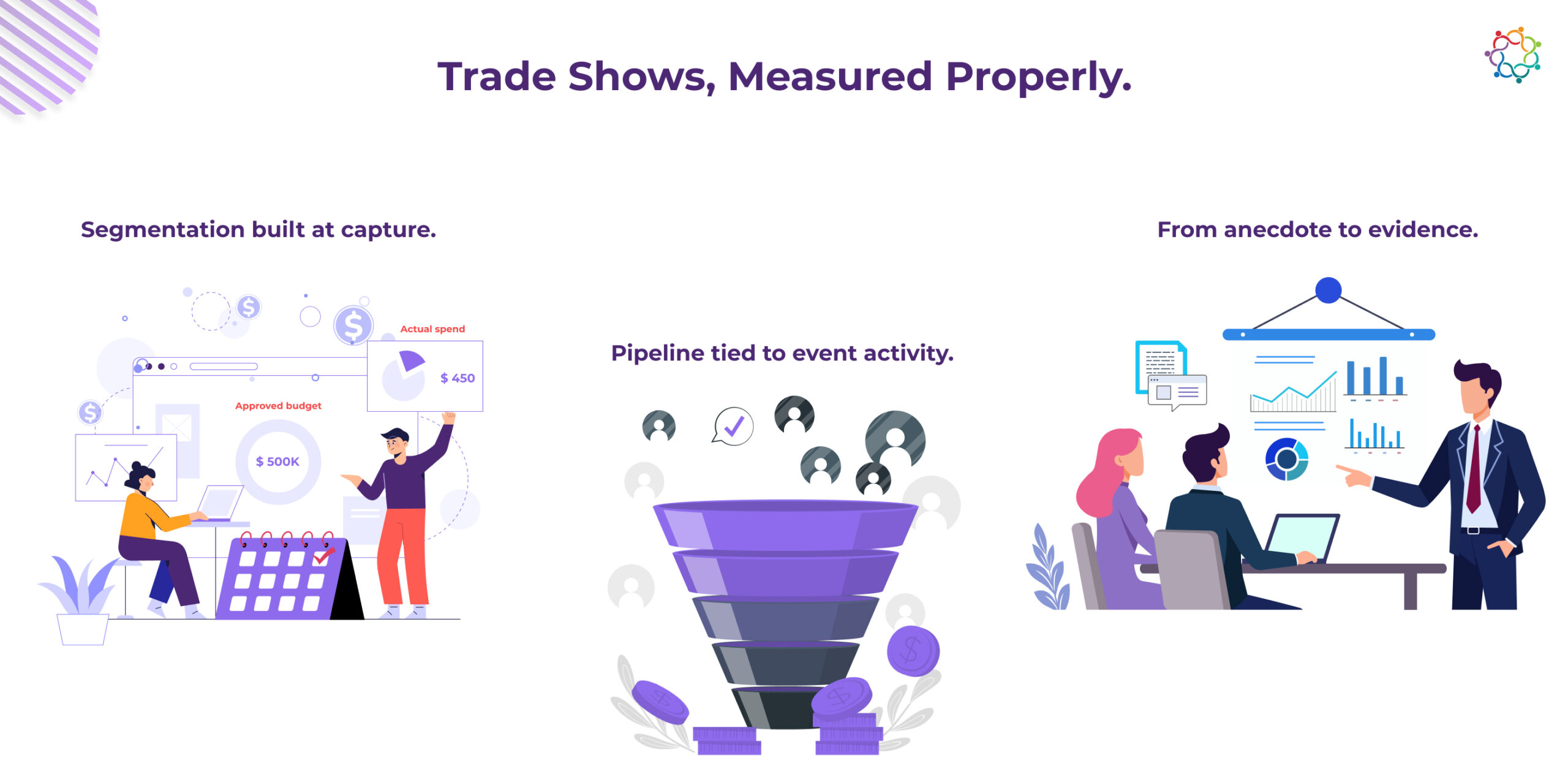
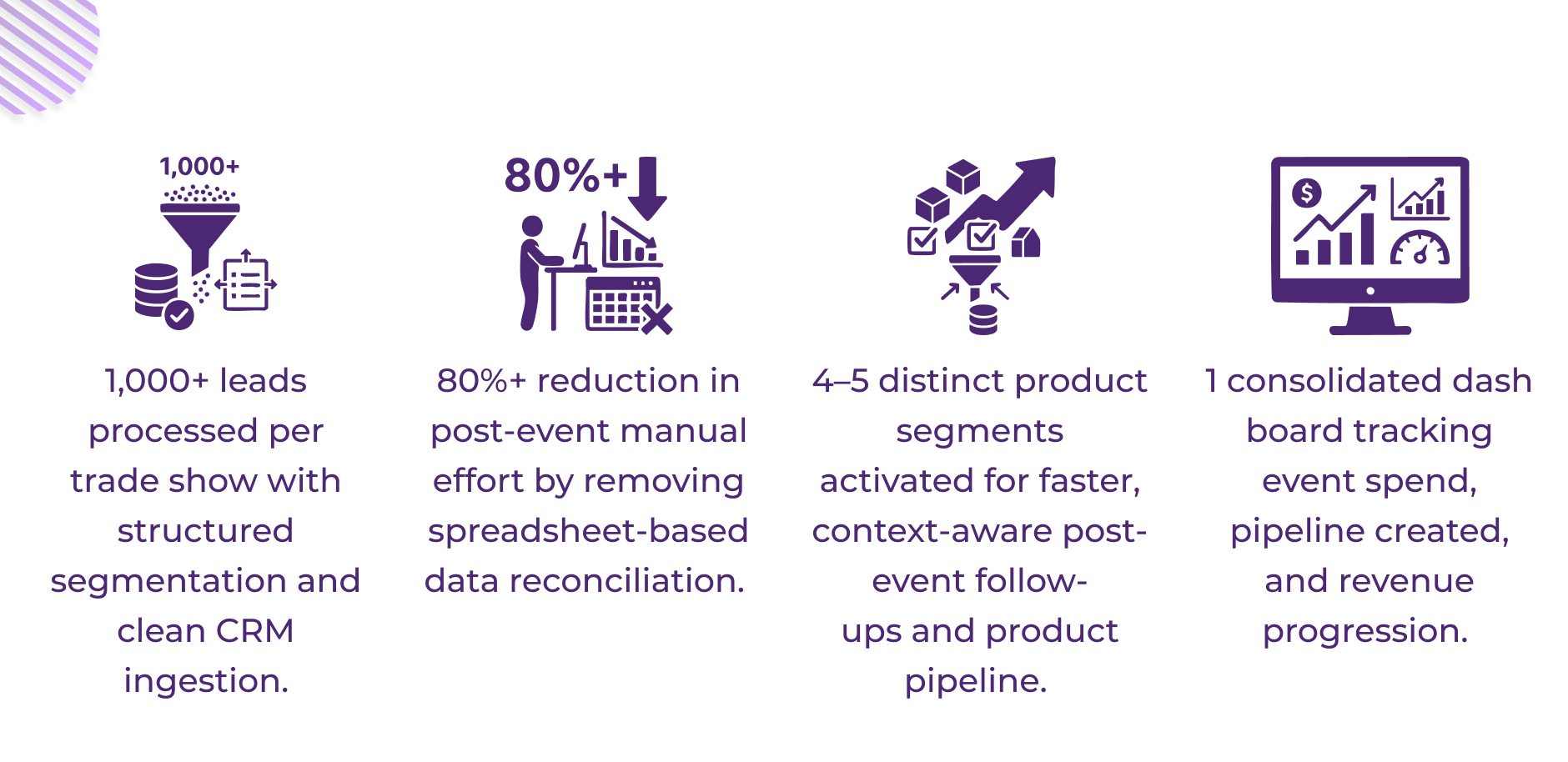
After each large trade show, hundreds of leads were exported, cleaned, normalized, and re-uploaded into Salesforce. Segmenting leads by product interest and triggering relevant follow-up campaigns required significant manual effort, delaying outreach at the moment of highest buyer intent.
Sales enablement gaps before and during events
Sales teams relied on ad hoc emails and shared documents to access event briefs, creatives, and product collateral. With no centralized, read-only repository, marketing teams became a bottleneck for basic information requests, increasing dependency on individuals rather than systems.
Limited leadership visibility into ROI
While data on budgets, pipeline, and revenue existed, it was scattered across tools and reports. Leadership lacked a single, consolidated view to assess how event spend translated into pipeline creation, product-level interest, and revenue realization over time.
Samaaro was implemented as an event intelligence and automation layer that sat on top of the client’s existing CRM and marketing stack, without disrupting on-ground execution at large third-party trade shows.
Centralized sales enablement and asset access
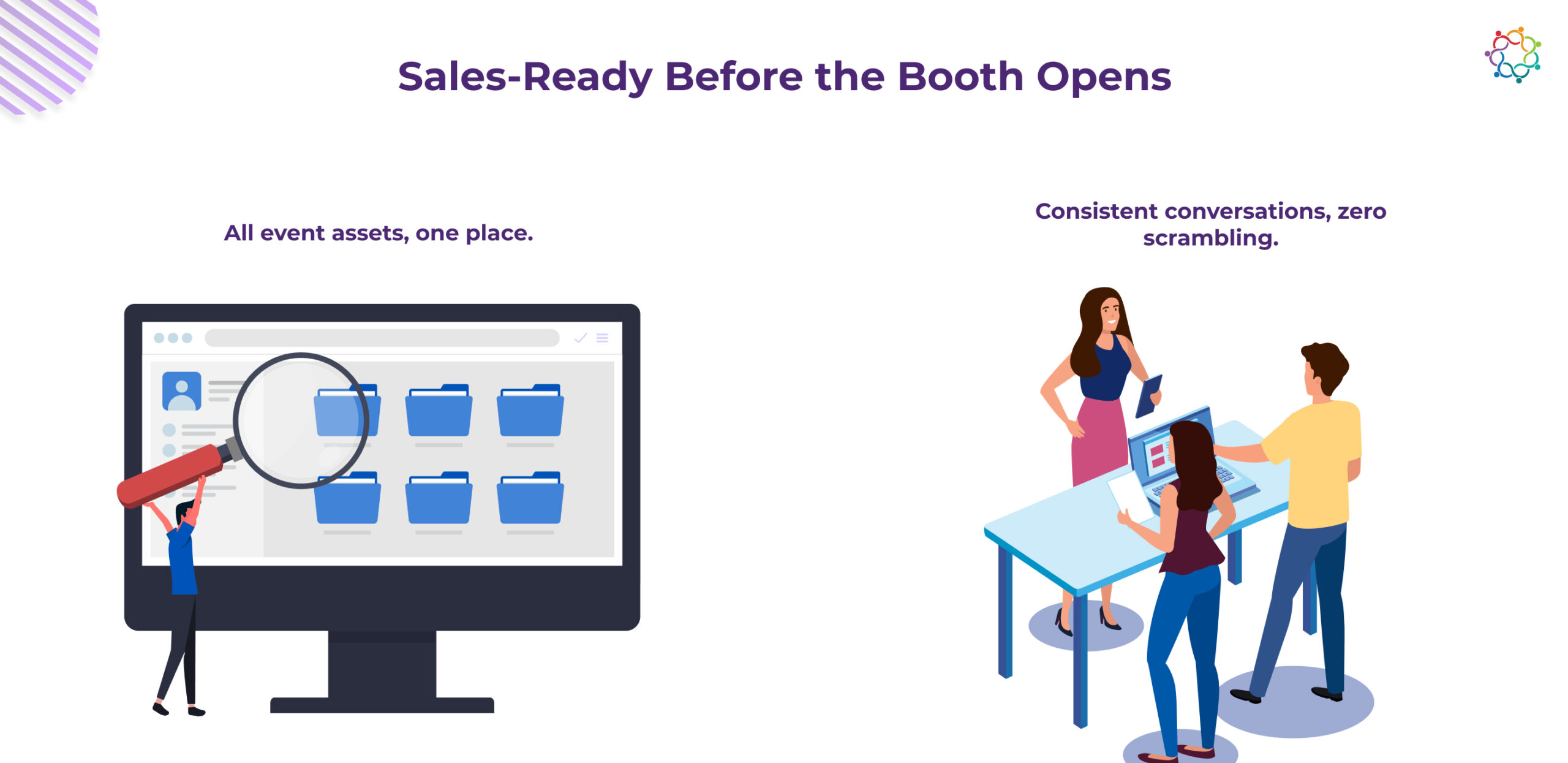
A read-only, centralized repository was created within Samaaro to host event briefs, sales decks, and product collateral. Sales teams could access the latest assets well before the event and during execution without repeated requests to marketing. This reduced last-minute coordination and ensured consistency in on-ground conversations.
Centralized event intelligence without replacing existing systems
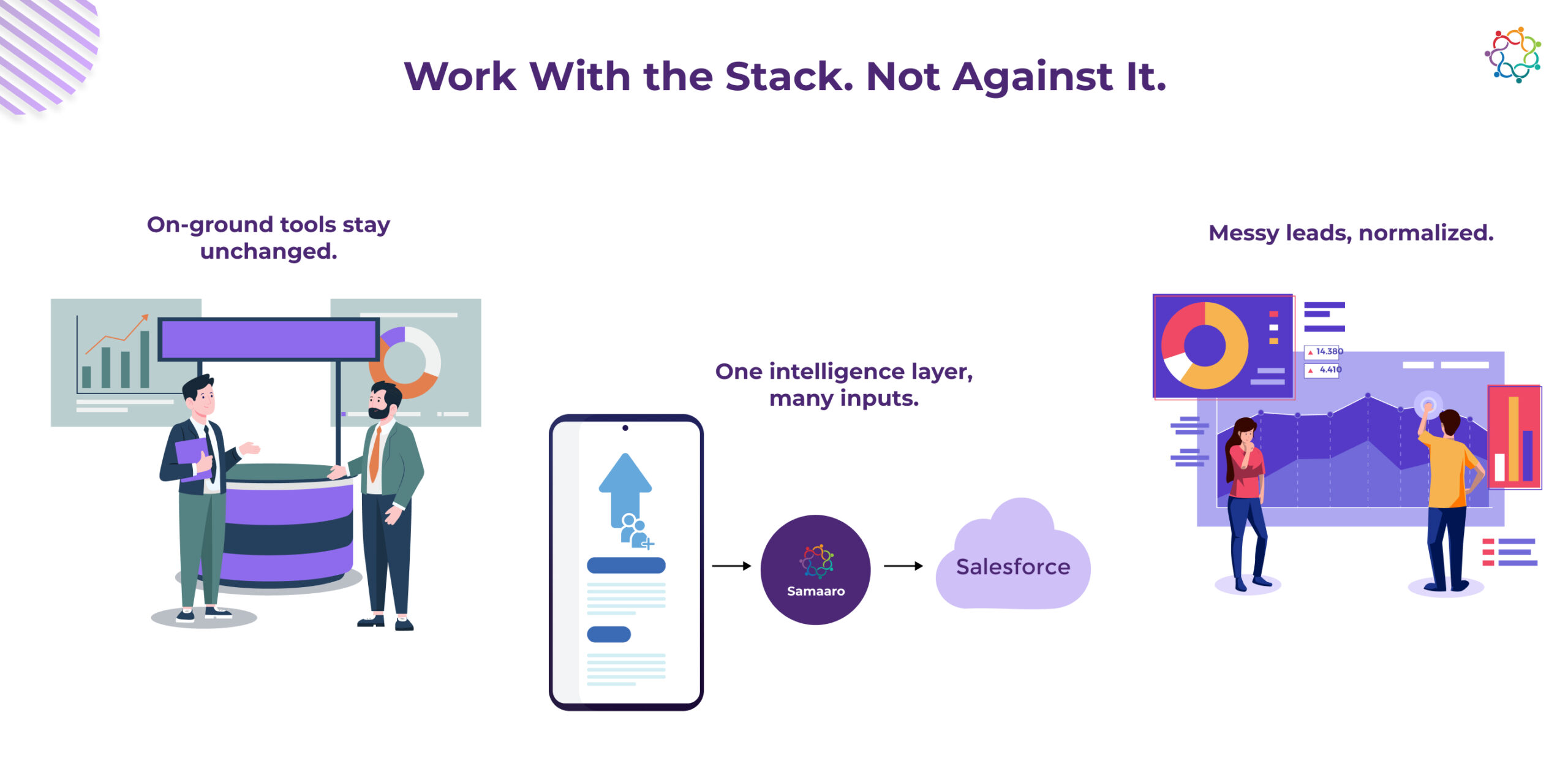
Samaaro was positioned to work alongside the trade show’s native lead capture app and Salesforce, not replace them. Post-event lead data was consolidated into a single structured layer, allowing marketing teams to normalize inputs, map product interest accurately, and prepare clean datasets for CRM updates. This reduced manual reconciliation effort and created a consistent foundation for downstream reporting and campaigns.
Automated post-event segmentation and follow-ups
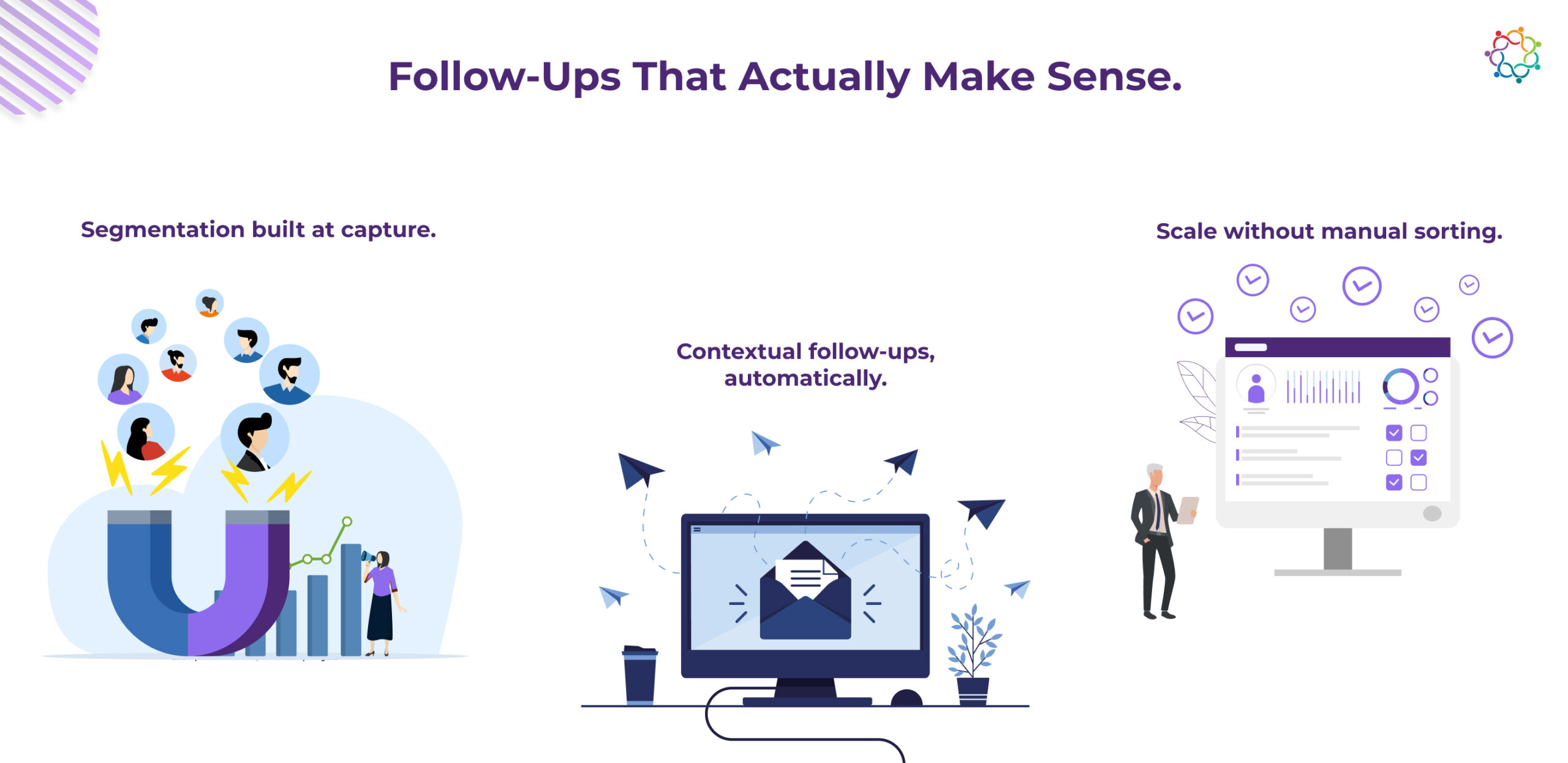
Samaaro enabled structured segmentation of leads based on product interest and engagement context captured during the event. This made it possible to trigger relevant post-event communications without relying on manual sorting or spreadsheet-driven workflows. As a result, follow-ups became faster, more contextual, and easier to scale across large lead volumes.

30–40% faster sales follow-ups enabled by real-time check-ins and automatic CRM updates.

100% persona-qualified attendance across invite-only mixers, roundtables, and leadership events.
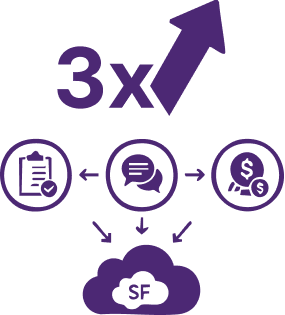
3× improvement in event data readinesswith unified registration, engagement, and sales inputs in Salesforce.
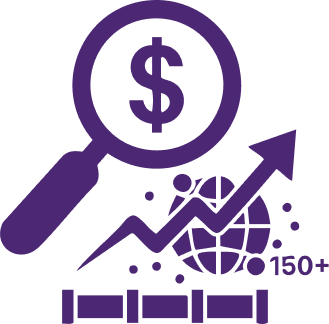
Full visibility into event spend and pipeline influence across 150+ global events.
After a flagship trade show generating over a thousand leads, the marketing team prepared post-event follow-ups within days instead of weeks. Leads were already segmented by product interest, synced into Salesforce, and aligned with approved budgets and pipeline views.
Instead of assembling reports across multiple tools, leadership reviewed event performance through a single dashboard while sales teams moved directly into relevant, product-led conversations. The event closed with clarity, not cleanup.
For B2B SaaS companies, the biggest risk with large trade shows is not poor execution. It is poor accountability.
When thousands of leads pass through disconnected systems, events quietly turn into cost centers, regardless of how busy the booth looks. High-performing teams treat trade shows as financial instruments, not marketing rituals. They build systems that connect spend, lead intent, pipeline creation, and revenue progression into one continuous view.
As budget scrutiny increases, the winners will not be the teams that attend more events, but the ones that can prove, week by week, how each event moved the business forward.

Samaaro is an AI-powered event marketing platform that enables marketing teams to turn events into a measurable growth channel by planning, promoting, executing, and measuring their business impact.
Location
© 2026 — Samaaro. All Rights Reserved.