Samaaro + Your CRM: Zero Integration Fee for Annual Sign-Ups Until 30 June, 2025
- 00Days
- 00Hrs
- 00Min

1
2
3
→
Bottom Line:
Event analytics must go beyond measuring engagement and focus on tracking post-event account behavior, because deals move after it.
Invite-only executive environments are engineered to feel valuable. The right accounts are invited. The right people show up. Conversations are thoughtful, informed, and often energizing. By every visible signal, the event works exactly as intended.
Senior stakeholders engage deeply. Industry perspectives are exchanged. Relationships appear to strengthen in real time. Inside the room, it feels like momentum is building toward something meaningful.
This is precisely why invite-only events are so heavily relied upon for enterprise deal acceleration. They create access that is otherwise difficult to achieve. They compress interaction into a high-quality setting. They give sales and marketing teams the illusion of progress.
But the illusion becomes visible only after the event ends.
When pipeline reviews happen weeks later, those same accounts often show no measurable movement. Deals remain in the same stage. Timelines do not shift. No new urgency appears. The conversations that felt decisive in the moment leave no structural impact on the deal.
This is the tension most teams fail to confront.
A productive room creates the feeling of progress. A pipeline reflects actual progress. Those are not the same outcome.
This blog breaks down why that gap exists, where momentum actually disappears, and why strong executive engagement inside an event rarely translates into deal movement after it ends.
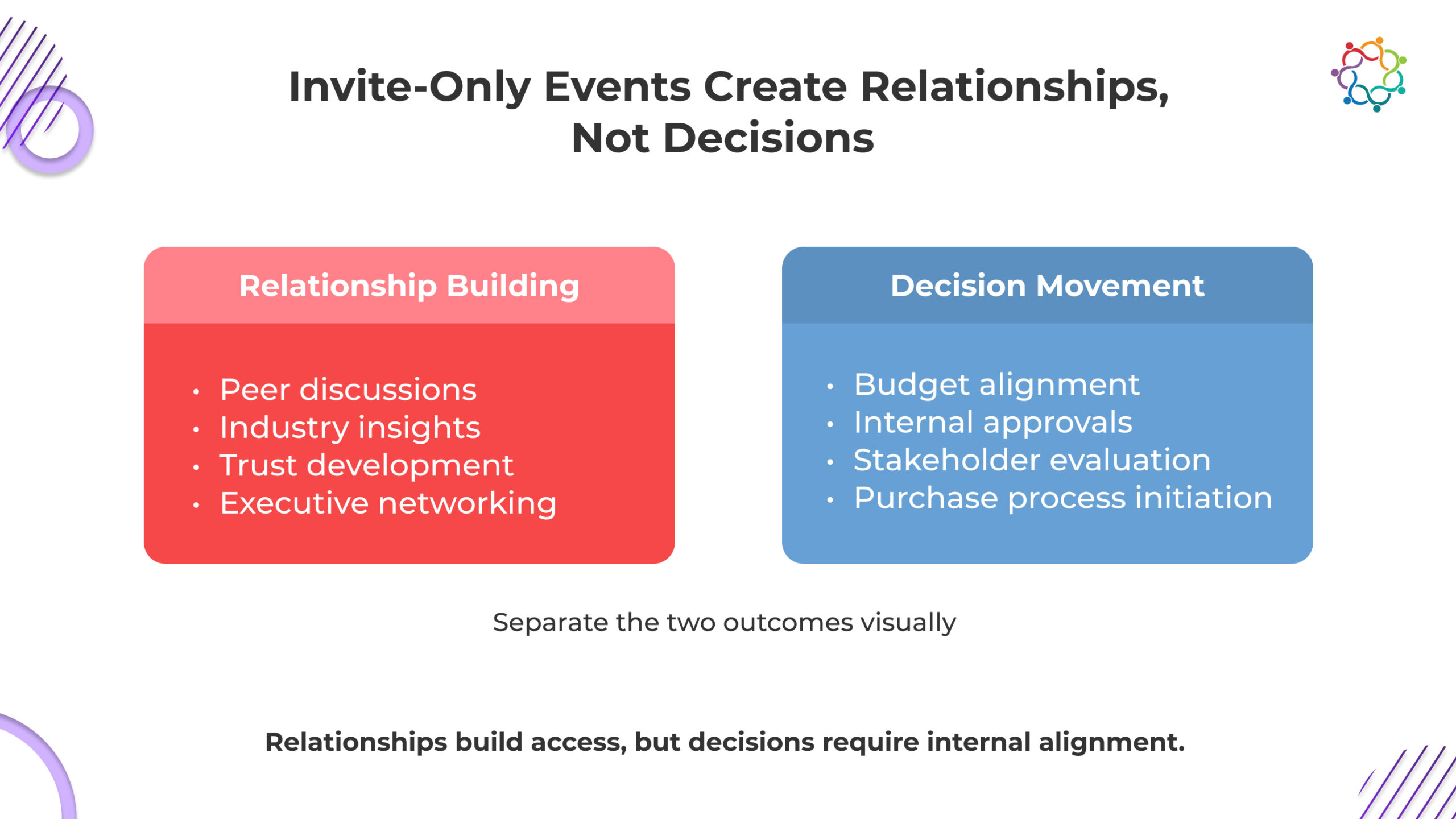
There is an assumption embedded in most executive events that needs to be confronted directly. The assumption is that proximity to senior buyers accelerates decisions.
The reality is far less convenient.
Executives do not attend these environments to make buying decisions. They attend to learn, to exchange ideas, and to build relationships that may or may not translate into commercial action later.
Invite-only events are intentionally designed to remove pressure. They create safe, non-transactional environments where senior leaders can speak openly without being forced into immediate commitments. That design is not a flaw. It is the reason these events work for engagement.
But it is also the reason they fail in deal movement.
This means that even when your solution is discussed, it is rarely evaluated in a way that moves a deal forward.
Trust may increase. Familiarity may improve. But enterprise decisions do not move on trust alone. They move when organizations initiate structured internal processes such as evaluation, budgeting, and alignment.
If those processes do not begin after the event, the deal does not move.
The uncomfortable truth is simple.
Closed-door executive environments are optimized for relationships. Deals move only when those relationships trigger internal action. Most of the time, they do not.
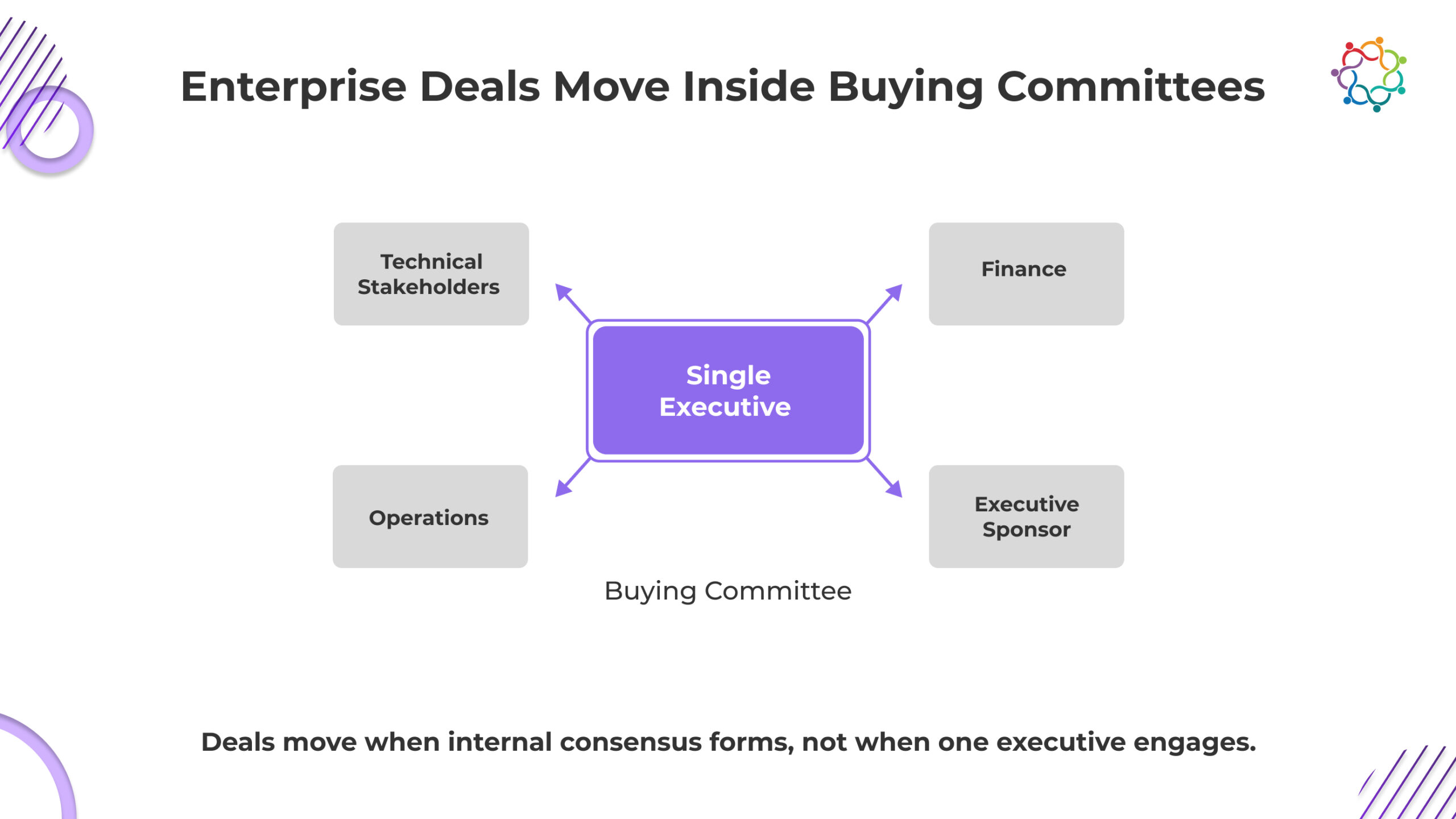
Even when the right executive is in the room, the deal is not.
This is where most expectations collapse.
Enterprise buying decisions are not controlled by individuals. They are governed by buying committees that include technical stakeholders, financial decision-makers, operational leaders, and executive sponsors. Each of these roles carries influence, and none of them can be bypassed.
This creates a structural limitation that invite-only events cannot solve.
The person attending your event may be a senior. They may be influential. They may even be supportive of your solution. But they are rarely empowered to move the deal forward alone.
This introduces friction the moment the event ends.
The attendee must take what they experienced and translate it internally. That means:
Most of the time, this translation never fully happens.
Not because the attendee is uninterested. But because internal alignment is difficult, political, and time-consuming. Competing priorities interfere. Other initiatives take precedence. The momentum from the event loses clarity as it moves into a more complex environment.
This is the point where deals stall without appearing broken.
The event may have influenced perception. But perception alone does not move the deal.
Deals move when internal consensus forms. And that process happens entirely outside the event environment.
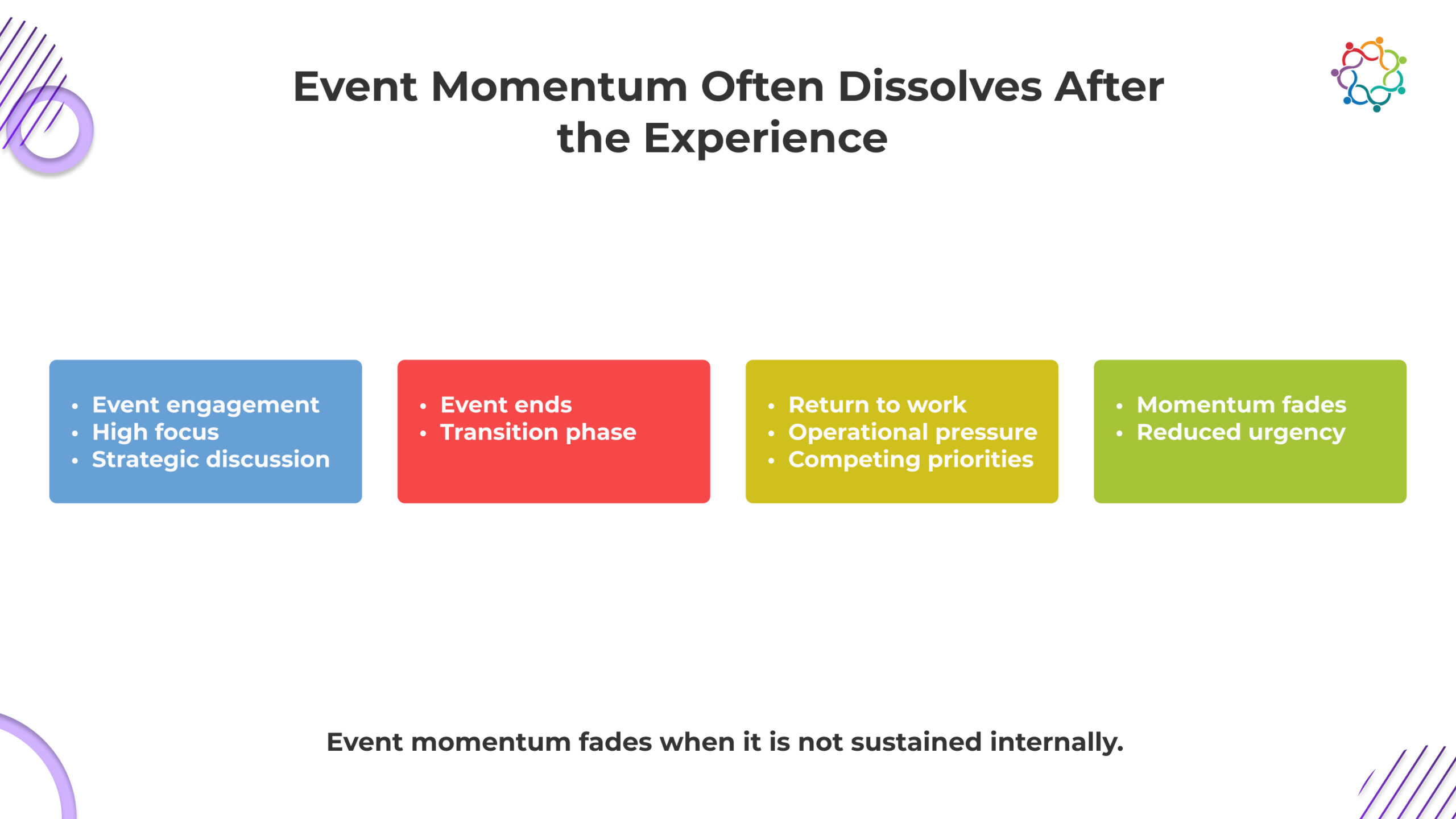
What feels like urgency inside an event is rarely real. It is borrowed.
Events create temporary conditions that amplify focus. Attendees are removed from daily distractions. Conversations are uninterrupted. Ideas are explored with unusual depth. In that moment, everything feels more important than it actually is in the broader context of the organization.
This creates a false signal.
During the event, buyers may express interest. They may ask detailed questions. They may even indicate a willingness to continue discussions.
But that energy does not belong to the deal. It belongs to the environment. The moment the event ends, that environment disappears.
Executives return to operational realities filled with competing priorities, internal deadlines, and ongoing initiatives that already demand attention. The urgency created during the event does not survive this transition.
This is where most perceived momentum collapses.
The conversation that felt critical becomes optional. The interest that felt immediate becomes deferred. The next steps that felt obvious become unclear.
The deal does not regress. It simply loses momentum without replacement. That is the defining characteristic of what can be called the Post-Event Deal Stall.
The event creates urgency that feels real but is not anchored in internal business pressure. Without that anchor, the urgency fades. And when urgency fades, deals stop moving.
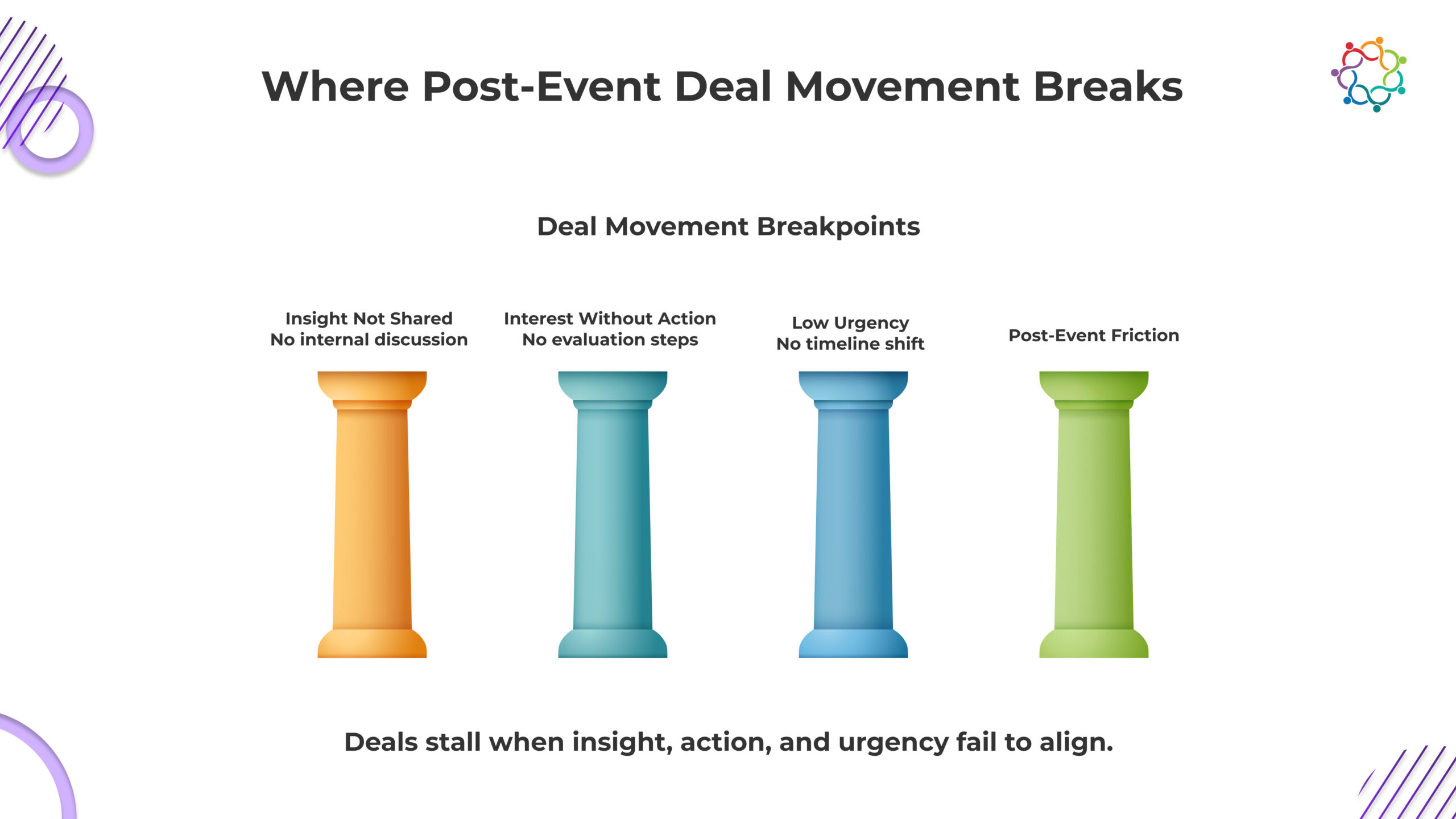
The Post-Event Deal Stall follows a clear, repeatable sequence. Momentum does not disappear randomly. It weakens step by step after the event ends, as insight fails to convert into internal action and structured decision movement.
The attendee leaves with strong perspectives and potential interest. But without structured internal sharing, that insight remains individual. The organization never absorbs it, so the opportunity fails to enter collective consideration.
Without deliberate follow-through, the attendee does not initiate discussions with other stakeholders. The event experience is not translated into organizational dialogue, preventing alignment from even starting.
Curiosity and positive sentiment fail to trigger a formal evaluation. No meetings, no assessments, no movement. The idea remains conceptual instead of entering the company’s decision process.
The event creates temporary focus, but internal priorities remain unchanged. Without real urgency inside the organization, the deal has no reason to progress.
This is where momentum quietly collapses, and deals stop moving without resistance.
After executive engagements, sales teams almost always report strong signals.
Long conversations took place. Senior stakeholders engaged deeply. Follow-up discussions were suggested. From a surface perspective, everything points toward progress.
This is where interpretation becomes dangerous.
These signals reflect engagement. They do not confirm intent.
Invite-only events are designed to encourage participation. Executives are expected to engage. They are expected to contribute. They are expected to explore ideas openly. High engagement is not a buying signal. It is the baseline behavior of the environment.
The mistake happens when this behavior is translated into pipeline expectations.
These interpretations are rarely accurate.
Executives can be highly engaged without any intention to initiate a buying process. They can express interest without aligning internally. They can agree that a solution is valuable without prioritizing it.
This creates a false sense of pipeline acceleration.
The conversation feels like progress. The CRM does not reflect it.
The gap between those two realities is not accidental. It is structural.
Engagement is easy to observe. Buying intent is not.
And when engagement is mistaken for intent, the Post-Event Deal Stall becomes inevitable.
Deal movement does not follow event timelines.
This is where attribution and expectation both break down.
Enterprise decisions unfold over extended periods. After attending executive environments, buyers must evaluate internally, align stakeholders, and assess financial implications. None of these processes operates within the timeframe of an event or its immediate aftermath.
This creates a disconnect.
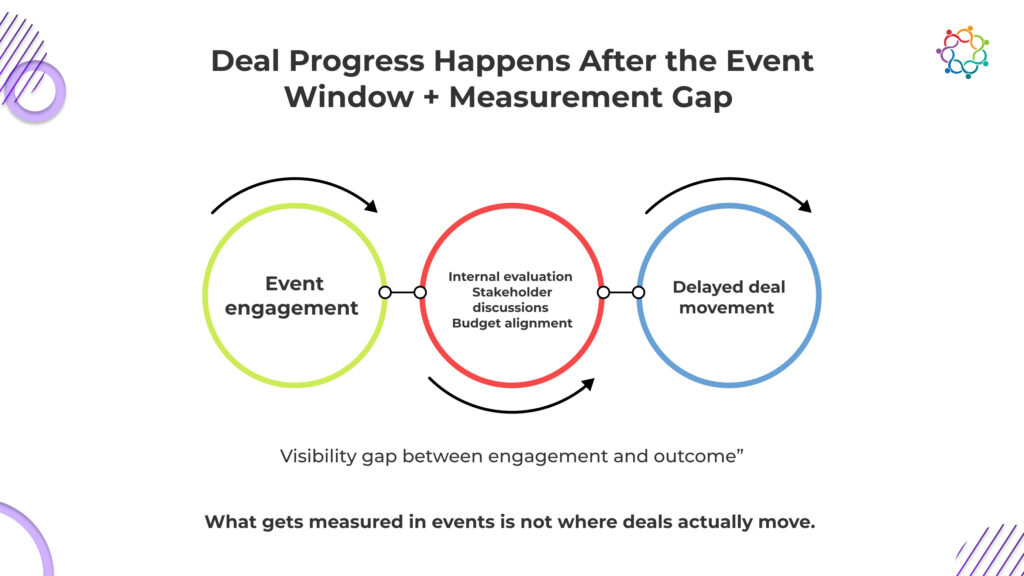
By the time a deal actually progresses, the event that influenced it may no longer appear relevant. The movement happens later, in a different context, driven by internal discussions that are not visible to external teams.
This makes invite-only events difficult to evaluate in terms of direct pipeline impact.
The influence may exist. The timing obscures it.
As a result, organizations either overestimate the immediate impact of events or fail to recognize their delayed influence. In both cases, the understanding of deal progression remains incomplete.
The key point is not that events lack value. It is that their influence does not align with measurable windows.
Deal movement happens when internal cycles reach alignment. That moment rarely coincides with the event itself.
Most organizations believe they understand event performance.
They track attendance quality. They measure participation. They evaluate conversation depth and satisfaction. These metrics create a clear picture of what happened inside the event.
What they do not capture is what happens after.
This is the fundamental limitation.
The system is designed to measure engagement because engagement is visible. It happens in controlled environments. It produces immediate data.
Deal movement, on the other hand, is complex and delayed. It happens inside buyer organizations. It depends on internal conversations that are not directly observable.
So it is ignored.
This leads to a distorted understanding of success.
An event can score highly across every engagement metric and still have zero impact on pipeline progression. The data will suggest success. The pipeline will contradict it.
This is not a measurement gap. It is a prioritization problem.
Organizations choose to measure what is easy rather than what is meaningful.
And until that changes, the Post-Event Deal Stall will continue to be misunderstood.
Because the system is not built to see it.
Closed-door executive environments are powerful. They create access, enable high-quality conversations, and strengthen relationships with the right accounts. None of that is in question.
What is often misunderstood is what those environments are capable of delivering.
They create awareness. They build trust. They shape perception. But they do not move deals on their own.
Deal progression depends on what happens after the event. It depends on internal alignment, organizational priorities, and decision urgency. These forces exist entirely outside the room.
When deals fail to move, the issue is rarely the event itself. It is what happens next, or more accurately, what does not happen next.
The Post-Event Deal Stall is not a failure of engagement. It is a failure of internal activation.
A strong room creates conversation. Deals move only when that conversation survives outside it.
At a broader level, this raises a deeper need for visibility. Organizations must understand how executive engagement evolves after events, how internal buyer behavior develops across accounts, and how those signals connect to pipeline movement.
Platforms like Samaaro are built around this exact challenge, helping teams move beyond event-level metrics toward true account engagement intelligence.