Samaaro + Your CRM: Zero Integration Fee for Annual Sign-Ups Until 30 June, 2025
- 00Days
- 00Hrs
- 00Min

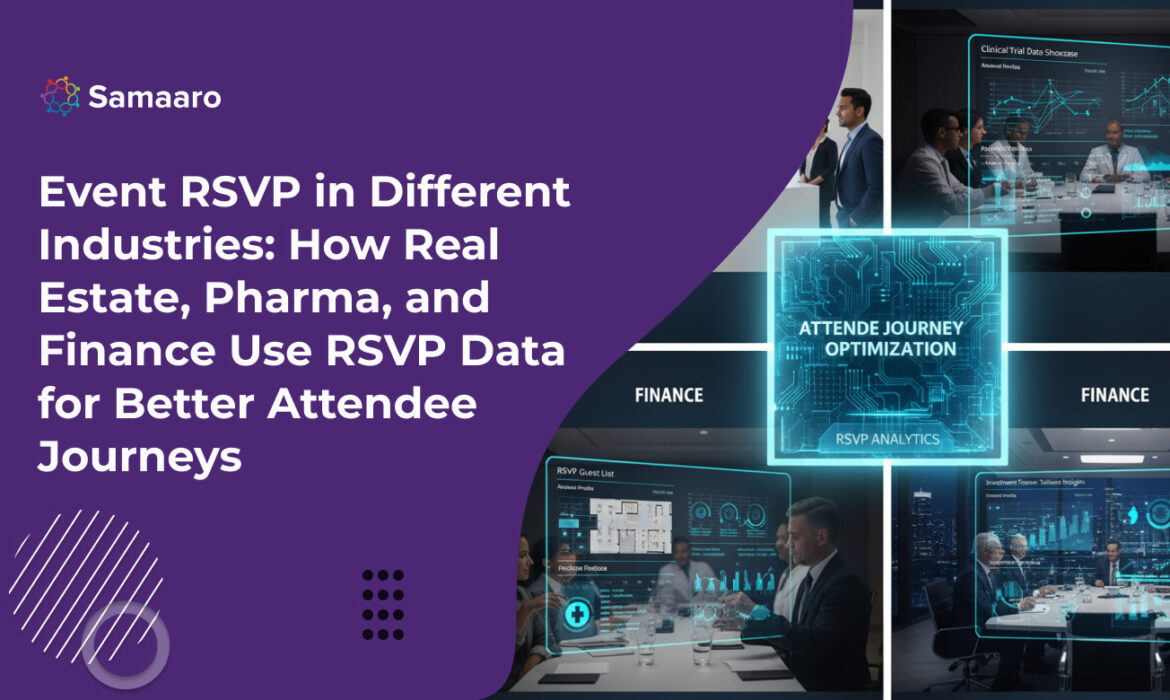
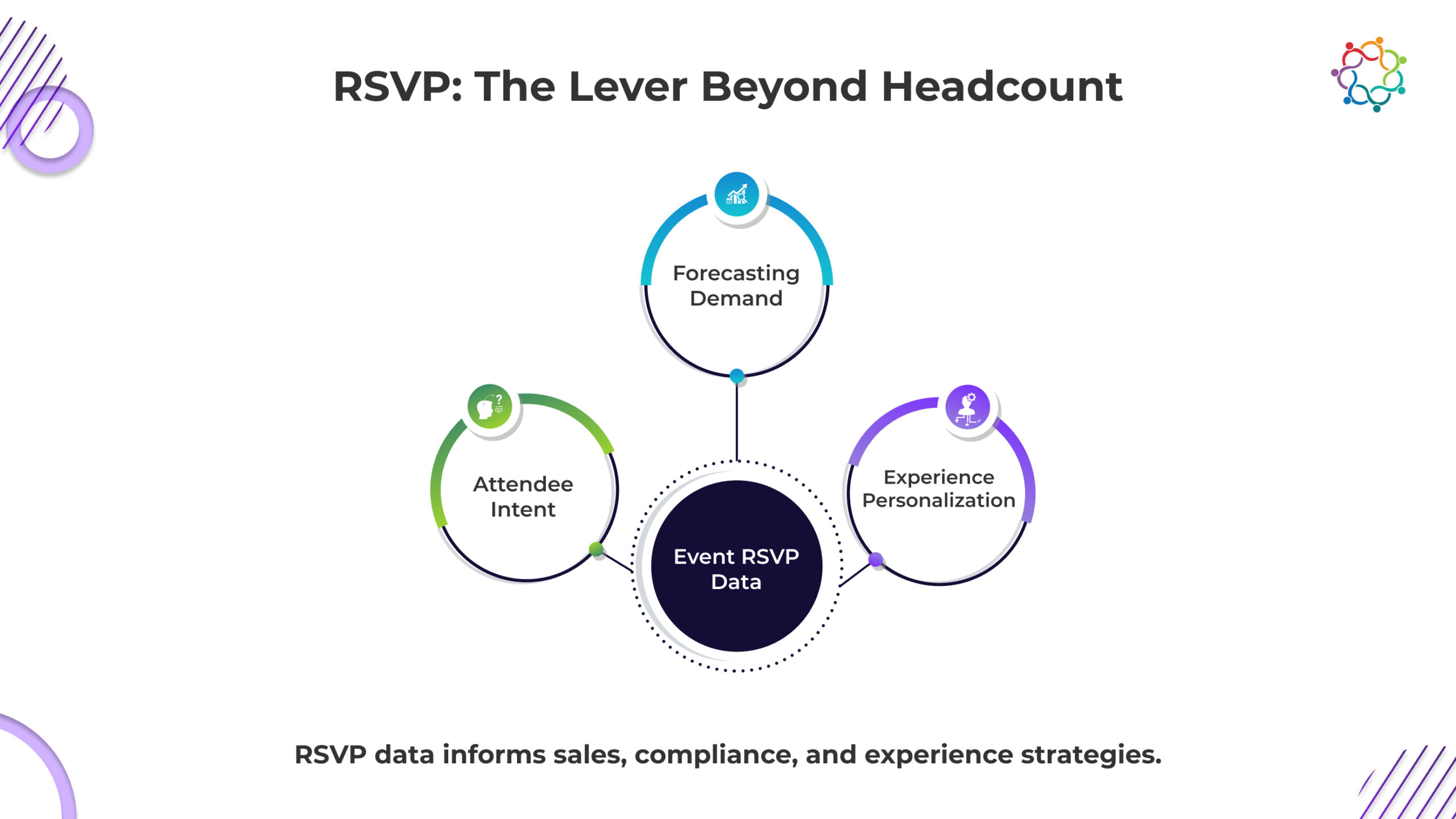
For most event teams, the RSVP process is still treated as an administrative checkbox, a simple “yes” or “no” response used to count seats or print badges. But in 2026, event RSVP data is fast becoming a strategic lever across industries, offering real-time insights into attendee intent, behaviour, and conversion potential.
An RSVP is not simply a count of attendees; it represents an indication of interest and readiness. When collected and analysed correctly, it can inform marketing spend, content development, even sales strategy. Furthermore, every sector interprets RSVP intent differently. A confirmed RSVP means one thing for a property event (an indication of readiness to buy), another thing in the CME space (needs for professional development and tracking compliance).
In this blog, we will look at how the real estate, pharma, and BFSI sectors are using RSVP intelligence for not just planning the event, but orchestrating smarter, data-guided attendee journeys that drive ROI.
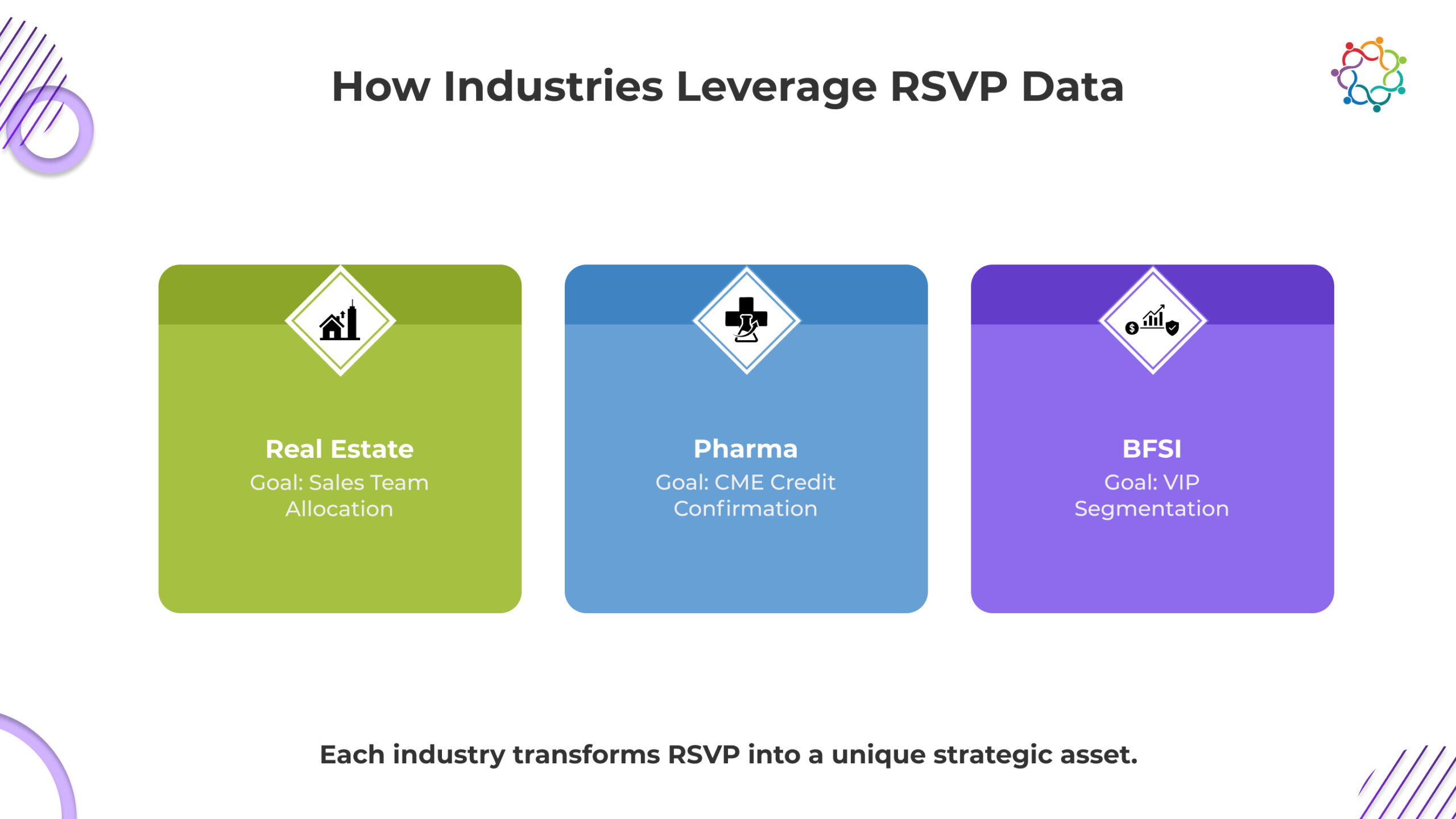
In real estate events, the RSVP has evolved from a basic attendance metric into a forecasting tool. Developers use event RSVP data to gauge buyer intent, segment attendees by property interest, and plan on-ground sales resources accordingly.
When handled electronically, an RSVP response gives developers not only the likelihood of attendance but also the number of attendees for each kind of property, the number of sales team assigned, and what budgets to allocate to marketing.
As an example, if 40 percent of the RSVPs indicated the person was a First Time Homebuyer, the developer could change the booth message and their pre-event email marketing campaign to reflect that group’s needs.
At a large property expo in Mumbai, one developer utilized a digital RSVP system to pre-qualify interest by interest level and location. They then dynamically assigned sales team reps as guests registered at the event. The result, shorter lines, no fuss getting guests in, and a reduction in no-shows by 25%, which increased the ratios of EOI to sale%.
By linking RSVP data into CRMs, developers also learn if each registered attendee signed an EOI, giving them even more visibility into clear ROI per event channel.
Within the pharmaceutical industry, RSVP data plays a vital role in delivering compliance. Each CME or educational medical event must keep clickstreams and confirm attendance eligibility at time of credit assignment. This is where digital RSVP tools are critical, marrying the pre-event intent with the post-event credit assignment.
When physicians or healthcare professionals show up and confirm attendance, the RSVP data integrates into the compliance flow, helping the organizers confirm attendance eligibility, in the right seat if that was necessary to receive credit for accredited sessions, and the ability to produce a certificate of attendance in real time.
A leading medical association in Singapore used RSVP tracking as an integrated feature of their CME platform to automate credit assignment. Once a participant checked in with the QR-based verification feature, the system would capture the participants RSVP record with the events session attendance records to generate a CME credit assignment.
In addition to compliance tracking, pharma used RSVP reporting to organize content experiences to take personalization to the next level.
By analysing what topics or therapy areas generated the most confirmed RSVPs, pharma could follow up with modules of content or microlearning programs for continued education with those interested physicians and make that first and only time interaction a long term, life-long content journey for their ongoing education.
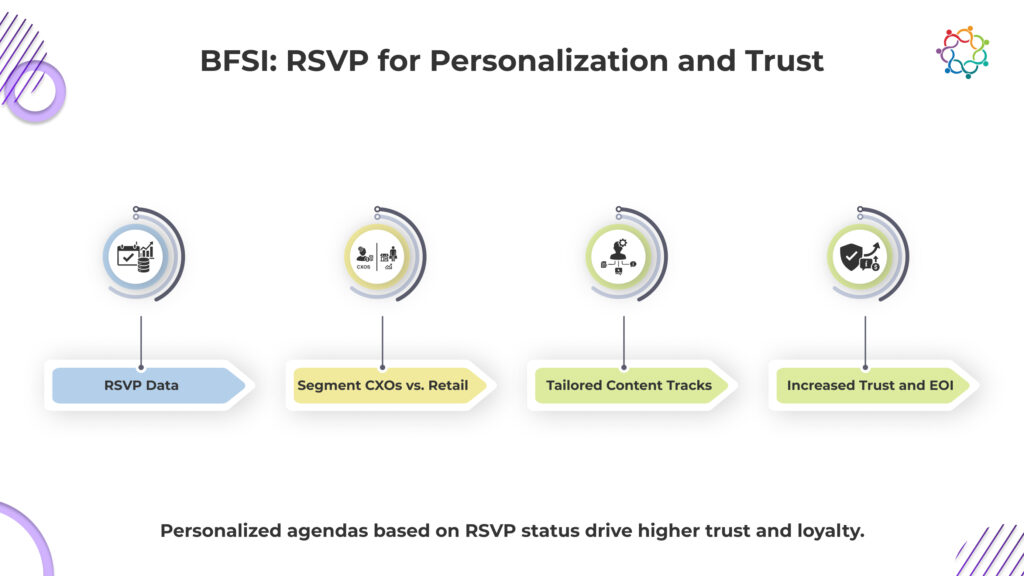
In the BFSI sector, data collected from event RSVPs are the backbone of the personalization, trust-based experiences for attendees. Financial services institutions host all types of events, from retail banking summits to private investor meetings, with each level of attendee requiring a different experience.
When RSVPs tabulated by attendee type (CXO, HNI, investor, or retail banker), organizers engage in specific and tactical planning, everything from tracks to networking sessions.
For a global investment bank, RSVP data was leveraged to personalize investor meets by assigning pre-approved seating zones for CXOs, HNIs, and retail bankers 1:1 meeting slot respectively.
Smart RSVP dashboards evolve managing VIP guests’ data modelling as well. In high-stakes investor summits, early-stage RSVPs signal time and needs for the team to prepare as needed for security clearances, hospitality requests, and timing communication back to VIP guests.
In one similarly structured event, when RSVPs were segmented into attendee type, the organizer can trigger customize communication journeys that guided CXOs on personalized sessions and nudged retail clients toward financial literacy tracks. We measured a 40% improvement in engagement with sessions and a strong conversion pipeline for the relationship managers for post-event follow up.
Samaaro’s event RSVP data solutions go beyond registration forms, they transform intent signals into measurable outcomes.
Industry-specific RSVP workflows: Whether it’s mapping for expressions of interest in real estate, compliance for continuing medical education in pharma, or creating segmented guest experiences in BFSI, Samaaro customizes the RSVP journey to align with each industry’s operational flow.
Real-time dashboards: Visualize real-time RSVP-to-attendance ratios with conversion tracking. Identify patterns such as which communication channels lead to the highest number of confirmed RSVPs and which segments show the most intent from attendance.
CRM Integration: Every RSVP record is automatically synced with the client’s CRM to ensure seamless continuity of data records from sign-up to post-event engagement.
Samaaro’s unified RSVP management system helps teams move beyond spreadsheets delivering predictive insights that improve attendance rates, streamline staffing, and enhance personalization across industries.
In 2026, industries are beginning to realize that RSVP data is the earliest and most accurate indicator of whether an event is successful. Whether it’s anticipating demand in real estate, assessing compliance in pharma, or creating a personalized experience in BFSI, RSVP analytics are the foundation of operational accuracy and customer delight.
To dig deeper into how event planning can harness the power of attendee intent, check out Mastering Event Success: The Crucial Role of Event RSVP in Planning and Engagement. This guide demonstrates how streamlined RSVP workflows prevent lost leads and lay the groundwork for meaningful post-event follow-ups.
A smart RSVP strategy does not just find people to fill seats, it finds a way to make sure each attendee’s journey is intentional, relevant, and measurable.
Want to use RSVP as a growth lever? Explore Samaaro’s RSVP solutions today.
Pharmaceutical and medical events take place in some of the most highly regulated environments in the world. All programming must ensure that every session, speaker and CME credit issued is compliant, and every touchpoint with a healthcare professional (HCP) must be compliant, traceable, and transparent.
Pharma conferences, CME and other medical programs are, by contrast to almost all corporate events, multi-layered productions. Education, compliance, engagement, and accreditation, all governed by different regulations must be addressed and content must blend all these components together. Using discrete tools to manage each layer creates data silos, reporting mistakes, layers of risk, and ineffectiveness.
For example, a single inconsistency with an attendance log reported to a CME issuing body could lead to disputes or worse, a red flag with a regulator. Many pharma teams are still using spreadsheets, email threads and generating certificates manually, both error-prone when managing hundreds of doctors at large-scale events.
Expectations for the industry have changed and regulators, associations and participants all seek speed, transparency and seamless digital experiences that can be backed up with data. The solution is consolidating compliance, attendee engagement and event management technology together into a single ecosystem.
For a long time, compliance has been an integral part of pharma meetings. However, considering growing scrutiny around the world, compliance is no longer a simply a box to check, compliance represents reputation protection.
Medical event planners are bound by both regional and/or international standards that guide their interactions with healthcare professionals (HCPs). These include declaring sponsorship, accurate allocation of CME credits and retaining genuinely independent educational content.
The Risks of Getting It Wrong:
Example:
A European medical association faced negative feedback after issuing CME certificates to attendees who didn’t fulfil the attendance requirements for the session, a process reliant on manual entry. The overall integrity of the event had been damaged; the association was then tasked with reissuing hundreds of certificates, costing time, and possibly trust, to all involved.
Compliance isn’t a nice-to-have, it’s a foundation. And as events grow and have worldwide participation, continuing to manage compliance elements manually is no longer feasible.
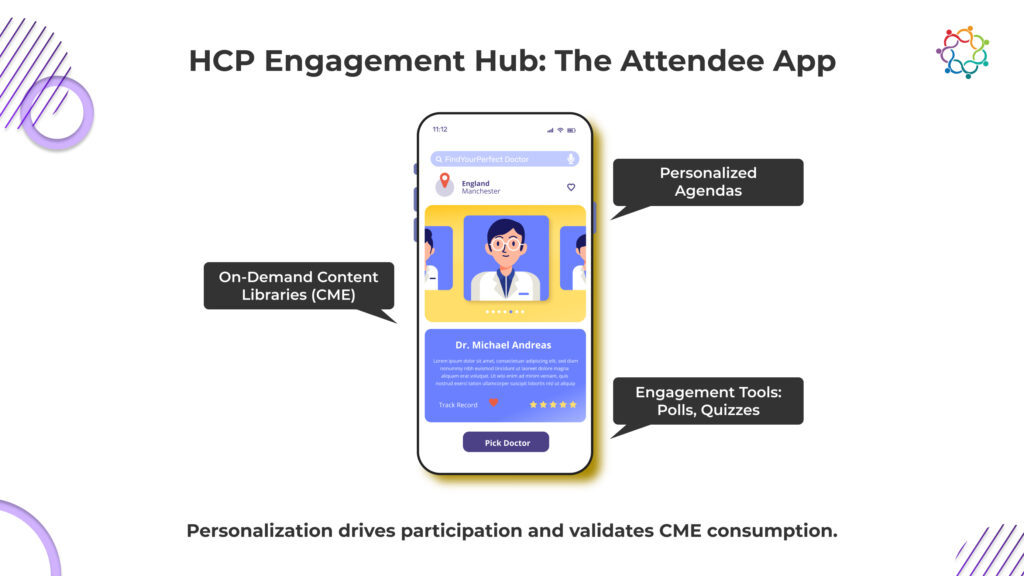
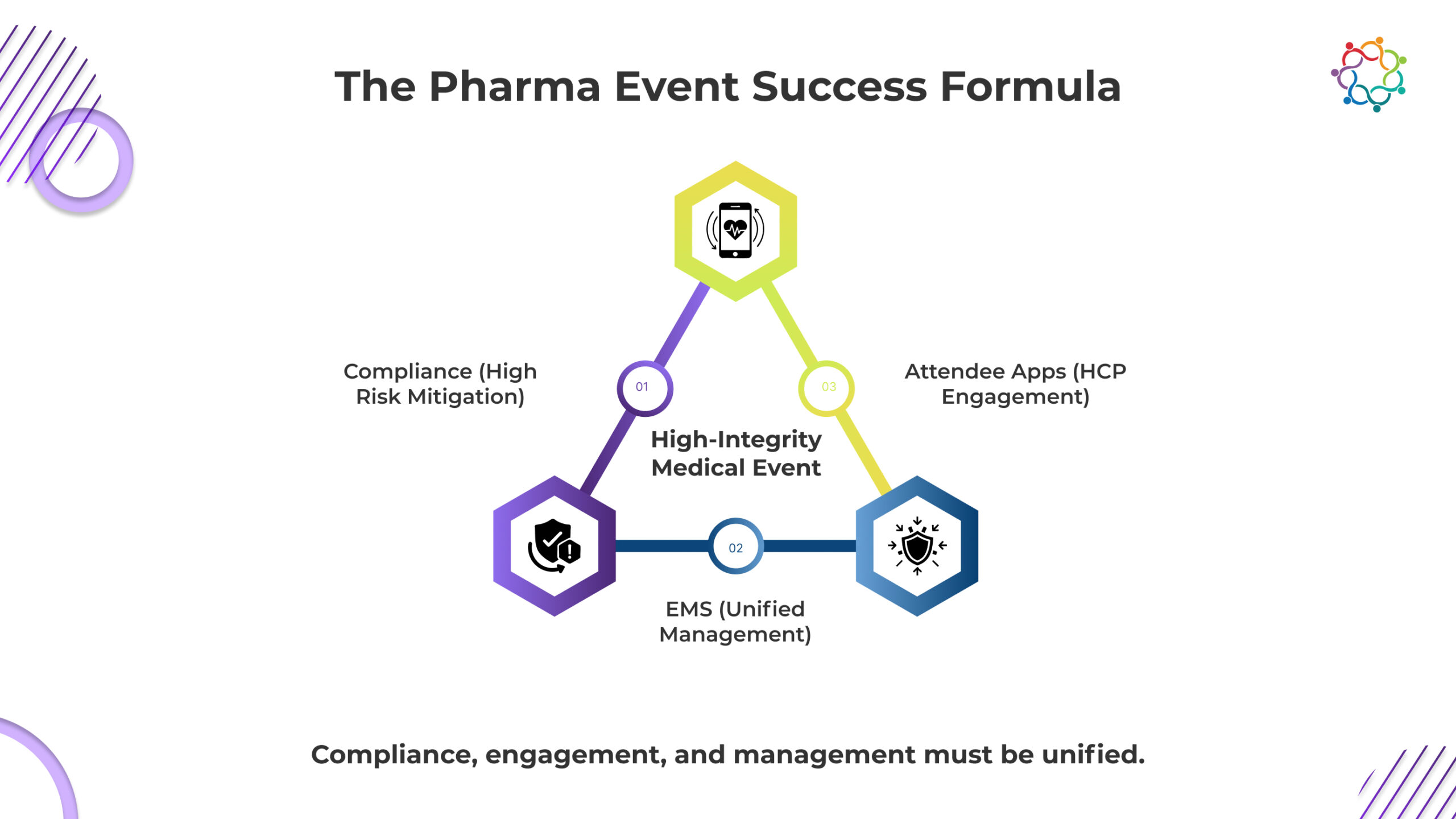
If compliance is at the base, attendee apps serve as the engagement layer connecting physicians, speakers, and organizers in real time.
Today’s pharma events require personalization, and yet personalization has to be conducted in a compliant setting. Attendee apps strike this balance perfectly by giving HCPs curated access to sessions, educational material, and engagement tools without compromising data.
Key Benefits of Attendee Apps:
Customized Agendas: Each doctor can view agendas specific to their specialty, past participation or CME objectives.
On-Demand Libraries of Content: Session recordings, abstracts, and case reports will be available to the attendee post-event for their continued learning.
Interactive Engagement Tools: Engagement in polls, quizzes, and questions during the sessions adds a level of participation and comprehension tracking.
Feedback Loop: Survey the doctor during the session and after the session and feed that into possible analytics dashboards for conference organizers to use to openly discuss and refine future events.
These all move beyond convenience and will enhance retention and knowledge transfer, two important metrics of CME success.
Example:
A leading pharma company in Singapore adopted a mobile event app for its regional CME conference. HCPs could bookmark sessions, participate in live polls, and track their CME progress directly within the app. post-event engagement increased by 40%, and CME completion rates improved significantly.
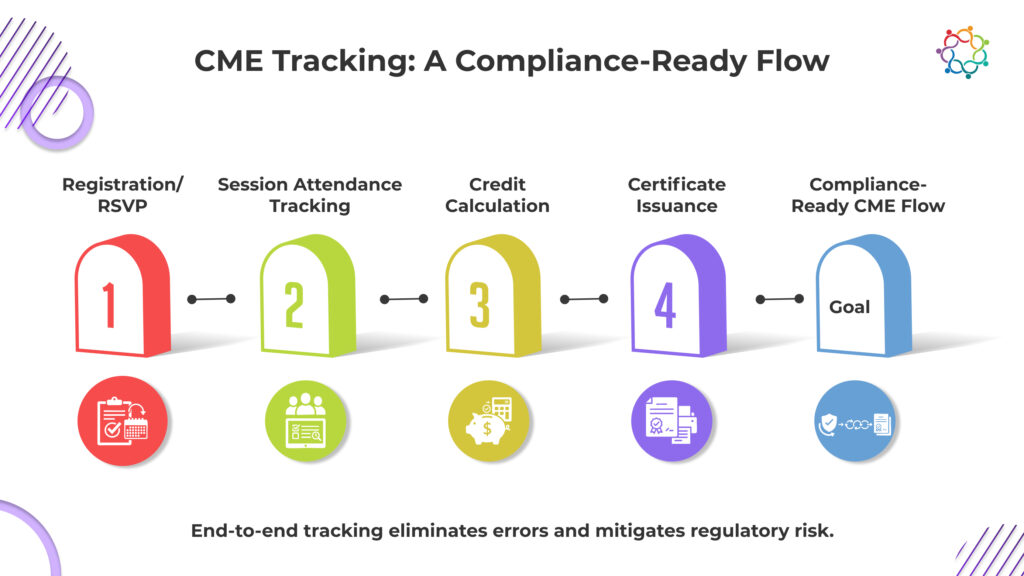
Event management software is what finally brings all moving parts together like registration, attendance, CME tracking, and certification into a single, compliance-ready ecosystem. Disjointed tools are already proving their limitations. As highlighted in Samaaro’s analysis on CME & Medical Conferences, fragmented platforms often lead to lost data, delays, and frustrated attendees.
By contrast, unified event management software offers real-time compliance dashboards, automated credit allocation, and seamless synchronization with medical CRMs ensuring every CME touchpoint is error-free and auditable.
How EMS Powers Compliance and Efficiency:
1. End-to-End Flow: From registration and attendance verification to CME tracking and certificate generation, all within one system.
2. Real-Time Compliance Dashboards: Track CME credits issued, attendance rates, and reporting accuracy live.
3. Automated Certification: No manual data entry, no delays, certificates are automatically issued based on attendance rules.
4. Data Security: Role-based access ensures sensitive HCP data is managed ethically and in compliance with GDPR, HIPAA, or regional equivalents.
5. Automated Reminders: HCPs receive timely alerts for upcoming CME sessions or renewal deadlines, improving retention.
Example:
A worldwide medical equipment organization utilized Samaaro’s EMS and was able to decrease their manual credit reconciliation by 85% while increasing compliance reporting accuracy to 99.7%. The platform also aided the client in automating CME reminders so that physicians completed their milestone of certification cycle on time.
EMS converts an obsolete, paper-intensive process and siloed records into a cohesive automated compliance system.
By the year 2026 the division between medical education and digital engagement will have converged. Doctors require personalization like their experience in consumer technology and regulators require data integrity similar to their experience in clinical systems. Pharmaceutical event technology is developing to accommodate both experiences simultaneously.
Here’s what defines the next generation of pharma events:
AI-Driven Personalization: Intelligent algorithms recommend sessions, content and networking opportunities tailored to each doctor’s specialty and CME rain.
CRM Integration for Medical Associations: Event platforms and medical CRMs can now flow together for ongoing member engagement status to keep accurate member records over time.
Global Compliance Frameworks: Built in tools for region-compliant standards (US, EU, APAC) automates the compliance oversight.
Data-Backed, Insights: Event analytics documenting what sessions drove CME completion and sustained post event engagement post-event.
The future of partnering with pharma for events is data-driven, compliant, personal and calm blending automation with ethical transparency.
Samaaro’s pharmaceutical event technology suite is designed to meet the challenges of the complexities of medical and CME events. The suite integrates compliance management, participant engagement, and data analytics into a single platform.
Essential Features:
Results – CME providers have reported shortened processes to complete certification, lower rates of compliance errors, and higher participant levels of satisfaction when engaging with CME-DCM. To reduce burden on their administration, the solutions offered to allow for better education and engagement outcomes for HCPs.
The pharmaceutical industry is changing, and its events need to change with it. Compliance with regulations, attendee engagement, and operational efficiency are no longer separate goals for successful CME and medical meetings but rather interdependent pillars.
If an event does not take compliance seriously, it risks losing its credibility. If it does not have engagement, it risks losing its relevance. To manage both effectively and responsibly, the only possibility is through integrated systems and platforms.
The winning combination of event elements in 2026:
For many years, real estate events, from important property launches to extravagant exhibitions, have revolved around glamour. Extravagant stalls, luxurious venues, and endless foot traffic were often synonymous with “success.” Now, as we enter 2026, property developers are starting to understand that foot traffic does not lead to conversions.
It’s often a mess behind those busy exhibit floors: visitor data remains incomplete, sales staff is often overwhelmed, and follow-ups do not happen. A thousand visitors could come through the gates, but if there are no interested buyers or conversions to site visits, the event ROI is close to zero.
It is not the event that is at fault, it is a lack of structure, and it is often based on data.
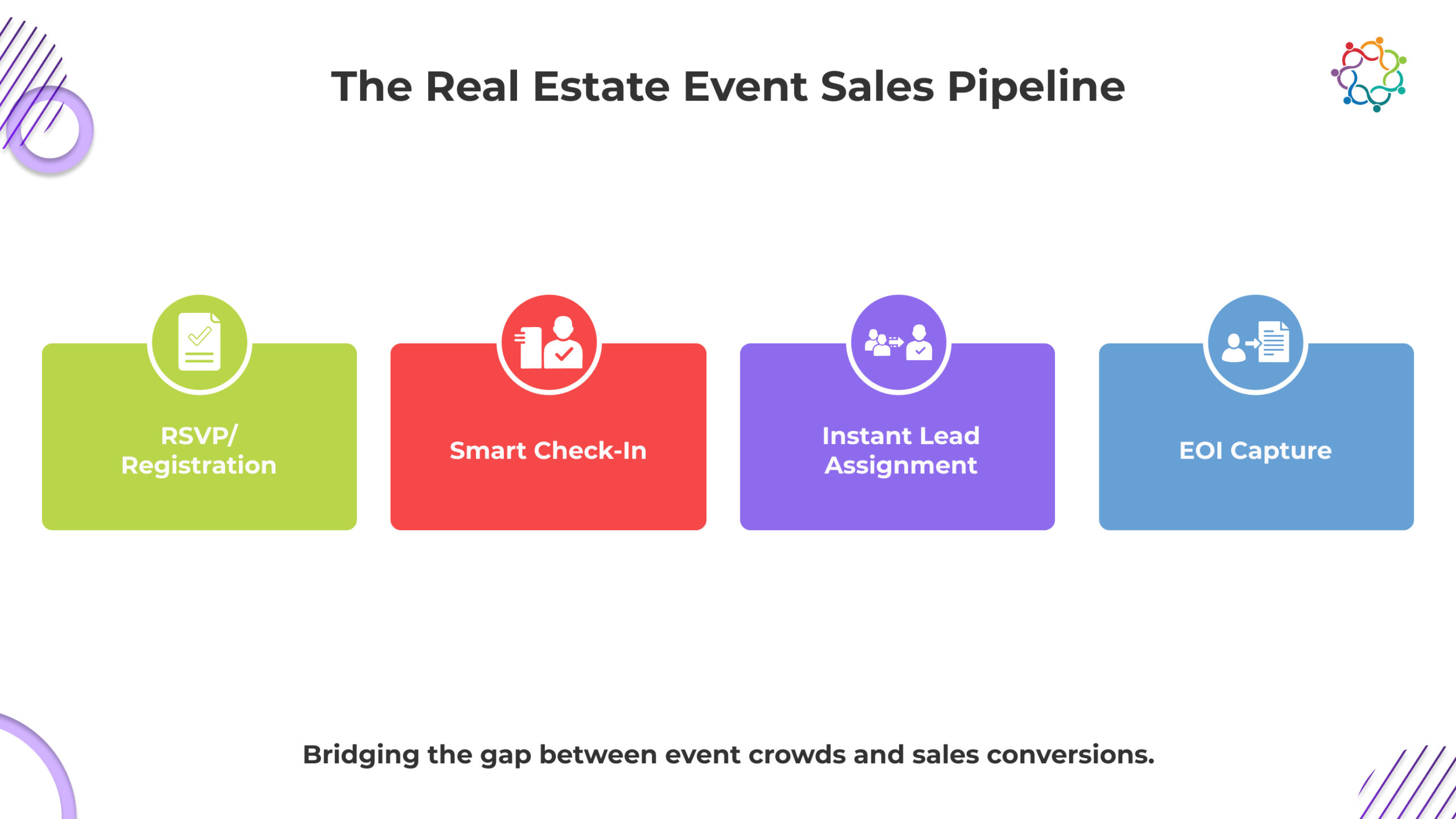
This is precisely why technology is rewriting the playbook, with today’s top-performing real estate companies now using event management software, RSVP tracking, and smart check-in systems that reform the event from crowds to sales potential.
By digitizing all touchpoints from event confirmation to post-event EOIs, property developers are meaningfully connecting return on our events with attendance.
Traditionally, at the point of the event cycle, “registration” is considered the starting line. In 2026, however, the smarter metric to consider is RSVPs because RSVP indicates intent, not just awareness.
When someone RSVPs they signal that they are indeed interested. This differentiation allows developers to project demand, staffing requirements, and prioritize qualified prospect leads.
Why consider RSVPs?
Example:
A Bengaluru-based developer hosting a premium villa launch noticed that out of 800 registrations, only 400 typically showed up. By introducing RSVP confirmations and automated reminders through event software, their no-show rate dropped to 15%, and their post-event conversion improved by 28%.
RSVP data also feeds directly into sales prep. Teams can segment RSVPs by region, interest level, or project type, ensuring salespeople know who to engage the moment they arrive.
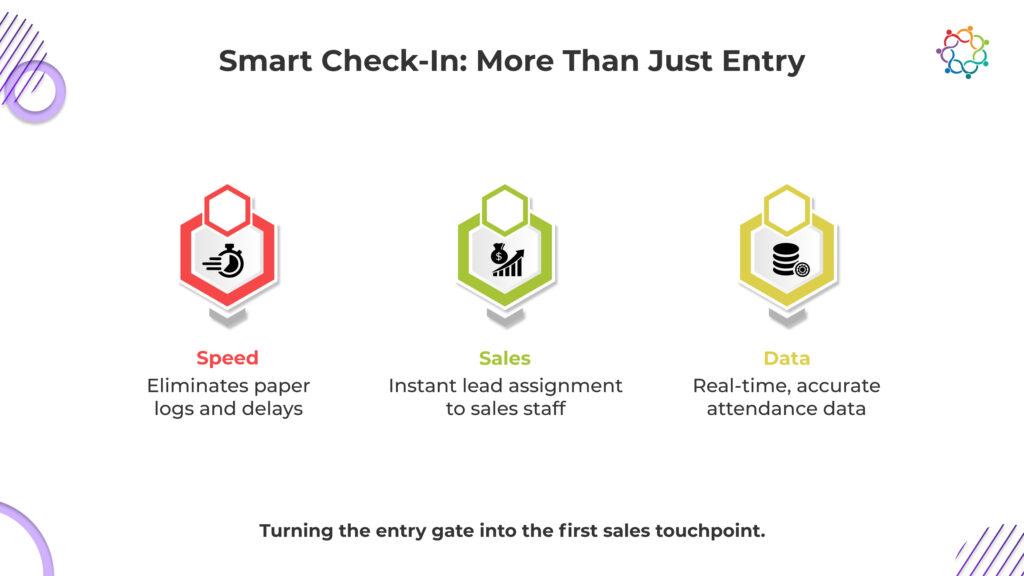
Imagine this scenario: a bustling property launch, with hundreds of guests entering the space at the same time. Typically, check-in involved paper forms, and manual entries, which irritated both buyer and staff alike.
Now picture that same property launch, but with either QR check-in or facial recognition check-in and the days of paper forms and ‘line-ups’ are gone. Upon entering the launch, visitors scan a QR code and are automatically put into the CRM. Based on the visitors’ project interest or ticket type, the system will now assign them a Sales Executive or booth Rep.
This is more than just check-in. This is the start of the sales discussion.
How Smart Check-In Drives Efficiency:
Example:
During a Pune property showcase, a developer integrated Samaaro’s smart check-in solution. Every visitor received a personalized QR code after RSVP. Upon scanning, their profiles appeared on the sales dashboard. Each rep knew which campaign had brought in the lead, Facebook ads, broker promotions, or referral programs. The result? A 30% increase in on-site EOI capture and a smoother experience for buyers.
Smart check-in systems don’t just enhance efficiency; they make every interaction measurable and actionable.
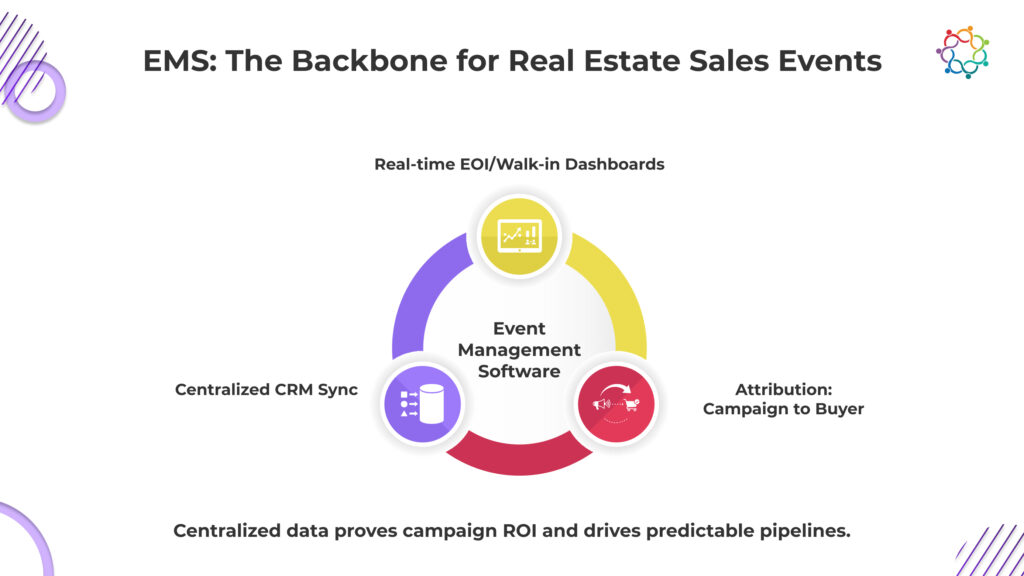
While RSVP and check-in handle the front end, event management software is the operational backbone that unifies all moving parts from registrations and leads to real-time sales updates.
Think of it as the developer’s command center. Every attendee action, every EOI, and every follow-up is tracked within a single dashboard.
Key Features That Matter:
Why It Matters:
Event management applications provide a data-enhanced sales setting for an otherwise charged, chaotic experience. No longer will developers guess how many EOIs were collected or which campaign was most successful; they will know in an instant.
Example:
In a cross-city real estate exhibition, one developer used Samaaro’s event software to enable lead tracking through events. After two events, they tracked 65% of the EOIs to individual campaigns, which helped immediately reallocate the ad budget for successes in future events.
At a large-scale property expo in Bangkok, over 2,000 attendees were expected. In the past, such numbers would mean endless queues and lost leads. This time, the developer implemented Samaaro’s RSVP and smart check-in suite, digitizing the entire attendee experience.
To see this in action, consider how developers are turning the EOI challenge into opportunity. Samaaro’s guide on “The EOI Challenge in Real Estate Events — And How Developers Can Solve It” shows how digital-first capture, queue management, and seamless lead attribution can increase EOI conversion by up to 30% during property expos.
Samaaro’s platform brings everything, RSVP, smart check-in, lead capture, and analytics, under one roof. Designed specifically for real estate teams, it transforms every event into a sales-ready environment.
Key Capabilities:
Developers using Samaaro’s tools report not just operational efficiency but predictable sales growth, turning what used to be “marketing spend” into measurable revenue streams.
2026 is the year of intelligent real estate events. Developers who embrace data-driven execution will no longer see events as isolated marketing costs but as structured, high-ROI sales engines.
Here’s what defines success in the new era:
The result?
Faster EOIs. Fewer no-shows. And a pipeline that grows predictably with every event.
Real estate events are no longer about how many came, they’re about how many converted.
Want to turn your next property event into a measurable sales engine? Explore Samaaro’s real estate event solutions today.
For many organizations, events are still treated as one-off spectacles, grand stages, packed venues, high registrations and yet little to show in terms of real, lasting impact. The applause fades, reports are filed, and the next event begins from scratch. What’s missing is continuity.
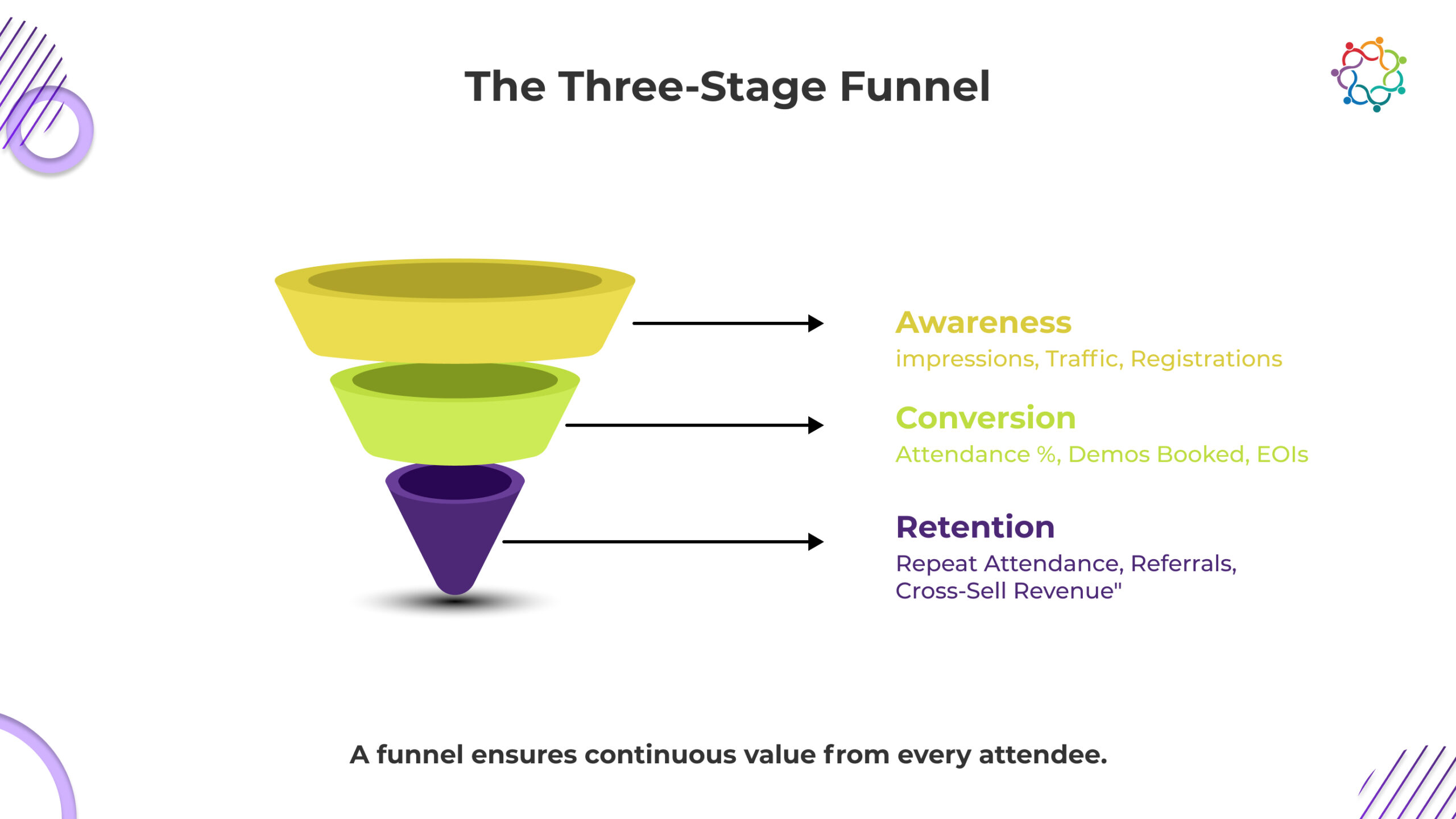
The truth is simple: awareness without conversion, and conversion without retention, equals wasted potential. That’s where an event marketing funnel transforms the equation.
Just as digital marketers build funnels that guide audiences from discovery to decision, event marketers must create a structured journey for attendees, one that nurtures initial curiosity into engagement, and ultimately into long-term loyalty.
When a defined funnel framework is in place, events evolve from isolated campaigns into sustained growth engines. Every touchpoint from the first RSVP to post-event engagement, contributes to measurable outcomes.
In short, funnel thinking creates strategic continuity across the event lifecycle. It ensures that every rupee invested at the awareness stage ultimately drives tangible business value through conversions and retention turning every event into a compounding asset rather than a single-use campaign.
Awareness relates to the ability to be seen and discovered; to reach the right audience, in the right place, and say the right thing to them. It is not simply enough to be loud; you must be intentional about how you authentically connect with them.
Key Tactics
Paid Media: The use of hyper-targeted ads in google, meta and LinkedIn allows you to reach segmented persona profile either they be those are home buyers, doctors, or CXOs.
Influencer & Speaker Promotions – A trusted voice promoting your event adds trust to a connection that no banner ad can offer.
Thought Leadership Content – Blogs, teaser videos, and speaker reveals are giving value to authority and creating anticipation
Email Drip Campaigns: Reach out to previous guests and prospects with personalization like “Come back to learn exclusive information.”
Metrics that matter:
Example:
A SaaS company with a new product in automation partnered with LinkedIn micro-influencers in the B2B tech field. Instead of telling everyone to attend the event, those micro-influencers expressed how excited they were to attend and shared their thoughts on industry challenges while they were at it which implicitly tied back to the posted event. The net result was a 2.3x increase in registrations and no increase in advertising budgets while also bolstering their presence in an engaged thought leadership space.
Pro Tip: Awareness is not being everywhere. Awareness is being in the channels your audience trusts.
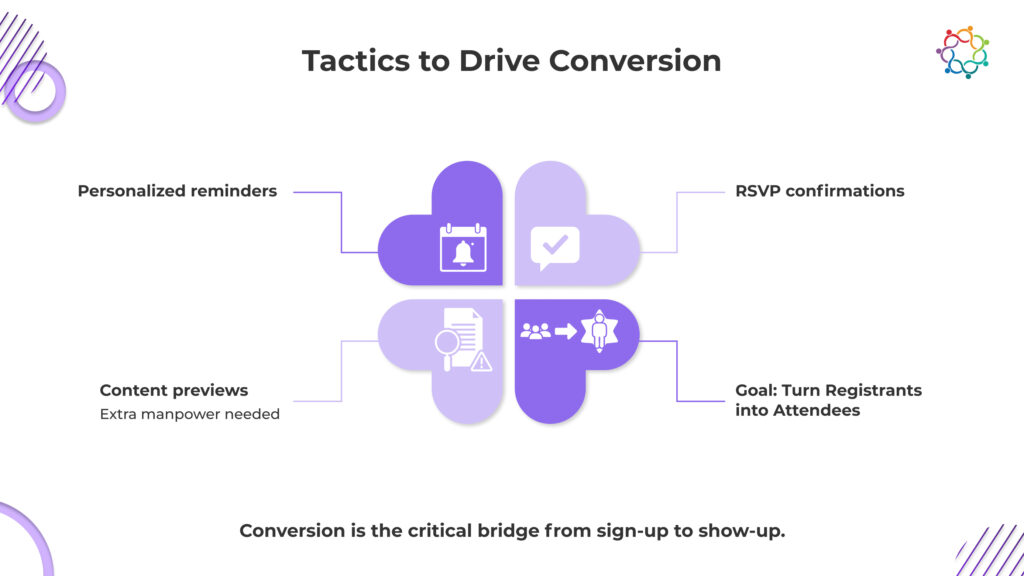
Once awareness has peaked, that leads us to the next obstacle: turning intent into action. Action into registrations. Registrations into attendance. Interest into expressions of interest. The conversion stage is where intent can become tangible and measurable.
But here is where most event marketers stumble. Users fill out the form, but they don’t show up. We capture leads, but they don’t get followed up. Conversion is converting attention into engagement, engagement into attendance, and attendance into revenue (or outcomes and strikes).
How do we do that?
Key Tactics:
Automate RSVP systems: Make it easier for the guest to confirm attendance. Every extra click…. every extra click equals a decreased likelihood the user will attend.
Remind with purpose: Instead of sending a generic reminder with “Don’t forget our event!” use reminders & prompts that reiterate value you’ll deliver- “Your session with Dr. Rao on AI in Healthcare starts at 10 AM!”
Previews: Provide early previews of agenda or speaker clips to build excitement.
Retarget: Use paid media or emails to retarget users who visited but did not register.
Key Metrics:
Example:
A real estate developer at a luxury property show was experiencing very low EOI rates, despite high attendance. They incorporated Samaaro’s event marketing platform, allowing for digital, QR-based registrations and engaged with automated WhatsApp follow-up messaging attendees to submit their EOIs before they left. The result? 20% of attendees submitted EOIs on-site and 35% of attendees closed following the event.
Pro Tip: Treat conversions like a conversation rather than a transaction; every touchpoint should instil confidence and remove friction.
If the conversion is the spark of event engagement, retention becomes the flame that sustains it. A good number of brands fail to continue to engage the attendee after the event, losing the potential for a valuable long-term relationship that leads to repeat attendance or referrals.
Retention is where event ROI can create the impact because a past attendee will cost significantly less to engage than a new attendee. Especially in the BFSI, healthcare, or real estate industry, retention is indicative of customer loyalty and long-term advocacy.
Key Tactics:
Content hubs for post-event engagement: Send out recordings of sessions, highlight reels, and follow-up guides to continue sharing knowledge with attendees, making it easy for them to revisit several sessions, and learn.
Nurture campaigns: Send segmented post-event emails based on who they are post-event, for example, investors, doctors, agents, or buyers.
Feedback loops: Follow up with a post-event survey and NPS form, to obtain satisfaction ratings and key insights on improvement.
VIP Benefits: Acknowledge your superstars with VIP access, early notifications to events, or rewards for referring others to attend.
The Metrics That Matter:
Example:
This major BFSI brand turned its yearly investor conference into a digital community that is now active from year to year. Attendees can receive content that is personalized for some content historians such as a quarterly invite to a virtual content pertinent to them. Ultimately, this engagement increased 25% retention of investors, and attendance had doubled for their next conference.
Pro Tip: Retention starts before the event even ends. Always let the participants know they will be receiving content in the future, or some other interactive experience that will reach them in the future, while the engagement is at a high point.
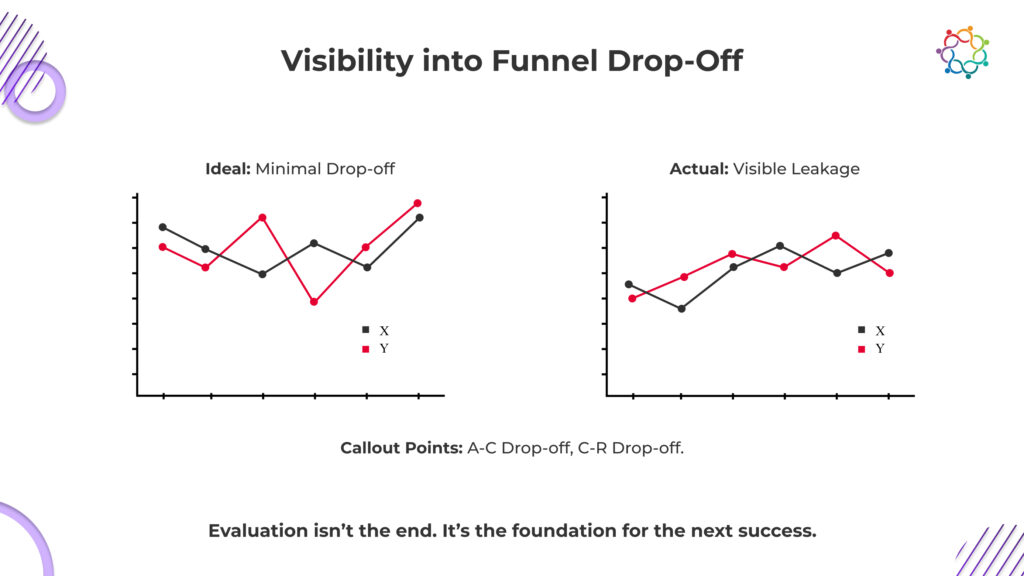
A well-built event marketing funnel isn’t just about strategy; it depends on the right tools at every stage. From attracting the right audience to converting leads and nurturing relationships post-event, technology keeps the funnel measurable and efficient.
For Awareness:
Use marketing automation tools and event CRMs to manage multi-channel outreach. Platforms that integrate with email, ads, and landing pages help track which sources drive the highest registrations. Real-time analytics dashboards ensure campaigns are optimized before the event even begins.
For Conversion:
Integrate your CRM directly with the event registration and check-in systems. This sync ensures every attendee interaction, RSVP, demo request, EOI, is captured instantly. Automation tools can trigger personalized reminders, confirmations, and pre-event engagement sequences to improve attendance rates.
For Retention:
Post-event engagement tools such as branded learning hubs, content libraries, and follow-up campaigns keep participants connected. Surveys and NPS trackers help gauge satisfaction, while analytics dashboards show who re-engages with your content, identifying the most valuable long-term prospects.
To build and refine this funnel effectively, marketers need more than tactics, they need a strategy grounded in measurable outcomes. That’s where advanced event marketing frameworks come in. By integrating CRM tools for conversion tracking, using analytics dashboards to identify drop-offs, and maintaining post-event learning hubs for retention, organizers can turn insight into action. For a deeper look at how modern marketers are building data-driven event funnels, explore Samaaro’s Event Marketing 2025 Guide.
Samaaro is an AI-powered event marketing platform that helps teams operationalize the full-funnel event model, from the first click to long-term participant retention. Instead of managing fragmented tools, marketers can plan, automate, and analyze the entire attendee journey on a single platform.
Key Capabilities
Example in Action
During a multi-location product experience campaign, a SaaS company used Samaaro to monitor its complete event funnel across four regions. The platform connected attendee engagement data, such as participation in product demos, directly with sales outcomes. Insights showed that attendees who engaged in live demonstrations were 45% more likely to convert within 30 days.
With Samaaro, the brand could quantify engagement impact, linking event participation directly to pipeline growth and measurable revenue outcomes.
Most successful brands emerging in 2026 are brands who treat events as continuous or sections of funnels with each event forefronts environment request toward engagement allow engagement around their performance and ROI.
This allows all of these includes into analytics future engagement marketing.
The future of event marketing is measuring, cyclical, intent across the ROI.
Do you want to create an event funnel that gets measuring ROI, then schedule a demo on Samaaro driven Event marketing platform.
For many years, technology companies have utilized events as branding showcases. High-profile booths, extravagant product demonstrations, and high-energy keynote stages account for the majority of the budget. The outcome? Events that feel exciting, generate buzz, and yield some social media interactions.
The branding metrics, however, are the vanity metrics. Likes, retweets, and footfall in the booth will look good in post-event reports, but will convince very few investors, board members, or sales leadership. The competitive nature of today’s brands has made it paramount for leadership to demand one thing, above all others, with respect to events: measurable pipeline return on investment.
If events are not feeding or stimulating the sales funnel directly, they are not serving their purpose. The future of tech event strategy is treating events as demand-generation engines, not fireworks shows.
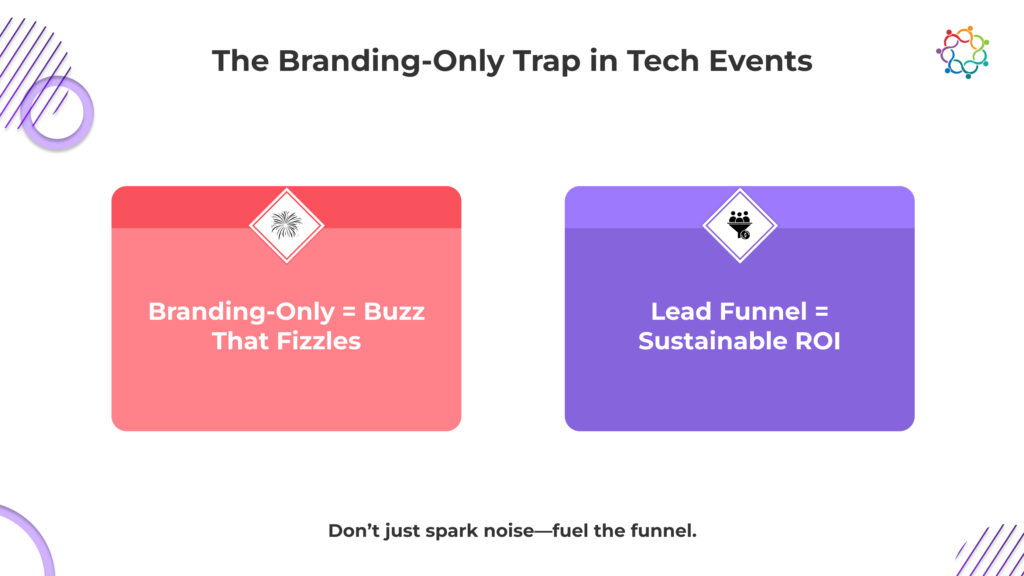
Branding is valuable, but when an event only considers branding efforts, the return is minor. Many SaaS and IT companies spend crores on their marketing via exhibitions, roadshows, and conferences, only to discover that the connection between the attendees at their branding event and the eventual revenue is tenuous.
Here are three reasons why a branding-first approach often does not work:
1. No measurable SQLs: Even if the booth drew 1000 visitors, if there is no system for qualifying, capturing, or tracking those leads afterwards, the value of a booth with varying attendee numbers can only be anecdotal.
2. Vanity metrics: Footfall, likes, and buzz do not convince pending investors. Boards are looking for metrics that tell the whole story of potential contribution back to the company, and therefore, want to see pipeline impact, closed-won deals, and even retention impact.
3. Missed opportunities: When a structure does not exist to capture potential leads from an event/booth, they all but disappear. Prospects leave with a paper brochure, and sales teams are left with no meaningful.
For instance, a SaaS expo where a company generated 1,000 leads in an Excel file and had no capability to CRM meant that by the time sales teams got to manually following up weeks later, most prospects were ice cold and the entire investment in attendance was wasted.
This makes an important statement about reality: it costs money to have tech-type events focused on optics rather than outcomes.
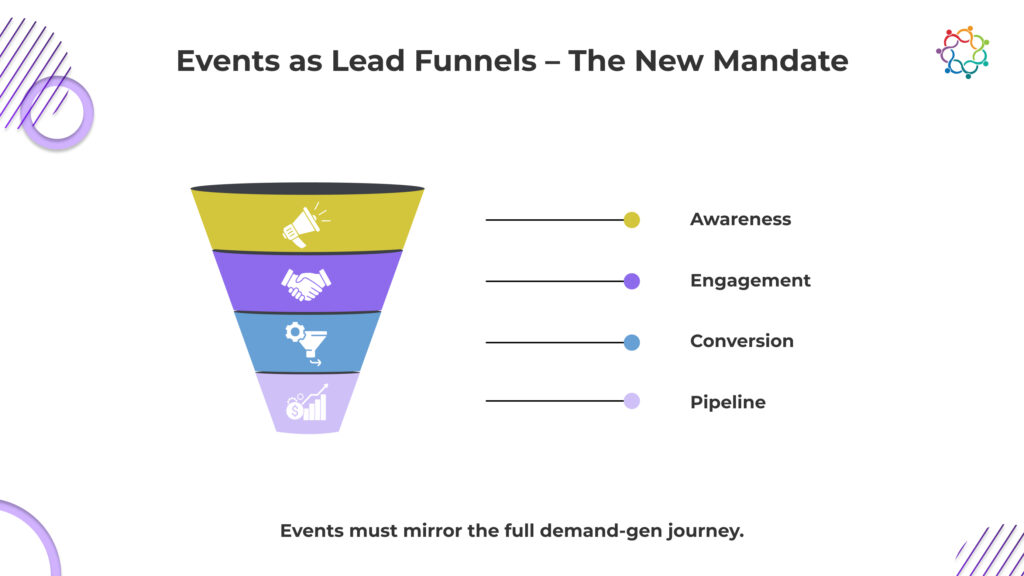
Today, progressive SaaS and IT leaders want events to become the next extension of their Demand Gen funnel just as digital had the explicit pipeline layout moving from impressions to conversions. Events simply need to be executed through funnel logic.
It looks like this:
Awareness – create front-end visibility through number of registrations, number of booth visits and number of people in keynotes.
Engagement – pick up data points with QR scans, demo sign in sheets, or people attending breakout sessions.
Conversion – use speed-to-lead by quickly moving MQLs into SQLs and tie the event quickly to the conversion.
Meanwhile, KPIs also need to shift. Rather than footfall, KPIs will track the movement from MQLs to SQLs to amount of opportunities created, pipeline contribution from the event, and revenue closed from event driven deals.
You can see this in the experience of a tech company using QR scanners for booth traffic tied directly to their CRM workflow, and within 48 hours, their sales development team booked 50 product demos. The speed and movement of conversion made the event shift from a branding.
This is no longer a suggestion; it is an expectation.
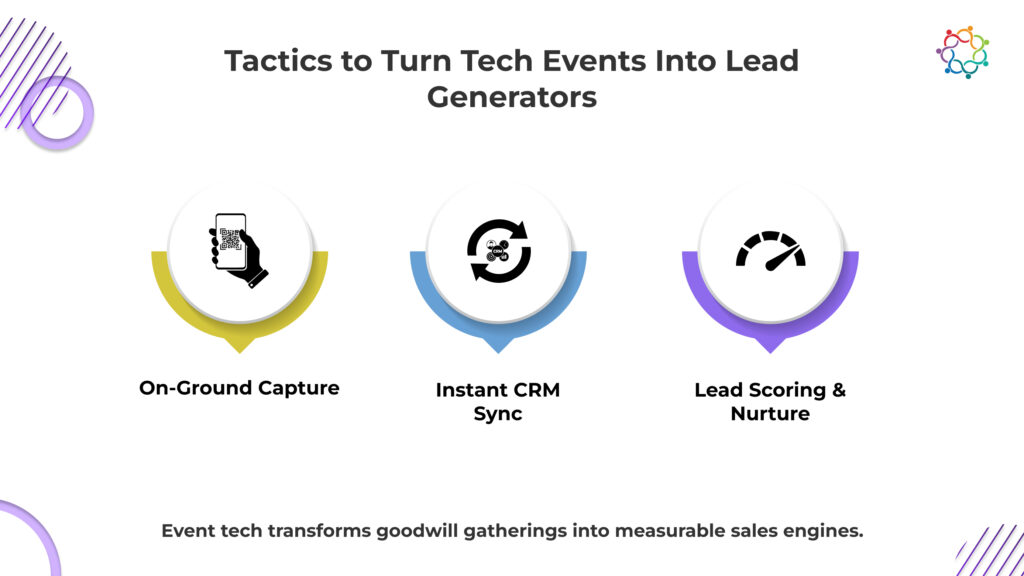
The evolution from brand-first to pipeline-first involves tactical evolution on the ground and technology infrastructure to support it. Here are four relevant tactics.
Booth QR/NFC capture – Rather than the fishbowls and business cards, use QR codes or NFC-enabled devices to instantly identify a possible lead and capture relevant data.
CRM integration to ensure real-time sync – Leads collected at the event must flow directly into your CRM, tagged with metadata that gives context to how they were captured. The objective is to eliminate lag time and put the wheels in motion for the follow-up while the lead is still warm.
Lead scoring model – Not every booth visitor is created equal. By scoring a lead on the role, engagement, and interest expressed, your team could have prioritized SQLs and increased focus on those high-value prospects.
Automated nurture sequences – This is a critical step that takes place after the event. Autonomous nurture workflow logic through email, WhatsApp or Text are important to ensure that no lead slips through the cracks. The right timely nudge can turn an event lead into a demo booking or signed contract.
All these tactical considerations maximize ROI while still holding yourself accountable to event planning when boards or investors come calling.
Samaaro’s event tech suite is particularly designed for the business that wants to turn an expense into a measurable sales engine:
On-Ground digital lead capture – QR codes make it easy to capture attendee data without human error or delay.
CRM sync for instant follow-up – Your leads are pushed directly into your CRM with full enrichment and event-related identifiers.
Pipeline linked dashboards – Samaaro’s analytics supports event engagement directly to revenue outcomes and provides your leadership with visibility on which events develop your pipeline.
Attribution tools – From booth scans to deals closed, every step is tracked (proving out exactly how an event contributed to your bottom line).
With Samaaro, companies no longer must choose between social and buzz or “accountable for continued revenue.” They can deliver both media experience and measurable event record keeping along with credible metrics.
Brand awareness is critical, but it is not enough. In a world where every rupee spent is questioned you need to prove your event justified its budget by providing real-world sales impact.
The days of webinars, tradeshows, conferences, etc. are simple branding exercises are over. Tech companies who think differently and return to decorating a final budget excuse will be left negotiating costly expenses with little to no concrete examples of contribution to the pipeline.
On the other hand, tech companies who live the experience of the event business model have a real opportunity to show revenue outcomes from purely remark with demos and sign conventions happening because of the event. The message is clear: brand buzz gets attention; pipeline wins budgets!
Have you transformed an event into a sales funnel? If not, go check out Samaaro’s event marketing suite today.
Medical events, especially Continuing Medical Education (CME) conferences, operate in a high-stakes environment. For corporate events, the worst outcome may be wasted marketing spend. But CME events are tied to professional licenses, strict compliance requirements, and the credibility of medical associations. A single error in tracking attendance, reporting, or certificate issuance can jeopardize a physician’s career and damage an organization’s reputation.
Despite these stakes, many CME teams still rely on disconnected tools: spreadsheets for registration, paper sign-in sheets for attendance, separate survey platforms for feedback, and stand-alone systems for issuing CME credits.
This fragmentation creates inefficiency, opportunities for error, and frustration. Physicians often spend more time in lines than engaging in the sessions, while certificates get delayed or mishandled.
Even if logistical issues are solved, disjointed systems still pose compliance risks. More than wasted time, they represent a structural weakness, eroding education outcomes, compliance standards, and the trust that holds professional medical communities together.
The value of CME credits cannot be overstated. Physicians and healthcare professionals need them to maintain licenses and practice across specialties. Licensing boards and governing councils require that CME credits come from recognized, approved bodies.
Every detail like attendance records, certificate timelines, and credit allocations must be exact and aligned with regulatory standards. Even a small error can have serious professional consequences.
When systems fail, the impact is immediate. Imagine explaining to a colleague that your CME certificate was delayed because of manual reconciliation, or worse, that credits were misassigned due to tracking errors. The physician is left frustrated, and the association loses credibility within the medical community.
This is not a theoretical problem. Many associations have faced backlash when certificates were delayed for weeks after CME events. Participants were left unsure if their attendance would count toward licensing requirements. Such failures are devastating, especially when tens of thousands of rupees are invested in organizing an event that must uphold accuracy and professionalism.
CME conferences are not just another entry on the calendar. They are pivotal professional milestones for physicians, and their integrity must be non-negotiable.
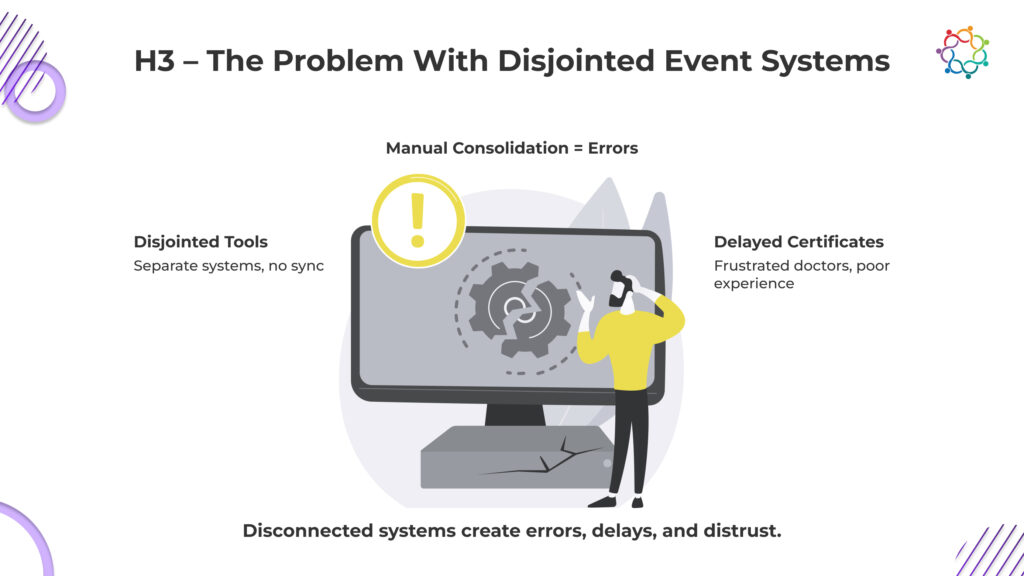
The ultimate cause of these issues is the disconnected way that so many medical conferences are run. Consider just one example of a single CME event. What can happen to a CME event is this:
Every transfer/tool connection adds additional risk to the possibility of failure. With manual attendance, there are inevitably typos, names don’t match, or attendance is missed altogether. Your attendees are frustrated waiting long lines at registration and at certificate collection. Your staff are burdened trying to create attendance data in multiple systems rather than focusing on their experience.
Ultimately, the lack of any systems linking does not lend to an efficient process in any form. Your systems do not talk to each other, and even worse, the organizer has no real visibility as to what is going on.
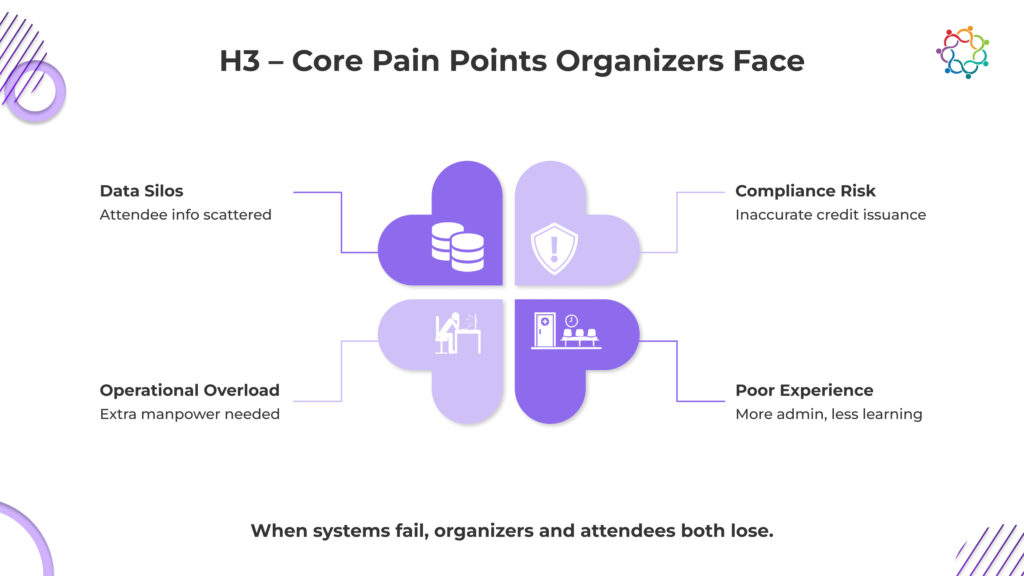
When using unconnected systems, organizers face four key challenges:
1. Data Siloing
Attendee information is spread across different tools. Registration is in one system, attendance in another, feedback in yet another. This makes it nearly impossible to see the full attendee journey or produce accurate reports.
2. Compliance Risk
Mistakes in tracking or certifying attendance can lead to regulatory issues. Even a single typo in credit reporting can put both the physician and the organization at risk.
3. Operational Strain
Event staff spend hours or even days reconciling data between systems. Time and resources that could enhance the learning experience are wasted on manual fixes.
4. Poor Attendee Experience
Doctors don’t come to CME events to stand in lines or chase certificates. Slow, cumbersome processes cause disengagement and damage the trust associations work so hard to build.
Overall, disconnected systems not only create silos and compliance risks, but they also alienate the very audience CME events are meant to serve.
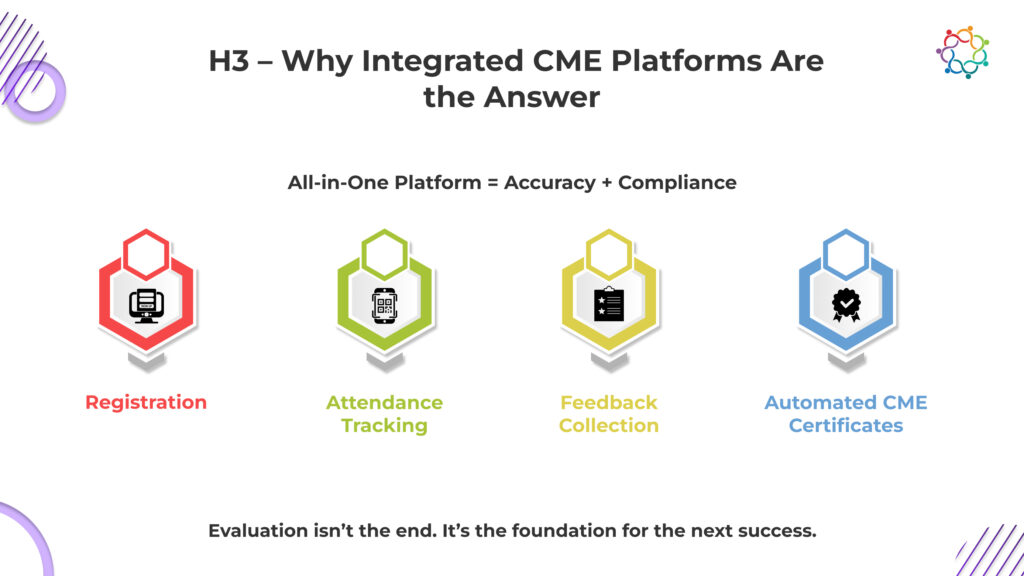
The solution is to have some level of integration or reasonably integrated platform to encompassing the entire CME journey from end to end. Instead of having to manage separate systems for registration, attendance, feedback, and certification, organizers can combine these processes into one easy to use system.
Integrated platforms are changing the way CME events are managed:
In short, while integrated CME platform can’t eliminate errors, it can increase efficiency, accuracy, and participant satisfaction.
Samaaro’s CME-ready event management platform was built to address the exact challenges organizers face, disjointed systems, compliance risk, and inefficient operations.
Here’s how Samaaro transforms CME event management:
With Samaaro, CME organizers can be confident their events are compliant, efficient, and truly focused on enhancing the learning experience for healthcare professionals.
CME events are not like other conferences. CME events exist in a world in which errors are costly. While a disjointed system may have been tolerable, and even acceptable, in the past, it is now an unnecessary risk.
By having an integrated CME platform, the organizer can transition from chaos to compliance. You can streamline your podcast and video offerings and protect your organizational credibility while providing doctors with a seamless learning experience.
For developers the message is clear- CME event management technology is not an option, it is necessary infrastructure for a successful, compliant and impactful medical conference.
Want to improve you CME or medical event management systems? Learn more about Samaaro today!
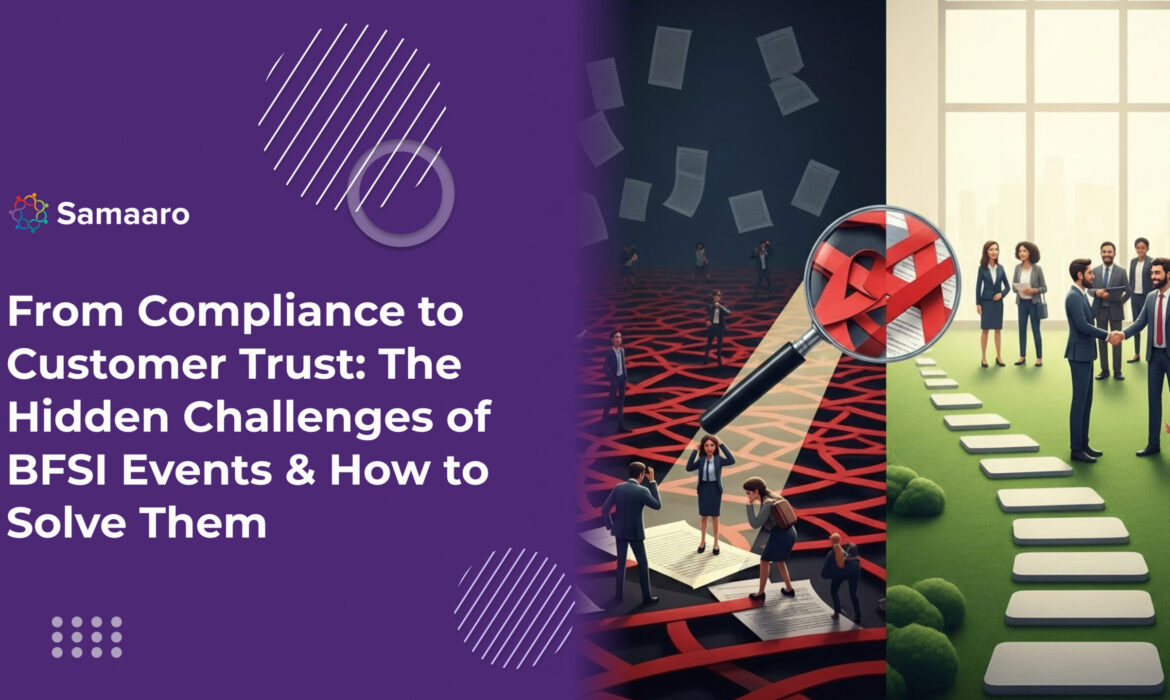
Experiences in banking, financial services, and insurance (BFSI) have a different feel than other business environments. Many businesses think about engagement and conversions; today’s BFSI firms are still thinking about that, but they have the added burden of compliance, and they’re striving to provide an authentic sense of trust with their customers too.
The balance is hard to maintain. Many firms focus their energy to produce the compliance piece and then forget the user experience. And others may put the fun and flashy part of the experience first and then forget to layer in the security and protections to avoid the liability.
BFSI experiences are about both authenticated trust and compliance. Trust is built not just through the rigor of a regulatory framework, but through personalization and transparency. The organizations that find their way are not the ones that see compliance as a result; the organizations that understand customer-first engagement is truly where the value is.
Compliance when it comes to BFSI experiences, is non-negotiable. Not only are BFSI companies expected to explain how the customer data is gathered; there are regulatory expectations that are reviewed around every presentation that is investigating the firm’s financial products. Both governments and regulators around the world are more often regulating BFSI experiences; specifically, as it relates to digital data.
Data Privacy Rules: BFSI Experiences require most organizations to handle highly sensitive customer data. A slight corner of your business ethics could prompt a potential breach; for instance, collecting event attendee details through a less secured channel could prompt a data breach for those customers who thought their information was protected.
Standard in Financial Communication: Every pitch of products, every keynote, every experience must be driven by regulatory rules. Not just communication, but potential over inducement of the product or potential marketing claims. Communication could potentially jeopardize individual and organization trust from over communication.
Audit Traces: Events are subject to audits; therefore, participant data must be audited. Organizations must track everything they have done with that data; date and time stamps can be used as audits; but that level of detail is needed.
Example: A global bank received heavy fines and reputational damage after attendees’ data were stored using third-party, unsecured applications. Not only was the firm hit with regulatory fines, but it also took the firm years to repair their reputation.
So, compliance is not just a box to check. It’s the baseline for all BFSI events.
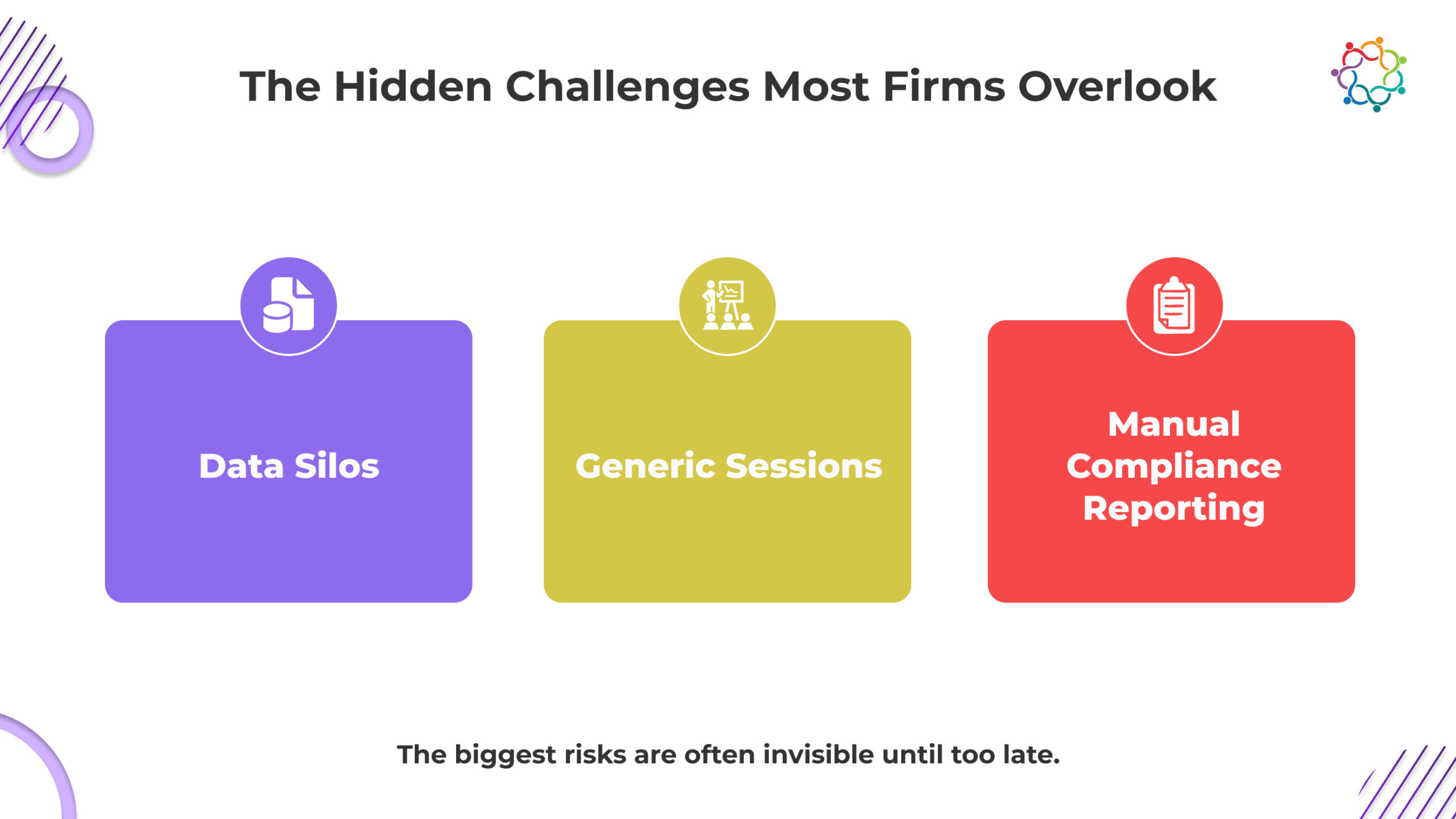
While compliance is top of mind for many BFSI firms, there are many hidden issues that unknowingly undermined events strategies. These issues can affect compliance but, more importantly, can erode customer trust.
Data Silos: Attendee data is often split into a registration platform, a feedback platform, and a CRM. When you cannot unify attendee data you cannot deliver a personalized experience or maintain an audit trail.
Generic Sessions: Many BFSI firms continue to use a one size fits all experience. HNIs, retail investors, corporate clients, and regulators are often stuffed into a generic session that does not address their issues. The attendee feels undermined.
Manual Compliance Reporting: Using spreadsheets and manual processes to reconcile registration data and sessions increases the risk of error – and even a slight error opens the firm to compliance risk.
These hidden issues may not get firms to comply fines, but they undermine credibility and trust which is worth more than the event attendance rate.
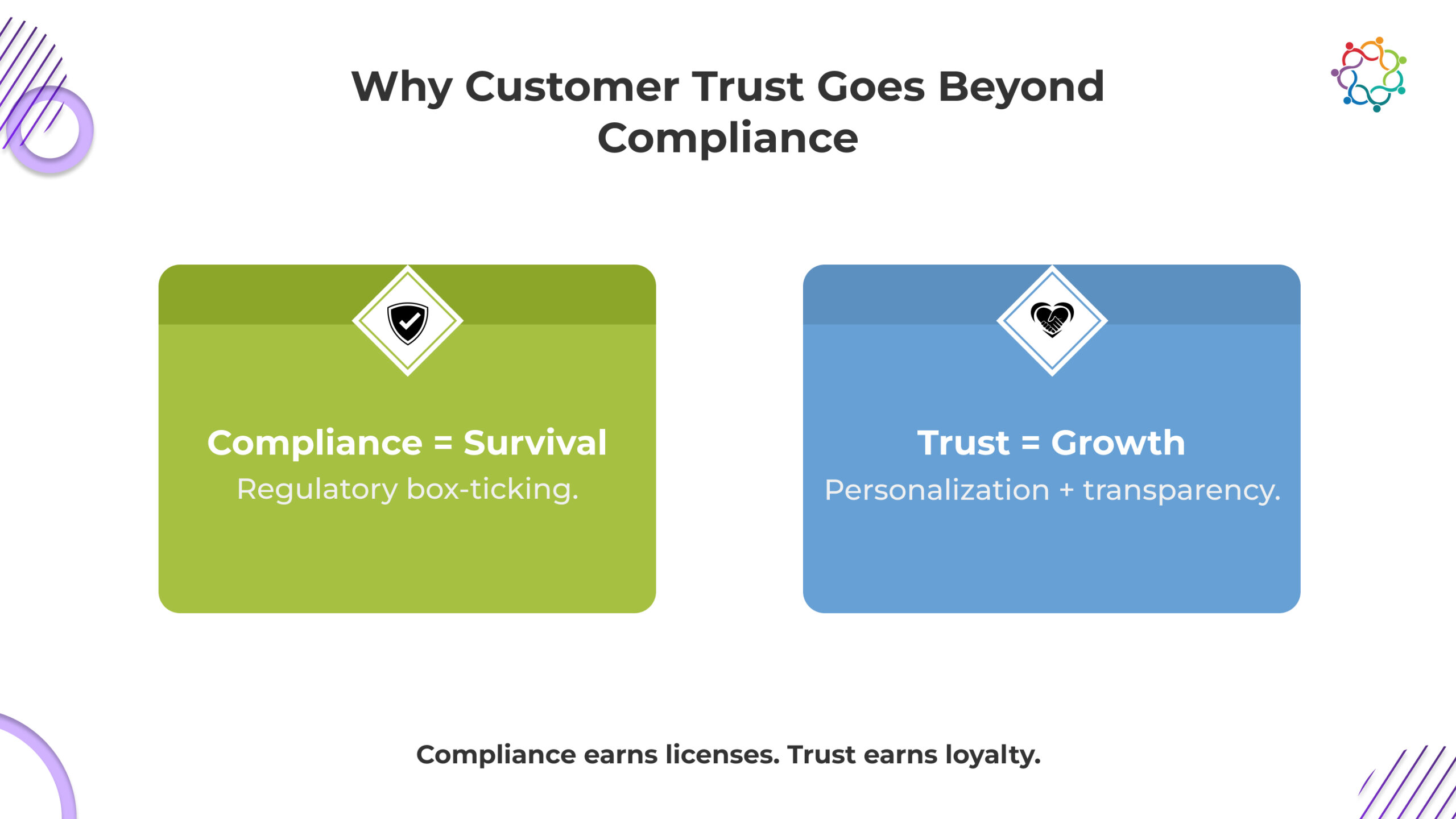
Compliance makes you compliant but does not create loyalty. Today’s consumers are seeking more than a secure platform; they want experiences that communicate they are valued and heard.
In the BFSI space, these are critical sessions, meaning networking, and transparency into what product and services are can be a pre-experience with them. It’s amazing what trust as a factor manifests when clients believe they have an experience that is still secure.
Example: A top BFSI brand wanted to renovate the client event that they hold annually. They curated their session from each of the audience: retail investors, corporate bankers, and wealth managers. Along the HNW clientele session purposed for HNW investment strategies. The results were remarkable with the client loyalty scores and matters of repeated engagement for the subsequent event significantly increased.
This example reveals a significant truth, that you might meet all the necessary regulatory directed items, but if you have not personalized it for your customer then it is not a premier event
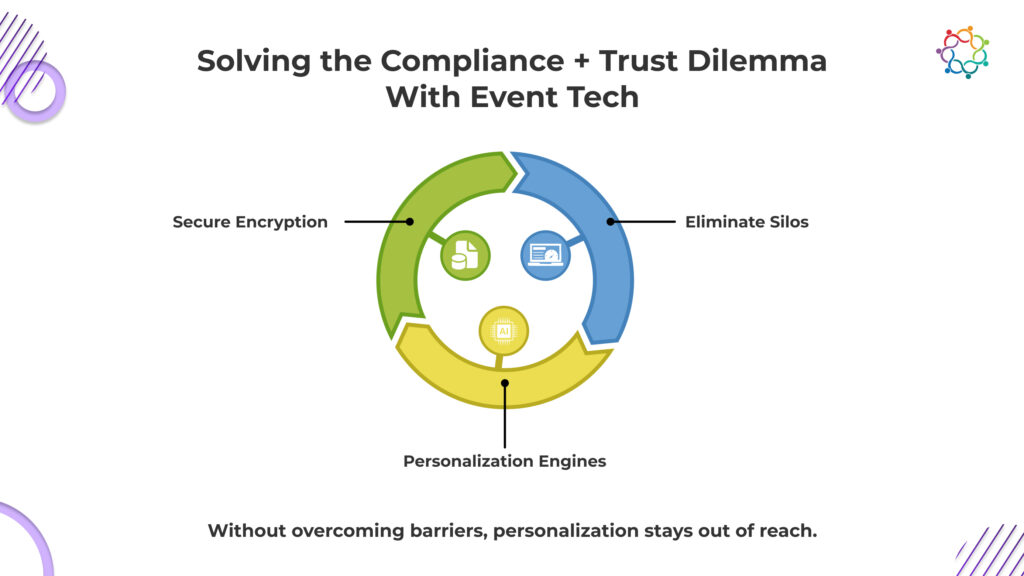
How can BFSI companies meet both demands, effectively, without completely tying their operational teams up with what needs to be?
Event technology companies develop modern Event technology platforms that offer compliance features, and your personalization metrics to improve the value.
Secure Encrypted Address- If you work with an event technology firm – you can be sure your data capture and storage meet international standards, protecting you from liability for criminal and regulatory or legal fines. GDPR is simply a part of compliance for an event technology firm to
Personalization Engines: With AI-based characteristics, organizers can create personalized agendas, suggest relevant sessions, and even identify appropriate individuals to network with based on interests. This way, each client feels they matter while ensuring compliance.
When done correctly, technology does not just mitigate risk but simultaneously establishes trust by facilitating secure and customized experiences that are transparent.
Samaaro’s BFSI-ready event platform is designed to solve the dual challenge every financial institution faces staying fully compliant while building trust through personalized client experiences.
Here’s how Samaaro enables both, without compromise:
With Samaaro, BFSI firms no longer have to choose between compliance and trust. The platform ensures events are secure, transparent, and regulation-proof, while delivering personalized experiences that build lasting client relationships.
In the world of high-stakes BFSI, compliance equals business as usual, trust equates to growth. A firm that can demonstrate security with transparency, and engagement with customer-first will not only establish a reputation with regulators. They will establish deep, rich long-term relationships with clients.
The hidden challenges of BFSI events; silos, generic experiences, manual compliance reporting is not insurmountable! With the right technology firms can benefit from secure, personalized and transparent engagements with attendees.
For BFSI leaders, the line has been drawn: compliance may keep you in the game, but trust helps you win it.
Interested in hosting compliant yet personalized BFSI events? Inquire about Samaaro’s BFSI event solutions!

For most CME event organizers and medical associations, success is measured only by how many physicians attended their event. The number of attendees does not go deeper into the success and engagement related to the event experience. Physicians and HCPs are busy, overwhelmed with information, and always questioning if the association and/or pharmaceutical brand is providing value.
If engagement ceases the moment the physician leaves the conference room, the organizer allows the opportunity to not build credibility and relationships. HCPs want continued value in terms of reminder value connected to compliance (like CE credits), digital communities, or on demand learning in bite-sized units.
Today, post-event engagement is not optional. You take a one-and-done engagement to build loyalty, trust, and influence.
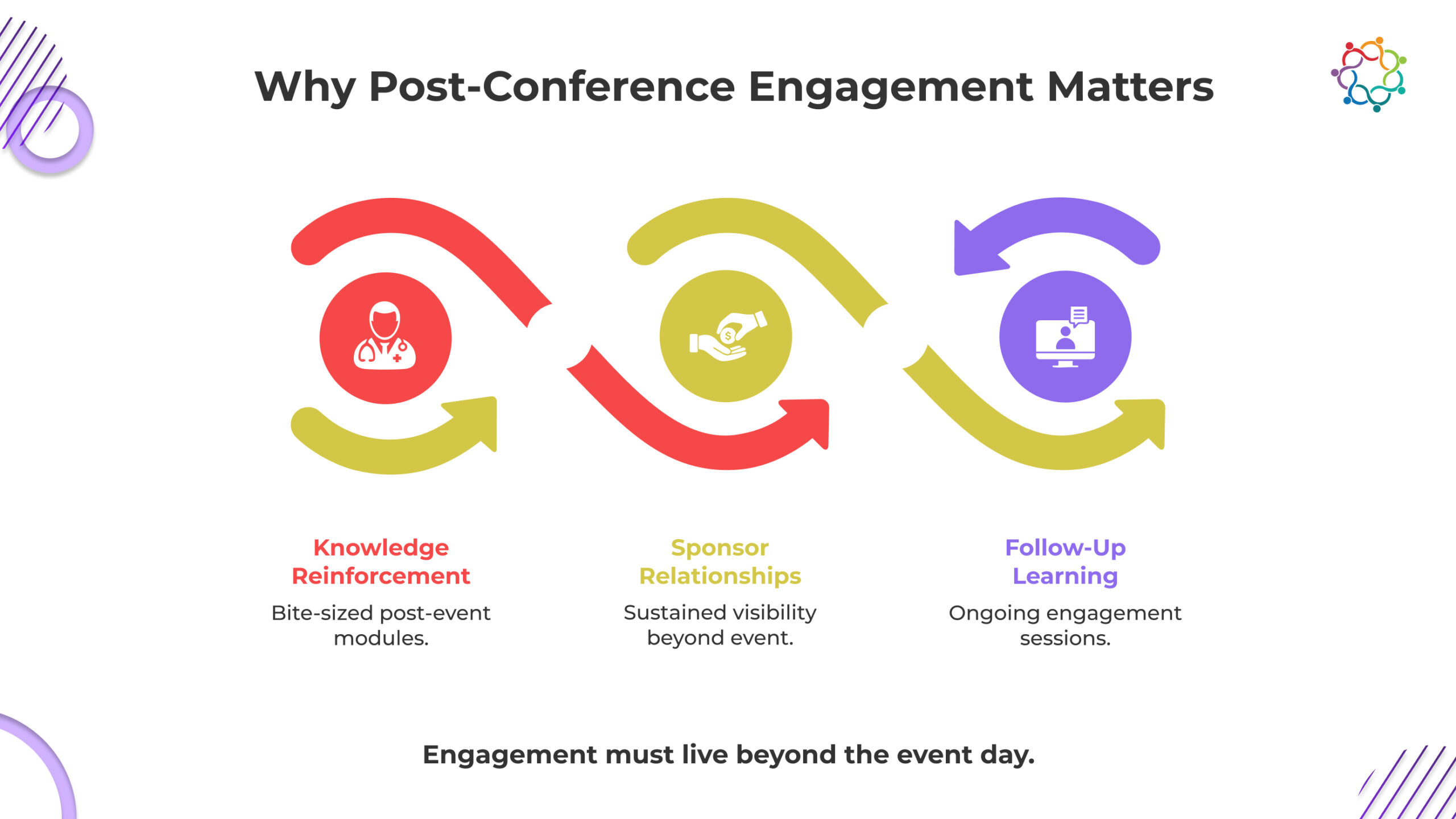
The stakes are higher in medical events than any other industry. Physicians don’t just attend networking events to get networking or branding awareness; doctors attend because the information may personally or professionally impact them and often continue compliance or licensing. This clearly demonstrates a sense of need to engage with the organizer and the attendees as one touch point.
Long-term engagement: The engagement experience and continued relationship after a conference or event means that the physicians keep engaging with the organizers, the association, and sponsors long after the conference ends. This means that the relationship can extend beyond the original giver of value.
Reinforcement of Learning: Complex science and medical education usually cannot be absorbed just in one setting; it takes repeated exposure to retain and reinforce what one has learned. As such, launching post-event microlearning opportunities, webinars, and content libraries are all opportunities for the physician to reinforce the value.
Thought-Leadership: Organizations that are engaging the physician after the event, are thought-leaders, and if they are a sustained engagement, they are credible. They offer more than one reason for hosting a conference or event.
For example, a global pharmaceutical organization saw an increase in the number of doctors planning to write their product three times over after sending follow-up modules of microlearning to doctors in attendance at their medical meeting. The organization transitioned from organizing an event, in one day, to providing knowledge engagement over a period.
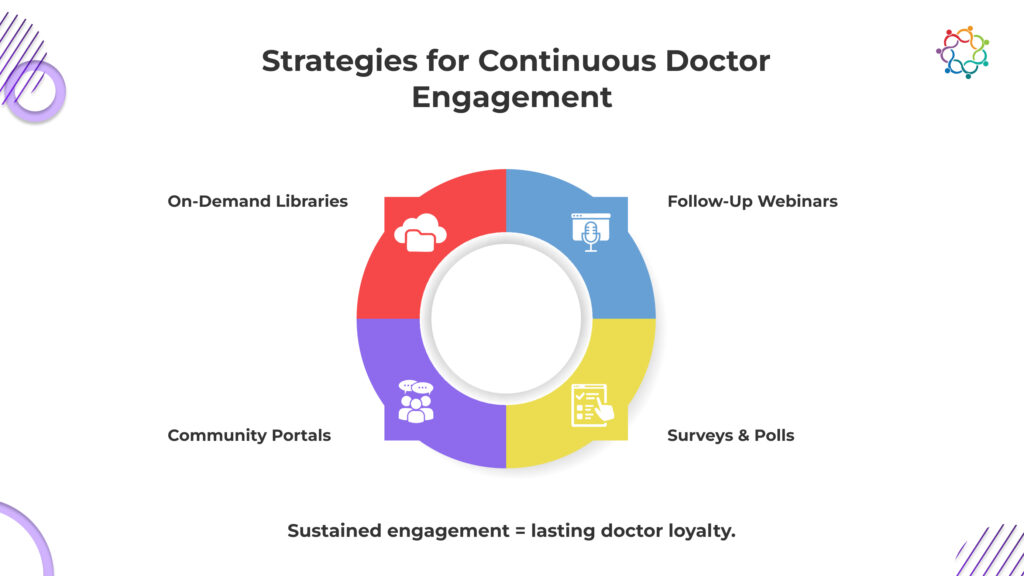
What does sustainable engagement look like? Successful ways that a meeting organizer can engage physicians are:
Physicians value flexibility. By offering a digital library of recorded content from the medical conference, additional readings, and modules they can earn CME credits that they can work through on their own timeline. Physicians can experience learning on their own time and extend the life of the medical conference content.
We hardly get time to discuss all of the topics in great depth at the medical conference. On a smaller scale, we can host topic specific webinars that can keep the path going for discussion but also one that provides an opportunity for physicians to engage with experts in a more personal way.
An exclusive closed members-only group encourages peer discussions or discussions between members of the same system. Sharing case studies, clinical updates, and moderator-led discussions create informal bonds that will extend beyond the event.
Two-way engagement is very important. By sending doctors a short survey or outreach poll after any meeting it gives an opportunity for the doctors to provide feedback or let organizers know their perspective while keeping the doctor engaged in the process after you have asked them to engage. Surveys also provide representation that the physician voice carries weight with the organizers and is another value that organizers should aim to build trust.
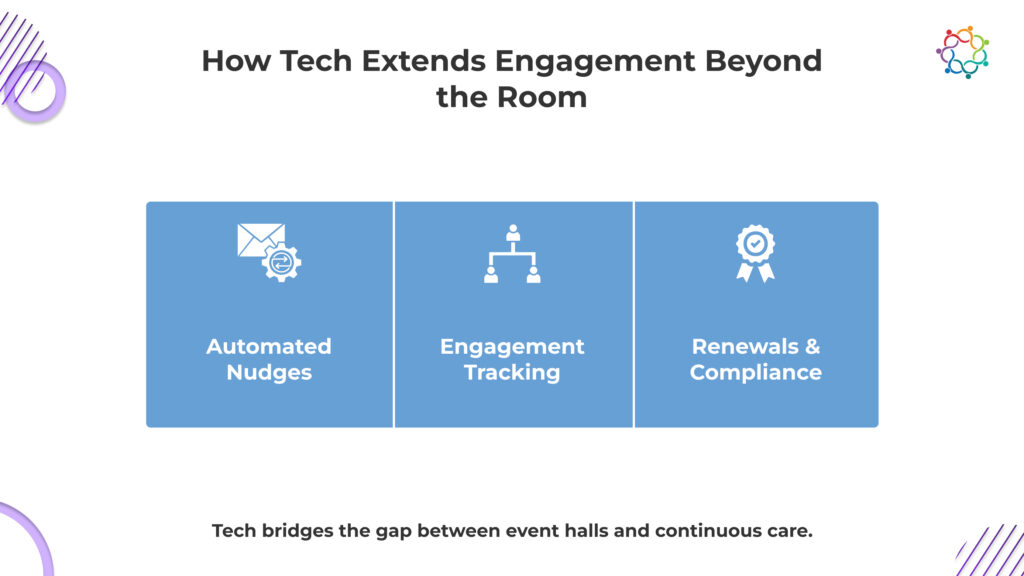
We do need technology engagement to create sustained engagement. Manually sending reminders and dispersing a lot of content to many places with engagement touch points can break down with one-off engagement tracking measures.
While there is a place for manual engagement, technology platforms minimize those issues and help organize the engagement by providing structured, automated engagement.
Automated Nudges: Doctors will receive a reminder about new content, upcoming certification expired, or a community discussion through email, SMS, or WhatsApp. Doctors will stay engaged and informed without the pressure of needing to remember to look for it.
Engagement Tracking: The platform can track which doctors downloaded educational pieces, attend a webinar, or engaged with their community, allowing the organizer to optimize and target
Reminders About Certification: Many physicians count on CME credit to meet licensure requirements and/or to renew their license. Rather than utilizing a manual process, automated systems help, by sending notifications to physicians when they are about to lose a CME credit and provide access to digital workflows that are easy to access for the purpose of renewing credits.
By increasing the digital engagement, organizers are establishing engagement ecosystems that fit tightly within a physician’s busy day-to-day professional life.
Samaaro helps CME providers, associations, and pharma brands transform one-off conferences into continuous engagement ecosystems. By connecting registration, learning, compliance, and follow-up in a single platform, Samaaro ensures that HCP engagement extends well beyond the closing session.
With Samaaro, CME events shift from being single-day gatherings into year-round engagement platforms, strengthening compliance, credibility, and trust with the medical community.
CME events and conference should not be considered single touch points anymore. In the knowledge-ecosystem of healthcare, the event and conference is only the beginning of the continuum of engagement.
Doctors and HCPs will want to continue ways to gain knowledge, they will want an easy seamless way to have that processed as compliant, and they will want further interactions worth their time in from their community. If the organizer does little after the conference, they become history! Organizations who build the foundation for post-event engagement through technology, are organizations who will create trust and make an impact.
In any case, CME is not a transaction, it is a long-term engagement.
Interested in continuing the HCP engagement after a conference? Samaaro healthcare event solutions!
For real estate developers, channel partner meetings are not just a “meet & greet,” but rather a way to build excitement around the partner ecosystem, build goodwill and ideally, sell inventory. Developers might spend lakhs on a venue, dinner, brochure, and once everything is done you realize the actual outcome on unit sales is much less.
Why? Enthusiasm does not sell projects. Without attribution or systematic tracking, developers are left with a lunch conversation and a promise, and nothing concrete to account for.
So, it’s not the partner meet format, it’s how the developer organizes the meetings. By layering in events technology, developers can turn channel partner meets from informal networking get-togethers into accountability-driven sales accelerator.
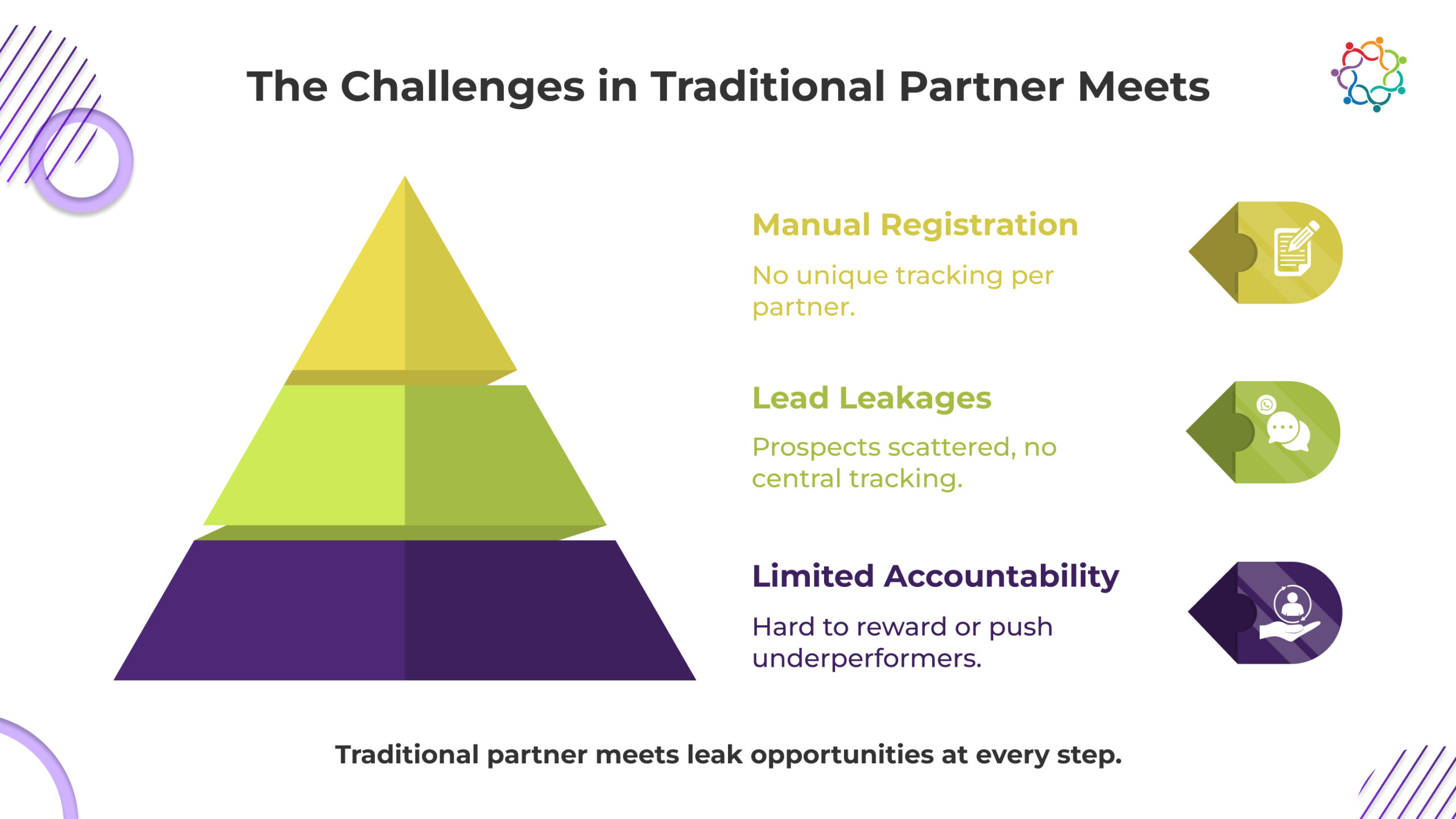
Despite the importance of channel partner meets, we still use the familiar, antiquated ways of running partner meet events.
Manual Registration & No Tracking: Partner names are collected either on a sheet or in a simple spreadsheet. No one needs a unique ID for the day or to track their contributions in the future. The creator developer won’t know after the event who called brought about what prospects.
Lead Leakages: Prospects discovered are often shared through a WhatsApp group or via personal follow ups leaving no central record. Leads fall into cracks and developers can’t attribute sales to a brand partner.
Limited Accountability: There is not an attribution aspect involved, meaning the underperforming partner can hide among the others. Meanwhile, best contributors are not receiving credit, acknowledgement or benefit.
One and Done: Partner communication is over once the partner meeting concludes. As nothing is in place for follow up, messy systems result in lost potential to build with promising partners for the future.
When taken all together, these precise reasons explain why ROI from partner meets is consistently. Without organization, developers cannot answer one simple question, “which partner is really moving the needle on sales?”.
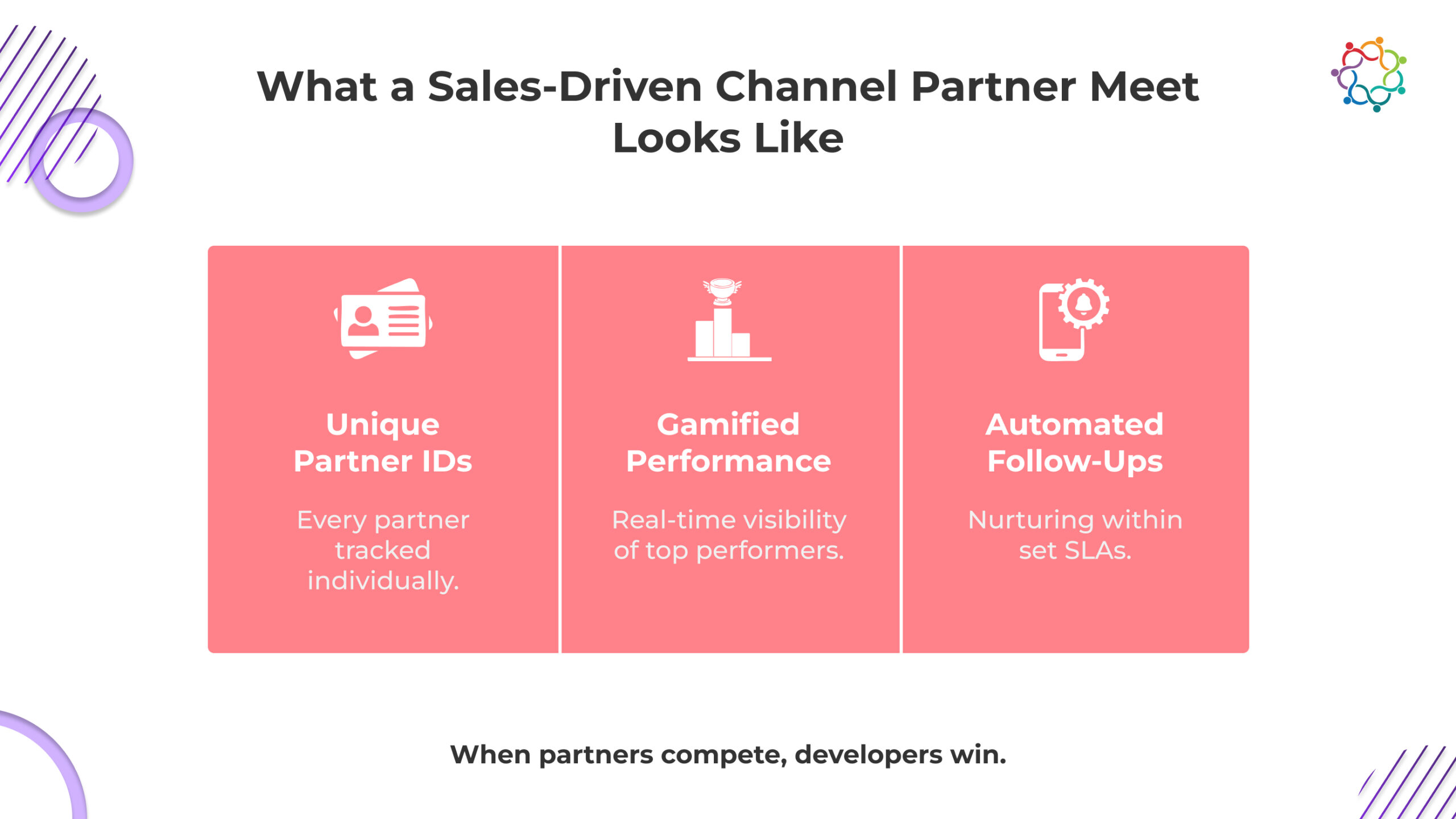
The secret to a sales-driven event is reframing how we think about partner meets as structured sales funnels. A sales-driven event has four core components:
Pre-Event Onboarding – In advance of the event, partners are assigned a unique digital identity which ties back every lead or opportunity into their unique identifier. You can see the clarity from the start.
Real-Time Attribution of Leads – As a prospect shows interest during your event, the system will automatically populate the lead with the associated partner – no data entry, no ambiguity.
Gamification to Spark Energy – Throughout the course of the event, leaderboards show which partners gained the greatest amount of expressions of interest or leads. The competition brought not just energy into the room, but also real competition to be successful.
Follow-Up Automation – This energizes the event further. Rather than relying on partners to follow-up after the event, the software gently prompts them to action within the agreed upon service-level agreements. This way no opportunity is missed.
The contrast is stark – traditional meets create conversation; sales meets create an actionable pipeline.
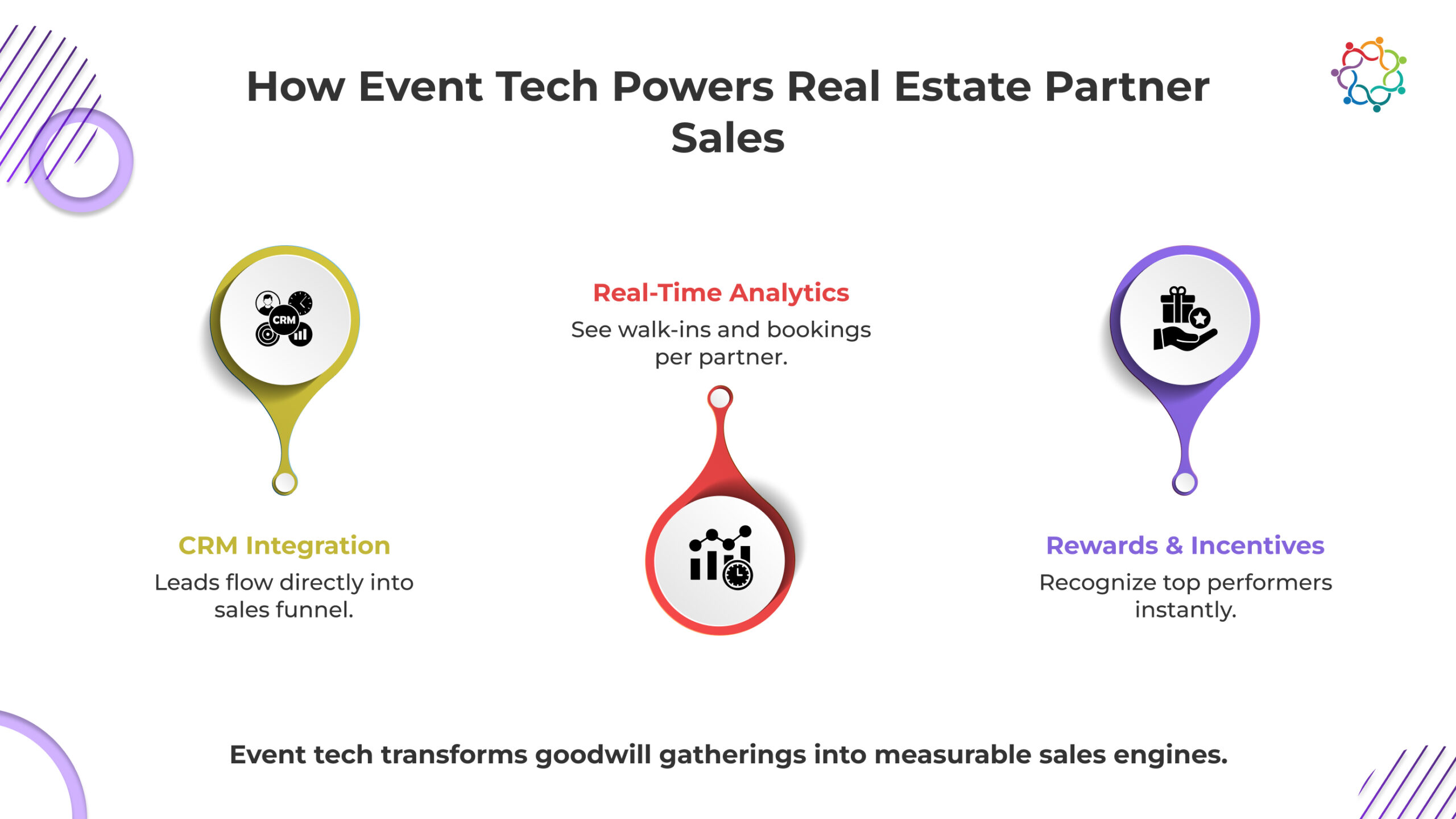
Event technology is what allows us to have accountability and results. Case:
CRM Integration – Every single lead created at the event will be exported back into the developer’s CRM. Thus, no leads will be lost, and developers will have complete transparency into their sales funnel.
Real-Time Analytics: Developers can examine dashboards during the event to see which partners are generating leads, which are driving visitations to the site, and which are actually turning into bookings.
Performance Benchmarking: Event tech enables benchmarking partner performance across many projects, events, and cities. Patterns emerge to show which partners perform consistently regardless of geography.
Reward Structures: With data transparency, the developers can apply reward models to real outcomes provide a benefit for high performers and targeted support for underperformers.
In short, event tech takes the guesswork away and allows channel partner meets to become a data-driven revenue accelerator.
Samaaro’s event platform is built to help real estate developers transform partner meets into structured, ROI-driven sales engines. By addressing the inefficiencies of manual processes, we enable developers to capture every lead, track partner performance, and prove outcomes with data.
Here’s how Samaaro powers channel partner engagement:
With Samaaro, developers can digitize channel partner meets end-to-end, turning goodwill gatherings into measurable sales engines that directly impact the bottom line.
Channel partner meets have historically been goodwill exercises, an opportunity for developers to thank and invigorate their networks. While that function is still important, it’s no longer sufficient. Today, developers cannot afford to run these types of events without accountability.
With the right event tech, channel partner meets can become structured, reportable, and ROI-based engines. The traditional partner meet becomes a quantifiable pipeline builder, rather than a moment in time of energy.
The roadmap is clear: developers who digitize partner engagement have reliably been able to convert conversations into commitments, from partnerships into predictable income.
To find out how to turn your next partner meet into an ROI sales engine, look to Samaaro’s real estate event solutions.
Banking, financial services, and insurance (BFSI) events exist during compliance, credibility, and customer trust. Their audiences, whether CXOs, investors, or high-net-worth individuals (HNIs), are notoriously knowledgeable and expect relevance, exclusivity, and efficiency.
However, many BFSI firms still think of event design in a one-size-fits-all way, with larger types of agendas and a generic type of messaging. The risk is that the engagement is diluted and opportunities to create real relationships are lost.
In an industry where trust and relationships equate to financial outcomes, personalization becomes the next big differentiator. The future of BFSI events is not about larger scale for scale’s sake, but rather creating experiences personalized to the scale of each segment present in the room.
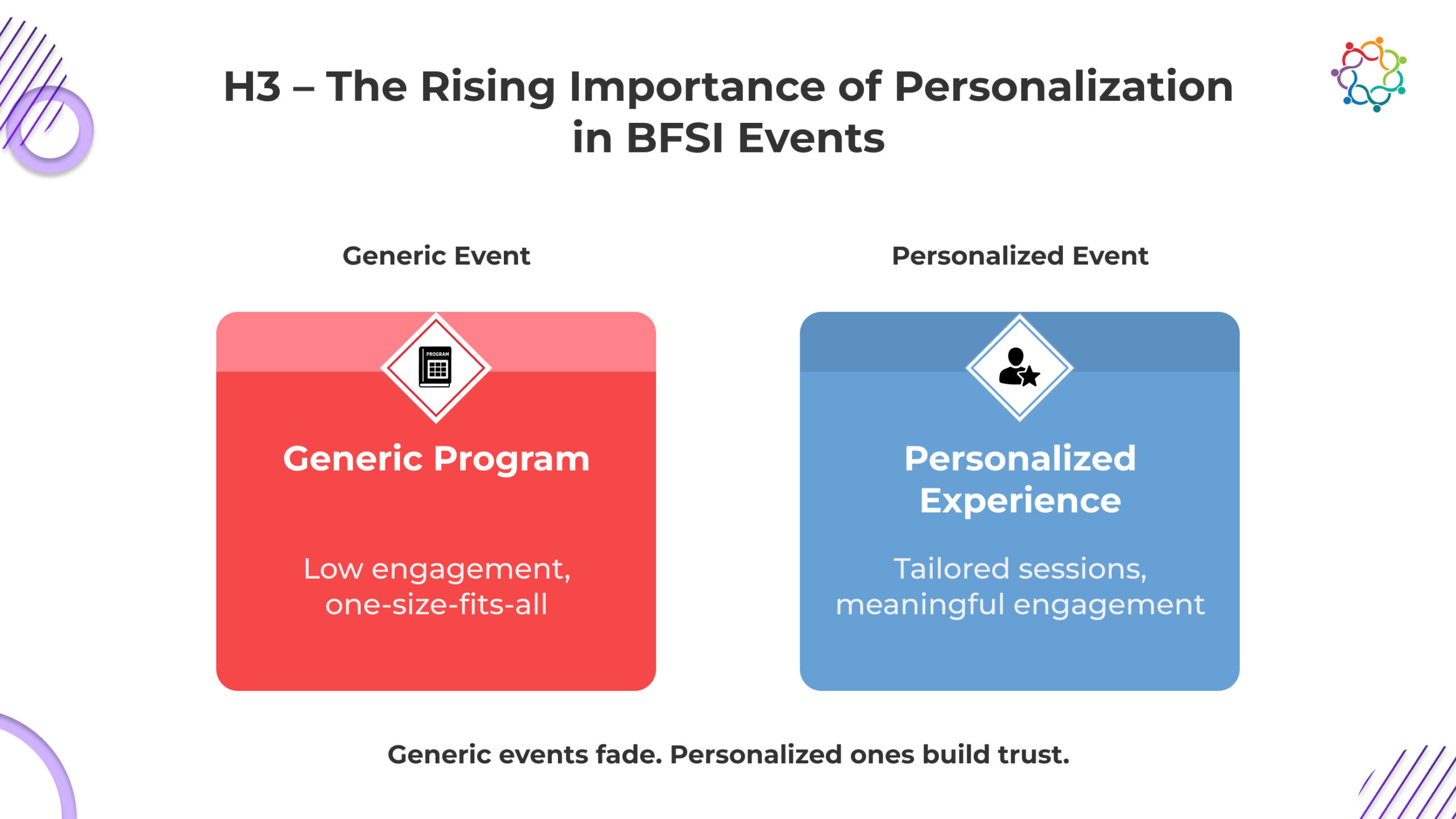
BFSI buyers and stakeholders have long decision cycles, frequently going through multiple levels of due diligence and trust building to get to their commitment stage. Every level of engagement, from pre-event communication to on-site networking experiences, need to mean something.
Personalization gives the sense of someone seeing you or recognizing value. It takes an event from a passive information event to a curated experience that engages the individual on some level related to their interests.
For example, at a financial leadership summit, a wealth manager who is present, may expect to be engaged with sessions around private client services, whereas a corporate banker would most likely be more engaged with treasury management or global payments. A single generic agenda runs the risk of catering to neither.
From customized sessions to customized communication, and to customized networking opportunities; BFSI firms can move the conversation “from broad awareness” to “deep engagement,” which responds to the trust and ultimately conversion.
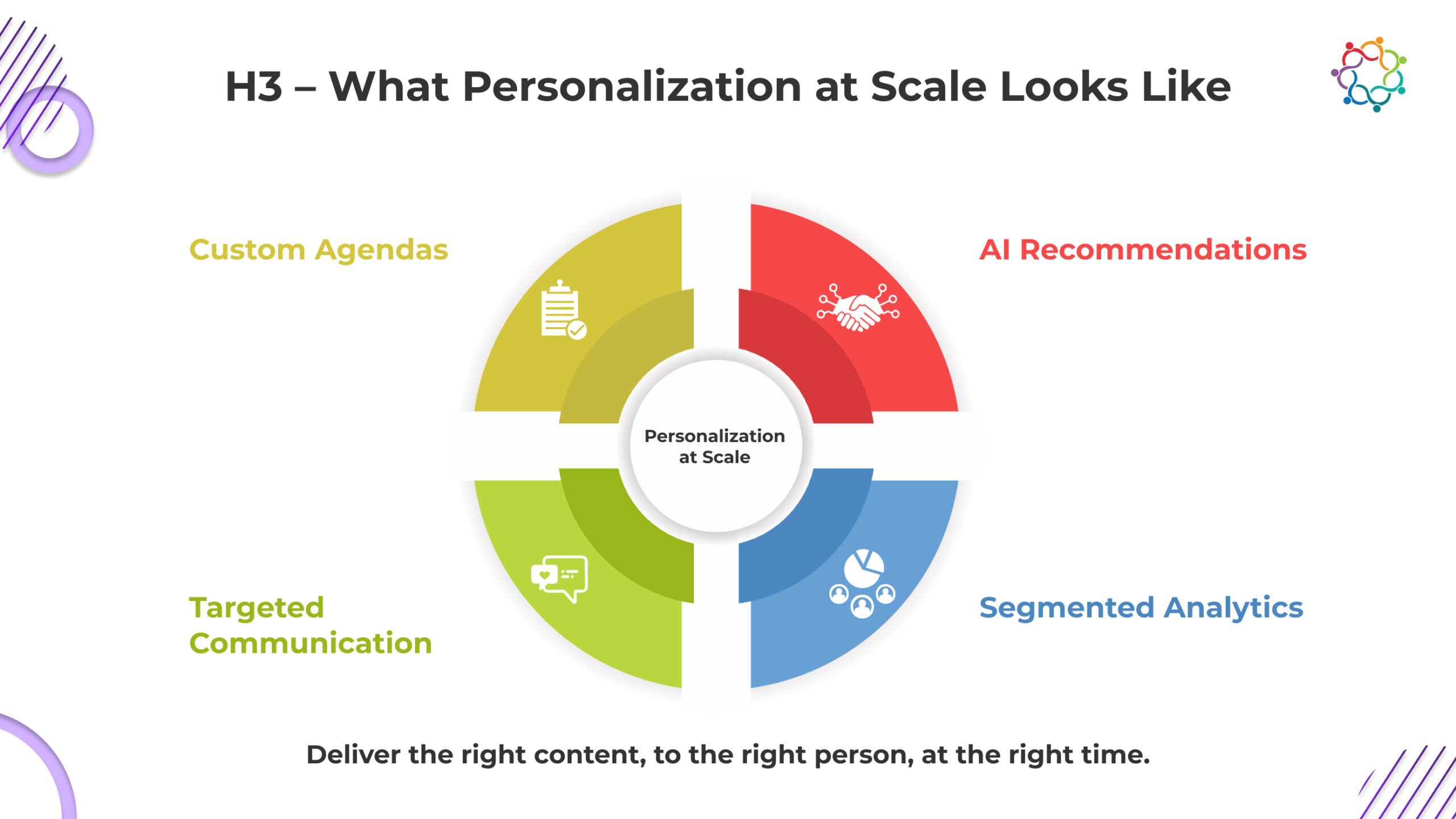
Personalization is not simply about the basics of greeting attendees by name. It is about rethinking the experience of an event across many points of engagement. And to truly personalize at scale means putting technology and process behind it.
This is personalization, at scale. Not just a random element of tailoring, but an organized, thoughtful approach to utilizing data to differentiate, that ensures no attendee feels like “just another guest.”
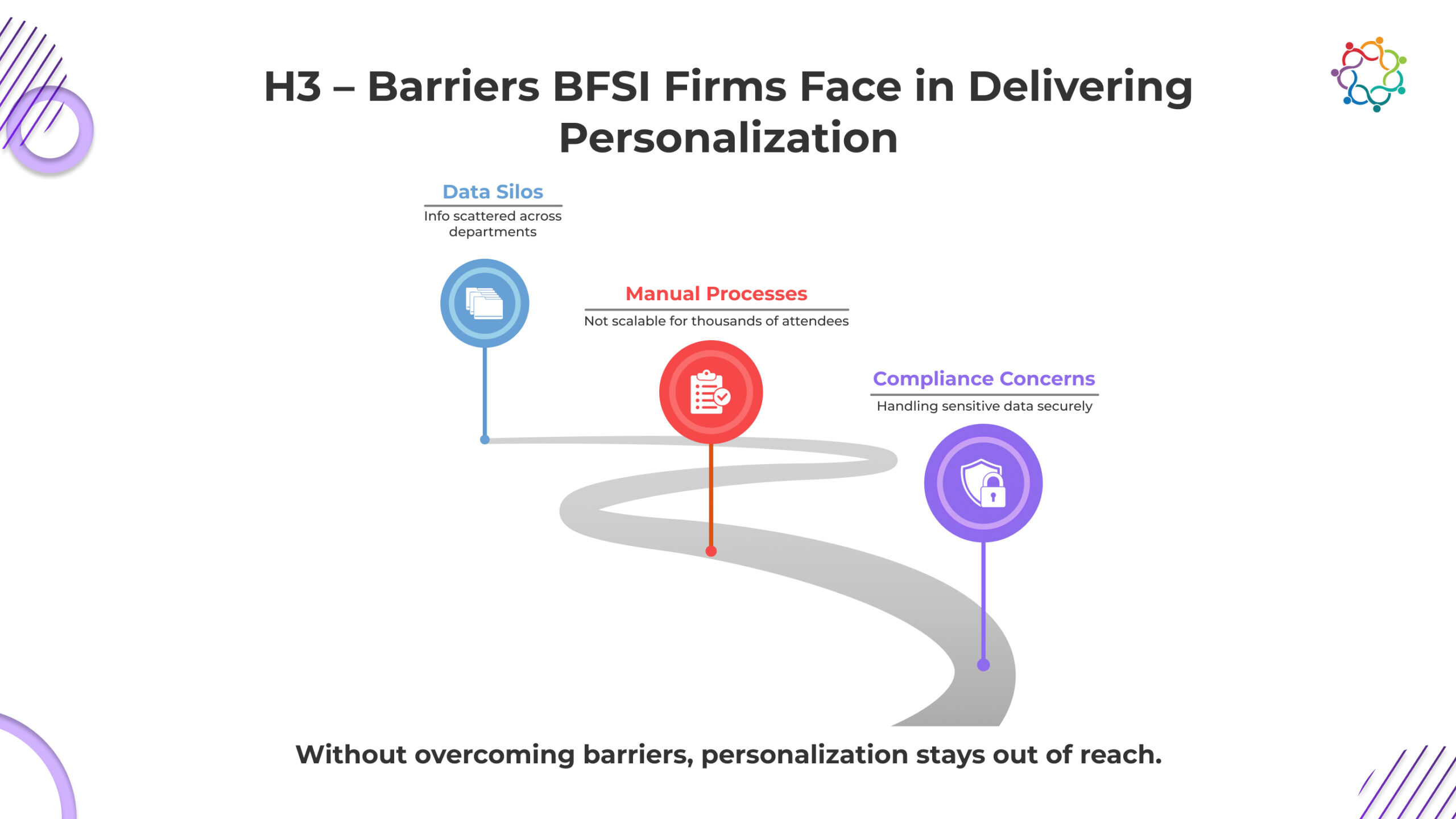
If personalization is so useful, why is there more personalization of event experiences being done across every BFSI event as of late? The short answer is that there are some structural stimuli that interrupt or make at scale personalization difficult:
Technology is the key to making personalization a reality in a highly regulated BFSI environment. With centralized data at their fingertips and effective pre-stage workflows automated, organizations leverage event tech solutions to scale curated experiences while remaining compliant.
The result becomes a win-win, the companies create the exclusivity their attendees are looking for, while maintaining operational efficiency and rigor that regulators require.
At Samaaro in Focus – Powering Personalization in BFSI Events
At Samaaro, we designed our BFSI event platform to meet the exact challenges of personalization, compliance, and efficiency in financial services.
Here’s how we help organizers deliver curated, high-impact experiences:
Samaaro enables BFSI firms to personalize at scale, delivering exclusivity, compliance, and measurable ROI without sacrificing efficiency.
The age of generic BFSI events is quickly becoming a thing of the past. In 2025 and beyond, personalization will become a meta distinguishing factor in whether the engagement event just “happened” or contributed towards developing trust, authentic engagement, loyalty and real measurable ROI.
By making a long-term investment in data-driven personalized event engagement for their attendees, BFSI firms can:
1. Develop deeper and stronger client relationships
2. Differentiate themselves from competing firms.
3. Engaging compliant events experience.
The takeaway is simple; personalization is no longer an aspiration; it is a necessity of the future. The firms who apply personalization, will set the new benchmark for the industry.
Want to go for BFSI event personalization at scale? Check out the data-driven personalized tools notice at Samaaro.