Samaaro + Your CRM: Zero Integration Fee for Annual Sign-Ups Until 30 June, 2025
- 00Days
- 00Hrs
- 00Min


Bottom Line: For Global MarTech leaders, Samaaro converts high-volume event activity into a measurable pipeline engine with real-time visibility across spend, data, and outcomes
Founded with a vision to simplify property discovery, Property Finder is one of MENA’s most trusted and influential real estate platforms. It helps individuals find homes, empowers brokers with data-driven tools, and supports developers in showcasing projects to the right audience. Beyond being a digital marketplace, Property Finder is a key voice in the real estate sector, curating high-impact workshops, exclusive networking evenings, closed-door roundtables, and industry award ceremonies. These events serve as powerful platforms to bring brokers, developers, investors, and regulators together to exchange insights, celebrate excellence, and shape the future of property markets. Every event is crafted with a focus on exclusivity, attention to detail, and meaningful interactions, values that reflect the brand’s premium positioning.
Registration & Ticketing, RSVP Automation, Check-in & Badge Printing, Event App, CRM Integrations, Marketing Automation
In real estate and other relationship-led B2B industries, over 70% of high-value partnerships are influenced by in-person interactions, yet fewer than 30% of companies can clearly measure how events impact customer engagement or loyalty.
As event programs scale across regions and formats, teams often track registrations and attendance, but struggle to connect participation with deeper outcomes like product adoption, repeat usage, or long-term customer value. The result is a gap between effort and insight. Events continue to consume significant budget and time, while their true business impact remains difficult to quantify.
For organizations running frequent, high-touch B2B events, closing this measurement gap has become as important as executing the events themselves.
In high-volume pharmaceutical organisations, manual event operations can consume over 20,000 working hours annually, with most of that time spent on coordination, follow-ups, reconciliation, and reporting, activities that add no direct strategic value. When multiplied across hundreds of events, even small inefficiencies quietly compound into million dollar-level operational costs.
Property Finder’s challenge was not about running events or managing logistics. Their B2B event program was already well-established and strategically important. The real challenge lay in extracting consistent, measurable business insight from events at scale.
As events became a core engagement lever for brokers, agents, and partners across the region, the team needed to evolve beyond execution and address deeper structural gaps.
Measuring event impact on customer engagement and adoption
While events were driving strong participation, it was difficult to clearly quantify how attending an event influenced customer behaviour over time. The team needed a reliable way to compare attendees and non-attendees across metrics such as engagement, product adoption, and loyalty, without relying on ad hoc analysis or manual data work.
Maintaining consistent end-to-end event journeys
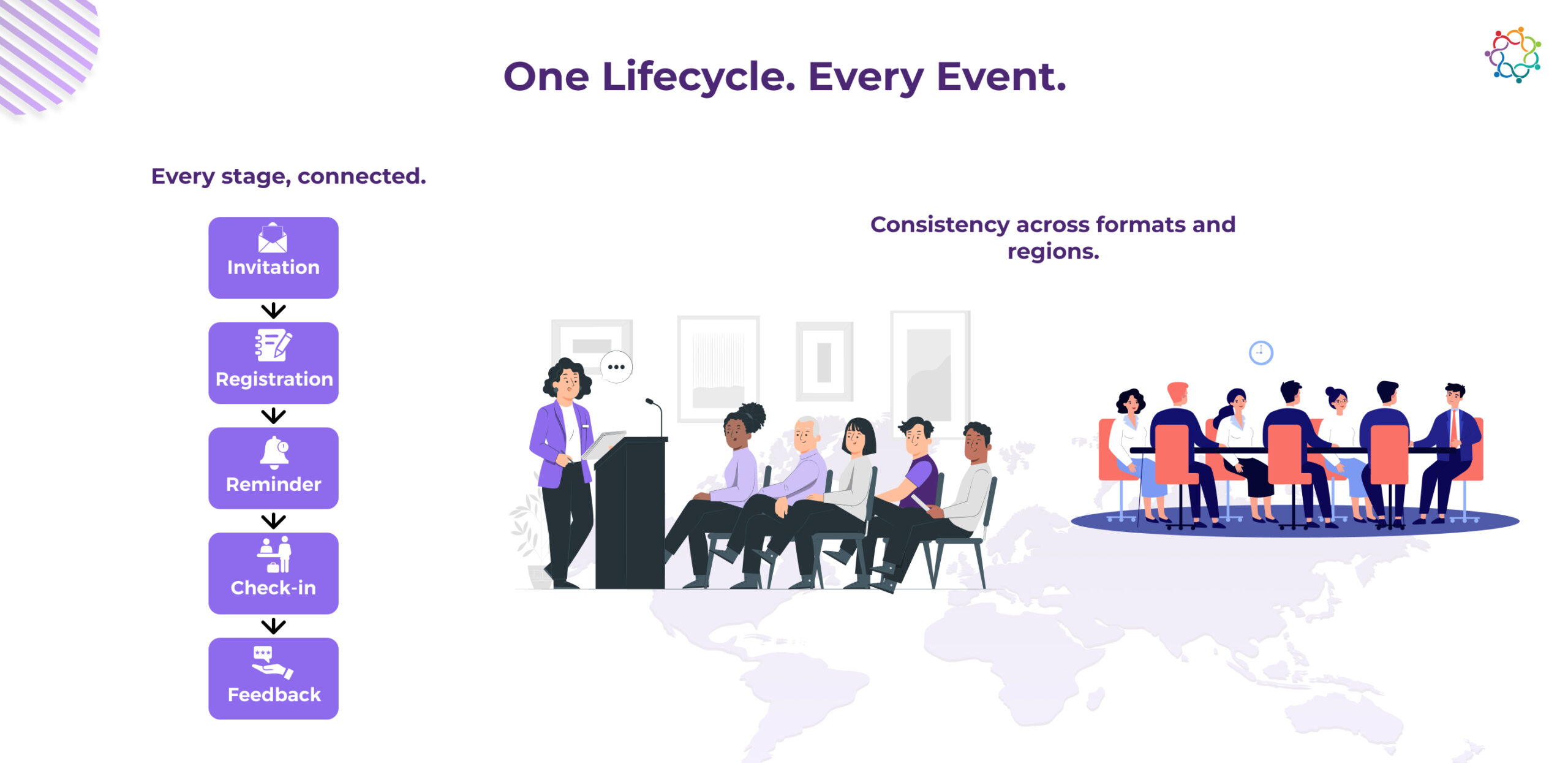
Property Finder required a predictable flow across invitations, registrations, reminders, on-site check-ins, and post-event surveys for every event format. Without a unified system, ensuring consistency across workshops, roundtables, and industry events increased operational complexity as scale grew.
Reducing dependency on manual coordination and specialist teams
Event data needed to flow cleanly into internal systems to support dashboards and cohort analysis. Any dependence on data teams or custom reporting slowed insight generation and limited how frequently event performance could be reviewed.
Ensuring platform reliability under complex requirements
With high expectations around brand experience and internal reporting, even minor system issues could impact confidence. The team needed an enterprise-grade platform that could handle complexity and customization without frequent disruptions.
End-to-end event lifecycle automation
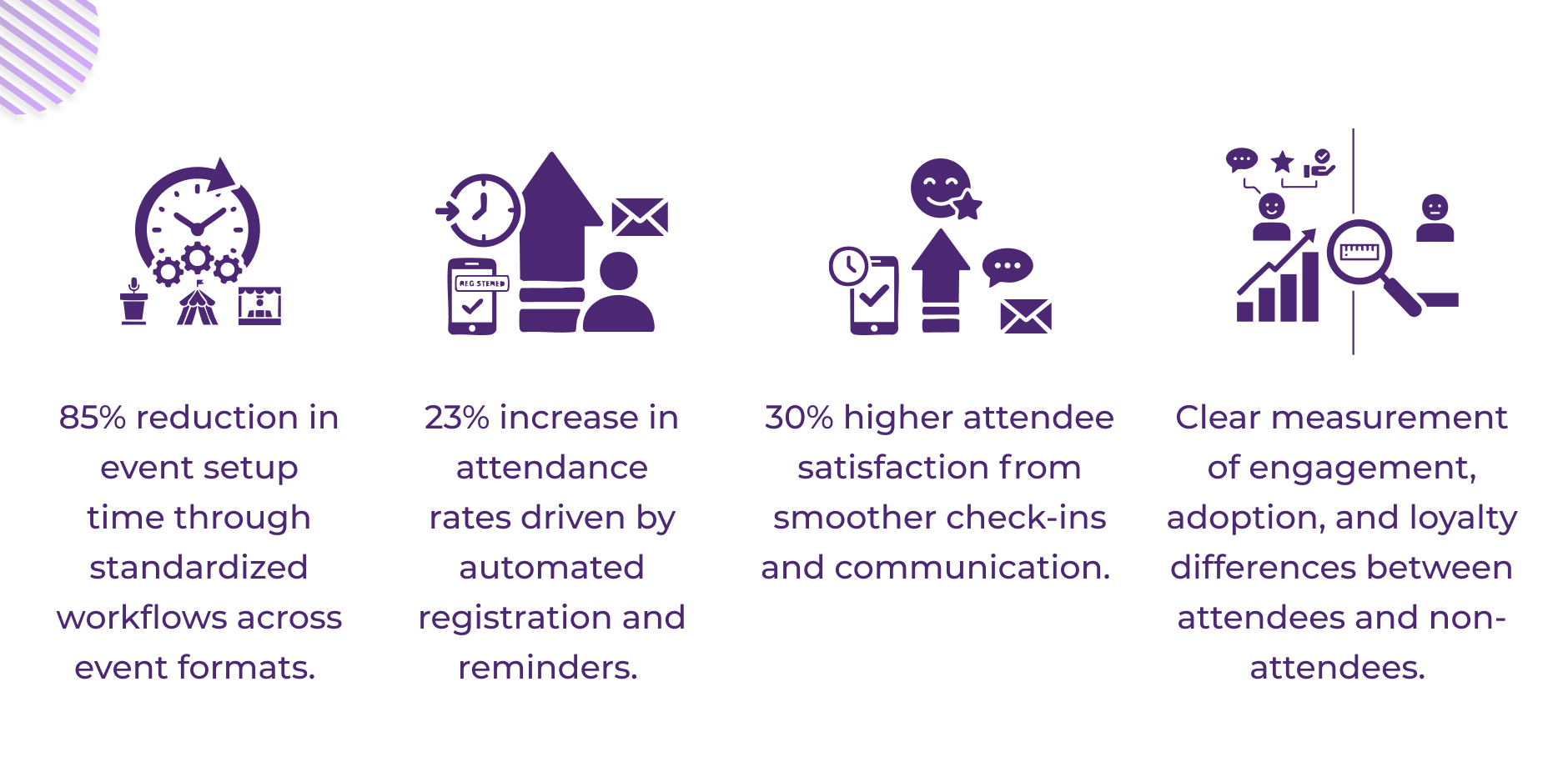
Samaaro enabled Property Finder to manage invitations, registrations, reminders, on-site check-ins, and post-event surveys within a single platform. This ensured every event followed a consistent journey, regardless of format or geography, and reduced operational variance across teams.
Reliable, enterprise-grade platform for complex B2B events
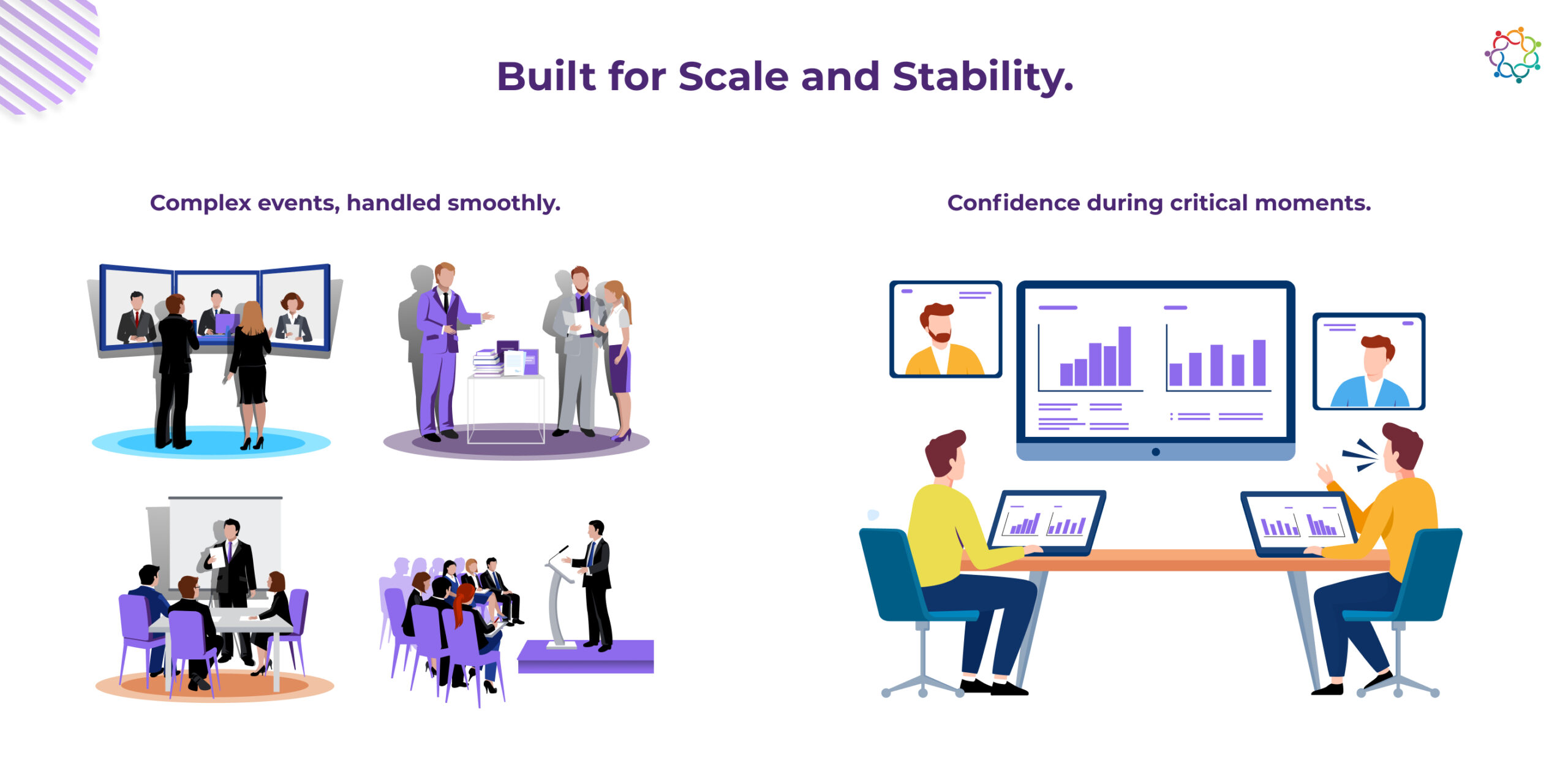
With frequent events and high customization requirements, platform stability was critical. Samaaro provided a dependable system that handled complexity with minimal disruptions, allowing teams to execute confidently without worrying about breakdowns during critical moments.
Measurement of event impact on engagement and adoption
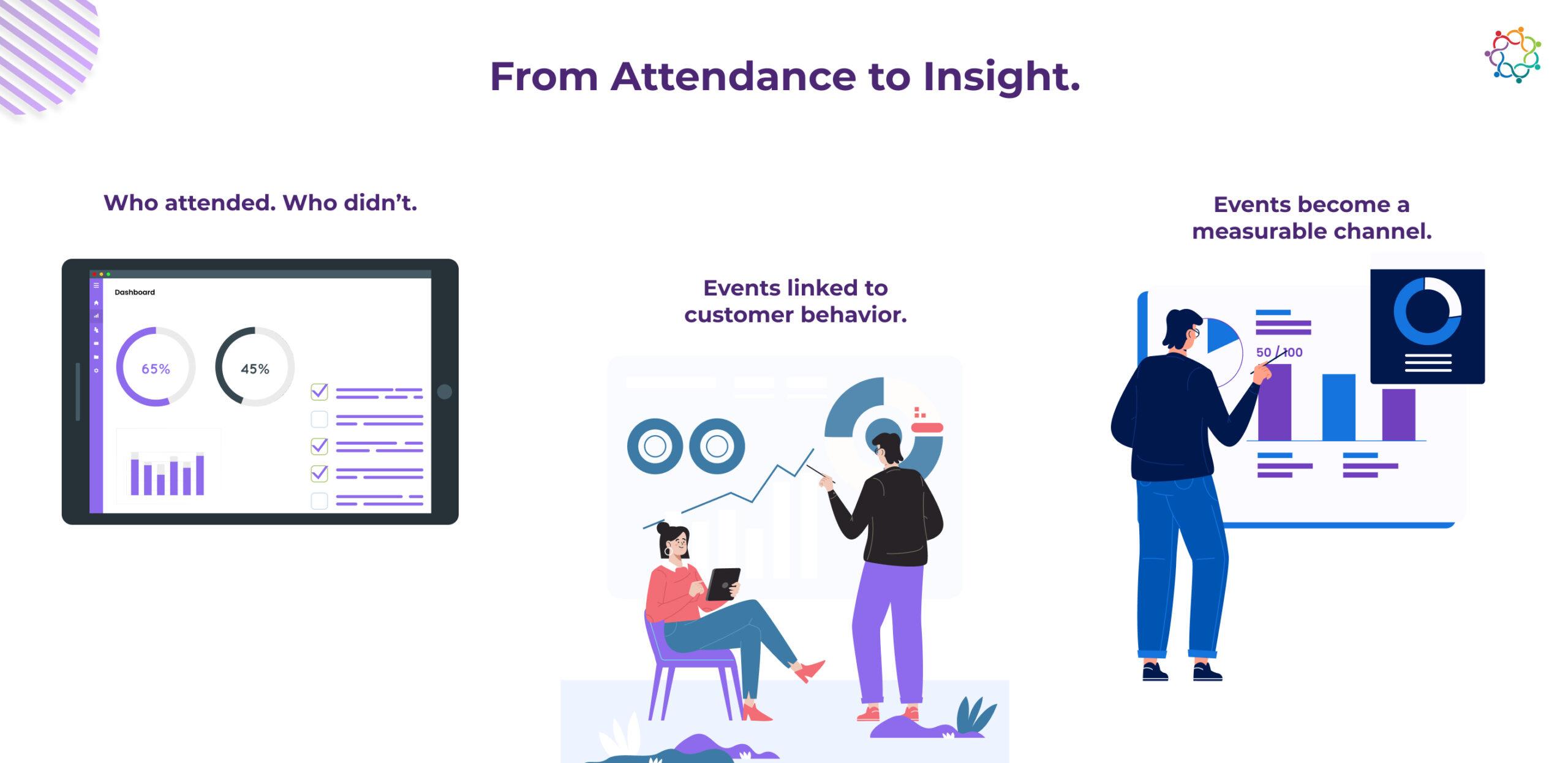
Beyond attendance tracking, Samaaro enabled the team to identify which customers attended events and compare them against non-attendees. This made it possible to analyze differences in engagement levels, product adoption, and long-term loyalty, turning events into a measurable engagement channel rather than a standalone activity.
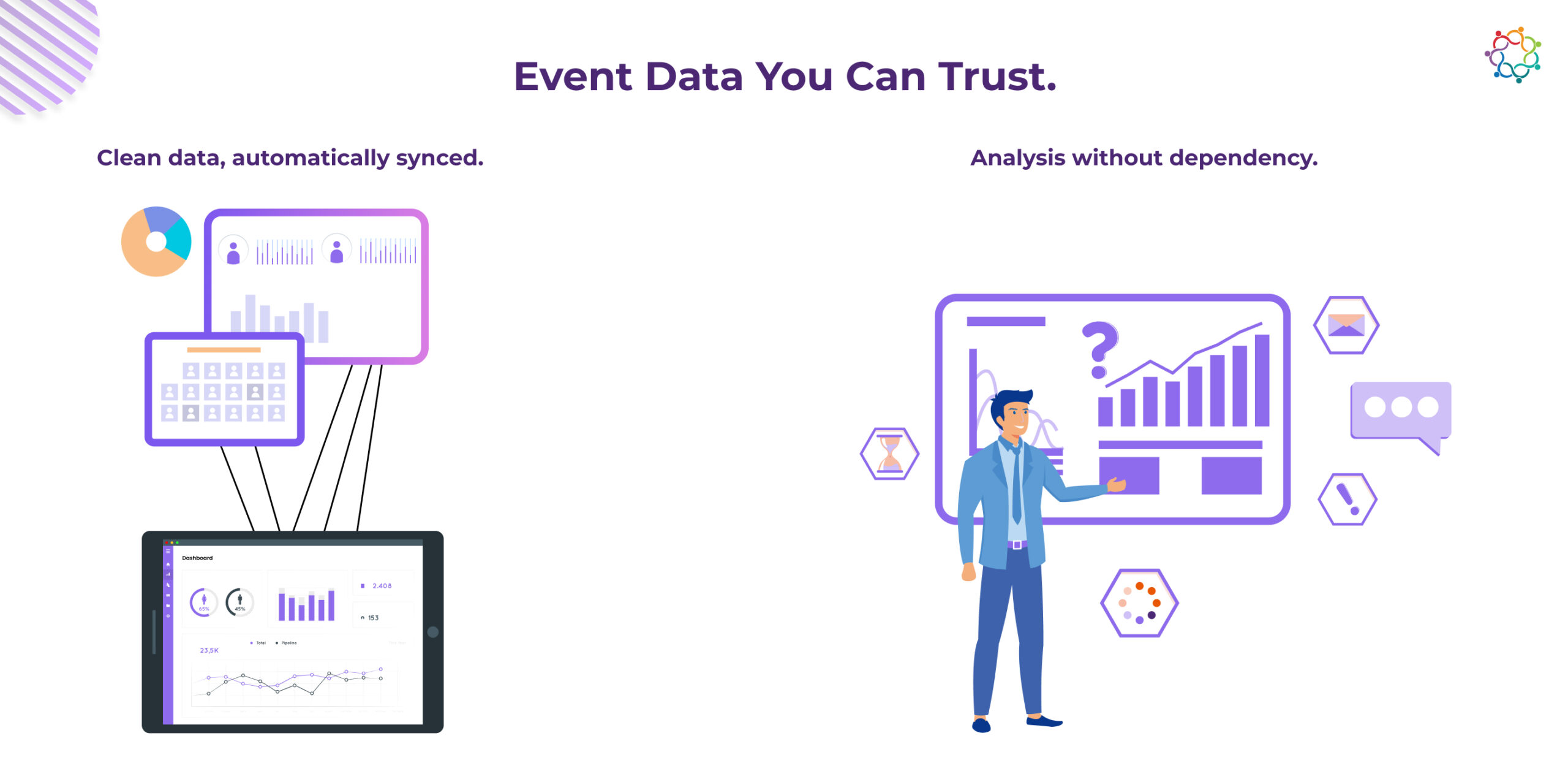
Seamless data flow into internal systems for analysis
Event data flowed cleanly into Property Finder’s internal systems and dashboards, reducing reliance on manual data handling or specialist teams. This allowed the marketing team to review event performance and customer cohorts more frequently and with greater confidence.
Flexibility and continuous customization at scale
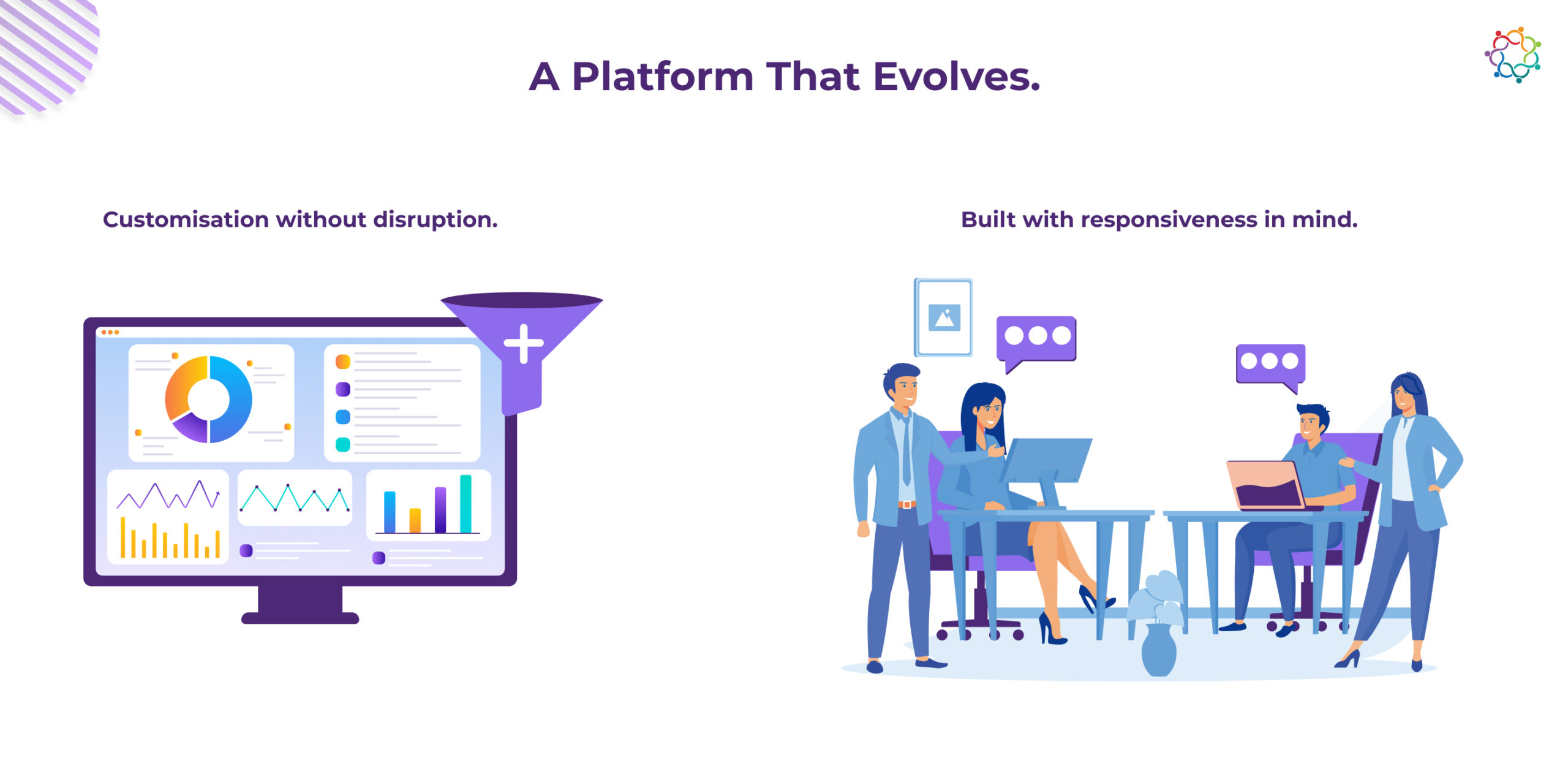
As Property Finder’s requirements evolved, Samaaro adapted with additional filters, reporting views, and workflow enhancements. This flexibility, combined with a highly responsive support team, ensured the platform continued to align with business needs over time rather than becoming a rigid tool.
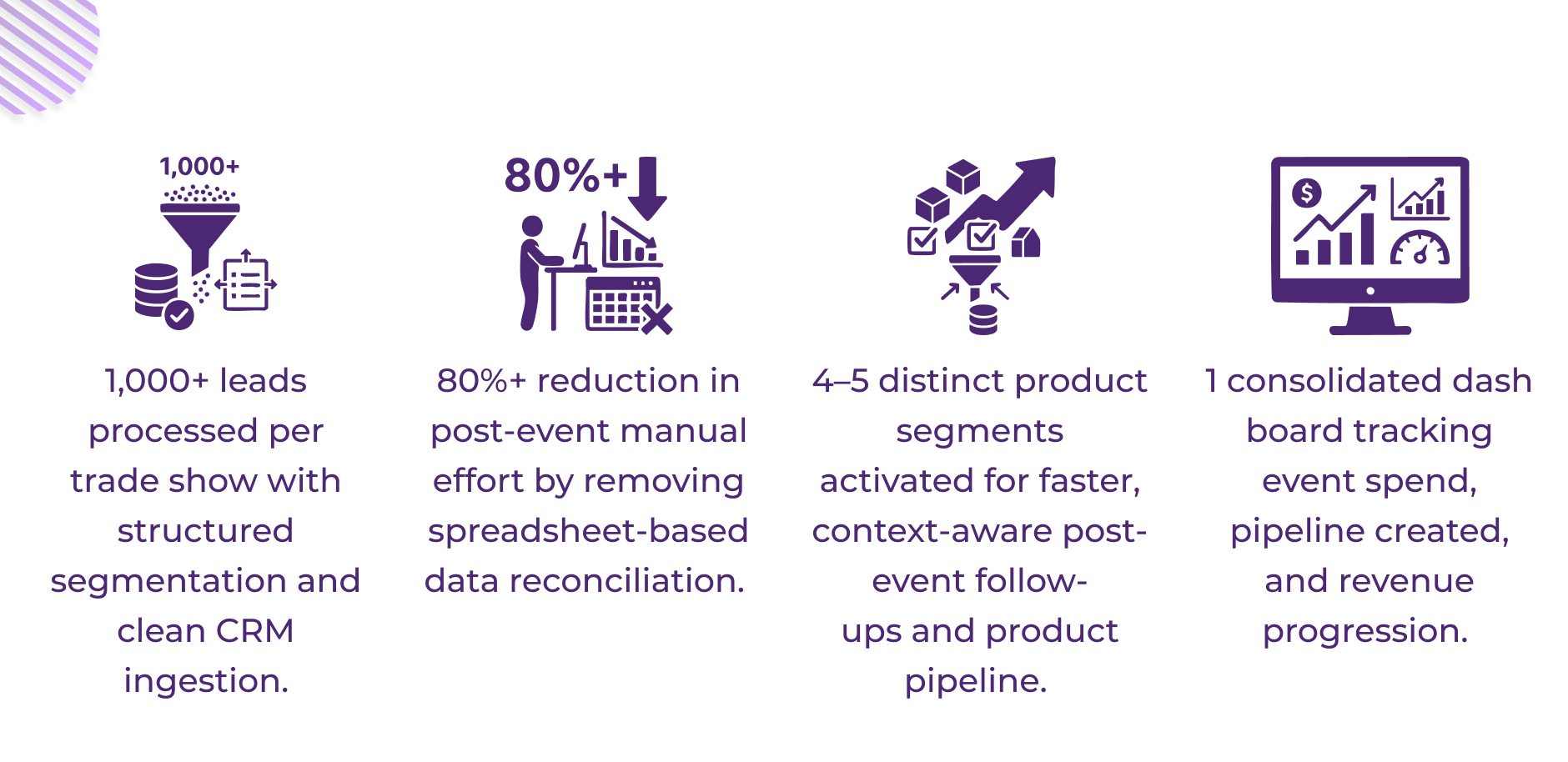
After a flagship trade show generating over a thousand leads, the marketing team prepared post-event follow-ups within days instead of weeks. Leads were already segmented by product interest, synced into Salesforce, and aligned with approved budgets and pipeline views.
Instead of assembling reports across multiple tools, leadership reviewed event performance through a single dashboard while sales teams moved directly into relevant, product-led conversations. The event closed with clarity, not cleanup.
“Samaaro helped us go beyond running events to actually measuring their impact. We were able to clearly compare customers who attended our events with those who didn’t and see differences in engagement, adoption, and loyalty. The platform was reliable even with complex requirements, and the team was extremely responsive and flexible throughout.”
— Nancy Matar, Head of Marketing, Property Finder
In B2B real estate, events are not peripheral marketing activities. They are core relationship infrastructure.
For platforms like Property Finder that work closely with brokers, developers, and partners, events play a direct role in driving engagement, product adoption, and long-term loyalty. As these programs scale, success depends less on hosting premium experiences and more on understanding which stakeholders engage deeply and how that engagement translates into business outcomes.
Real estate companies that treat events as measurable engagement channels gain a clearer view of their ecosystem. Those that don’t risk running high-effort programs without knowing which relationships are truly strengthening over time.
Bottom Line: For B2B SaaS teams investing heavily in trade shows, Samaaro transforms high-volume event participation from a cost-heavy activity into an accountable, pipeline-driven growth engine.
The Client is a global leader in travel and hospitality technology, providing AI-powered SaaS solutions to hotels, airlines, and online travel agencies. The organization participates in a high volume of global events, with a primary focus on large-scale third-party trade shows.
Events are a fundamental revenue lever for the client, moving beyond brand awareness to serve as a critical engine for generating qualified leads and influencing pipeline conversion. With a complex global marketing operation, the company is focused on operationalizing events as repeatable, automated channels that can prove their direct impact on the bottom line.
Event Management Software, Event Marketing Automation, Event Marketing and Promotion, Lead Assignment Hub and Queue Manager, Event Budget Planner, Task Planner and Team Collaboration, Feedback and Surveys
In B2B SaaS, enterprise trade shows often account for 25–40% of the annual field marketing budget, yet a significant portion of the pipeline they influence remains poorly tracked or under-reported.
Thousands of leads are captured on the event floor, but fragmented systems, manual data handling, and delayed follow-ups make it difficult to connect spend with pipeline creation and revenue outcomes. As leadership scrutiny on event ROI increases, marketing teams are under pressure to prove not just activity, but measurable business impact from their largest event investments.
This challenge becomes more pronounced at scale, where even small inefficiencies multiply across thousands of interactions.
In high-volume pharmaceutical organisations, manual event operations can consume over 20,000 working hours annually, with most of that time spent on coordination, follow-ups, reconciliation, and reporting, activities that add no direct strategic value. When multiplied across hundreds of events, even small inefficiencies quietly compound into million dollar-level operational costs.
The client’s challenge was not participation or scale. Their flagship trade shows consistently delivered high engagement and a large volume of leads. The difficulty lay in operationalizing that scale into measurable, repeatable revenue outcomes.
As the size and importance of these events grew, several structural challenges emerged:
Fragmented systems across the event lifecycle
Pre-event planning, on-ground lead capture, post-event communication, and CRM updates were handled across multiple platforms. While each tool served a purpose, the lack of a unifying event layer led to manual data transfers, repeated clean-ups, and heavy dependence on spreadsheets to stitch information together.
Manual effort dominating post-event workflows
After each large trade show, hundreds of leads were exported, cleaned, normalized, and re-uploaded into Salesforce. Segmenting leads by product interest and triggering relevant follow-up campaigns required significant manual effort, delaying outreach at the moment of highest buyer intent.
Sales enablement gaps before and during events
Sales teams relied on ad hoc emails and shared documents to access event briefs, creatives, and product collateral. With no centralized, read-only repository, marketing teams became a bottleneck for basic information requests, increasing dependency on individuals rather than systems.
Limited leadership visibility into ROI
While data on budgets, pipeline, and revenue existed, it was scattered across tools and reports. Leadership lacked a single, consolidated view to assess how event spend translated into pipeline creation, product-level interest, and revenue realization over time.
Samaaro was implemented as an event intelligence and automation layer that sat on top of the client’s existing CRM and marketing stack, without disrupting on-ground execution at large third-party trade shows.
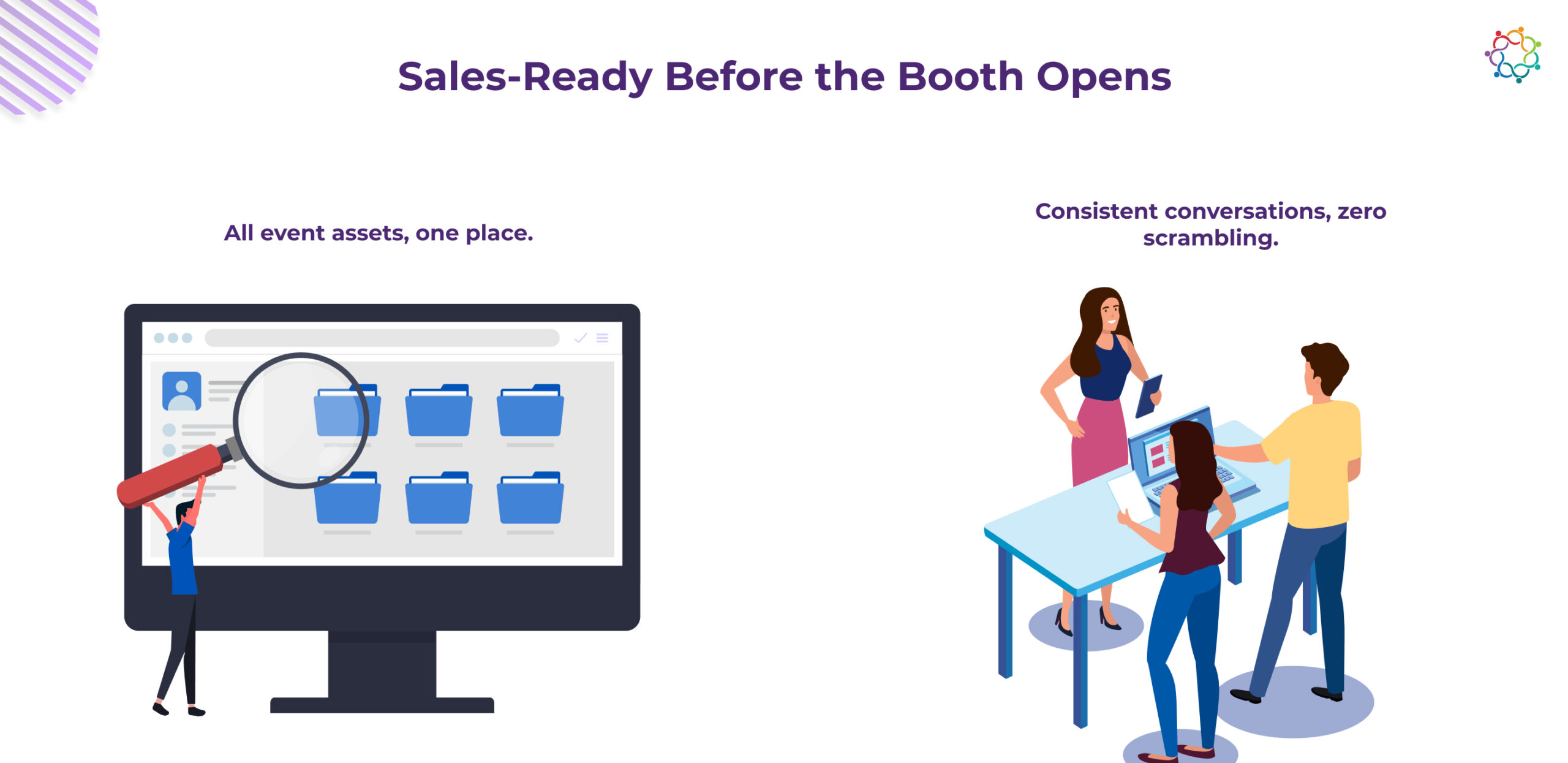
Centralized sales enablement and asset access
A read-only, centralized repository was created within Samaaro to host event briefs, sales decks, and product collateral. Sales teams could access the latest assets well before the event and during execution without repeated requests to marketing. This reduced last-minute coordination and ensured consistency in on-ground conversations.
Centralized event intelligence without replacing existing systems
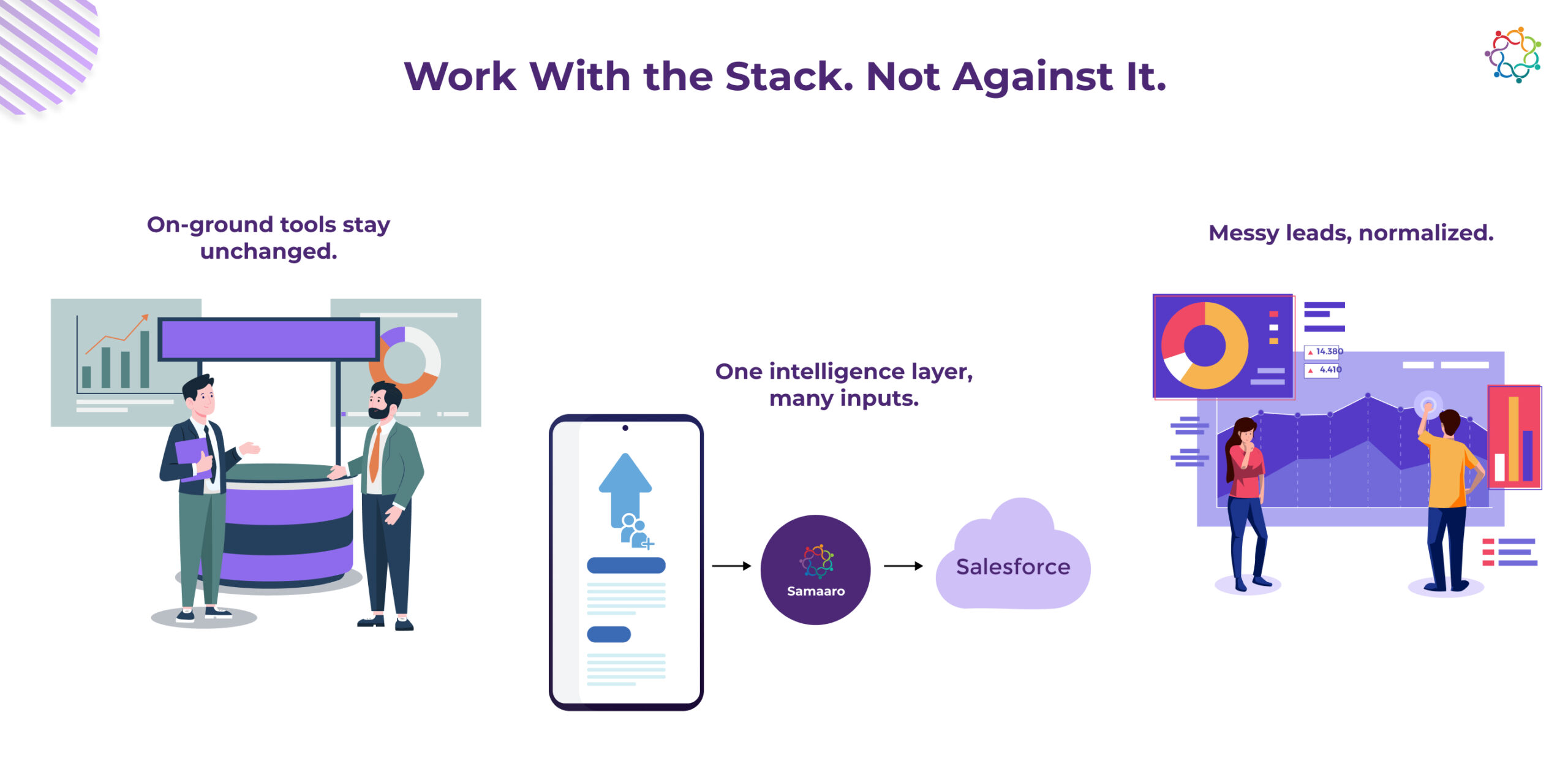
Samaaro was positioned to work alongside the trade show’s native lead capture app and Salesforce, not replace them. Post-event lead data was consolidated into a single structured layer, allowing marketing teams to normalize inputs, map product interest accurately, and prepare clean datasets for CRM updates. This reduced manual reconciliation effort and created a consistent foundation for downstream reporting and campaigns.
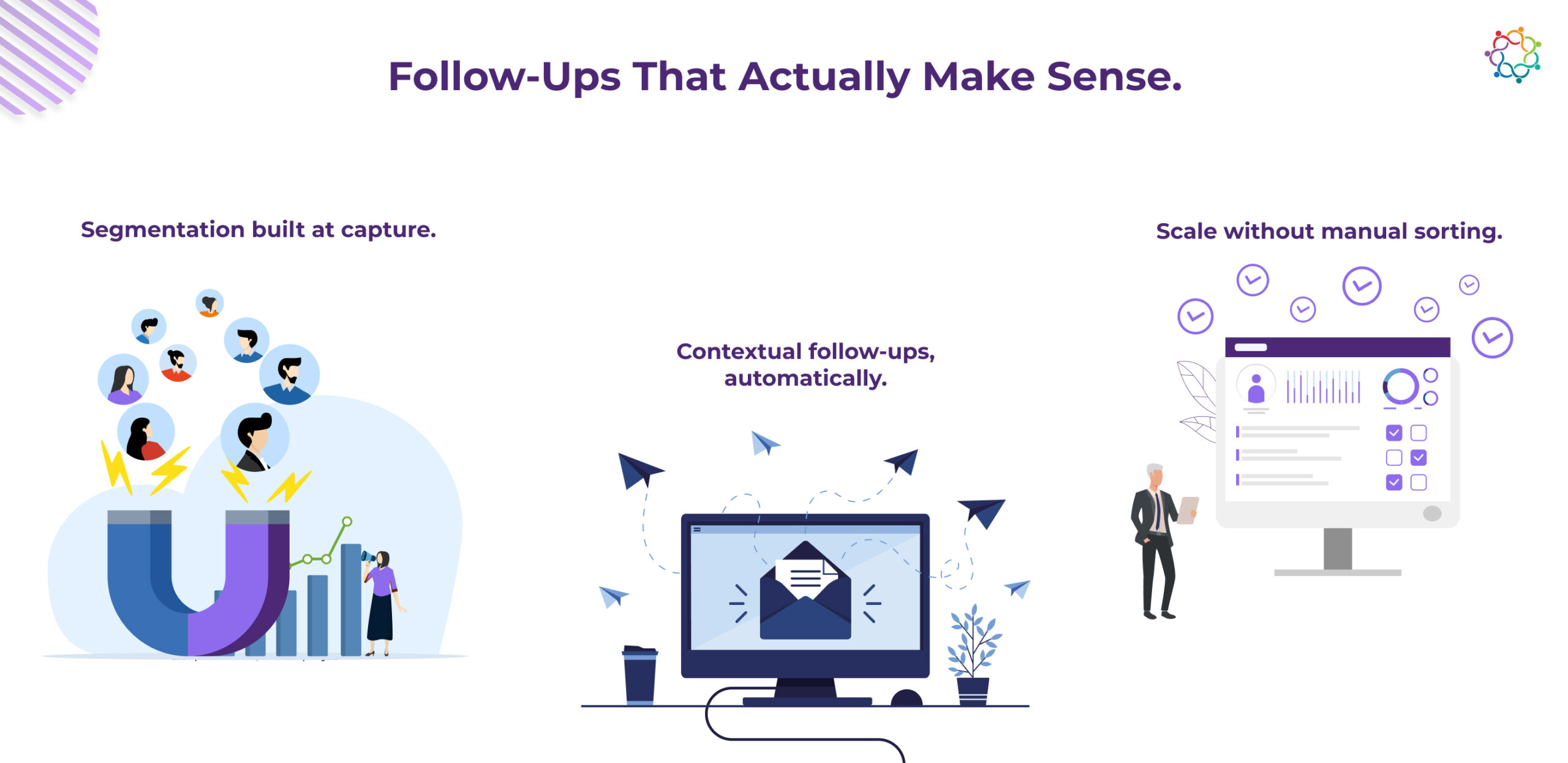
Automated post-event segmentation and follow-ups
Samaaro enabled structured segmentation of leads based on product interest and engagement context captured during the event. This made it possible to trigger relevant post-event communications without relying on manual sorting or spreadsheet-driven workflows. As a result, follow-ups became faster, more contextual, and easier to scale across large lead volumes.
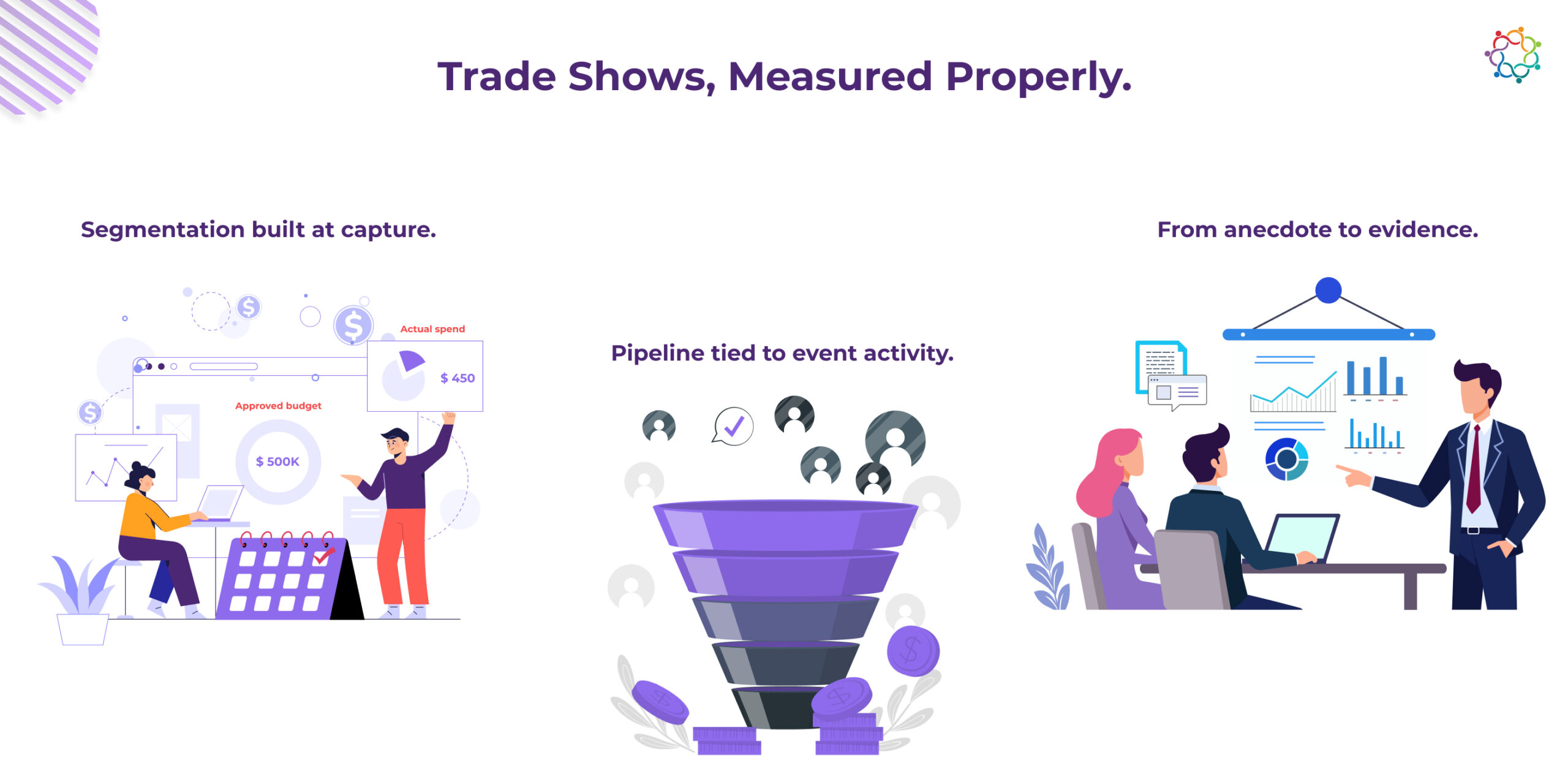

30–40% faster sales follow-ups enabled by real-time check-ins and automatic CRM updates.

100% persona-qualified attendance across invite-only mixers, roundtables, and leadership events.
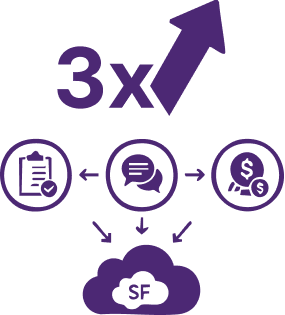
3× improvement in event data readinesswith unified registration, engagement, and sales inputs in Salesforce.

Full visibility into event spend and pipeline influence across 150+ global events.
After a flagship trade show generating over a thousand leads, the marketing team prepared post-event follow-ups within days instead of weeks. Leads were already segmented by product interest, synced into Salesforce, and aligned with approved budgets and pipeline views.
Instead of assembling reports across multiple tools, leadership reviewed event performance through a single dashboard while sales teams moved directly into relevant, product-led conversations. The event closed with clarity, not cleanup.
For B2B SaaS companies, the biggest risk with large trade shows is not poor execution. It is poor accountability.
When thousands of leads pass through disconnected systems, events quietly turn into cost centers, regardless of how busy the booth looks. High-performing teams treat trade shows as financial instruments, not marketing rituals. They build systems that connect spend, lead intent, pipeline creation, and revenue progression into one continuous view.
As budget scrutiny increases, the winners will not be the teams that attend more events, but the ones that can prove, week by week, how each event moved the business forward.
Bottom Line: For global MarTech organizations, Samaaro turns high-volume event programs into scalable GTM infrastructure - where clean data, qualified participation, and pipeline influence are built in by design.
The client is a global Marketing Technology (MarTech) leader with a strong focus on AI-powered customer engagement and retention. The organization runs a massive volume of persona-driven events every year across various global regions, ranging from high-touch C-suite roundtables and product-focused mixers to massive flagship conferences and industry awards.
Events play a critical role in the client’s go-to-market strategy, serving as a primary channel for pipeline acceleration, relationship building, and customer nurturing. With multiple regional teams operating in parallel and more than 150 events being conducted globally throughout the year, the organization places a heavy emphasis on standardizing workflows, data reliability, and the ability to seamlessly transition event intent into Salesforce for immediate sales follow-up.
Event Website Builder, RSVP Management with Approval Workflows, Omnichannel Communication, Onsite Check-In and Digital Lead Capture, Zoom Integration for Webinars, Salesforce CRM Integration, Budget Planner, Event Reporting
In B2B SaaS, over 70% of pipeline influenced by events is lost not due to poor attendance, but due to delayed follow-ups, unqualified attendees, and fragmented event data.
As event programs scale, teams often add more formats, more regions, and more stakeholders, without fixing the operational backbone that connects events to sales outcomes. The result is familiar: high activity, unclear impact, and overstretched teams.
This is the challenge many global MarTech organizations face as events move from occasional campaigns to always-on GTM engines.
In high-volume pharmaceutical organisations, manual event operations can consume over 20,000 working hours annually, with most of that time spent on coordination, follow-ups, reconciliation, and reporting, activities that add no direct strategic value. When multiplied across hundreds of events, even small inefficiencies quietly compound into million dollar-level operational costs.
The client’s event program was already delivering value. The challenge was not effectiveness; it was sustainability at scale.
As the number of events, regions, and internal stakeholders increased, the existing setup began to show signs of strain. Processes that worked well for individual events became harder to manage across a global, always-on program.
Key challenges included:
1. Managing multiple event formats with inconsistent workflows
The organization ran a diverse mix of events, including invite-only mixers, customer roundtables, mini conferences, webinars, and large flagship gatherings. Each format had different requirements, but execution often relied on fragmented tools and manual coordination. This made it difficult to standardize workflows without over-centralizing control.
2. Maintaining attendee quality in invite-only events
Most events were persona-driven and invitation-based. However, forwarded invites and open registrations made it harder to consistently ensure the right profiles were attending. Manual checks added operational overhead and increased the risk of misaligned audiences.
3. Fragmented attendee and engagement data
Registrations, attendance, webinar participation, and on-ground interactions were captured across multiple systems. While data eventually reached Salesforce, the lack of a unified event layer slowed consolidation and reduced real-time visibility into attendee engagement and intent.
4. Delayed sales follow-ups at high-intent moments
Sales teams participated actively in both hosted and industry events. However, capturing notes, identifying engaged prospects, and triggering CRM updates often happened after the event, reducing the immediacy and effectiveness of follow-up conversations.
5. Limited visibility into event spend and pipeline influence
With multiple teams running events across regions, tracking budgets and understanding how different event types influenced pipeline required manual reporting. Leadership needed clearer answers on how investments translated into sales momentum, without increasing reporting complexity
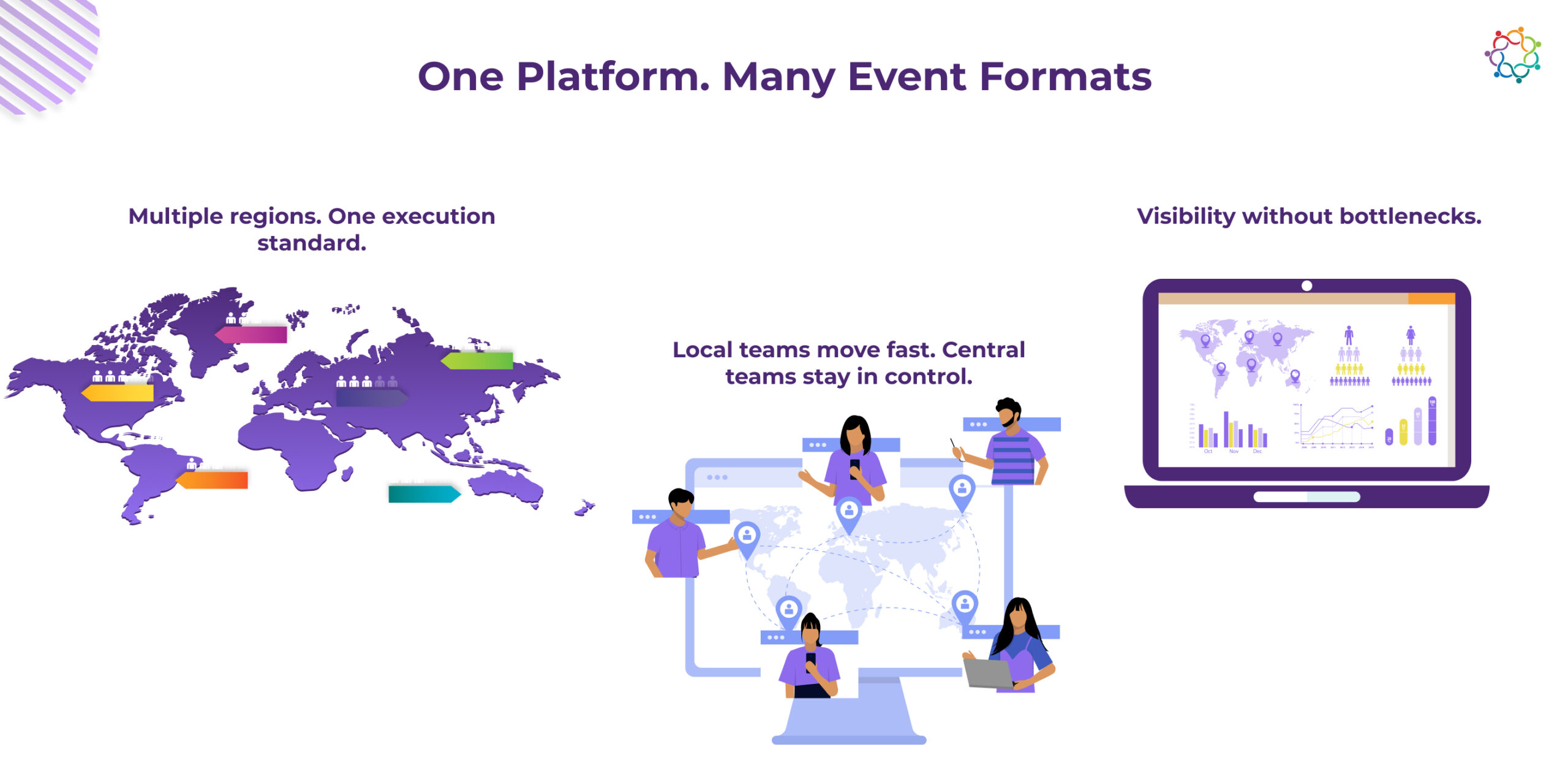
Standardized event execution across formats and regions
Samaaro enabled the client to manage mixers, customer roundtables, mini conferences, flagship events, and webinars within a single platform. Regional teams could create and run events independently while operating within standardized workflows. This reduced execution variance across regions and allowed the central team to maintain visibility and control without slowing down local teams.
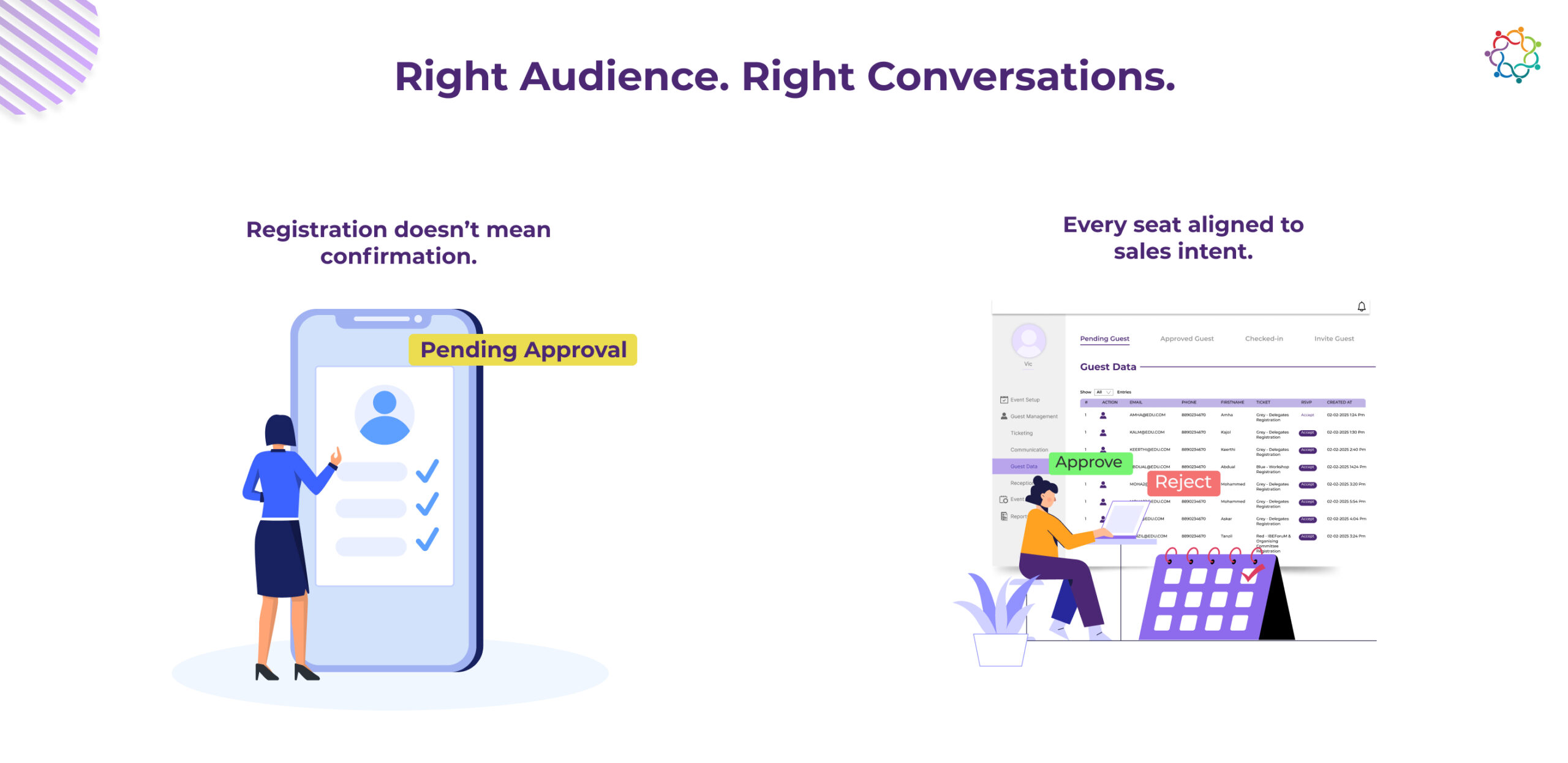
Invite-only and approval-based registration workflows
Samaaro introduced controlled registration flows that allowed the client to qualify attendees before confirmation. Approval-based workflows helped enforce persona-specific participation, reduced the impact of forwarded invites, and ensured that high-touch events consistently reached the intended audience. As a result, event conversations became more relevant and aligned with sales objectives.
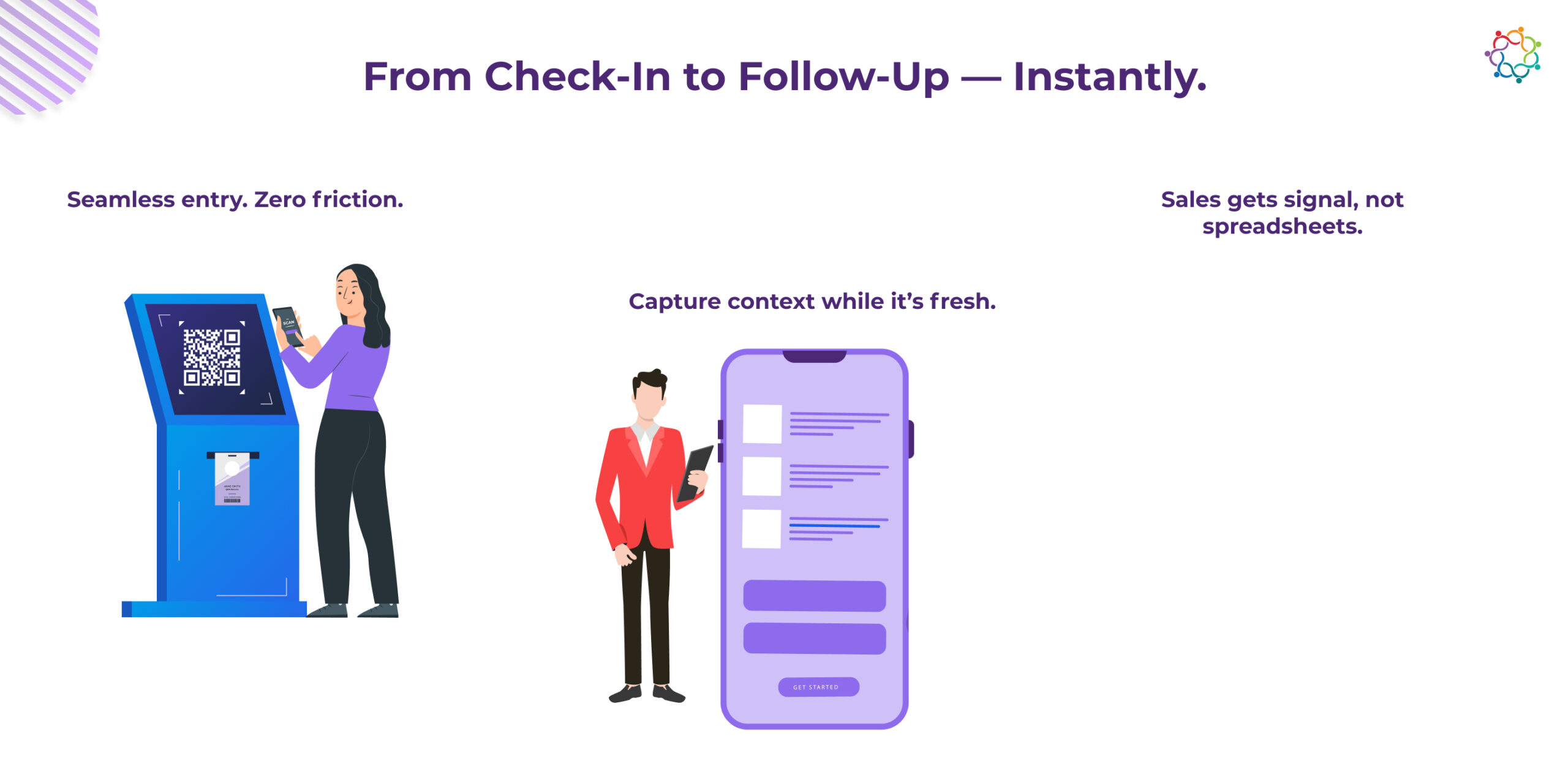
On-site check-ins with real-time sales notifications
For in-person events, Samaaro enabled seamless check-ins and digital lead capture for sales teams. Sales representatives could log interactions on-site, with attendee activity and notes immediately reflected in the system. This allowed sales teams to follow up faster while context was still fresh, improving the quality and timing of post-event conversations.
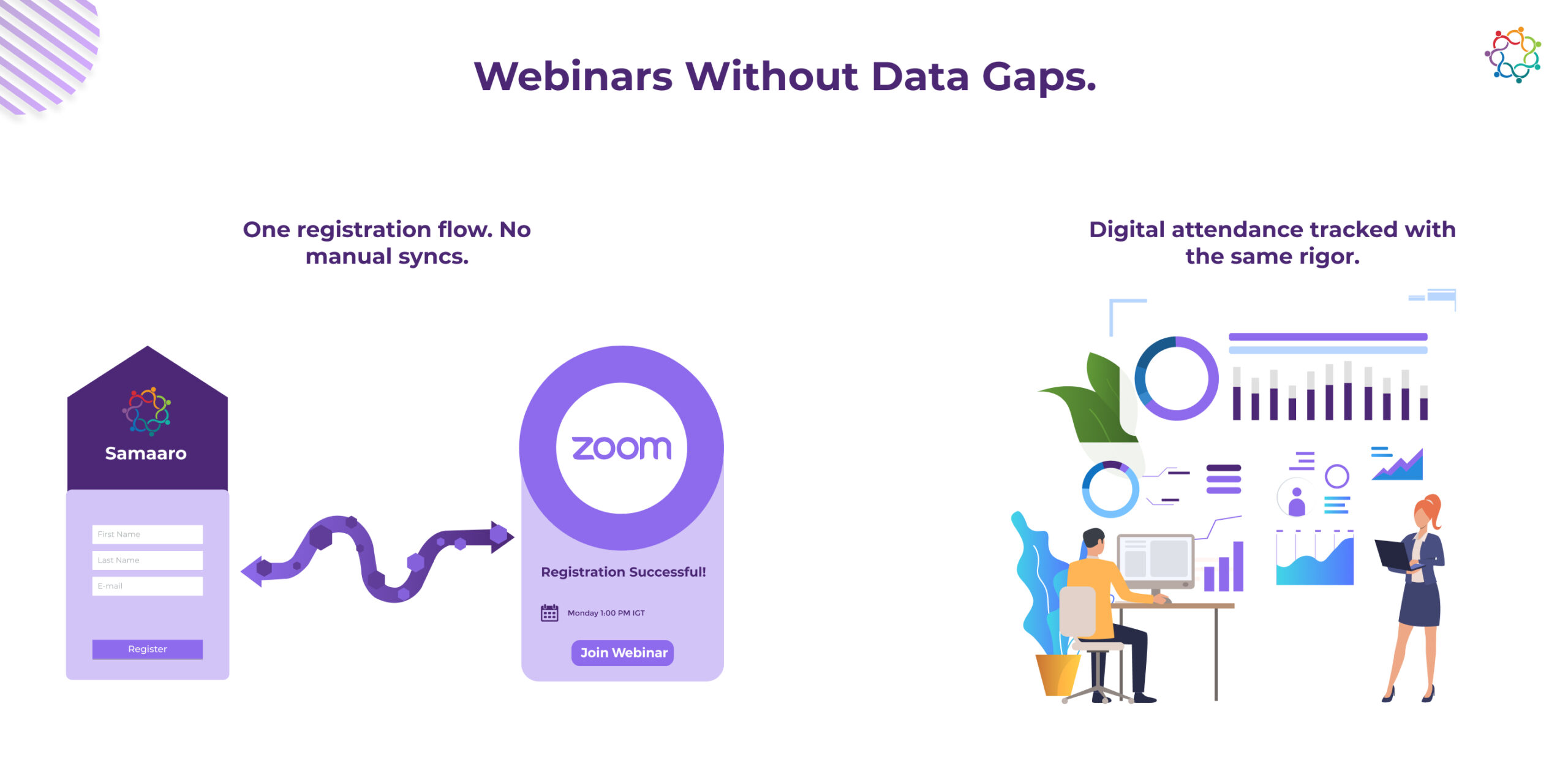
Native Zoom integration for webinar execution
Webinars were executed through a direct Zoom integration, allowing registrations, attendance data, and engagement signals to flow automatically into Samaaro. This eliminated manual reconciliation between webinar platforms and event records, and ensured that digital event participation was captured with the same rigor as in-person events.
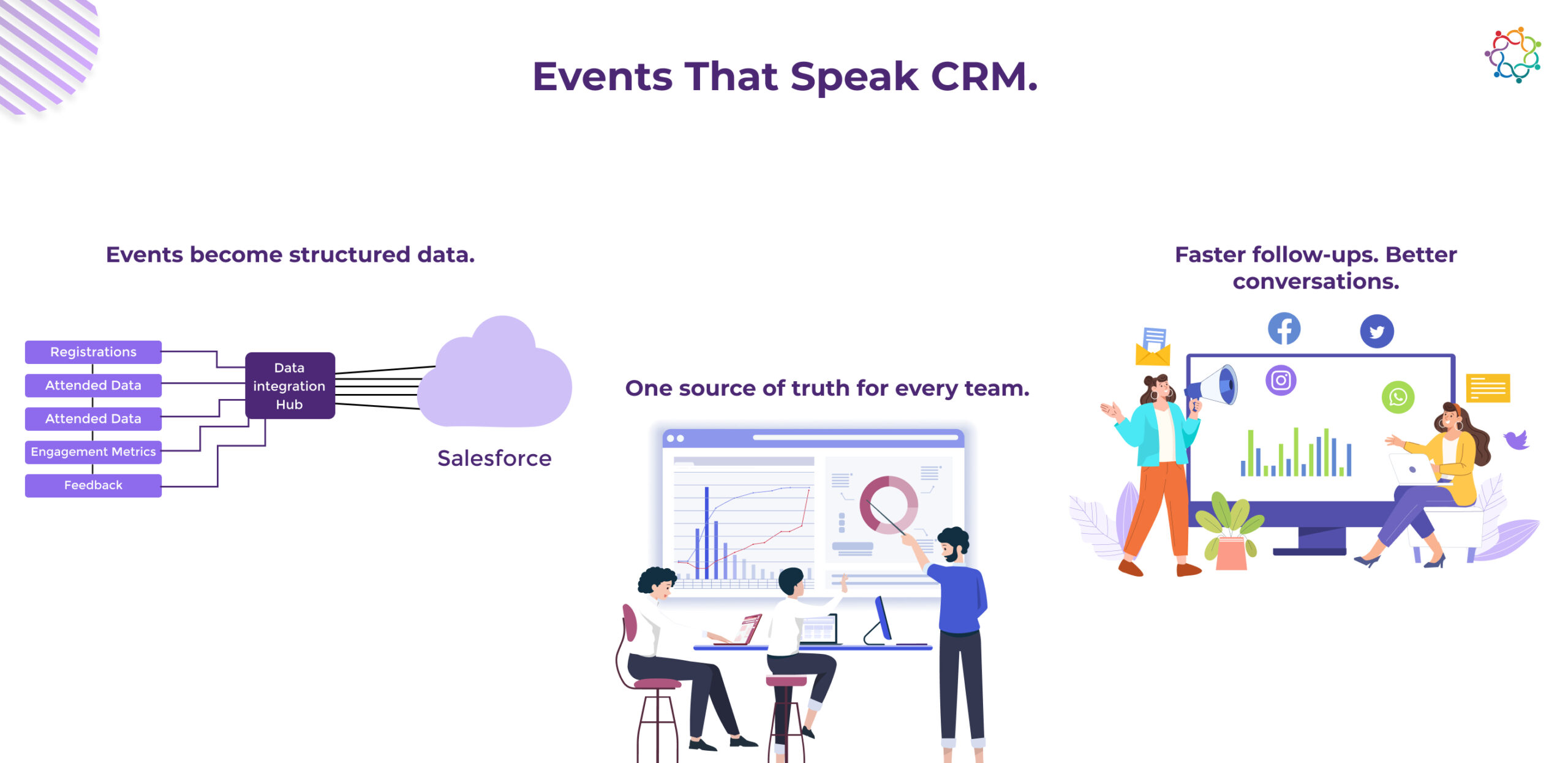
Salesforce CRM integration for unified data management
Samaaro acted as a single event data layer feeding into Salesforce. Registration details, attendance status, engagement activity, and sales notes were synced automatically. This gave both marketing and sales teams a shared, reliable view of event influence and reduced delays caused by manual data entry.
Budget planning and spend tracking at the event level
The platform allowed teams to plan and track event budgets centrally while maintaining regional flexibility. Marketing leaders gained clearer visibility into how spend was distributed across event types and regions, enabling more informed decisions without increasing reporting overhead.
Reporting on event impact and pipeline influence
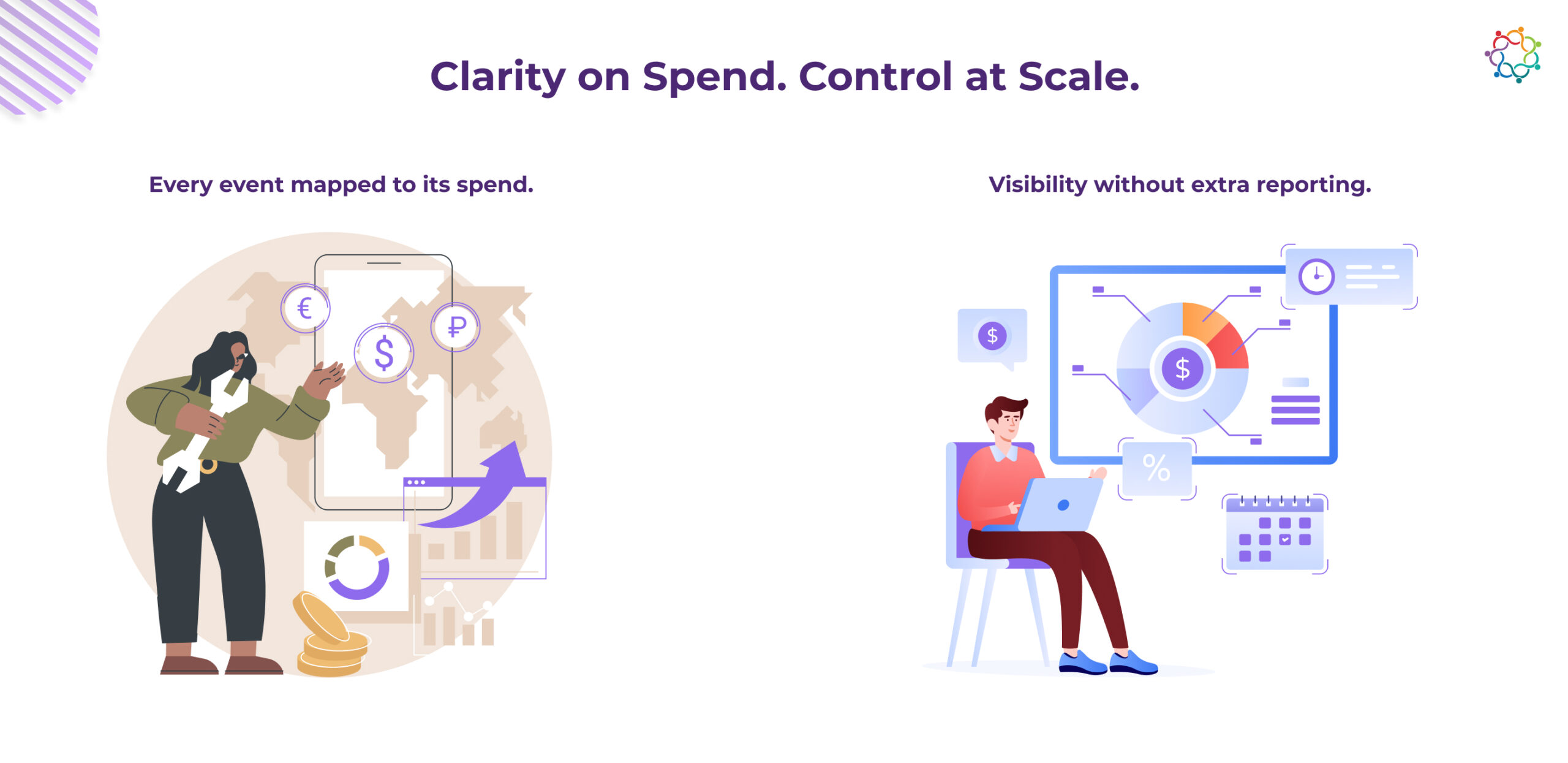
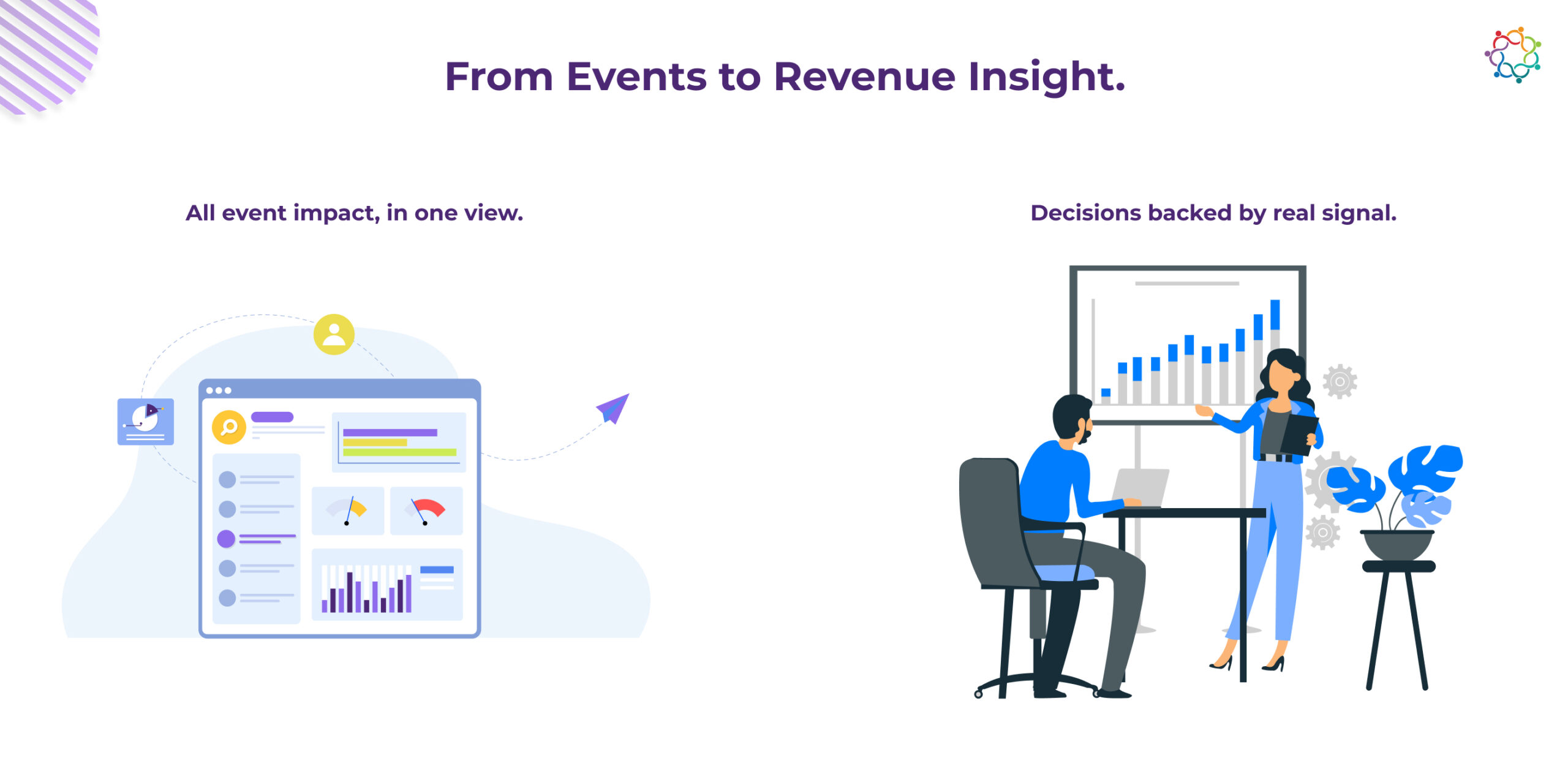
Samaaro provided consolidated reporting across events, formats, and regions. Teams could evaluate how different event investments influenced pipeline movement and sales follow-ups, creating a clearer link between event activity and business outcomes. This improved leadership confidence in the event program and supported more structured planning at scale.
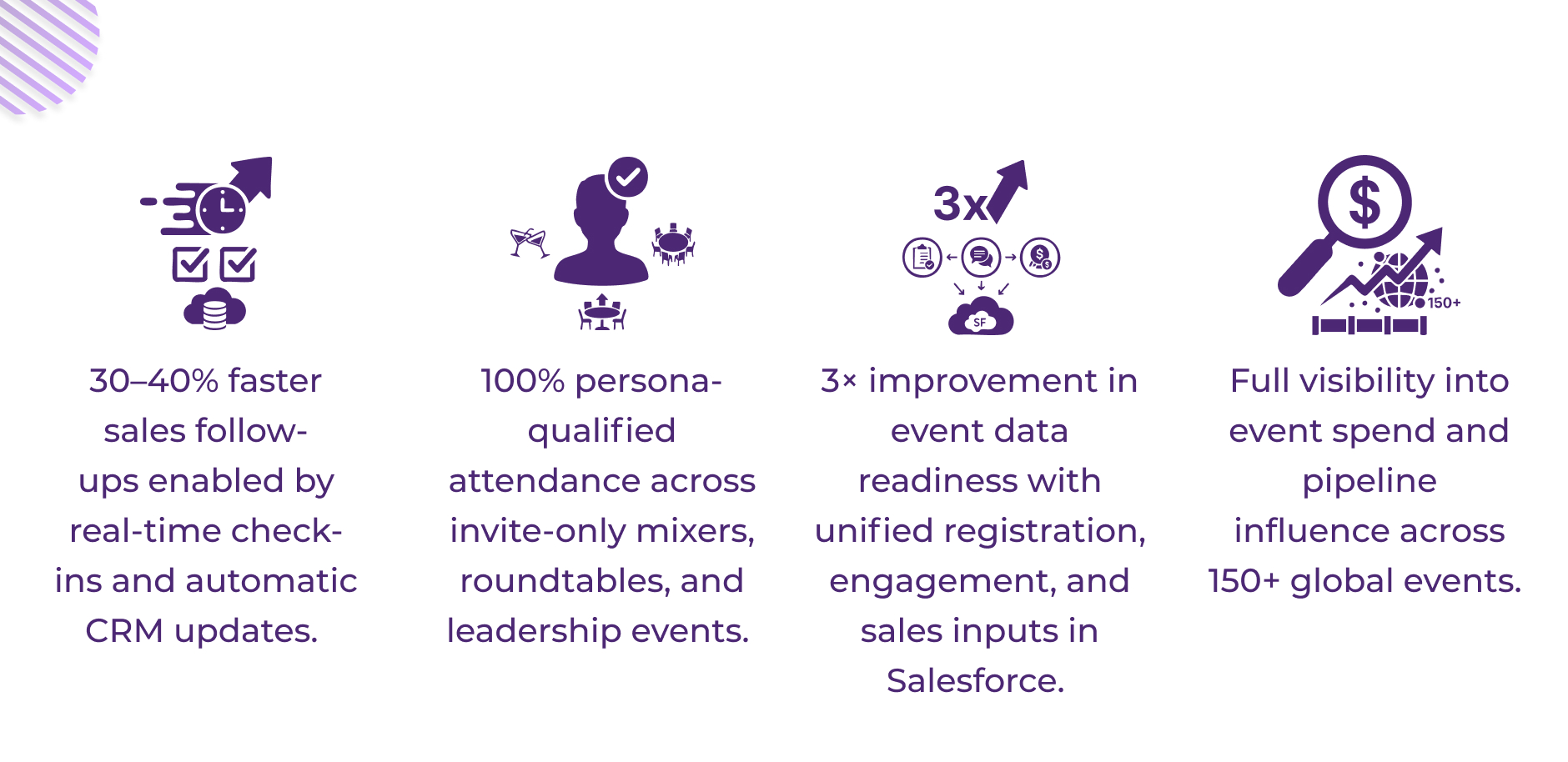
30–40% faster sales follow-ups enabled by real-time check-ins and automatic CRM updates.
100% persona-qualified attendance across invite-only mixers, roundtables, and leadership events.
3× improvement in event data readinesswith unified registration, engagement, and sales inputs in Salesforce.
Full visibility into event spend and pipeline influence across 150+ global events.
During a regional customer roundtable, the sales team received real-time notifications as attendees checked in and engaged during the session. Notes were captured digitally while conversations were still ongoing, and key follow-ups were triggered the same day inside Salesforce.
Instead of post-event coordination calls and spreadsheet cleanups, the team moved directly into contextual sales conversations within hours of the event closing. For the first time, event momentum carried forward without operational lag.
As B2B event programs scale, the competitive advantage no longer comes from hosting more events. It comes from operating them better.
Modern field marketing is shifting from isolated campaigns to continuous, always-on engagement engines. In this model, events are no longer brand moments. They are data systems, sales enablement channels, and pipeline infrastructure.
Organizations that treat events as disconnected activities will continue to see high volume with low clarity. Organizations that treat events as integrated GTM systems will gain speed, control, and compounding impact.
The future of B2B events is not about bigger stages or larger audiences.
It is about clean data flows, qualified participation, fast sales activation, and measurable pipeline influence.
That is where event programs stop being cost centers and start becoming growth engines.


Event Requests & Planning Workflow, Budget Planning & Financial Control, Task Planning & Team Collaboration, Event Websites & Registration Forms, Communication Automation, Reception Dashboard & Seamless On-Site Operations, Event App (Web, Android & iOS), Feedback Collection & Recognition Delivery (e-Certificates), Lead Generation & Sales Enablement, AI-Powered Reporting & Analytics
The client is a leading Indian pharmaceutical company with a nationwide presence and a strong focus on field-driven growth. The organisation runs a high volume of in-person events every year across sales, marketing, and medical teams, ranging from doctor engagement programs and product-focused meetings to distributor interactions and regional conferences.
Events play a critical role in the company’s go-to-market strategy, serving as a recurring channel for relationship building, education, and on-ground execution. With multiple teams operating in parallel and more than 125 events being conducted across regions throughout the year, the organisation places emphasis on operational consistency, data reliability, and the ability to understand the true business impact of its event investments.
In high-volume pharmaceutical organisations, manual event operations can consume over 20,000 working hours annually, with most of that time spent on coordination, follow-ups, reconciliation, and reporting, activities that add no direct strategic value. When multiplied across hundreds of events, even small inefficiencies quietly compound into million dollar-level operational costs.
As the organisation’s event footprint expanded across sales, marketing, medical affairs, training, and leadership teams, events became one of the company’s most frequent operational activities. Programs were being conducted continuously across regions, ranging from CME programs and product launches to distributor meets, trainings, offsites, and international conferences.
At this scale, the challenge was no longer about executing individual events successfully. It was about running hundreds of events consistently, predictably, and with measurable outcomes.
While each team optimised for its own execution, leadership lacked a single, reliable view of how events were performing as a program. Answering questions around efficiency, cost control, team effort, and return on investment required manual consolidation and assumptions rather than real-time data.
The organisation did not need more event activity. It needed a way to treat events as a scalable operating system, with standard planning, controlled execution, reliable data capture, and clear visibility into cost, effort, and impact across the year.
Samaaro was proposed as a single, enterprise-grade event marketing platform to manage the company’s entire event portfolio, across medical, marketing, training, leadership, and distributor programs. The objective was to replace fragmented, manual workflows with a structured system that could scale across hundreds of events while making cost, effort, and ROI measurable at a leadership level.
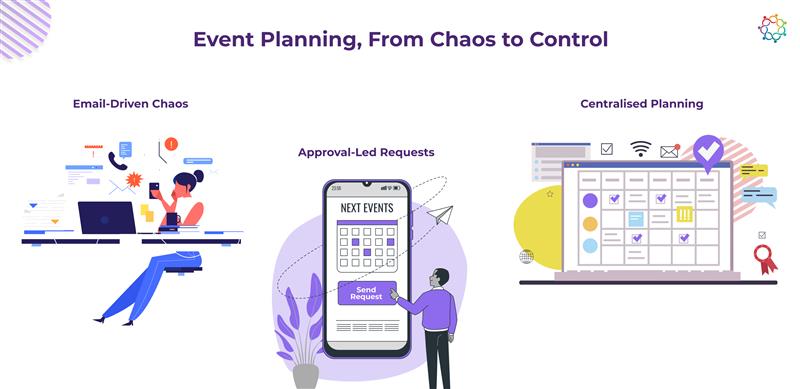
1. Event Requests & Planning Workflow
Result:
Event planning shifted from email-driven coordination to a transparent, approval-led process with full traceability.
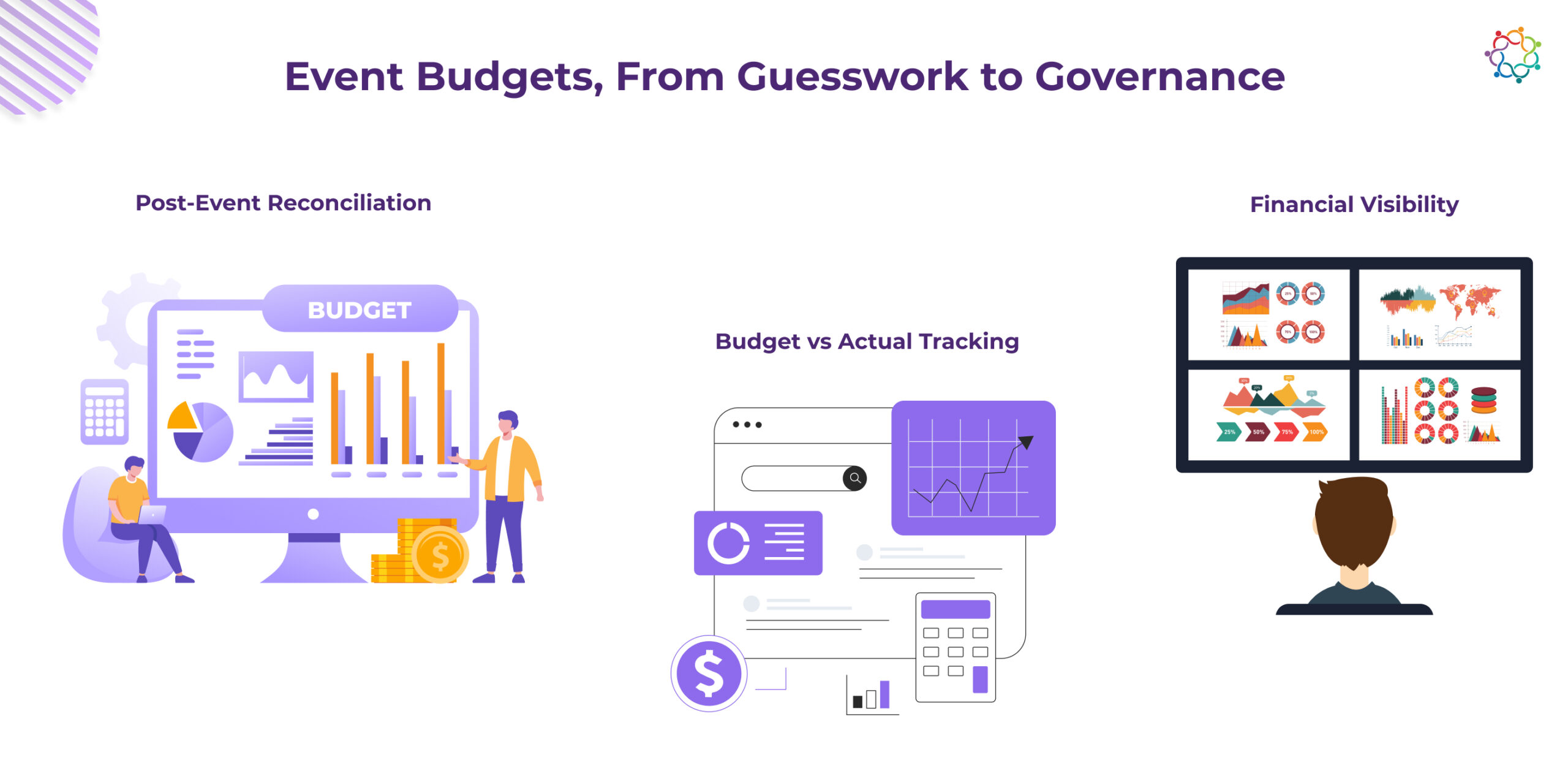
2. Budget Planning & Financial Control
Result:
Event spend became visible in real time, enabling early detection of overspends and better cost control.
3. Task Planning & Team Collaboration
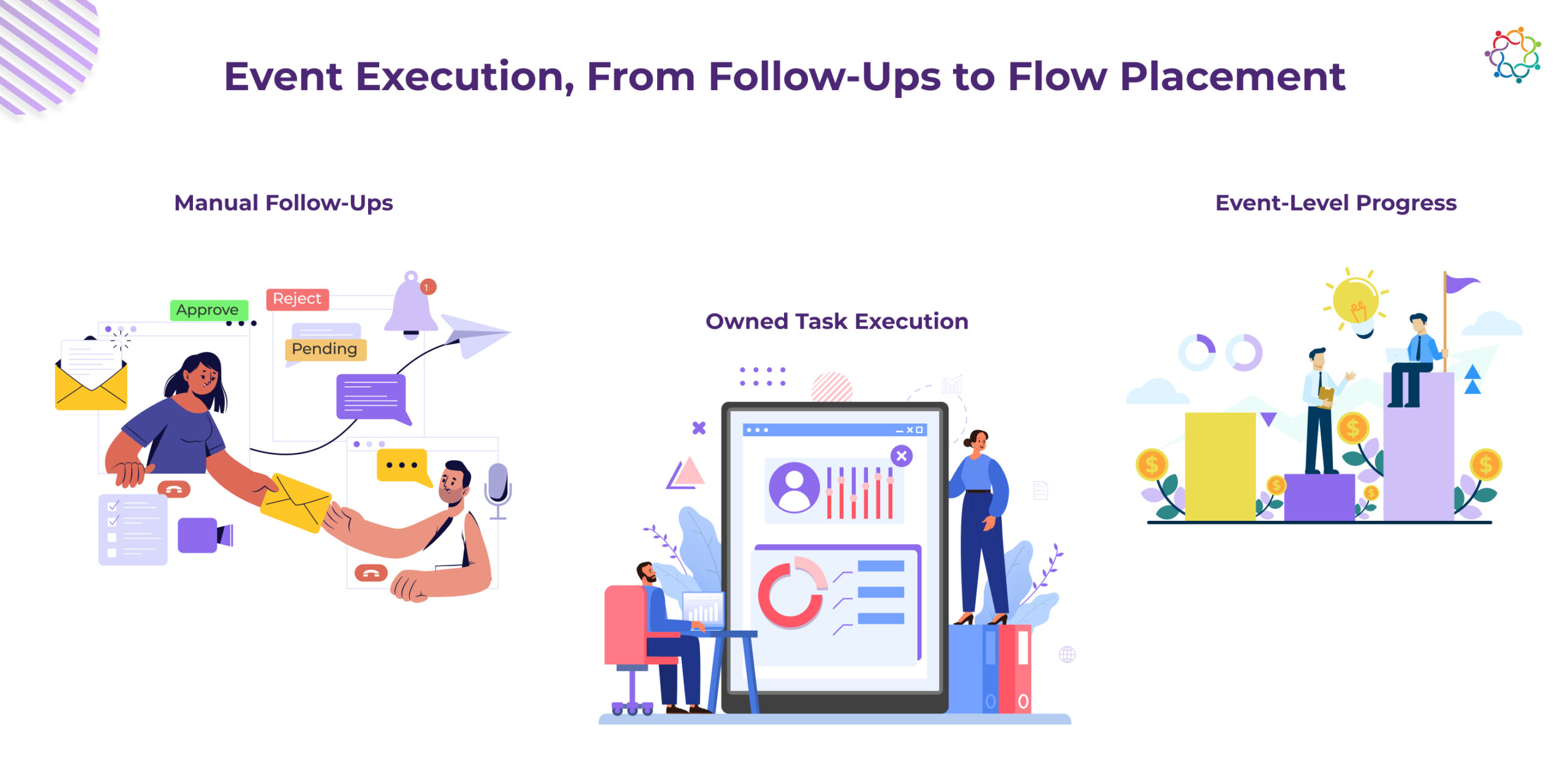
Result:
Execution discipline improved without adding management overhead.
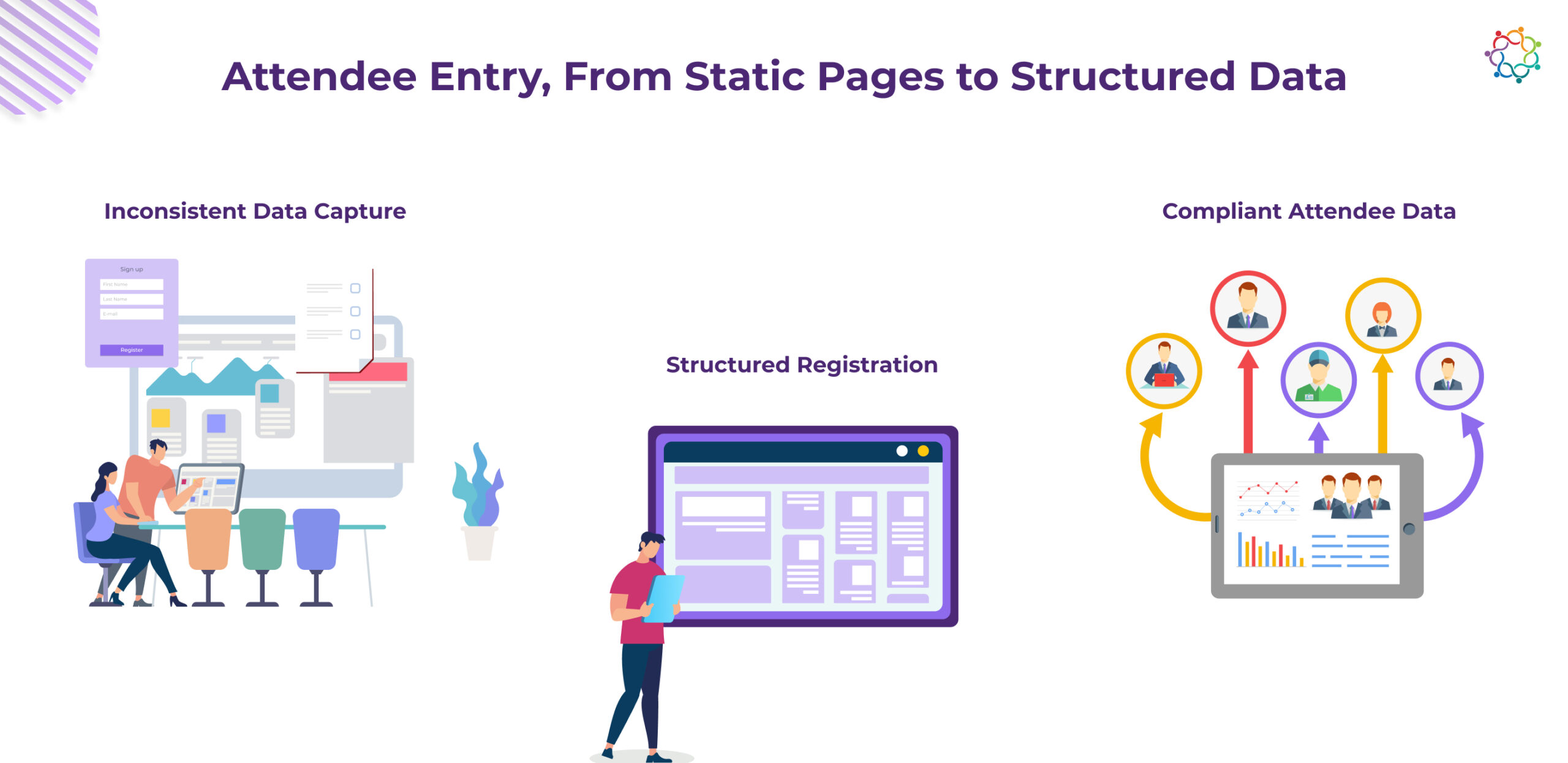
4. Event Websites & Registration Forms
Result:
Attendee data became structured and compliant from the first touchpoint.
5. Communication Automation
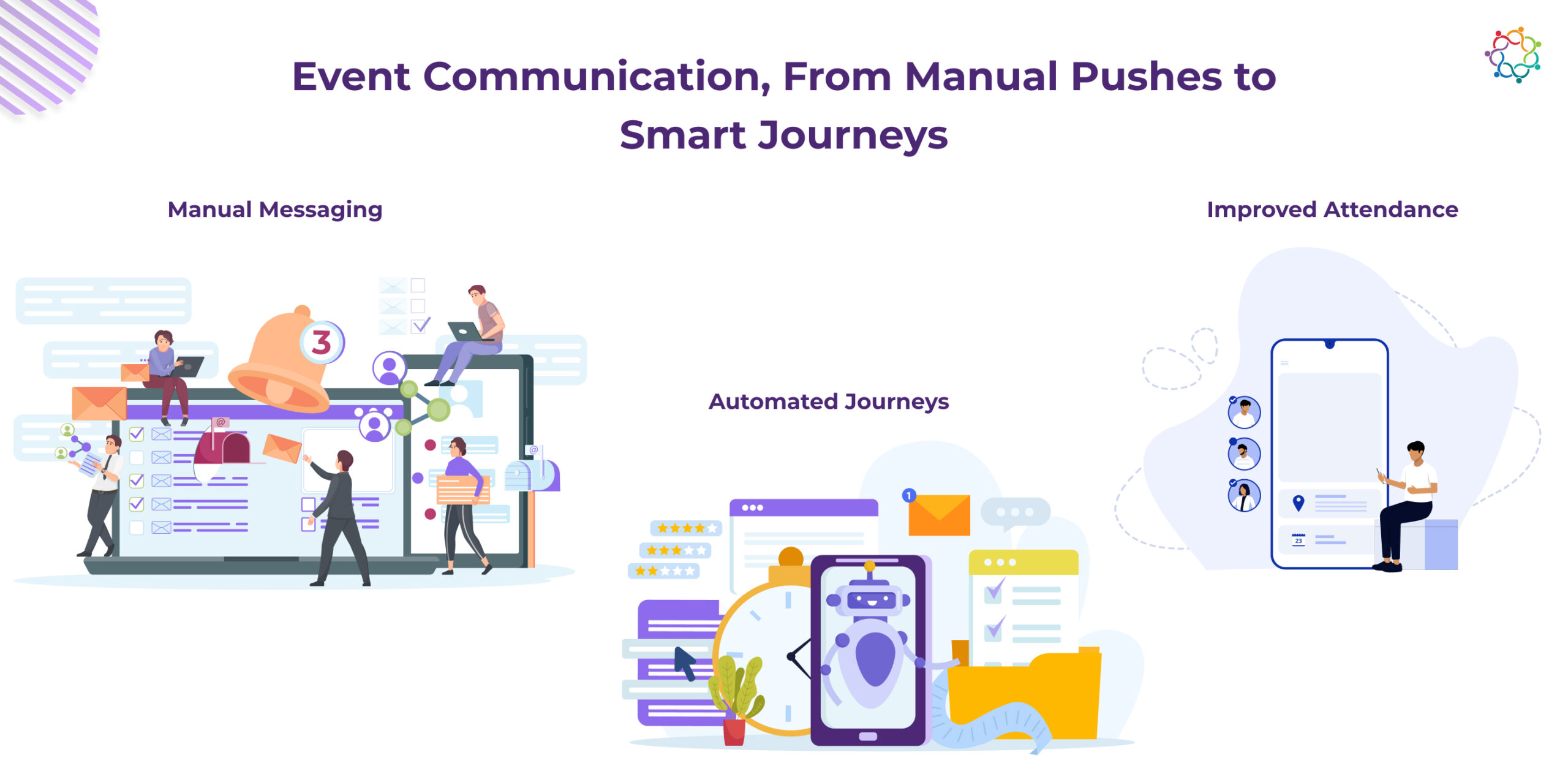
Result:
Registration and attendance improved without increasing coordination effort.
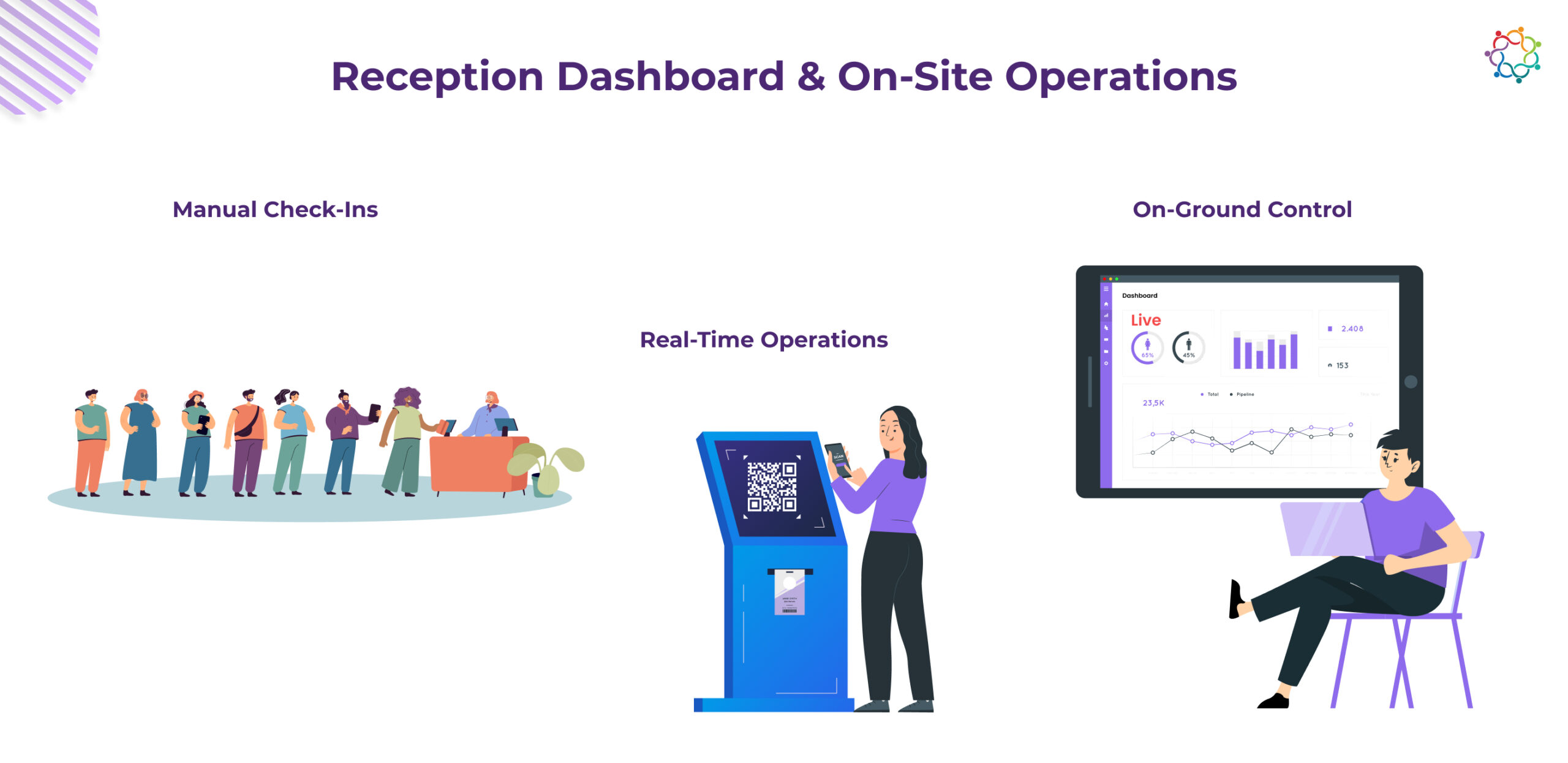
6. Reception Dashboard & On-Site Operations
Result:
On-ground operations became faster, more accurate, and free from manual errors.
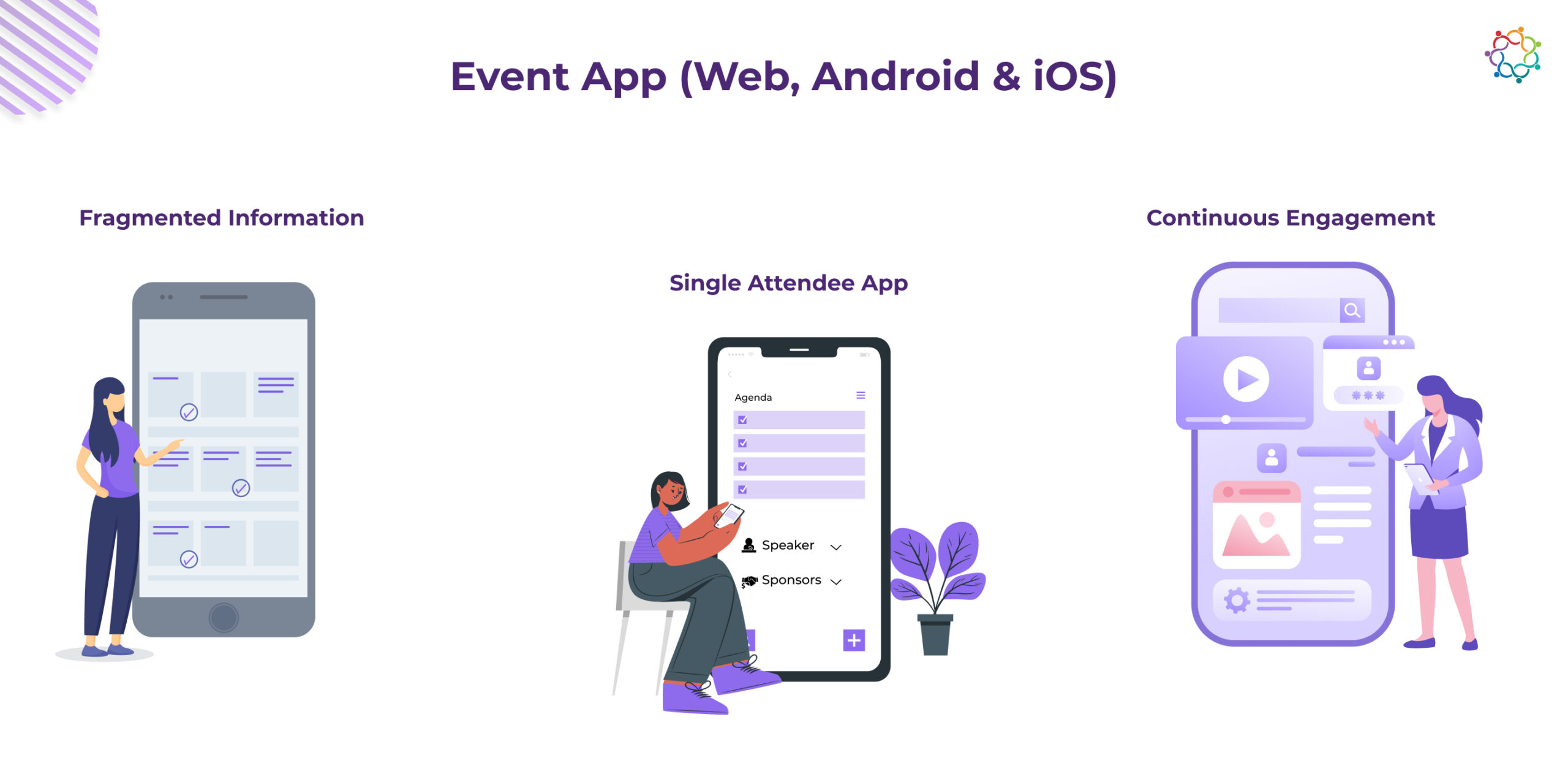
7. Event App (Web, Android & iOS)
Result:
Attendee experience moved from fragmented communication to a single, controlled channel.
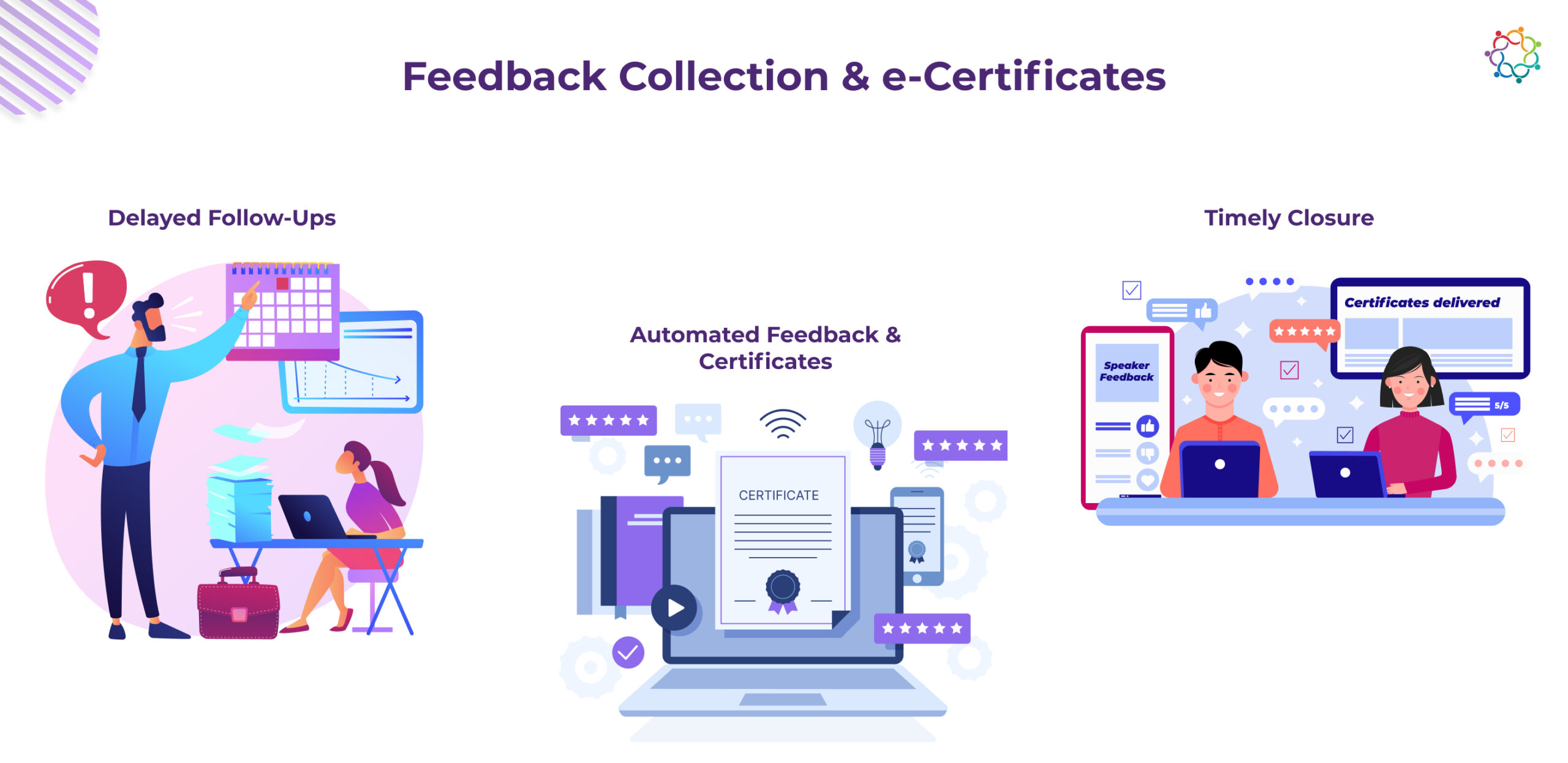
8. Feedback Collection & e-Certificates
Result:
Post-event feedback and recognition became timely and consistent.
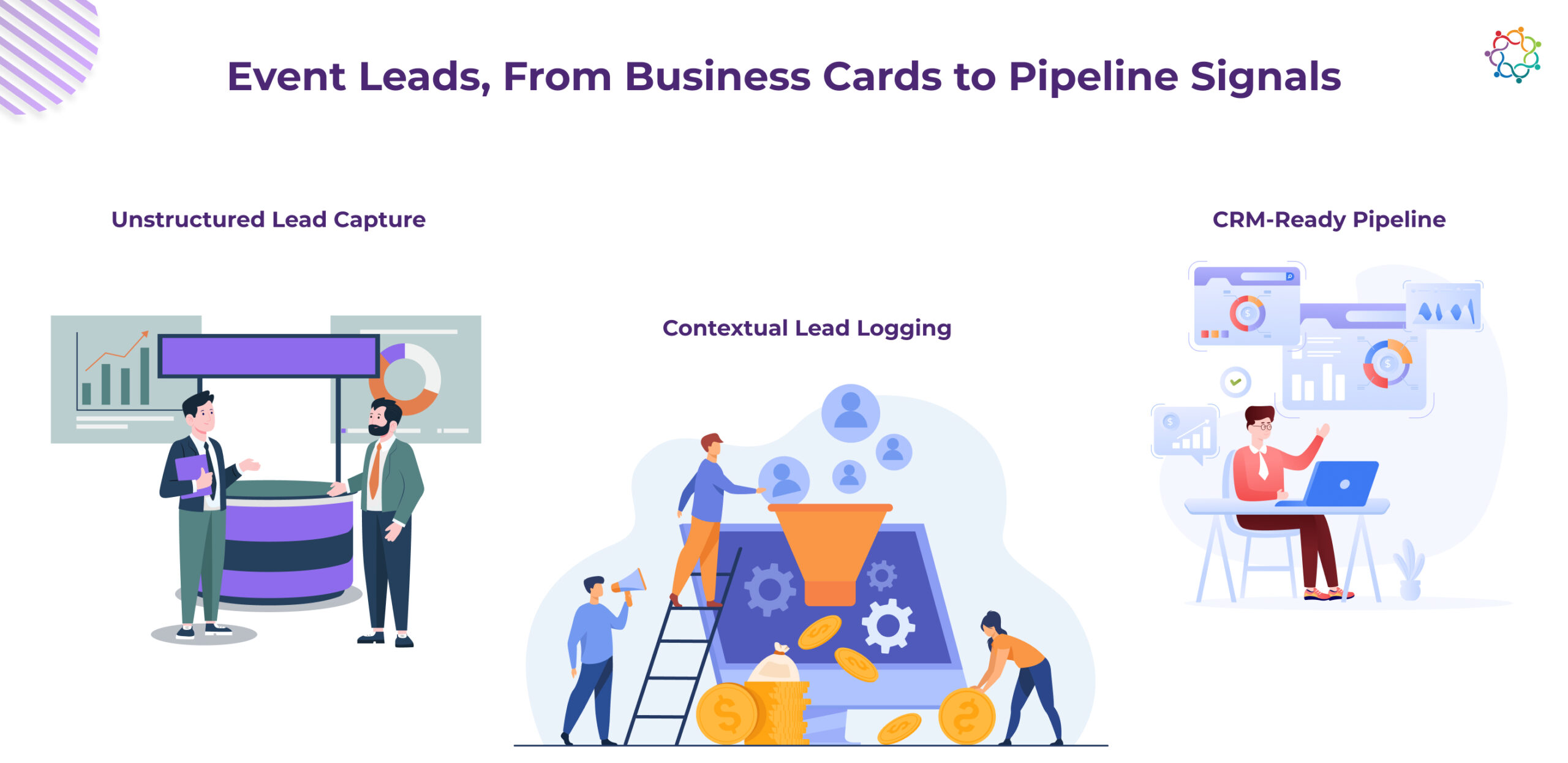
9. Lead Generation & Sales Enablement
Result:
Events became measurable sales inputs rather than standalone activities. It became easier to capture sales team performance at such events.
10. AI-Powered Reporting & Analytics
Result:
Leadership gained a consolidated, data-backed view of event performance and ROI.
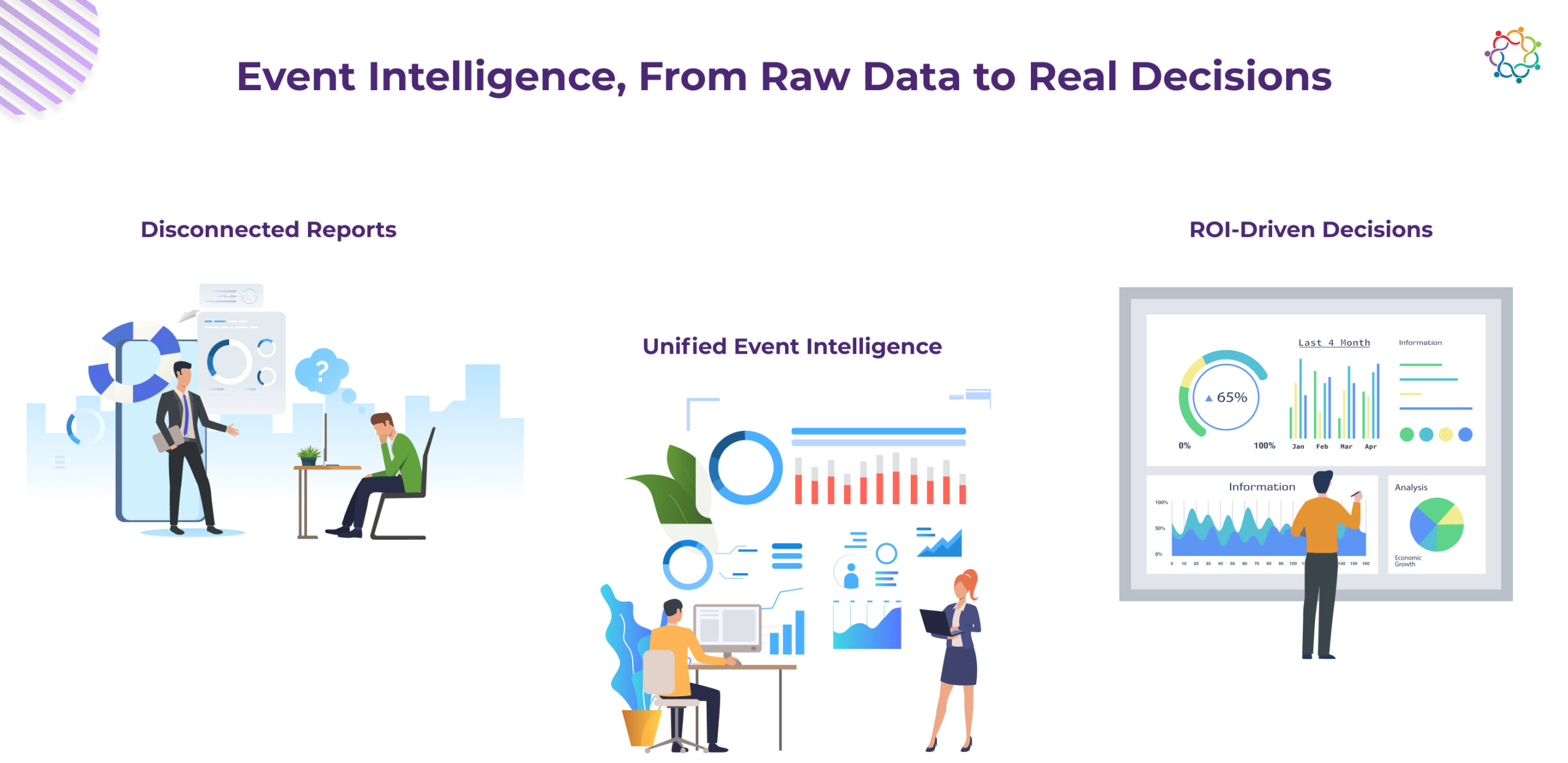

5.47× ROI on event operations with measurable savings exceeding platform investment.
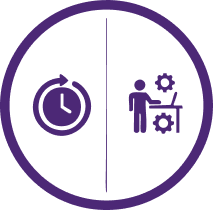
80% reduction in event setup and management time cutting annual manual effort from 21,600 hours to a fraction of previous workloads.
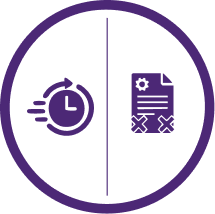
95% reduction in operational errors by eliminating data duplication, miscommunication, and manual reconciliation.
Midway through a planning cycle, the leadership team reviewed a consolidated snapshot of the year’s event program, covering programs across medical, marketing, training, and sales. What stood out was not the number of events, but the accumulated effort behind them: thousands of coordination hours, repeated approval loops, duplicated communication, and post-event reconciliation happening independently across teams.
As they traced a single event end-to-end, from request and approval to budgeting, execution, and reporting, it became clear that the real cost of events wasn’t just venues or logistics, but time, rework, and invisible inefficiencies multiplied at scale. When the same workflow was projected across the full annual event volume, the operational cost surfaced clearly, along with how much of it could be avoided.
That conversation shifted how events were viewed internally. They were no longer treated as isolated programs that “just needed to happen,” but as a system that could either quietly drain resources or actively return value depending on how it was run.
In fast-scaling pharmaceutical organisations, events don’t fail because they are poorly executed, they fail because they are under-examined at scale. When dozens of teams run hundreds of programs across the year, even small inefficiencies compound into meaningful cost, effort, and decision blind spots.
This case highlights a broader shift the industry is beginning to confront: events can no longer be treated as isolated marketing or medical activities. They behave more like operational infrastructure, consuming time, budget, and organisational energy whether or not they are actively optimised. The difference between events being a necessary expense and a defensible investment lies in whether they are run as repeatable systems with measurable economics.
For pharma leaders, the question is no longer whether events work. It is whether the organisation can clearly explain what they cost, what they return, and what changes when they scale. The teams that answer this early gain not just efficiency, but control, and that control increasingly defines competitive advantage.


HCP Segmentation & CRM Integration, Invite-Only RSVP Management, Event Website & Session Information, Communication Automation, On-Site Check-In & Attendance Validation, Structured Discussion & Insight Capture, CRM Sync & Engagement Continuity, Reporting & ROI Visibility
The client is a large pharmaceutical company headquartered in United Kingdom with an active Medical Affairs and Scientific Engagement function that conducts multiple HCP roundtables throughout the year. These engagements are designed as structured, non-promotional forums for scientific exchange with senior healthcare professionals and key opinion leaders, supporting therapy-area learning, evidence evaluation, and informed decision-making.
The organisation hosts different formats of HCP roundtables depending on context and objective, ranging from formal advisory discussions held at company headquarters, to focused in-person roundtables conducted at external venues or alongside scientific meetings. As these engagements became a recurring and strategic part of the company’s medical affairs program, the team placed increasing importance on consistency, traceability, and defensible documentation across every roundtable, regardless of format or location.
In pharma-led HCP roundtables, compliance exposure increases as group size decreases. Smaller, invite-only scientific discussions often involve higher-value interactions, stricter regulatory expectations, and closer scrutiny, yet are still frequently coordinated through emails, calendars, and informal attendance assumptions.
Without a structured system to document who was invited, who attended, and how insights were generated, even well-run HCP roundtables can struggle to demonstrate defensible value, audit readiness, and return on investment when reviewed months later.
The pharmaceutical company’s HCP roundtables were designed with strong scientific intent and were executed across multiple formats, formal advisory discussions at headquarters, focused in-person roundtables at external venues, and smaller working sessions aligned with scientific meetings. While each format served a distinct purpose, they all shared one expectation: high standards of governance, documentation, and defensibility.
As these roundtables became more frequent and more strategically important, managing them consistently across teams and formats became increasingly complex. Invitations were carefully curated, agendas were structured, and discussions were moderated, but critical aspects such as attendance validation, participation records, and post-event documentation were often managed through a combination of emails, calendars, sign-in sheets, and manual summaries.
This created a subtle but growing challenge, not around execution quality, but around accountability and value articulation.
Internally, medical affairs and leadership teams needed clearer answers to questions such as:
While each roundtable delivered meaningful scientific exchange, proving their impact required significant manual effort. Attendance confirmation, insight consolidation, and reporting varied by team and format, making it difficult to present a uniform, defensible view of return on investment across the broader program.
The challenge was not about scaling volume or changing how scientific discussions were conducted. The team needed a way to bring structure to recurring, high-value engagements, so that compliance, traceability, and ROI were embedded into the process, rather than inferred after the session had concluded.
Samaaro was implemented to bring consistency and control to how HCP roundtables were planned, executed, and reviewed across the organisation. Rather than changing the nature of scientific discussions, the platform helped standardise how these engagements were managed and documented, ensuring that every roundtable followed the same reliable process regardless of format or location.
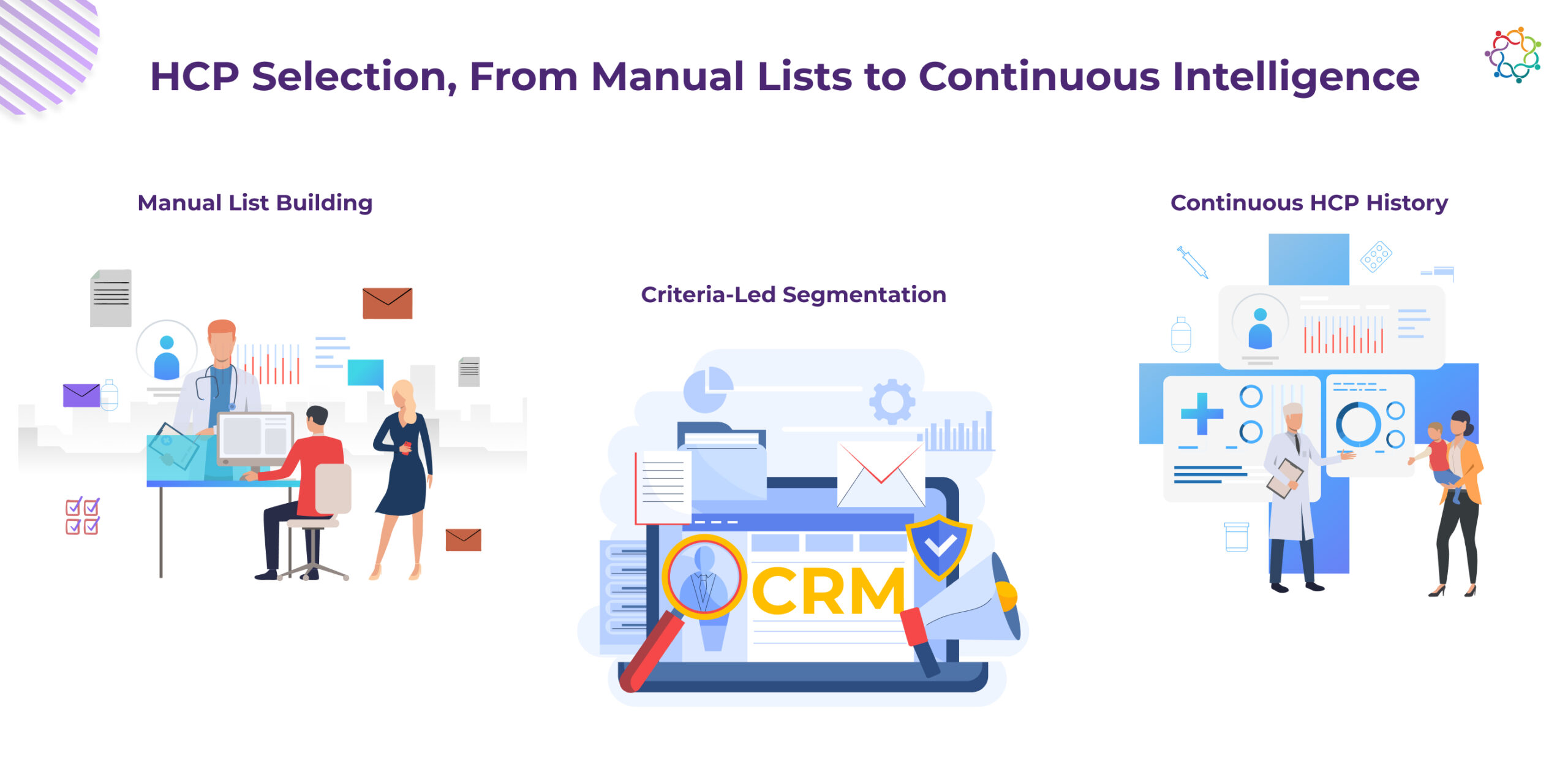
HCP Segmentation & CRM Integration
Invite-Only RSVP Management

Event Website & Session Information
On-Site Check-In & Attendance Validation



100% verified attendance
through invite-only RSVPs and QR-based check-in
40–50% reduction in manual effort
by centralising invitations, attendance, and reporting.
1 system of record for every roundtable
capturing attendance, insights, and feedback without reconstruction.

Year-round ROI visibility
by syncing verified participation and outcomes into the CRM.
During an internal review of multiple HCP roundtables conducted over the quarter, the medical affairs team was able to present a single, consolidated view of every engagement, showing who was invited, who attended, what was discussed, and what insights were captured, without pulling data from emails, spreadsheets, or individual notes. What was typically a manual reconstruction exercise became a straightforward review, marking a clear shift in how scientific engagements were governed and justified.
As HCP roundtables become more frequent and strategically important, the risk is no longer in running them, it’s in how they are documented and defended over time. Small, invite-only scientific discussions carry a higher compliance and ROI burden than large events, yet are often managed with less structure.
This case shows that the real shift for pharma teams is moving from session-based execution to program-level governance. When invitations, attendance, insights, and feedback are captured consistently across every roundtable, value stops being anecdotal and becomes reviewable. For organisations running recurring HCP engagements, technology is no longer about convenience; it is the mechanism that makes scientific exchange measurable, repeatable, and defensible.

A leading data solutions organisation with operations spanning India, the Middle East, and Southeast Asia, the company regularly participates in hundreds of technology and industry events every year as a sponsor or thought-leadership partner.
The firm’s marketing and sales teams invest significantly in global sponsorships, from regional conferences to international tech summits, to engage decision-makers, nurture enterprise relationships, and build brand visibility.
Information Technology & Data Solutions
Budget Manager | Lead Management Hub | Automated Communication | Salesforce Integration
As the company’s global sponsorship activity scaled across markets, the leadership team faced a growing challenge – measuring impact and accountability at scale.
Despite significant investments, the marketing leadership lacked a unified way to answer three fundamental questions:
Without a unified system, spend tracking was scattered, leads were inconsistently recorded, and reporting to leadership was time-consuming and fragmented.
The company needed a centralized dashboard to see sponsorship spend, performance, and conversion trends across the global event portfolio, not just one event at a time.
The marketing team engaged Samaaro’s event marketing suite to centralize planning, tracking, and reporting across all sponsorship activities.
By combining Budget Management, Lead Management Hub, and Salesforce integration, the marketing team built an always-on system that tied spend, leads, and sales outcomes together, across every geography, every sponsorship, every event.

1. Budget Manager – Centralized ROI Control Across Hundreds of Events
Previously, sponsorship budgets were managed through scattered regional spreadsheets, and every event required multiple layers of approval before finalization. To simplify this, the company adopted Samaaro’s Budget Manager, a unified interface to plan and track all event expenses by category, sub-category, and vendor.
Managing budget requests across hierarchies became as easy as ABC, while still ensuring governance and compliance. Once approved, teams logged actual spends against planned lines, allowing leadership to monitor real-time variances, prevent overspending, and connect every expense to measurable outcomes like leads generated, meetings conducted, and deals added to Salesforce. This gave the leadership a live ROI dashboard showing cost per lead, cost per opportunity, and pipeline value per event.
2. Lead Assignment Hub – Tracking Sales Performance Across Events
With Samaaro’s Lead Assignment Hub, capturing leads at global events became quick and structured. Sales teams used the built-in business card scanner to instantly record visitor details and attach notes on discussions, eliminating manual entry.
Each lead was automatically enriched with key data points like lead score, solution interest, and projected closure timeline, ensuring quality insights from the moment of capture.
Sales agents could track their own performance: number of leads generated, meetings held, and follow-ups completed.
Regional managers had visibility into team performance metrics across multiple events.
The data automatically synced with Salesforce, ensuring that every event-generated lead, regardless of location or team, flowed directly into the company’s CRM for follow-up and tracking.
This not only improved data accuracy but also helped the marketing team calculate lead-to-opportunity ratios across different markets.


3. Automated Communication – Continuous Relationship Nurturing
Using Samaaro’s Automated Communication solution, leads were segmented post-event by geography, industry, and engagement type and reduced their follow up time from days to minutes.
Each lead received an instant contextual follow-up sequence:
This ensured no lead went cold after any event, even when 10+ sponsorships were happening simultaneously across regions.
4. Salesforce Integration – Unified Visibility Across the Pipeline
Every approved lead and engagement record automatically synced to Salesforce, maintaining a single source of truth.
The integration allowed leadership to:
What was once fragmented across teams and geographies became a unified, measurable sponsorship ecosystem.


230+ events tracked annually across geographies

32% improvement
in lead-to-opportunity conversion rates

100% data sync between Samaaro and Salesforc

38% reduction
in cost per qualified lead across the sponsorship portfolio
Over the course of a year, the firm recorded a measurable improvement in how sponsorship impact was tracked.
For the first time, the CMO could open a single dashboard and see:
“Our sponsorships finally have math behind them,” said the CMO. “I can now defend every dollar spent with data.”
Sponsorships are no longer about presence, they’re about performance.
For enterprise marketers managing global portfolios, visibility into cost, conversion, and pipeline contribution is the new currency of success.
By connecting spend, lead data, and CRM outcomes into a single measurable framework, platforms like Samaaro give leaderships the clarity they need to scale sponsorships not just with confidence, but with proof.


Brand Ripplr, a trailblazer in influencer marketing, is at the forefront of curating impactful connections between brands and content creators across the MENA region and beyond. As a full-service platform and agency, Brand Ripplr empowers businesses to unlock authentic engagement and drive measurable results through strategic collaborations with its expansive network of social media influencers. Beyond its core services, Brand Ripplr is a significant contributor to the influencer ecosystem, exemplified by its hosting of the prestigious MENA Content Creator Awards. These annual gatherings serve as a vital platform for recognizing excellence, fostering industry dialogue, and uniting international celebrities, regional creators, and leading brands, thereby setting the standard for curated, content-rich engagement within the digital sphere.
Digital Marketing and Advertising & Marketing
Registration, Check-in & Badge Printing
For Brand Ripplr, a leading influencer marketing platform, creating high-touch, invite-only moments wasn’t just about exclusivity, it was about control. From managing limited seats to personalizing access for high-value creators and clients, every interaction had to feel curated. But with growing scale, traditional invite systems were falling short. That’s where Samaaro stepped in.
For an invite-only gathering of the region’s top influencers, Brand Ripplr had the experience design covered, but what they needed was a smarter way to operationalize exclusivity.
Traditional RSVP flows weren’t built to handle segmented access, creator-specific invites, and attendee caps, all while maintaining a premium feel. They needed a platform that could support:
Two-tiered access: VIP creators and brand clients had to receive different forms of communication and entry points.
Social handle-based validation: Many influencers didn’t register with email IDs; their identity was tied to social media.
Capacity-based auto-closure: Once the limited seats filled up, registrations needed to stop instantly to prevent crowding.
Their core challenge? Streamlining RSVPs with precision, while ensuring the exclusivity of the experience wasn’t compromised at any stage.
What set Samaaro apart was its flexibility to handle both open registration and high-security invite-only access, on a single platform. Our team created a system that mirrored the exclusivity of Brand Ripplr’s vision while keeping the backend agile and automated.
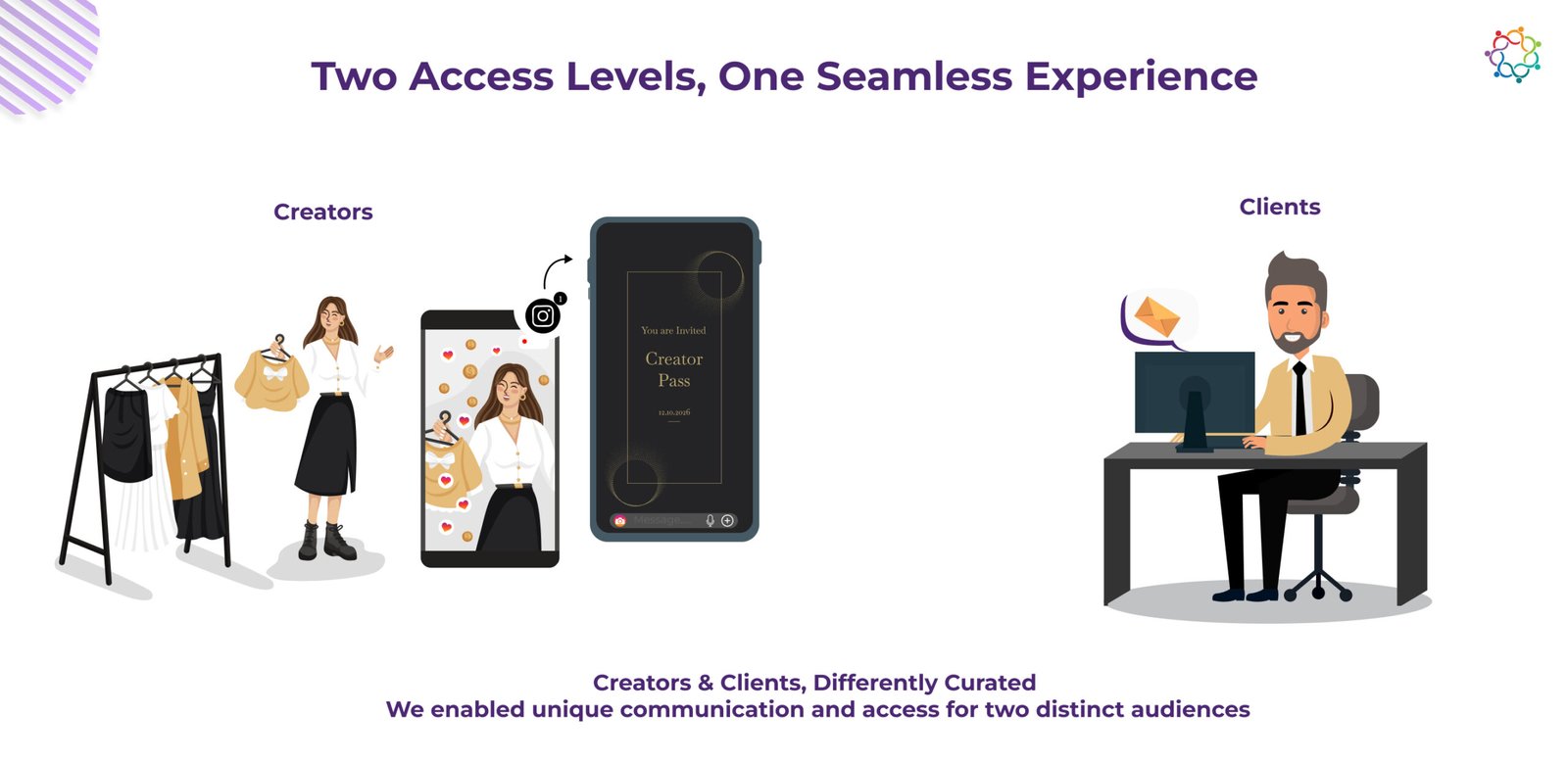
1. Dual Ticketing Paths
To handle two very different audiences, VIP influencers and invited clients — Samaaro created two separate ticketing workflows:
This ensured zero oversubscription and full control over who attended.
2. Unique Invite Matching with Social Handles
Influencers don’t always RSVP like the rest of us. So we let Brand Ripplr upload a curated list of Instagram handles, matching them against registrations dynamically. Only those on the pre-approved list could sign up for the event.


3. Auto-Shutdown When Capacity Was Reached
Brand Ripplr wanted to limit total entries to 400. Samaaro’s ticketing engine automatically shut down registrations the moment that number was hit, ensuring no chaos on event day.

400-seat capacity
managed with full control,
zero overflows

100% invite validation
via social handle matching

2 unique workflows
enabled on one platform
According to a 2024 Statista report, over 74% of marketers plan to increase budgets for experiential influencer events, prioritizing access control, exclusivity, and creator experience. But here’s the paradox: as the guest list shrinks, the expectations soar.
Brand Ripplr’s approach shows us that precision is the new premium. Whether it’s validating a guest through their Instagram handle or auto-capping registrations to avoid chaos, the future of influencer events lies in marrying high-touch curation with low-effort tech enablement.
This case is a blueprint for modern brand-led experiences, where controlling access isn’t just about security; it’s part of the storytelling.
Key signals:
Events with verified invite lists see up to 2.7x higher NPS from high-value attendees.
1 in 3 creators are more likely to post content when the experience feels personalized.
The ability to link CRM data with ticketing workflows is becoming a must-have in the influencer event tech stack.
In short: tech-powered exclusivity is no longer optional, it’s the new expectation.
One of Southeast Asia’s fastest-growing real estate developers, headquartered in Bangkok. With a portfolio spanning luxury condominiums, gated villa communities, and mixed-use commercial hubs, the company has built a reputation for delivering aspirational urban spaces. The developers host large-scale property launches across Bangkok, Singapore, and Kuala Lumpur, often drawing 1,500+ channel partners, investors, and prospective buyers. These events are high-energy, high-stakes environments where limited inventory meets surging demand. For the developer, the success of a launch is not just about sales, it’s about building trust with investors, ensuring fair allocation, and delivering a premium experience that reflects their brand promise.
The client, a leading Bangkok-based developer, was preparing for the grand launch of its latest property. Hosting 10–12 property launches annually, the team needed a structured way to collect Expressions of Interest (EOIs), validate payments, and efficiently manage large onsite queues at all their events. By using Samaaro’s integrated suite, the client was able to automate EOI collection, streamline communication, and simplify onsite queue management, ensuring a consistent, frictionless experience for both channel partners (CPs) and customers.
Real estate launches are often chaotic. Channel partners and customers rush to secure units, creating long queues, delayed verification, and miscommunication.
The Bangkok developer faced these key challenges:
This created friction at every stage, risking the credibility of the launch experience.
1. Digital EOI Form Setup
a. The developer’s team used Samaaro’s event registration platform to design a tailored EOI process.
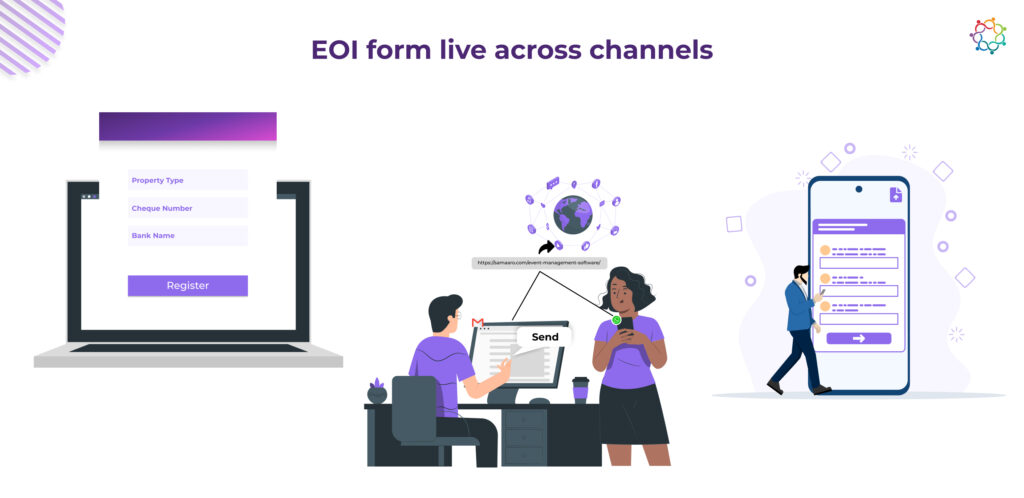
b. The registration flow captured both personal details and buyer intent, including property type of interest, token amount paid, cheque details (number, bank name, date), document uploads (cheque photo/PDF)
c. The EOI link was distributed across channel partner networks and embedded on the developer’s official website, ensuring maximum reach and faster submissions.
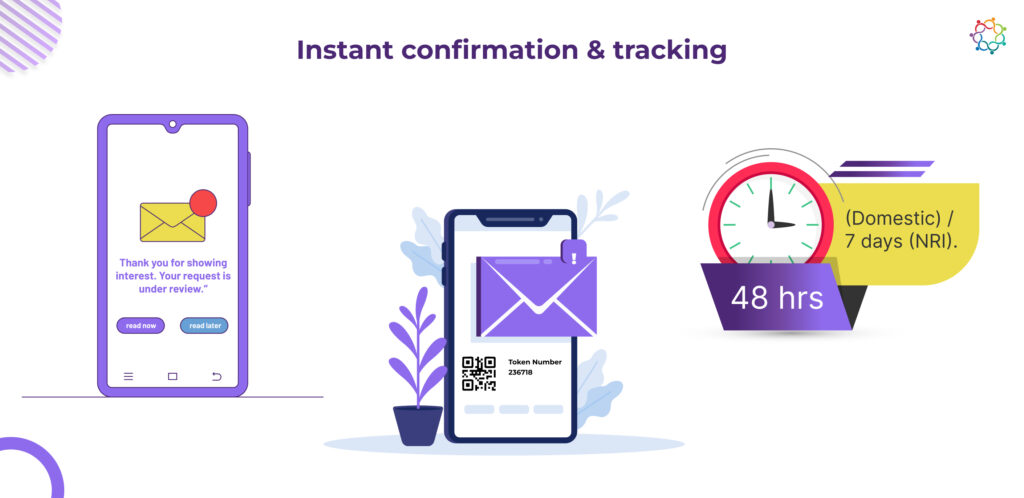
2.Automated Acknowledgement & Tracking
a. Upon submission, CPs/customers received an email & WhatsApp message with:
i. Acknowledgement note
ii. Unique token number
iii. QR code for onsite verification
iv. Application validity (48 hours for plots, 72 hours for villas)
3. Automated Review & Approval Workflow
a. The builder’s admin team reviewed applications, validated cheque details, and approved/rejected requests.
b. Accepted applicants were notified instantly via email & WhatsApp; rejected ones were informed with reasons and directed to resolve issues with the admin team.

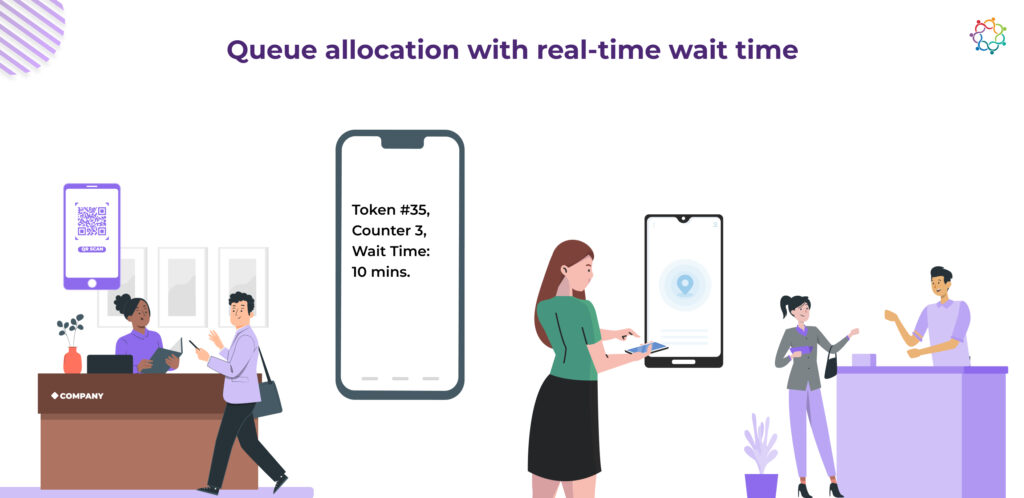
4. Onsite Queue Management
a. At the launch venue, CPs/customers scanned their QR codes at reception.
b. Samaaro’s Queue Management System generated a token number, allocated a counter, and displayed estimated wait time.
c. Sales agents could instantly pull up applicant details (property interest, payment info, documents).
5. Final Verification & Processing
a. Sales agents added real-time notes such as “Cheque received” or “Documents verified”.
b. A confirmation email/WhatsApp was sent instantly: “Your EOI has been successfully processed.”


100% digital EOI collection, eliminating paperwork errors and manual spreadsheets

65% reduction in queue wait times with automated counter allocation leading to a 40% higher NPS amongst CPs and customers.

80% faster verification (under 3 minutes per application) process as sales agents had applicant data upfront

Zero communication gaps, real-time updates via WhatsApp & email kept CPs/customers fully informed
One channel partner, who previously spent over two hours waiting at their earlier launches, was surprised when his QR code scan instantly allocated him to a counter with a 10-minute wait time. His EOI was processed in under 3 minutes, a game-changer in customer experience.


Website Builder, RSVP Management, Event App, Feedback Manager
With a week-long seminar planned for employees flying in from multiple countries, Bureau Veritas sought to modernize the way it conducted internal events. While their program and speakers were well-defined, their existing process lacked a scalable and structured system to manage attendee engagement and logistics.
They needed more than just a digital event; they needed a smart system that could centralize:
What set Samaaro apart was its flexibility to handle both open registration and high-security invite-only access, on a single platform. Our team created a system that mirrored the exclusivity of Brand Ripplr’s vision while keeping the backend agile and automated.
1. A Clean, Informative Event Microsite
We built a minimalist event website to centralize all event details. Attendees received personalized RSVP links that also collected travel and stay preferences, making it easier for the organizing team to plan transportation and accommodation logistics with confidence.
2. Travel Itinerary Coordination with Centralized Logistics
Attendees flying in from different locations could submit travel and stay preferences directly through the RSVP form. The organizing team used this data to manage airport pickups, hotel bookings, and internal transport, reducing last-minute coordination and ensuring everyone arrived prepared.

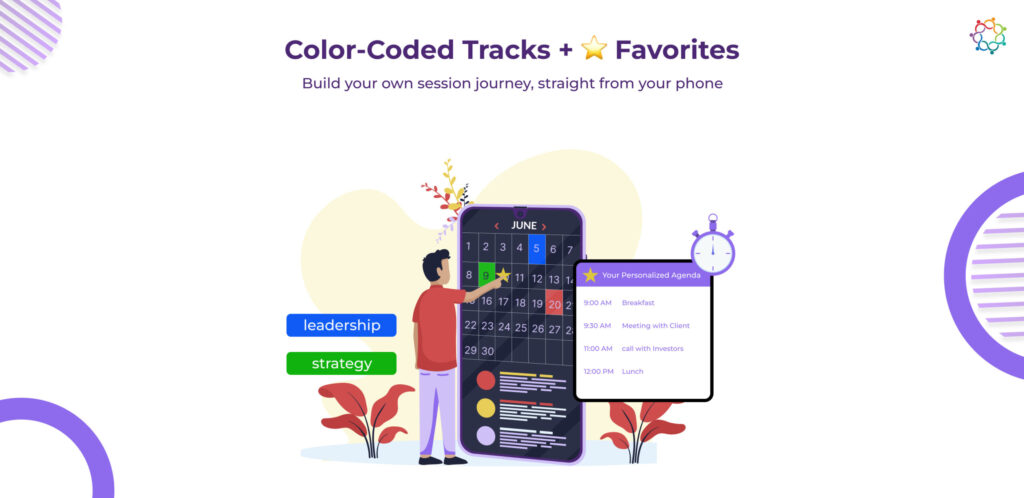
3. Smart Agenda Navigation with Color-Coded Tracks & Favorites
To simplify navigation across multiple parallel sessions, tracks were grouped by vertical and color-coded within the event app. This helped attendees instantly recognize relevant content while reducing the chances of overlap.
Participants could also bookmark sessions as favorites, creating a personalized agenda that was accessible on the go, eliminating the need for printed materials and enabling smoother session planning.
4. Digital Check-In at Session Level
No QR scanners or manual entries, just a simple self-check-in system inside the app. This made it easier to track session-wise attendance without interrupting the flow of the event.
5. In-Session Interactivity Tools
To maximize value per session, we integrated interactive tools such as live Q&A, polls, and downloadable notes. This created a two-way learning environment that was richer than passive listening.

6. Smart Feedback Collection
Feedback forms were triggered automatically after each session and could be accessed via the app or email. This ensured a high response rate and gave organizers deep insights into speaker effectiveness and session quality.


100% registrations were captured through the
centralized RSVP system, streamlining communication
and eliminating manual errors.

98% of travel itineraries
were finalized ahead
of time through the
RSVP form, leading to
smoother pickups,
hotel coordination, and
zero-day-of-event
confusion.

99.9% attendees used
the app-based agenda
instead of printed
booklets.

92% of attendees used
the favorites feature to personalize their schedules.

95% session check-in
rate via the app, without
manual tracking or delays.

600+ feedback responses collected, giving the
Bureau Veritas team
actionable insights for
future planning.
As sessions wrapped up, one thing became clear—every attendee walked in knowing where to be, what to expect, and how to engage. With track colors and favorites simplifying everything inside the app, the experience felt structured yet flexible.
For a seminar that once relied on spreadsheets and paper guides, this transformation wasn’t just digital—it was a shift in how internal events are experienced.
Internal events aren’t just about alignment, they’re about efficiency.
This case reveals a critical shift happening in large enterprises: employee-facing events now demand the same strategic rigor and personalization as external ones.
A recent report by Gallup indicates that highly engaged employees show 21% higher profitability and are 41% less likely to miss work. Platforms like Samaaro allow companies like Bureau Veritas to bring structure, personalization, and data-backed insights into internal events, proving that employee experience is just as worth investing in.
BFSI
Website with custom registrations, Check-In & Badge Printing, Attendee App.
When IvyCap Ventures, a leading VC firm connecting investors and startups, scaled their summits with diverse attendee types, they faced a pressing question: How do you streamline registrations and check-ins across varied stakeholders without compromising on guest experience?
IvyCap’s events bring together a complex mix, investors, startups, portfolio companies, speakers, and VIPs, each requiring distinct registration and access handling. The event team grappled with:
They needed a solution that could simplify registrations, speed up VIP check-ins, and amplify attendee interaction without adding operational overhead.
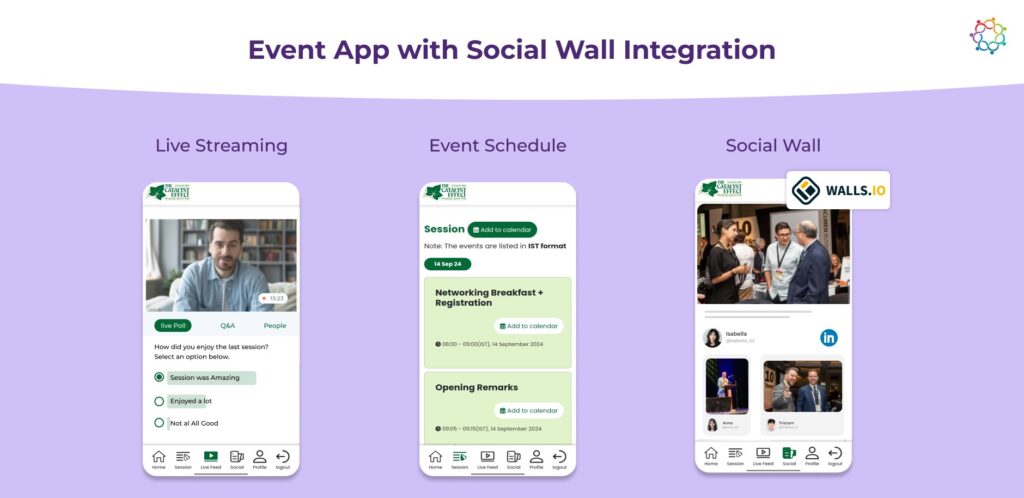
IvyCap partnered with Samaaro because it offered a flexible platform tailored for multi-pass registration and efficient check-in workflows. Samaaro’s solution also integrated a live attendee app with social media features, crucial for IvyCap’s goal of driving buzz and engagement. Plus, Samaaro’s strong customer support and data security gave IvyCap the confidence to scale operations seamlessly.
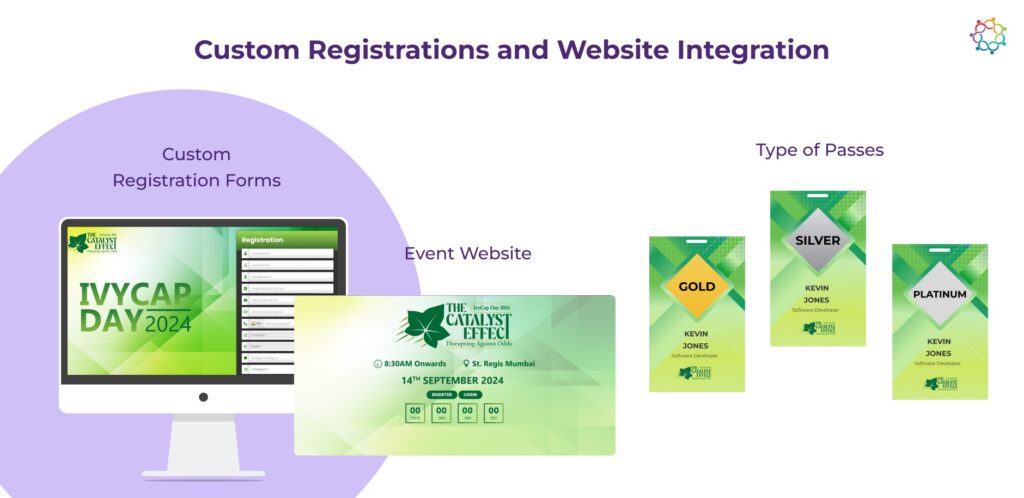
A bespoke registration system, embedded in IvyCap’s event website, managed multiple attendee categories smoothly, investors, startups, VIPs, speakers, reducing drop-offs and registration confusion.
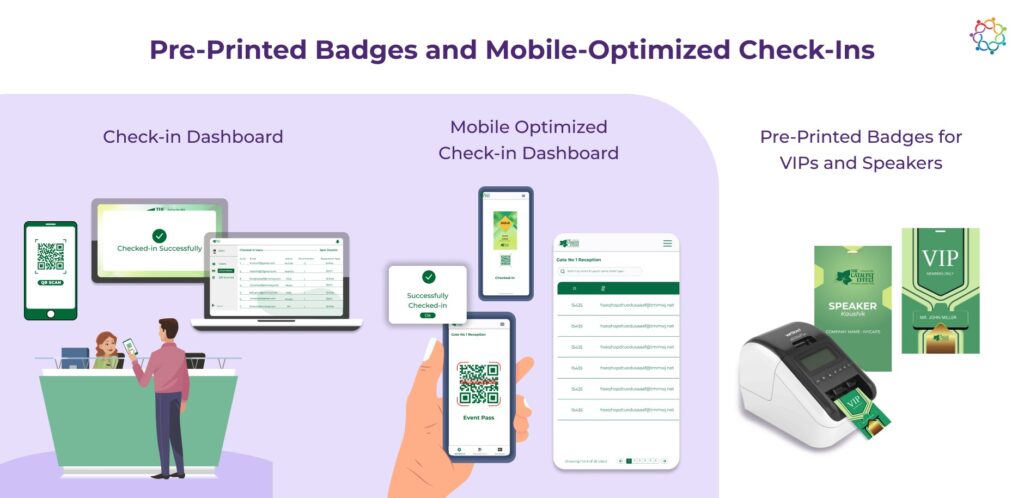
VIPs and speakers received pre-printed badges enabling instant check-in, while other attendees benefited from a mobile-optimized scanning dashboard designed to work in low-connectivity environments, cutting check-in times to under 3 seconds.

20% increase
in registrations
year-over-year
with minimal drop-offs

Check-in times
reduced to under 3
seconds per guest

Check-in times
reduced to under
3 seconds per guest
Before Samaaro, IvyCap’s VIPs and speakers often faced long waits, creating frustration and delaying event flow. One event manager recalled,
“Seeing VIPs walk straight in with pre-printed badges was a game-changer. It freed us up to focus on the content instead of the queues.”
As startup and investor gatherings grow larger and more complex, platforms that combine tailored registrations, fast check-ins, and live engagement tools become essential. IvyCap’s success underscores a broader industry shift: technology must empower event teams to handle complexity while enhancing the attendee experience.
For venture capital firms and startup ecosystems, these tools aren’t just conveniences, they’re critical for building meaningful connections and showcasing innovation in real time.
Ready to streamline your event operations and deliver seamless experiences for all attendees?

Built for modern marketing teams, Samaaro’s AI-powered event-tech platform helps you run events more efficiently, reduce manual work, engage attendees, capture qualified leads and gain real-time visibility into your events’ performance.
Location
© 2026 — Samaaro. All Rights Reserved.