Samaaro + Your CRM: Zero Integration Fee for Annual Sign-Ups Until 30 June, 2025
- 00Days
- 00Hrs
- 00Min

Bottom Line: When an event is about sustainability, paperless check-in lets the experience on the ground match the message on stage.
TVS Motor Company, a flagship company of the TVS Group and one of India’s biggest producers of two-wheelers and three-wheelers, is motivated by a vision of cleaner, smarter mobility. Beyond mobility, it is a major voice on sustainability, bringing together leaders from business, government, academia, and civil society to drive the agenda on climate and sustainable growth through about eight invite-only gatherings annually.
Automotive manufacturing (two-wheelers and three-wheelers)
Event Landing Page, Email and WhatsApp Communications, QR- Based Check-in and Access Control, On-Site Walk-in Registration, Reports and Analytics
Did You Know ? A single 1,000-attendee conference can generate around 25 kilograms of plastic from event badges alone, and almost none of it is ever recycled.
For a company hosting a day dedicated to the environment, TVS wanted the event itself to reflect that commitment, right down to how guests were registered and welcomed. So the conventional paper-and-badge approach was off the table from the start.
Samaaro gave TVS a single digital platform to carry the event from invitation to check-in, built to match the standard the day called for:
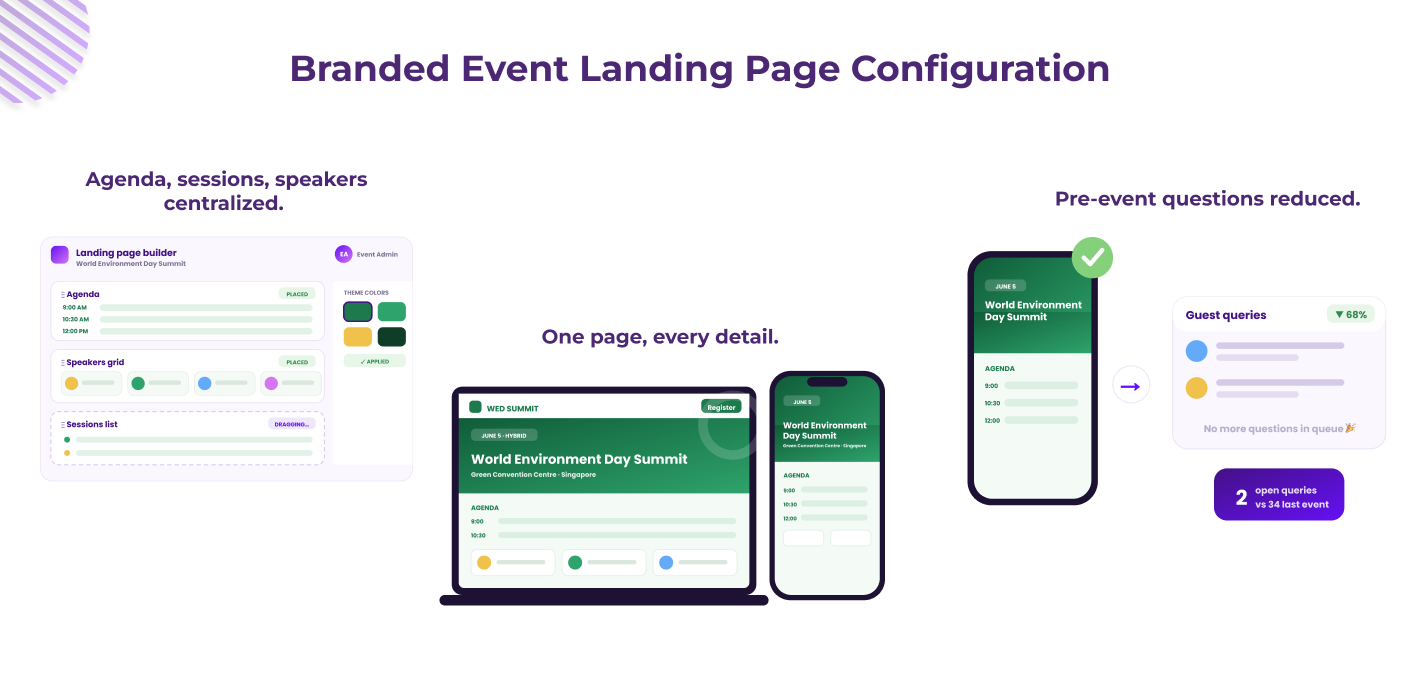
Samaaro built a dedicated landing page that brought the agenda, sessions, and speakers together in one place, styled in the event’s own colors. Invitees arrived already informed about the day, and the team fielded fewer questions beforehand.
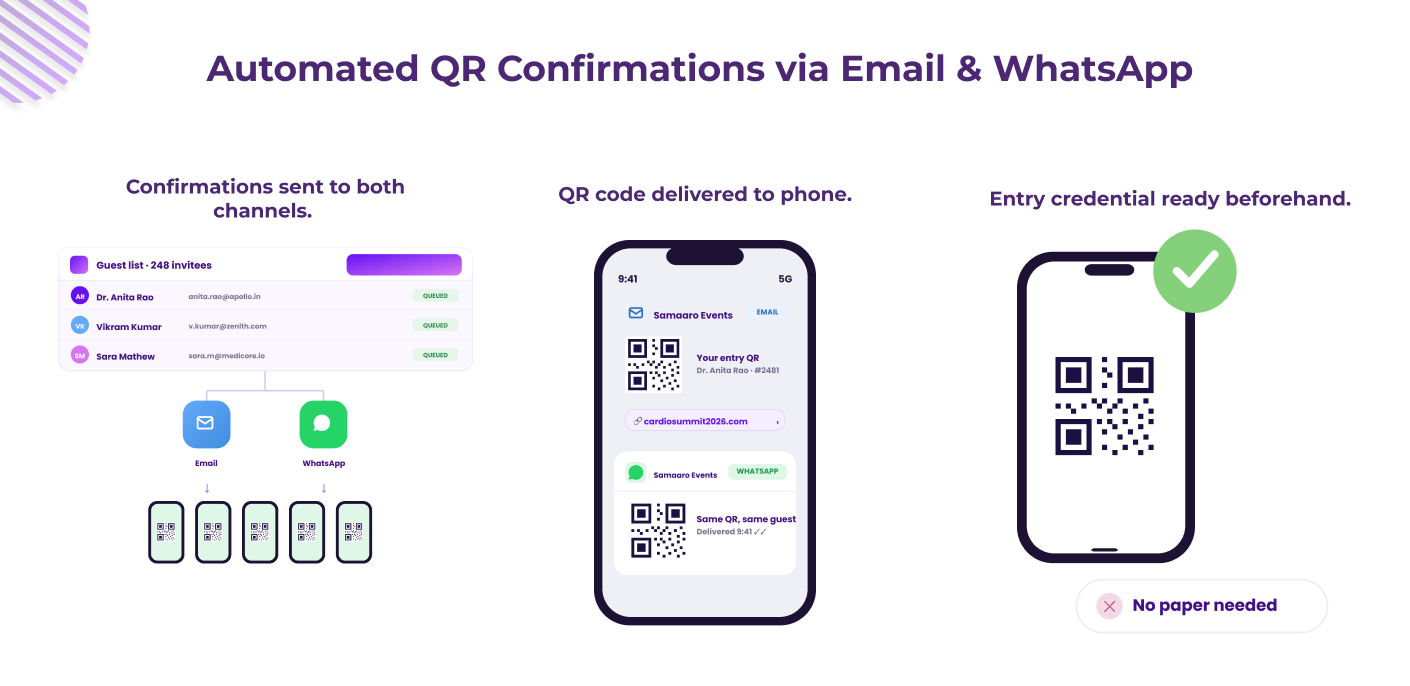
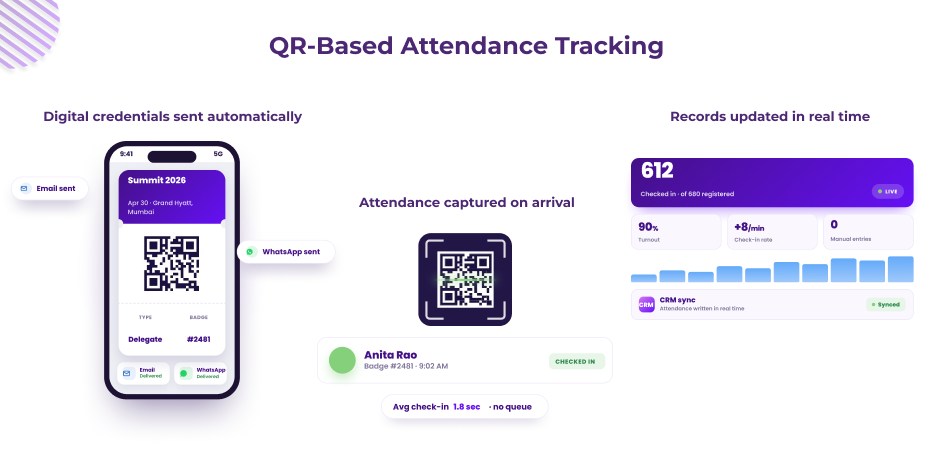
Every guest received a single email and WhatsApp message carrying both their personal QR code and the link to the landing page. Everything they needed then sat in one place on their own phone, from the first tap to the moment they walked in.
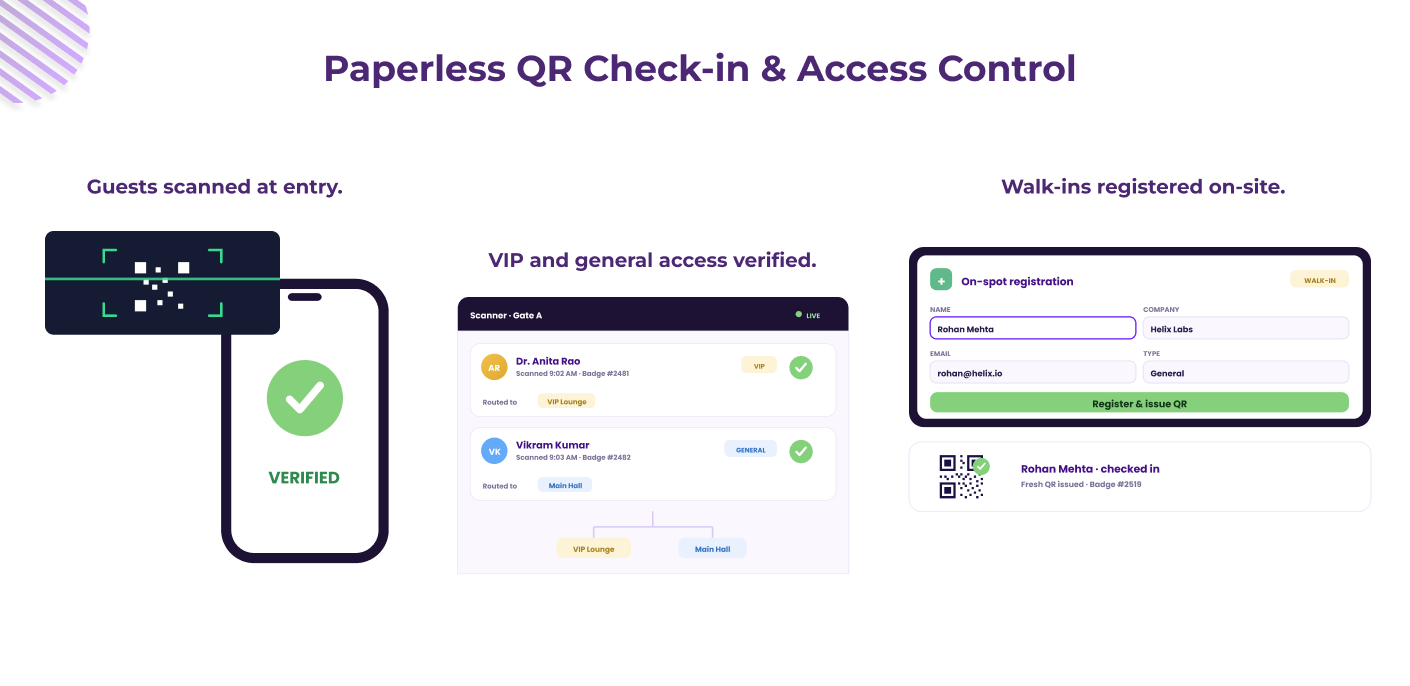
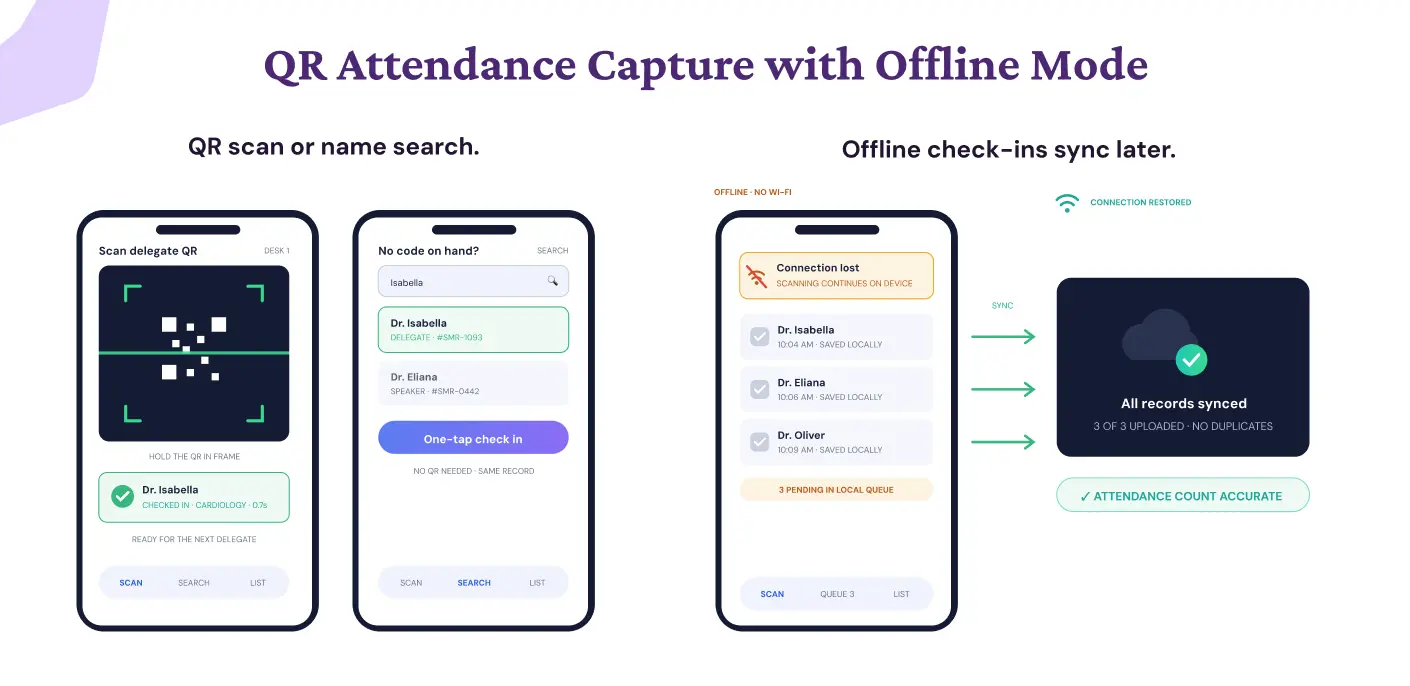
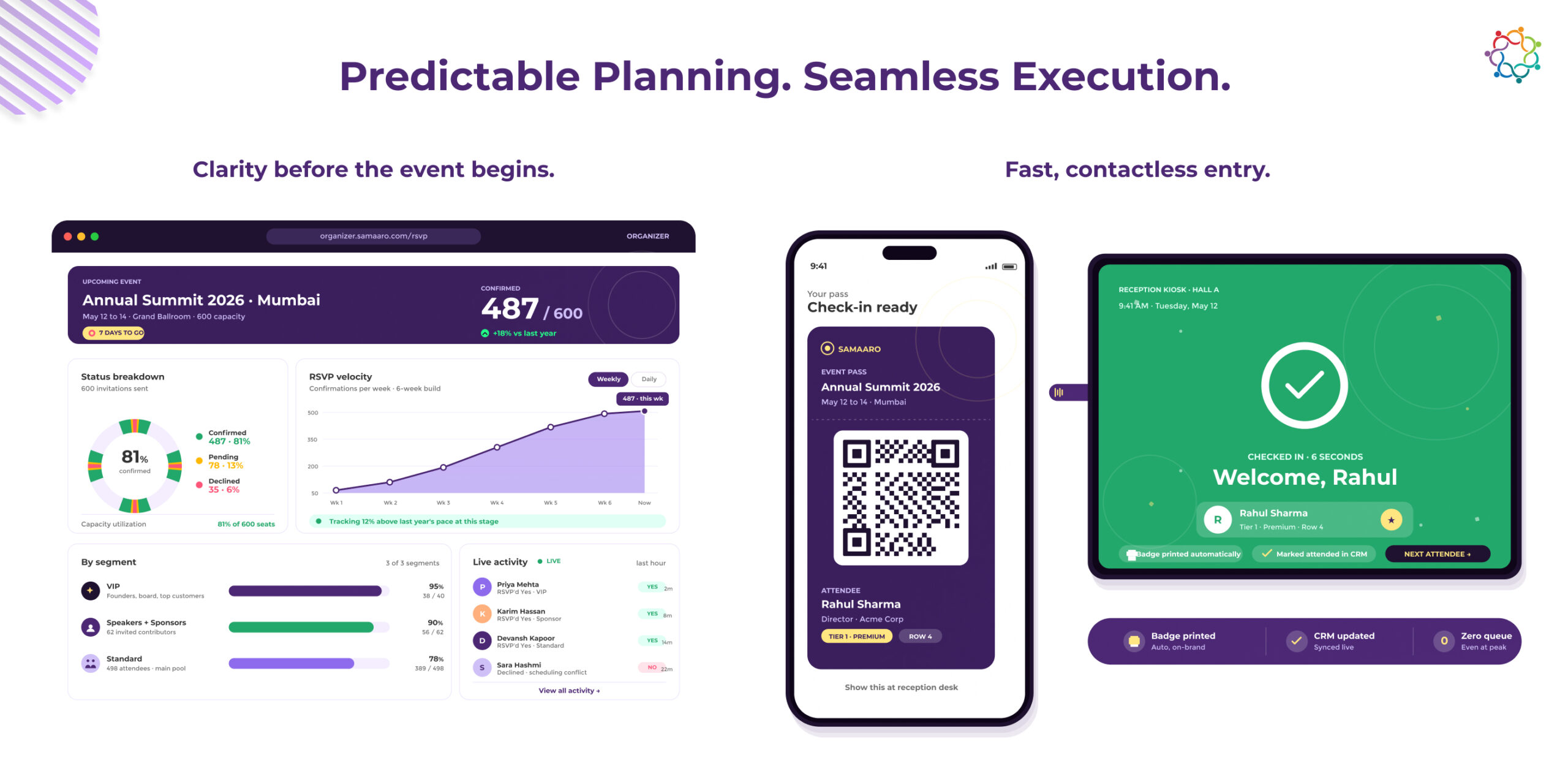
On the day, the entire reception operated through mobile QR scanning, with VIP and general access handled in the same workflow, and walk-ins accommodated on the spot. Entry was fast and controlled, with no printed lists to search and no roster to keep, and no one left waiting.
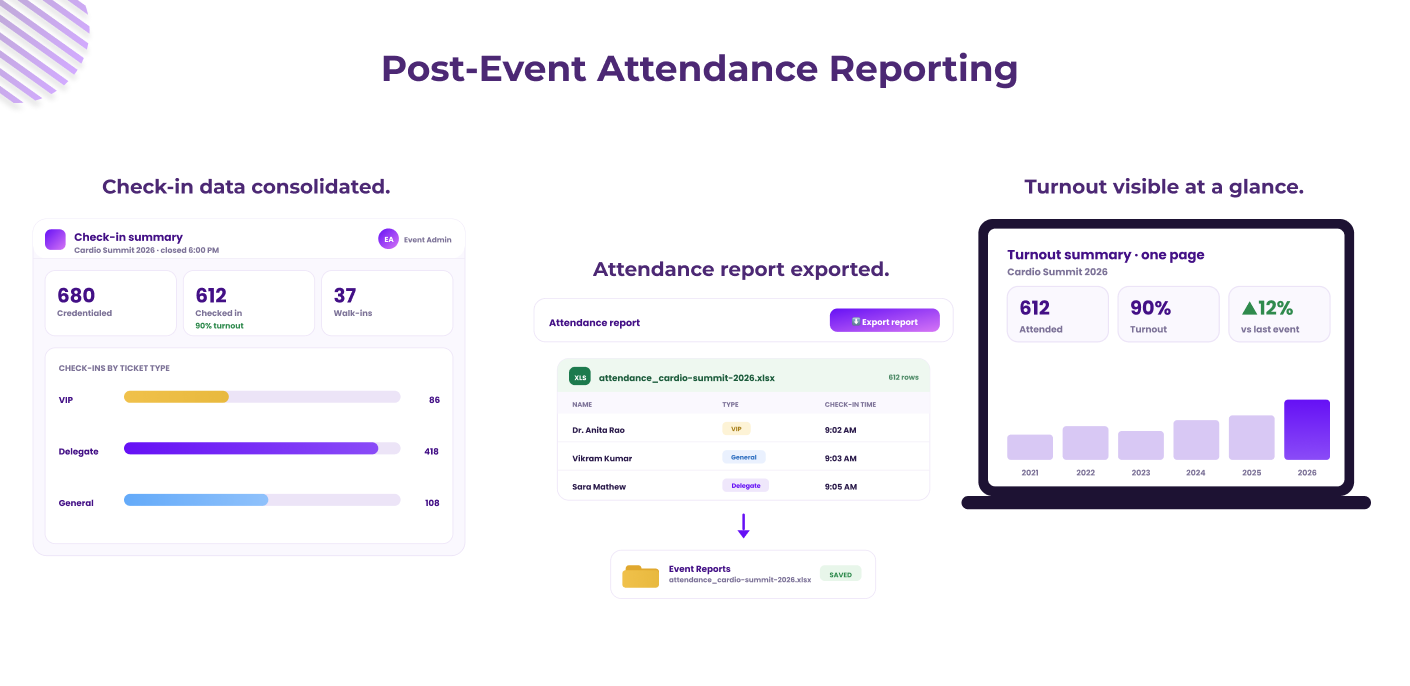
Afterward, Samaaro handed the team a complete, exportable record of every check-in. Leadership could see turnout at a glance and pull the numbers it needed, without reconciling anything by hand.
What made it unique?
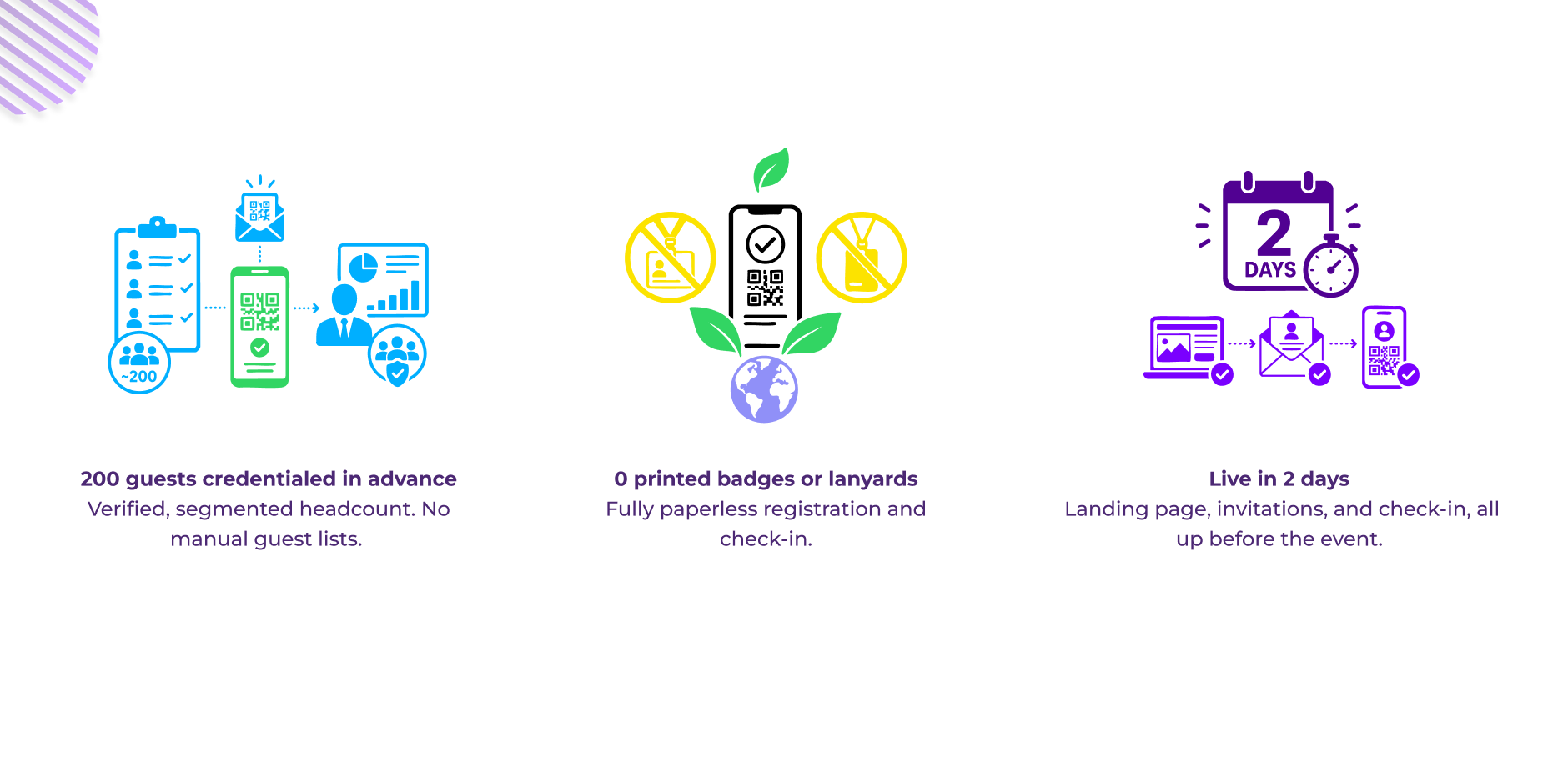
This was TVS Motor Company’s first fully digital event, and the occasion itself was dedicated to sustainability. Moving the whole journey onto guests’ phones meant the day left behind no paper or plastic of its own, making the platform a natural fit for the World Environment Day theme.
“Samaaro made our World Environment Day event genuinely seamless from start to finish. The landing page, the registration flow, and the communication journey were all well executed, and the on-site scanning and check-in were smooth and effortless on the day. Just as valuable was their team’s support on the ground, which kept everything running without a hitch. For our first fully digital event, it set a high bar.”
Shubh Srivastava, TVS Motor Company
How an event is run becomes a part of what it says. Audiences and leadership now expect the choices behind a gathering, from materials to logistics, to reflect the values it stands for, and sustainability is one of the first places that scrutiny lands. Printed badges and lanyards are among the most visible, least-recycled artifacts of the in-person event, which is why more organizations are putting credentials on attendees’ phones. For a company with public sustainability commitments, paperless check-in is a small change with an outsized signal: it lets the experience on the ground match the message on stage.
Samaaro runs registration, communications, and check-in end-to-end, paperless, and built to your brand, so your team can focus on the room and not the paperwork. Book a demo to see how Samaaro can power your next event.

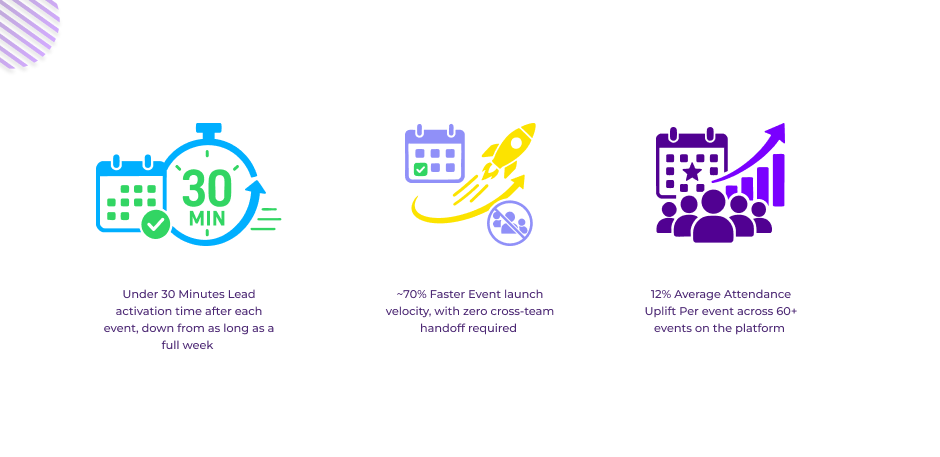
Bottom Line: Lead activation drops from a week to under 30 minutes, launches run roughly 70% faster, and attendance climbs 12% per event.
A global software testing and developer experience platform, serving 30,000+ enterprise engineering and QA teams across 100+ countries. Its ABM function, built three years ago, ran a calendar of 120+ events a year spanning three motions: one-to-one executive sessions at named accounts, one-to-few pod-level roundtables grouping 75 to 125 accounts under a single CSM, and one-to-many virtual webinars for top-of-funnel reach. Across in-person and virtual formats, events sat at the centre of the company’s enterprise demand generation, driving named-account expansion alongside its established product-led growth motion.
Enterprise SaaS / Developer Experience & Software Testing
Event marketing platform, Dynamics 365 CRM integration, Zoom integration, Marketo handoff, multi-channel guest communications (email + WhatsApp), QR-based check-in, real-time lead routing, cloneable event templates, geography- and event-format-specific team access controls, campaign-level and people-level reporting
When an ABM program matures into a revenue channel, the operational stack built for a leaner motion starts to crack, and the gaps show up first in the moments that matter most: the hours immediately after an event ends.
As the program scaled, every event was stitched together across a fragmented stack of point tools, connected through manual handoffs and downstream enrichment. Pulling data, sending invites, hosting, capturing attendance, enriching contacts, and waiting on the operations team to compile the final attendee list often stretched to days, sometimes a full week
Samaaro consolidated the entire ABM event engine, across in-person and virtual formats and across all three event motions, onto a single platform. From event setup through post-event reporting, every step of the guest journey was unified and connected natively into the team’s existing revenue stack.
What made the solution unique?
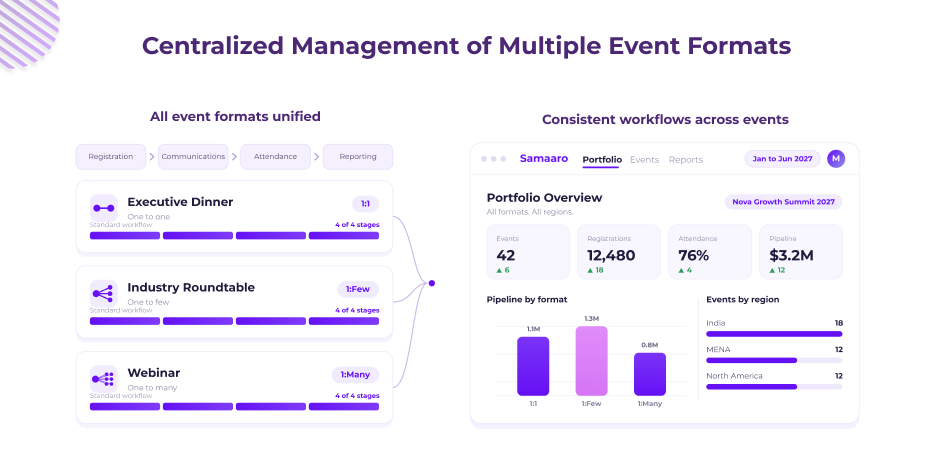
1) A Unified Operating System Across In-Person and Virtual Events
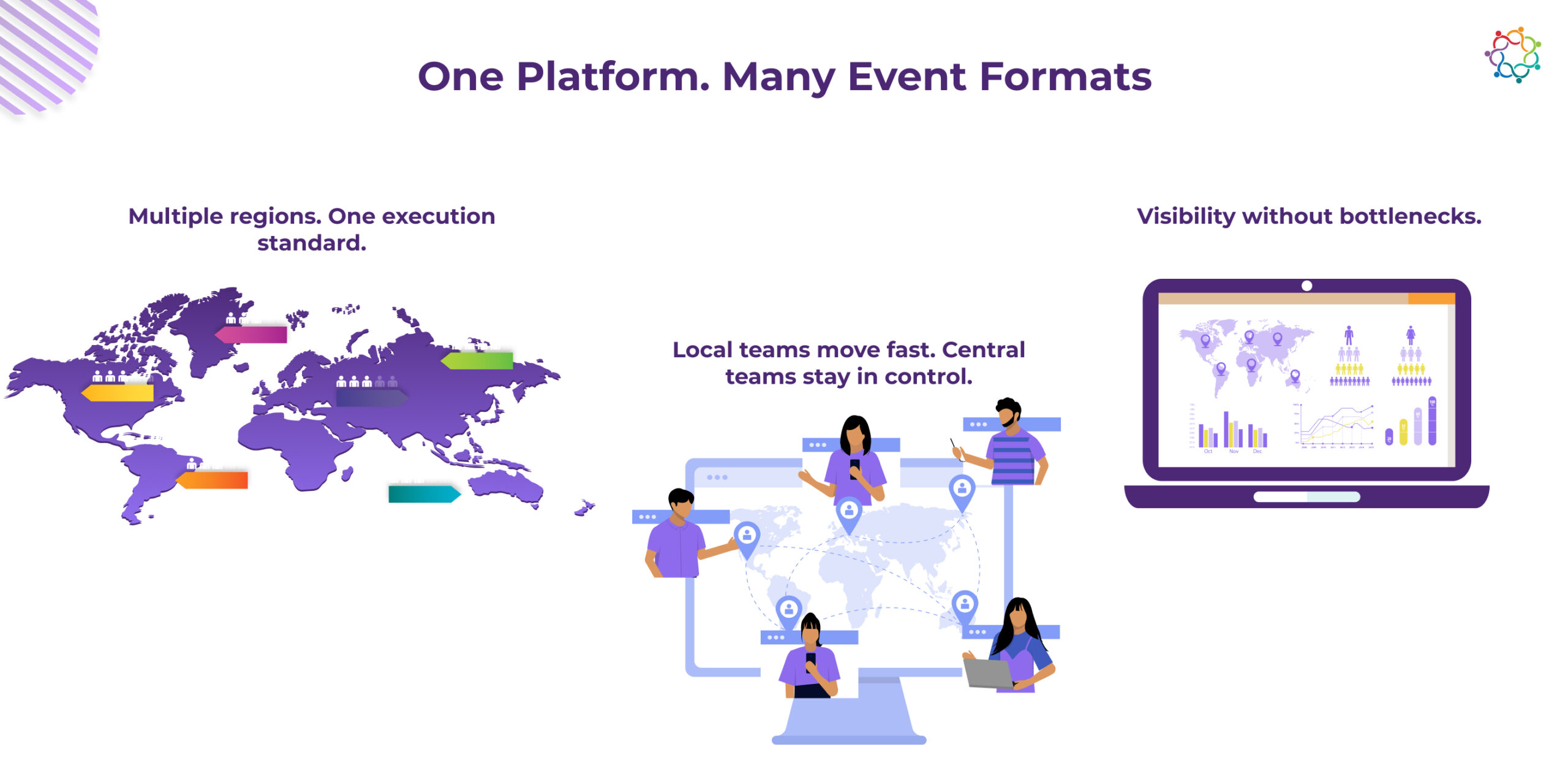
The team managed one-to-one, one-to-few, and one-to-many events from a single workspace, regardless of format. Whether the event was a virtual webinar, an executive session at a customer office, or a pod-level roundtable, the setup, communications, attendance capture, and reporting flowed through the same platform.
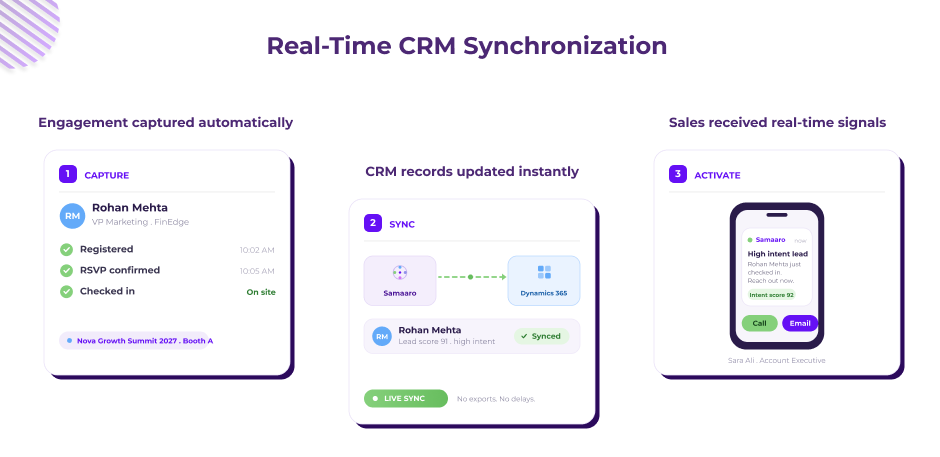
2) Real-Time CRM Sync That Eliminated the Post-Event Handoff Lag
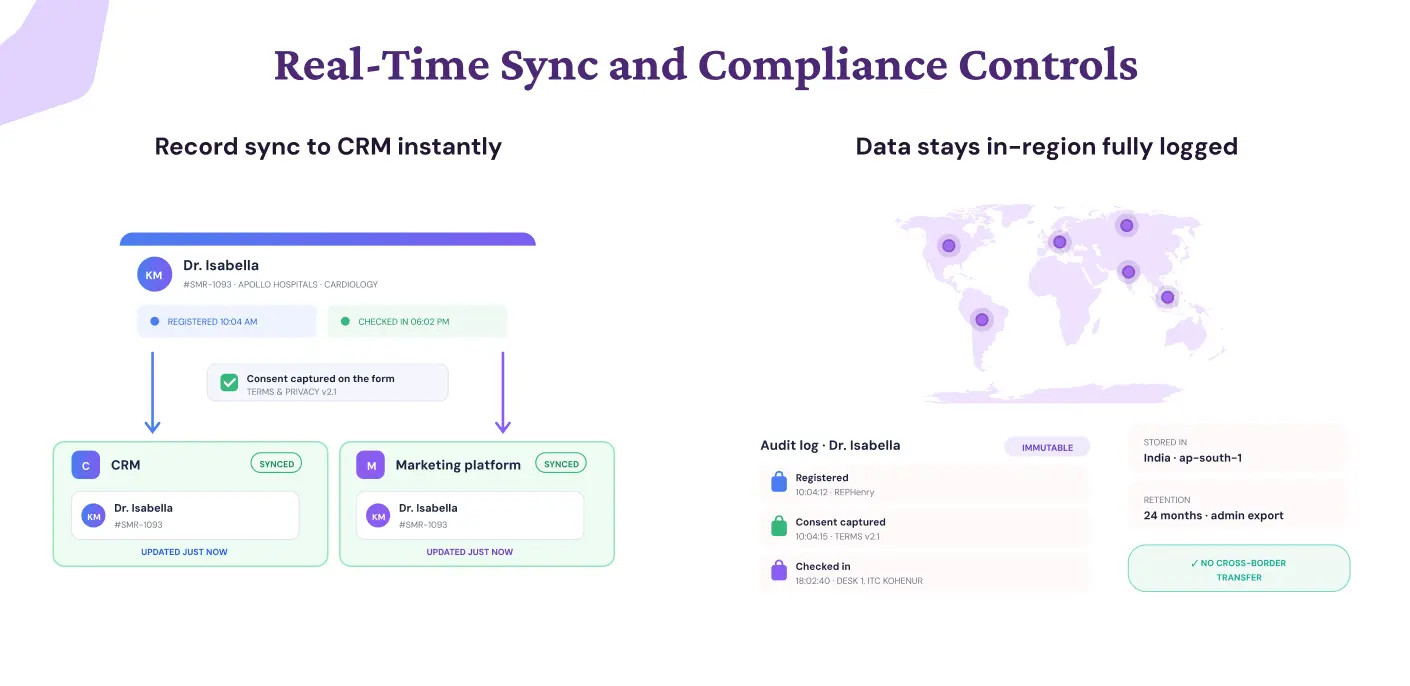
Registrations, RSVPs, attendance, and engagement signals flowed directly into Dynamics 365 the moment they happened, replacing the multi-day operations handoff with a live data flow. Sales reps could begin outreach within minutes of an event ending, capturing leads at their highest intent.
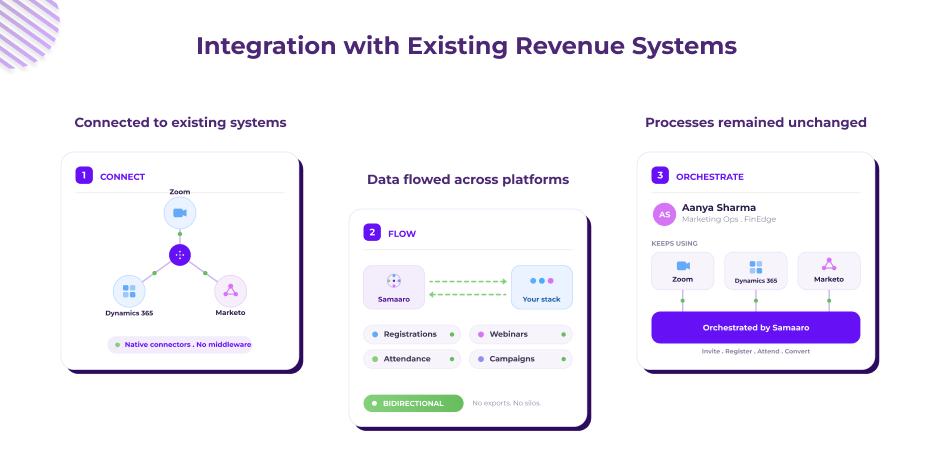
3) Native Integration with the Existing Revenue Stack
Samaaro integrated natively with Zoom for virtual events and with Dynamics 365 and Marketo for the team’s existing CRM and nurture workflows, so the marketing team continued running drip campaigns and follow-up cadences in the tools they already trusted, while the ABM team gained a single layer above it that orchestrated the event itself.
4) Instant On-Site Check-In via QR Code
For in-person events, every confirmed attendee received a QR code via email and WhatsApp. On the day of the event, the team scanned each guest at the venue, capturing attendance instantly and pushing it into Dynamics 365 in real time, replacing manual Excel lists and post-event ZoomInfo enrichment.
5) Multi-Channel Guest Communications Across the Entire Journey
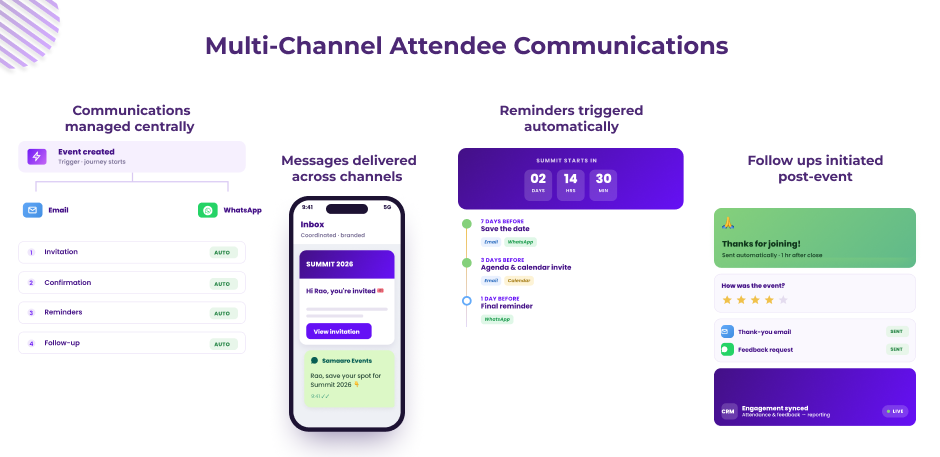
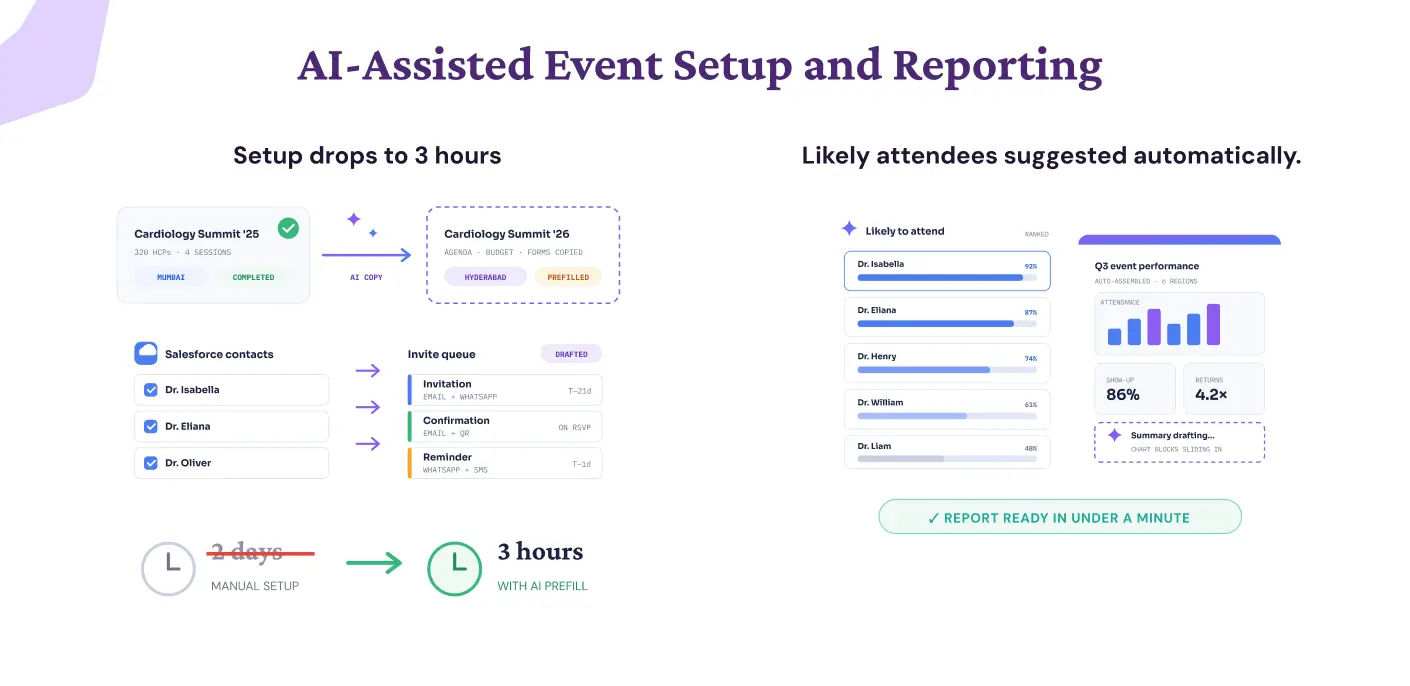
Invites, confirmations, reminders, and post-event follow-ups went out automatically across email and WhatsApp, handling the full guest journey without manual triggers, and delivering the kind of reminder cadence that lifted attendance rates materially.
6) Cloneable Event Templates That Removed Cross-Team Dependency
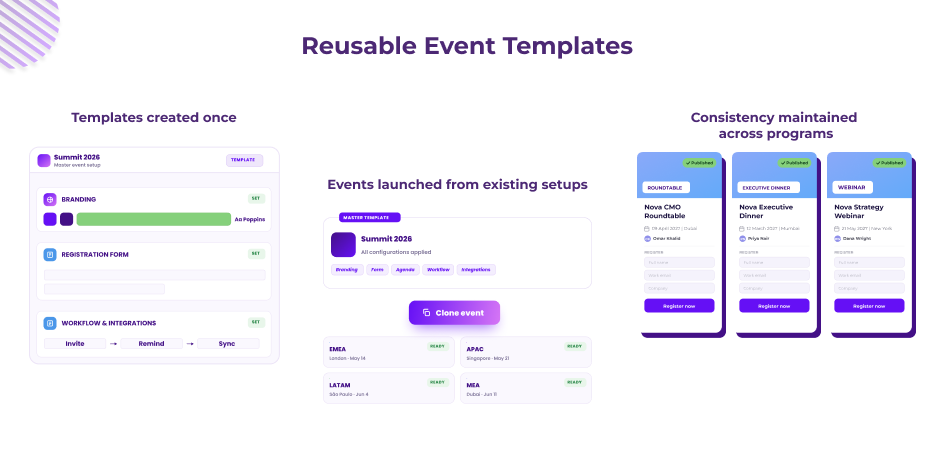
Once the team set up the first event in a series, every subsequent event could be cloned in minutes, with branding, registration forms, communication templates, and integrations carrying over intact. The dependency on a separate team to build a new WordPress landing page for every event was removed.
7) Geography- and Event-Format-Specific Access Controls Across Teams
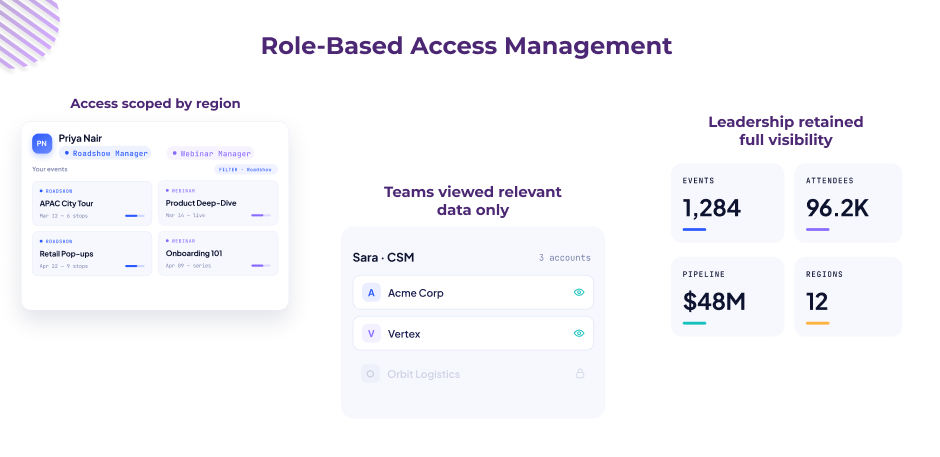
With multiple ABM sub-teams operating across regions and event motions, Samaaro enabled role-based access scoped by both geography and event format. Members of the roadshow team saw only roadshow data, one-to-one CSM-led sessions stayed within the CSM’s pod of accounts, regional admins worked within their geography, and program leadership held visibility across the entire calendar. The right data stayed with the right teams, and the operational risk of cross-team data leakage as the program scaled was removed.
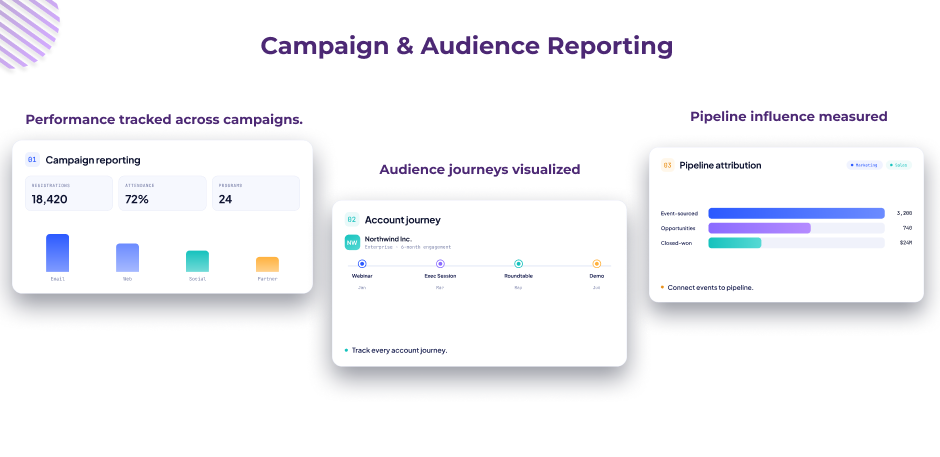
8) Campaign-Level and People-Level Reporting in a Single View
Beyond event-level reports, the team now had campaign-level dashboards showing total registrations across the program, channel attribution, and email and WhatsApp performance, alongside individual journey tracking that showed how a given target account engaged across multiple events over time.
This solution wasn’t just an event tool. It became the operating system for the team’s entire ABM event motion.
The ABM team moved from a stitched stack to a single source of truth for every event they ran. Leads flowed into Dynamics 365 in real time, sales reps began outreach within minutes instead of days later, and new events launched without waiting on a separate team. A lean ABM team ran a denser calendar without adding headcount, finally giving leadership the program-level visibility they had been asking for.
Across B2B SaaS, ABM event programs have moved from a periodic motion into one of the highest-converting channels in the modern marketing mix. As they have scaled, the operating complexity behind them has scaled too, and stacks built for a leaner motion start to strain. The shift maturing ABM teams are making today is from event tooling to event infrastructure: a single operating system that treats events as a growth channel, connects natively to the revenue stack, and delivers the leadership-level visibility that program-led marketing now runs on.
👉 Running a high-cadence ABM event program? Let’s talk about how Samaaro can simplify it for you. Talk to our team

Bottom Line: Premium conferences are judged not by attendance, but by the quality of meetings created and the follow-through generated for every leader in the room.
The client is one of India’s most influential new-age business media and innovation intelligence brands. Across editorial, research, data platforms, and live experiences, they have built a defining ecosystem for India’s founders, investors, and decision-makers. A central pillar of that ecosystem is live, with 15+ flagship gatherings curated every year across roundtables, founder meet-ups, summits, and themed forums. For the brand, these events are a strategic moat that turns editorial reach into compounding relationships. For the people in the room, founders, investors, CXOs, and operators, they are the highest-signal gatherings in the country to learn, connect, and find what is next.
Media & Business Intelligence / Conferences & Summits
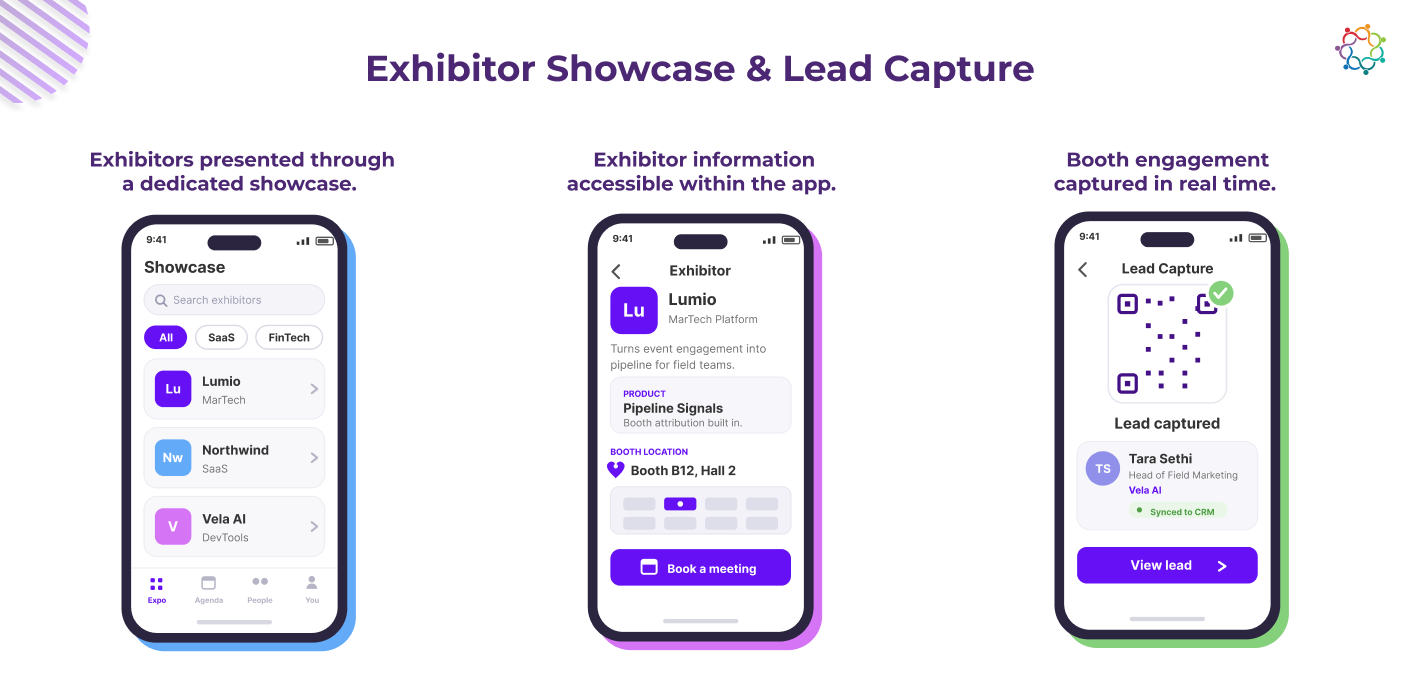
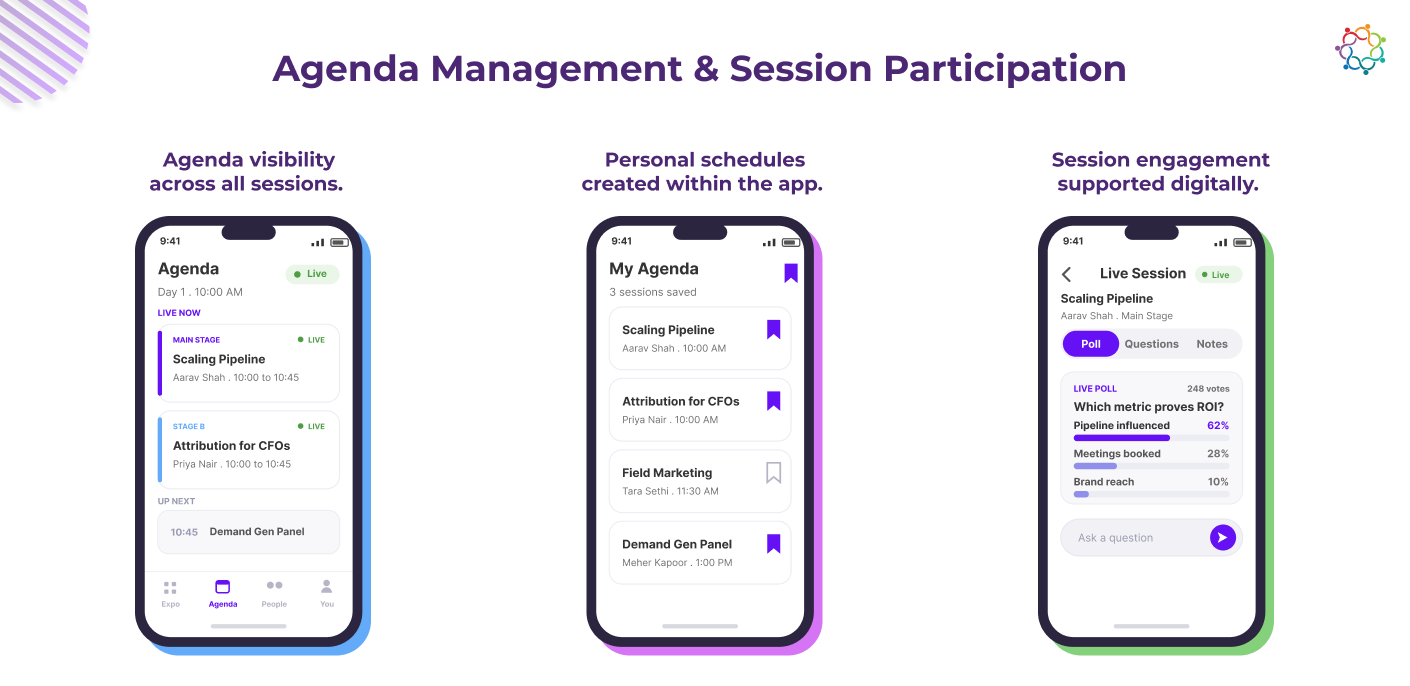
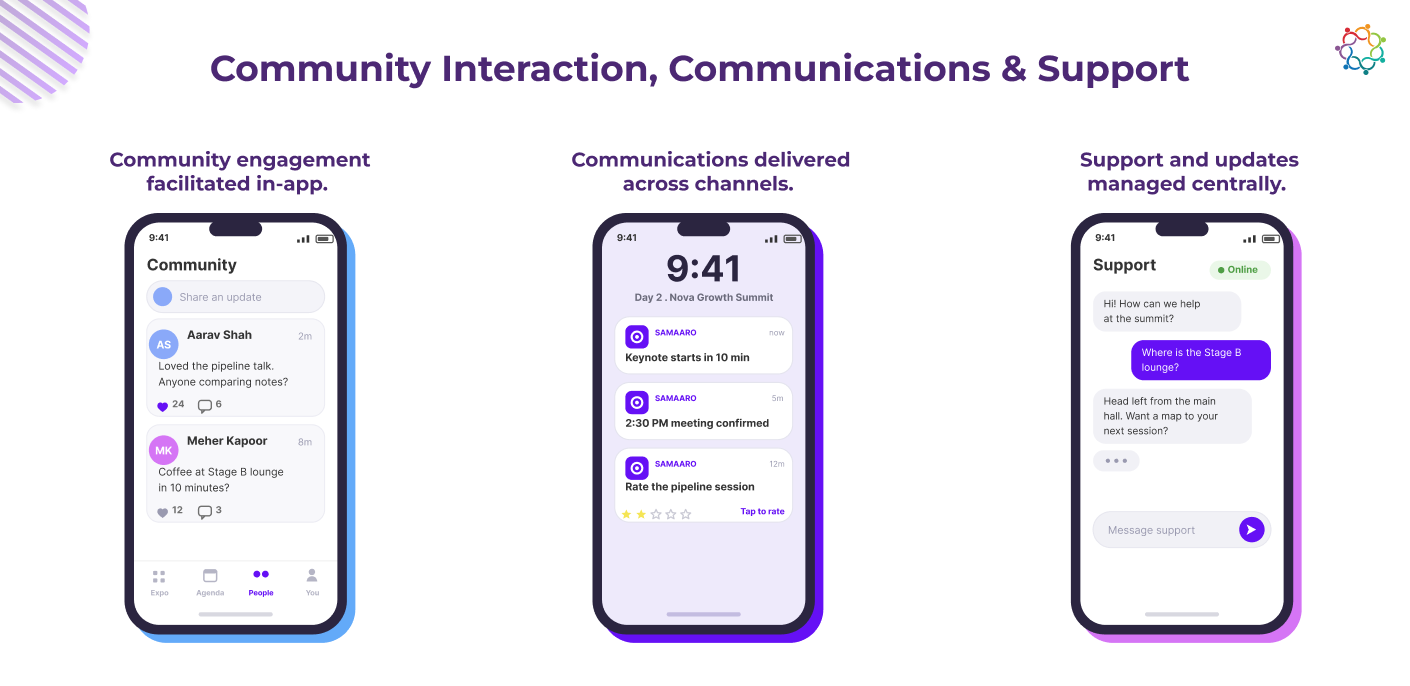
Branded Attendee Mobile App, AI-Powered Matchmaking & Networking with LinkedIn Profile Integration, One-Tap Meeting Booking, Dedicated Exhibitor Showcase & QR-Based Lead Capture, Session Engagement (Agenda, Polls, Q&A, Personal Notes), Email, WhatsApp & SMS Communications, QR-Based Check-In, In-App Community Feed & Support Desk
When 1,000+ of India’s most influential AI builders, CXOs, founders, and government voices gather under one roof for two days, every missed introduction is a partnership that may never happen, an investment thesis that may never form, and a hire that may never be made. That is exactly what the client set out to engineer at The AI Frontier Summit.
A Premium, Multi-Zone, Two-Day Summit with Zero Margin for a Generic Experience
Hosting a hand-curated two-day flagship with 1,000+ senior decision-makers, two parallel stages, a startup-led exhibitor zone, and immersive experience zones meant the experience had to feel as engineered as the audience itself. Three core challenges stood out:
The leadership team’s broader ambition was clear: free the field force to focus on what only they can do, building scientific relationships with doctors, and let technology absorb everything else.
A Branded Event App Engineered Around Curation, Discovery, and Engagement
Samaaro became the operating system for the company’s global HCP engagement program, replacing fragmented internal tooling with a single platform purpose-built for the operational complexity of running CME and HCP programs at global scale.
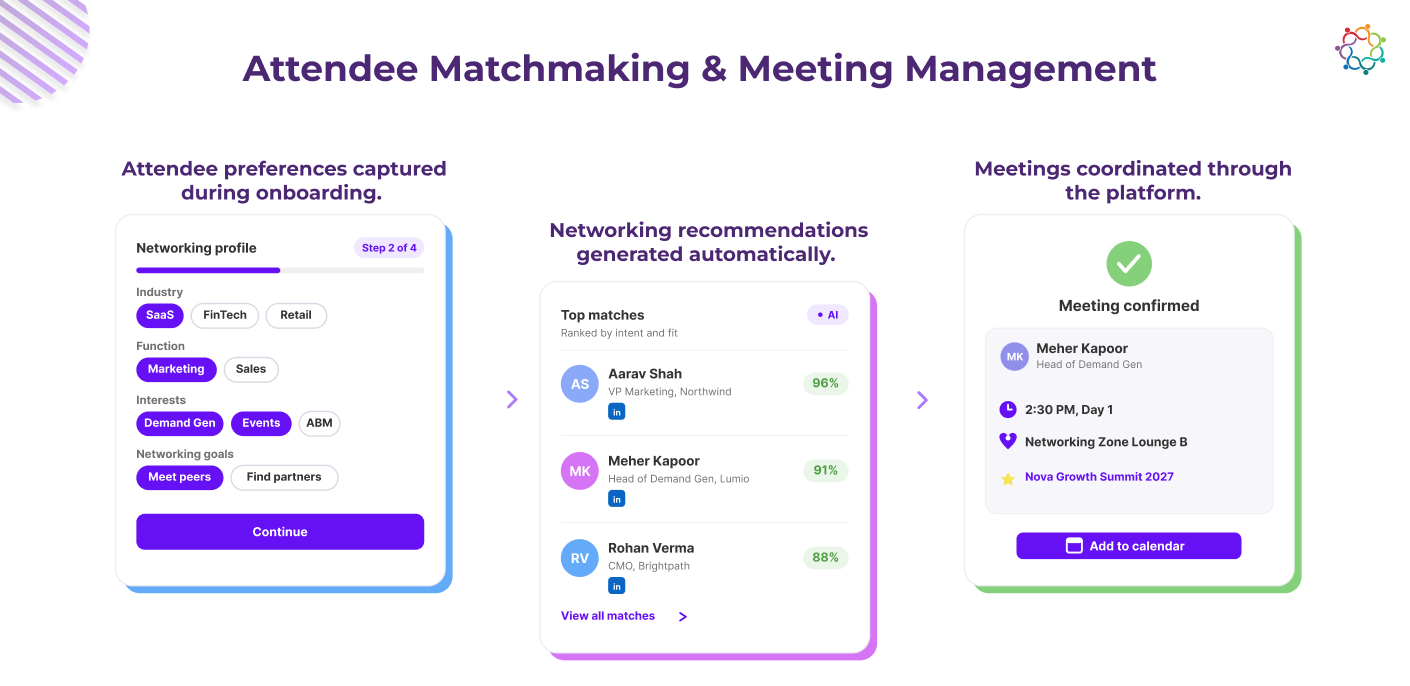
1) AI-Powered Matchmaking and One-Tap Meeting Booking
Every attendee was guided through a smart onboarding journey sharing industry, function, designation, and the kind of people they wanted to meet. The app surfaced personalized Top Recommendations with LinkedIn profile integration on every attendee card for instant context, allowed filtering by sector, role, and region, and made one-tap meeting scheduling possible inside a dedicated networking zone. Meetings were locked in with shared calendars and venue-mapped slots, removing the WhatsApp-and-spreadsheet chaos that usually surrounds curated networking.
2) A Dedicated Exhibitor Showcase with Spotlight Profiles
The exhibitor zone earned its own destination inside the app. Attendees opened a single tab to browse all participating startups, with brand logos, booth numbers, and short positioning lines visible at a glance. One tap opened a detailed profile, and QR-based drop-in let attendees register interest at the booth itself. Exhibitors received their own lead-capture dashboard, while the team got real-time footfall visibility, making exhibitor ROI quantifiable for the first time.
3) A Unified Live Agenda Across Two Stages and Two Days
Attendees used the live agenda to plan their movements between the two stages, save sessions, participate in polls and Q&As, and take downloadable personal notes that auto-sorted by session and exported as a structured document post-event. Speaker bios surfaced LinkedIn handles for instant context on every voice on stage.
4) Community Feed, Real-Time Support, and Multi-Channel Communications
A built-in social wall created a mini-community for the summit. A live in-app support desk plus a dedicated WhatsApp coordination group between Samaaro’s CSM and the brand’s event managers handled live troubleshooting. A structured cadence across Email, WhatsApp, and SMS covered RSVPs, confirmations, agenda reminders, and feedback.

Booked through the matchmaking engine across the two days

across confirmed attendees, with the app becoming the default operating layer for the summit

captured through in-app feedback, anchored by the networking and live agenda experience
The summit room felt designed long before the doors opened. Attendees walked in already knowing who they wanted to meet, exhibitors arrived with a clear view of who they were about to engage, and the team had a single live view of the two-day experience. Networking shifted from happy accident to designed outcome, and The AI Frontier Summit delivered on being one of the most engineered AI gatherings in the country.
Premium conferences are entering a new chapter. Audiences are more senior, more selective, and more aware of the opportunity cost of their time. Content alone no longer carries the room. The differentiation now lies in how intelligently the experience is engineered around every attendee.
Matchmaking that once relied on luck is now driven by structured intent. Exhibitor zones that once measured success by handshakes are now backed by quantifiable data. Organizers who once measured success by attendance are now measuring it in meetings created and pipeline generated. For India’s most ambitious event brands, Samaaro is becoming the operating layer that turns flagship gatherings into compounding intelligence engines.
👉 Curating the room is half the work. Let’s talk about how Samaaro helps the other half deliver itself.

Bottom Line: In pharma, field time is the scarcest asset; automating the reporting around events is how you give it back.
A leading global pharmaceutical company, with a portfolio spanning prescription medicines, active pharmaceutical ingredients, and biosimilars has a presence in more than 50 countries. Known for its strong commitment to scientific exchange and clinical partnership, the company has built a reputation as a trusted partner to the medical community across emerging and developed markets.
Each year, the company hosts over 180 HCP engagement events across its five regional markets in Asia, EMEA, and the Americas, including CME conferences, KOL roundtables, scientific symposia, advisory boards, and field-level doctor engagement sessions. These events sit at the heart of the company’s commercial strategy, driving doctor education, therapy-area awareness, and measurable engagement with the medical community in every market it operates in.
Pharmaceuticals & Life Sciences
Event Website Builder · RSVP Management · Check-In & Badge Printing · Automated Event Communications · Field Event Lead Capture · Event Budget Planner · Integrations · Reporting and Analytics
Did you know ?
Field representatives in pharmaceutical companies spend an estimated 25–30% of their working hours on administrative and reporting tasks tied to scientific engagement programs, time that could otherwise be invested in clinical dialogue and relationship-building with doctors. For organizations running hundreds of CME conferences and HCP touchpoints across multiple geographies each year, this is one of the single largest hidden operational drags on commercial productivity.
The company had built an internal application to manage its CME and HCP engagement programs, a system that had served the organization well as the program scaled. But as the volume, geographic complexity, and compliance demands of the program expanded, the operating model around that system began to show its limits. Roughly 70% of HCP engagement events were physical conferences, and across hundreds of events run across five regions, three structural pressures emerged.
The leadership team’s broader ambition was clear: free the field force to focus on what only they can do, building scientific relationships with doctors, and let technology absorb everything else.
Samaaro became the operating system for the company’s global HCP engagement program, replacing fragmented internal tooling with a single platform purpose-built for the operational complexity of running CME and HCP programs at global scale.
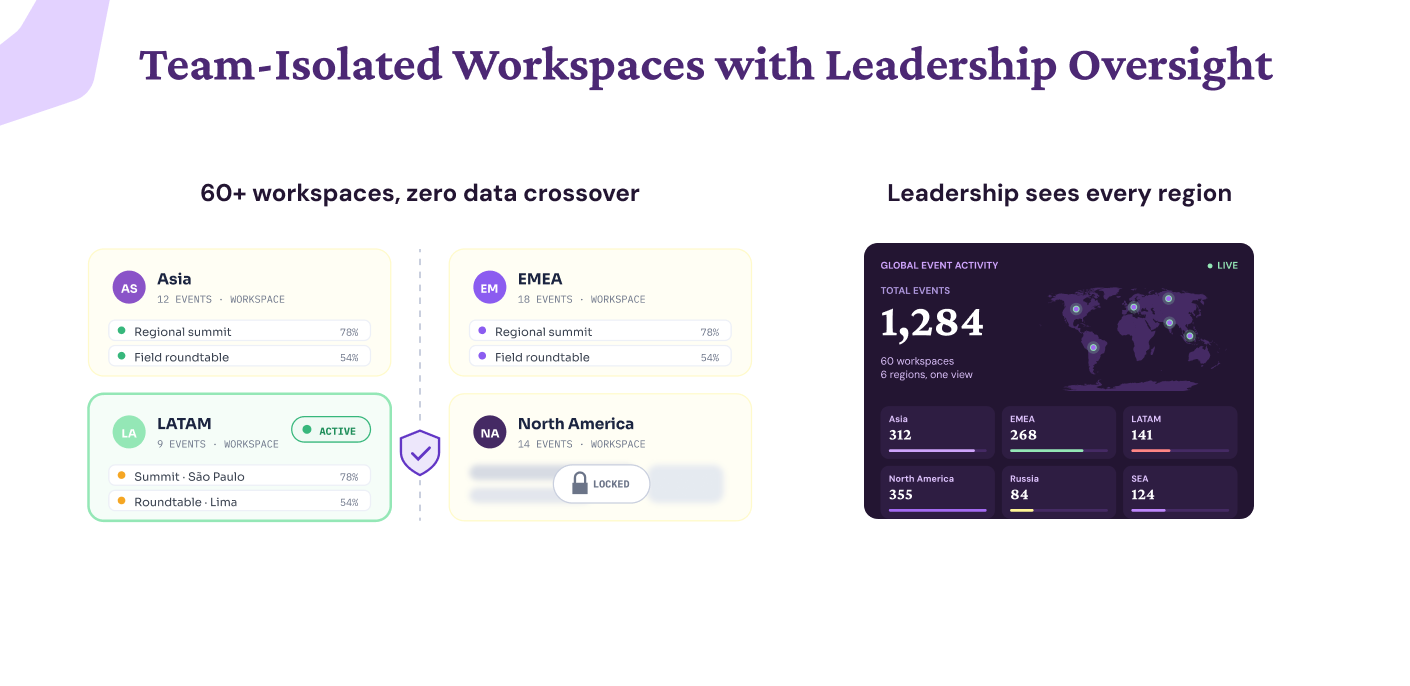
1) One unified platform for every region
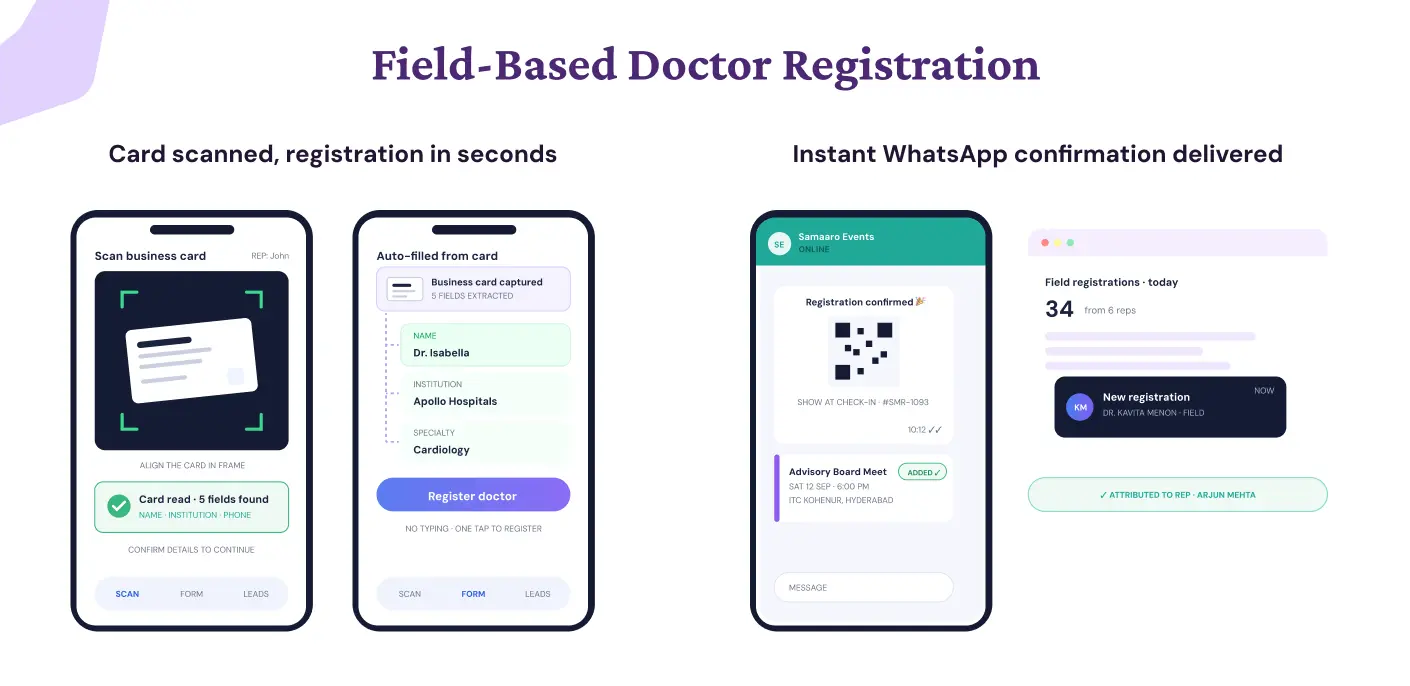
2) A mobile-first workflow built for the HCP’s chamber
3) Real-time data sync into the existing CME platform
4) A longitudinal view of every doctor’s engagement journey.
5) Leadership-grade visibility into event spend.
Within the first full year on Samaaro, the company’s field force was able to step back from operational reporting and refocus on doctor engagement, the work that actually moved the commercial needle. Event data that had once taken days to reach the central CME system flowed in real time, closing compliance gaps and giving regional marketing leads a clean line of sight into program performance across every market the company operates in. What was once a fragmented, manually stitched-together CME workflow became a single, governed program operating at global scale.
Pharmaceutical marketing is in the middle of a quiet operational shift. As HCP engagement programs scale across geographies and compliance demands sharpen, the cost of running these programs on stitched-together internal tools and manual field workflows is no longer just an efficiency tax. It is a competitive disadvantage. The most forward-leaning commercial organizations are recognizing that field talent is too scarce and too expensive to spend on data entry, and that the data these events generate is too valuable to leave sitting in disconnected spreadsheets.

Bottom Line: Approvals run 85% faster and engagement is up 60%, because one sign-up now carries an investor from event interest to booked meeting.
Apex Invest, a division of global financial services provider Apex Group, is a premier networking and distribution platform for the alternative investment industry, operating across financial hubs like Abu Dhabi, Switzerland, and the United States. The company specializes in highly targeted events that combine keynote sessions, panel discussions, and structured private meetings, connecting capital allocators & fund managers. By facilitating over 250,000 meetings through data-driven matchmaking and relationship-focused gatherings, Apex Invest helps clients raise capital and uncover new investment opportunities, positioning itself as a critical connector in the global alternative investment ecosystem.
Financial Services, Asset Management, Wealth Management
Global Events Discovery Page, Universal Form, Admin Dashboard Approval Flows, Affiliate & UTM Tracking, Attendee App, QR Check-in, Personalised Itineraries, Feedback Manager, Apex Invest IO Platform Integration, Meeting Scheduler
When enterprise data governance constraints neutralize your event platform’s capabilities, the operational gap doesn’t disappear. It gets filled by manual workarounds, external vendors, and spreadsheet analytics. At 150+ events per year, that operational debt compounds.
The client’s event program spans multiple formats: large-scale pipeline generation events, invite-only CXO roundtables, and product launch events. Despite the program’s scale and strategic importance, the team had been operating on Splash, the company’s globally standardized event marketing platform used across its worldwide marketing operations, but enterprise data governance policies had constrained several of its deployment-level capabilities. The result was a growing layer of manual processes, external vendor dependencies, and disconnected data systems that compounded with every event.
Global financial firms spend millions annually on investment roadshows and summits, yet up to 45% of attendee data is lost due to fragmented registration systems.
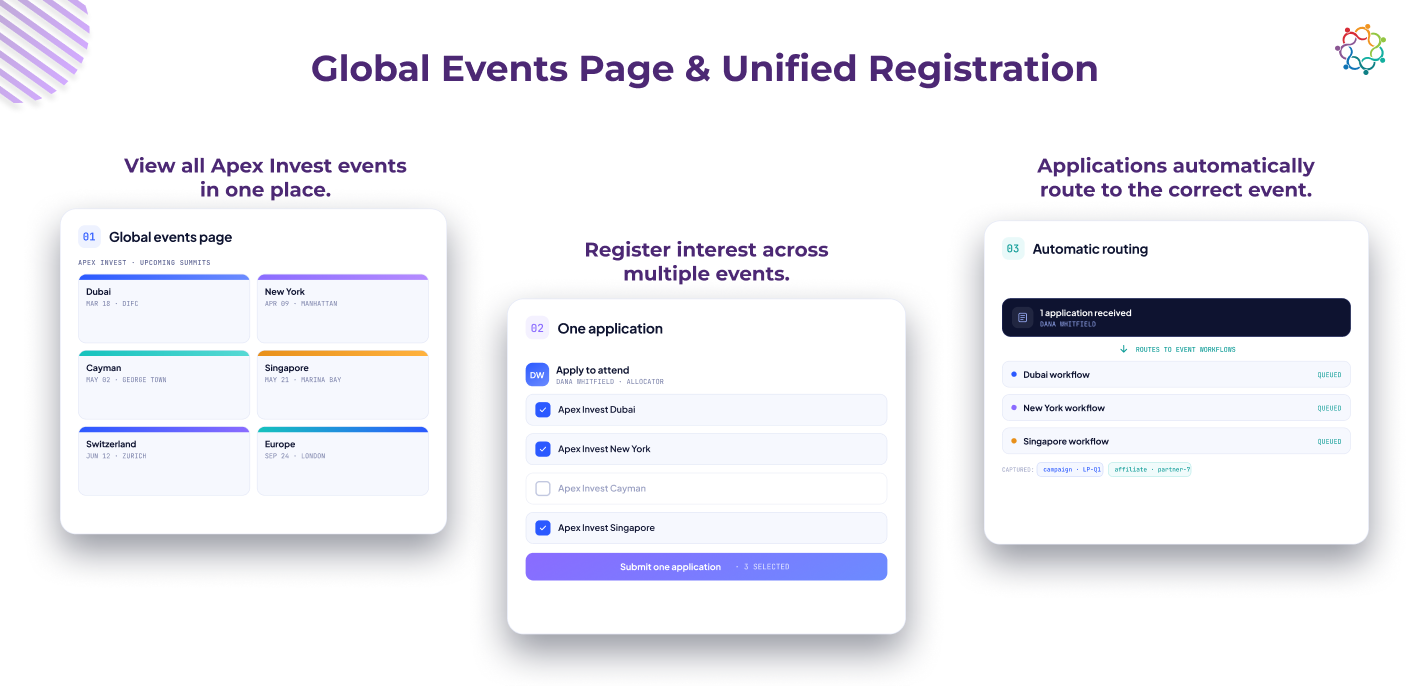
Apex Invest hosts investment summits across Cayman, Singapore, Dubai, Switzerland, New York, and Europe, all designed to bring allocators and managers together for curated meetings and deal-making.
But until recently, their registration, approvals, and attendee management processes were fragmented across regions, making it cumbersome for the marketing and event ops teams to manage the guest experience.
Apex Invest, a global leader in financial events, wanted to streamline how their global summits were discovered, managed, and experienced. Despite their strong event presence, certain operational gaps limited efficiency and scalability.
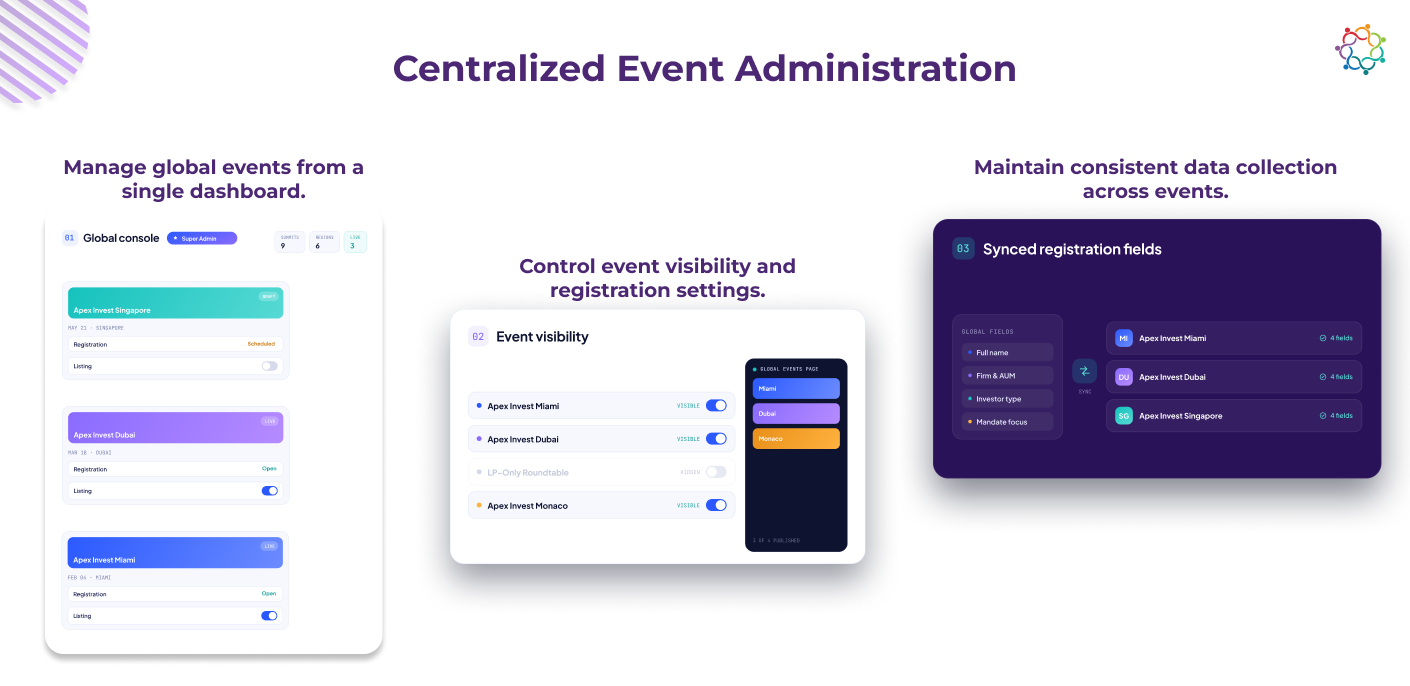
1. Unified registration flow across global events
Each summit had its own landing page and registration form, which meant prospects had to sign up separately for different events. Apex wanted to simplify this experience by creating a single Global Events Page, one that showcased their entire event portfolio and allowed attendees to register for multiple events through a unified form. The goal was to drive higher registrations across their global series without fragmenting the user journey.
2. Smarter attendee categorisation and approvals
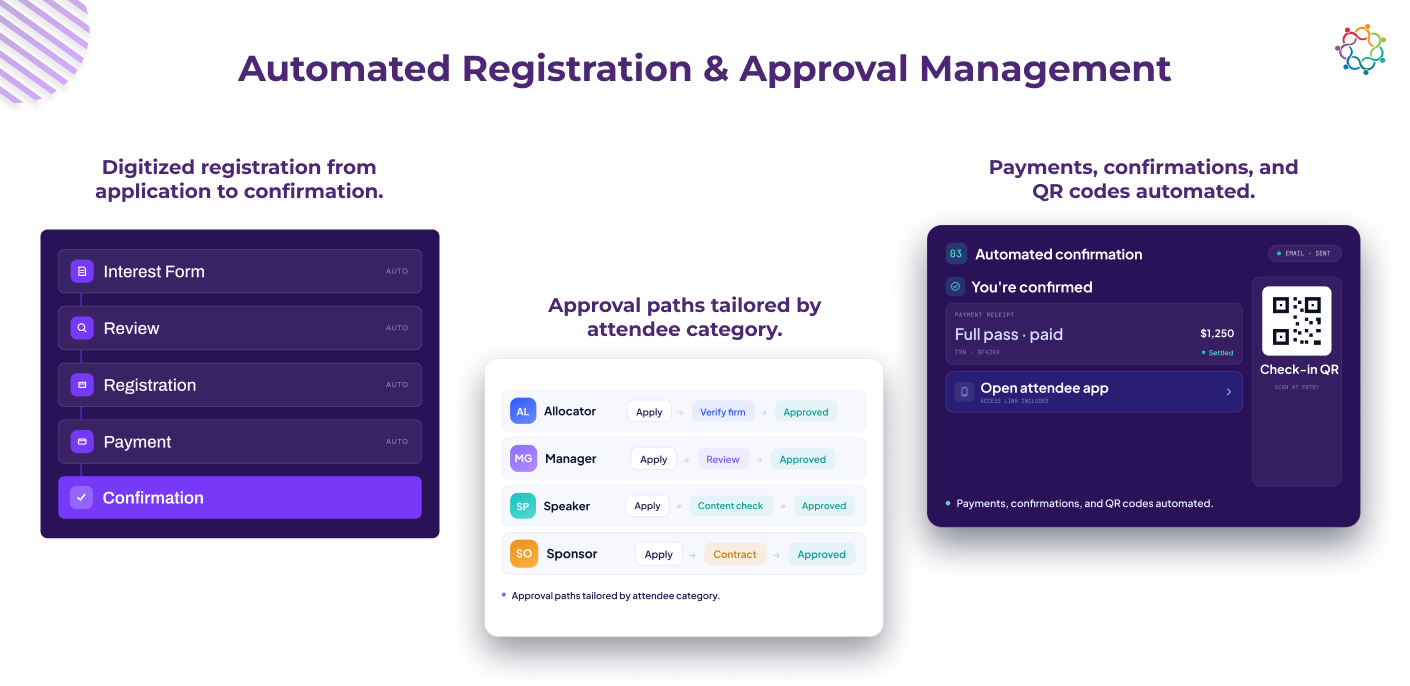
Managing diverse attendee groups; Managers, Allocators, Speakers, Sponsors, came with complex, manual registration flows and approval steps. Apex sought a more intelligent system: one that could adapt to different attendee types, automate approvals, and preserve category-specific validations, all while reducing administrative effort and human error.
3. Enhanced attendee experience across touchpoints
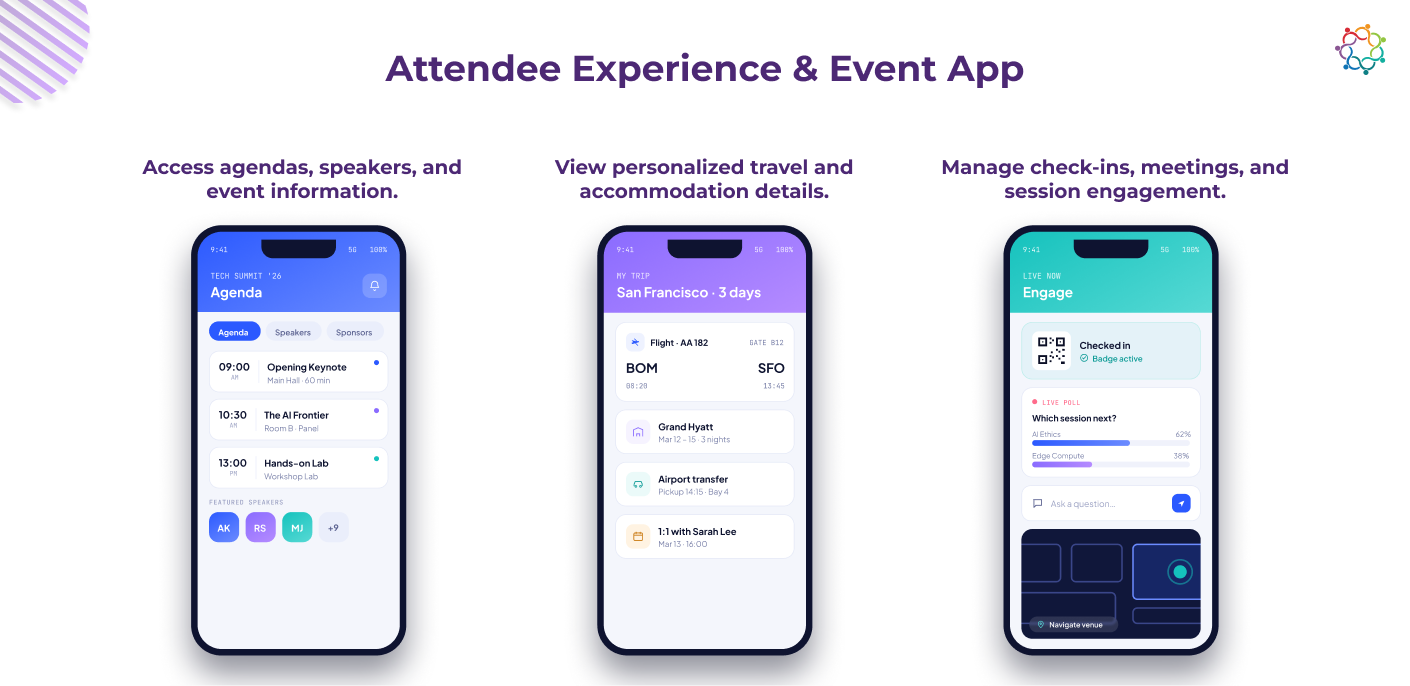
While Apex delivered world-class content, attendees often lacked a central digital space to access event information and engage seamlessly. They wanted a premium attendee app, available on both desktop and mobile, offering everything from personalised agendas and QR check-ins to curated travel itineraries and 1:1 meeting scheduling. The intent was to deliver a more cohesive, high-touch experience for every delegate.
4. Clear visibility into marketing performance
With multiple touchpoints per account, a Head of HR attending a pipeline event, a CHRO joining a CXO roundtable, a talent leader at a product launch, the team needed to stitch together multi-event journeys to demonstrate cumulative engagement. But audience data lived in disconnected silos across individual events, making it impossible to build a longitudinal view of how field marketing touchpoints contributed to deal progression.
5. Two platforms working in isolation
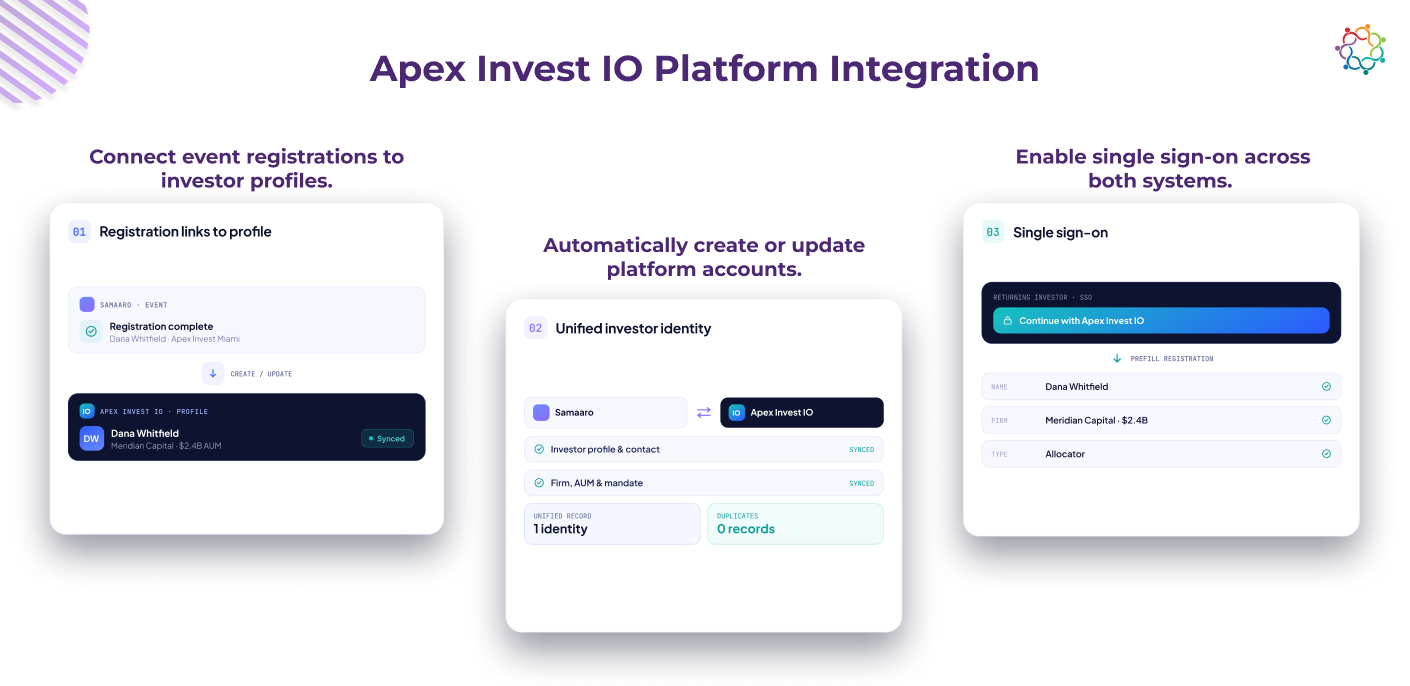
Apex Invest runs two connected offerings: the events themselves, and the Apex Invest IO platform, where allocators and managers maintain their profiles and discover one another. Until recently, the two sat in silos. An attendee who registered for an event still had to create a platform account separately afterwards, entering the same details twice before they could begin networking. Apex wanted these worlds joined, so a single event sign-up would carry an investor straight onto the platform.
6. Networking left to chance
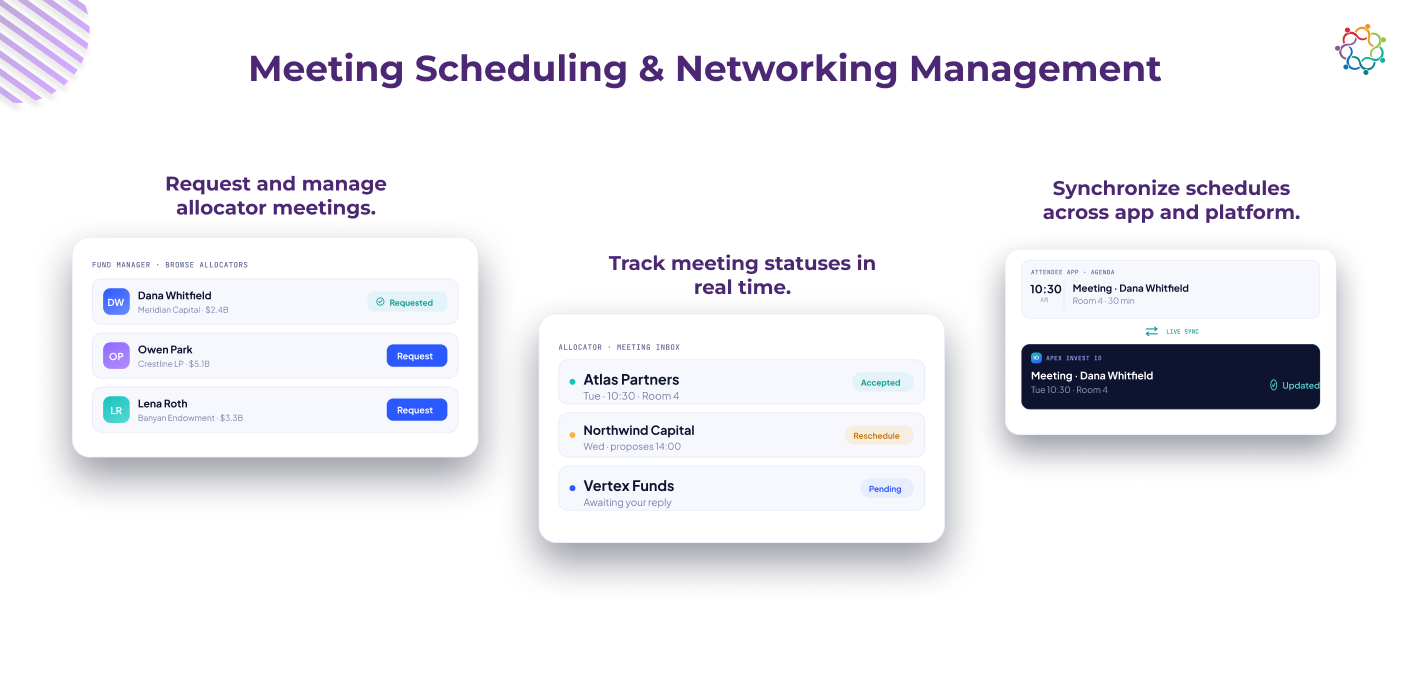
Curated meetings are the centrepiece of every Apex summit, yet the meetings between allocators and managers were arranged off-platform. There was no structured way to request, accept, schedule, or track these connections, and no visibility into the introductions that justified attendance. Apex wanted meeting facilitation built directly into the experience and connected to the platform, so high-value introductions could be managed and measured in one place.
Samaaro delivered a unified framework that combined a centralised events hub, smarter workflows, a premium attendee experience, and a deep integration with the Apex Invest IO platform.
1) Global Events Page & Universal Apply-to-Attend
2) Automated Registration & Approval Workflows
3) Attendee App
4) Centralised Admin Controls
5) Apex Invest IO Platform Integration
6) Meeting Scheduler & Networking Hub

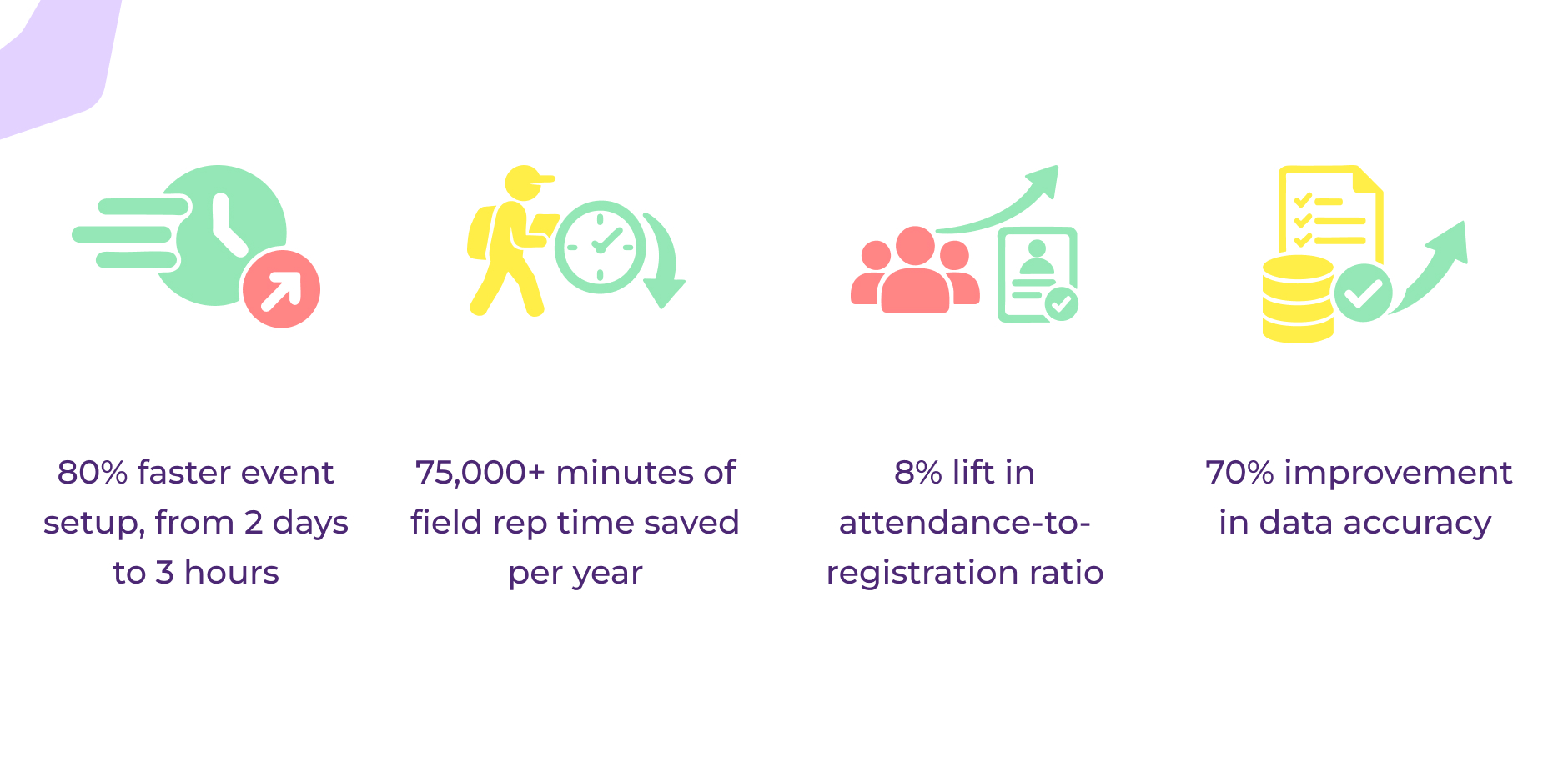
85% faster approval workflows with tailored attendee categories

100% global visibility → all events accessible from one central hub

60% increase in attendee engagement via the all-in-one app
During one of Apex Invest’s flagship events, an allocator shared a game-changing experience: for the first time, they could seamlessly manage schedules, access meetings, and navigate sessions for multiple Apex events, all through a single app. There were no multiple logins, no scattered updates, and no confusion. Every detail, from session timings to personalized agendas, was instantly accessible, allowing the allocator to focus on meaningful conversations and high-impact networking. This clarity transformed what was typically a stressful, fragmented event experience into one that felt intuitive, smooth, and entirely under control.
For global financial firms, fragmented registration systems and disjointed attendee experiences can erode both trust and operational efficiency. When attendees struggle to navigate multiple platforms, the quality of engagement suffers, and brand perception can take a hit. Apex Invest’s approach, centralizing event workflows under a single, integrated system, demonstrates how firms can scale globally while delivering locally personalized experiences. By unifying scheduling, registration, and meeting management, organizations ensure that every investor interaction feels premium, seamless, and connected. In an industry where every touchpoint counts, a cohesive, well-orchestrated event ecosystem isn’t just convenient, it’s a strategic differentiator that builds confidence, fosters engagement, and future-proofs your events.

Bottom Line: For enterprise field marketing teams constrained by global platform limitations, Samaaro replaces manual workarounds with a CRM-native event engine that connects every touchpoint to pipeline, automatically, across 150+ events per year.
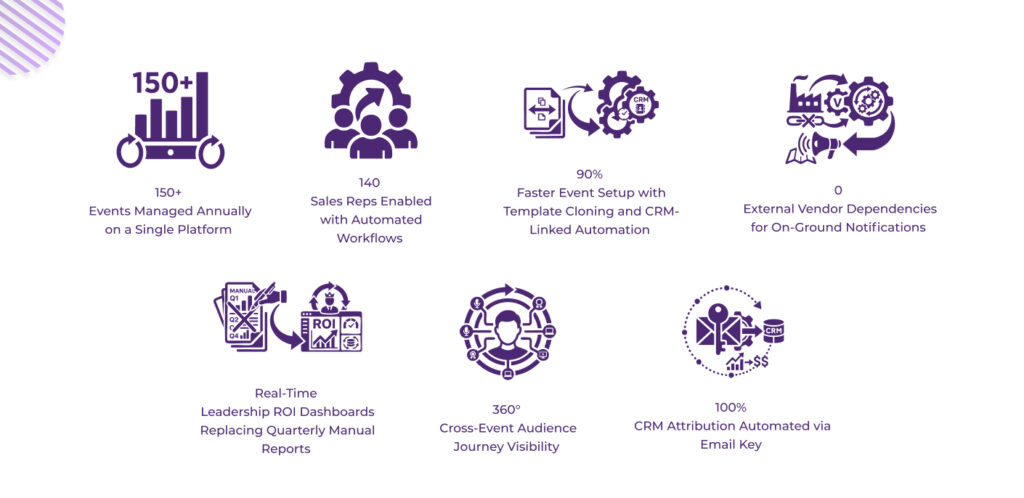
A US-headquartered global HR tech company, responsible for driving demand generation across the company’s HR technology and workforce solutions portfolio, the team runs 150+ owned events per year across the APAC region, serving a 140-member sales organization spread across multiple regions, segments, and business lines.
Enterprise Technology / HR & Talent Solutions
Event marketing platform, CRM integration (Salesforce), automated invitation workflows, real-time sales agent notifications, audience management, ROI dashboards, budget planner
When enterprise data governance constraints neutralize your event platform’s capabilities, the operational gap doesn’t disappear. It gets filled by manual workarounds, external vendors, and spreadsheet analytics. At 150+ events per year, that operational debt compounds.
The client’s event program spans multiple formats: large-scale pipeline generation events, invite-only CXO roundtables, and product launch events. Despite the program’s scale and strategic importance, the team had been operating on Splash, the company’s globally standardized event marketing platform used across its worldwide marketing operations, but enterprise data governance policies had constrained several of its deployment-level capabilities. The result was a growing layer of manual processes, external vendor dependencies, and disconnected data systems that compounded with every event.
When 500+ team members from six business units across India and Bangladesh converge at an international offsite, the experience cannot afford to feel fragmented. Every missed update, every inaccessible document, every disengaged attendee represents a lost opportunity to align the entire sales force for the year ahead.
That’s exactly what PepsiCo Foods set out to solve with their TSM Kickoff 2026.
The team’s globally mandated event marketing platform, Splash, handled the fundamentals well: landing page creation, template cloning, and basic registration. But as the program scaled from 15 events per quarter to 50, five specific operational ceilings became impossible to work around.
1. CRM-Disconnected Invitation Workflows
Enterprise security policies had disabled the platform’s campaign and list management features, preventing bulk audience imports or automated invitation sequences. Sales representatives had to individually send email invitations from outside the platform. This was a significant time burden across a 140-member team, each managing 50+ accounts. Every event required a manual coordination cycle between the field marketing lead and each sales rep, with no automated account-owner mapping or centralized send capability.
2. No Real-Time Sales Engagement at Events
When attendees checked in at event venues, the sales team had no visibility into who had arrived. Representatives would crowd the registration desk mid-event trying to identify their accounts. The field marketing team eventually introduced real-time check-in notifications through an external GDPR-approved event agency, a workaround that added incremental cost to every event and operated entirely outside the event marketing platform.
3. Revenue Attribution Required Manual Cross-Matching
The event platform was not properly integrated with the company’s CRM (Salesforce). Tracking event-influenced pipeline required the operations team to manually export registration data, pull closed-won deals from Salesforce, and cross-match records in spreadsheets. This process was further complicated by entity name mismatches: CRM records used legal entity names while registration forms captured short-form company names. Producing attribution reports for leadership was a multi-week effort each quarter.
4. No Cross-Event Audience Intelligence
With multiple touchpoints per account, a Head of HR attending a pipeline event, a CHRO joining a CXO roundtable, a talent leader at a product launch, the team needed to stitch together multi-event journeys to demonstrate cumulative engagement. But audience data lived in disconnected silos across individual events, making it impossible to build a longitudinal view of how field marketing touchpoints contributed to deal progression.
5. No Integrated ROI Reporting
With multiple touchpoints per account, a Head of HR attending a pipeline event, a CHRO joining a CXO roundtable, a talent leader at a product launch, the team needed to stitch together multi-event journeys to demonstrate cumulative engagement. But audience data lived in disconnected silos across individual events, making it impossible to build a longitudinal view of how field marketing touchpoints contributed to deal progression.
Samaaro was deployed as the team’s event marketing platform for the APAC field marketing programs, replacing the Splash-centered stack of disconnected tools, manual processes, and external vendor workarounds with a single, CRM-integrated system designed for high-volume, sales-aligned event operations.
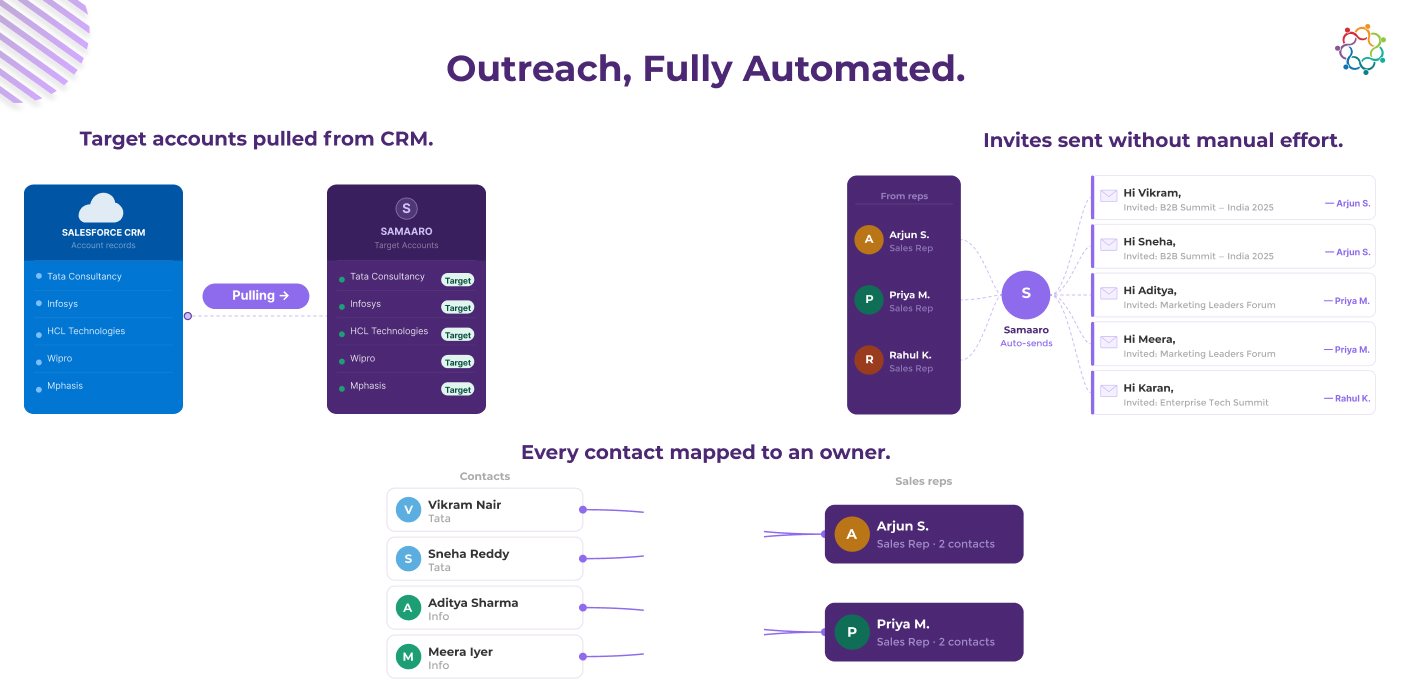
Automated Invitation Workflows with Account-Owner Mapping
Samaaro’s native integration with Salesforce enabled the team to pull target accounts directly from the CRM, automatically map each contact to their assigned account owner, and send personalized invitations from the relevant sales representative’s email. All of this without requiring sales reps to block time for manual outreach. What previously consumed hours of coordination per event across a 140-member sales team became a single, automated workflow managed by the field marketing lead.
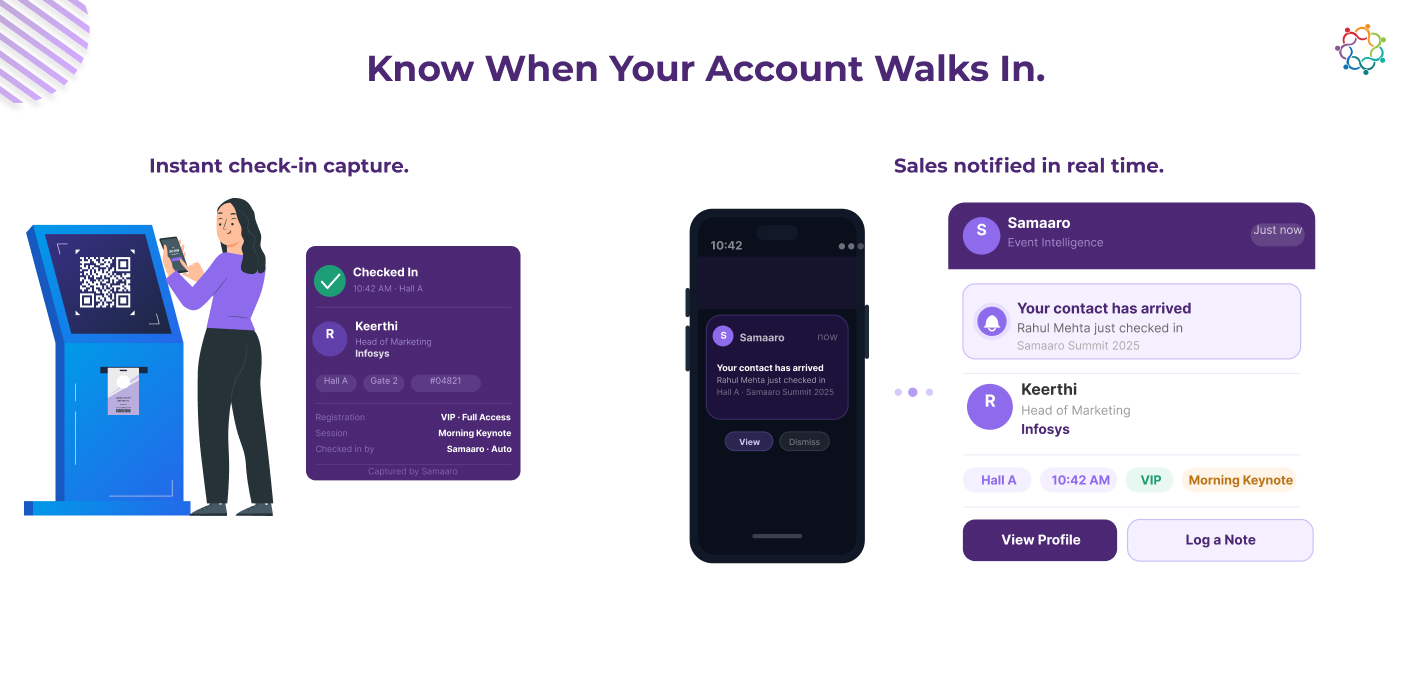
Real-Time Sales Agent Check-In Notifications
When an attendee checks in at an event venue via QR code scan, Samaaro instantly notifies the assigned sales representative, enabling account owners to find and engage their contacts on the floor rather than crowding the registration desk. A dedicated sales dashboard captures meeting notes and outcomes in real time, with all data syncing directly to the CRM. This replaced the external vendor workaround the team had been paying for separately at each event.
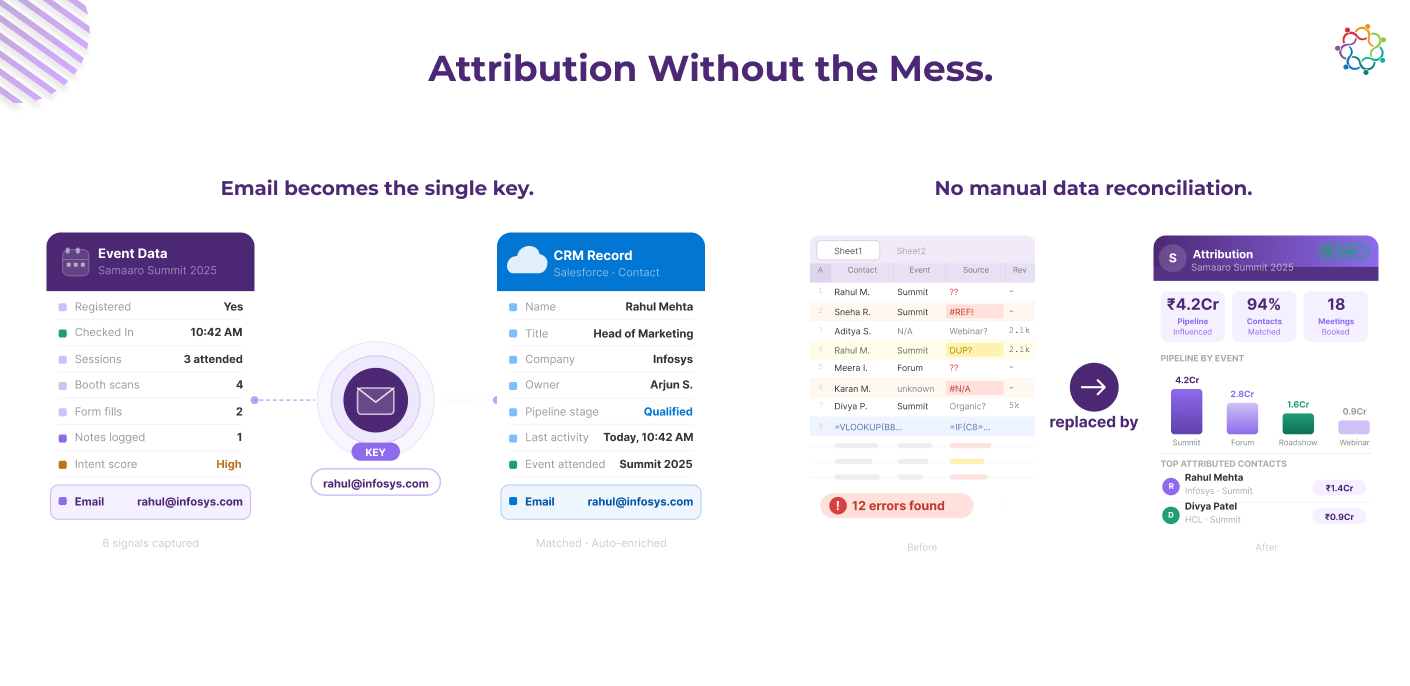
Email-Based CRM Matching for Clean Attribution
Samaaro uses email address as the unique key connecting event data to CRM records, eliminating the entity name mismatch problem that had made manual attribution so labor-intensive. Every registration, RSVP response, check-in, and follow-up interaction maps directly to the corresponding CRM record, enabling automated attribution reporting without spreadsheet cross-matching.
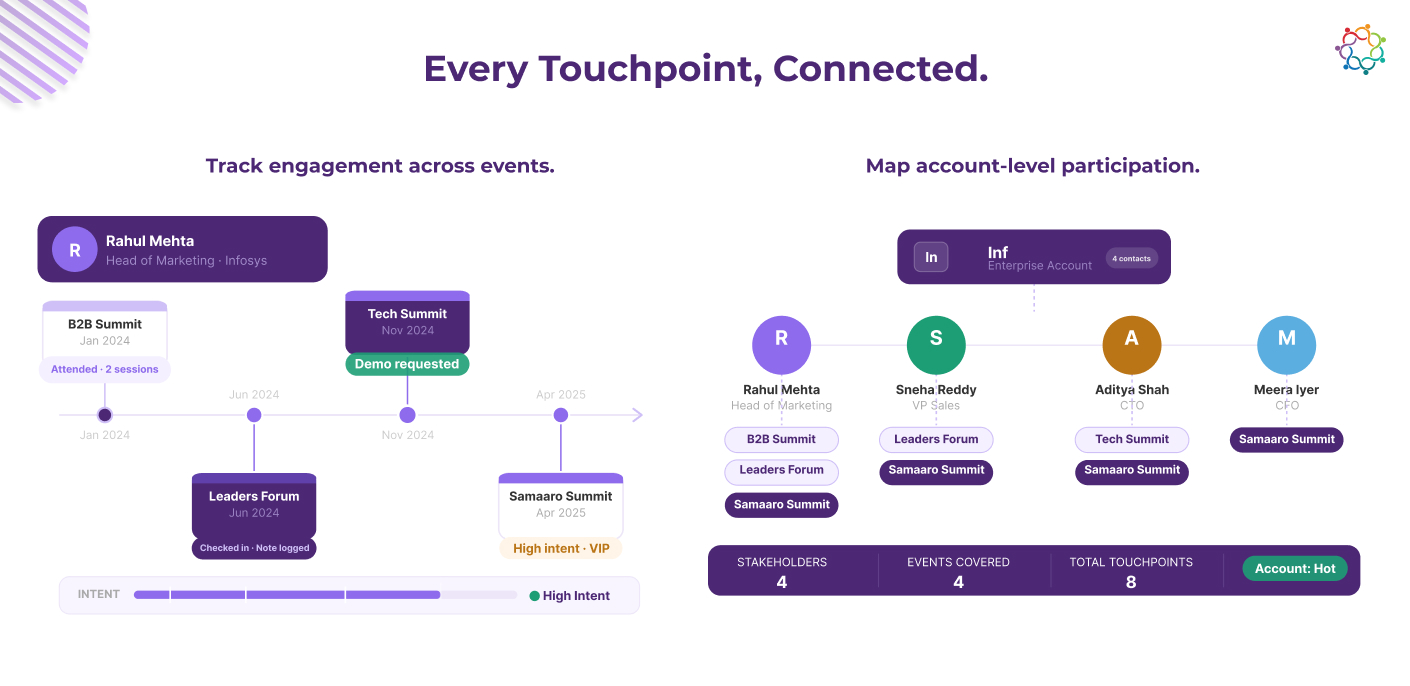
Cross-Event Audience Journey Tracking
Samaaro’s audience intelligence layer aggregates engagement data across every event in the program, building a longitudinal profile for each contact. The team can now see that a specific account was represented at three events across two quarters, which individuals attended, and how engagement depth evolved. This is exactly the multi-touchpoint narrative leadership needs to connect field marketing activity to deal outcomes.
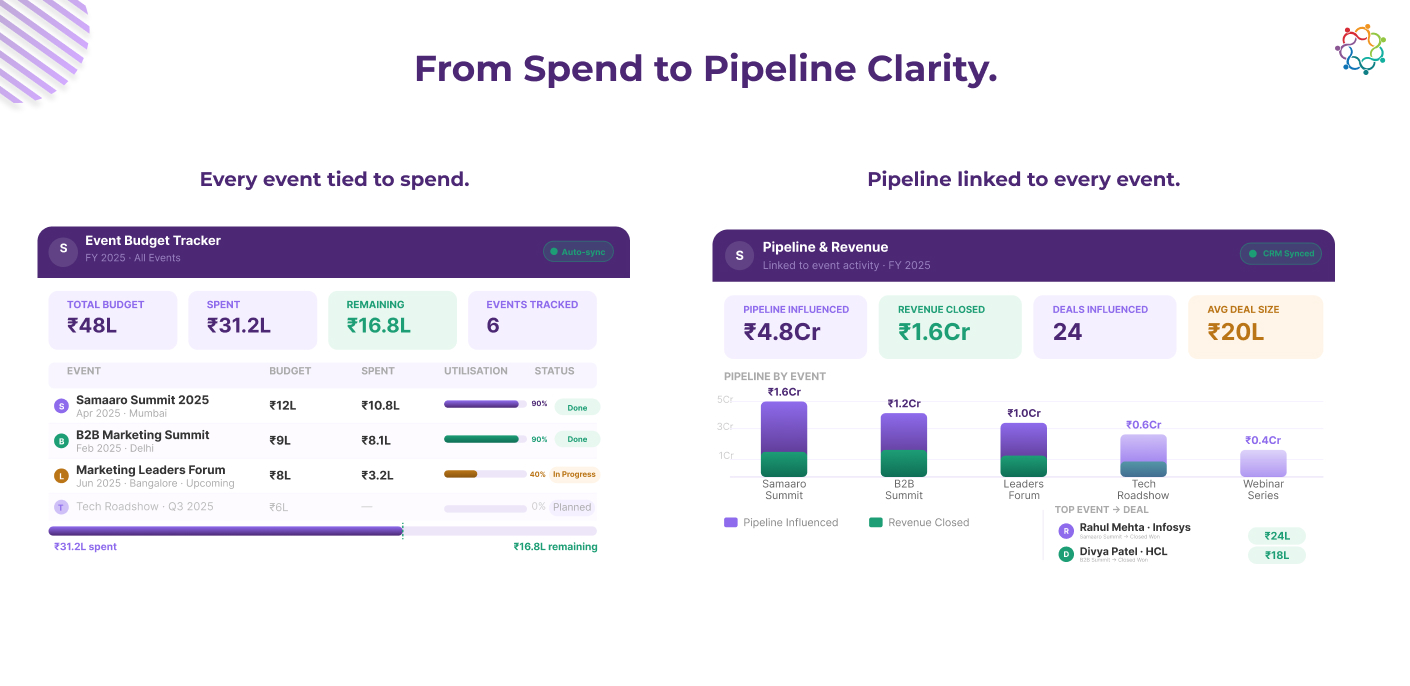
Integrated Budget Planning and ROI Dashboards
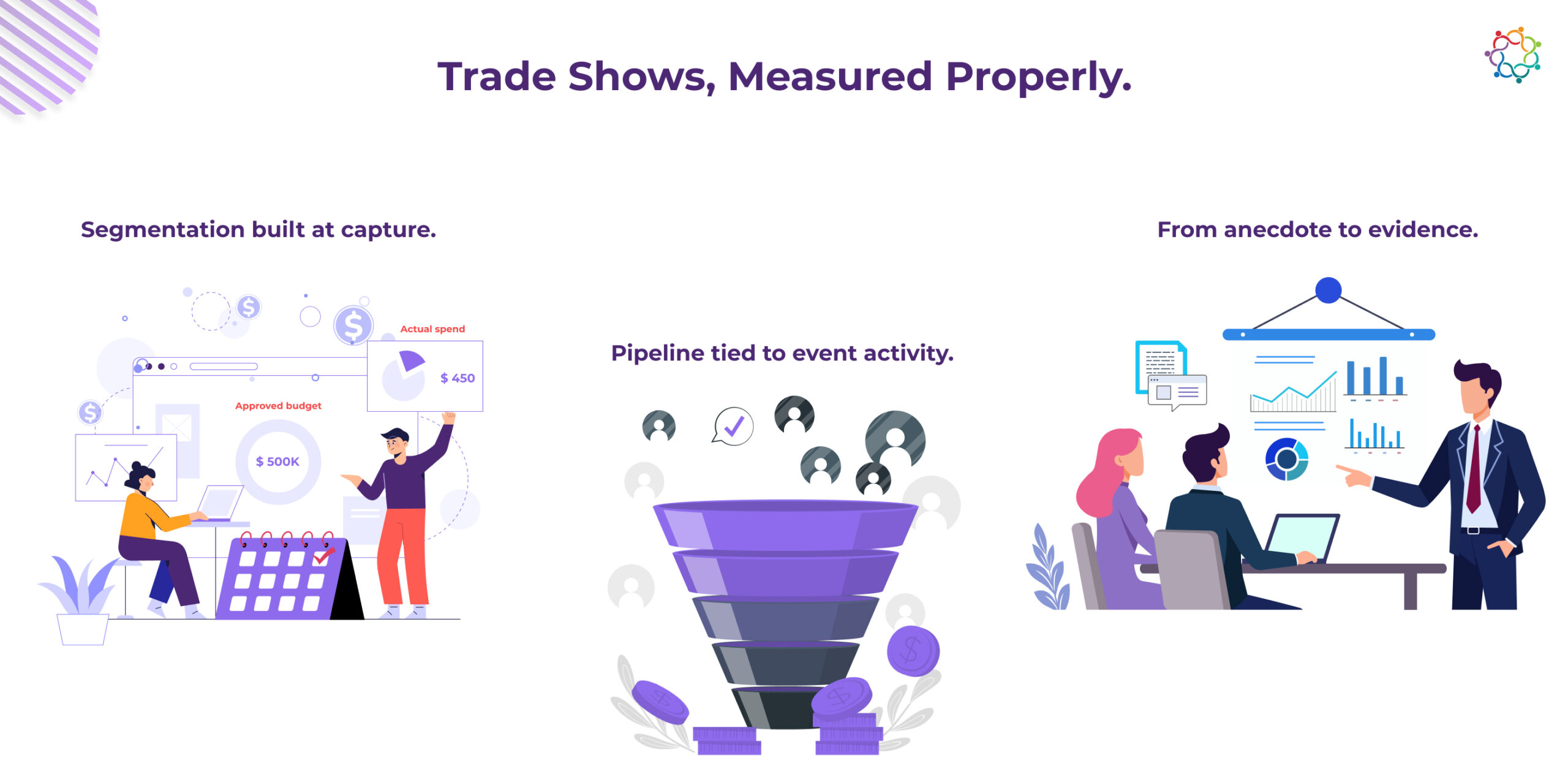
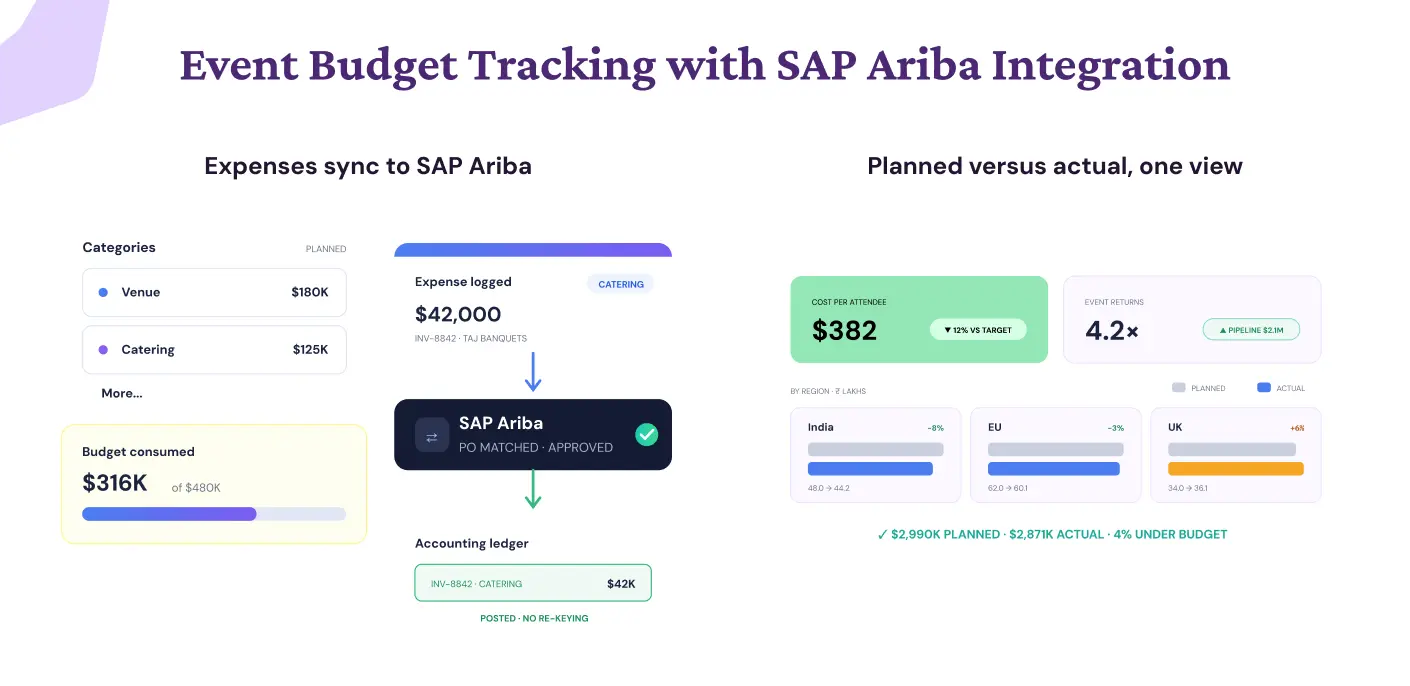
Every event’s expenses are logged within the platform and automatically connected to pipeline and revenue data through the CRM integration. Leadership-level dashboards show approved budget vs. actual spend, event-influenced pipeline, cost-per-attendee, and program-level ROI across any date range. The annual event analysis that previously required weeks of manual data assembly is now available on demand.

After a flagship trade show generating over a thousand leads, the marketing team prepared post-event follow-ups within days instead of weeks. Leads were already segmented by product interest, synced into Salesforce, and aligned with approved budgets and pipeline views.
Instead of assembling reports across multiple tools, leadership reviewed event performance through a single dashboard while sales teams moved directly into relevant, product-led conversations. The event closed with clarity, not cleanup.
For the first time, the field marketing team can present a unified narrative to leadership, connecting individual event touchpoints to account-level engagement and pipeline progression without weeks of manual data reconciliation. Sales representatives spend their time at events engaging prospects instead of checking registration lists, and the field marketing lead operates a 150+ event program with the operational efficiency of a platform-native workflow rather than a patchwork of spreadsheets, external agencies, and manual coordination.
Enterprise field marketing teams running high-volume event programs increasingly face a paradox: the very data governance and security frameworks that protect their organizations also constrain the tools those organizations have standardized on. When platform features are disabled at the policy level, the operational gaps don’t disappear. They migrate to manual workarounds that become invisible infrastructure, absorbing budget and headcount without appearing on any technology roadmap.
The shift from event management to event marketing demands platforms built around CRM-native architecture, where audience data, attribution, and ROI measurement are not add-ons but foundational capabilities. For teams accountable not just for event execution but for the pipeline those events generate, the ability to connect every touchpoint to a business outcome, automatically, in real time, across an entire program, is the difference between running events and running a measurable growth channel.
👉 Running a high-volume field marketing program? Let’s talk about how Samaaro can simplify it for you. Talk to our team

Bottom Line: Sales kickoffs are now operating systems, while platforms replace fragmented execution with predictable, personalized, and measurable event experiences at scale.
PepsiCo, one of the world’s leading food and beverage companies, operates a vast sales network spanning multiple regional units across India and Bangladesh. To energize its sales force and set the tone for the year ahead, PepsiCo Foods organized its annual Territory Sales Manager (TSM) Kickoff , a multi-day offsite in Pattaya, Thailand, held from 15–17 January 2026. With 500+ confirmed attendees flying in from six business units, the event needed to deliver a premium, app-first experience that kept every attendee informed, engaged, and celebrated, from the moment they received their invite to the closing day of the summit.
FMCG / Consumer Goods
Attendee Mobile App, Multi-Channel Communications (Email + WhatsApp), Travel & Itinerary Management, Reception & QR Check-In Dashboards, Session Management
In real estate and other relationship-led B2B industries, over 70% of high-value partnerships are influenced by in-person interactions, yet fewer than 30% of companies can clearly measure how events impact customer engagement or loyalty.
As event programs scale across regions and formats, teams often track registrations and attendance, but struggle to connect participation with deeper outcomes like product adoption, repeat usage, or long-term customer value. The result is a gap between effort and insight. Events continue to consume significant budget and time, while their true business impact remains difficult to quantify.
For organizations running frequent, high-touch B2B events, closing this measurement gap has become as important as executing the events themselves.
When 500+ team members from six business units across India and Bangladesh converge at an international offsite, the experience cannot afford to feel fragmented. Every missed update, every inaccessible document, every disengaged attendee represents a lost opportunity to align the entire sales force for the year ahead.
That’s exactly what PepsiCo Foods set out to solve with their TSM Kickoff 2026.
Organizing PepsiCo’s annual sales kickoff in Pattaya, Thailand meant coordinating attendees from six distinct business units, each with their own travel logistics, session tracks, and recognition programs. The organizing team faced three core challenges:
With 500+ attendees flying from different cities, each person had unique flight details, hotel vouchers, and travel documents. The team needed a centralized, mobile-first platform where every attendee could instantly access their own logistics information, eliminating reliance on scattered emails, travel agent follow-ups, and last-minute WhatsApp coordination.
2. Fragmented Coordination Across Six Business Units with No Unified Communication Layer
With six business units operating independently, each with their own internal coordination channels, there was no single communication layer to ensure consistent messaging. RSVP tracking, travel updates, schedule changes, and on-ground logistics were being managed in silos, creating coordination noise and increasing the risk of missed or conflicting information reaching attendees.
3. Segmented Experiences for Specialized Groups, In Real Time
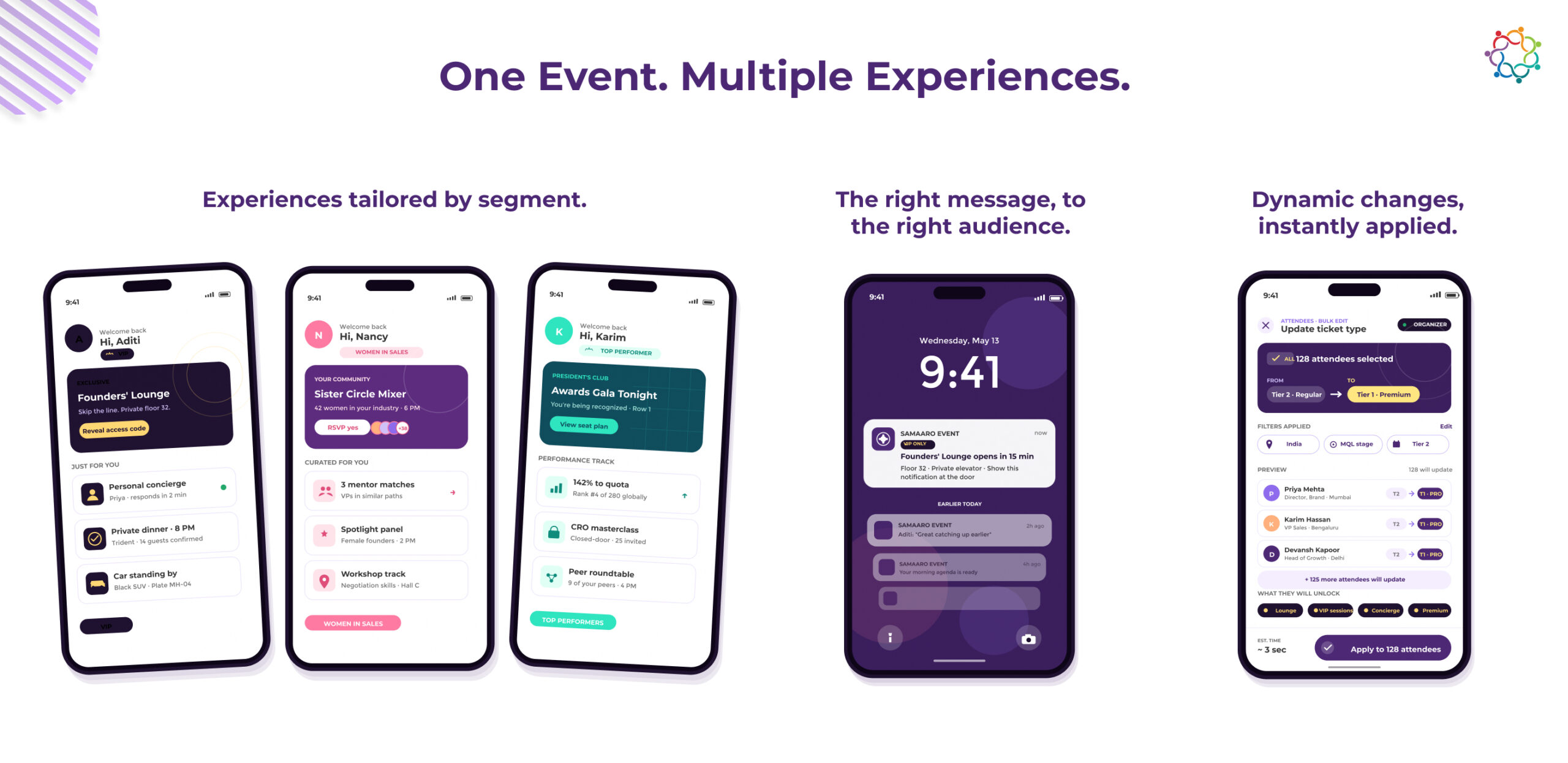
The event wasn’t one-size-fits-all. PepsiCo had distinct attendee segments, one for women in sales, a category for top performers being recognized mid-event, and the VVIP leadership group. Each segment needed tailored content, targeted notifications, and exclusive moments, all managed dynamically during a live, multi-day event.
Samaaro delivered a fully customized event platform, anchored by a branded mobile attendee app, that served as the single operating system for attendee communication, logistics access, on-ground coordination, and engagement across all six business units.
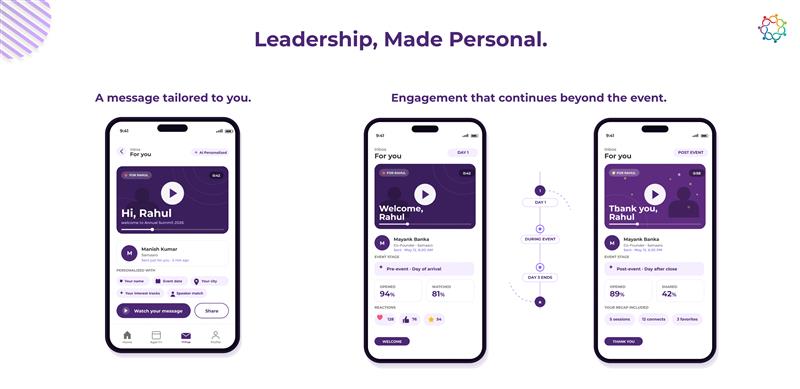
AI-Personalized Video from Leadership (Vitra Integration)
On first login, every attendee was greeted with a personalized video message from PepsiCo’s sales leadership, addressing them by name. Built through Samaaro’s integration with Vitra. After the event, the welcome video was swapped to a personalized thank-you message, extending the experience beyond the final day and reinforcing the personal connection with leadership.
Social Feed, Gamified Leaderboard & Session-Level Engagement Controls
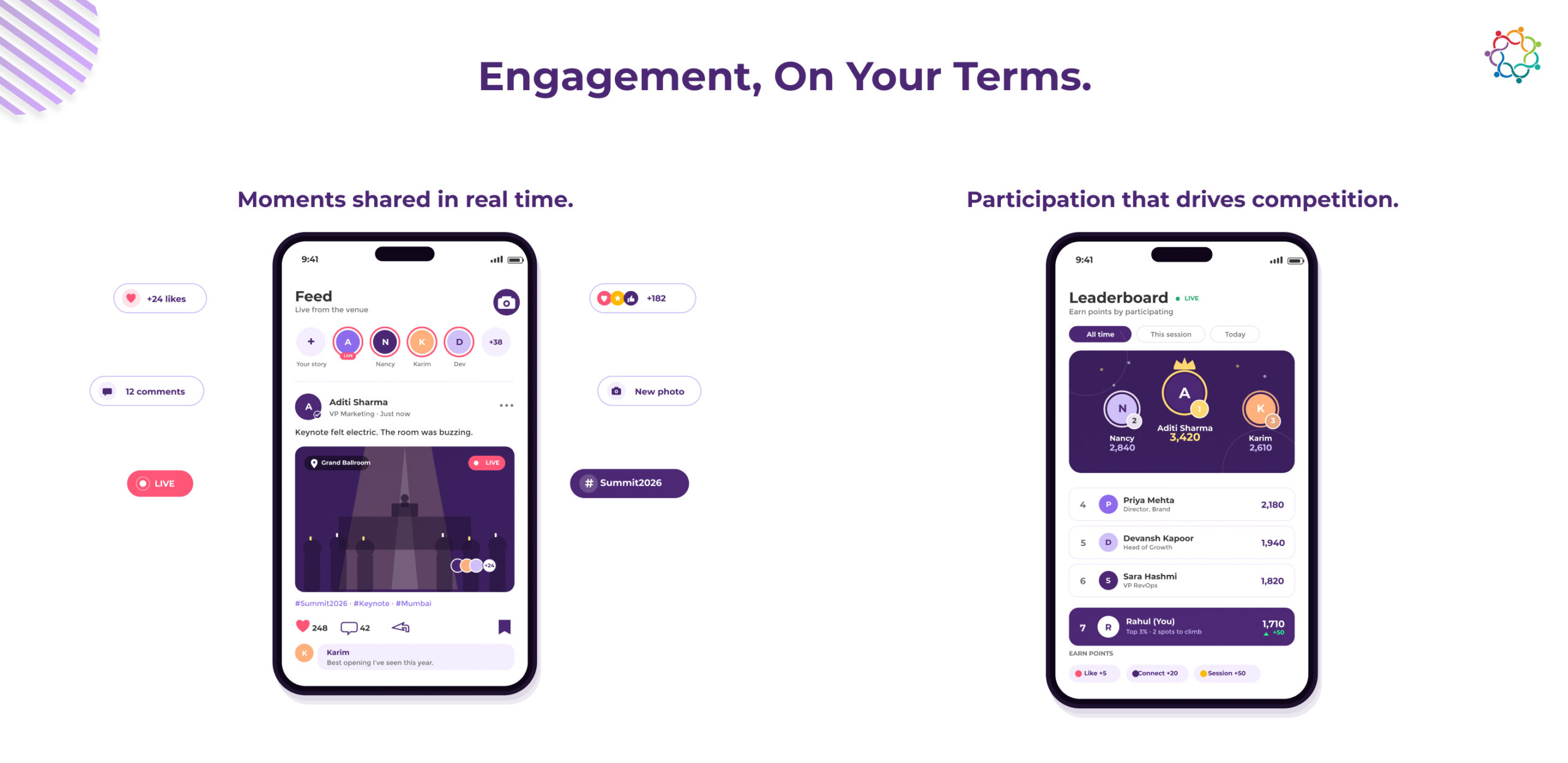
A built-in social wall enabled attendees to post photos, like, and comment throughout the event, with a real-time leaderboard ranking participants based on engagement, driving healthy competition and award-worthy participation. At the agenda level, Samaaro gave PepsiCo granular control over engagement: for specific sessions, the organizing team could disable the social feed during keynotes to maintain audience focus, and trigger targeted pop-up notifications for specific ticket types attending that session, ensuring the right message reached the right audience at the right time.
Segment-Specific Pop-Ups Dynamic Ticket Management
Using ticket-type-based segmentation, PepsiCo delivered exclusive in-app experiences to each group. One group received a dedicated pop-up about their breakfast session, another received a mid-event recognition pop-up upon being dynamically reassigned to their new ticket type, and celebrity guest notifications drove social feed activity and leaderboard engagement. Samaaro’s bulk ticket upload feature enabled the team to shift ticket types for hundreds of attendees at once as segments evolved throughout the event.
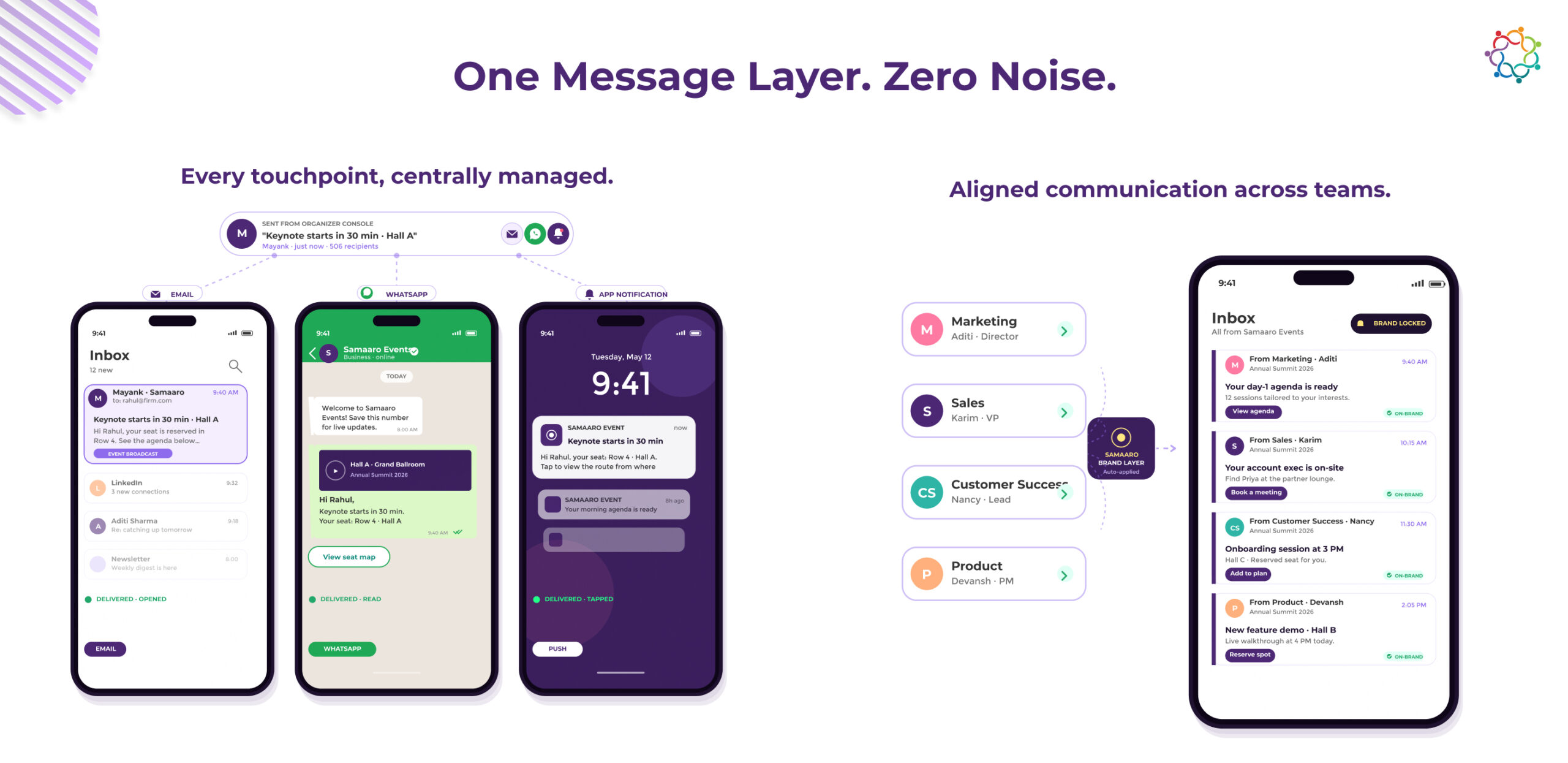
Centralized Multi-Channel Communications
Samaaro replaced scattered, unit-by-unit coordination with a structured communication cadence across email and WhatsApp, covering RSVP invitations, registration confirmations, app download prompts, segment-specific invites, and personalized video delivery. A single communication layer improved messaging consistency across all six units and reduced coordination noise for the organizing team.
Attendance Predictability & On-Ground Operations
Samaaro’s RSVP and registration system gave PepsiCo high planning confidence well before the event, reducing last-minute follow-ups across units. On the ground, multiple QR-based reception dashboards enabled real-time check-ins, session attendance tracking, and gift distribution management, providing operational visibility across every touchpoint.

96.6% high attendance predictability across six business units

528 downloads with peak activity during the pre-event travel phase

550+ social wall interactions recorded during the event, reflecting strong attendee engagement.
After a flagship trade show generating over a thousand leads, the marketing team prepared post-event follow-ups within days instead of weeks. Leads were already segmented by product interest, synced into Salesforce, and aligned with approved budgets and pipeline views.
Instead of assembling reports across multiple tools, leadership reviewed event performance through a single dashboard while sales teams moved directly into relevant, product-led conversations. The event closed with clarity, not cleanup.
PepsiCo Foods TSM 2026 established what a centralized event operating system looks like for multi-unit programs. With 96.6% RSVP certainty, 561 attendees with itinerary access before arrival, and measurable engagement throughout the event, Samaaro replaced fragmented coordination with a single platform that delivered predictability, personalization, and structured engagement at scale.
The sales kickoff is evolving from a straightforward offsite into a high-stakes alignment event where organizations set the energy, targets, and culture for the entire year. As companies scale their teams across geographies, the coordination complexity grows, but most still manage these events with a patchwork of emails, WhatsApp groups, and manual tracking. The result: inconsistent experiences, no engagement data, and zero repeatability.
Leading FMCG, technology, and enterprise organizations are shifting toward centralized event platforms that unify communications, personalize the attendee journey, and generate measurable outcomes. What PepsiCo’s TSM Kickoff demonstrates is that this shift doesn’t require months of planning, with the right platform, a complex multi-unit international offsite can go from brief to go-live in weeks and still deliver the predictability and measurability that modern sales organizations expect.
👉 Planning a large-scale sales kickoff or offsite? Let’s talk about how Samaaro can help you turn it into a measurable, repeatable growth event.

Bottom Line: A premium event proves its worth only when you can measure what it changed, and that takes one connected system.
Founded with a vision to simplify property discovery, Property Finder is one of MENA’s most trusted and influential real estate platforms. It helps individuals find homes, empowers brokers with data-driven tools, and supports developers in showcasing projects to the right audience. Beyond being a digital marketplace, Property Finder is a key voice in the real estate sector, curating high-impact workshops, exclusive networking evenings, closed-door roundtables, and industry award ceremonies. These events serve as powerful platforms to bring brokers, developers, investors, and regulators together to exchange insights, celebrate excellence, and shape the future of property markets. Every event is crafted with a focus on exclusivity, attention to detail, and meaningful interactions, values that reflect the brand’s premium positioning.
Registration & Ticketing, RSVP Automation, Check-in & Badge Printing, Event App, CRM Integrations, Marketing Automation
In real estate and other relationship-led B2B industries, over 70% of high-value partnerships are influenced by in-person interactions, yet fewer than 30% of companies can clearly measure how events impact customer engagement or loyalty.
As event programs scale across regions and formats, teams often track registrations and attendance, but struggle to connect participation with deeper outcomes like product adoption, repeat usage, or long-term customer value. The result is a gap between effort and insight. Events continue to consume significant budget and time, while their true business impact remains difficult to quantify.
For organizations running frequent, high-touch B2B events, closing this measurement gap has become as important as executing the events themselves.
Property Finder’s challenge was not about running events or managing logistics. Their B2B event program was already well-established and strategically important. The real challenge lay in extracting consistent, measurable business insight from events at scale.
As events became a core engagement lever for brokers, agents, and partners across the region, the team needed to evolve beyond execution and address deeper structural gaps.
Measuring event impact on customer engagement and adoption
While events were driving strong participation, it was difficult to clearly quantify how attending an event influenced customer behaviour over time. The team needed a reliable way to compare attendees and non-attendees across metrics such as engagement, product adoption, and loyalty, without relying on ad hoc analysis or manual data work.
Maintaining consistent end-to-end event journeys
Property Finder required a predictable flow across invitations, registrations, reminders, on-site check-ins, and post-event surveys for every event format. Without a unified system, ensuring consistency across workshops, roundtables, and industry events increased operational complexity as scale grew.
Reducing dependency on manual coordination and specialist teams
Event data needed to flow cleanly into internal systems to support dashboards and cohort analysis. Any dependence on data teams or custom reporting slowed insight generation and limited how frequently event performance could be reviewed.
Ensuring platform reliability under complex requirements
With high expectations around brand experience and internal reporting, even minor system issues could impact confidence. The team needed an enterprise-grade platform that could handle complexity and customization without frequent disruptions.
End-to-end event lifecycle automation
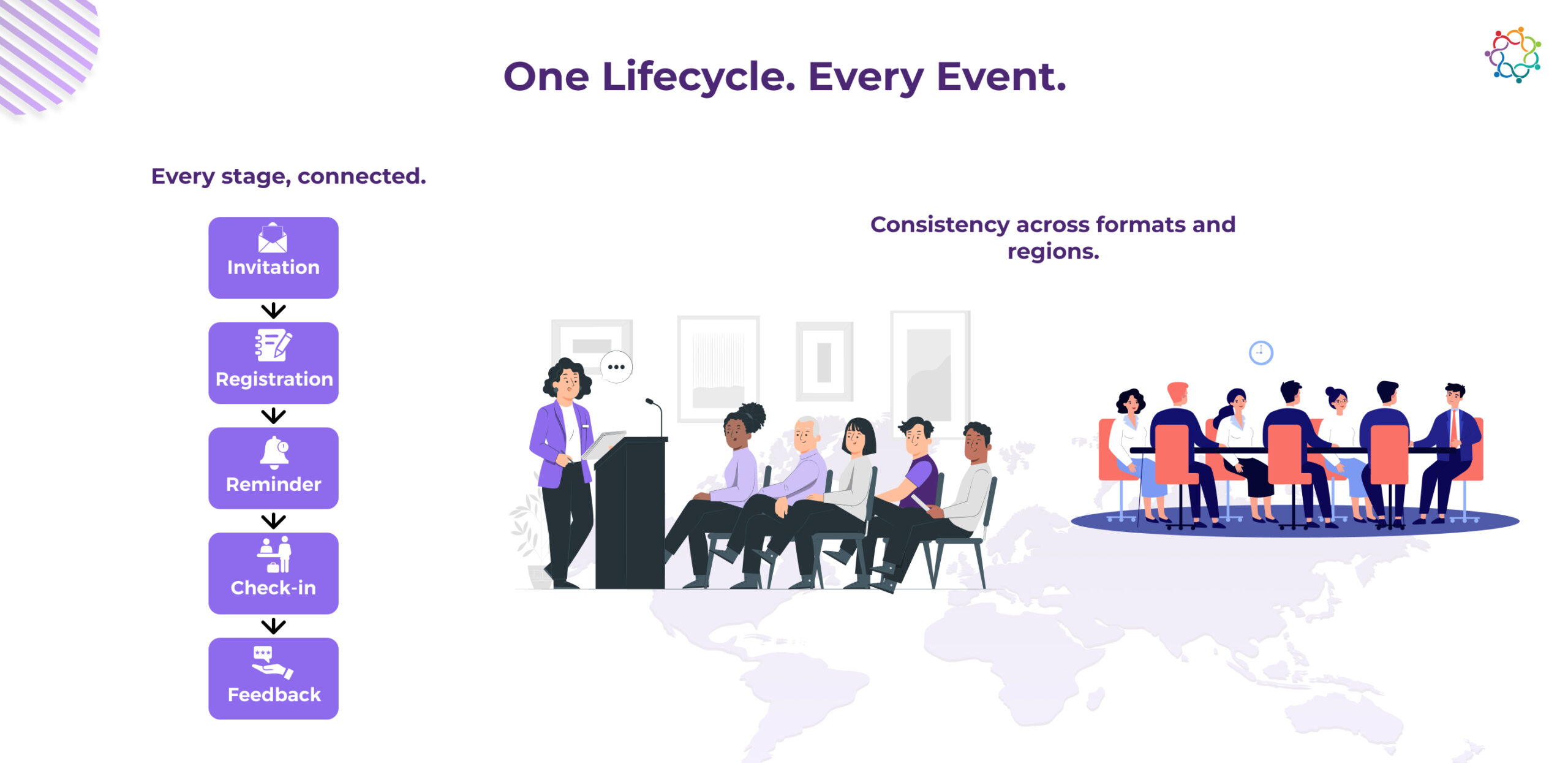
Samaaro enabled Property Finder to manage invitations, registrations, reminders, on-site check-ins, and post-event surveys within a single platform. This ensured every event followed a consistent journey, regardless of format or geography, and reduced operational variance across teams.
Reliable, enterprise-grade platform for complex B2B events
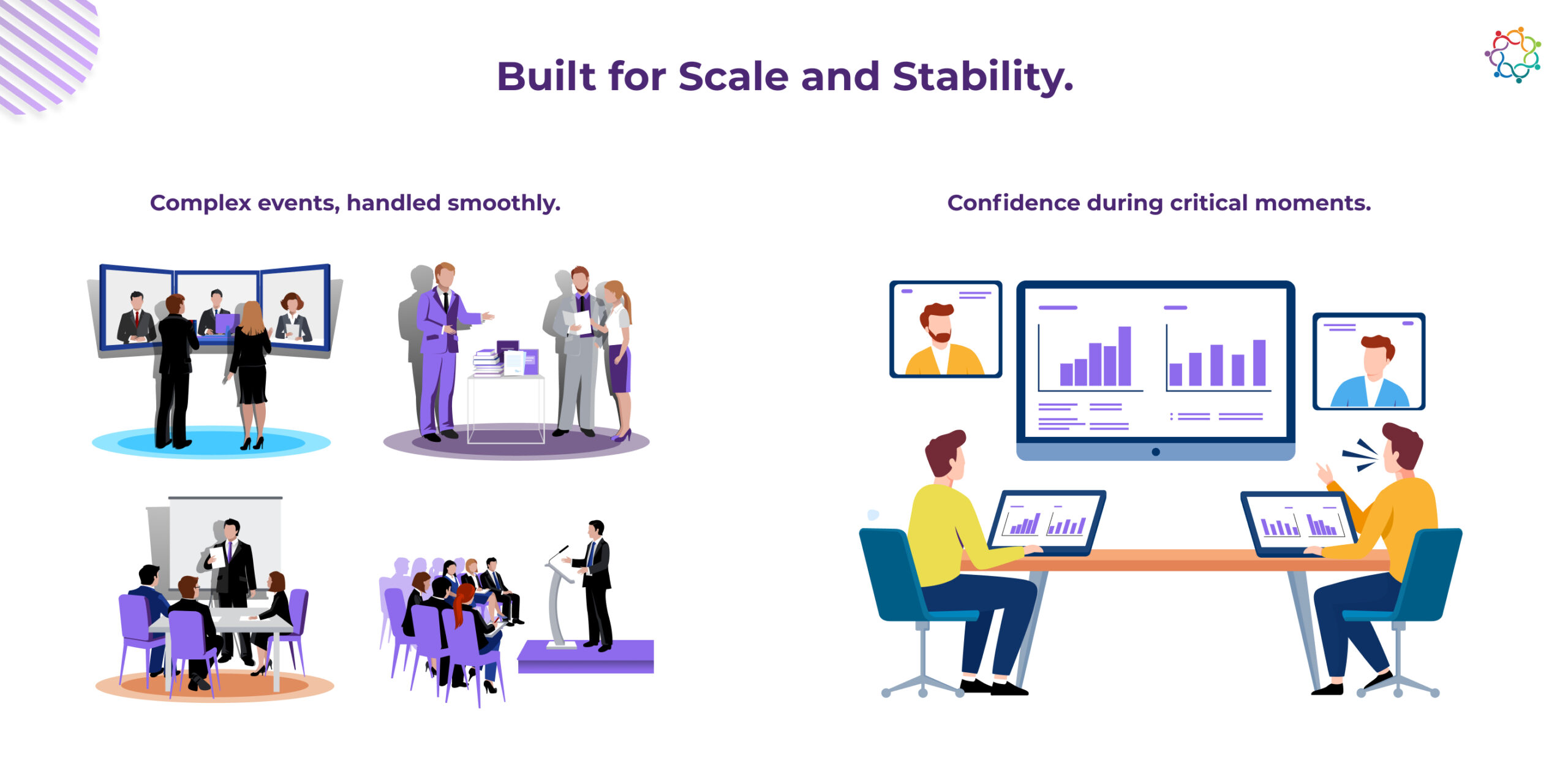
With frequent events and high customization requirements, platform stability was critical. Samaaro provided a dependable system that handled complexity with minimal disruptions, allowing teams to execute confidently without worrying about breakdowns during critical moments.
Measurement of event impact on engagement and adoption
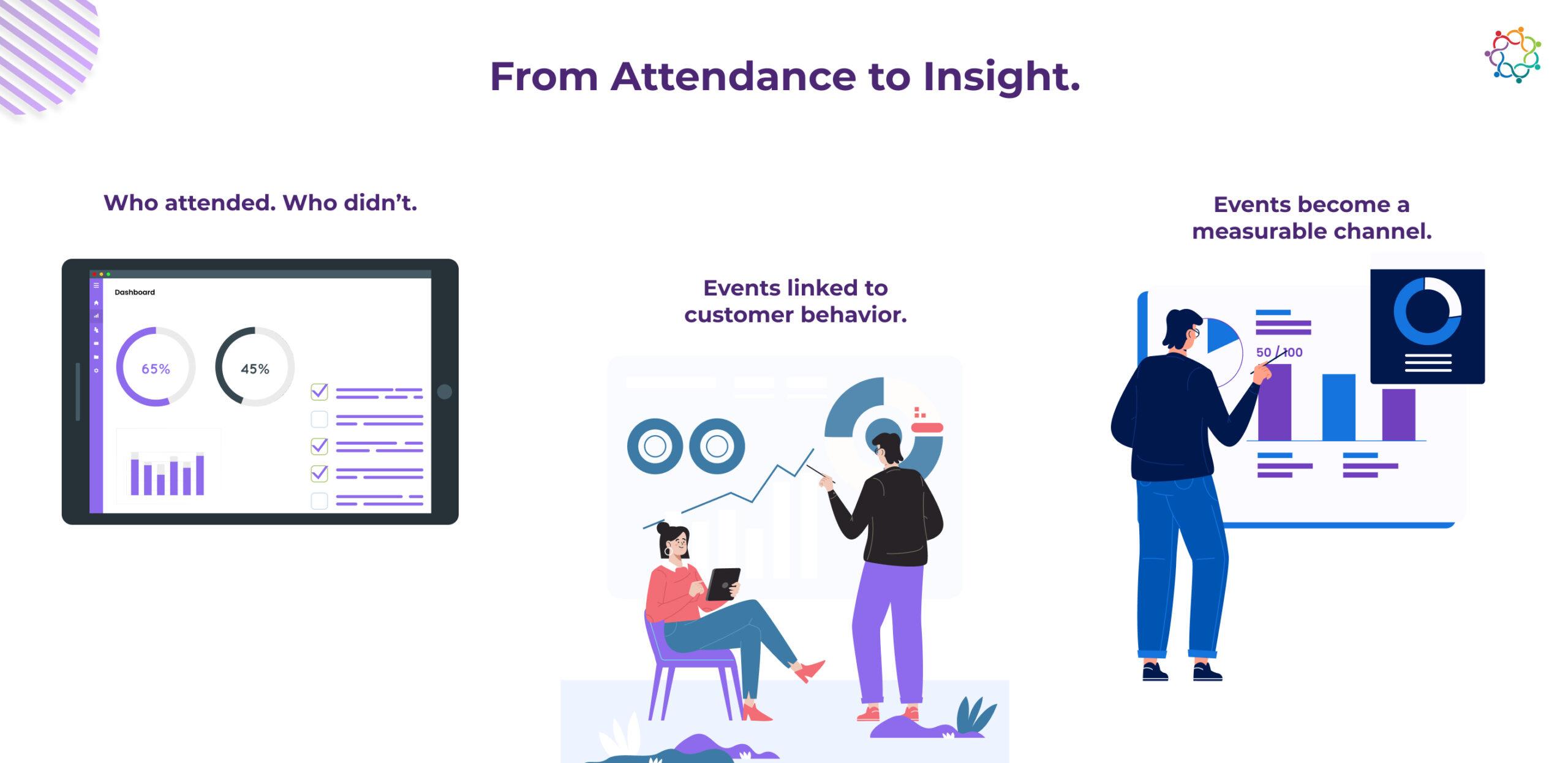
Beyond attendance tracking, Samaaro enabled the team to identify which customers attended events and compare them against non-attendees. This made it possible to analyze differences in engagement levels, product adoption, and long-term loyalty, turning events into a measurable engagement channel rather than a standalone activity.
Seamless data flow into internal systems for analysis
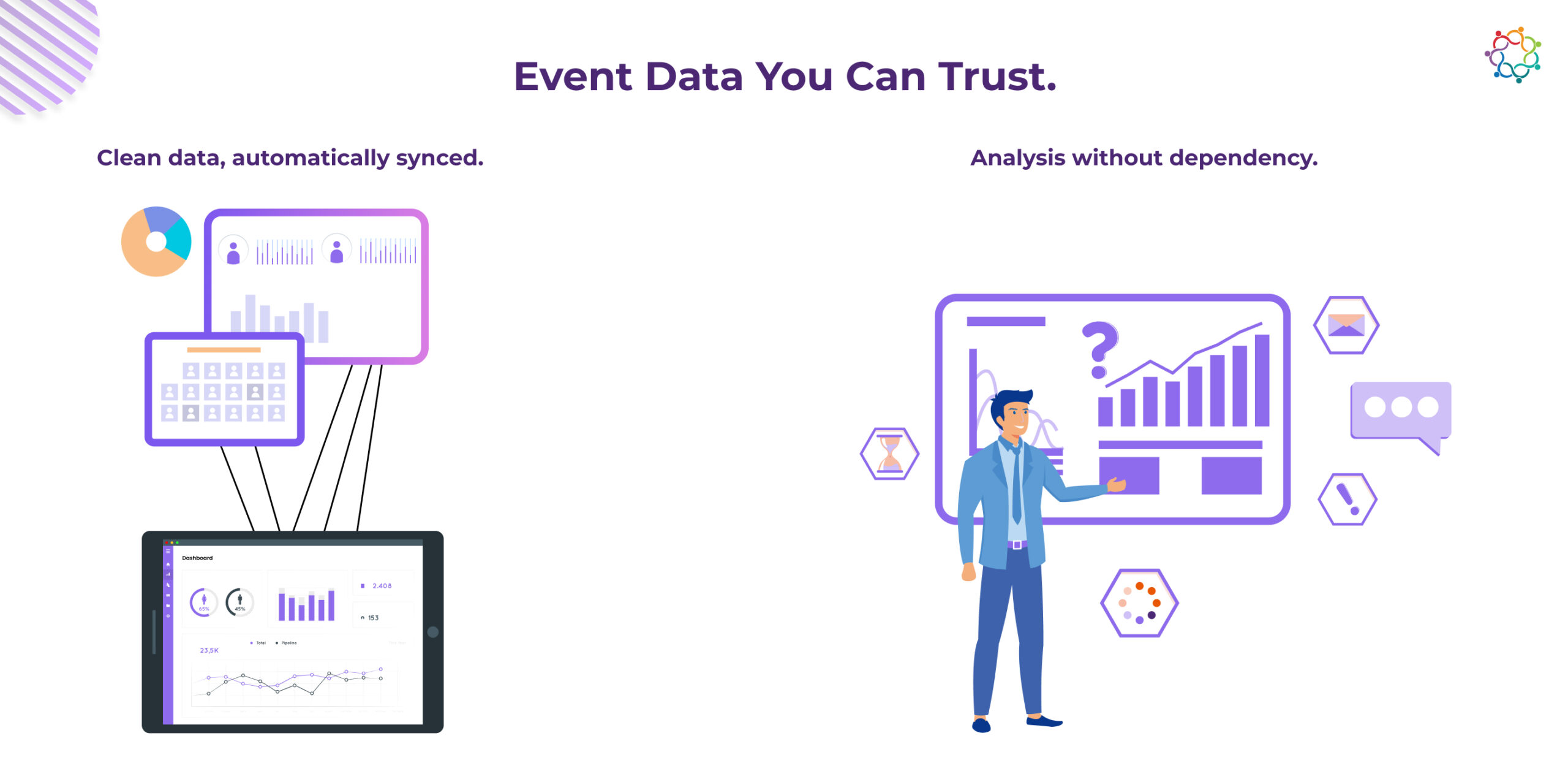
Event data flowed cleanly into Property Finder’s internal systems and dashboards, reducing reliance on manual data handling or specialist teams. This allowed the marketing team to review event performance and customer cohorts more frequently and with greater confidence.
Flexibility and continuous customization at scale
As Property Finder’s requirements evolved, Samaaro adapted with additional filters, reporting views, and workflow enhancements. This flexibility, combined with a highly responsive support team, ensured the platform continued to align with business needs over time rather than becoming a rigid tool.

After a flagship trade show generating over a thousand leads, the marketing team prepared post-event follow-ups within days instead of weeks. Leads were already segmented by product interest, synced into Salesforce, and aligned with approved budgets and pipeline views.
Instead of assembling reports across multiple tools, leadership reviewed event performance through a single dashboard while sales teams moved directly into relevant, product-led conversations. The event closed with clarity, not cleanup.
“Samaaro helped us go beyond running events to actually measuring their impact. We were able to clearly compare customers who attended our events with those who didn’t and see differences in engagement, adoption, and loyalty. The platform was reliable even with complex requirements, and the team was extremely responsive and flexible throughout.”
— Nancy Matar, Head of Marketing, Property Finder
In B2B real estate, events are not peripheral marketing activities. They are core relationship infrastructure.
For platforms like Property Finder that work closely with brokers, developers, and partners, events play a direct role in driving engagement, product adoption, and long-term loyalty. As these programs scale, success depends less on hosting premium experiences and more on understanding which stakeholders engage deeply and how that engagement translates into business outcomes.
Real estate companies that treat events as measurable engagement channels gain a clearer view of their ecosystem. Those that don’t risk running high-effort programs without knowing which relationships are truly strengthening over time.

Bottom Line: Track every lead, dollar, and deal in one place, and trade shows turn from a cost into a revenue channel.
The Client is a global leader in travel and hospitality technology, providing AI-powered SaaS solutions to hotels, airlines, and online travel agencies. The organization participates in a high volume of global events, with a primary focus on large-scale third-party trade shows.
Events are a fundamental revenue lever for the client, moving beyond brand awareness to serve as a critical engine for generating qualified leads and influencing pipeline conversion. With a complex global marketing operation, the company is focused on operationalizing events as repeatable, automated channels that can prove their direct impact on the bottom line.
Event Management Software, Event Marketing Automation, Event Marketing and Promotion, Lead Assignment Hub and Queue Manager, Event Budget Planner, Task Planner and Team Collaboration, Feedback and Surveys
In B2B SaaS, enterprise trade shows often account for 25–40% of the annual field marketing budget, yet a significant portion of the pipeline they influence remains poorly tracked or under-reported.
Thousands of leads are captured on the event floor, but fragmented systems, manual data handling, and delayed follow-ups make it difficult to connect spend with pipeline creation and revenue outcomes. As leadership scrutiny on event ROI increases, marketing teams are under pressure to prove not just activity, but measurable business impact from their largest event investments.
This challenge becomes more pronounced at scale, where even small inefficiencies multiply across thousands of interactions.
In high-volume pharmaceutical organisations, manual event operations can consume over 20,000 working hours annually, with most of that time spent on coordination, follow-ups, reconciliation, and reporting, activities that add no direct strategic value. When multiplied across hundreds of events, even small inefficiencies quietly compound into million dollar-level operational costs.
The client’s challenge was not participation or scale. Their flagship trade shows consistently delivered high engagement and a large volume of leads. The difficulty lay in operationalizing that scale into measurable, repeatable revenue outcomes.
As the size and importance of these events grew, several structural challenges emerged:
Fragmented systems across the event lifecycle
Pre-event planning, on-ground lead capture, post-event communication, and CRM updates were handled across multiple platforms. While each tool served a purpose, the lack of a unifying event layer led to manual data transfers, repeated clean-ups, and heavy dependence on spreadsheets to stitch information together.
Manual effort dominating post-event workflows
After each large trade show, hundreds of leads were exported, cleaned, normalized, and re-uploaded into Salesforce. Segmenting leads by product interest and triggering relevant follow-up campaigns required significant manual effort, delaying outreach at the moment of highest buyer intent.
Sales enablement gaps before and during events
Sales teams relied on ad hoc emails and shared documents to access event briefs, creatives, and product collateral. With no centralized, read-only repository, marketing teams became a bottleneck for basic information requests, increasing dependency on individuals rather than systems.
Limited leadership visibility into ROI
While data on budgets, pipeline, and revenue existed, it was scattered across tools and reports. Leadership lacked a single, consolidated view to assess how event spend translated into pipeline creation, product-level interest, and revenue realization over time.
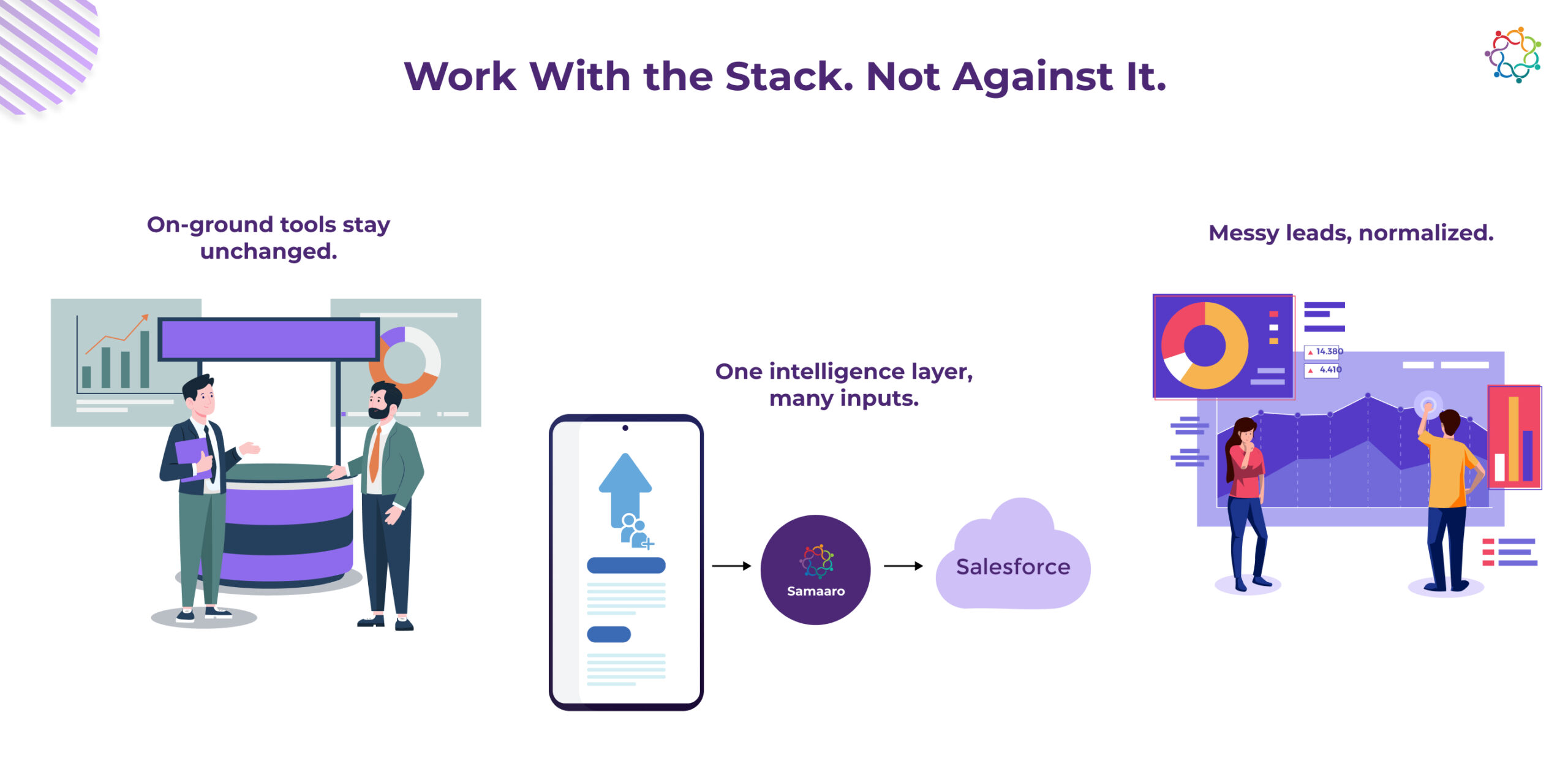
Samaaro was implemented as an event intelligence and automation layer that sat on top of the client’s existing CRM and marketing stack, without disrupting on-ground execution at large third-party trade shows.
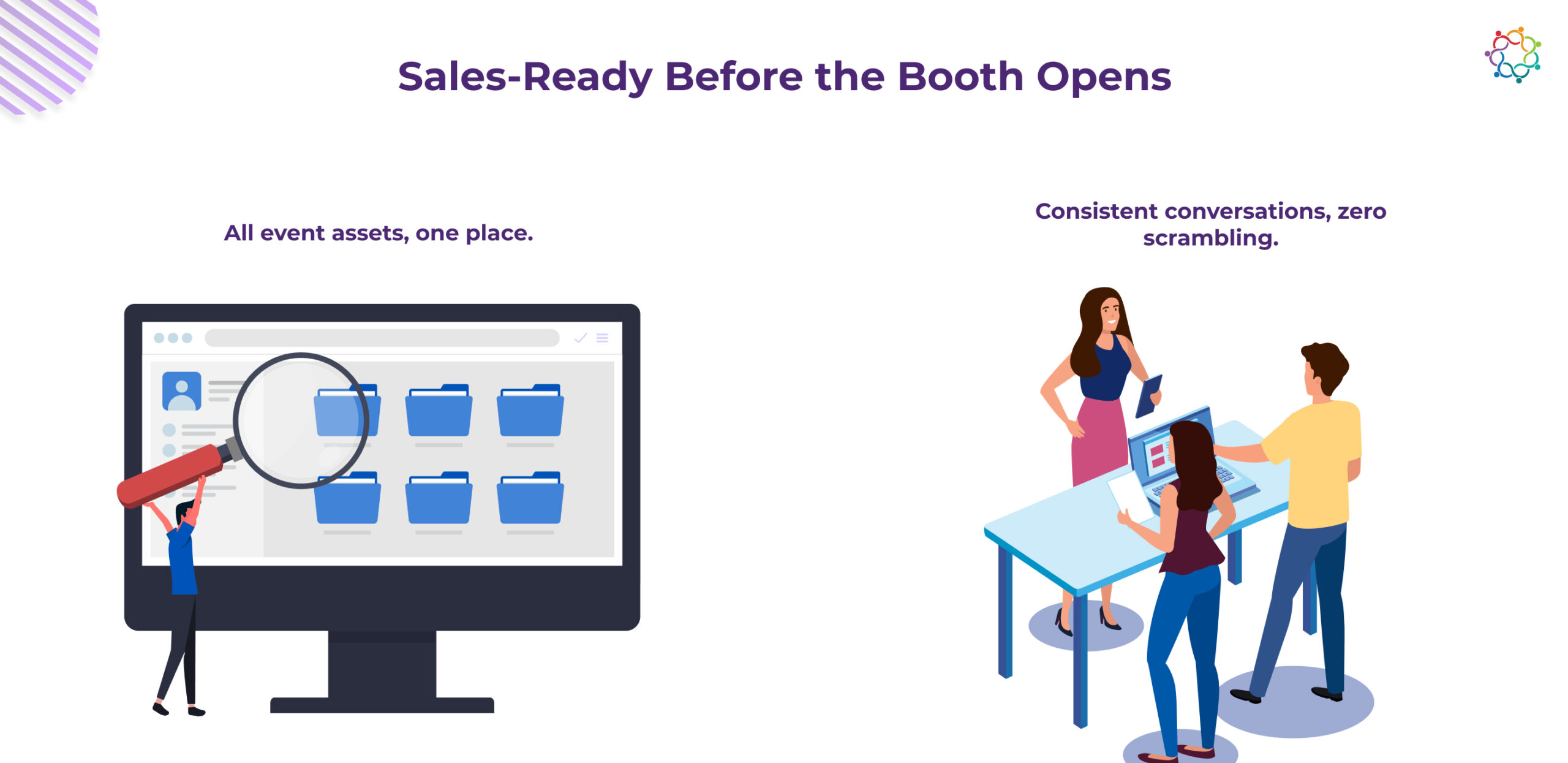
Centralized sales enablement and asset access
A read-only, centralized repository was created within Samaaro to host event briefs, sales decks, and product collateral. Sales teams could access the latest assets well before the event and during execution without repeated requests to marketing. This reduced last-minute coordination and ensured consistency in on-ground conversations.
Centralized event intelligence without replacing existing systems
Samaaro was positioned to work alongside the trade show’s native lead capture app and Salesforce, not replace them. Post-event lead data was consolidated into a single structured layer, allowing marketing teams to normalize inputs, map product interest accurately, and prepare clean datasets for CRM updates. This reduced manual reconciliation effort and created a consistent foundation for downstream reporting and campaigns.
Automated post-event segmentation and follow-ups
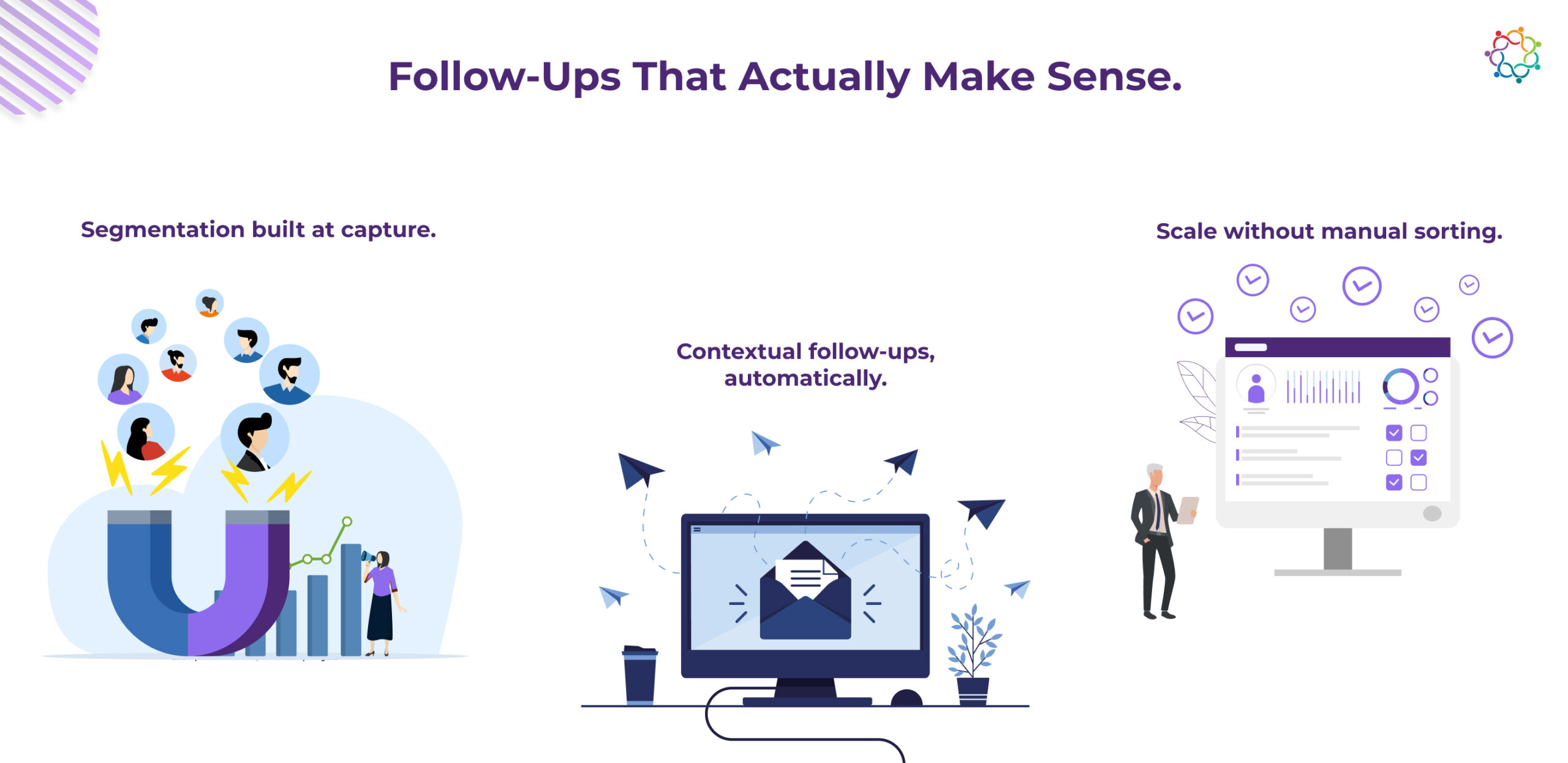
Samaaro enabled structured segmentation of leads based on product interest and engagement context captured during the event. This made it possible to trigger relevant post-event communications without relying on manual sorting or spreadsheet-driven workflows. As a result, follow-ups became faster, more contextual, and easier to scale across large lead volumes.


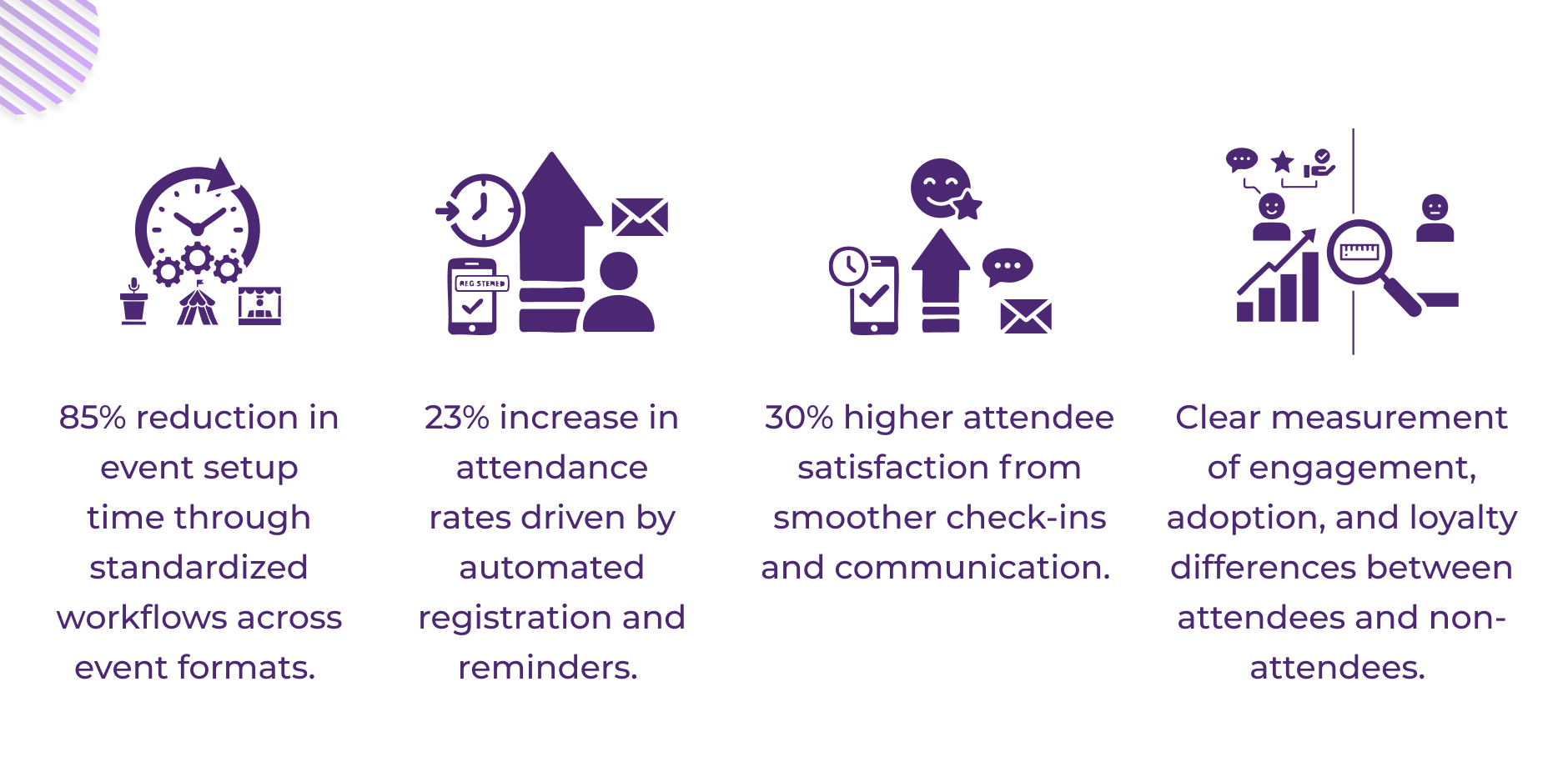
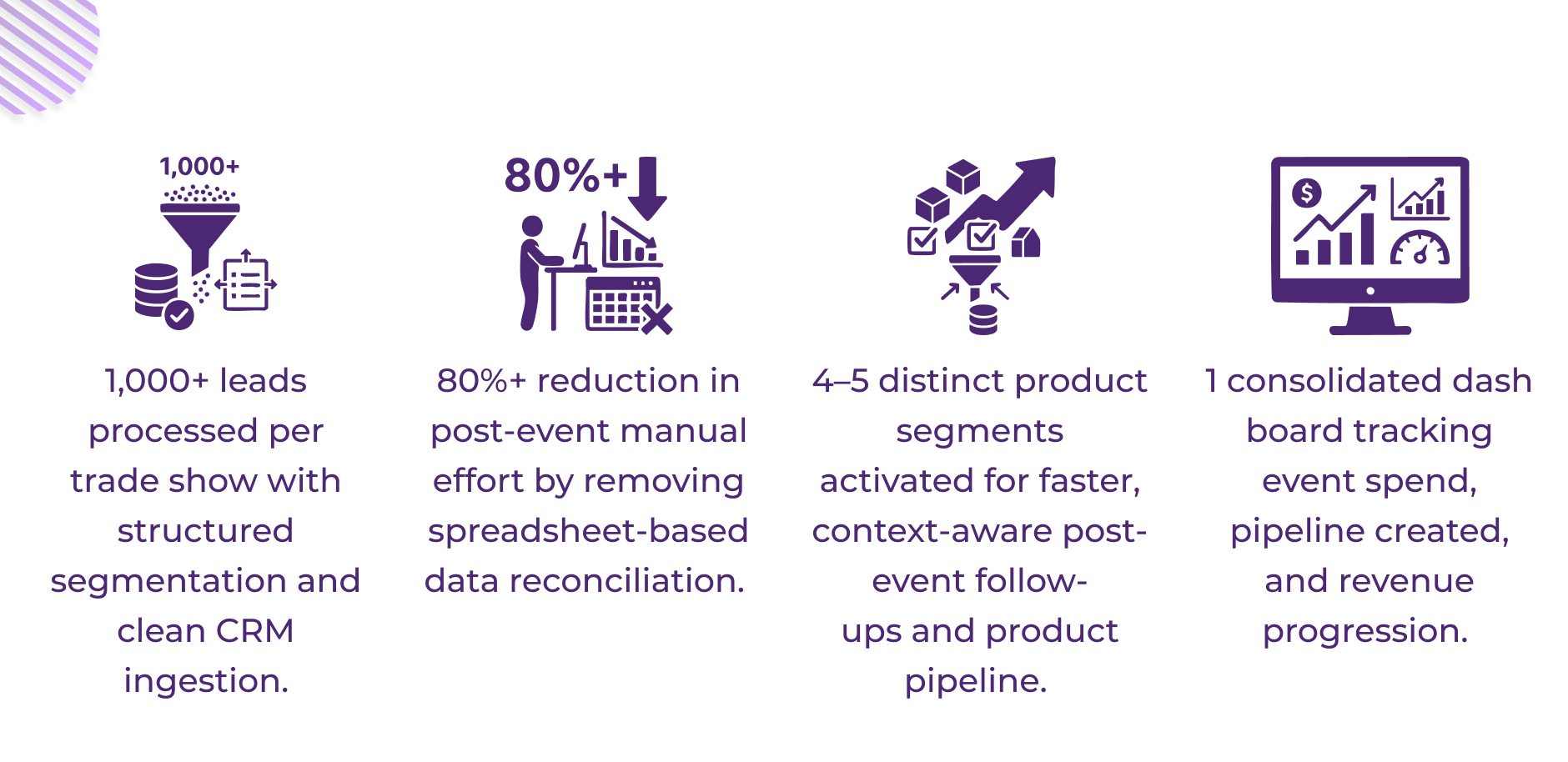
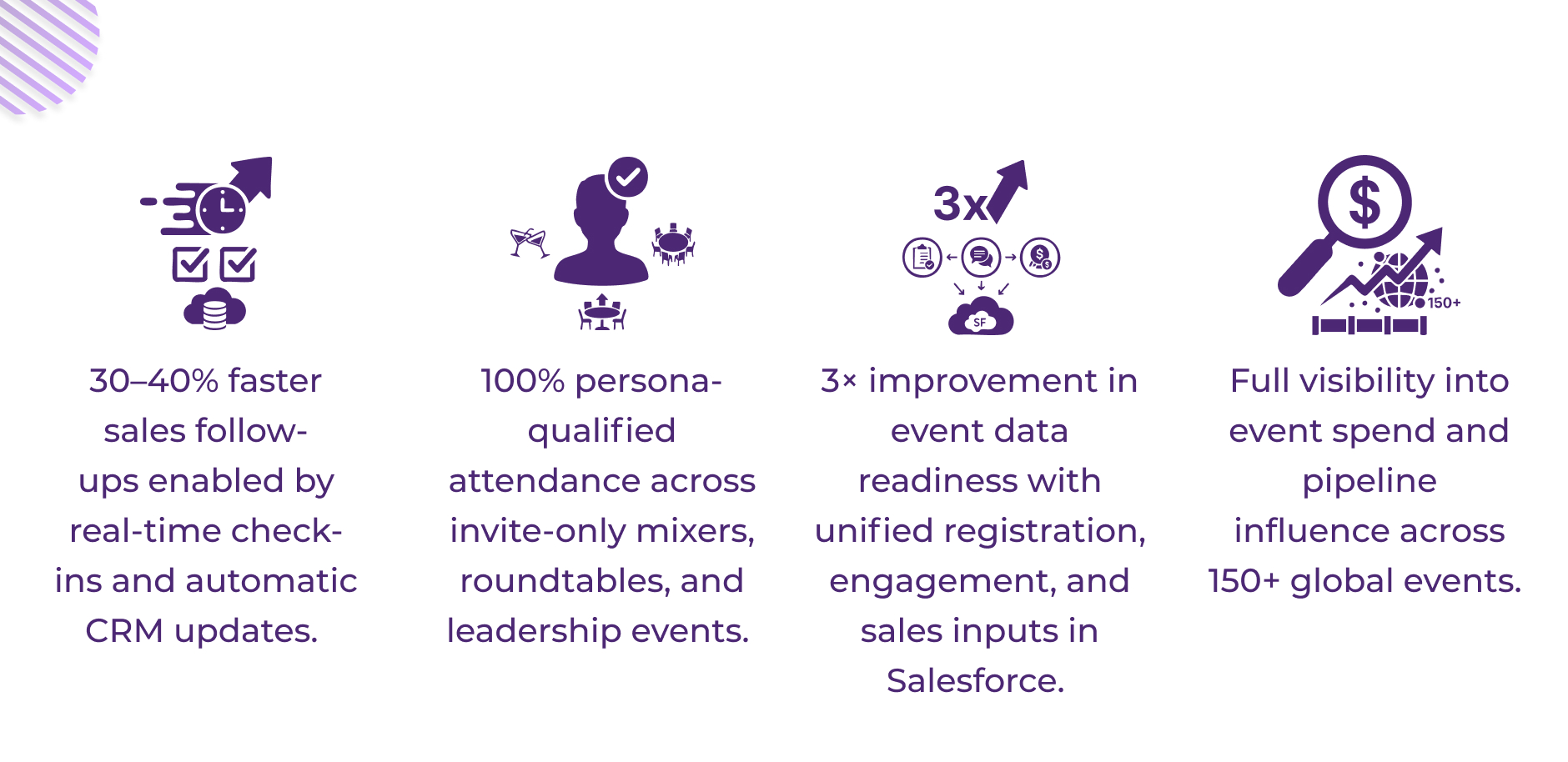
30–40% faster sales follow-ups enabled by real-time check-ins and automatic CRM updates.

100% persona-qualified attendance across invite-only mixers, roundtables, and leadership events.

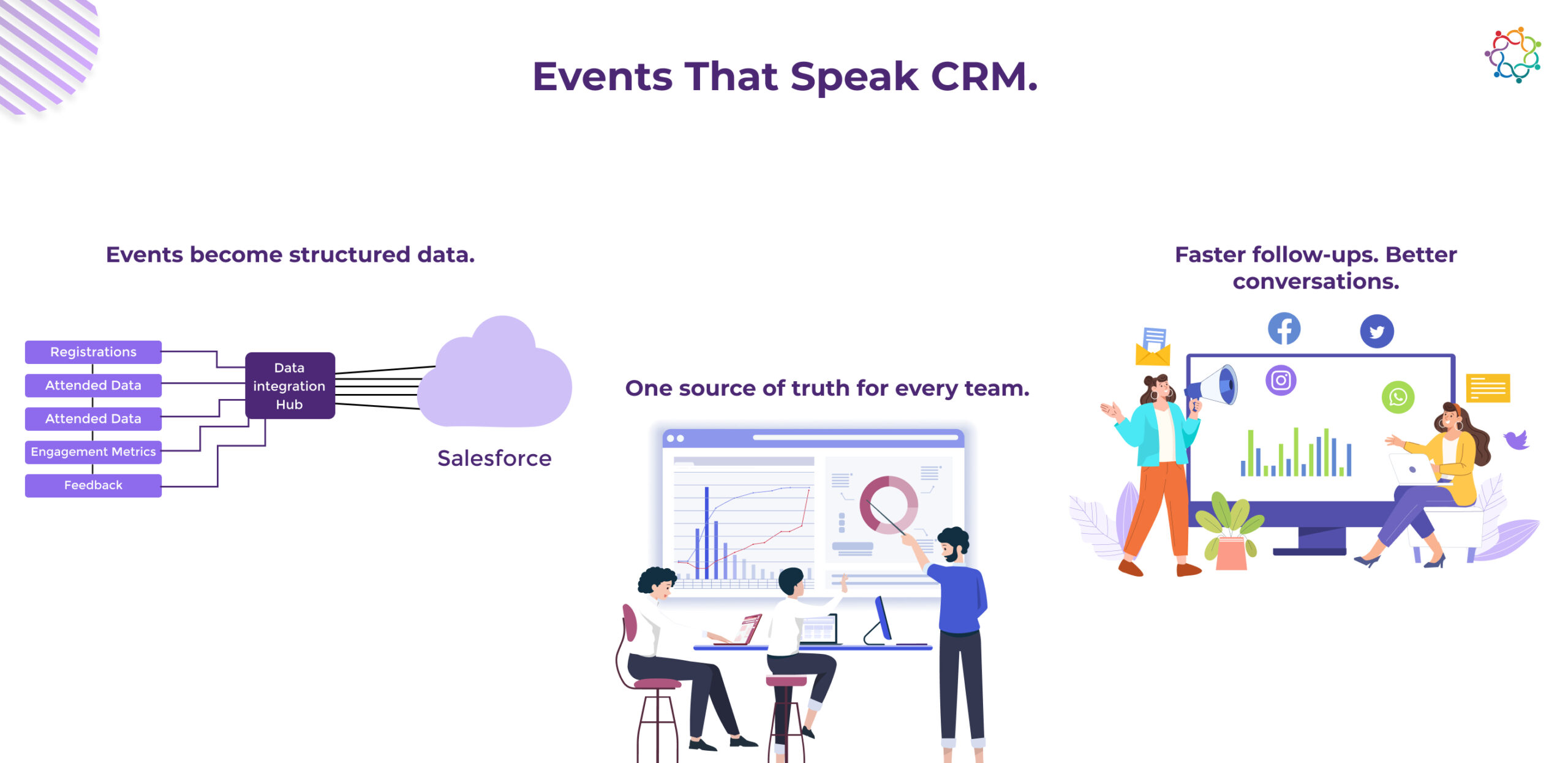
3× improvement in event data readinesswith unified registration, engagement, and sales inputs in Salesforce.

Full visibility into event spend and pipeline influence across 150+ global events.
After a flagship trade show generating over a thousand leads, the marketing team prepared post-event follow-ups within days instead of weeks. Leads were already segmented by product interest, synced into Salesforce, and aligned with approved budgets and pipeline views.
Instead of assembling reports across multiple tools, leadership reviewed event performance through a single dashboard while sales teams moved directly into relevant, product-led conversations. The event closed with clarity, not cleanup.
For B2B SaaS companies, the biggest risk with large trade shows is not poor execution. It is poor accountability.
When thousands of leads pass through disconnected systems, events quietly turn into cost centers, regardless of how busy the booth looks. High-performing teams treat trade shows as financial instruments, not marketing rituals. They build systems that connect spend, lead intent, pipeline creation, and revenue progression into one continuous view.
As budget scrutiny increases, the winners will not be the teams that attend more events, but the ones that can prove, week by week, how each event moved the business forward.

Bottom Line: 30-40% faster follow-ups, 3x better data readiness, and 100% qualified attendance come from infrastructure, not extra effort.
The client is a global Marketing Technology (MarTech) leader with a strong focus on AI-powered customer engagement and retention. The organization runs a massive volume of persona-driven events every year across various global regions, ranging from high-touch C-suite roundtables and product-focused mixers to massive flagship conferences and industry awards.
Events play a critical role in the client’s go-to-market strategy, serving as a primary channel for pipeline acceleration, relationship building, and customer nurturing. With multiple regional teams operating in parallel and more than 150 events being conducted globally throughout the year, the organization places a heavy emphasis on standardizing workflows, data reliability, and the ability to seamlessly transition event intent into Salesforce for immediate sales follow-up.
Event Website Builder, RSVP Management with Approval Workflows, Omnichannel Communication, Onsite Check-In and Digital Lead Capture, Zoom Integration for Webinars, Salesforce CRM Integration, Budget Planner, Event Reporting
In B2B SaaS, over 70% of pipeline influenced by events is lost not due to poor attendance, but due to delayed follow-ups, unqualified attendees, and fragmented event data.
As event programs scale, teams often add more formats, more regions, and more stakeholders, without fixing the operational backbone that connects events to sales outcomes. The result is familiar: high activity, unclear impact, and overstretched teams.
This is the challenge many global MarTech organizations face as events move from occasional campaigns to always-on GTM engines.
In high-volume pharmaceutical organisations, manual event operations can consume over 20,000 working hours annually, with most of that time spent on coordination, follow-ups, reconciliation, and reporting, activities that add no direct strategic value. When multiplied across hundreds of events, even small inefficiencies quietly compound into million dollar-level operational costs.
The client’s event program was already delivering value. The challenge was not effectiveness; it was sustainability at scale.
As the number of events, regions, and internal stakeholders increased, the existing setup began to show signs of strain. Processes that worked well for individual events became harder to manage across a global, always-on program.
Key challenges included:
1. Managing multiple event formats with inconsistent workflows
The organization ran a diverse mix of events, including invite-only mixers, customer roundtables, mini conferences, webinars, and large flagship gatherings. Each format had different requirements, but execution often relied on fragmented tools and manual coordination. This made it difficult to standardize workflows without over-centralizing control.
2. Maintaining attendee quality in invite-only events
Most events were persona-driven and invitation-based. However, forwarded invites and open registrations made it harder to consistently ensure the right profiles were attending. Manual checks added operational overhead and increased the risk of misaligned audiences.
3. Fragmented attendee and engagement data
Registrations, attendance, webinar participation, and on-ground interactions were captured across multiple systems. While data eventually reached Salesforce, the lack of a unified event layer slowed consolidation and reduced real-time visibility into attendee engagement and intent.
4. Delayed sales follow-ups at high-intent moments
Sales teams participated actively in both hosted and industry events. However, capturing notes, identifying engaged prospects, and triggering CRM updates often happened after the event, reducing the immediacy and effectiveness of follow-up conversations.
5. Limited visibility into event spend and pipeline influence
With multiple teams running events across regions, tracking budgets and understanding how different event types influenced pipeline required manual reporting. Leadership needed clearer answers on how investments translated into sales momentum, without increasing reporting complexity
Standardized event execution across formats and regions
Samaaro enabled the client to manage mixers, customer roundtables, mini conferences, flagship events, and webinars within a single platform. Regional teams could create and run events independently while operating within standardized workflows. This reduced execution variance across regions and allowed the central team to maintain visibility and control without slowing down local teams.
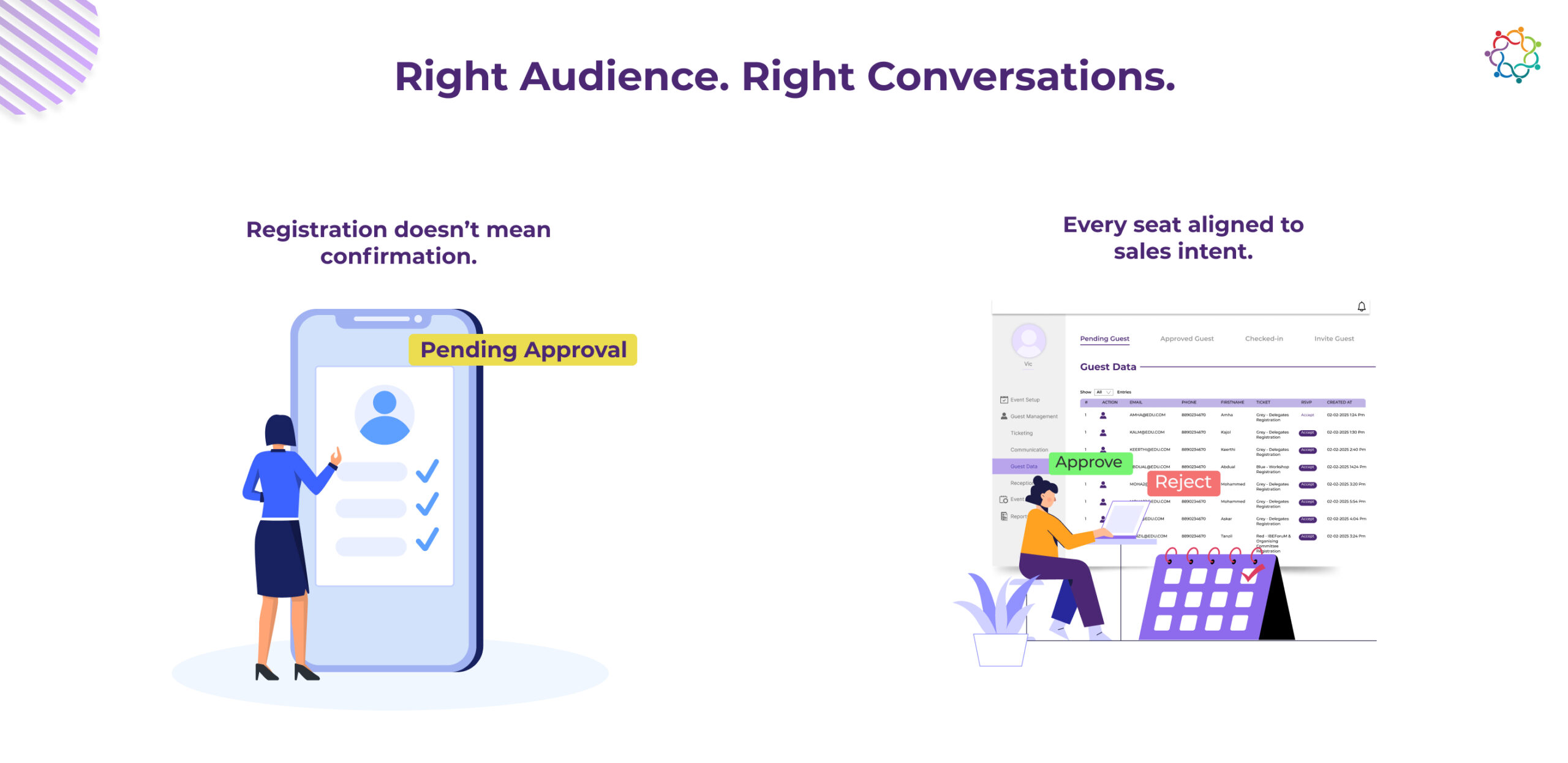
Invite-only and approval-based registration workflows
Samaaro introduced controlled registration flows that allowed the client to qualify attendees before confirmation. Approval-based workflows helped enforce persona-specific participation, reduced the impact of forwarded invites, and ensured that high-touch events consistently reached the intended audience. As a result, event conversations became more relevant and aligned with sales objectives.
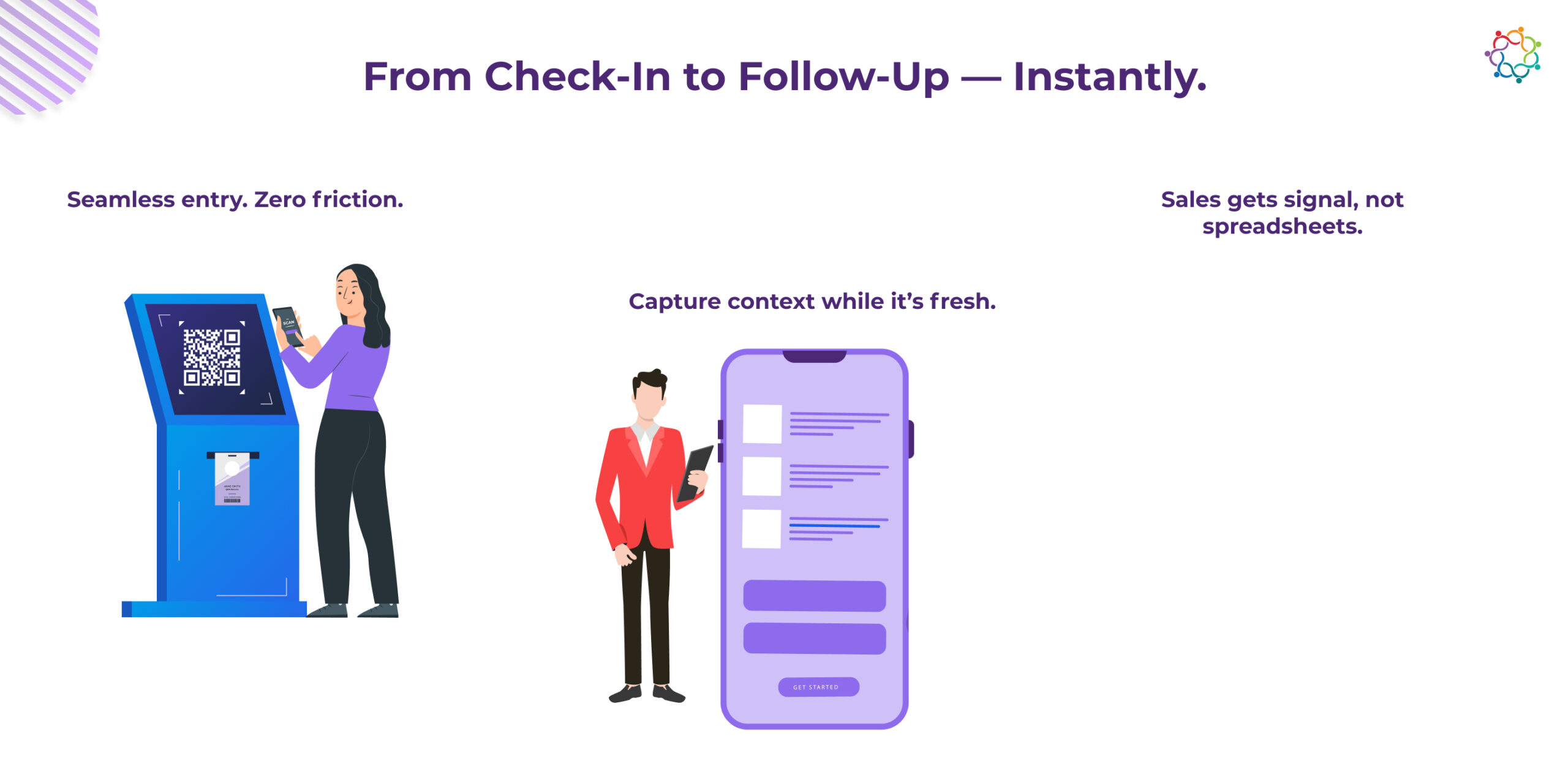
On-site check-ins with real-time sales notifications
For in-person events, Samaaro enabled seamless check-ins and digital lead capture for sales teams. Sales representatives could log interactions on-site, with attendee activity and notes immediately reflected in the system. This allowed sales teams to follow up faster while context was still fresh, improving the quality and timing of post-event conversations.
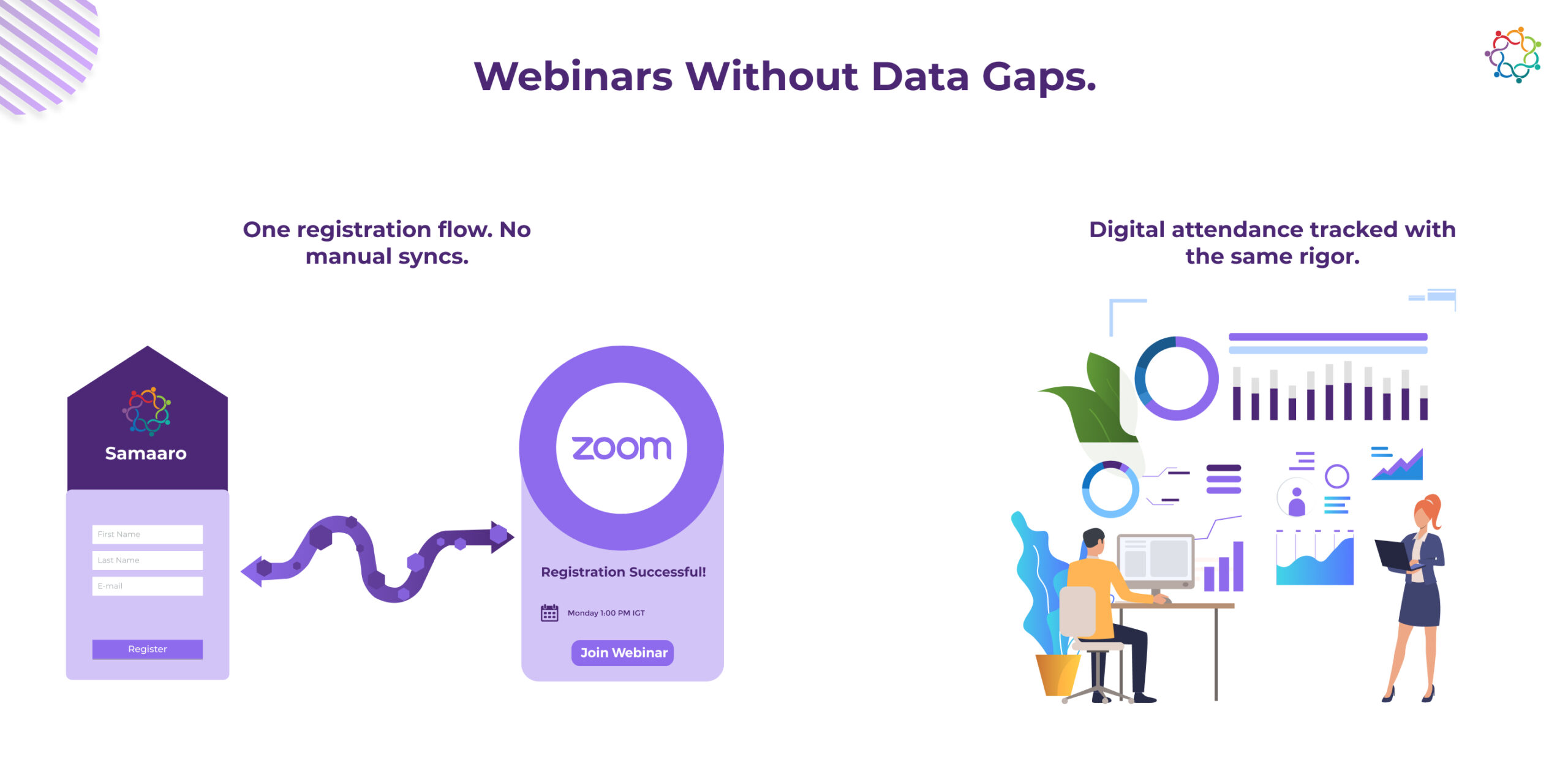
Native Zoom integration for webinar execution
Webinars were executed through a direct Zoom integration, allowing registrations, attendance data, and engagement signals to flow automatically into Samaaro. This eliminated manual reconciliation between webinar platforms and event records, and ensured that digital event participation was captured with the same rigor as in-person events.
Salesforce CRM integration for unified data management
Samaaro acted as a single event data layer feeding into Salesforce. Registration details, attendance status, engagement activity, and sales notes were synced automatically. This gave both marketing and sales teams a shared, reliable view of event influence and reduced delays caused by manual data entry.
Budget planning and spend tracking at the event level
The platform allowed teams to plan and track event budgets centrally while maintaining regional flexibility. Marketing leaders gained clearer visibility into how spend was distributed across event types and regions, enabling more informed decisions without increasing reporting overhead.
Reporting on event impact and pipeline influence
Samaaro provided consolidated reporting across events, formats, and regions. Teams could evaluate how different event investments influenced pipeline movement and sales follow-ups, creating a clearer link between event activity and business outcomes. This improved leadership confidence in the event program and supported more structured planning at scale.


30–40% faster sales follow-ups enabled by real-time check-ins and automatic CRM updates.

100% persona-qualified attendance across invite-only mixers, roundtables, and leadership events.

3× improvement in event data readinesswith unified registration, engagement, and sales inputs in Salesforce.

Full visibility into event spend and pipeline influence across 150+ global events.
During a regional customer roundtable, the sales team received real-time notifications as attendees checked in and engaged during the session. Notes were captured digitally while conversations were still ongoing, and key follow-ups were triggered the same day inside Salesforce.
Instead of post-event coordination calls and spreadsheet cleanups, the team moved directly into contextual sales conversations within hours of the event closing. For the first time, event momentum carried forward without operational lag.
As B2B event programs scale, the competitive advantage no longer comes from hosting more events. It comes from operating them better.
Modern field marketing is shifting from isolated campaigns to continuous, always-on engagement engines. In this model, events are no longer brand moments. They are data systems, sales enablement channels, and pipeline infrastructure.
Organizations that treat events as disconnected activities will continue to see high volume with low clarity. Organizations that treat events as integrated GTM systems will gain speed, control, and compounding impact.
The future of B2B events is not about bigger stages or larger audiences.
It is about clean data flows, qualified participation, fast sales activation, and measurable pipeline influence.
That is where event programs stop being cost centers and start becoming growth engines.

Samaaro is an AI-powered event marketing platform that enables marketing teams to turn events into a measurable growth channel by planning, promoting, executing, and measuring their business impact.
Location


© 2026 — Samaaro. All Rights Reserved.