Samaaro + Your CRM: Zero Integration Fee for Annual Sign-Ups Until 30 June, 2025
- 00Days
- 00Hrs
- 00Min


1
2
3
→
Bottom Line:
A customer advisory board event only delivers value when feedback is captured, translated, and acted on as product decisions, not just discussed.
Product teams today are not short on data. Usage metrics, NPS scores, support ticket volumes, and session recordings signal that the quantitative layer is thicker than it has ever been. And yet teams continue shipping features that miss the market, roadmaps that do not reflect what buyers actually need, and product decisions made in rooms where no customer voice was present.
The missing ingredient is not more data. It is a direct, structured, and unfiltered dialogue with the customers who understand the problem at a strategic level.
Most companies that recognize this gap do one of two things. They skip CABs entirely because the effort feels disproportionate to the perceived return, or they run sessions that are effectively product demos with a Q&A at the end. The customer sits politely, nods at the roadmap, and leaves without saying a single thing that changes a product decision.
A customer advisory board event that is well-designed is not a customer appreciation dinner or a roadmap preview session. It is a structured, facilitated environment in which a carefully selected group of strategic consumers provides advice on product direction, identifies issues that the internal team is unable to see, and challenges assumptions before they become costly errors.
It is worth being clear about what a CAB is not, because the confusion is common. A QBR is transactional and account-focused. A customer conference is broadcast, not a dialogue. A user research session is tactical and feature-specific. A CAB operates at the level of product vision and market direction, and its output is decisions, not satisfaction scores.
This guide covers every element of a customer advisory board event that product marketing and customer success leaders need to run one that actually delivers.
Member selection is upstream of everything else in this process. Get the room wrong, and the quality of your agenda, facilitation, and capture systems will not save you. Wrong members produce feedback that is either too polished to be useful or too specific to generalize into product decisions.
Who belongs in the room?
The ideal CAB member is senior enough to speak to strategic challenges rather than feature preferences, engaged enough with your product to have real opinions formed through real use, and different enough from the other members to prevent the session from becoming an echo chamber. VP level or above is the right seniority bar. Diversity across industry, company size, and use case is not a nice-to-have. It is a structural requirement for producing feedback that reflects the actual market rather than one segment of it.
Who to keep out
Avoid customers who are unconditionally happy with the product. They will validate rather than challenge, and validation is not what a CAB exists to produce. Avoid customers who are so unhappy that they will use the session to relitigate support issues. And avoid participants who are too junior to influence their own organisation’s buying decisions; their feedback may be accurate, but it cannot travel up the way you need it to.
How to build the roster
For a single event, ten to sixteen members is the right size. Enough diversity to generate genuine disagreement, small enough for real conversation. A deliberate composition works: 40 percent power users who engage with the product at depth, 30 percent strategic buyers who evaluate the competitive landscape, and 30 percent growth-stage customers who represent the direction your ICP is moving.
Frame the recruitment ask as a two-way exchange. Members get early access to roadmap thinking, peer networking with counterparts facing identical problems, and direct influence on product decisions. You get unfiltered strategic input. Send a pre-read document two weeks before the event covering discussion themes, rules of engagement, and what happens to their feedback after the session.
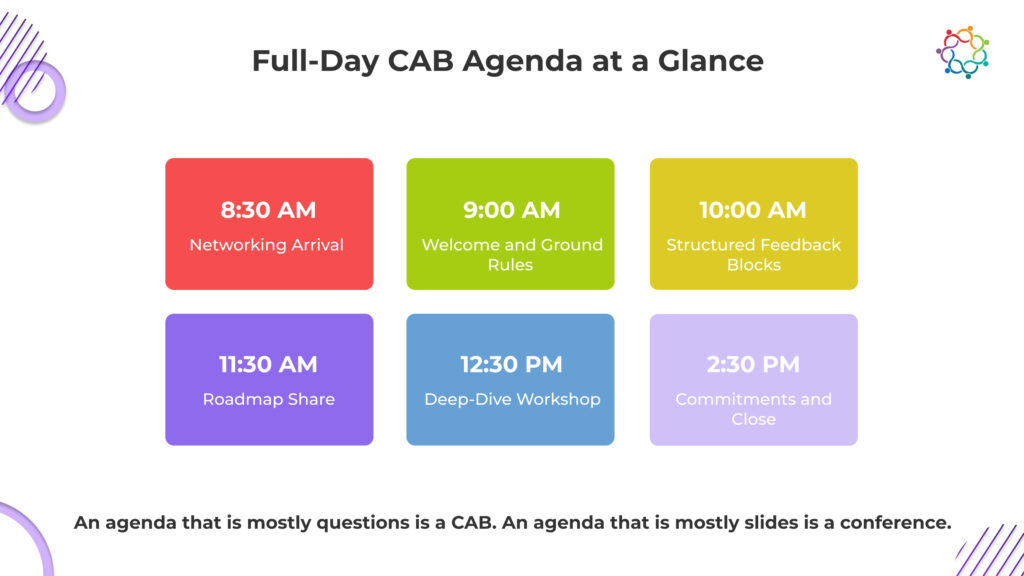
Every agenda item should be a question, not a presentation. The moment your agenda becomes a list of slides to show, you have built a conference, not a CAB. Allocate at least 60 percent of total session time to customer voice and treat that ratio as non-negotiable.
A full-day customer advisory board event agenda that works:
The roadmap slot requires a specific rule. Present only enough to provoke a reaction, not enough to answer every question. The moment you finish the share, ask: “What is missing from this picture?” and “What would you re-prioritize, and why?” If the twenty-minute slot runs as a twenty-minute pitch with Q&A at the end, you have inverted the ratio that the entire agenda depends on.
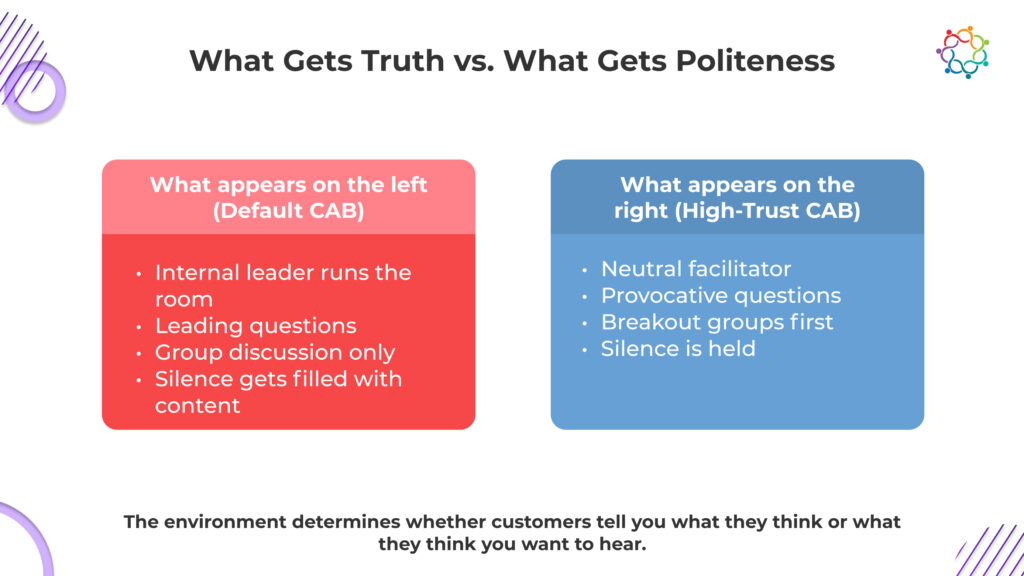
Customers in a room with your executive team will default to diplomatic, softened feedback unless the environment is specifically designed to prevent it. This is not dishonesty. It is the entirely predictable result of putting people in a social situation where criticism feels risky.
Five techniques that change the dynamic:
Use a neutral facilitator.
When your Head of Product runs the session, customers self-censor around the hierarchy in the room. A facilitator from a different internal function or an external professional removes that dynamic entirely.
Ask provocative questions
“What should we stop doing?” lands completely differently from “What do you like most about our roadmap?” Design questions that require customers to take a position, not just affirm one.
Use anonymous polling for sensitive topics.
Tools like Slido or Mentimeter allow members to register honest opinions before group discussion shapes their answers. The data surfaces uncomfortable truths that no one would say first in a room.
Run breakout groups before plenary report-back
Small groups of three to four customers produce more candid conversation than a full table with a VP of Product present and listening. Bring the outputs back to the full group rather than starting there.
Hold a parking lot for off-topic ideas.
Members who feel heard on tangents stay more engaged on the core questions. A visible parking lot signals that nothing raised is being dismissed.
What to avoid is equally important: do not defend the product when a customer criticizes it, do not let one voice dominate the room, and do not fill the silence. Silence after a hard question usually means someone is about to say something that matters.
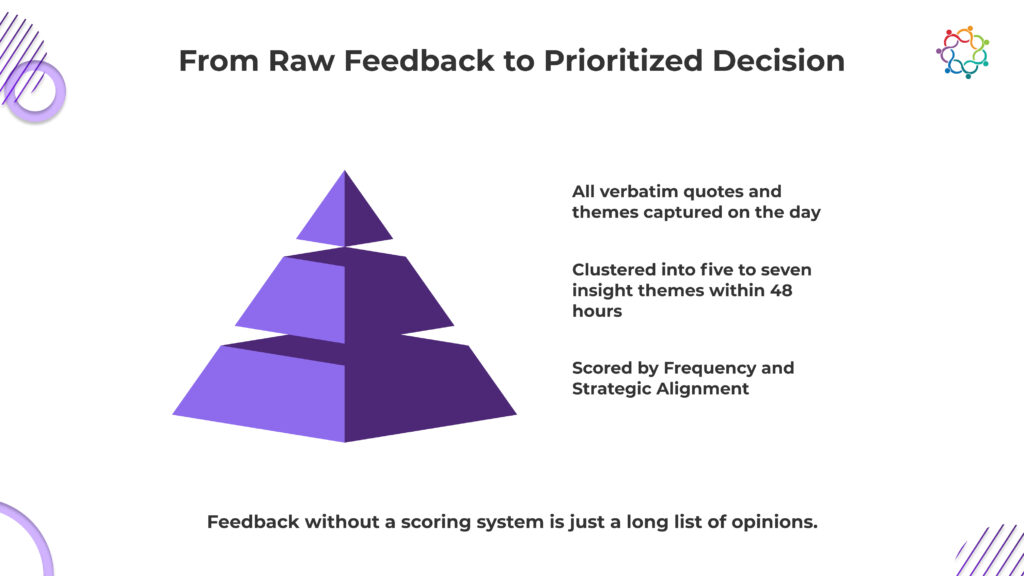
Capturing feedback well requires a dedicated note-taker who is separate from the facilitator. This person captures verbatim quotes, not paraphrased summaries.
When you write “customers want better integrations,” that’s a vague roadmap note. When you capture the exact words a VP used to describe a workflow failure, that’s a product brief. Verbatim quotes are the raw material. Summaries are opinions about the raw material.
Use a structured capture template for each discussion block covering: the topic, the verbatim customer quote, frequency (how many others echoed the same point), urgency signal, and potential product implication. Tag themes in a shared document visible to your internal team only as the session progresses.
Within 48 hours of the event, run an internal debrief with product, marketing, and customer success present. Cluster the raw notes into five to seven primary insight themes. Then score each theme on two axes:
Frequency, meaning how many members raised it, and strategic alignment, meaning how closely it maps to your current product direction and ICP needs. High frequency combined with high alignment means act on it and tell members you did. High frequency with low alignment means investigate further because it may signal a strategy gap. Low frequency with high alignment means flag it for individual follow-up with the member who raised it.
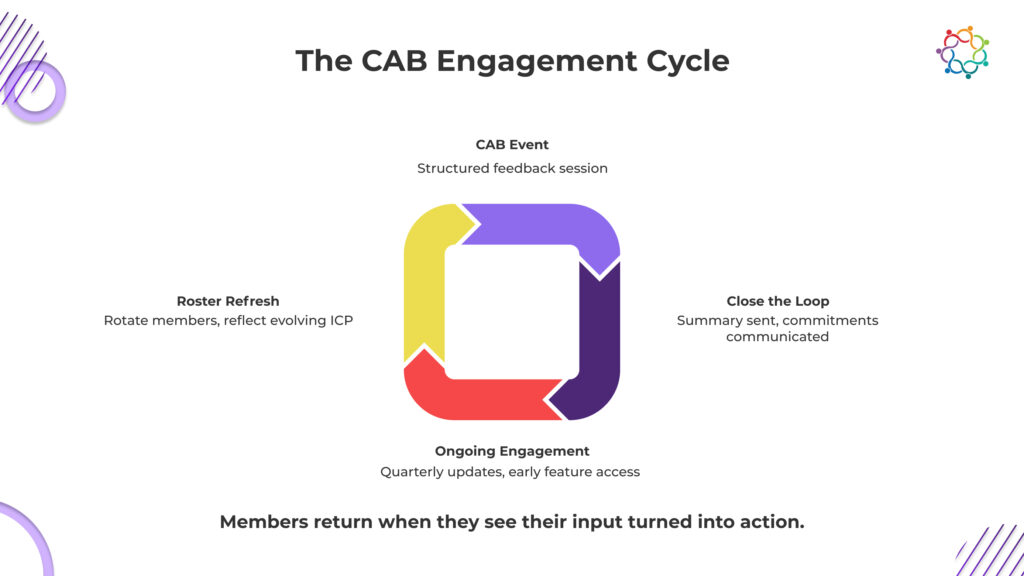
The session ends. The feedback exists. What happens in the next five business days determines whether your CAB program builds trust or burns it.
Send a personalised thank-you within 24 hours that references something specific the member said. Not a mass email. A note that proves you were listening. Follow it with a formal CAB summary document within five business days covering the key themes heard, the initial product team response, and committed next steps with owners and timelines attached.
Be explicit about what will not be acted on and why. Honesty about constraints builds more trust than vague promises about everything being considered.
Between events, create a quarterly cadence that shows members what has changed in the product as a direct result of CAB input. Give select members early access to features connected to their specific feedback. Invite them to 30-minute follow-up calls to pressure-test specific decisions. These are not favours. They are the mechanism by which members remain invested in the program.
To make the program repeatable, document the full event design in a CAB playbook covering member criteria, agenda template, facilitation guide, capture system, and follow-up protocol. Run the event twice per year for most SaaS companies, quarterly for enterprises with fast-moving roadmaps. Refresh membership, thoughtfully rotate out members who have disengaged, and bring in voices that reflect where your ICP is moving, not where it was.
If your CAB event ends and your product team has not changed a single priority as a result of it, you did not run a customer advisory board event. You ran a customer dinner with a nicer agenda.
Your customers are already forming opinions about your product. The only question is whether they are forming them in your room or in someone else’s.
The CAB Event Planning Template includes everything you need to run this from scratch: member selection scorecard, full-day agenda template, facilitation question bank, feedback capture sheet, and post-event follow-up email sequence.
Samaaro helps enterprise teams capture structured feedback, polling, and session-level insights at customer advisory board events, then route them into a single system, so CAB input becomes product decisions rather than debrief notes nobody revisits. Talk to our team.