Samaaro + Your CRM: Zero Integration Fee for Annual Sign-Ups Until 30 June, 2025
- 00Days
- 00Hrs
- 00Min

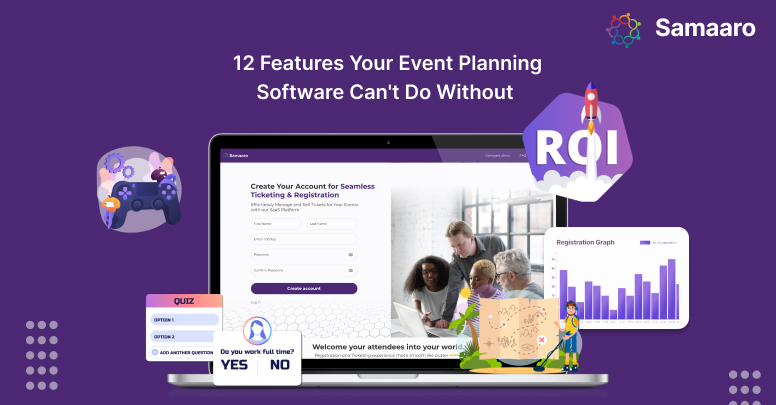
Most well-run events aren’t just well-planned, they’re run on the right software. Capterra’s research puts the number at 90 percent of event coordinators now using event management software to plan and execute their events, and that’s not a coincidence. The right platform changes what’s possible, faster execution, a better attendee experience, and a clearer read on ROI once the event wraps, turning tasks that used to take a team of people days of manual coordination into something that runs largely on its own.
Here’s a rundown of the features worth checking for before committing to a platform, from the event website through post-event reporting. Missing any one of these usually shows up as a gap somewhere in the event, a registration bottleneck, a sponsor left in the dark, feedback nobody ever collects, so it’s worth checking the full list rather than assuming the basics cover it.
1. Event Website Builder
Your event website is usually the first real touchpoint a prospective attendee has with the event. A builder that lets you customize layout, add multimedia, and lay out schedules, speakers, and sponsors without touching code makes that first impression count, and it’s often the deciding factor for someone weighing whether an event is worth their time before they’ve committed to anything.
2. Custom Registrations and Ticketing
A registration form built around what your specific event actually needs, not a generic template, is the foundation for everything that follows. CSV uploads for bulk registrations, single sign-on, and CRM integration keep the process smooth for large events, and customized tickets add a personal touch that a generic PDF doesn’t. Getting this step wrong, a clunky form or a login that doesn’t work, costs registrations before the event has even started.
3. On-Site Check-In and Badge Printing
A fast check-in process sets the tone for the whole day. Badge printing on-site that actually looks professional, rather than a handwritten sticker, reflects on the event as a whole from the moment someone walks in, and a slow line at the door colors how people feel about everything that follows it, even sessions that have nothing to do with registration at all.
4. Speaker Management
Events with multiple speakers need a dedicated way to manage communication, session assignments, and speaker profiles. Centralizing bios, session topics, and materials in one place keeps the event narrative consistent instead of scattered across email threads, which matters more as the speaker count grows past a handful, when tracking who has confirmed what starts to require its own spreadsheet if the software doesn’t handle it.
5. Sponsor Management
Sponsors fund and often shape an event, so the software should make it easy to track sponsorship tiers, allocate exhibit space, and confirm deliverables like logo placement. Clear visibility into their involvement is what keeps sponsors satisfied and likely to come back next time, rather than left wondering whether their logo actually made it onto the signage they paid for.
6. Event App
A custom event app puts schedules, maps, and real-time updates in an attendee’s pocket instead of on a printed handout that gets lost by lunch. It’s also usually the fastest way to push a last-minute room change or session update to everyone at once, rather than relying on word of mouth to travel through a crowd of five hundred people.
7. Networking Tools
AI matchmaking that suggests relevant connections based on attendee profiles, paired with a meeting scheduler for booking one-on-ones, turns networking from a hallway coincidence into something people can actually plan around. That’s especially valuable for attendees who find cold approaches uncomfortable but still want to make useful connections while they’re there.
8. Event Marketing Tools
Getting people to the event in the first place takes real marketing, targeted email campaigns, social promotion, and personalized invitations, ideally built into the event marketing platform itself rather than run through a separate tool that doesn’t share data with registration. Integration with marketing automation tools and automated event communications means reminders and follow-ups go out on schedule without someone manually triggering each one, which matters most in the final week before an event when there’s no time left for manual outreach.
9. Accessibility
Real-time translation for multilingual audiences and transcripts for presentations aren’t nice-to-haves, they’re what actually lets everyone in the room engage with the content, not just the people who share the primary language or don’t need a written alternative. An event that overlooks this quietly excludes a chunk of its own audience without ever meaning to, and it’s usually the attendees least likely to say anything about it.
10. Engagement Tools
Live polling, interactive Q&A, and a bit of gamification, scavenger hunts, leaderboards, keep attendees participating instead of passively watching. A session with an active poll running gets noticeably more attention than a straight lecture, and the data from that poll also tells a speaker in real time whether the room is actually following along.
11. Lead Generation
QR codes at exhibits and lead retrieval tools throughout the event capture attendee intent as it happens, rather than relying on a stack of business cards collected at random. That data is what makes post-event follow-up actually targeted instead of a blanket email to everyone who walked in, and it’s the difference between a follow-up that converts and one that gets deleted unread.
12. Surveys and Reporting
Feedback collected right through the event app, while the experience is still fresh, tells you what worked and what didn’t far more reliably than a survey sent a week later, when the specifics have already blurred together in attendees’ memories. Paired with post-event reports on attendance and engagement, that feedback is what actually shapes a better version of the event next time, rather than repeating the same format on instinct because it seemed to go fine.
Getting all twelve of these right in one platform, rather than stitching together separate tools for each, is usually the difference between an event that runs smoothly and one where something falls through the cracks on the day. A registration tool that doesn’t talk to the event app, or a feedback survey with no connection to the CRM, creates exactly the kind of gap that a unified platform is built to close. Checking a prospective platform against this list before signing a contract is far cheaper than discovering the gap mid-event.