Samaaro + Your CRM: Zero Integration Fee for Annual Sign-Ups Until 30 June, 2025
- 00Days
- 00Hrs
- 00Min

A senior executive gets 200 emails a day. Your event invite is competing with a board deck, a budget review, and three requests from their own team. It has about four seconds to win.
Getting a director-level contact to RSVP is a solvable problem. Getting a CFO, CTO, or VP of anything to RSVP to an event they did not already plan to attend is a categorically different challenge, and most event invite emails are not built to meet it.
The core problem is not copywriting but perspective. Most invites center on what the company wants to show, the agenda, or the venue. Senior leaders don’t decide based on these. They ask: Is this worth my time?
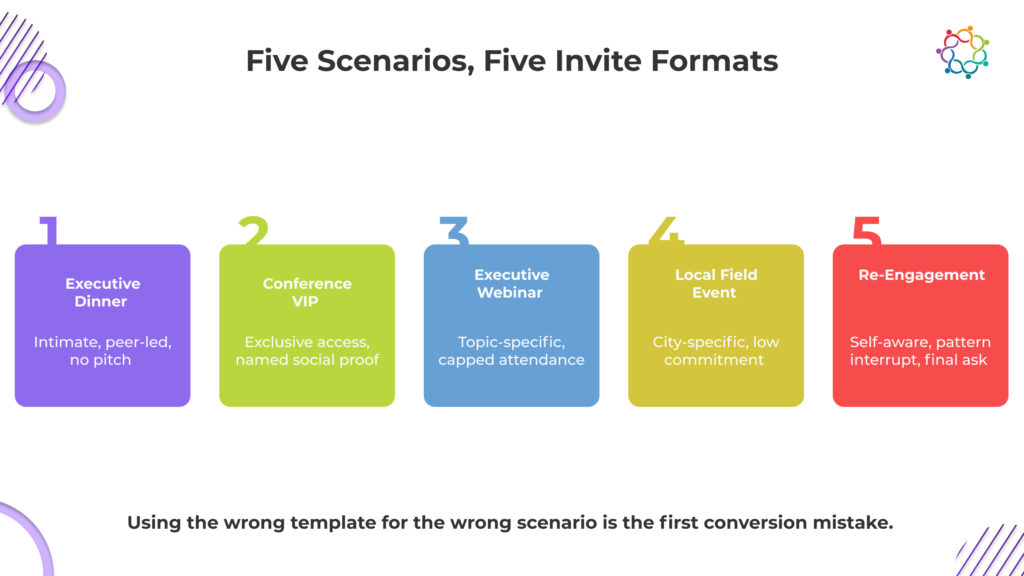
These are not generic templates with placeholder text. Five specific invitation structures for five distinct executive event scenarios. Each one includes an annotation explaining the copy logic, what’s doing the work, what to preserve, and what breaks if you change it.

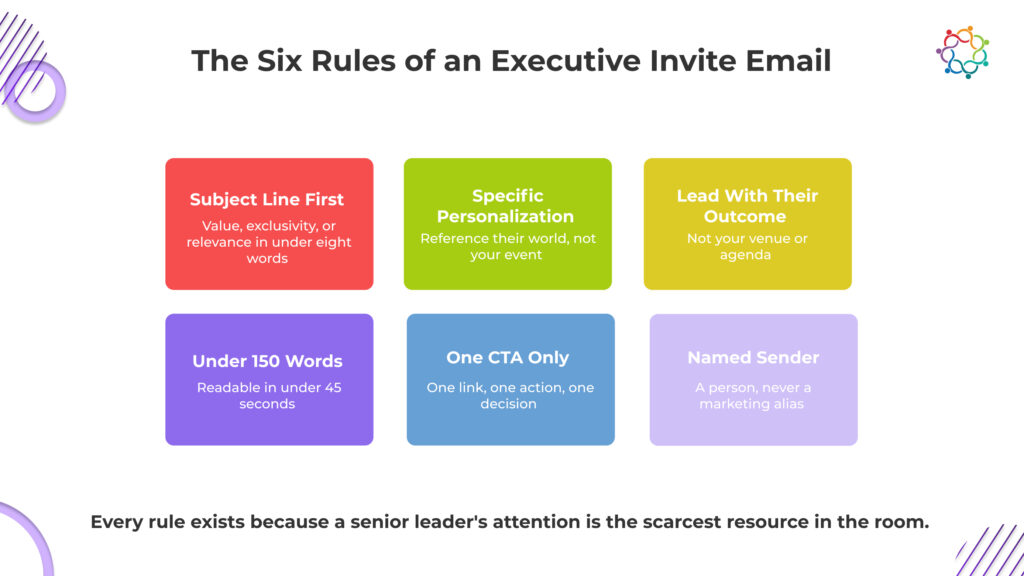
These rules apply to every executive event invitation regardless of format, event type, or seniority level. If a template violates one of them, the template stops working.
Rule 1: The subject line is the invitation. If it does not communicate value, exclusivity, or relevance in under eight words, the email will not be opened. Subject line quality is not a detail. It is the entire game.
Rule 2: Personalization must be specific, not superficial. “I thought of you for this event” is not personalization. “Given your work scaling the revenue org at Acme Corp.” Generic personalization signals a mass send, and a senior leader recognizes it immediately.
Rule 3: Lead with what is in it for them. The venue, the agenda, and the date are secondary. The primary message is the outcome the executive walks away with. Everything else is supporting evidence for that outcome.
Rule 4: Brevity is respect. An invite that runs more than 150 words signals that the sender does not understand what a senior leader’s inbox looks like. Every executive event invitation should be readable in under 45 seconds without skimming.
Rule 5: One ask only. One link. One action. One decision. Adding a secondary CTA, a forwarding suggestion, or a “feel free to reply with questions” line dilutes the ask and introduces friction at the exact moment you need the reader to act.
Rule 6: The sender matters as much as the message. An invite from a named VP or executive converts significantly better than one from a marketing alias. If the relationship exists, use it. If it does not, the tone and framing of the email should create the impression of one.

Each template below is built for a specific executive event scenario. Do not use them interchangeably without adjustment. The annotations explain the logic behind each copy decision, what is doing the work, and what breaks if changed. Every template follows all six rules from the section above.
Scenario: Inviting a C-suite or VP-level contact to a curated dinner with a small group of peer executives. No product pitch. Pure peer value.
Subject line options:
Email:
Hi [First Name],
I am hosting a private dinner in [City] on [Date] for a small group of [function] leaders from companies like [relevant peer company 1] and [relevant peer company 2].
The conversation will focus on [one specific, timely topic relevant to their role]. No slides. No pitch. Just a candid peer discussion over dinner.
We have space for eight leaders. Three seats remain.
Would you be open to joining us?
[Sender first name]
[Title]
[Direct phone or calendar link]
Why it works:
The subject line uses a peer name and a scarcity signal, both of which are proven triggers for senior leaders. “No slides. No pitch.” directly dismantles the most common executive objection to vendor-hosted events before the reader forms it. The body is three sentences of context and one question. The scarcity signal is honest and creates urgency without pressure. The CTA is a soft open question, not a registration link, which reduces friction to zero.
Scenario: Inviting an executive to attend a major industry conference as your company’s VIP guest, with exclusive access, hosted meals, or a curated side experience.
Subject line options:
Email:
Hi [First Name],
Are you attending [Conference Name] this year?
We are hosting a small group of [function] leaders for a private [breakfast/lunch/dinner] on [Date] during the conference. Past guests have included leaders from [Company A] and [Company B].
The session runs 60 minutes and is built around one question: [insert specific, timely, provocative industry question relevant to their role].
I would like to reserve a seat for you.
[Calendar link or RSVP link]
[Sender first name]
Why it works:
Opening with a question forces an immediate yes or no that creates relevance before the invite has been made. Social proof uses named organisations, not the vague phrase “senior leaders.” The 60-minute runtime is stated explicitly because executives do not commit to open-ended time requests. The single link CTA has no surrounding explanation and no escape routes.

Scenario: Inviting a VP or C-suite contact to a virtual executive session where the content is directly relevant to a challenge they are actively navigating.
Subject line options:
Email:
Hi [First Name],
We are running a 45-minute executive session on [specific topic] on [Date] at [Time].
[Speaker name], [Title] at [Company], will cover [one specific, outcome-oriented insight or framework]. Three other [function] leaders from [relevant industry] are joining the conversation.
Given your focus on [specific relevant context about their role or company], I thought this would be directly useful.
[Registration or RSVP link] Spots are capped at 20.
[Sender first name]
Why it works:
Topic specificity in the subject line replaces vague “join our webinar” language entirely. Speaker credibility is established with title and company, not a biography paragraph. “Given your focus on” signals real research without over-explaining it. The cap of 20 creates scarcity in a virtual format where scarcity is otherwise structurally absent.
Scenario: Inviting a senior leader to a city-based half-day or evening event with local peers. Low time commitment, high peer relevance.
Subject line options:
Email:
Hi [First Name],
We are bringing together a small group of [function] leaders based in [City] on [Date] for a focused conversation on [specific topic].
The format is relaxed: [60-minute discussion / evening drinks and dinner / half-day workshop]. No formal agenda. Just a structured conversation with people who are working through the same challenges you are.
Others attending include leaders from [Company A], [Company B], and [Company C].
It is being held at [Venue or neighbourhood], starting at [Time].
Would this work for you?
[RSVP link or calendar invite]
[Sender first name]
Why it works:
Geography in the subject line creates immediate relevance — the reader sees their city and stops scrolling. “No formal agenda” lowers two barriers at once: it signals low time commitment and removes the expectation of a structured sales pitch. Named companies in the attendee list replace vague social proof with specific, recognizable names. The closing question sounds like something a peer would ask, not something a marketer would send.
Scenario: Re-inviting a senior executive who did not respond to a previous invite, declined a past event, or has gone quiet on all outreach.
Subject line options:
Email:
Hi [First Name],
I know I have reached out before, and the timing has not worked.
We are hosting [brief event description] on [Date] in [City / virtually]. The conversation is specifically focused on [one highly relevant topic tied to a current challenge in their role or industry].
I will keep this short: if the topic is relevant, I would love to have you there. If the timing still does not work, I completely understand and will not follow up again on this one.
[RSVP link]
[Sender first name]
Why it works:
Acknowledging the previous outreach immediately removes the awkwardness and signals self-awareness. “I will not follow up again on this one” is a pattern interrupt that removes implicit social pressure and paradoxically increases response rate. Topic relevance is stated in one line without justification. The entire email reads in fifteen seconds, which is the only viable goal for a re-engagement scenario.

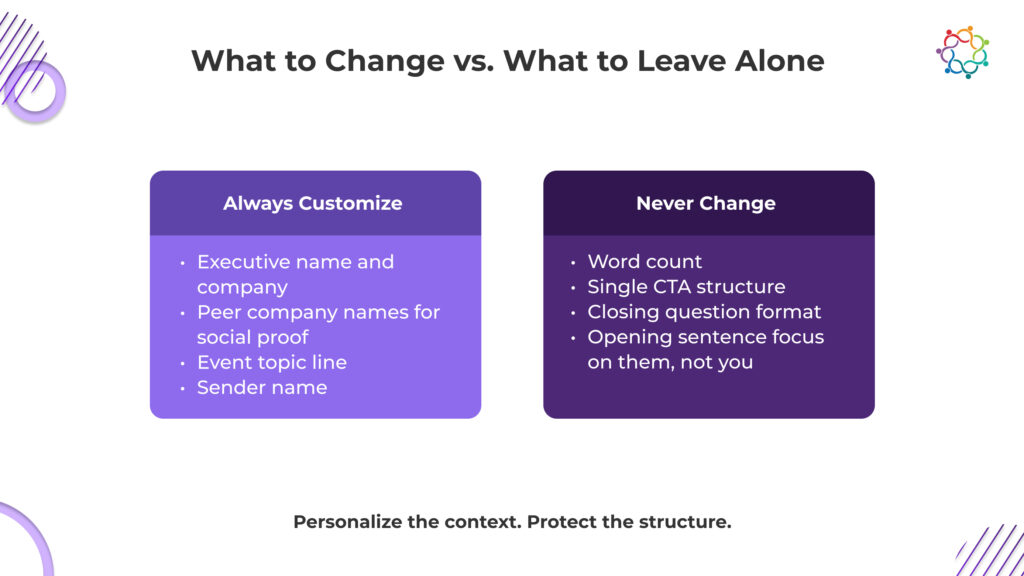
Every event invite email template in this guide was built with specific structural logic. Some elements are variables. Others are load-bearing. Changing the wrong ones is how templates stop converting.
Always customise:
Never change:
The one customisation that changes everything: replace any company or product reference in the first two sentences with a reference to the executive’s world, their industry challenge, their peer group, their current context. The moment the first sentence is about you, the email is over.

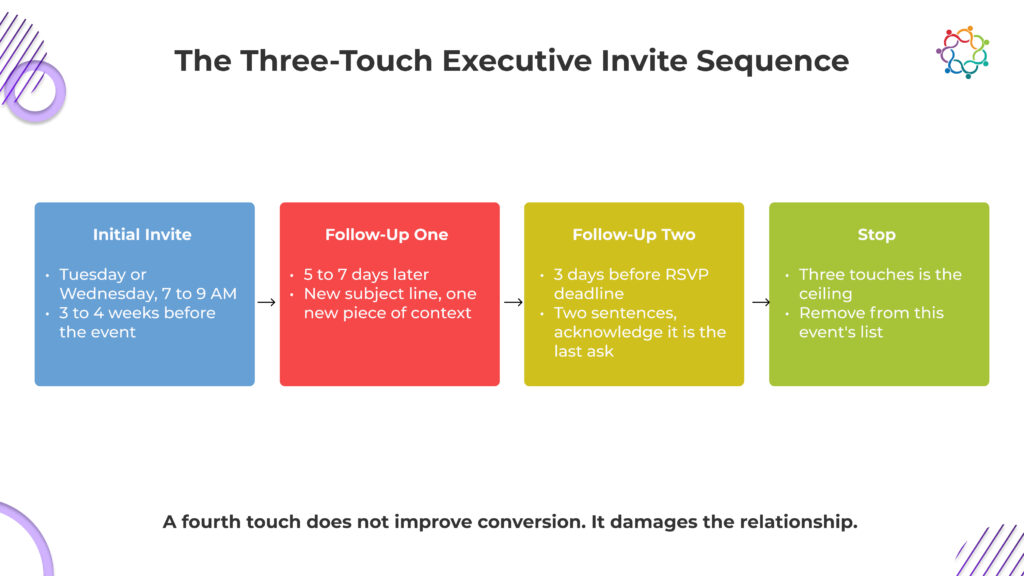
Send on Tuesday or Wednesday mornings between 7 and 9 AM in the recipient’s time zone. These windows consistently outperform Monday sends, which compete with a weekend backlog, and Thursday or Friday sends, which compete with end-of-week prioritisation.
Lead time matters for perceived exclusivity. Three to four weeks for in-person events. Ten to fourteen days for virtual. An invite that arrives less than two weeks before an in-person event signals poor planning and reduces the perceived value of the invitation itself.
Follow-up runs a maximum of three total touches. The initial invite, a follow-up five to seven days later with a changed subject line and one new piece of context, such as a confirmed speaker or a peer who just responded, and a final touch three days before the RSVP deadline in two sentences that acknowledge it is the last ask. Three touches are on the ceiling. A fourth touch does not improve conversion. It damages the relationship and costs more than the seat is worth.
These templates will not work if the event itself is not worth a senior leader’s time. Copy earns the open. It cannot manufacture value that is not there. Before deploying any event invite email templates for executives, make sure the event delivers something a senior leader cannot get elsewhere — peer access, exclusive insight, or a genuine conversation that no vendor demo or thirty minutes of research can replicate.
Take your last executive invite email. Read it from the recipient’s perspective. Count the sentences that are about them versus the sentences that are about you. Then rewrite it.
Your event invite is not a marketing asset. It is a personal ask. Treat it like one.
All five templates are available in a single ready-to-use document with subject line variants, annotation notes, customisation guidance, and send timing reference.

The copy gets them to RSVP. What happens next, confirmations, reminders, seat allocation, and no-show recovery, is where the guest list either holds or falls apart. See how Samaaro handles it.


Samaaro is an AI-powered event marketing platform that enables marketing teams to turn events into a measurable growth channel by planning, promoting, executing, and measuring their business impact.
Location


© 2026 — Samaaro. All Rights Reserved.