Samaaro + Your CRM: Zero Integration Fee for Annual Sign-Ups Until 30 June, 2025
- 00Days
- 00Hrs
- 00Min


1
2
3
→
Bottom Line:
financial services events drive credibility and trust, but lead volume obscures their real value and misguides strategy.
The most dangerous metric in financial services events is also the most celebrated.
Lead volume creates the appearance of success long before any real outcome exists. Registrations increase, attendee lists expand, and reports begin to signal strong demand. It feels like growth. It looks like momentum.
But this is the Lead Illusion.
Because the moment performance is evaluated against actual client acquisition, the narrative breaks. Large audiences rarely translate into meaningful advisory relationships. Most attendees disengage. Many were never viable prospects to begin with.
This is not a gap in execution. It is a flaw in measurement.
Lead volume does not just misrepresent performance. It creates false confidence, pushing teams to optimize for attendance instead of relationship depth.
This blog examines why lead volume fails as a metric, and what it hides about how financial services events actually create value.
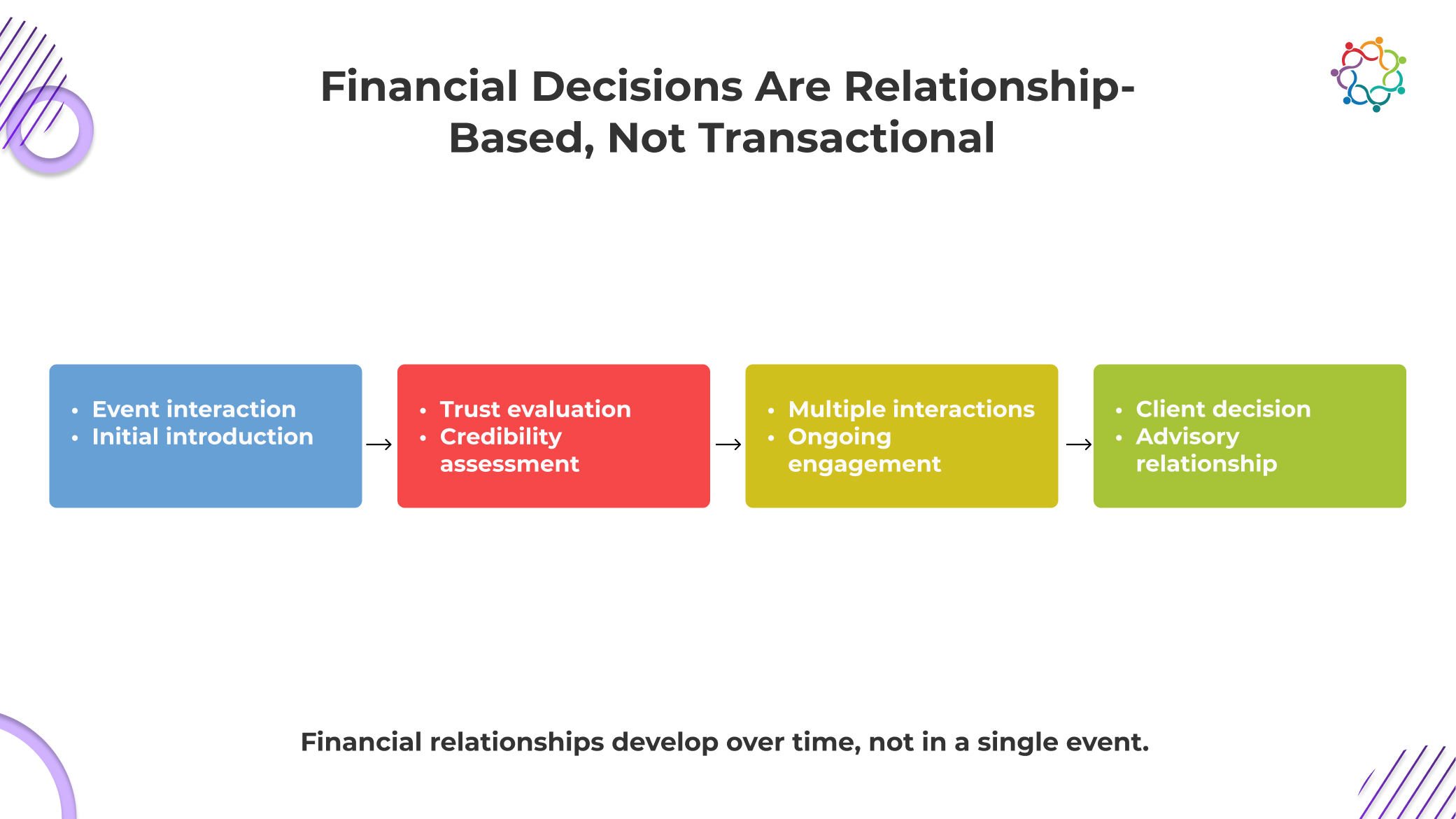
Most marketing systems are built around transactions. Financial services do not operate that way. This is where the entire measurement model begins to break.
Financial decisions are not quick. They are not impulsive. They are not driven by exposure alone. They are shaped by perceived risk, long-term consequences, and personal trust.
When an individual considers engaging with a financial advisor, they are not evaluating a product. They are evaluating a relationship that may influence their wealth, security, and future. This evaluation is fragile. It is slow. And it is deeply personal.
At any financial industry event, attendees are subconsciously asking:
None of these questions is resolved in a single interaction.
This is where most financial services events are misunderstood. They are treated as conversion environments when they are actually introduction environments.
The event creates visibility. It does not create commitment. The gap between those two is where most lead-based reporting fails. A person may attend an investment seminar, engage with the content, and even express interest. But that does not mean they are ready to shift their financial strategy or transfer assets.
Trust in financial services is not built through exposure. It is built through repeated validation.
This makes the journey from attendee to client fundamentally incompatible with lead volume as a success metric. Because lead volume assumes immediacy. Financial relationships operate on patience.
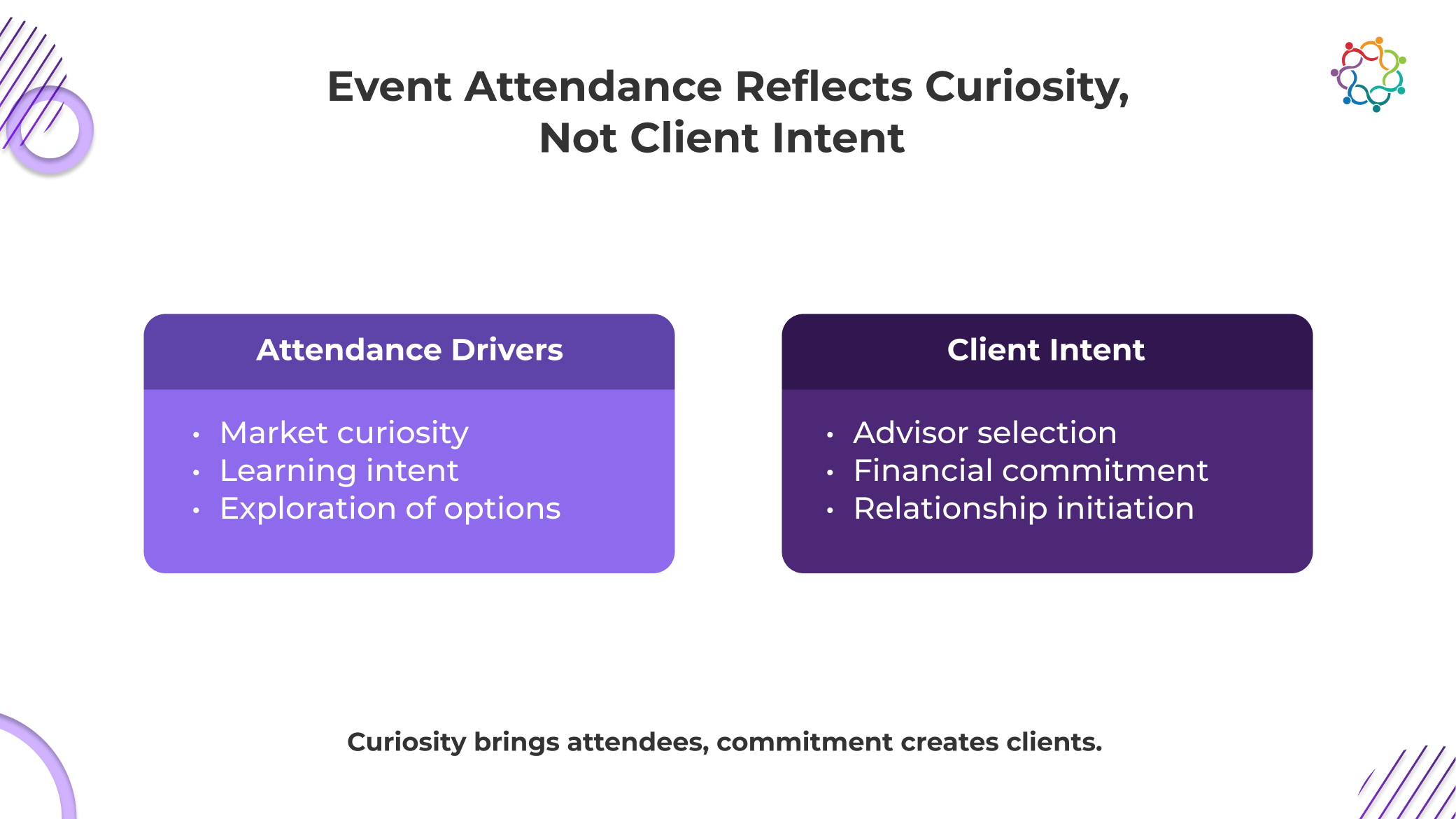
It is easy to assume that attendance signals demand. In financial services, that assumption is flawed.
Most people attending investment seminars or wealth management events are not there to become clients. They are there to learn, observe, or validate their existing understanding.
This is not a small distinction. It is the core reason that volume fails.
Attendees often show up with motivations that have nothing to do with hiring an advisor:
This means a large portion of any audience was never going to convert. Not later. Not eventually. Not at all.
Yet lead-based reporting treats every attendee as a potential client.
This is where the distortion begins. Educational engagement is interpreted as commercial intent. Curiosity is counted as a pipeline. Passive participation is recorded as an opportunity.
The result is a metric system that inflates perceived demand while ignoring actual readiness.
In reality, the overlap between education and client acquisition is limited. Someone can fully value a financial planning workshop and still have no intention of changing advisors or making new investments.
This creates a hard truth that most teams avoid acknowledging. Attendance does not indicate who is buying. It indicates who is interested in listening. And those are not the same audience.
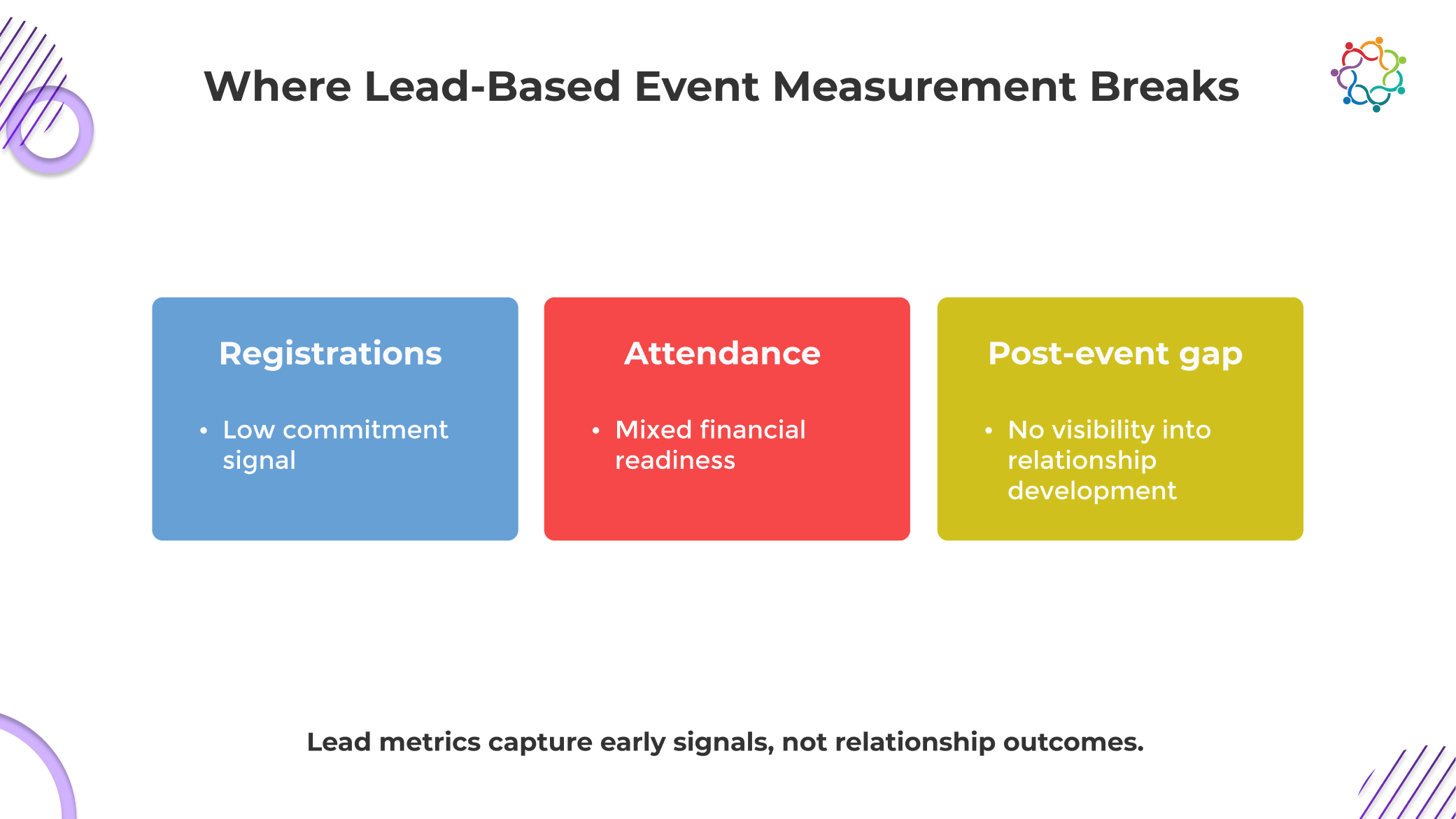
Lead-based measurement persists because it is simple. It produces clean numbers. It creates easy comparisons.
But that simplicity comes at a cost. It removes the nuance required to understand financial client acquisition.
More importantly, it actively encourages the wrong behavior.
Registration is a low-friction action. It requires minimal effort and almost no risk.
People sign up for investment seminars out of curiosity, convenience, or even habit.
This does not indicate seriousness. It does not indicate financial readiness.
Yet registrations are often treated as early-stage pipeline indicators.
They are not. They are signals of attention. Nothing more.
Even when individuals attend, their intent varies widely.
Some already have trusted advisors. Others are years away from making significant financial decisions. Some are simply exploring options without urgency.
Lead metrics flatten this diversity into a single number.
That number suggests uniform potential. The reality is fragmented and uneven.
Advisory relationships are built through sequences, not moments.
These interactions define whether a relationship forms. They happen after the event. Often much later. Lead metrics ignore this timeline entirely.
This is where the real damage occurs.
By focusing on early-stage signals, teams begin optimizing for volume instead of depth. More attendees. More registrations. More surface-level engagement.
Less attention is paid to meaningful interaction.
The Lead Illusion does not just mismeasure outcomes. It pushes organizations toward shallow engagement at scale. And that is where wasted spending begins to accumulate.
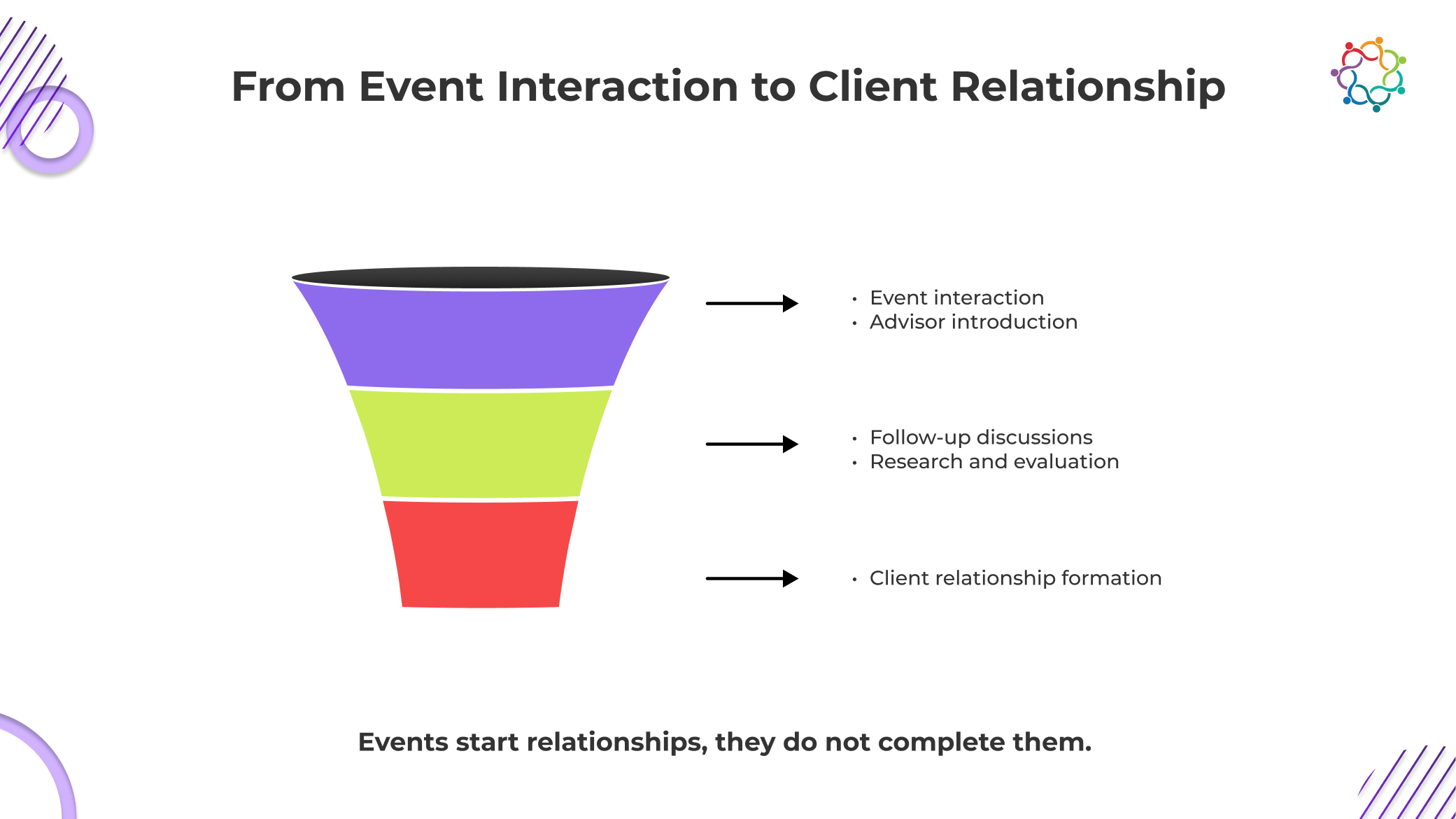
If financial services events are not conversion engines, what are they actually doing? They are shaping perception. More specifically, they are shaping how potential clients evaluate credibility.
During an event, attendees observe signals that influence their long-term judgment:
These signals matter. They influence future decisions. But they do not trigger immediate action. This is where many teams soften their understanding. They say events “influence perception” and stop there.
That is not strong enough.
Events do not influence decisions. They influence perceived credibility. That distinction matters because credibility is only one component of client acquisition.
An attendee may leave with a stronger impression of an advisor’s expertise and still take no action for months. Or years.
This delay is not a failure. It is how financial decision-making works. But if you are measuring success through immediate lead conversion, this delayed impact becomes invisible.
And what cannot be measured is often undervalued.
The most critical moment in financial client acquisition does not happen inside the event. It happens after.
This is where most measurement models completely lose visibility. Once the event ends, the decision process moves into private environments.
Individuals begin to:
None of these actions is captured in traditional event reporting.
Yet these are the moments where decisions are actually made.
This is why financial services events cannot be evaluated as isolated experiences. They are entry points into a longer journey. The event introduces the advisor. It does not finalize the relationship.
Confusing these stages leads to flawed expectations.
Teams expect conversion signals too early. When they do not see them, they either overestimate success through lead volume or underestimate the event’s long-term impact. Both are incorrect.
The real issue is not performance. It is visibility. You are measuring the wrong moment in the journey.
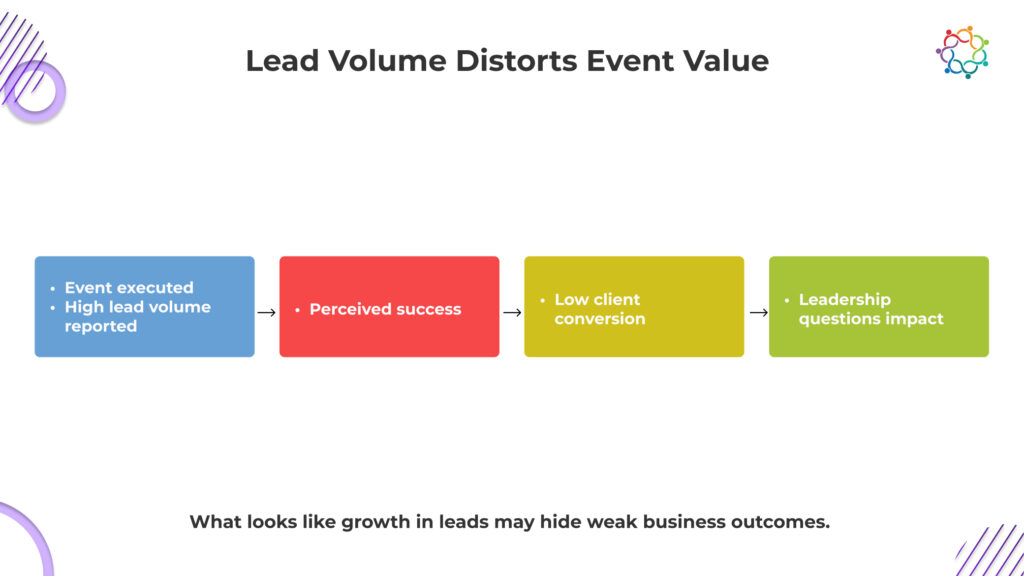
This is where the problem becomes organizational, not just analytical.
When success is reported through lead volume, leadership receives a distorted view of reality.
High numbers create the appearance of momentum. Reports suggest strong demand generation. Event programs look scalable and repeatable.
But when those numbers fail to translate into client acquisition, confidence begins to erode. This creates a silent conflict between marketing and leadership.
Marketing presents activity. Leadership expects outcomes. And the gap between the two widens with every event cycle.
The consequences are not theoretical. They are financial.
This is the real cost of the Lead Illusion.
It does not just mislead reporting. It misguides investment decisions.
Over time, leadership begins to question whether financial advisor events or investment seminar marketing efforts contribute to growth at all. Not because they do not. But because the metrics used to evaluate them fail to prove it.
Financial client acquisition does not follow campaign timelines. It follows trust timelines. These timelines are inherently slow. Clients need time to observe consistency, validate expertise, and reduce perceived risk.
This process cannot be compressed into a single event or a short reporting window.
Yet most measurement frameworks attempt exactly that. They apply short-term metrics to long-term decision processes. This is where the fundamental mismatch becomes unavoidable.
Trust-based engagement evolves gradually. Lead metrics capture instant activity.
These two systems are incompatible. This is why financial services events often appear underperforming when evaluated too quickly. Their real impact has not had time to materialize. At the same time, lead volume creates the illusion that something meaningful has already happened.
So, you end up with a paradox.
Strong reported performance with weak visible outcomes. The truth is simpler and more uncomfortable. The metrics are broken.
They are not just incomplete. They are structurally incapable of capturing relationship-driven value.
Lead volume is not just an imperfect metric. It is a dangerous one.
It tells you the event worked when it did not. It rewards attendance when there is no intent. It gives leadership confidence where there should be scrutiny.
This is the uncomfortable reality. You are not measuring growth. You are measuring activity that looks like growth.
And every time you optimize for more leads, you move further away from real client relationships.
In financial services, the risk is not low conversion.
The risk is building an entire event strategy around people who were never going to become clients.