Samaaro + Your CRM: Zero Integration Fee for Annual Sign-Ups Until 30 June, 2025
- 00Days
- 00Hrs
- 00Min


1
2
3
→
Bottom Line:
Field events don’t lack impact; they lack visibility, and what isn’t seen will never be credited.
“You didn’t run out of events. You ran out of proof.”
That is the uncomfortable reality most B2B teams face after a full year of executing field events. The calendar was full, the rooms were booked, and the right people showed up. Conversations happened, sales teams walked away with momentum, and marketing reported strong engagement.
Everything points to progress until the question changes. Not how many events were run, but which of them actually drove revenue.
This is where the Event Attribution Gap becomes impossible to ignore. Activity is visible, but revenue impact is not, and visibility is not what leadership funds. At this point, the narrative weakens because performance cannot be proven.
This blog diagnoses why that proof breaks, where attribution fails, and how event influence disappears before revenue is ever measured.
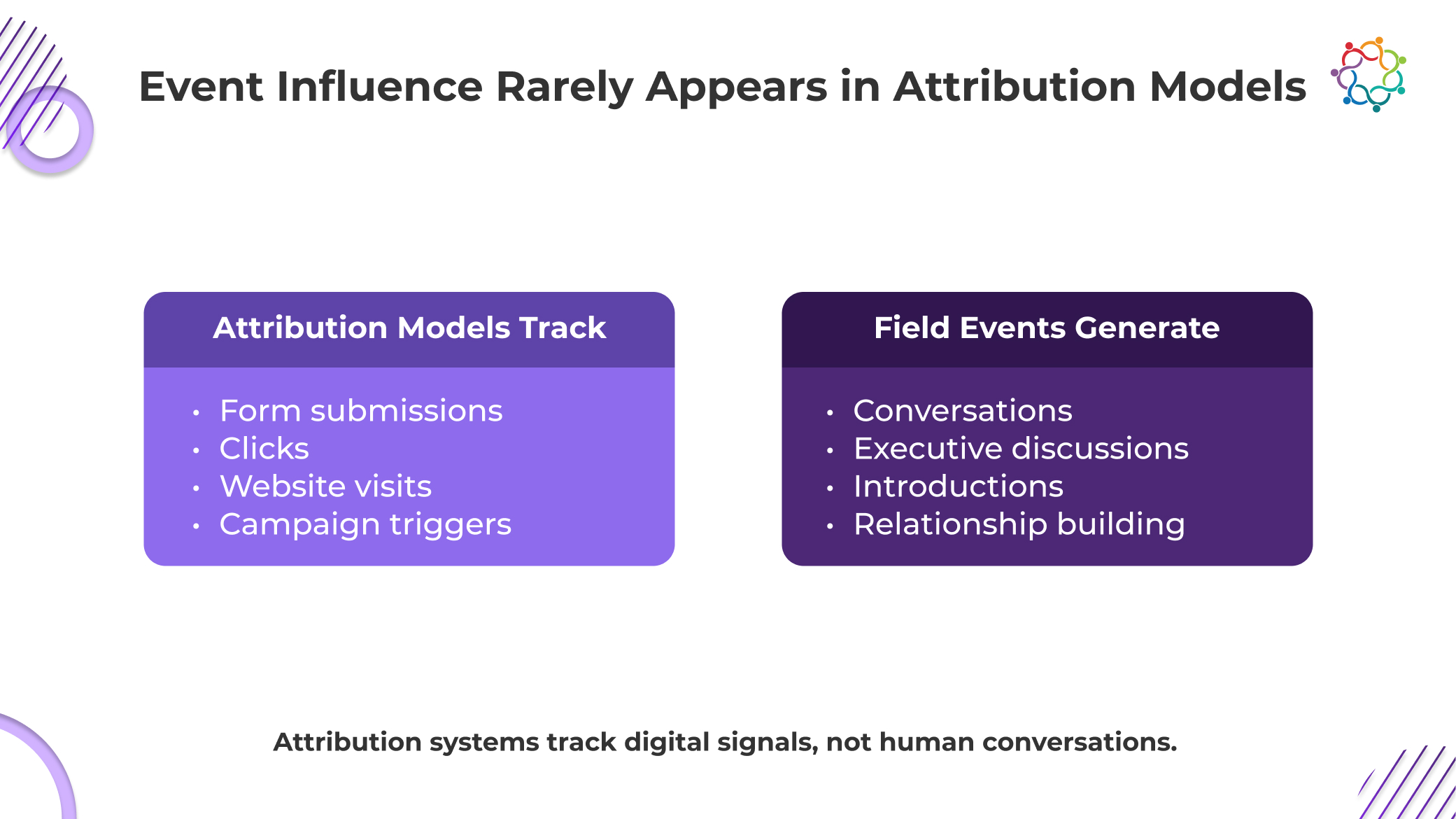
Your attribution model is not broken. It is doing exactly what it was designed to do. It captures clicks, form fills, and digital activity because those are easy to record, structure, and report. That is what your entire measurement system is optimized for.
But these events do not produce that kind of data. They produce conversations, alignment, and decision-shaping moments that never enter a system. The interactions that actually influence deals happen in rooms, not in dashboards.
This is where the Event Attribution Gap becomes unavoidable. You are relying on a system that cannot see the interactions you know are critical. Then you expect it to explain revenue.
So the model credits what it can track, not what actually mattered. And you accept those outputs as truth.
At that point, the issue is no longer attribution. It is your willingness to measure the wrong signals and still expect the right answers.
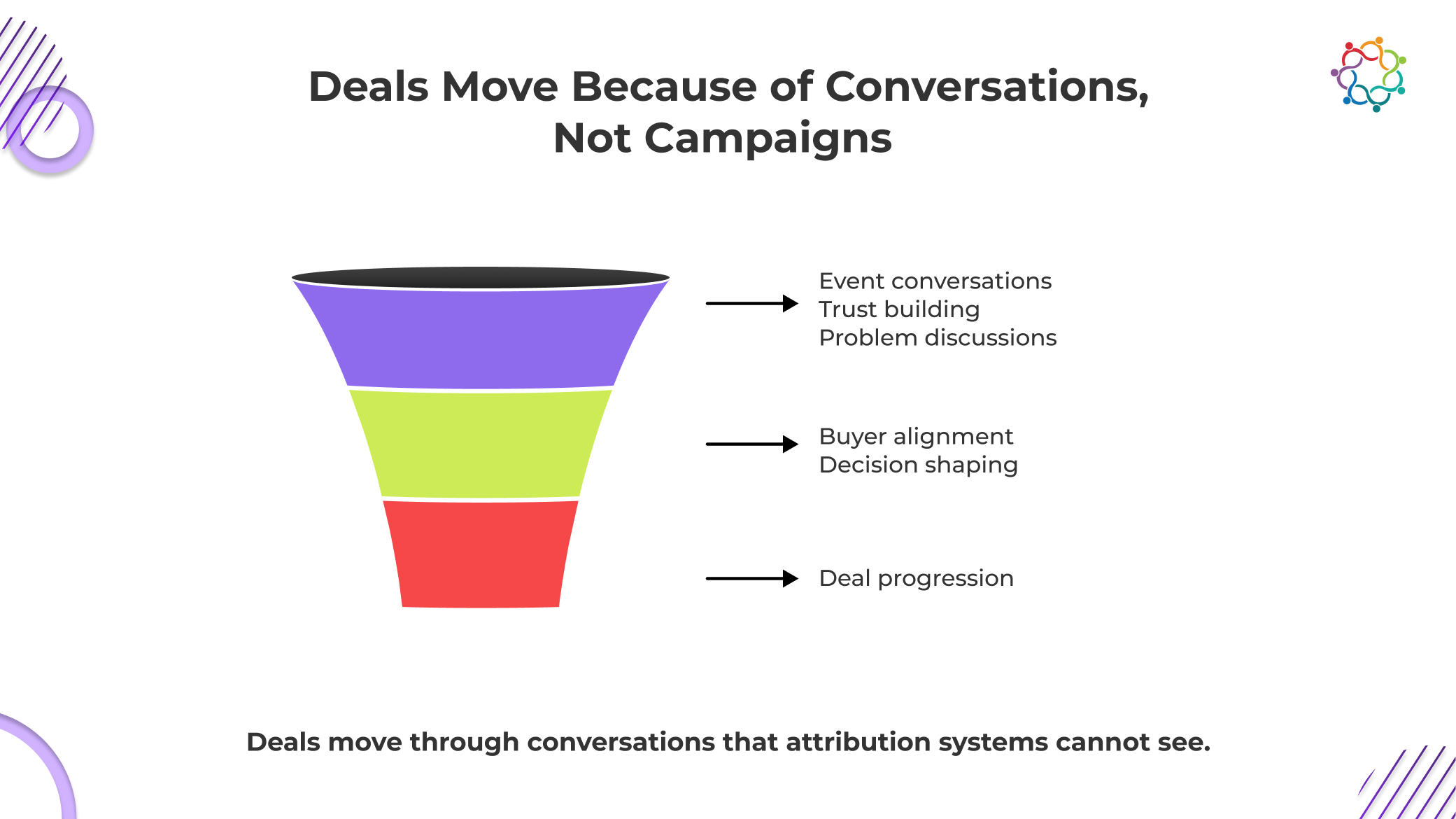
You already know deals do not move because someone clicked an email or downloaded a whitepaper. Those actions create activity, not commitment. What actually moves deals is trust, and trust is built in conversations that your systems never record.
In complex B2B environments, decisions progress when buyers gain clarity, align internally, and feel confident in the people they are engaging with. These shifts happen in discussions, not in dashboards. And field events are where these discussions accelerate.
This is the uncomfortable truth behind the Event Attribution Gap. The moments that change deal direction are the same moments your attribution model cannot see. So when revenue is analyzed, those interactions are missing, replaced by whatever digital signal appeared later.
You are not tracking what moves the deal. You are tracking what is easy to log.
And then you wonder why the story your data tells never matches the reality your sales team experiences.
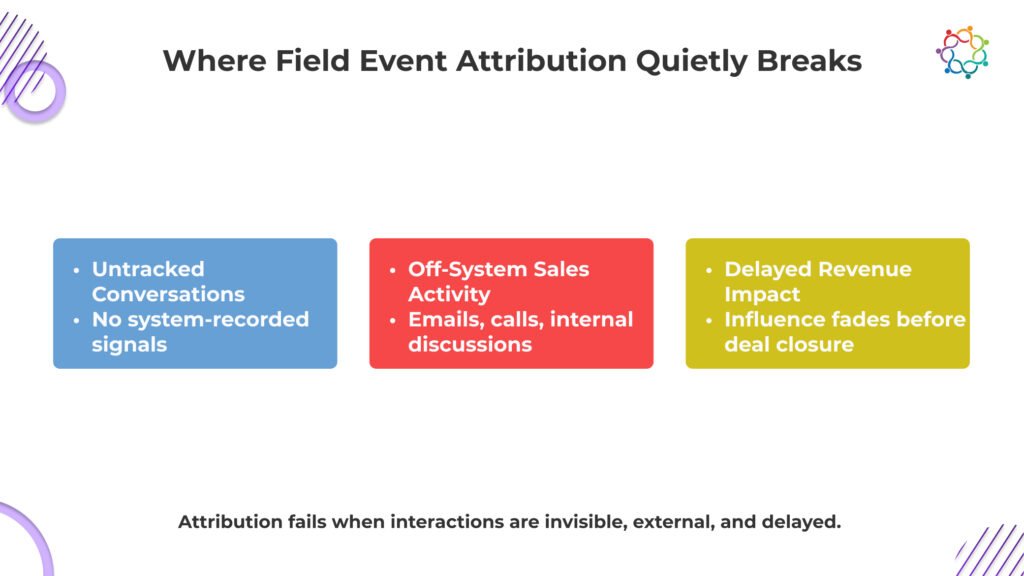
The Event Attribution Gap is not a single failure point. It is a chain reaction that unfolds across the entire revenue journey.
The process begins with in-person interaction. Buyers engage in discussions that shape their thinking. These conversations are often the most critical moments in the decision process.
But they are not captured.
No system records them. No structured data is generated. The interaction exists, influences, and disappears.
Because these interactions are not logged, they never enter attribution systems. There is no signal to assign weight to. No event to connect to opportunity progression.
At this stage, the influence is already at risk of being lost.
As the deal progresses, other interactions begin to appear. Emails are exchanged. Content is consumed. Forms may eventually be filled out.
These actions are captured.
They become the visible markers of engagement, even though they are not the original drivers.
By the time revenue is realized, attribution models assign credit to the last visible interactions. The earlier event influence is absent.
The result is a complete breakdown chain:
Conversation → No system capture → No attribution signal → Influence disappears → Revenue misattributed
This is how field event ROI becomes systematically undervalued.
Not because the impact is weak. But because the system never saw it.
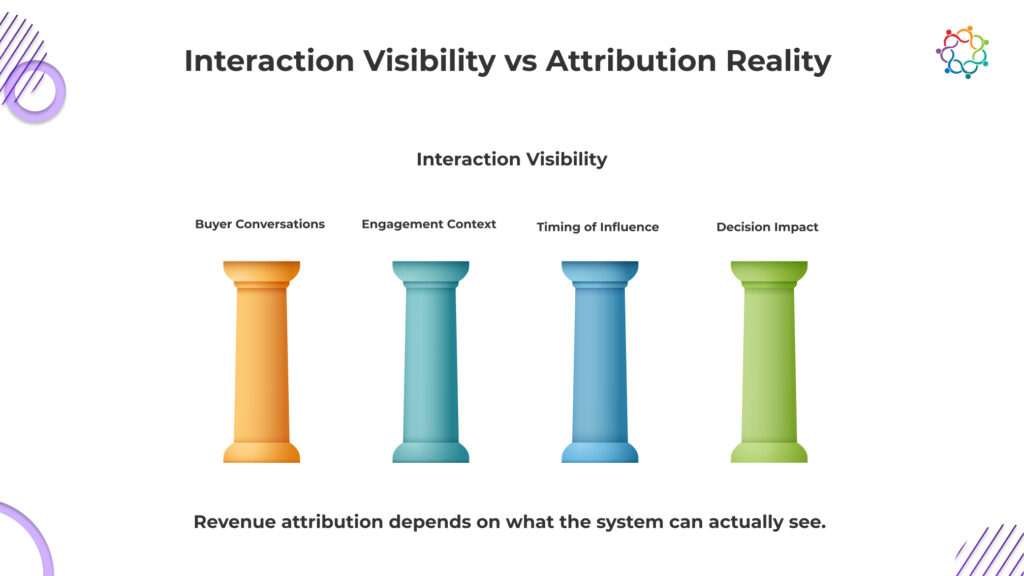
Revenue attribution does not fail randomly. It fails precisely where visibility disappears. If your system cannot see an interaction, it cannot assign value to it. The conclusion it produces will always be incomplete, no matter how advanced the model appears.
You are relying on outputs that only reflect recorded activity, while ignoring the fact that some of the most critical buyer interactions were never captured in the first place. Field events create moments where intent sharpens, objections surface, and decisions begin to take shape. But if those moments are not documented, they effectively do not exist in your attribution logic.
At that point, your system is not evaluating performance. It is reinforcing a partial version of reality. And you continue to trust it, even when it consistently overlooks the interactions that actually influence revenue outcomes.
You are measuring revenue too late in the journey and expecting to understand what influenced it early. That is the disconnect. By the time a deal becomes visible in your system, key decisions have already been shaped.
Such events often influence buyers when they are still forming opinions, defining problems, and deciding which vendors deserve attention. These are not trackable stages. There are no forms, no CRM entries, and no measurable signals. But this is where direction is set.
Your attribution model only starts paying attention once visible activity appears. By then, the foundation will have already been built. The system credits what it can see, not what actually created momentum.
So the story you present internally begins in the middle, not at the origin. And that distortion compounds over time.
You are not missing data at the end of the journey. You are missing the beginning, where the most decisive influence actually occurs.
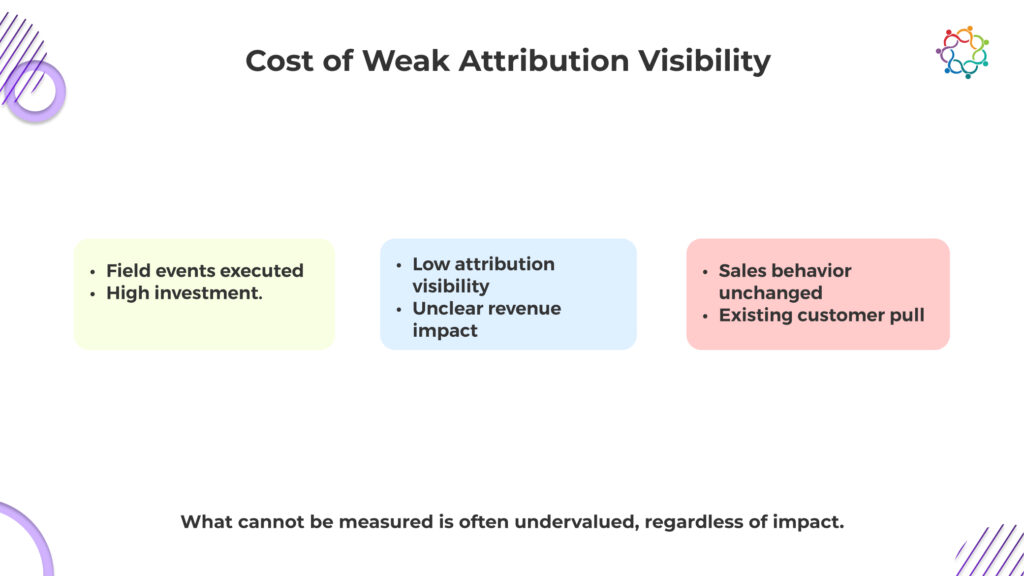
When you cannot clearly connect field events to revenue, the consequences are not subtle. They show up in how decisions are made, how budgets are allocated, and how marketing performance is judged.
Leadership does not wait for perfect attribution. It acts on what is visible. And what is visible often favors channels that produce immediate, trackable signals.
This is how strategy gets distorted. You begin optimizing for visibility instead of impact. Over time, this leads to over-investment in low-impact channels and under-investment in high-influence environments.
The risk is not just misreporting. It is misdirection. You are actively steering resources away from what drives revenue, simply because it is harder to measure.
The issue persists because the foundation itself was never built to support this kind of reality. Marketing measurement systems were designed for digital environments where every interaction can be tracked, timestamped, and stored.
But such events do not operate within those constraints. They rely on human interaction, context, and relationship dynamics that cannot be easily converted into structured data.
You are trying to force a relationship-driven channel into a system built for transactional tracking. That mismatch is the root of the problem.
Instead of questioning the system, most teams try to adapt their reporting to fit it. They simplify, approximate, or overstate connections just to produce something that looks measurable.
But the limitation does not go away.
Until measurement approaches reflect how buyers actually engage and make decisions, attribution will continue to fall short. Not because events lack impact, but because the system was never designed to recognize it.
Field events play a critical role in shaping how buyers think, engage, and ultimately decide. They create the conversations that build trust, align stakeholders, and move deals forward.
But most attribution systems are not built to capture this reality.
They measure digital interactions, not human influence. They prioritize visibility over significance. And as a result, they consistently underestimate the impact of such events.
The Event Attribution Gap is not a flaw in execution. It is a flaw in how impact is measured.
If organizations want true revenue visibility, they need to rethink what attribution is supposed to capture. Not just actions, but interactions. Not just signals, but influence.
Because the current system is clear about one thing.
Field events don’t fail to drive revenue. They fail to show up in the systems used to measure it.