Samaaro + Your CRM: Zero Integration Fee for Annual Sign-Ups Until 30 June, 2025
- 00Days
- 00Hrs
- 00Min

1
2
3
→
Bottom Line:
AI-powered event follow-up ensures that every event interaction is converted into timely, contextual pipeline activity, rather than remaining untouched in a CSV.
Your event ended six hours ago. Somewhere in your CRM, 300 leads are sitting untouched. The team is exhausted. The badge scanner data is in a CSV on someone’s desktop. The 48-hour follow-up window, where response rates are highest, is already closing. And nobody has touched the data yet.
The failure is not knowledge. Every team knows what post-event follow-up should look like. The failure is time. Scoring leads, segmenting by behaviour, personalising outreach, routing to the right rep, triggering nurture sequences, each step is straightforward in isolation. Doing all of them within two hours of an event closing, at any meaningful scale, is structurally impossible by hand. That is not an effort problem. It is an architecture problem.
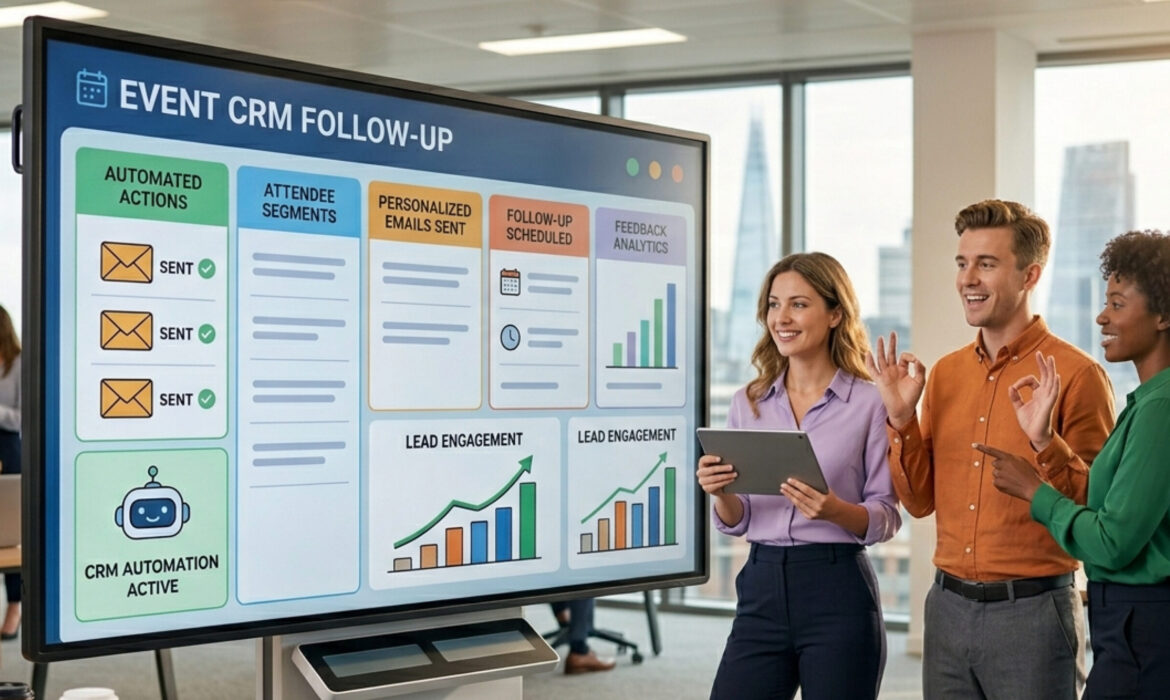
AI-powered event follow-up is not a feature upgrade. It is a structural change in how fast and how accurately a team can move from event to pipeline activity. This is not a conversation about replacing the human judgment that goes into event strategy. It is about removing the manual execution layer that sits between event data and pipeline action, the layer where most post-event pipeline quietly disappears.
Before we dive in, it is important to connect the manual approach we just described to the changes that AI can bring. This blog walks through exactly what changes when the CRM does the heavy lifting after an event.
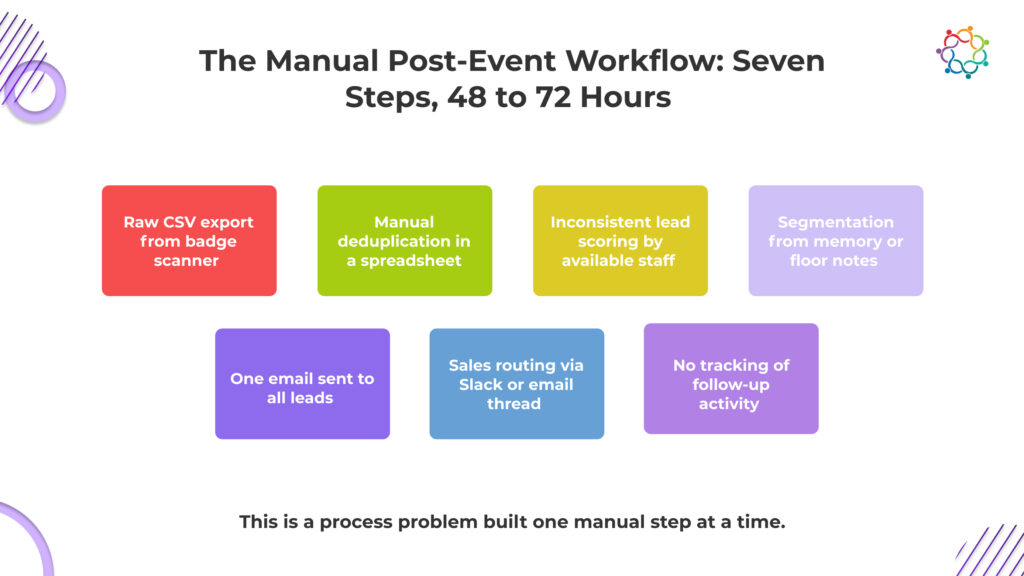
Before examining what AI changes, it is worth being precise about what it is replacing. Most marketing ops teams have lived this sequence enough times to recognise it without being told.
The manual post-event workflow runs like this:
The average manual post-event data processing cycle takes 48 to 72 hours from event close to CRM-ready data. By that point, the leads that were warmest when they left the booth have already been contacted by other vendors, returned to their existing priorities, and mentally filed your conversation under “things to maybe look into later.”
The downstream damage is not just slow follow-up. It is inconsistent lead quality reaching sales, rep frustration from cold or context-free handoffs, and a near-total absence of event attribution data in the CRM. When leadership asks which events are driving the pipeline, the honest answer is: we do not know, because the data was never structured well enough to tell us.
This is not a people problem. It is a process problem. And it is exactly the problem post-event CRM automation is built to solve.
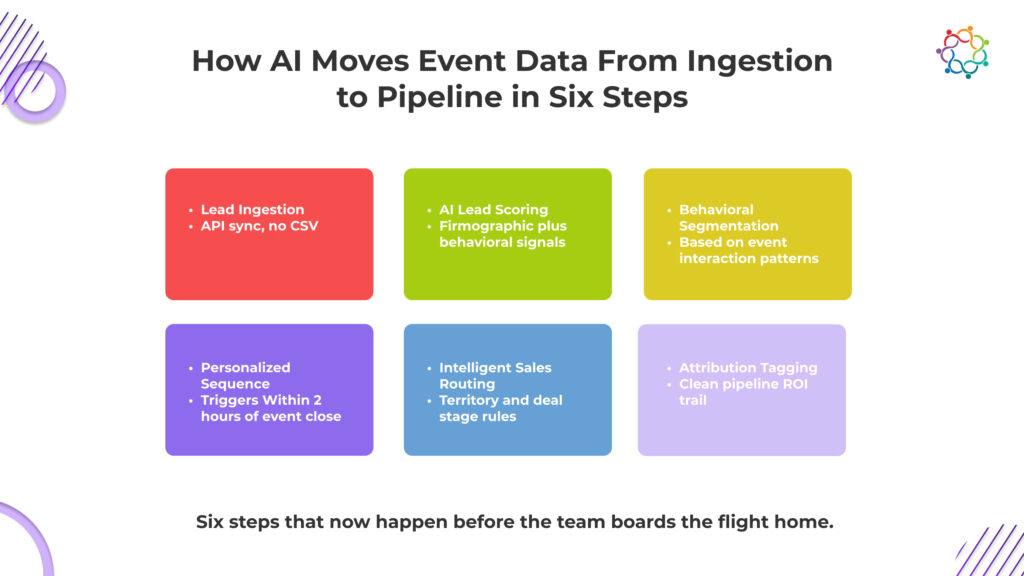
The same workflow, with AI handling each step, looks structurally unrecognisable. The difference is not in the steps. It is in the speed, the consistency, and the quality of the output at each one.
Step 1: Lead Ingestion
Event data flows automatically from the badge scanner, registration platform, or event app directly into the CRM via native integration or API. No CSV export. No manual import. No deduplication spreadsheet. Data arrives structured, deduplicated, and CRM-ready.
Manual lead processing takes 48 to 72 hours. The AI-powered target is under two hours from the event, close to CRM-ready data.
Step 2: AI Lead Scoring
Every lead is scored in real time using a model trained on firmographic fit, behavioural signals from the event sessions attended, booth dwell time, content downloaded and historical conversion data from previous events. Hot, Warm, and Cold tiers are assigned without human input and without the variance that comes from asking three different team members to score the same list.
Manual scoring produces 20 to 35 per cent variance between team members scoring the same lead. AI scoring variance on a well-configured model sits below 5 per cent.
Step 3: Behavioural Segmentation
Leads are automatically segmented based on their specific event interactions. An attendee who visited the product demo booth and downloaded a case study enters a different follow-up track than someone who attended a keynote and left. The system does not flatten everyone into one list; it routes them based on what they actually did.
Step 4: Personalised Sequence Triggers
The CRM triggers a follow-up email sequence specific to each segment within two hours of the event closing. Subject lines, body copy, and CTAs vary by lead score, segment, and deal stage. No one writes a single email and sends it to everyone.
Manual first follow-up averages 24 to 48 hours post-event. AI-powered event follow-up reaches the most engaged segment within two to four hours of event close. Teams using AI-powered segmentation and automated outreach report 25 to 40 per cent higher MQL conversion rates from events compared to manual workflows.
Step 5: Intelligent Sales Routing
High-scoring leads are automatically routed to the correct sales rep based on territory, account ownership, or deal stage rules already in the CRM. The rep receives an AI-generated briefing summary covering the lead’s event behaviour, firmographic profile, and a suggested first outreach angle. The first conversation does not start from a blank CSV row.
Step 6: Attribution Tagging
Every lead, every sequence triggered, and every subsequent conversion is automatically tagged to the originating event. This creates a clean attribution trail that answers the question leadership has been asking for years: which events are actually driving pipeline, and at what cost per opportunity.
Manual workflows accurately attribute 40 to 60 per cent of the event-sourced pipeline. A properly configured AI model should reach 85 per cent attribution accuracy or higher.
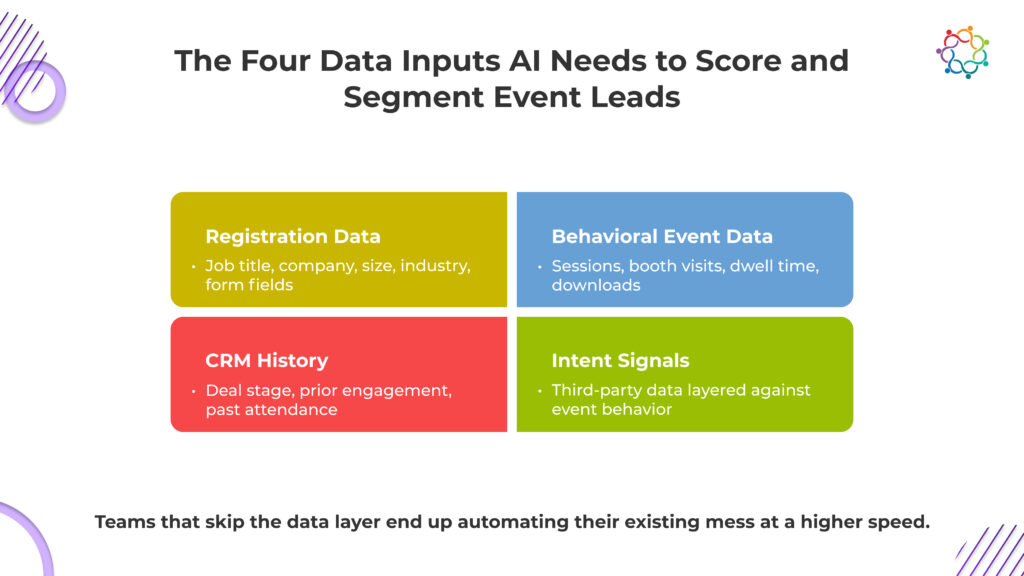
Teams that move straight from “we should automate event follow-up” to “let us buy an AI tool” consistently hit the same wall. The tool works. The data does not. AI readiness is a prerequisite to AI investment, not a consequence of it.
Four data inputs AI needs to score and segment event leads with any accuracy:
Beyond the four inputs, there is a fifth issue that causes more AI follow-up failures than any of the above: field mapping. Job title in the badge scanner needs to match job title in the CRM. Company name formatting needs to be consistent across platforms. Event platforms and CRMs routinely use different field names, different formatting standards, and different conventions for the same data points. Data technically “flows” into the CRM and creates duplicates, mismatches, and broken scoring because nobody mapped the fields before the event ran.
This is unglamorous work. It is also the work that determines whether everything downstream functions or breaks.
You event platform must have a reliable native integration or API connection to your CRM. If the data transfer is still manual, the automation cannot start.
Teams that skip the data infrastructure work and go straight to AI tools end up automating their existing mess at a higher speed. Fix the data layer first.
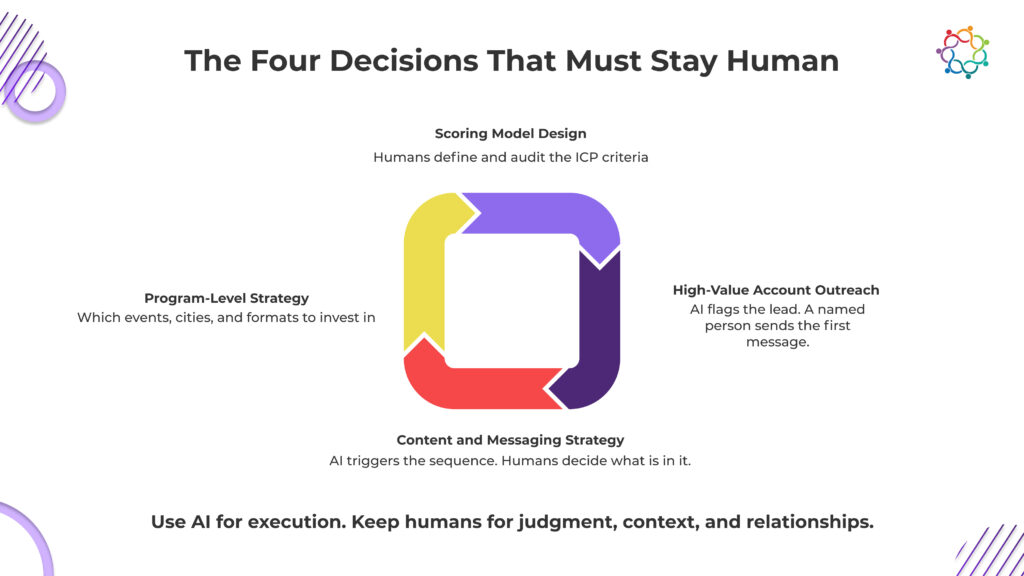
Deploying automation well requires being honest about where it stops. The teams that use AI-powered event follow-up most effectively are the ones that treat it as a force multiplier for human judgment, not a replacement for it.
Lead Scoring Model Design
AI scores lead according to criteria that a human defined. If the ICP definition is wrong or the historical conversion data is skewed toward a customer segment that no longer reflects the current strategy, the model will score leads confidently and consistently in the wrong direction. A human needs to own the model configuration and audit it on a regular cadence.
High-Value Account Outreach
For enterprise accounts or strategic prospects, a personalised email from your VP of Sales referencing a specific conversation will outperform any automated sequence in open rate, response rate, and deal progression. AI should flag these accounts for priority human outreach, not handle them.
Content and Messaging Strategy
AI triggers the right sequence at the right time for the right segment. It cannot determine whether the content inside that sequence is compelling, differentiated, or actually relevant to the specific challenge the lead mentioned at the booth. That judgment requires a human who understands the product, the market, and the buyer.
Program-Level Strategy
Which events to run, which cities to prioritise, which formats to invest in, and which audience segments to pursue are strategic decisions that require business context, market knowledge, and judgment about trade-offs that AI does not have access to.
Use AI to remove the manual work. Keep humans in the decisions that require context, relationship, and judgment.
The question marketing ops and RevOps teams should be asking is not whether to automate event follow-up. Every team that has honestly calculated the cost of the manual alternative already knows that answer. The real question is how much pipeline is being left in the 48-hour window every time an event runs the old way.
Run the math on the last event your team executed. Count the hours between close and the first personalised follow-up. Count the leads that received generic outreach because there was no time to personalise. Count the accounts that were never followed up on at all because the CSV was too large, and the week moved on.
That gap is the AI opportunity.
The event is a door opener. The follow-up is where the deal starts. Stop doing it manually.
The AI Event Follow-Up Readiness Checklist covers data infrastructure requirements, CRM integration checklist, field mapping guidance, and the five performance benchmarks from this piece.
The 48-hour window does not wait for your CSV. Samaaro connects your event platform to your CRM with automated lead scoring, behavioural segmentation, and contextual sales routing so the follow-up workflow runs while your team recovers. See how it works.