Samaaro + Your CRM: Zero Integration Fee for Annual Sign-Ups Until 30 June, 2025
- 00Days
- 00Hrs
- 00Min

Key Takeaways (TL;DR)
1
2
3
→
Bottom Line:
The fiftieth roadshow should feel easier than the fifth; if it does not, you built events, and you never built a program.
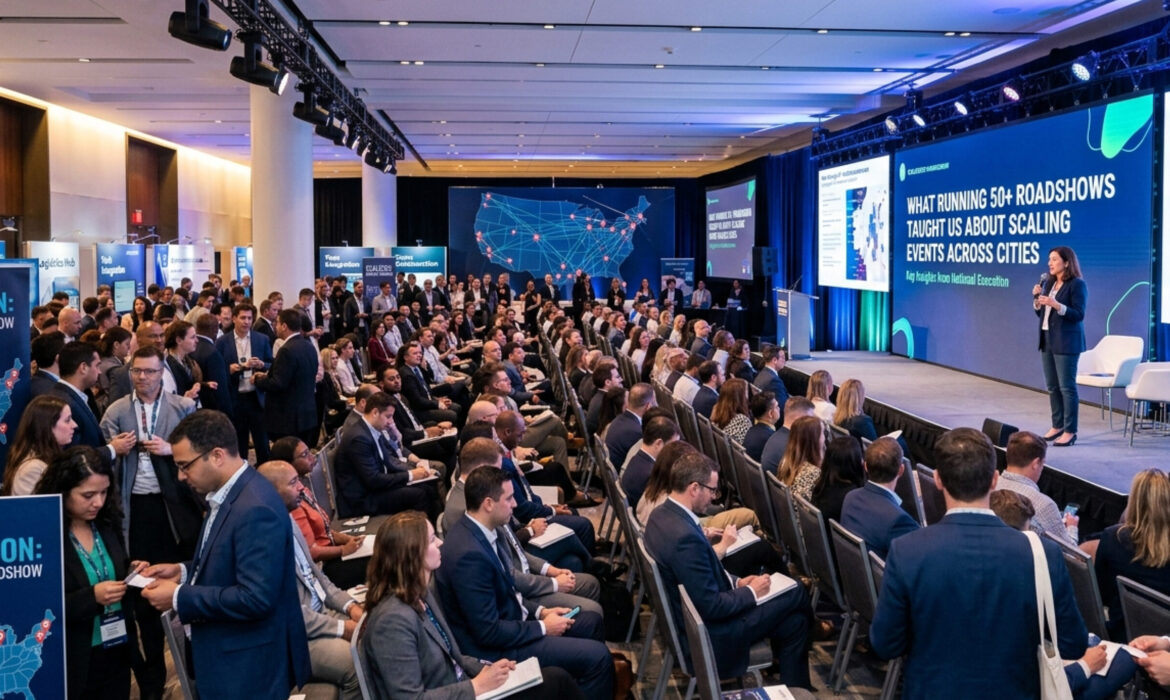
The first roadshow feels like a victory. The tenth feels like a system. The fiftieth teaches you everything the first nine could not.
Most marketing leaders hit the same inflection point around stop five. The first roadshow was an experiment. The third was a proof of concept. By the fifth, you realise that what is preventing you from scaling is not budget or headcount. It is the absence of a repeatable system, and no amount of effort compensates for that absence at volume.
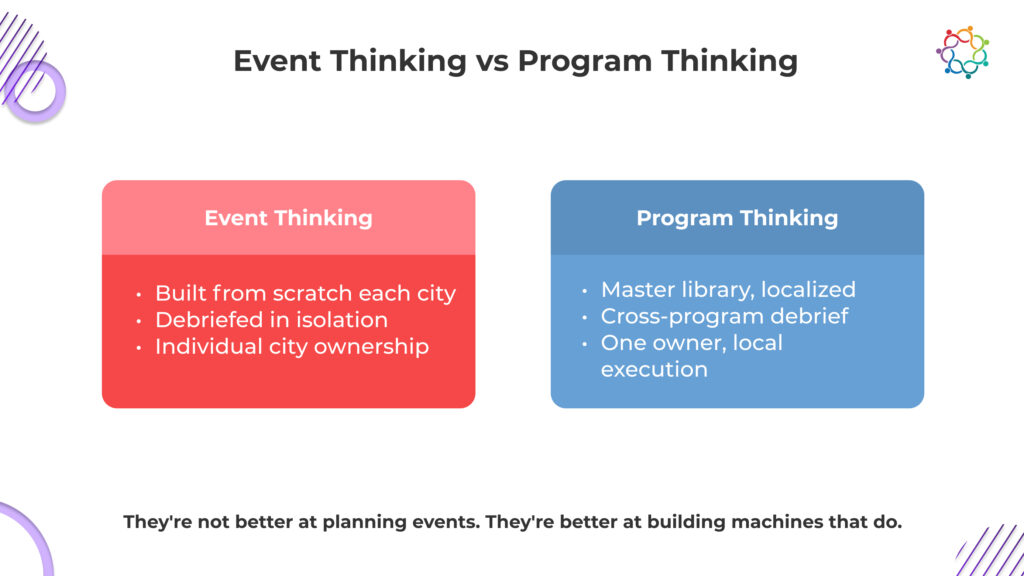
The false assumption that kills most multi-city programs before they reach ten stops is the belief that a roadshow is one event copied and pasted across cities. It is not. Each city carries a different audience density, a different competitive landscape, a different partner ecosystem, and a different tolerance for specific event formats. What fills a room in New York does not automatically fill one in Singapore or in a secondary regional hub. The teams that figure this out early build programs. The ones that do not rebuild the same event from scratch in city after city until someone asks why the budget is not producing results.
Scaling roadshow events across cities is not a coordination challenge. It is a systems design challenge. The teams that scale roadshows successfully are not better at planning events. They are better at building machines that plan events for them.
Most teams find out what their program is made of around stop four or five. The cracks that were invisible in one or two cities become operational problems at scale, and they almost always trace back to two failure points that nobody addressed early because they seemed manageable at the time.
In a single-city program, venue sourcing is a task that takes a few days. In a ten-city program running on a compressed timeline, it becomes a resource drain that pulls senior team members away from strategic decisions and into logistics they were never meant to own.
Every city has different venue availability windows, different pricing norms, different lead times, and different AV capabilities. Without a structured evaluation process, each city becomes a bespoke sourcing project. The fix is a venue criteria scorecard that any team member or agency partner can use to evaluate and shortlist options without requiring a senior judgment call on every decision. Define your non-negotiables: minimum room capacity, AV requirements, catering standards, parking or transit access, proximity to your target audience’s business district, and the scorecard turns venue sourcing from a judgment call into a process.
After ten stops, build a preferred vendor list by city. After twenty, you will have enough data to know which venue categories consistently underperform for your audience type.
By the fourth or fifth city stop, the core event narrative starts shifting in ways that feel harmless individually. A regional sales leader adds a slide. A speaker emphasises a different angle. A facilitator improvises a new segment because the room felt like it needed something different. Across ten cities, the program has quietly become a different event in every market.
The fix is not rigid scripting. It is a locked core narrative document that defines the three things every city stop must communicate, regardless of who is presenting or what local adjustments are made. Everything around those three things is customisable. Those three things are not.
Execution failures at scale are rarely strategic. They are operational, and they almost always trace back to two areas that receive the least strategic attention before the program launches.
Sending the same core team member to every city stop works for the first five or six. After that, it leads to burnout, inconsistent energy on the floor, and a single point of failure that the entire program depends on.
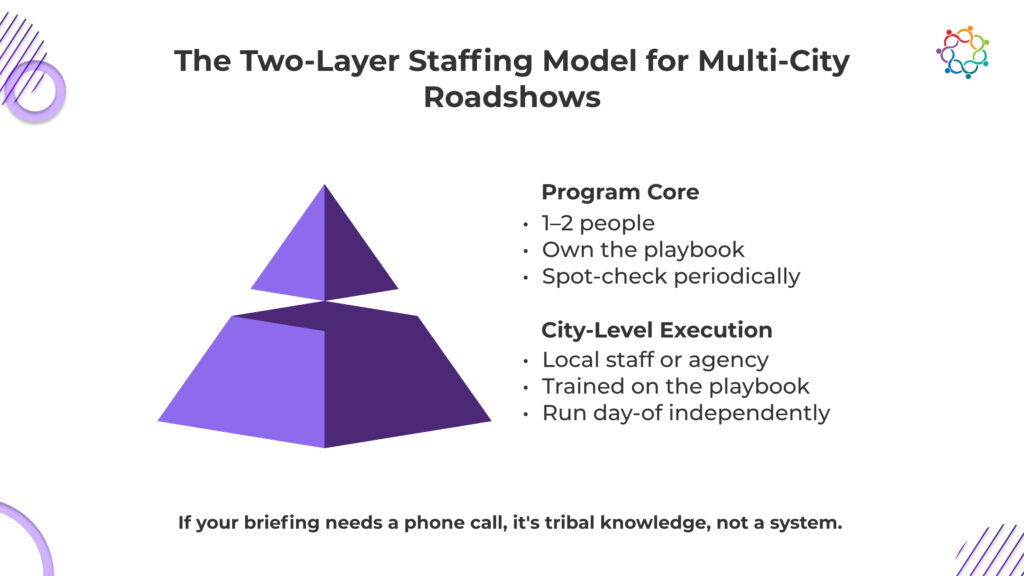
The solution is a two-layer staffing model. Layer one is the program core: one or two people who own the playbook, quality standards, and program-level decisions. They attend the first stop in every new city format and spot-check periodically. Layer two is city-level execution: local staff, agency partners, or regional sales support who are trained on the playbook and own day-of execution independently.
The critical enabler is a staff briefing document thorough enough that a city-level team member who has never attended a previous stop can execute to the same standard as stop one. If the briefing requires a thirty-minute call to explain, it is not a system. It is still tribal knowledge.
In a single-event program, shipping booth materials is a manageable shared task. In a multi-city program on a compressed schedule, it becomes a chain of dependencies; the same materials are reused across stops, so a missed shipment in city four delays setup in city five.
Assign one person or one agency partner as the logistics owner for the entire program. They track every shipment, manage inventory across cities, own the freight vendor relationship, and have a contingency plan for every scenario where materials arrive late, damaged, or not at all. At scale, shared responsibility for logistics is no responsibility at all.
Most teams treat audience targeting and content as constants across a multi-city program. They are the two variables most likely to force a mid-program recalibration when left unexamined.
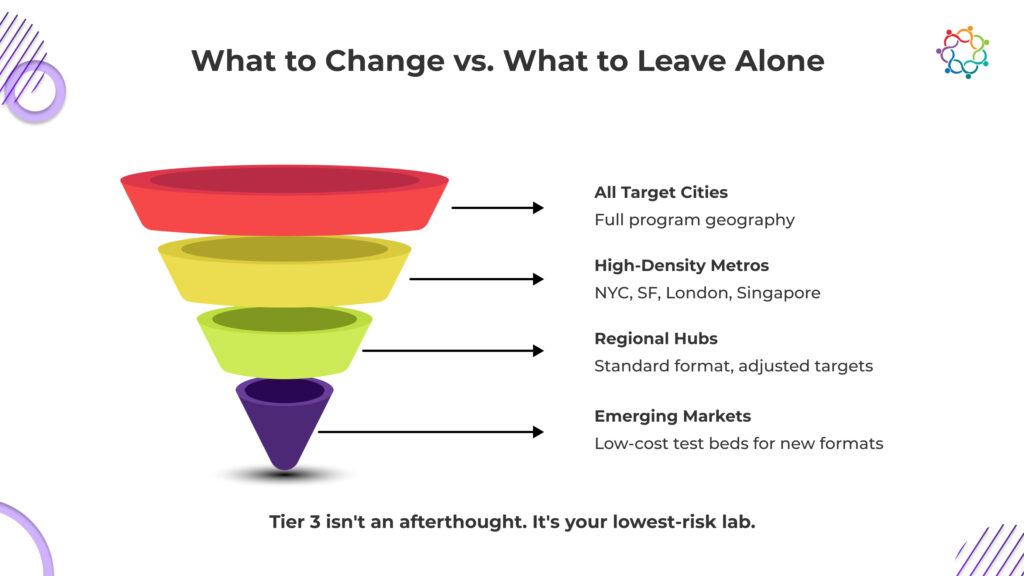
A roadshow format that fills eighty seats in New York will struggle to fill forty in a secondary market. Teams that apply a single attendance target across all cities consistently feel like they are underperforming in markets where the addressable audience is simply smaller.
Tier your cities before the program launches:
The strategic bonus of tiering: Tier three markets become low-cost test beds for new formats, topics, and speakers before you deploy them in tier one markets, where the stakes and costs are significantly higher.
The market moves. The product evolves. Competitors shift their messaging. A roadshow narrative built at program launch and never updated will feel stale by mid-program, and the audiences most likely to notice first are the ones you most need to impress, the ones following the brand closely or attending multiple stops.
Build a content refresh cadence into the program calendar. Review the core narrative every ten stops or every quarter, whichever comes first. The best source of fresh ideas is the Q&A section of your own roadshow stops. What the audience asks in city twelve tells you exactly what the content is missing in city thirteen.
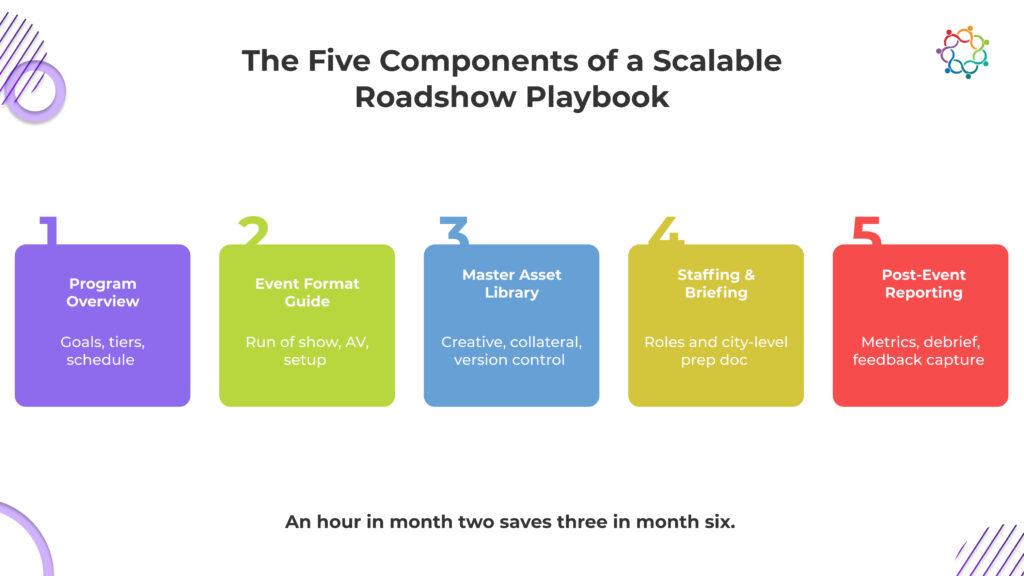
Every scaled roadshow program that runs with consistency without burning out the team has one thing in common: a documented playbook that any competent team member can pick up and execute from. Every program that collapses under its own weight at scale lacks one.
The five essential components of a repeatable roadshow playbook:
The most common objection: “We do not have time to build a playbook.” The accurate version of that sentence is: “We do not have time not to.” Every hour spent building the playbook in month two saves three hours of firefighting in month six.
One person must own the playbook and be responsible for keeping it current. A playbook that is not maintained is not a system. It is documentation of how things used to work.
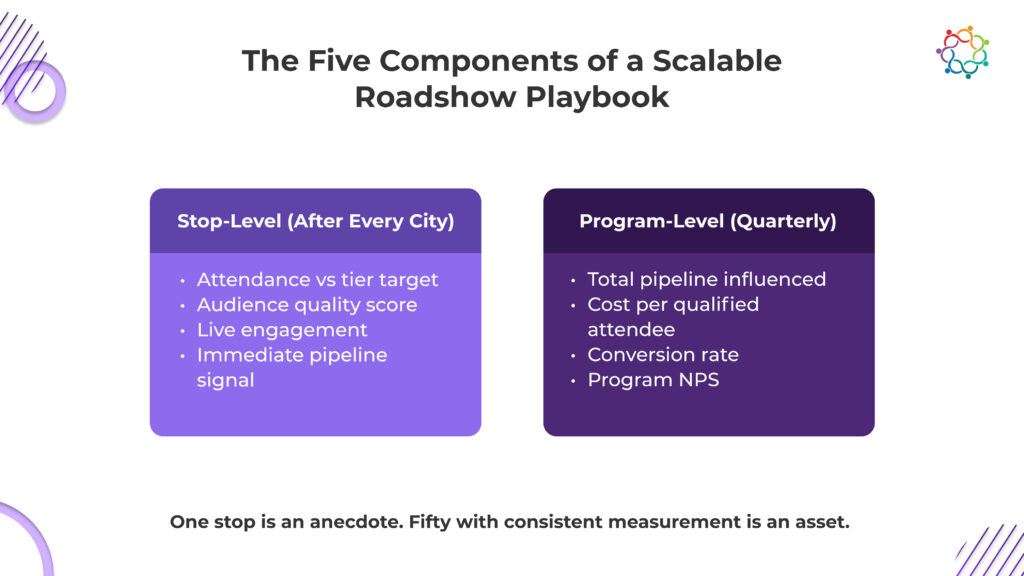
The measurement trap most multi-city teams fall into is treating each city stop as a standalone event. Attendance counts and post-event survey scores are useful at the stop level. They are close to meaningless without program-level context to compare them against.
A measurement framework built for scale runs across two layers:
Stop-level metrics, measured after every city:
Program-level metrics, measured quarterly and at program close:
The insight that only becomes visible after fifty stops is city-level benchmarking. Once you have enough data, you can benchmark Tier 1 cities against each other and Tier 2 cities against each other. You start identifying which markets consistently outperform and which consistently underperform relative to their tier. City selection for the next program cycle stops being a gut decision and becomes a data-driven one.
A single great stop with weak data is an anecdote. Fifty stops with consistent measurement are a strategic asset. Build the measurement system before you need it.
Scale does not create new problems. It amplifies the problems that were already there. A venue sourcing process that feels manageable at three stops is already broken; you just cannot see the break yet. A messaging framework that feels solid at five stops is already drifting. The program at stop fifty is not a different challenge from stop one. It is the same challenge running at a volume where every weakness is visible, and every gap is expensive.
Look at your current roadshow program. Find the one thing that works because of a person rather than a process. That is where your scaling risk lives. Fix it before the next stop.
The fiftieth roadshow should feel easier than the fifth. If it does not, you built events. You never built a program.
The Roadshow Program Playbook Template covers all five playbook components in a ready-to-use operational guide with placeholder instructions for each section.
Samaaro gives multi-city programs a single system for registration, attendee tracking, engagement capture, and post-event reporting across every stop, so the data from city one flows into the same dashboard as city fifty, and your measurement doesn’t reset with every new venue. See how it works.