Samaaro + Your CRM: Zero Integration Fee for Annual Sign-Ups Until 30 June, 2025
- 00Days
- 00Hrs
- 00Min


1
2
3
→
Bottom Line:
A webinar that does not generate pipeline is not a demand gen asset; it is a very expensive piece of content, and most teams never find out why.
You spent three weeks promoting it, two hours running it, and got 200 registrants. So why does your CRM show four qualified leads?
Webinars are one of the most resource-intensive formats in B2B marketing. Speaker prep, platform setup, promotion, live facilitation, and post-event follow-up. Yet most demand gen teams treat each webinar as a one-day event rather than a three-phase lead generation system, and they pay for that choice in a pipeline that never materialises.
Leads don’t disappear in one place. They leak at three points: before the session, when registration attracts volume without qualifying intent. During the session, when passive attendance produces no usable signal. And after the session, when follow-up is too slow, too generic, or sent to the wrong segment.
This is not a beginner’s guide to hosting webinars. It’s a tactical playbook for demand gen teams already running programs who want significantly more pipeline from the same effort. Twenty-nine tactics, organised by phase, including the ones most B2B teams have never tried.
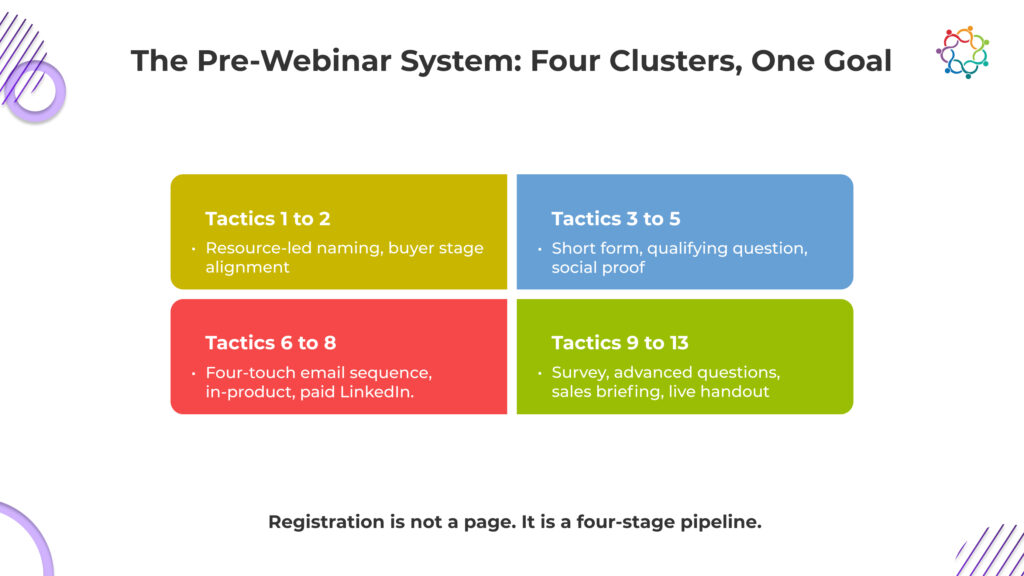
The pre-webinar phase has one job: get the right people into the room, ready to engage. Every decision from topic selection to the reminder email three days out either serves that goal or wastes promotional budget on registrants who were never going to convert.
Topic and Positioning
Tactic 1: Name your webinar like a resource, not an event. “How CFOs Are Cutting SaaS Spend in 2025” outperforms “Q3 Product Webinar” in every registration metric. The title is the first conversion point, and a title that sounds like a calendar invite generates calendar invite response rates.
Tactic 2: Align the topic to a specific buyer journey stage, not a trending theme. Top-of-funnel topics drive registration volume. Mid-funnel topics drive intent. Running a top-of-funnel webinar when you need a mid-funnel pipeline is a structural mismatch that no amount of follow-up fixes.
Registration Page Optimisation
Tactic 3: Keep the form to five fields maximum. Company name, work email, job title, and company size. Every additional field beyond that measurably reduces conversion. Friction before the session means fewer people in the room, regardless of how relevant the topic is.
Tactic 4: Add one qualifying question that doubles as a segmentation signal. “What is your biggest challenge with X right now?” gives sales context before the lead is ever touched and creates the segmentation variable that drives personalised follow-up.
Tactic 5: Include social proof on the registration page. Past attendee count, speaker credentials, and one or two testimonials from previous sessions. Trust reduces registration friction in a way that a longer description never will.
Promotion Strategy
Tactic 6: Run a four-touch pre-event email sequence. Touch one is the announcement at three weeks out. Touch two is value-added content related to the topic at two weeks out. Touch three is a speaker spotlight at one week out. Touch four is a day-before reminder with logistics and what to expect. A single announcement email is not a promotional strategy.
Tactic 7: Promote inside the product if your platform allows it. In-app banners or notification prompts to existing users consistently outperform cold email outreach in registration conversion. The audience is already engaged with your platform and has context for why the topic matters.
Tactic 8: Use paid LinkedIn promotion for high-value campaigns. Targeting by exact ICP job titles and company sizes fills the room with decision-makers that organic reach will not reach, regardless of your content quality.
Pre-Event Engagement
Tactic 9: Send a pre-webinar survey 48 hours after sign-up. Two or three questions about the registrant’s current challenge. This does three things simultaneously: it increases show-up rate through micro-commitment, it gives the speaker real audience data to reference during the session, and it produces the segmentation data that drives post-event follow-up.
Tactic 10: Create a registrant-only question submission thread. A LinkedIn post or email thread where registrants can submit questions in advance. Engagement investment before the session increases engagement during it, and the questions tell you what the audience actually cares about rather than what you assumed they did.
Tactic 11: Send a “what to expect” email three days before the event. Include specific questions that will be answered, any tools to have ready, and a calendar link. No-show rates are driven by uncertainty as much as disinterest. Remove the uncertainty.
Tactic 12: Brief your sales team on the registered lead list before the event. Flag high-value accounts so sales can send a personalised pre-event note. A message from a named rep, “I noticed you are joining our webinar Thursday, happy to connect after”, converts significantly better than any automated sequence.
Tactic 13: Prepare a live-only resource handout. A one-page PDF, a template, or a checklist tied to the topic. Announce it in the reminder email as an incentive to attend live rather than watch the replay. People will show up for an exclusive resource they cannot access otherwise.
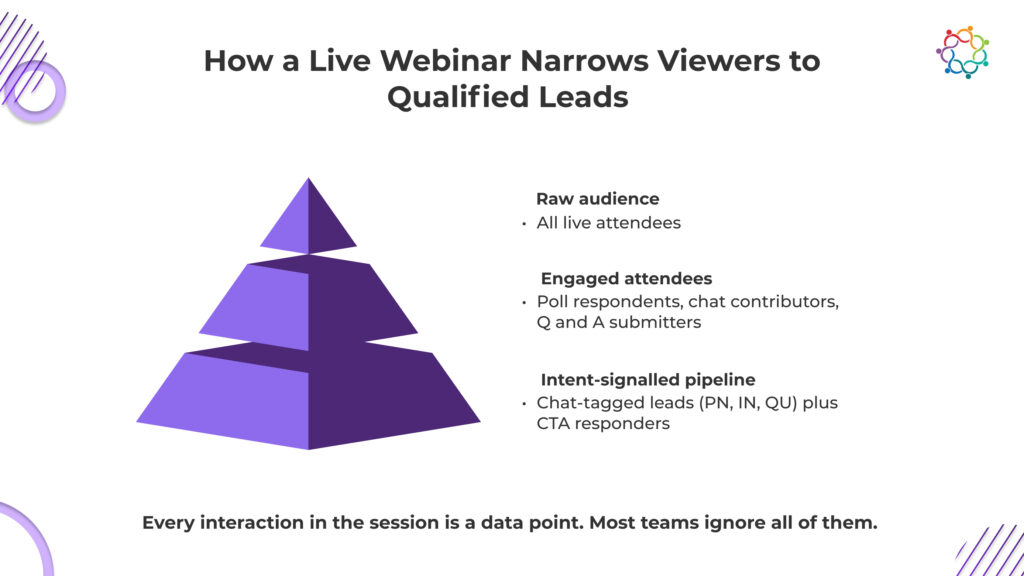
The live session is where intent signals are generated or lost permanently. Every attendee in that room is telling you something through their behaviour. Most teams capture none of it.
Format and Structure
Tactic 14: Open with a poll in the first 90 seconds. Before introductions. Before the agenda. A single provocative question that establishes interactivity as the session norm and captures an immediate segmentation data point before attention has a chance to drift.
Tactic 15: Structure content in 10 to 12-minute blocks separated by an interaction moment. A poll, a chat prompt, a Q&A pause, or a live reaction question. Attention drops sharply after ten minutes of uninterrupted presentation. Break the pattern before you lose the room, not after.
Interaction Mechanics
Tactic 16: Use the chat as a live lead scoring layer. Assign one team member to monitor and tag responses in real time: PN for pain point named, IN for product interest, QU for question worth following up on. This converts a passive chat stream into the most contextually rich data your CRM will receive all quarter.
Tactic 17: Run a mid-session poll tied to your value proposition. “How are you currently solving X?” with answer options mapped to your competitive landscape. It feels like engagement to the attendee. It’s a qualification signal for your team.
Tactic 18: Call on chat contributors by name. Social recognition increases participation measurably. When attendees know they can be acknowledged publicly, the chat becomes a competitive engagement surface rather than a place people type and forget.
Closing and CTA
Tactic 19: End with one specific CTA tied to the buyer’s next logical step. Not “reach out to learn more.” Something like: “If you want to run this framework in your own environment, we have a 30-minute working session available this week.” Specific beats generic at every stage of the funnel.
Tactic 20: Do not close the Q&A when the session ends. Tell attendees that unanswered questions will receive a personal written response within 48 hours. This creates a direct post-event touchpoint with the most engaged segment of the room, and no additional promotional effort is required.
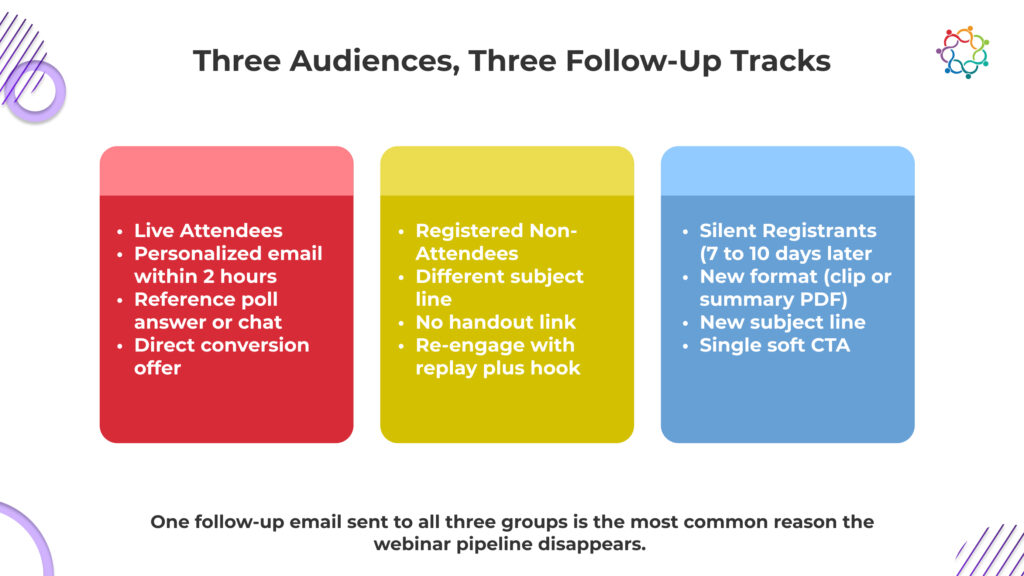
This is where most B2B teams drop the ball. The session is over, the team is exhausted, and 200 contacts are sitting in a CRM waiting for outreach that either never arrives, shows up too late, or says the wrong thing to the wrong segment.
Speed and Segmentation
Tactic 21: Send the follow-up email within two hours of the session ending. Recall and intent peak in the immediate post-event window. A two-hour delay is acceptable. A 24-hour delay is a conversion killer, and the next morning is already too late for the highest-intent segment.
Tactic 22: Segment follow-up into at least three tracks. Live attendees, registered non-attendees, and on-demand viewers who engage with the replay later. Each group has a different relationship to the content, a different level of intent, and requires a different message and CTA. One email to all three is not a follow-up. It is noise.
Tactic 23: Personalise by referencing what the attendee actually did. “Based on your answer to our poll, it sounds like X is a priority for your team” outperforms every generic recap email in existence. The data exists. Use it.
Content and CTA Strategy
Tactic 24: Lead with the most actionable insight from the session, not the replay link. Replay-first emails signal you have nothing new to offer. The insight earns the click. The replay is the secondary resource.
Tactic 25: Include the live resource handout only in the attendee follow-up. Not the non-attendee version. The exclusivity reinforces the value of showing up live and creates a differentiated touch for each segment that costs nothing to execute.
Tactic 26: Include one conversion offer specific to the webinar topic. A free audit, a template download, a strategy call, or a product trial tied directly to what they just watched. Generic product pitches after a warm session reset the relationship to cold. Make the offer earn its place.
Sales Handoff and Nurture
Tactic 27: Equip sales with an outreach template that references the specific session. The attendees’ poll responses, any chat signals flagged during the session, and the webinar topic. A cold-feeling sales email after a warm session experience is a trust reset that your pipeline cannot afford.
Tactic 28: Add non-converting attendees to a webinar-specific nurture track. The next two to three pieces of content are mapped to the same topic. Returning them to the generic newsletter sequence breaks the topical thread the webinar started and eliminates the intent signal it created.
Tactic 29: A registrant who didn’t attend and didn’t open the follow-up email is not a lost lead yet. Send a second email seven to ten days later with a different subject line and a different format: a two-minute highlight clip instead of the full replay, or a one-page summary PDF instead of a link. This typically reactivates 10 to 15 per cent of the silent group. Given that 30 to 40 per cent of your registrant list goes silent after one touch, that’s the pipeline most teams write off without ever testing whether it was recoverable.
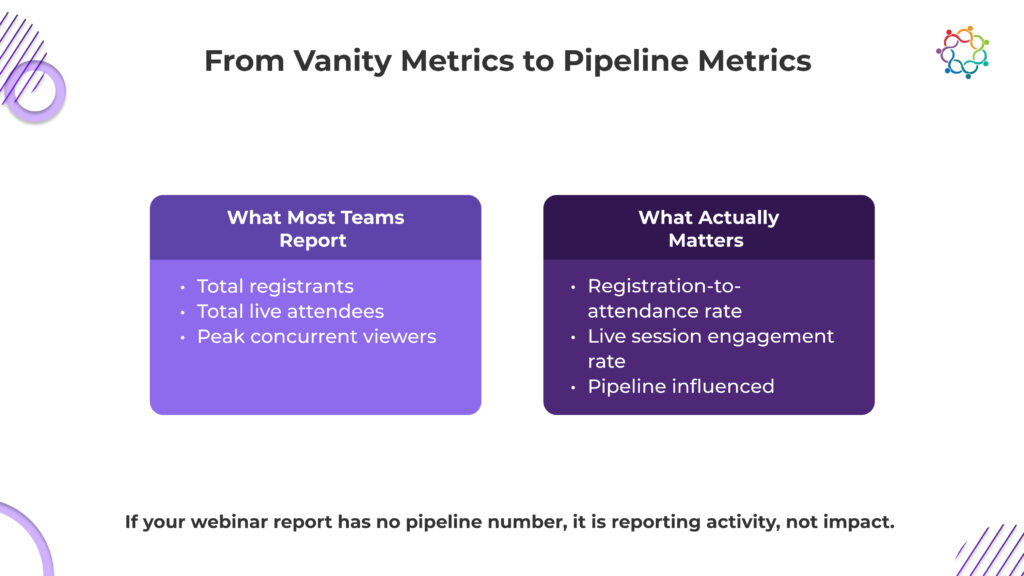
Webinar lead generation programs that optimise for registrant counts are measuring the wrong thing and building programs around a metric that does not connect to revenue.
The five metrics that actually reflect whether a webinar program is working:
Five metrics. One reporting slide. Reviewed in the debrief within 48 hours of each event. If your webinar report does not include a pipeline number, you are not measuring the right thing.
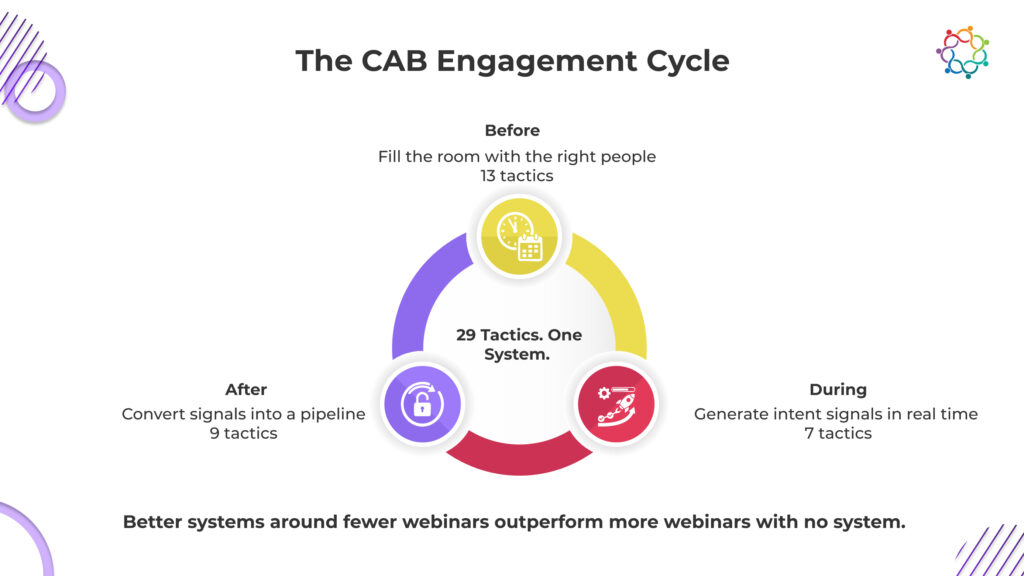
The answer to underperforming webinars is almost never more webinars. It is better to have systems around the ones already running. Most demand gen teams are sitting on months of registrant data, session recordings, and post-event intent signals they have never fully activated.
Pick one section from this guide. Run one tactic you have not run before on your next webinar. Measure it. Then come back for the next one.
A webinar that does not generate pipeline is not a demand gen asset. It is a very expensive piece of content. Make yours earn its place.
Samaaro connects the system between phases, registration data flowing into attendee engagement tracking, post-session lead scoring syncing directly into your CRM, so the 48-hour follow-up window doesn’t close while your team is still exporting CSVs. See how it works.