Samaaro + Your CRM: Zero Integration Fee for Annual Sign-Ups Until 30 June, 2025
- 00Days
- 00Hrs
- 00Min

1
2
3
→
Bottom Line:
Real estate events create pipeline activity, but without buyer intelligence, they cannot shorten time-to-revenue.
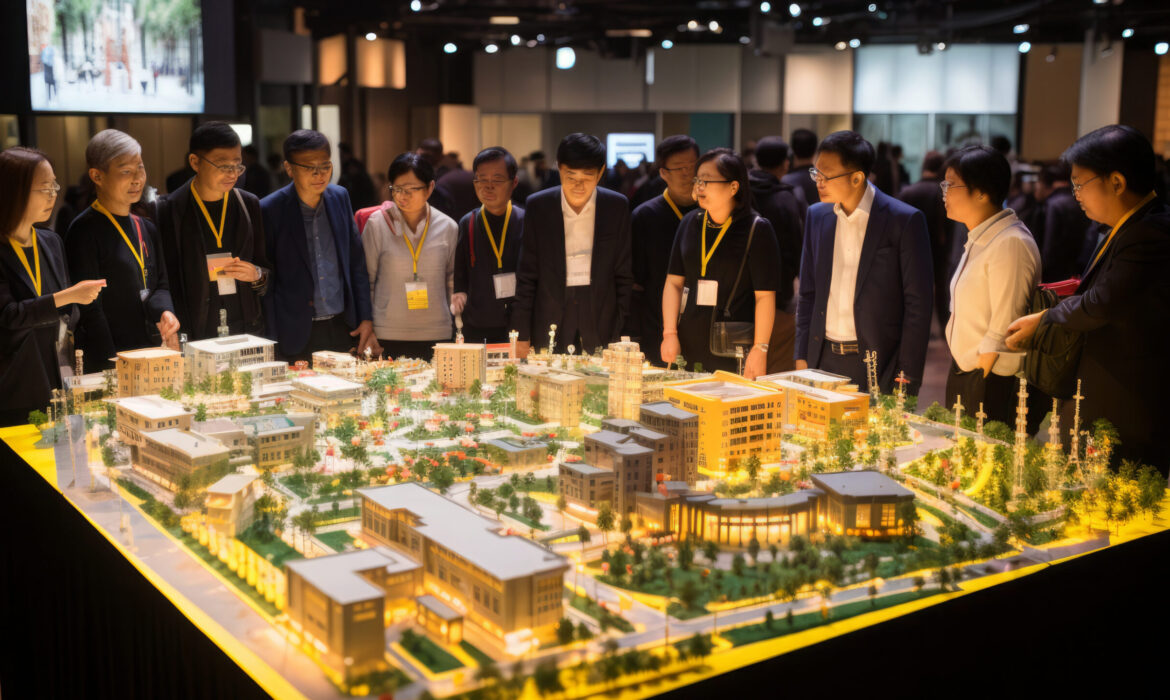
Every real estate sales cycle follows a fixed lifecycle: inquiry, evaluation, financial preparation, decision, and closure. Real estate events intervene at only one point in this chain. They increase inquiries. They do not compress evaluation, financial readiness, or decision-making. This is where the illusion begins. Lead volumes spike. Pipelines expand. Internal dashboards signal momentum. Leadership assumes acceleration is underway.
But closure timelines remain unchanged.
The event has filled the top of the funnel while leaving the rest of the lifecycle untouched. Buyers still take weeks or months to secure financing, align family decisions, and build conviction. The sales cycle continues at its original pace. The apparent acceleration exists only at the entry point, not at the revenue point.
This creates a dangerous misinterpretation. Pipeline growth is mistaken for revenue acceleration. Activity is mistaken for progress.
This blog explores why this structural disconnect exists, where the sales cycle quietly slows after events, and why these events fail to accelerate conversion unless they reveal who is actually ready to buy.
You cannot control buyer readiness. But your sales cycle suffers when you cannot identify it.
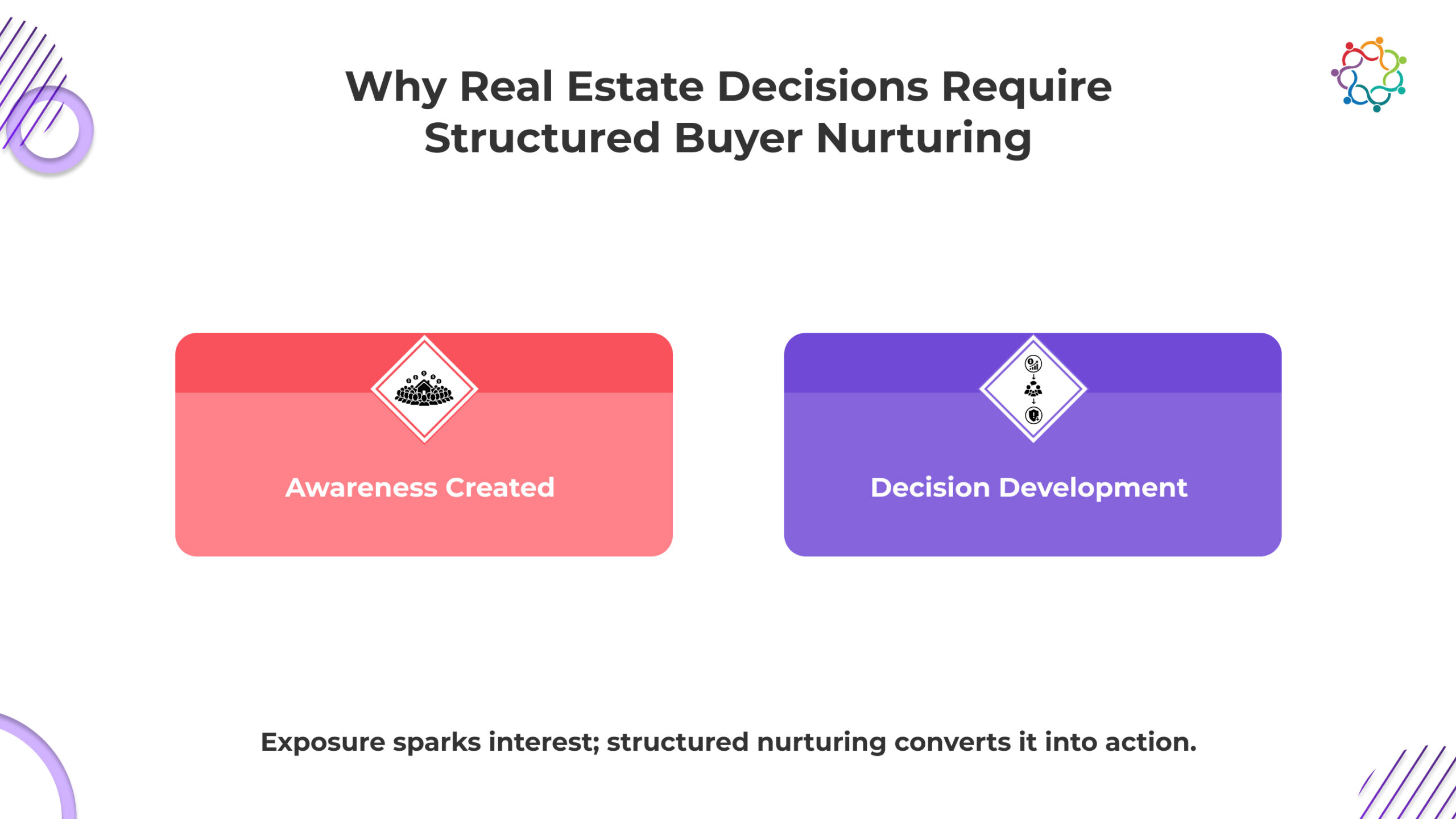
Property buying is not a single decision. It is a sequence of financial validation, internal justification, and risk acceptance. Buyers must confirm loan eligibility, evaluate cash flow impact, align family expectations, and convince themselves the timing is right. None of this finishes at an event. The event only introduces the possibility. The actual decision develops afterward, slowly and privately.
This is where your pipeline becomes deceptive.
When buyers enter your pipeline, they bring uncertainty with them. Some will take months. Some will never convert. Yet they occupy the same space as buyers who could close sooner. Without structured nurturing and progression tracking, you cannot influence their movement.
So your sales cycle stretches.
Not because buyers are slow. But because you cannot see where they truly are. Until that changes, your pipeline is not moving toward revenue. It is waiting for it.
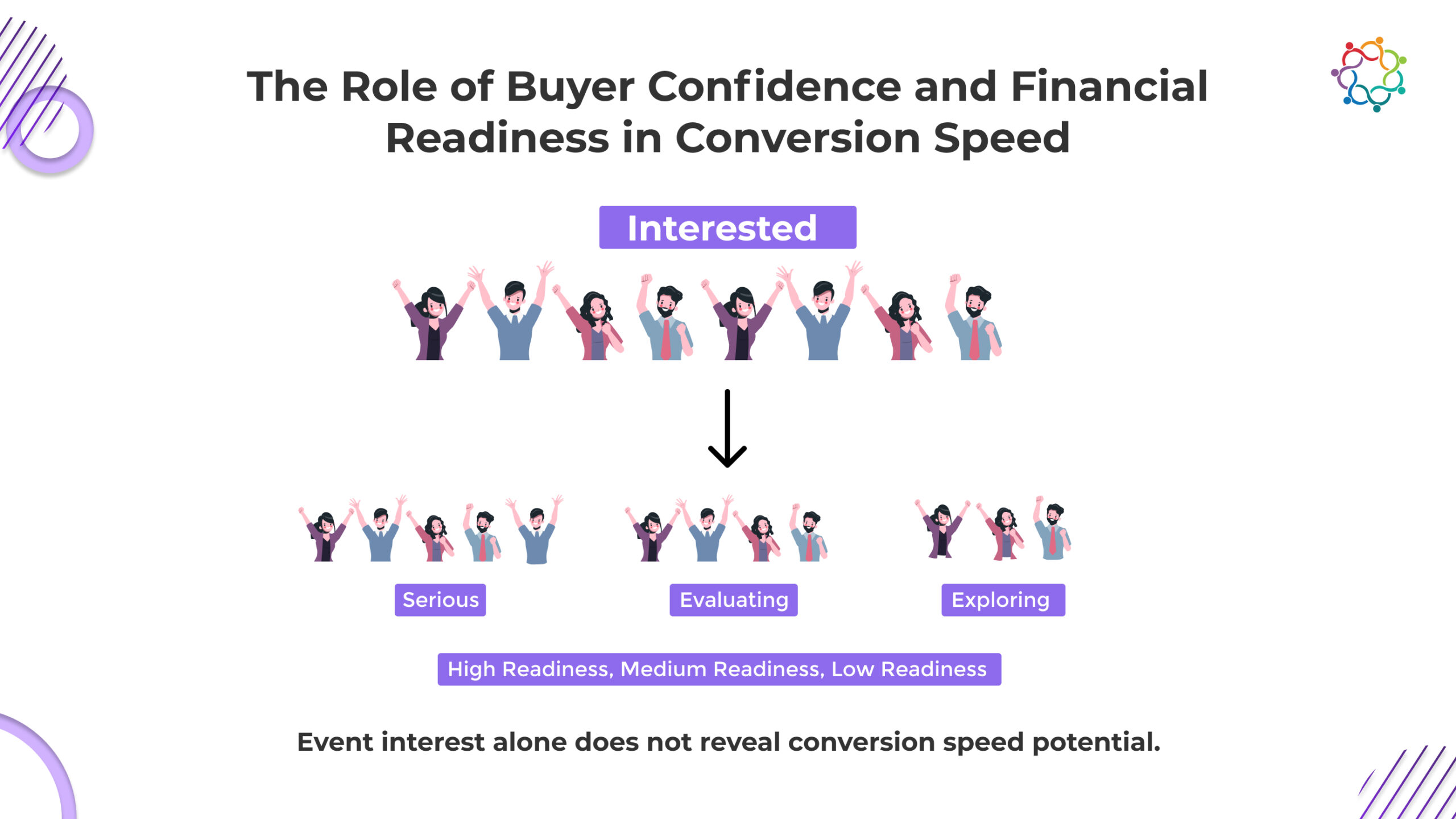
Conversion velocity is directly linked to buyer psychology. At any event, attendees may present similar levels of curiosity, but the depth of their readiness varies widely. Some are actively evaluating immediate purchase options, while others explore possibilities for future consideration. Both categories appear identical during initial engagement, yet their timelines diverge significantly.
This divergence creates the Buyer Readiness Gap: the distance between observable interest and actionable ability to commit. Sales acceleration fails when this gap is unrecognized. Without actionable signals on who is prepared to transact, sales teams cannot focus effort efficiently.
Structured understanding of financial readiness and confidence progression is critical. Buyers with financial constraints, incomplete approvals, or unresolved internal decision debates require nurturing to progress. Events that merely aggregate inquiries obscure these realities. They provide an illusion of activity while leaving serious signals hidden. High-performing organizations invest in systems that translate engagement into discernible readiness signals, allowing sales prioritization to target buyers most likely to shorten the sales cycle.
The growing role of specialized event technology in enabling this shift has been examined in depth across real estate event environments.
Key insights include:
Ignoring these underlying dynamics results in persistently extended sales cycles. To change the perception of events from pipeline generators to acceleration drivers, it is crucial to understand how confidence, financial preparedness, and structured involvement interact.
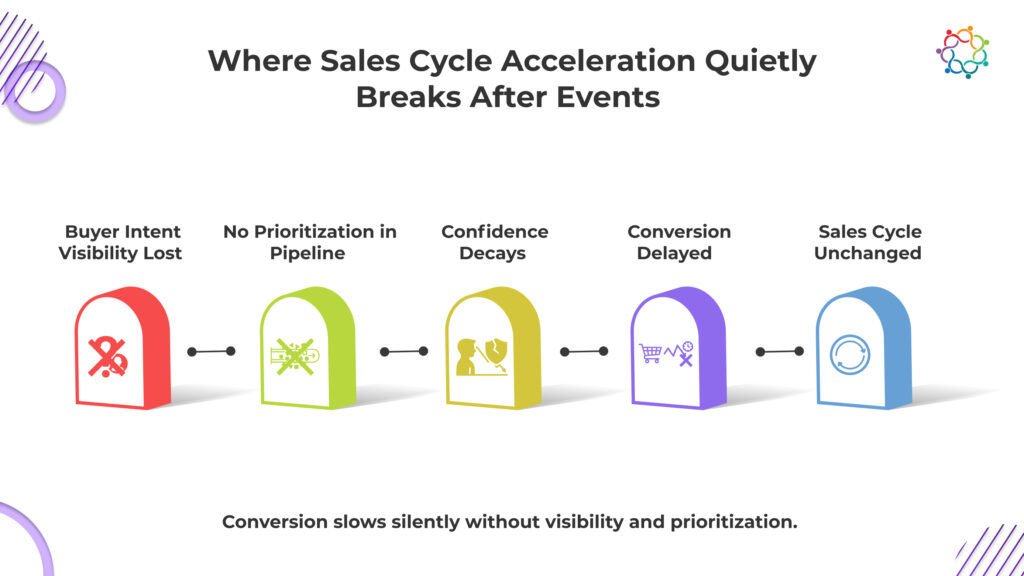
The sales cycle does not slow because buyers disappear. It slows because your visibility disappears. The moment the event ends, your prioritization signal weakens. Every buyer is equally important. Every follow-up feels urgent. But urgency without prioritization creates delay, not acceleration.
What follows is where your sales cycle quietly breaks, and why your pipeline growth fails to translate into faster revenue.
Events often succeed in generating high volumes of visible interest. However, once the event concludes, clarity diminishes. Developers lose track of which buyers are genuinely ready to act versus those simply exploring options. This collapse in intent visibility results in:
The initial optimism created by event attendance is deceptive. Sales teams misallocate time, following up on exploratory leads while high-intent buyers are not engaged quickly enough. Without mechanisms to capture and analyze engagement signals, post-event efforts default to volume-based responses rather than velocity-based actions.
Real estate events traditionally funnel all attendees into a single pipeline. This undifferentiated approach obscures urgency levels, creating systemic inefficiencies:
Segmentation based on readiness and engagement is essential for accelerated outcomes. Low-velocity organizations rely on raw numbers, while high-velocity organizations segment leads to identify early movers and prioritize interventions.
The contrast highlights why pipeline growth without strategic segmentation fails to accelerate conversion.
Event-generated momentum fades rapidly without ongoing engagement. Buyers revisit their decisions independently, often re-evaluating financial, familial, and lifestyle considerations. Confidence erosion leads to extended timelines:
Sales cycles do not stall abruptly; they elongate quietly as event-generated interest decays. Organizations that fail to maintain structured engagement underestimate the hidden cost of unmonitored buyer journeys. Without visibility into confidence decay, developers cannot intervene strategically, cementing the status quo of delayed revenue realization.
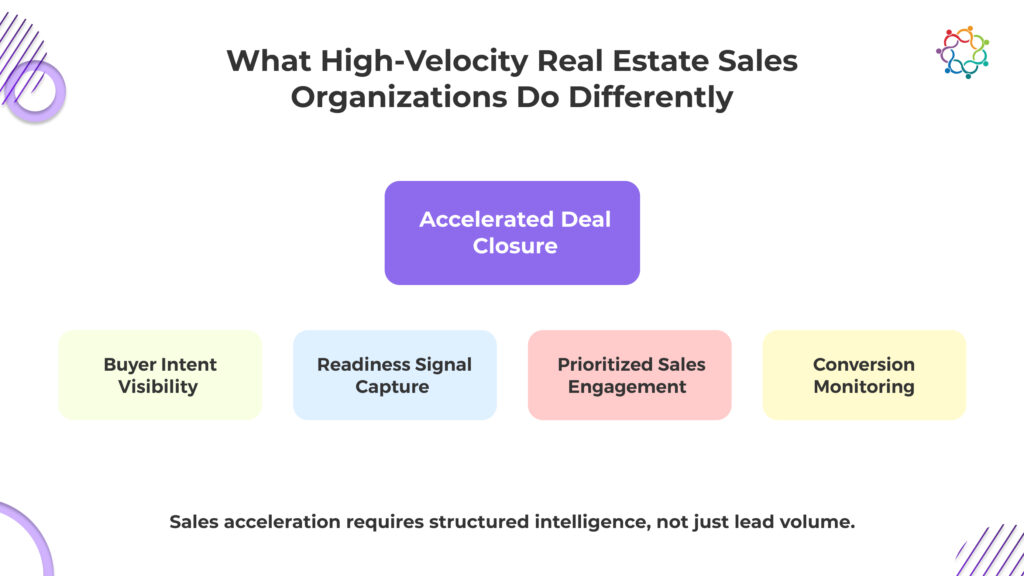
Most real estate organizations believe their sales cycle is slow because buyers take time. High-velocity organizations know the truth. Sales cycles stay long because the organization cannot identify who is ready. The delay is not created by the buyer. It is created by your inability to distinguish intent from curiosity.
Low-velocity organizations celebrate pipeline size. High-velocity organizations question pipeline composition. They understand that every unidentified serious buyer inside a large, undifferentiated pipeline is delayed revenue. When prioritization is absent, serious buyers are forced to wait. And when serious buyers wait, revenue waits.
| Low-Velocity Organizations | High-Velocity Organizations |
| Measure success by lead volume | Measure success by time-to-conversion |
| Treat all buyers as equal opportunities | Identify and isolate high-intent buyers early |
| React to inquiries after the event | Continuously track readiness progression |
| Expand pipeline without accelerating closure | Compress sales cycle by prioritizing seriousness |
| Focus on marketing activity | Focus on revenue timing |
Low velocity is not a demand problem. It is an intelligence failure. Until your system reveals who is ready to buy, your pipeline is not an asset. It is a delay disguised as an opportunity.
Every additional day in your sales cycle has a financial cost. Capital remains locked in unsold inventory. Cash inflows are delayed. Interest, operational expenses, and reinvestment timelines continue moving, but revenue does not. Yet most organizations still treat events as lead capture exercises instead of revenue acceleration infrastructure.
This is the structural mistake.
When events fail to identify which buyers can close sooner, they increase pipeline size without improving cash flow timing. Your balance sheet does not benefit from how many people attended. It benefits from how quickly someone buys. Without buyer intelligence, sales teams spend critical weeks on buyers who cannot convert, while buyers who could convert remain unprioritized.
Time-to-revenue is not compressed by visibility. It is compressed by prioritization.
If your events cannot help you isolate buyers who accelerate cash inflow, they are not helping your sales cycle. They are extending your capital recovery timeline while creating the illusion of progress.
Financially, events that generate leads without accelerating sales introduce hidden costs:
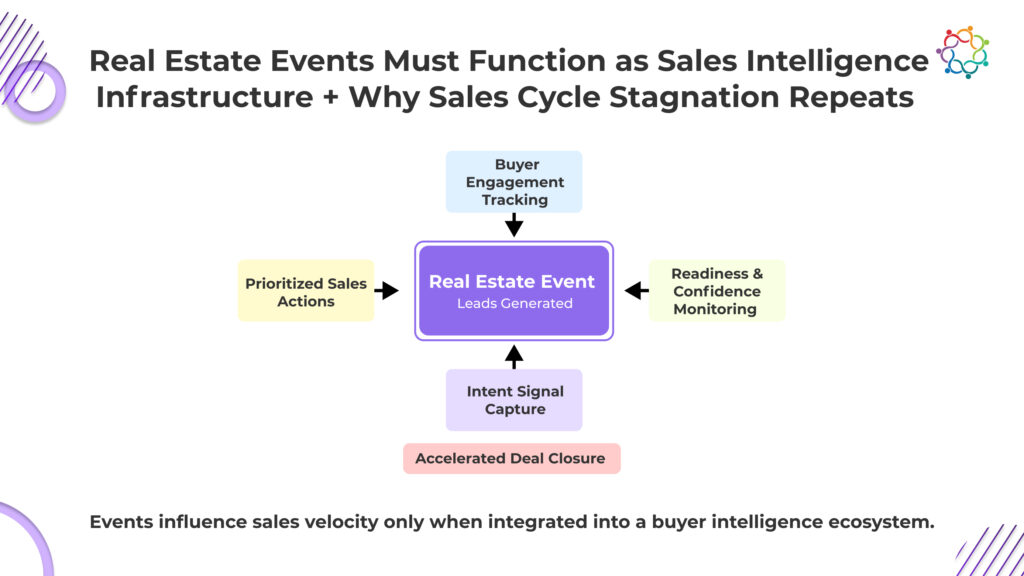
Events are capital-intensive if treated purely as lead-generation tools. Conversely, when structured to capture buyer intelligence, they reduce sales cycle duration and improve capital efficiency. Leadership-level insight reinforces this point: events accelerate revenue only when they shorten decision timelines, not when they merely produce interest. Treating real estate events as sales intelligence systems allows organizations to optimize both conversion velocity and financial outcomes.
Your sales cycle does not remain long by accident. It remains long because your organization is structured to tolerate delayed revenue. Events are declared successful the moment lead numbers look impressive. Marketing reports growth. Dashboards show expansion. But none of these metrics brings cash into the business faster.
Time-to-revenue is never measured. So it never improves.
When leadership rewards pipeline creation instead of pipeline conversion speed, the system reinforces delay. Sales teams inherit bloated pipelines with no clarity on who will close. Weeks pass qualifying buyers who will not convert. Meanwhile, inventory remains unsold, cash inflow remains pending, and capital remains locked.
This cycle repeats because nothing inside the system is designed to accelerate cash recovery.
Until your events are evaluated on how much they shorten revenue timelines, you are not running a sales acceleration system. You are running a pipeline accumulation system that quietly prolongs your own cash realization.
Real estate events expand your pipeline, but pipeline size does not determine when revenue arrives. Revenue arrives when buyers close. And closure depends on how quickly you can identify and prioritize those ready to commit. Without that capability, your sales cycle remains unchanged, regardless of how successful your event appears.
This is the line most organizations avoid confronting.
Organizations ready to operationalize their real estate events around conversion intelligence are already moving in this direction with Samaaro.
A real estate event that cannot improve time-to-close is a marketing expense, not a revenue accelerator. It consumes capital, delays cash recovery, and creates activity without advancing revenue.
Until your events shorten time-to-close, they are not accelerating your business.