Samaaro + Your CRM: Zero Integration Fee for Annual Sign-Ups Until 30 June, 2025
- 00Days
- 00Hrs
- 00Min


1
2
3
→
Bottom Line:
Launch success is measured by sustained buyer movement, not event-day attention.
Property launches events produce a surge of measurable activity. Attendance peaks. Inquiry volumes rise sharply. Sales teams exit the event with full pipelines and optimistic booking projections. On paper, demand appears strong.
Yet booking conversion tells a conflicting story.
In the weeks following the launch, buyer momentum slows. High inquiry volume fails to translate into proportional reservations. Buyers who showed interest during the event delay financial commitment afterward, creating financial tension.
The launch successfully generates attention, but booking velocity fails to sustain at the same level.
This gap exists because attention and conversion operate on different timelines. Excitement forms instantly. Commitment forms gradually.
Property launches events succeed at activating buyers. They fail when that activation is not structurally sustained.
This blog explores why buyer excitement created during launch events weakens after the event, and how conversion breaks before bookings are secured.
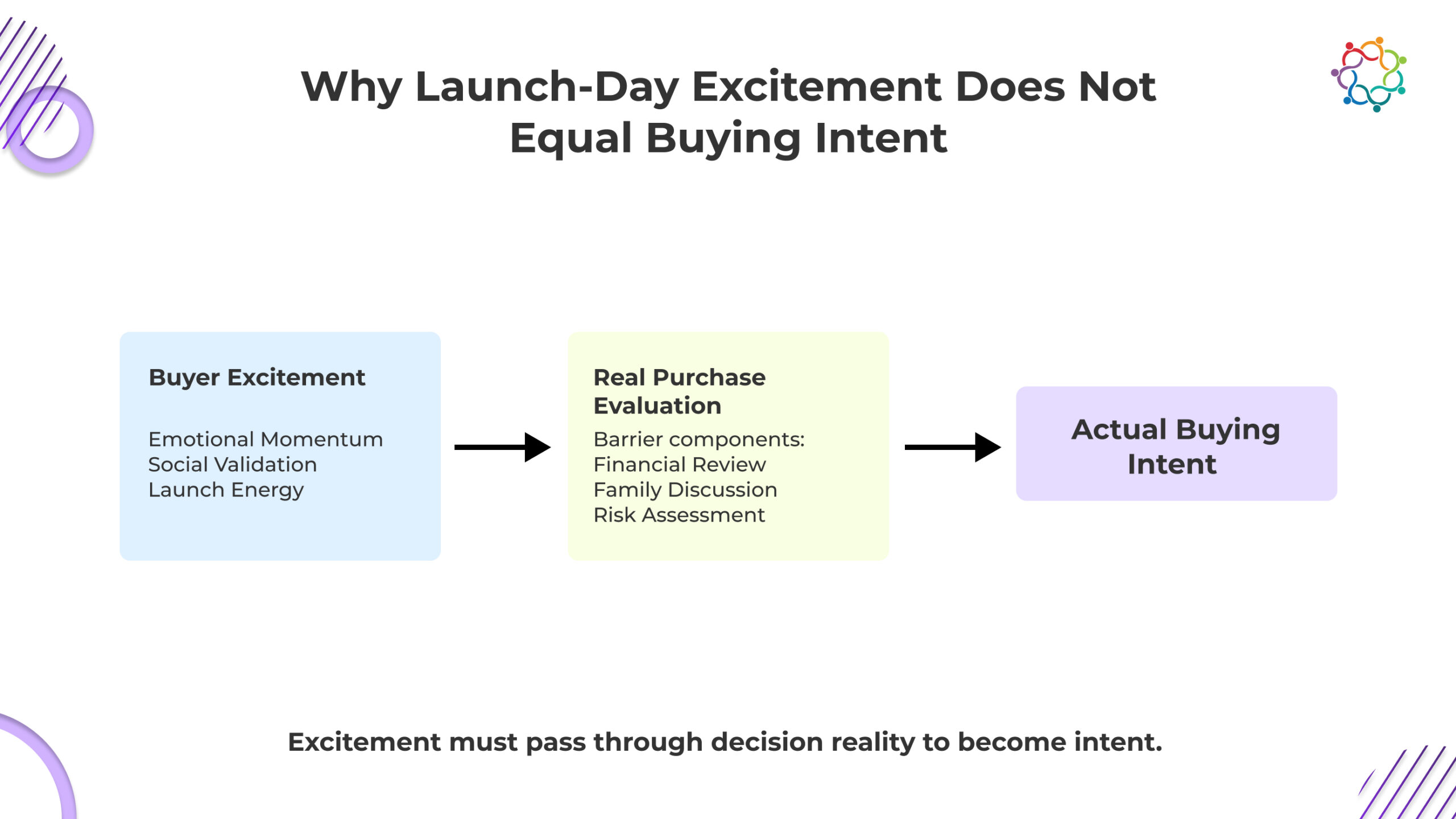
Property launch events are designed to capture buyer attention in a single decisive moment. Scarcity cues, social validation, and project reveals create emotional acceleration. Buyers feel closer to ownership than they did before entering the event.
But emotional proximity is not financial readiness.
No buyer completes their financial validation, risk assessment, or family consultation inside the launch environment. Those decision mechanisms activate after the event, when buyers return to independent evaluation. This is where most developers lose control of the decision trajectory.
Launch excitement creates psychological alignment. Buying intent requires decision validation.
When the event ends, the emotional momentum you created enters its most fragile phase. Buyers begin questioning affordability, comparing alternatives, and reassessing urgency. If engagement continuity is not structurally maintained at this exact stage, confidence weakens before commitment stabilizes.
This is the uncomfortable reality.
Launch events do not fail because buyers were never interested. They fail because the system allows interest to decay before it becomes a booking.
If intent is not sustained after the launch, conversion loss is not accidental. It is inevitable.
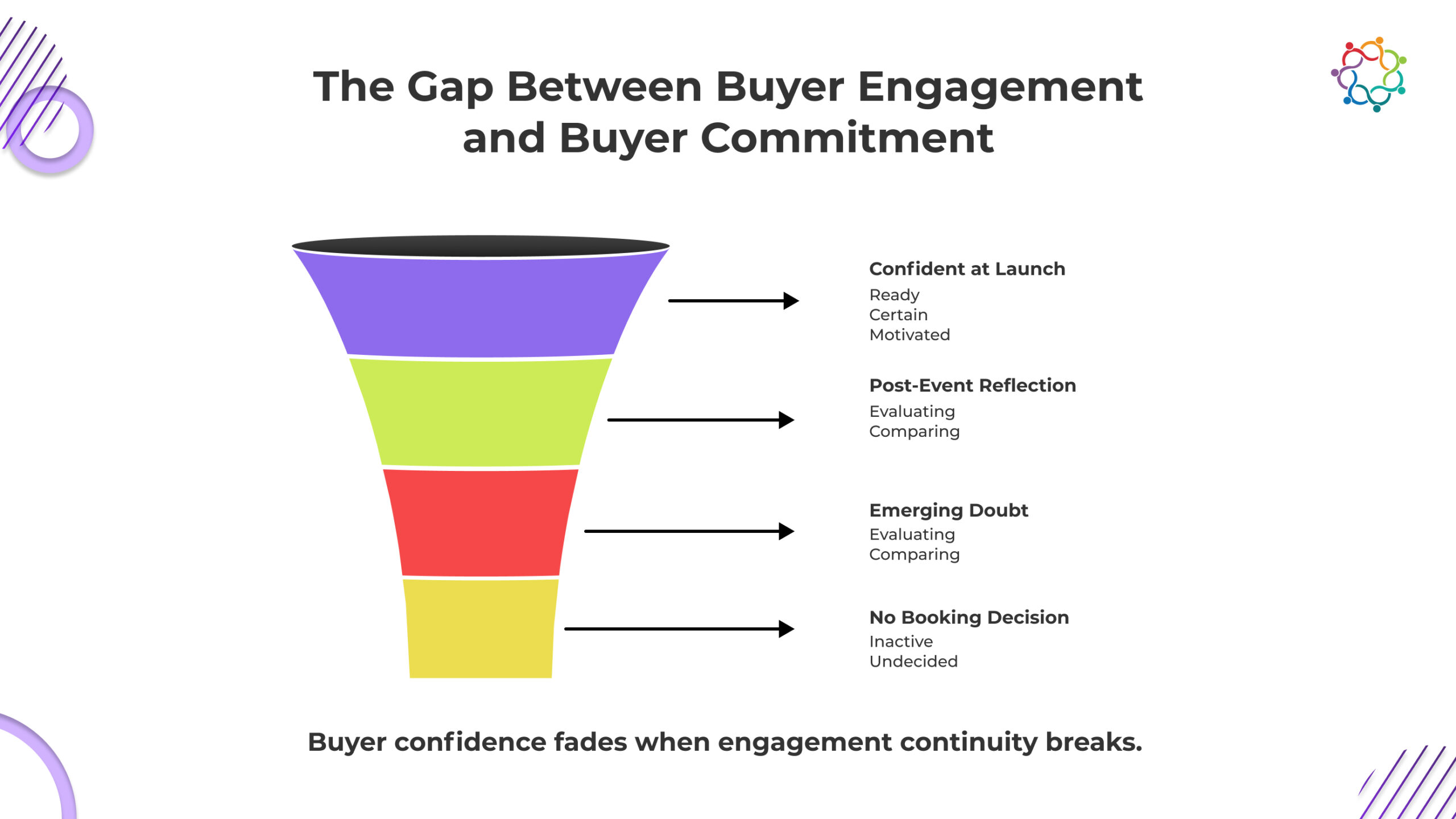
During a launch event, buyers operate in a controlled high-certainty environment. Information is immediate, questions are answered on the spot, and confidence feels elevated. Buyers experience clarity, urgency, and reassurance, all the signals that drive temporary commitment.
But the moment buyers leave, all certainty evaporates. The environment that supported their confidence disappears. External factors re-enter the decision process: competing projects, financial doubts, family opinions, and risk assessments. Emotional momentum alone cannot carry a decision across this friction.
This creates a structural gap between engagement and commitment. Buyer interest during the launch signals potential, not actionable intent. The Buyer Hesitation Curve explains the phenomenon: confidence peaks at the event and declines progressively without reinforcement. Without structural engagement continuity, momentum collapses silently.
Key insights:
Conversion stalls because the system does not preserve decision certainty after the event.
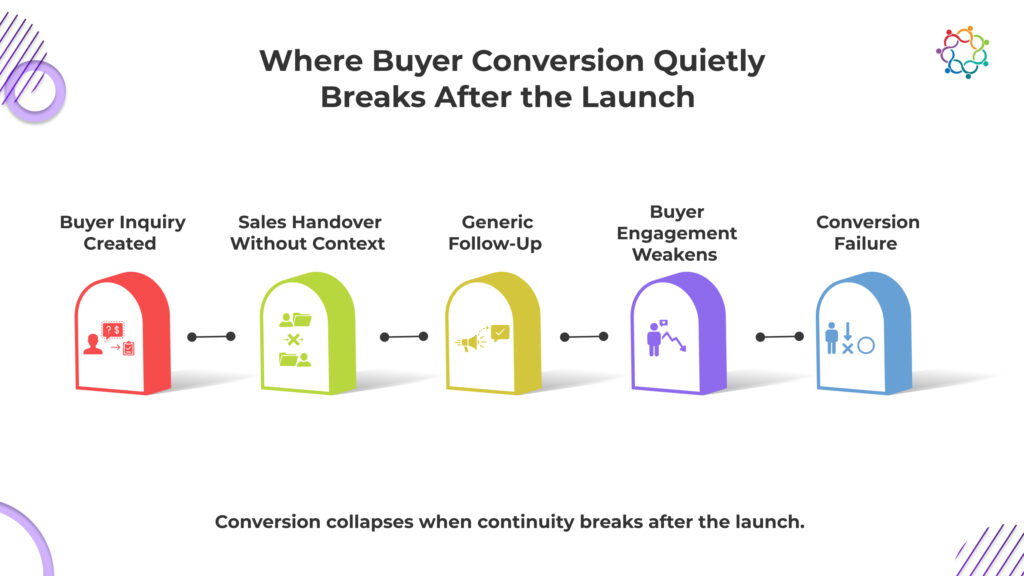
Conversion does not collapse in a visible moment. It weakens in the operational gaps that developers choose not to see. Launch events create a surge of buyer intent, but intent alone does not produce revenue. What happens immediately after determines whether that intent survives or disappears.
Most developers assume conversion loss happens because buyers change their minds. Conversion loss occurs because the system fails to preserve decision continuity after the event. Once buyers leave the launch environment, their confidence becomes unstable. If engagement, prioritization, and visibility do not continue with precision, hesitation replaces urgency.
This is where projected revenue begins to leak silently. Not because demand was weak, but because the conversion system was never strong enough to protect it.
Marketing hands over leads. Sales inherits names without intent clarity. They cannot see who was ready and who was browsing.
High-intent buyers are treated like low-intent buyers. No prioritization. No urgency alignment.
By the time sales identify serious buyers, their urgency is already gone. Conversion did not fail because buyers disappeared. It failed because the system could not recognize them in time.
During the launch, buyers felt seen. After the launch, they feel processed. Follow-ups become generic. Context disappears. Emotional continuity breaks.
This signals something dangerous to the buyer. The urgency was situational, not structural.
Buyers respond by slowing down. Decision timelines stretch. Doubt enters.
Momentum does not survive generic engagement. It weakens inside it.
After the event, most developers lose sight of buyer progression. They cannot see who is advancing and who is disengaging.
Sales follow up blindly. Timing becomes guesswork. Serious buyers are missed. Hesitant buyers are over-pursued.
This is not a lead problem. It is a visibility failure. You cannot convert intent you cannot see.
Launch pipelines create revenue optimism. Numbers suggest future bookings. But pipelines do not generate revenue. Conversions do.
When intent is not sustained, buyers delay. When buyers delay, pipelines weaken. Projected revenue never materializes.
This is where the real loss happens.
Not during the launch. After it. Developers do not lose buyers because launches failed. They lose buyers because conversion was never structurally protected.
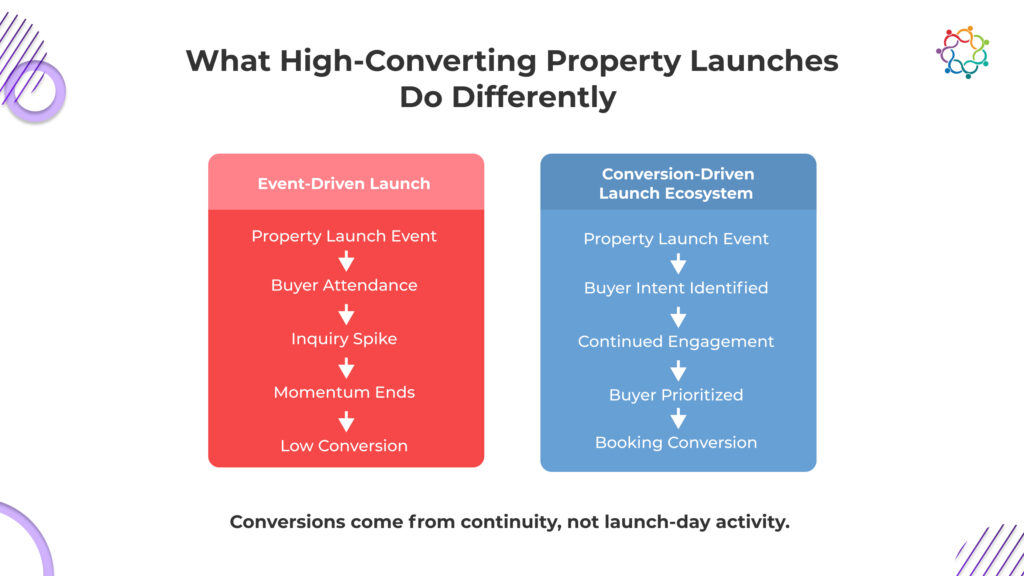
The difference between low-converting and high-converting launches is not launch-day performance. It is post-launch structural continuity.
Most developers optimize for visible activity. They measure attendance, inquiries, and immediate engagement response.
These metrics reflect attention, not conversion progression.
High-converting systems optimize for conversion continuity.
Property launch events that produce consistent booking outcomes operate inside conversion-centric ecosystems designed to sustain buyer progression beyond the event.
They focus on structural continuity across three critical dimensions:
This creates conversion stability. Buyer momentum does not collapse after the event. It transitions smoothly into decision progression. This structural difference reshapes revenue outcomes.
Low-converting systems create temporary attention spikes.
High-converting systems create sustained booking velocity.
This reframes how launch success must be evaluated. Launch success is not determined by how many buyers attend.
It is determined by how many buyers continue progressing toward commitment after the event. Conversion continuity becomes the true measure of commercial performance. Without continuity, launch momentum becomes conversion waste.
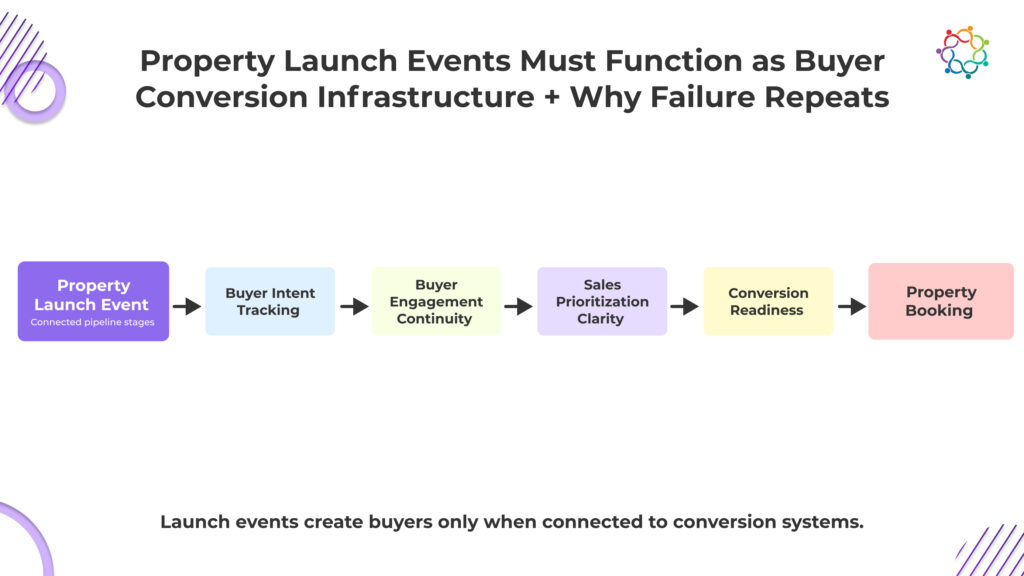
Launch events are often treated as isolated marketing moments. This perception limits their commercial impact. Their true function is architectural.
Conversion architecture is the system that governs how buyer intent moves from emotional activation to financial commitment without visibility loss.
Property launch events serve as entry points into a broader conversion system. They capture buyer intent signals and introduce buyers into the revenue pipeline.
But capturing intent is only the first stage.
Conversion architecture requires structural continuity across three interconnected layers.
Intent Capture Layer
Launch environments generate initial buyer interest. They create emotional alignment and identify potential buyers.
This stage supplies the conversion system with raw intent signals.
Intent Preservation Layer
Buyer intent must remain visible after the event. Buyers move through independent decision phases. Their engagement signals must remain accessible.
Without preservation, intent disappears inside the pipeline.
Intent Conversion Layer
Sales engagement must align with buyer readiness. Buyers require reinforcement at specific decision stages.
Without alignment, buyers hesitate and delay commitment.
These layers determine conversion effectiveness.
Buyer progression stays stable only when conversion layers work together. Launch events supply intent, not revenue. If the conversion architecture is weak, attention never becomes bookings. The system fails to convert captured intent. Conversion strength, not launch intensity, determines revenue outcomes.
Conversion failure repeats because most developers are measuring the wrong victory. Inquiry volume gets reported. Attendance gets celebrated. Internal conversations focus on how much attention the launch generated.
But attention does not pay revenue. Bookings do.
This creates an uncomfortable organizational truth. Your system is optimized to create the appearance of demand, not the outcome of conversion. As long as launch success is declared before booking outcomes are proven, conversion loss will continue repeating without resistance.
This means conversion failure is not surprising. It is designed into the system.
Until leadership starts measuring buyer commitment instead of buyer activity, every launch will continue creating noise without delivering the revenue it promised.
Property launch events generate attention, excitement, and inquiries. Yet, attention alone does not create bookings. Without structured post-event engagement, buyer intent fades, confidence weakens, and revenue leaks silently.
High-performing developers treat launches as conversion infrastructure, preserving intent and aligning sales with readiness.
If a launch cannot sustain buyer engagement after the event, it cannot sustain bookings.
For developers building launch ecosystems that preserve intent beyond the event, this is a conversation worth having.
Success is not measured on launch day; it is earned in what happens next, or It rarely returns.