Samaaro + Your CRM: Zero Integration Fee for Annual Sign-Ups Until 30 June, 2025
- 00Days
- 00Hrs
- 00Min


1
2
3
→
Bottom Line:
Without measurable alignment, execution will silently drift, eroding organizational performance.
Data tension exists between visible communication success and invisible organizational alignment. Internal events, town halls, leadership rollouts, and communications sessions often appear effective: strategy is articulated, priorities are clear, attendance is high, and engagement seems strong. From leadership’s perspective, alignment is achieved.
Execution tells a different story. Teams interpret priorities differently, decisions diverge from the intended direction, and strategic initiatives drift. Awareness is created; shared understanding is not. Leadership assumes that delivering a message ensures alignment, but employee interpretation remains unmeasured and largely invisible.
The structural truth is harsh: these events do not fail at communication; they fail at alignment. Awareness is not alignment. Without systems to capture interpretation and engagement, misalignment spreads silently, surfacing only when execution fractures, priorities dilute, and organizational performance erodes.
This blog exposes why such events structurally fail, why misalignment remains hidden, and how organizations must treat them as alignment infrastructure, not mere communication rituals.
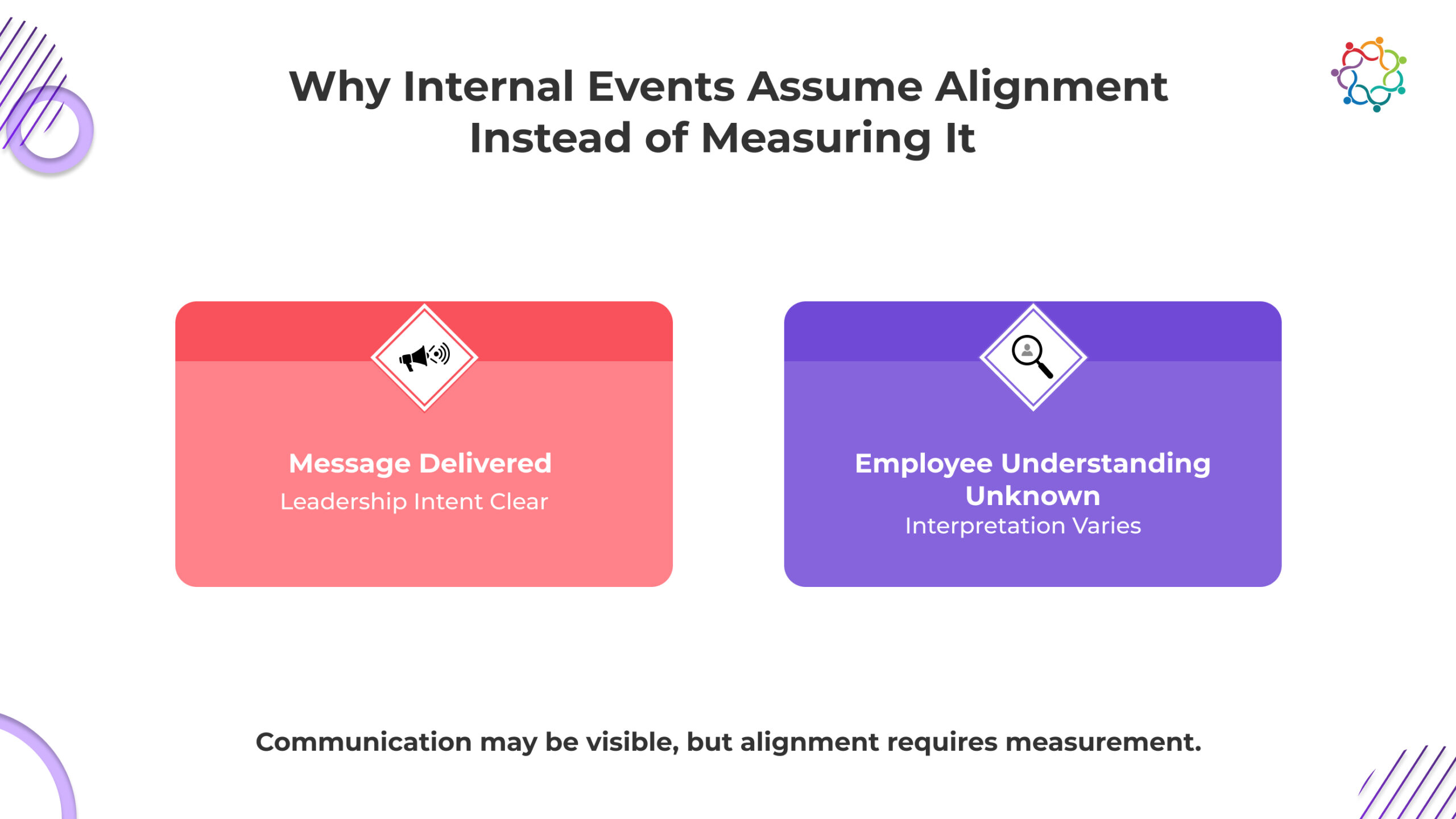
These events are designed to broadcast leadership intent. Strategy is explained. Goals are presented. Expectations are defined. And yet, the structural assumption remains that communication itself equals alignment. Leadership believes that clarity of message translates directly into aligned execution.
In reality:
Organizations rarely capture how employees interpret messages. Misalignments often emerge silently, unnoticed until they manifest as inconsistent execution or misprioritized efforts. When alignment is assumed rather than measured, leadership cannot see the gaps.
Key tension:
This structural flaw explains why high-quality organizational events often fail to produce the intended organizational outcomes. Alignment cannot be determined from attendance or participation alone. Post-event measurement of interpretation, engagement, and comprehension is necessary. Without this, execution deviates from leadership expectations, and strategy intent subtly deteriorates.
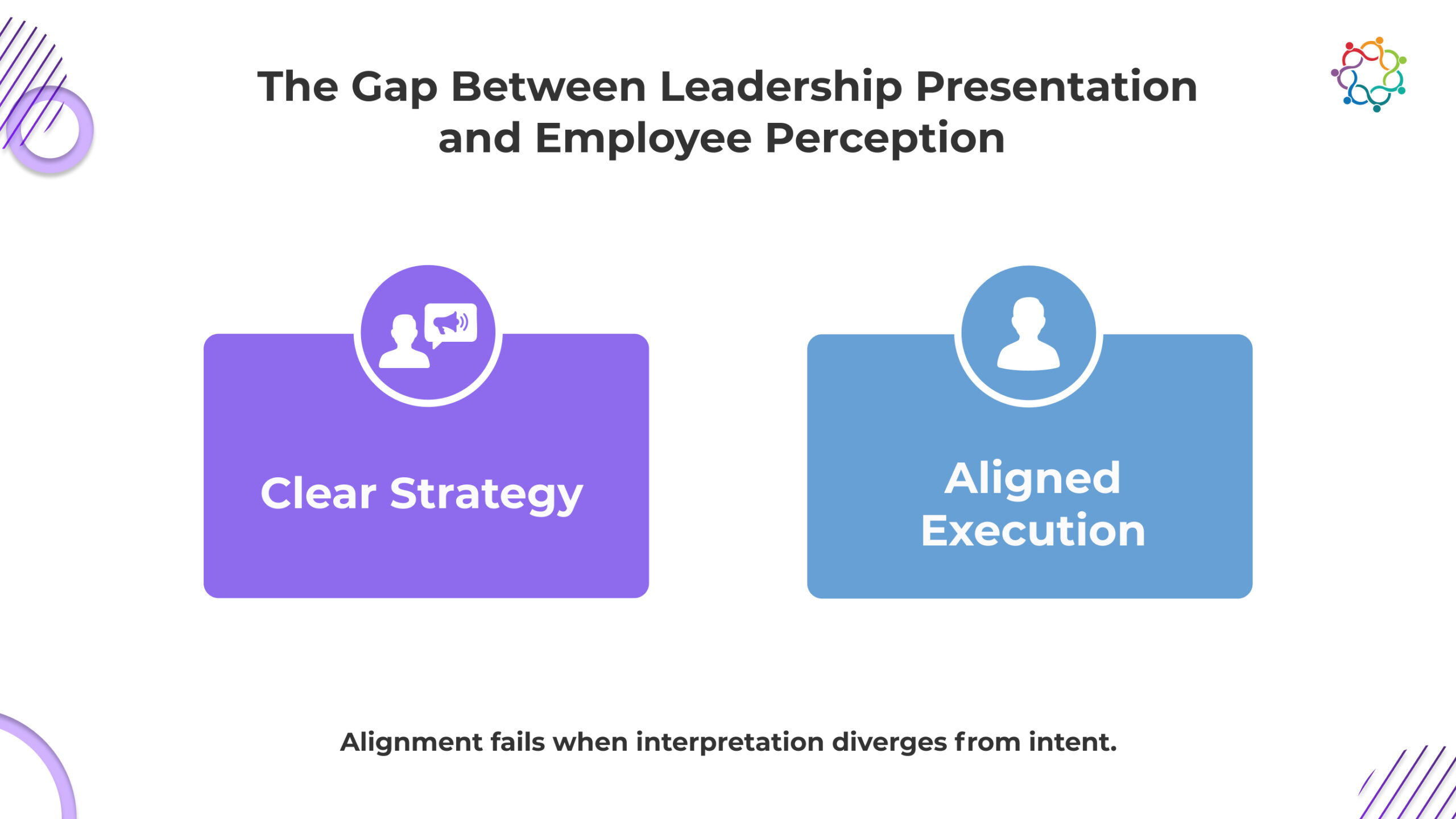
Even the clearest leadership presentation does not guarantee consistent employee understanding. Alignment fails at the intersection of communication and interpretation. Leadership articulates priorities, vision, and goals from a strategic standpoint. Operational realities, individual experiences, and current departmental demands are used by employees to filter those messages.
This results in a perception gap, the discrepancy between what management wants and what staff members absorb. Key drivers that cause the gap:
The result is invisible misalignment. Leadership may see engagement and nodding heads, but understanding cannot be inferred. Misinterpretation multiplies quietly across teams, fragmenting execution, delaying initiatives, and eroding performance.
Alignment fails not because messages are unclear, but it fails because interpretation remains unseen, unmeasured, and unchecked.
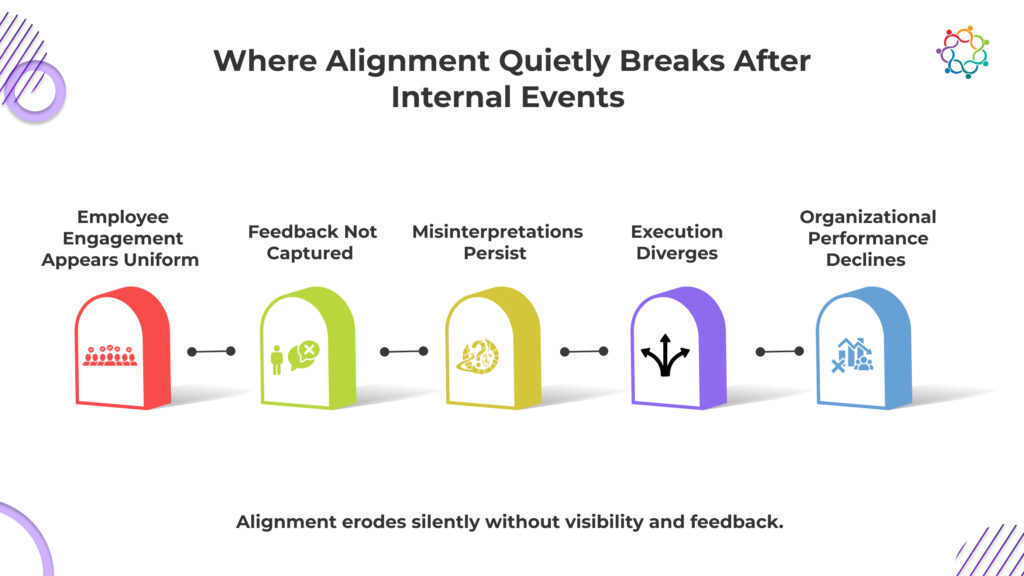
Alignment does not fail at the moment of communication; it erodes silently across four structural failure points: visibility, feedback execution, and performance cost.
During events, employee participation appears uniform. Leadership sees faces, notes Q&A activity, and assumes alignment. What looks like engagement is often compliance. Post-event, leadership cannot see who truly understood, who internalized priorities, or who disengaged silently. Without visibility into interpretation, every assumption about alignment is a blind spot waiting to fracture execution.
Most internal campaigns capture feedback superficially, if at all. Surveys and informal questions rarely reveal how employees interpret messages. Misinterpretations persist. Leadership cannot correct them because the organization has no mechanism to validate clarity. This absence of feedback turns every internal event into a high-cost experiment in invisible misalignment.
Interpretation gaps manifest in action. Teams prioritize differently, decisions contradict one another, and strategic focus splinters. Projects duplicate effort or stall. Leadership sees outcomes, but not the fragmentation beneath. Each misaligned decision compounds, silently eroding organizational coherence and performance.
Misalignment is not theoretical. It wastes resources, delays important projects, and reduces productivity. Employees act on assumptions rather than validated priorities. The goals of leadership are not met. Strategic priorities change with time. Operational reality contradicts the organization’s belief that it is aligned. The cost becomes visible only after productivity slows, initiatives stall, and outcomes weaken because interpretation was never validated.
Alignment failure is not an abstract risk. It is a systemic, measurable, and costly reality. Ignoring it is a choice.
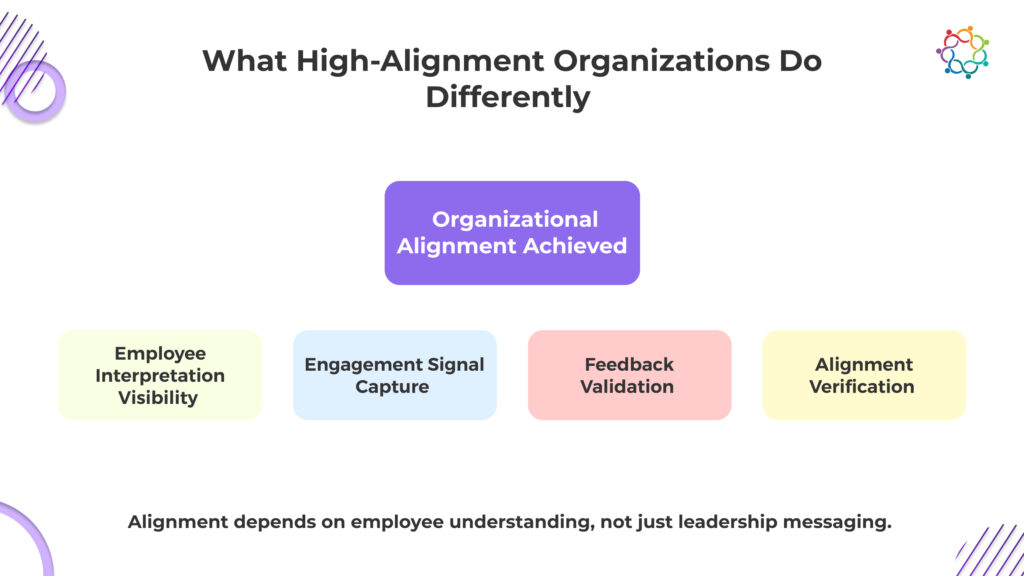
These events are often evaluated through a false lens. Organizations congratulate themselves on smooth presentations, polished slides, and high attendance. This is dangerous. Attendance does not equal understanding. Visibility does not equal alignment. Execution reveals the truth: teams act inconsistently, priorities drift, and strategic objectives fail silently.
The difference is brutal. One group focuses on optics. The other focuses on reality. Leadership can be convinced by applause, nodding heads, or survey completion, but none of these proves alignment. Misalignment compounds across teams, departments, and initiatives.
High-performing organizations refuse to be comfortable with superficial success. They demand evidence of understanding, track interpretation, and hold alignment accountable at every level. Internal events are not theater. They are diagnostic instruments for real organizational coherence.
Anything else is a luxury that costs performance.
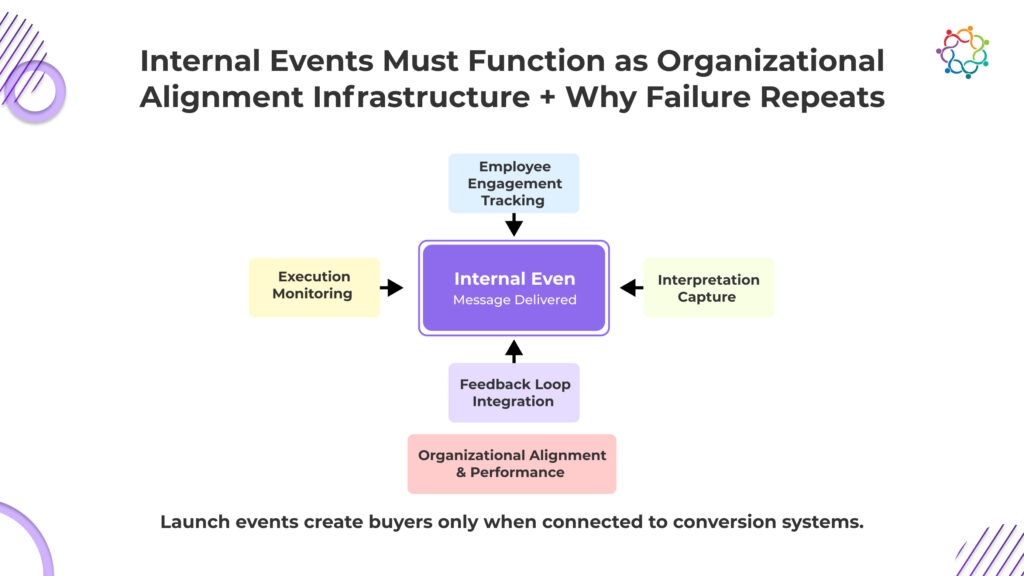
Most organizations treat events as ceremonial communication moments. Delivering a message does not guarantee understanding. It does not guarantee execution. Leadership can present a strategy flawlessly, but if no system exists to validate interpretation, alignment fails silently.
Internal events must shift from performance to infrastructure. They are not one-off presentations. They are diagnostic systems that reveal how employees internalize priorities, interpret strategy, and act on leadership intent. Without this, alignment gaps multiply unnoticed, and execution fractures.
If leadership is comfortable assuming alignment from attendance or applause, performance will inevitably suffer. Every event that is not connected to an alignment system risks wasted effort, misdirected resources, and fragmented execution. Organizational events are not for optics. They are the only mechanism to translate strategy into coordinated action.
Alignment breakdown is not accidental; it is baked into organizational systems. Internal events are judged by attendance, not whether employees actually align. Leadership celebrates visibility while ignoring understanding.
Communication is mistaken for alignment, and applause becomes proof of success. Rewards reinforce message delivery, not clarity or execution. Every event that prioritizes optics over interpretation entrenches misalignment, fragments execution, and silently erodes performance.
Organizations convince themselves they are aligned while teams drift on assumptions. Leadership comfort with superficial metrics ensures that the gap between intent and action widens unchecked, and strategic objectives fail before they even reach the ground.
Reality: The organizational system rewards visibility, not clarity. As a result, alignment failure becomes self-perpetuating. Without redesigning how these events are structured, evaluated, and integrated into alignment systems, misalignment will recur with each subsequent event.
Events deliver messages. They look successful. Attendance is high. Presentations are polished. Yet execution tells a different story. Alignment is invisible. Misinterpretation spreads silently. Teams act on assumptions, priorities fragment, and organizational performance erodes.
Leadership cannot afford comfort. Communication alone never ensures outcomes. High-performing organizations demand evidence of understanding. They treat internal events as alignment infrastructure, not theater.
For organizations ready to treat internal events as alignment infrastructure rather than communication rituals, this is a conversation worth initiating with Samaaro. The difference ultimately defines whether strategy remains an announcement or becomes coordinated execution.
If alignment cannot be measured, it cannot be enforced. Execution will betray intent every single time.