Samaaro + Your CRM: Zero Integration Fee for Annual Sign-Ups Until 30 June, 2025
- 00Days
- 00Hrs
- 00Min


1
2
3
→
Bottom Line:
Without tracking trust progression, pipelines expand while revenue remains delayed, creating future uncertainty disguised as opportunity.
Revenue delays in financial institutions rarely begin in the pipeline. They begin by misinterpreting what event success actually means. When financial services events produce hundreds of leads but fail to accelerate client conviction, revenue timelines silently extend. Relationship managers inherit volume without readiness. Forecasts appear healthy. Closures do not follow. This creates a dangerous financial distortion. Leadership believes future revenue has strengthened, when in reality, revenue probability has not moved at all.
Registrations, attendance, and CRM additions offer visible proof of activity. But financial decisions do not follow activity. They follow trust. Clients do not commit capital because they attended. They commit capital because they believe.
This creates a structural blind spot. Institutions measure who appeared. They fail to measure who advanced toward confidence. And when confidence does not advance, revenue does not materialize.
This blog exposes why trust, not lead volume, determines whether these events influence real revenue.
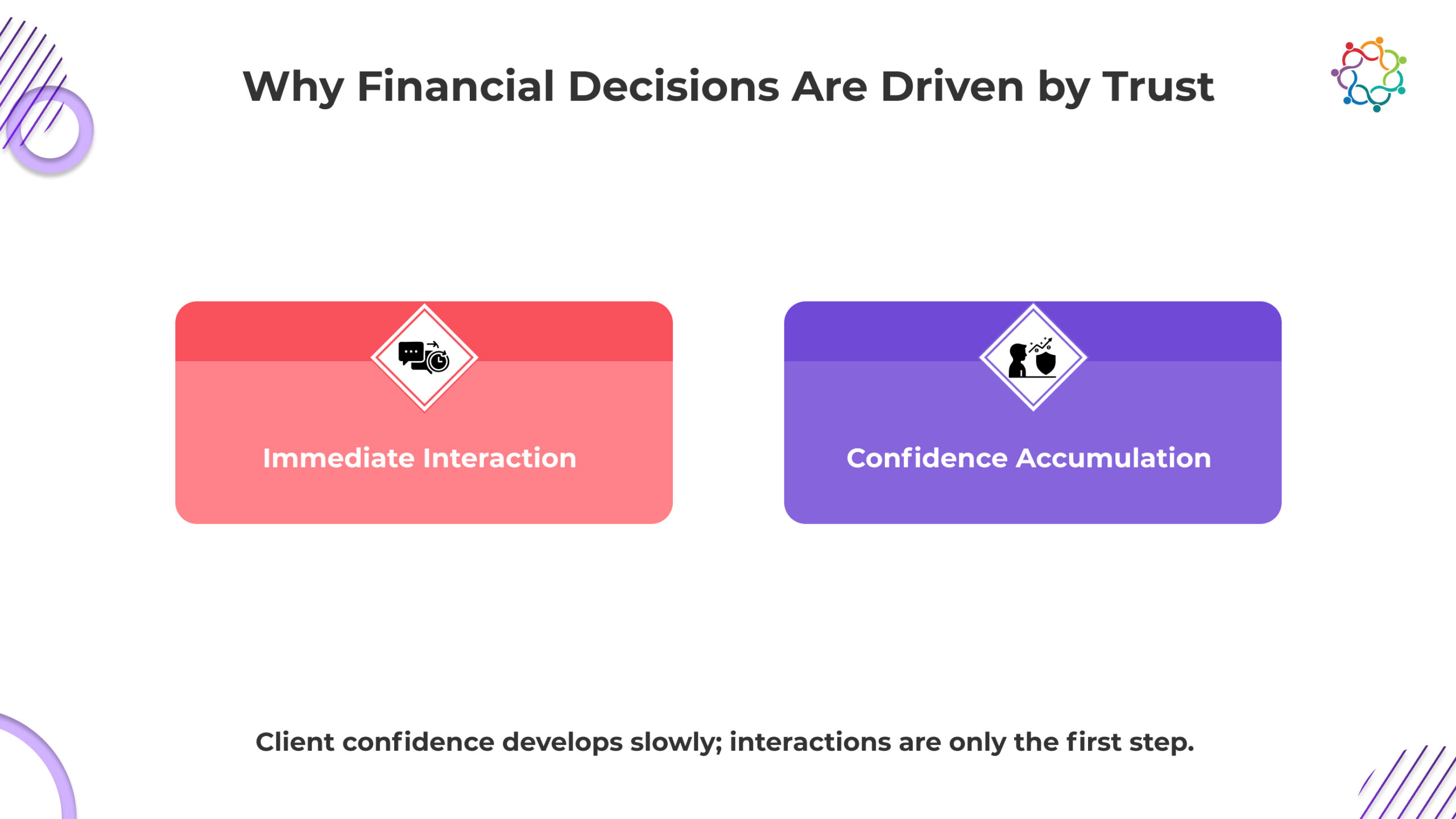
Every financial event creates interaction. Very few create conviction. This is the gap leadership refuses to confront.
Clients do not attend to be impressed. They attend to assess exposure. Every interaction answers one silent question. “Can this institution be trusted with consequences that cannot be reversed?” If that question remains unresolved, nothing else you presented matters. The relationship does not progress.
You can fill rooms. You cannot force belief. Attendance proves your brand can attract curiosity. It does not prove your institution reduced client hesitation. If hesitation remains, capital remains exactly where it was before your event. Untouched.
Understanding your offering is not the barrier. Clients often understand very quickly. What delays revenue is unresolved doubt about your consistency, intent, and long-term reliability. Until doubt weakens, decision timelines stretch indefinitely while you keep reporting engagement success.
There is no neutral outcome. If client confidence strengthens, future financial conversations accelerate. If confidence weakens or stalls, resistance increases. This means your event did not just fail to help revenue. It actively made future conversion harder, whether you admit it or not.
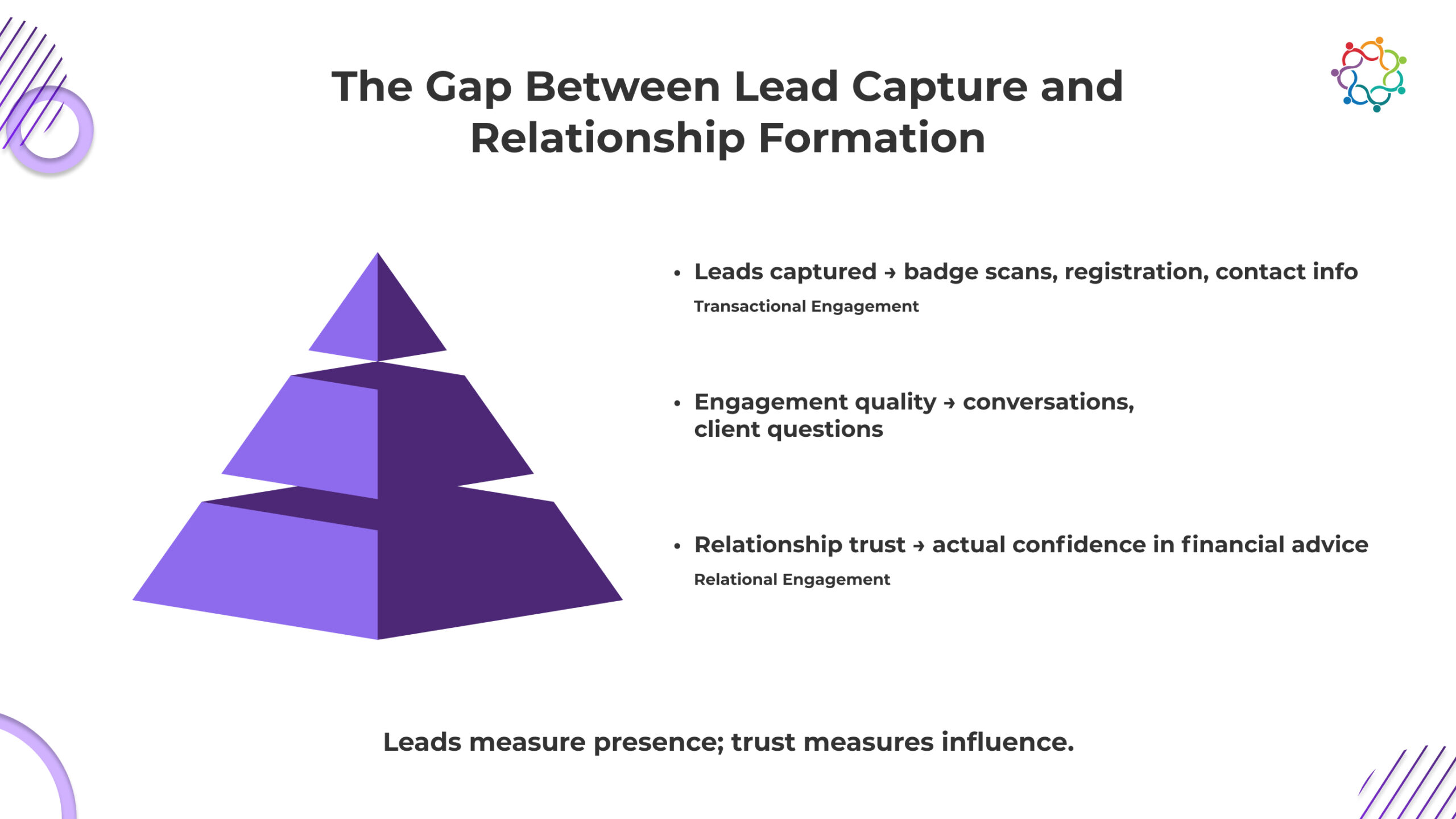
Your pipeline looks full. Your revenue is not. That gap exists because lead capture created visibility without creating trust.
This dynamic impact on trust and forecast accuracy has been explored deeply in case studies demonstrating how events can transform financial services engagement outcomes.
When a client’s badge is scanned, your system records progress. The client has entered your world. But you have not entered theirs. You do not know whether they left with confidence, doubt, or indifference. Yet your forecasts quietly assume forward movement.
This is the structural mistake.
Transactional engagement gives you contact. Relational engagement gives you permission. Only one of these produces revenue. Most leads never convert because nothing actually changed in the client’s mind. They showed interest. They did not develop a belief.
Lead quantity measures how many people you reached. Relationship depth determines how many will trust you with consequences.
If trust did not advance, your pipeline did not advance.
You did not generate future revenue. You generated future uncertainty disguised as opportunity.
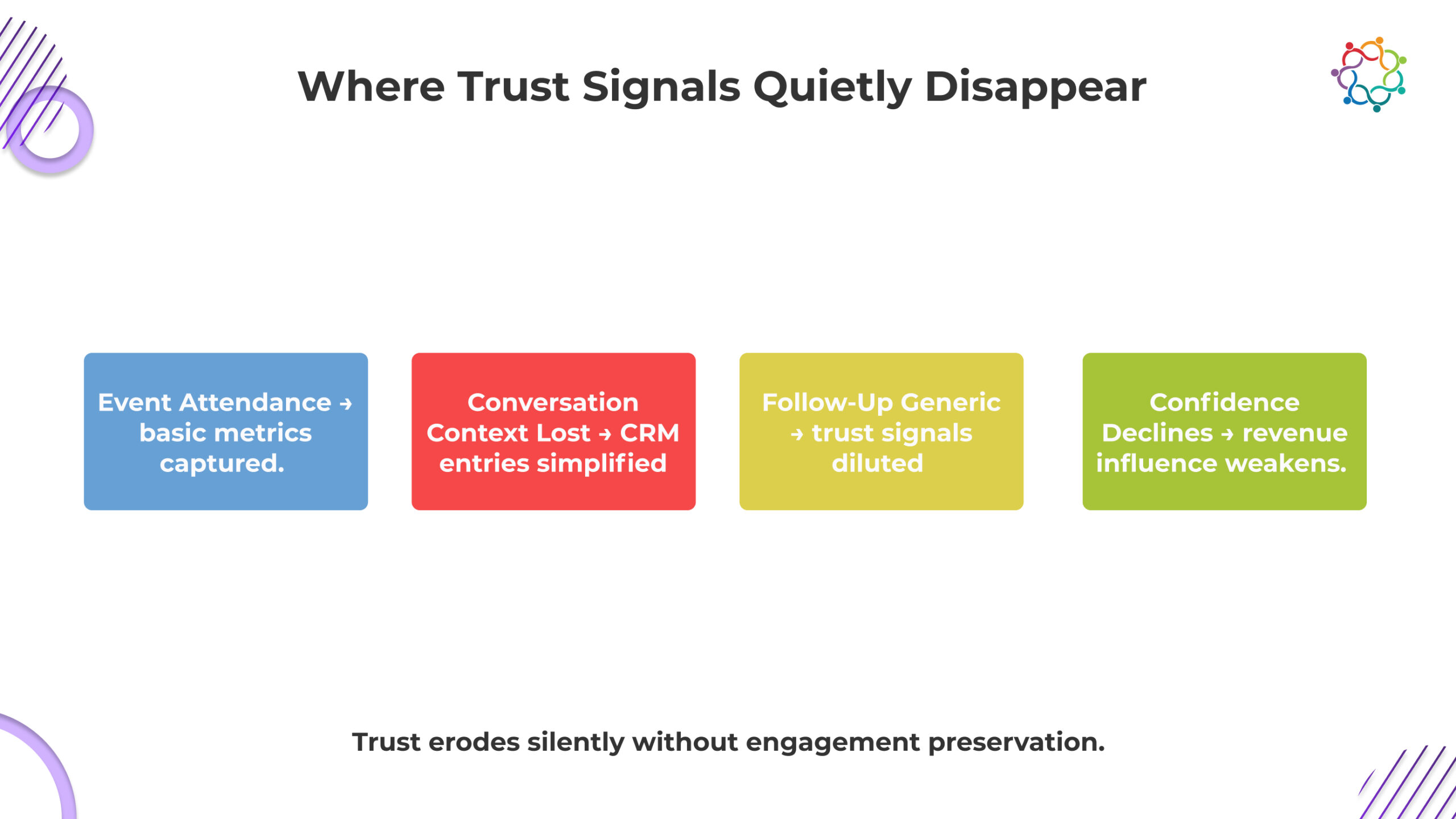
Trust erosion rarely happens during the event itself. It happens afterward, when engagement signals lose context, continuity breaks, and relationship momentum quietly weakens without institutions even realizing it has begun.
Client engagement during events contains layers of meaning. Questions asked, conversations initiated, time invested in discussion, and emotional tone all signal trust formation. But most systems compress these signals into static attendance records.
This simplification destroys relationship intelligence.
When engagement depth gets reduced to attendance logs, institutions lose visibility into:
Without this context, leadership assumes engagement was uniform. It was not.
Trust formation is uneven. Some clients move forward. Others move away. When these distinctions disappear inside reporting systems, institutions lose the ability to understand their own credibility trajectory.
Trust signals do not disappear because clients stopped evaluating. They disappear because institutions stopped observing.
After events conclude, relationship managers inherit lead lists. But they do not inherit engagement intelligence. They receive names without psychological context.
This forces relationship managers to restart conversations without understanding where trust previously stood.
This interruption creates friction:
Clients perceive a disconnection between event interaction and follow-up.
Relationship continuity weakens
Confidence progression slows down.
Clients expect institutional memory. When institutions fail to demonstrate it, credibility weakens. Trust requires continuity. Without continuity, confidence resets.
This extends decision timelines and reduces revenue probability.
Generic follow-ups represent one of the fastest ways to destroy fragile trust formation.
When clients receive outreach that fails to reflect prior interaction depth, they recognize the transactional intent immediately. The institution appears more interested in conversion than understanding.
This perception creates emotional distance.
Trust fades gradually through signals like:
Lack of personalized continuity
Absence of contextual awareness
Communication that prioritizes institutional needs over client confidence
Trust does not collapse instantly. It erodes quietly. By the time institutions recognize this erosion, the client has already disengaged psychologically.
And once confidence weakens, revenue opportunity weakens with it.
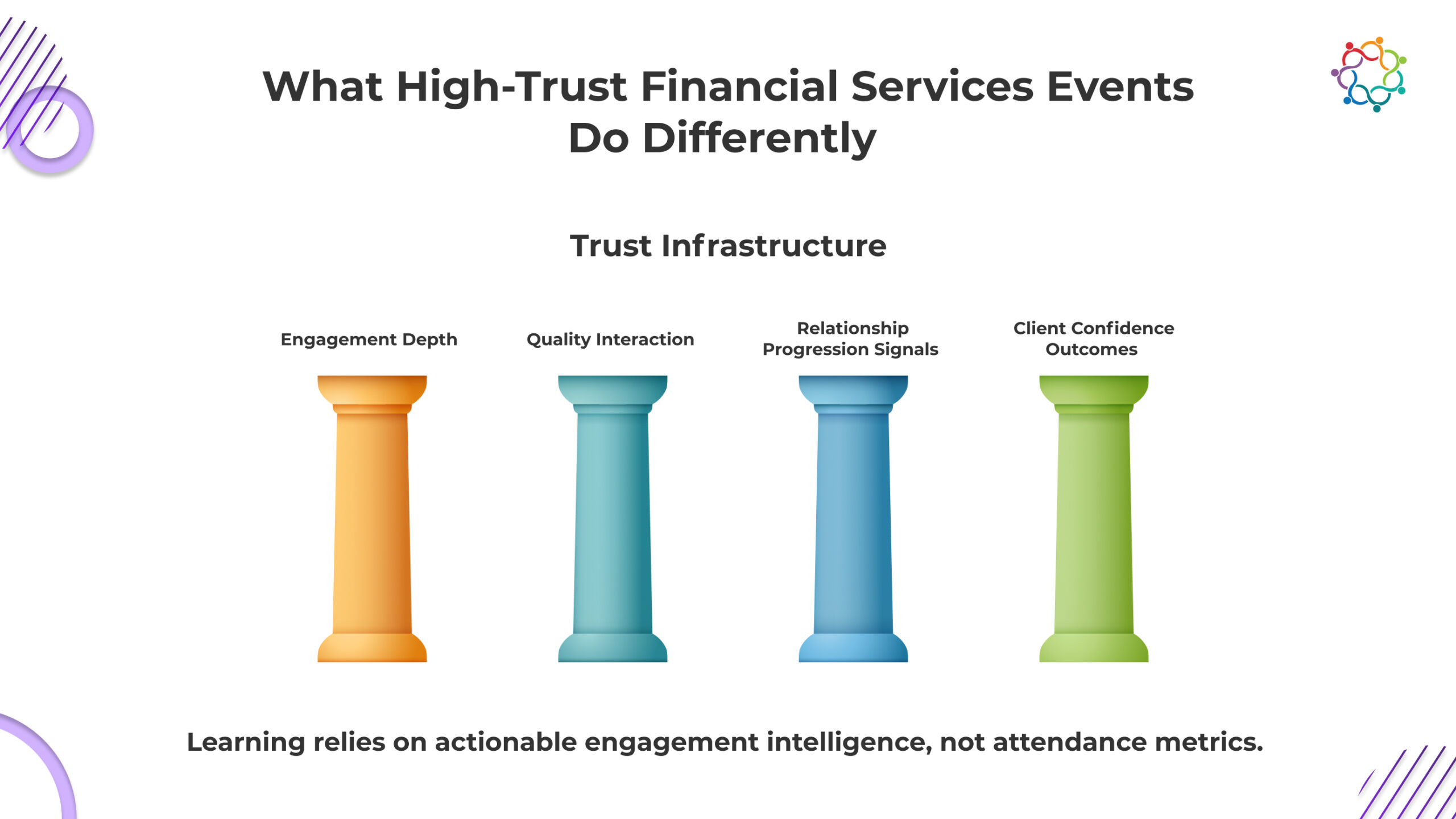
Most of your events are optimized to be seen as successful. Very few are optimized to be believed.
You celebrate the attendance scale because it is visible. Clients evaluate credibility because that is consequential. This is the disconnect you are operating inside.
Low-impact environments expand your contact database. High-trust environments expand your revenue probability. The difference is not cosmetic. It is commercial.
Clients do not move closer to allocating capital because they attended. They move closer when their skepticism weakens, and their confidence strengthens.
This creates an uncomfortable reality. If your event increased leads but did not increase client confidence, nothing actually improved. Your reports look stronger. Your revenue position does not.
Trust density, not lead volume, determines whether future financial conversations accelerate or stall.
If confidence did not deepen, your event did not create momentum. It created noise that only your internal dashboards interpreted as progress.
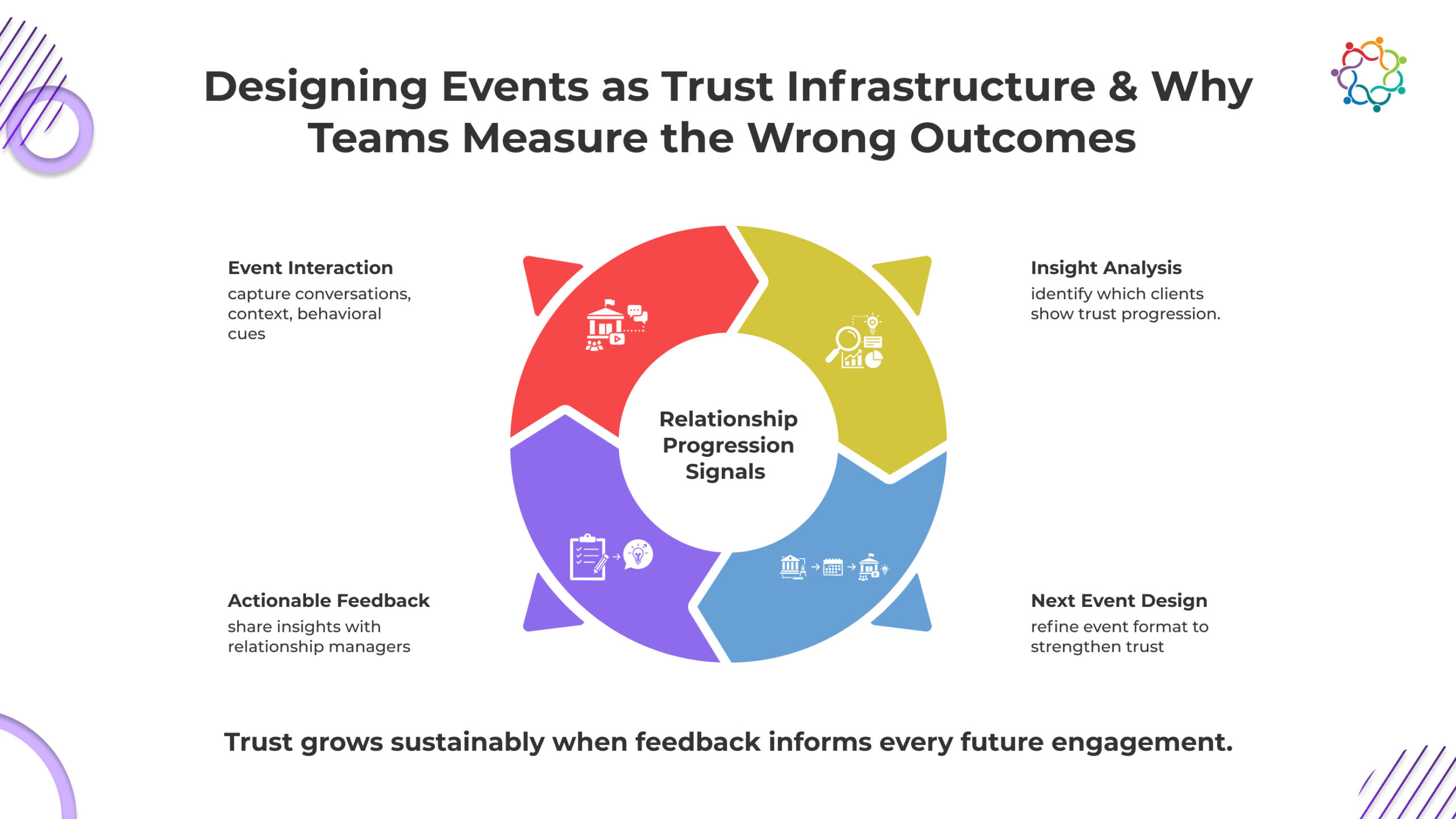
You are treating events as marketing campaigns. Clients are treating them as evidence of whether you deserve their trust. This disconnect is costing you revenue.
Trust does not form inside a single event. It forms across a sequence of reinforcing signals. Every event either strengthens that sequence or breaks it.
Trust influence operates across three layers:
If continuity breaks after the event, confidence weakens. When confidence weakens, decision timelines expand, and revenue probability drops.
Events do not create revenue directly. They create the conditions that make revenue possible.
If your event cannot sustain trust beyond its duration, then it did not build infrastructure.
It created temporary attention that your revenue cannot use.
Revenue does not happen when clients meet you. It happens when clients stop fearing the consequences of choosing you. This is the progression you cannot see but are financially dependent on. Exposure creates awareness. Credibility shapes perception. Confidence reduces hesitation. Only then does financial commitment become possible.
Most of your leads are stuck between awareness and confidence. They know you exist. They are not ready to trust you. Until trust strengthens, capital does not move. Your pipeline remains visually full but commercially inactive.
Trust accelerates revenue by reducing decision friction. Clients stop delaying. Internal approvals face less resistance. Competitive alternatives lose influence. Without this psychological shift, nothing converts.
This is the reality you must confront. Events do not produce revenue because clients attend.
They produce revenue only when they make you feel safer than waiting.
Organizations measure lead volume because it protects reporting comfort.
Trust progression is slow, ambiguous, and difficult to defend in performance reviews. Lead volume is immediate, clean, and defensible. So the organization defaults to what is easy to show, not what actually moves capital.
This creates a system where visible activity replaces commercial reality.
These metrics create the illusion of momentum. They help justify budgets. They help demonstrate marketing productivity.
But they do not tell you the only thing that matters. Did the client move closer to trusting you with financial consequences?
If that answer is unclear, then your reporting is not protecting revenue. It is protecting perception.
And perception does not close financial relationships. Trust does.
Your dashboards are full. Your revenue may not be. Lead volume creates comfort for leadership. It does not create confidence in clients. Every registration, every badge scan, every post-event interaction that fails to advance trust is a missed revenue opportunity.
Financial decisions are not activity-driven. They are trust-driven. Events influence perception, accelerate confidence, and reduce hesitation, but only if the trust signals survive beyond the event. Otherwise, your contact list is just noise, and your pipeline is just an idea.
If your events do not strengthen trust, they do not influence financial decisions. They are marketing exercises masquerading as revenue engines. The moment you prioritize lead volume over confidence, you guarantee that future financial commitment will remain stalled, invisible, and delayed.
In financial services, revenue does not follow exposure. It follows trust.
If your events are not measurably strengthening client confidence, they are not influencing capital movement. They are simply creating activity your revenue cannot use.
Forward-looking teams are integrating structured frameworks that ensure every client interaction contributes to measurable confidence and long-term financial commitment.