Samaaro + Your CRM: Zero Integration Fee for Annual Sign-Ups Until 30 June, 2025
- 00Days
- 00Hrs
- 00Min


1
2
3
→
Bottom Line:
FPartner events shape relationships, not revenue; real sales change comes from structural incentives, not event attendance.
The most dangerous outcome of partner events is not failure; it is the lack of preparation. Rooms are full. Conversations are active. Partners engage, ask questions, and lean into discussions. The signals are all positive, and they arrive immediately. Leadership walks away with a clear impression that partners are aligned and ready to move.
But this is where the misread begins. What you are seeing is not readiness. It is responsive to a controlled environment.
Inside the event, attention is focused, messaging is uninterrupted, and partners are temporarily operating within your narrative. In that moment, alignment feels real because there are no competing pressures.
However, the moment partners return to their actual sales environment, those pressures return. Competing vendors, active deals, and revenue targets take over. And that is where the earlier signals start to collapse.
Because alignment inside an event is not the same as priority inside a pipeline.
This is the Partner Priority Gap, the disconnect between partner alignment during the event and actual prioritization when revenue decisions are made.
This blog examines why that gap exists and why it consistently prevents partner sales performance from changing.
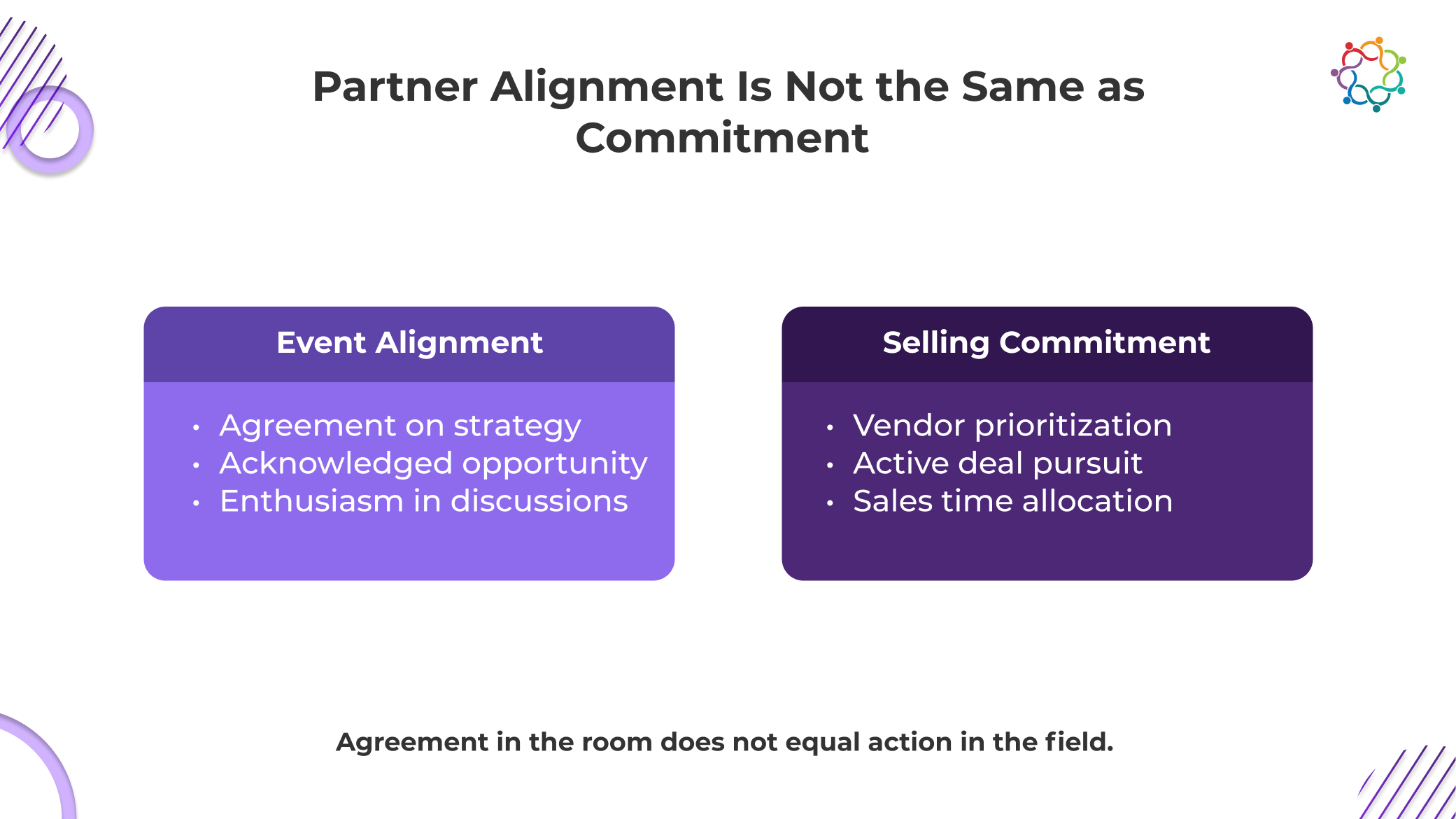
Inside any well-run partner marketing event, the narrative is compelling. Market opportunity is clearly framed. Differentiation is positioned. Growth potential is highlighted.
Partners agree because the story makes sense. But agreement is not the trigger for action.
Partners do not reorganize their selling behavior because they understand your strategy. They do it when your offering changes their revenue equation.
That is the edge most organizations avoid confronting.
A partner can fully agree with your positioning and still not sell your product. Because agreement does not influence how they allocate time, resources, or attention across deals.
Once the event ends, partners return to a far less controlled environment. Now they are no longer responding to messaging. They are making commercial decisions.
None of these factors is resolved by alignment.
So, while the event creates a temporary moment of clarity, it does not alter the underlying economics of partner behavior.
And without changing economics, behavior does not move.
This is why partner events consistently overperform on engagement and underperform on revenue impact. They influence what partners think, not what partners do.
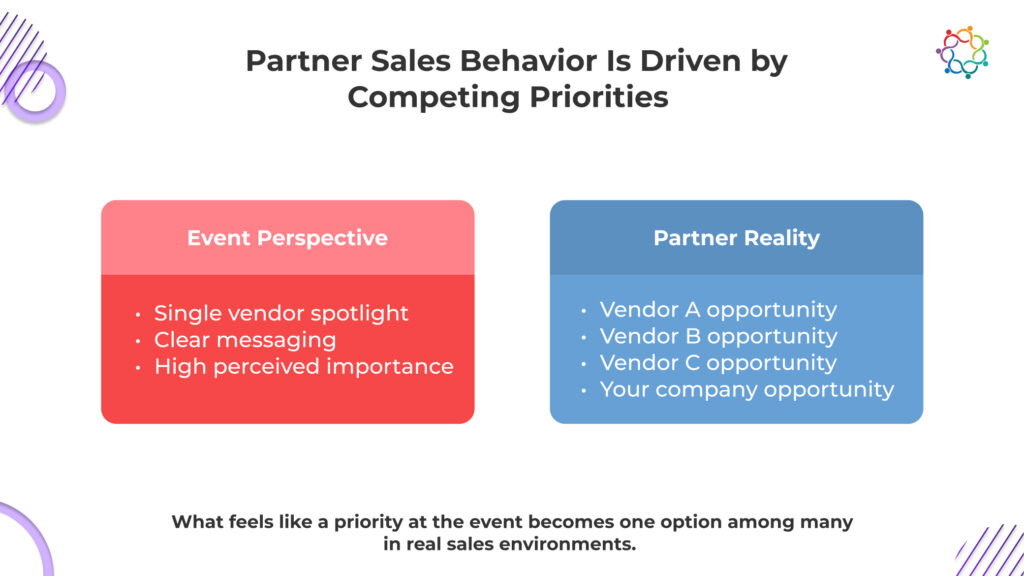
Partners do not operate on strategic alignment. They operate on deal movement. Inside any partner organization, multiple vendors compete for the same limited selling time, and that time is allocated based on what converts fastest with the least resistance.
This is the part most organizations avoid confronting directly.
Even if your positioning is strong and your narrative lands during the event, it still enters a pipeline where urgency, simplicity, and speed dominate decision-making. A partner will naturally move toward the solution that is easier to explain, quicker to position, and more likely to close without friction.
Because every extra step slows revenue down.
So, your offering is not being evaluated against how well it aligns. It is being judged against how efficiently it turns effort into income.
And in that environment, the easiest deal almost always wins.
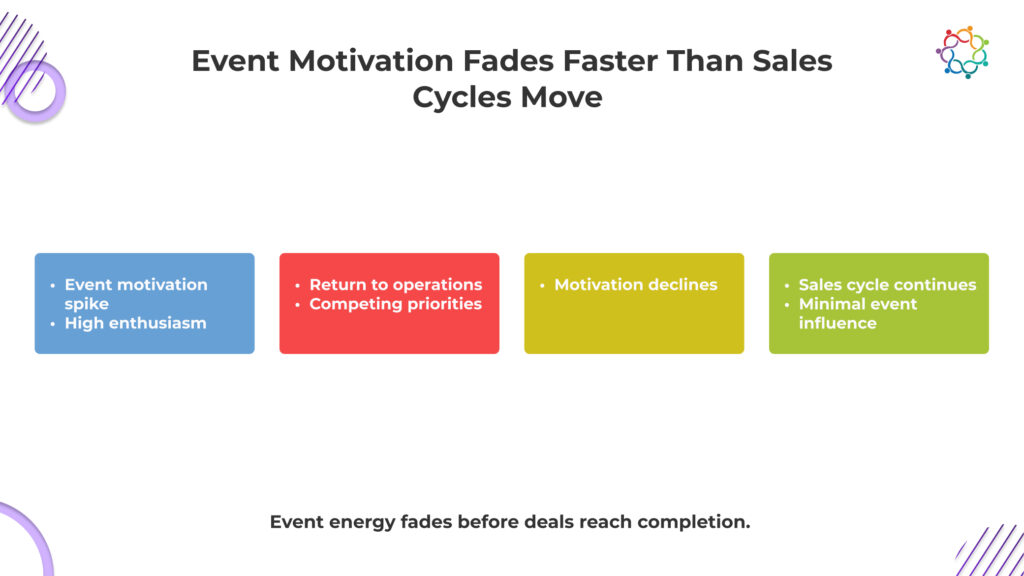
The problem is not that motivation fades. The problem is that revenue decisions happen after motivation is no longer relevant.
Right after partner events, partners are interested. But deals are not closed in that moment. They are evaluated later, when pressure, urgency, and economics take over.
And that is where things start slipping.
Here is the part most teams miss.
Motivation does not just fade. It gets outcompeted.
By the time a partner is deciding where to invest effort, your opportunity is no longer competing with the memory of the event. It is competing with deals that are easier, faster, and more profitable.
And that is where revenue is actually decided.
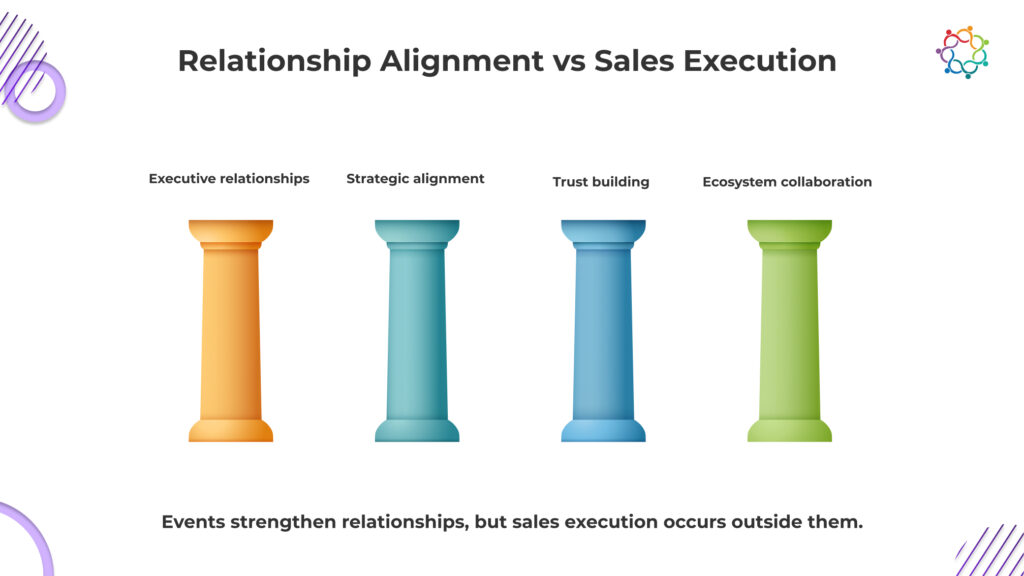
It is comfortable to believe that stronger relationships lead to stronger revenue. That belief is rarely challenged because it feels directionally correct.
But in partner ecosystems, it is incomplete.
Relationships create access. They build trust. They keep you in the conversation. But they do not determine what gets sold. Because when a partner evaluates an opportunity, they are not asking who they trust more. They are asking what makes more commercial sense right now.
High-performing ecosystems are clear about this, and more importantly, they reject the signals others rely on.
Instead, they focus on one uncomfortable truth.
Partners will always choose the path that maximizes return for the least effort in the shortest time.
So even in the strongest relationships, revenue remains selective. Because trust may keep you relevant. But economics decides if you get sold.
You are influencing the wrong layer of the partner organization and expecting revenue from it. The people you engage at events shape relationships, not deal decisions. Sales happen elsewhere.
Executives align on vision, partnerships, and long-term direction. But they do not decide which product gets pitched tomorrow. Their alignment rarely translates into immediate selling pressure on the ground.
Frontline sellers care about what closes. If your solution takes longer to explain, position, or negotiate, it gets deprioritized instantly, regardless of how strong the event messaging was.
Even if sales teams are exposed to event content, it does not stay with them during live deals. In high-pressure selling situations, only what is easy and familiar survives.
Events do not reduce friction in pricing, positioning, or closing. So when sales reps evaluate deals, nothing has actually improved. And unchanged conditions lead to unchanged behavior.
If the people closing deals do not change how they sell, your event never had a chance to change revenue.
When partner revenue does not change after an event, the instinct is to question the event itself.
Was the messaging strong enough? Was attendance high enough? Was engagement sufficient?
These questions feel logical. But they are misdirected.
Because the system used to evaluate partner event ROI is built around engagement, not performance. And that system does more than mismeasure. It actively discourages honest evaluation.
Why?
Because engagement is easier to report. It produces immediate metrics. It shows visible success. It justifies investment quickly. Revenue impact, on the other hand, is delayed, complex, and harder to attribute. So organizations default to what they can prove quickly.
And in doing so, they reinforce a cycle where events are optimized for participation, not for ecosystem sales performance.
This creates a dangerous loop.
Events look successful on paper. Leadership expects revenue impact. Revenue does not change. But the metrics still validate the investment. So nothing fundamentally shifts.
And the Partner Priority Gap continues to widen.
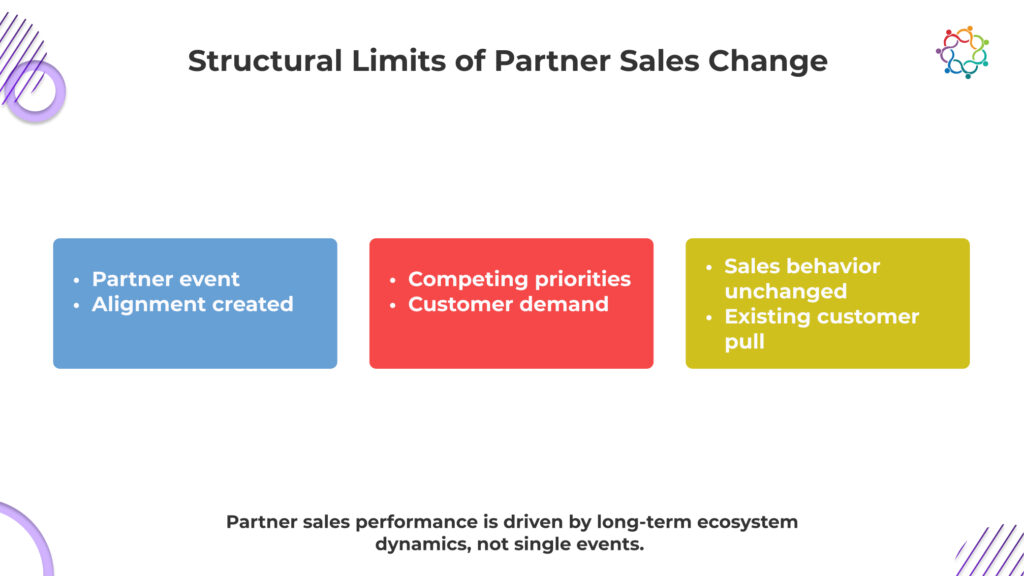
The reason this pattern repeats across organizations is simple. Partner events are designed to influence perception. Partner sales performance is driven by structure.
These forces do not disappear after an event. They remain constant. They continue to shape behavior long after alignment fades.
So, expecting an event to override these dynamics is not just optimistic. It is structurally unrealistic.
This is why even the most well-executed partner ecosystem events fail to produce consistent revenue change.
Because they are being asked to do something they are not designed to do. They can influence how partners see you. They cannot control how partners sell.
And until that distinction is fully accepted, organizations will continue to misattribute performance gaps to execution, instead of acknowledging the underlying structure.
You did not mis-execute the event. You misread what it could ever influence.
Partner events foster alignment, visibility, and stronger relationships. However, these outcomes do not necessarily influence how partners choose what to sell, as those decisions tend to be shaped by factors like margin, speed, ease, and demand.
If your offering does not lead on those factors, it may not be immediately prioritized—regardless of event timing.
So, the question is no longer whether your event worked.
It is whether your product can compete in a partner’s revenue reality.
Because the Partner Priority Gap does not close with better events. It only closes when your offering earns a place in the partner’s revenue priorities.
Because if it cannot, no level of alignment will ever convert into sales.