Samaaro + Your CRM: Zero Integration Fee for Annual Sign-Ups Until 30 June, 2025
- 00Days
- 00Hrs
- 00Min


1
2
3
→
Bottom Line:
Demo Day pipeline conversion depends on a pre-built follow-up system; without it, even the strongest demo only creates temporary interest, not revenue.
Demo day ended. The energy was real. The pipeline looked strong. Then day 30 arrived, and half of it was gone. The demo was not the problem. Everything after it was.
A demo day that generates genuine pipeline excitement is a real win. It takes serious product, marketing, and event execution to pull off, and the teams reading this did that part right. The product was compelling. The room was engaged. The conversations were the kind that feel like they are going somewhere.
What happened next is what this blog is about.
The pipeline did not disappear because the product was unconvincing or the demo was weak. It disappeared because the system designed to catch, qualify, and convert that pipeline interest was not built to handle the specific dynamics of what happens to a lead after a live product showcase. Interest peaks during the demo. It begins decaying the moment the event ends. Without a conversion system that activates within hours rather than days, the decay wins before follow-up even begins.
Demo day pipeline conversion does not happen automatically after a strong event. It requires a post-event system built specifically for how demo day leads behave.
Seven diagnoses follow, each with a pattern and a fix.
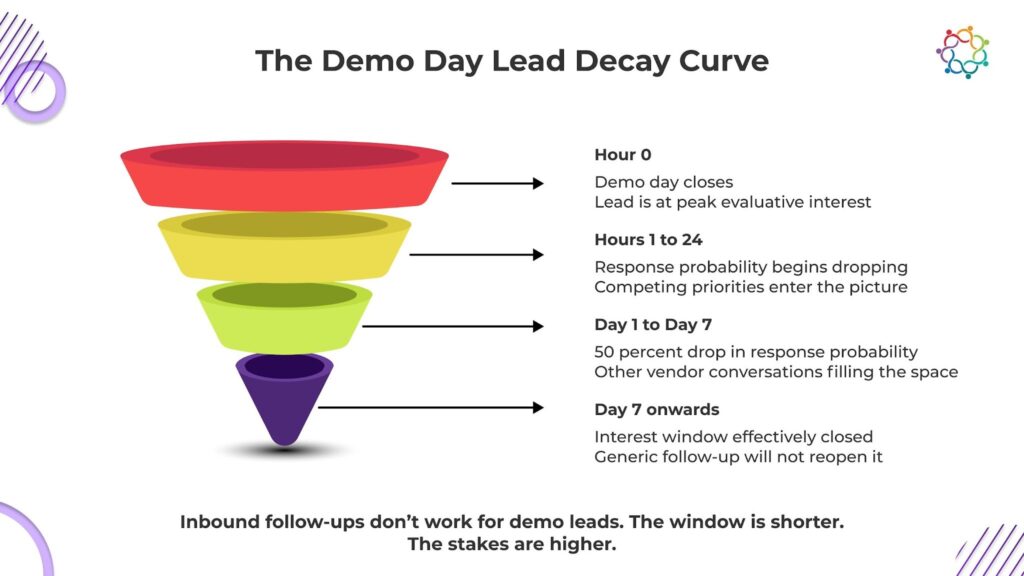
Before diagnosing what goes wrong, it is worth being precise about why demo day leads behave differently from every other lead type in the CRM.
A demo day attendee arrives at peak emotional and evaluative interest. They have just watched the product solve a problem they recognise in real time, in a live environment, with other peers present. That recognition is time-sensitive in a way that no other lead state is. It fades as competing priorities return, internal stakeholder inertia reasserts itself, and other vendor conversations fill the space the demo created.
Research on B2B lead response rates consistently shows that response probability drops by more than 50 per cent after the first 24 hours and continues declining sharply through day seven. Demo day leads follow this curve, but with a steeper drop, because the live event context that created the interest cannot be replicated in a follow-up email. The email arrives after the moment has passed.
The follow-up system built for inbound content leads will not work here. The window is shorter, the intent is higher, and the stakes of a slow or generic response are significantly greater than with any other lead type the marketing team manages.
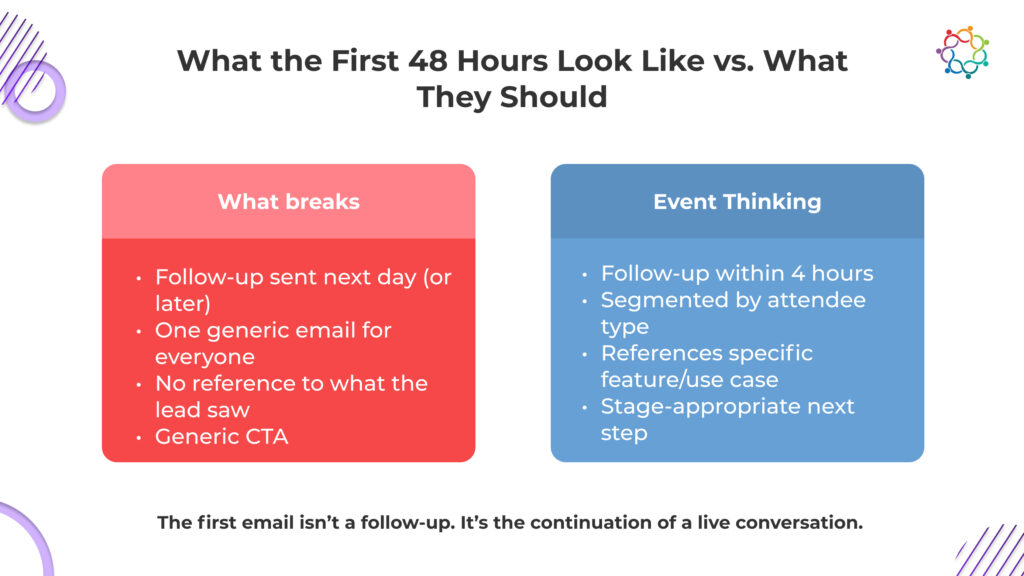
The first two diagnoses share a common trait: both are problems that are fully solvable before the event runs, not after. By the time the team realises the follow-up failed, the window has already closed.
The pattern: Most SaaS and fintech teams send the post-demo follow-up the next morning, sometimes two days later if the event ran long and the team is exhausted afterwards. By then, the lead has answered competitor emails, returned to their existing workload, and is no longer in the evaluative state the demo created. The follow-up arrives in a different mental context than the one it was meant to reach.
The fix: Build a same-day follow-up trigger into the demo day operations plan before the event runs, not as an afterthought on the day. The first email should go out within four hours of the event closing, while the attendee is still in the context of having seen the product. This is not a full nurture sequence. It is a single, short, high-relevance message that acknowledges what they saw and opens the next conversation.
One rule applies without exception: the four-hour email must reference something specific from the demo. Not a generic recap. A specific feature, a use case that was covered, or a moment from the session that connects back to what was demonstrated. Generic acknowledgement at this stage is indistinguishable from a mass send.
The pattern: A single follow-up email goes to every demo day attendee regardless of which product track they saw, which use case resonated with them, or what stage of evaluation they indicated they were in. The prospect who was one conversation away from a trial receives the same email as the partner who attended for context.
The fix: Segment the follow-up into at least three tracks before the event. First-time prospects seeing the product for the first time get one message and CTA. Existing customers evaluating an expansion or new feature get a different one. Partners or influencers attending for context get a third. Each track needs a different message, a different CTA, and a different sales routing path. The segmentation is simple, but it has to be planned before the event, not assembled from a spreadsheet the morning after.
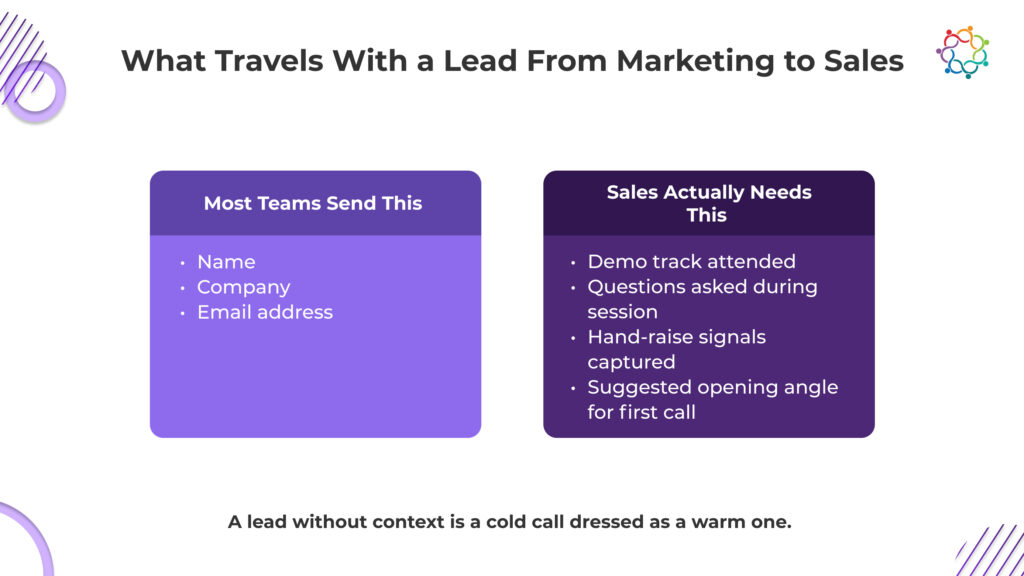
The third and fourth diagnoses happen at the boundary between marketing and sales, and they are where the most avoidable pipeline losses occur. Both are structural problems, not performance problems.
The pattern: Demo day ends, and the full attendee list is sent to the sales team as a single batch. No scoring, no segmentation, no indication of which conversations were hot, which were exploratory, and which were people who attended because the session was convenient. Sales reps spend equal time on unequal leads, and the highest-intent prospects receive the same generic outreach as everyone else on the list.
The fix: Run a rapid lead scoring pass within 24 hours using behavioural signals captured during the demo. Which attendees requested a follow-up meeting? Who stayed for the full session? Who asked product-specific questions in the Q&A? Who visited a specific feature track more than once? These signals are proxies for intent that most teams capture passively and then ignore entirely.
The scoring does not need to be complex. A three-tier system, immediate follow-up, standard nurture, and long-term keep-warm, applied consistently after every demo day, outperforms a sophisticated model that gets used each time differently.
The pattern: The lead arrives in the sales rep’s queue with a name, a company, and an email address. No context on which demo track they attended, what questions they asked, or what specifically interested them. The rep opens with a generic discovery call, and the lead experiences the conversation as starting from zero despite having just attended a detailed product demonstration.
The fix: Create a lead briefing template that travels with every demo day lead into the CRM. It should include: demo track attended, session duration, questions asked or submitted, hand-raise signals captured, and a suggested opening angle for the first sales conversation based on what the lead actually engaged with. The rep’s first call should pick up where the demo left off, not start from an introduction.
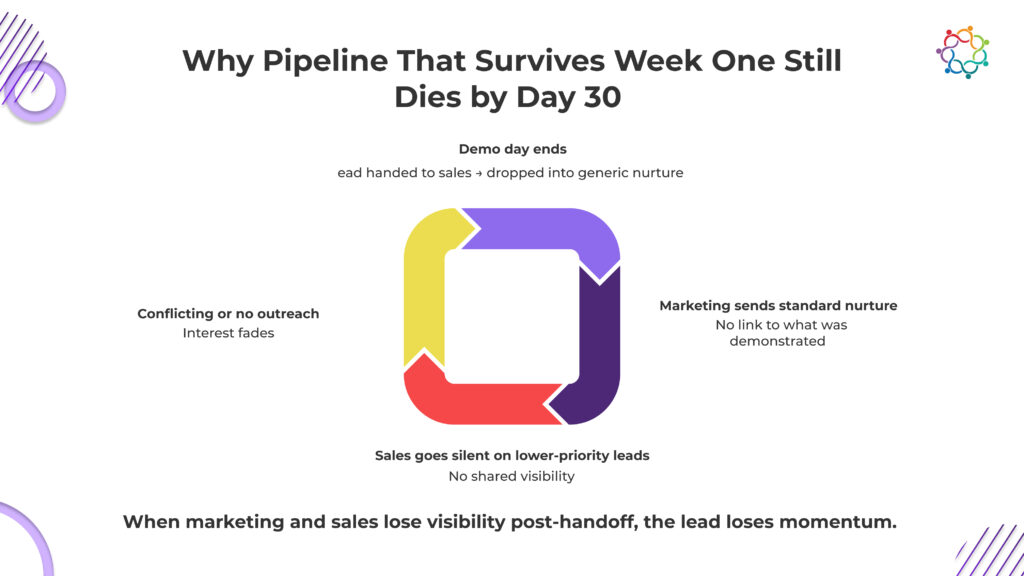
The fifth and sixth diagnoses are slower-burning. The leads that made it through the first week are still active, but the system around them is quietly eroding the interest that the demo created.
The pattern: Leads that do not convert immediately get dropped into the standard marketing nurture sequence. Blog posts, product newsletters, and general case studies with no connection to the specific product they saw demonstrated or the specific problem that resonated with them during the event. The nurture continues the relationship in name only. In practice, it severs the thread the demo started.
The fix: Build a demo day-specific nurture track that runs for 21 days post-event. Every piece of content in the sequence should connect directly to what was demonstrated. Day three sends a case study from a company in the same industry using the specific feature the attendee saw. Day seven delivers a short video of the exact use case most relevant to their role. Day fourteen offers a live Q&A session exclusively for demo day attendees. The thread of the demo should run through every touchpoint in the sequence, not disappear the moment the attendee is handed to a generic programme.
The pattern: Marketing hands off the leads, sales begins working them, and the two functions lose visibility into each other’s activity entirely. Marketing continues sending nurture emails to leads already in active sales conversations. Sales stops following up on leads that marketing is actively warming. The lead receives a confusing, uncoordinated experience that signals the vendor does not have its operations in order.
The fix: Create a shared demo day pipeline view in the CRM that both sales and marketing can see and update in real time. Define clear ownership handoff triggers: at what point does a lead move from marketing nurture to sales ownership, and what happens to leads that sales has deprioritised. Without defined triggers, both teams default to their own assumptions, and the lead falls between them.
Every diagnosis above is real. Every fix is worth implementing. But there is an upstream problem that makes all of them necessary in the first place, and most teams never get to it because the post-event failures absorb all the attention.
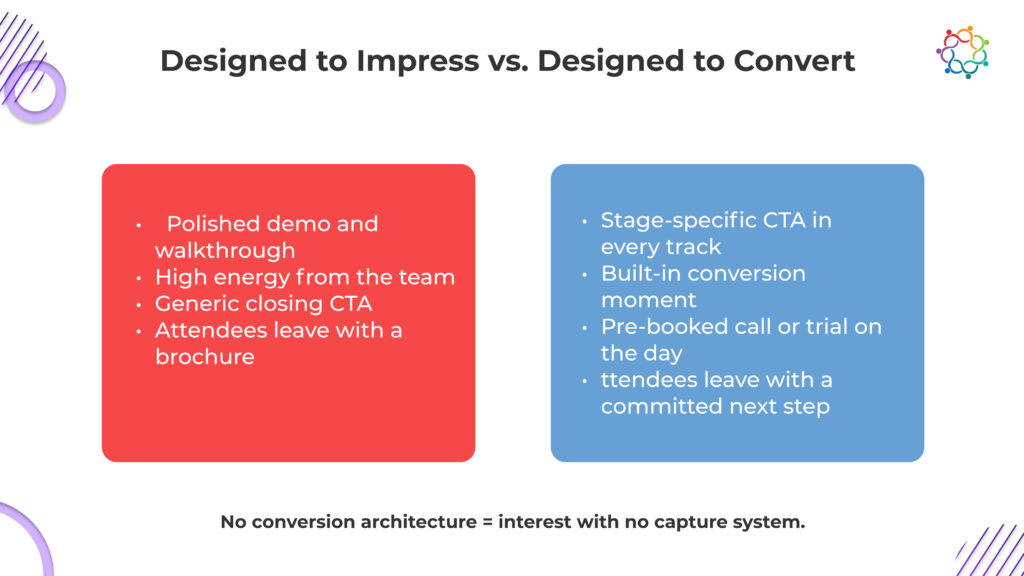
Most demo days are designed to impress. A converting demo day is designed to move a specific audience from one buying stage to the next, and those are not the same thing.
An impressive demo day is built around the product at its best: polished presentation, live feature walkthrough, energetic team, and a room that leaves them feeling good about what they saw. A converting demo day is built around moving a specific audience from one buying stage to the next. Every agenda element is designed to lower the friction to a specific next step, not to showcase the product.
The structural differences are specific:
If the demo day agenda does not have a conversion architecture built into it, the event is generating interest with no system to catch it. The pipeline drop-off is not a follow-up problem. It is an event design problem, and fixing the follow-up without addressing the design will produce marginal improvement at best.
The demo day pipeline does not disappear because buyers lost interest. It disappears because the system designed to hold that interest was not built for the specific urgency of a post-demo lead. The buyer moved on because something else filled the space the follow-up failed to occupy.
Look at the last demo day debrief your team ran. If it covered attendance numbers and lead volume but not follow-up speed, segmentation depth, or conversion rate by day 30, the wrong things were measured. Run it again with these seven diagnoses as the agenda.
A great demo earns the right to a second conversation. The follow-up system decides whether that conversation ever happens.
The Demo Day Conversion Audit Template covers all seven diagnosis areas with a self-scoring column, a fix priority ranking system, a 30-day implementation checklist, and the Demo Day Conversion Timeline that maps the full pre/during/post system visually.
Samaaro captures the behavioural signals from your demo day session attendance, booth engagement, hand-raise moments and routes them into your CRM with the context your sales team needs to follow up while the interest is still warm. See how it works.