Samaaro + Your CRM: Zero Integration Fee for Annual Sign-Ups Until 30 June, 2025
- 00Days
- 00Hrs
- 00Min


Key Takeaways (TL;DR)
1
2
3
→
Bottom Line:
healthcare event marketing, without capturing genuine physician insight, reinforces preconceptions rather than improves strategy.
Healthcare event marketing generates a constant stream of visible signals. Rooms fill up. Sessions run smoothly. Physicians ask questions, nod along, and stay engaged through discussions. On the surface, it looks like alignment is happening.
It is not.
What you are measuring is behavioral compliance, not cognitive response. Physicians are trained to engage professionally, listen actively, and participate constructively. That behavior creates the appearance of resonance, even when critical evaluation is happening internally.
Most healthcare event dashboards do not capture thinking. They capture movement. They record who showed up, how long they stayed, and whether they interacted. None of that explains what they actually believed, challenged, or rejected.
This is where Insight Blindness begins. You are not missing data. You are interpreting the wrong signals as truth.
The more polished the event, the stronger this illusion becomes.
This blog examines how this illusion forms, where physician thinking disappears, and why it creates a strategic risk for healthcare organizations.
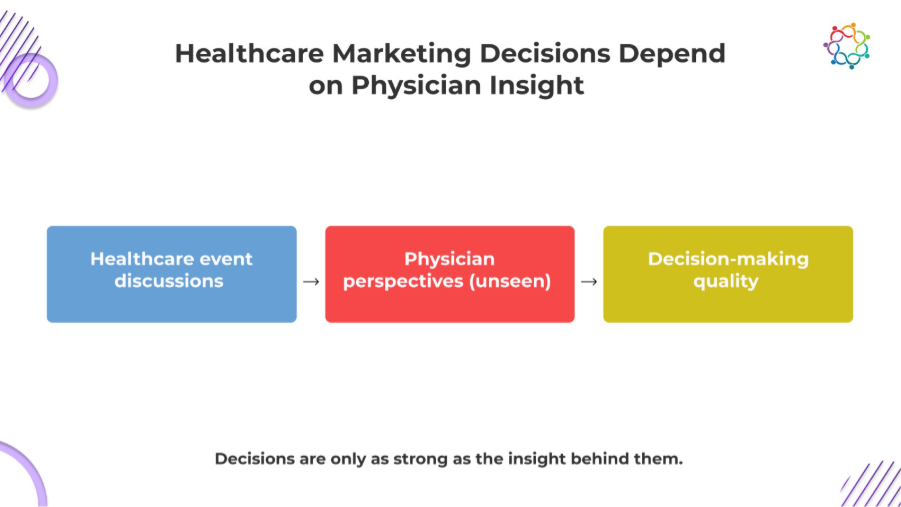
Healthcare marketing decisions are not abstract. They directly influence how therapies are positioned, how education is structured, and how physicians interpret clinical value. These decisions require a precise understanding of medical stakeholder thinking.
Physicians are not passive recipients of information. They evaluate, compare, question, and filter every clinical message they encounter.
Their perspectives shape:
This is not optional context. It is the foundation of an effective strategy.
Healthcare events bring together doctors, experts and clinical leaders in a high intensity environment where specific topics are discussed in full. These are rare moments. They bring together their expertise and practical experience in one place.
But the opportunity is gone if the group walks away with only a list of who showed up and for how long.
You are left to determine what doctors do without knowing how they think.
Without insight, preconceptions take hold. Messaging is grounded in inside reality, not outward belief. Campaigns are born from apparent alignment, not from verified knowledge.
The risk is not that you know too little. It is that you believe you know enough to act.
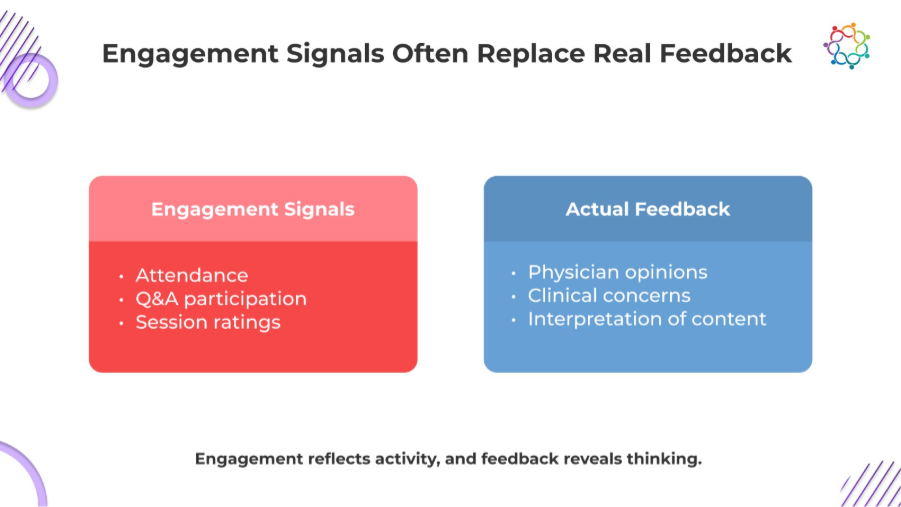
Healthcare event reporting relies on engagement because it is visible, measurable, and easy to present. That convenience creates a problem. These signals do not just lack depth; they distort reality by implying alignment where none may exist.
Full rooms = interest in the issue, not acceptance of the message. Doctors come to learn, come to assess, not to agree, but attendance is often taken as agreement.
Questions suggest that the topic has been considered, but often display perplexity, doubt, or gaps. To take them as positive affirmation is to miss the point of the exchange.
High ratings are a sign of delivery quality and event organizing. They do not verify whether the audience agreed or disputed clinical viewpoints.
You can be an active participant and silently disagree. The critical perspective may be unrecorded, with physicians engaging openly but criticizing assumptions inside.
Healthcare environments impose constraints not typical in most marketing situations. Clinical responsibility, professional hierarchy and regulatory sensitivity limit public physician communication.
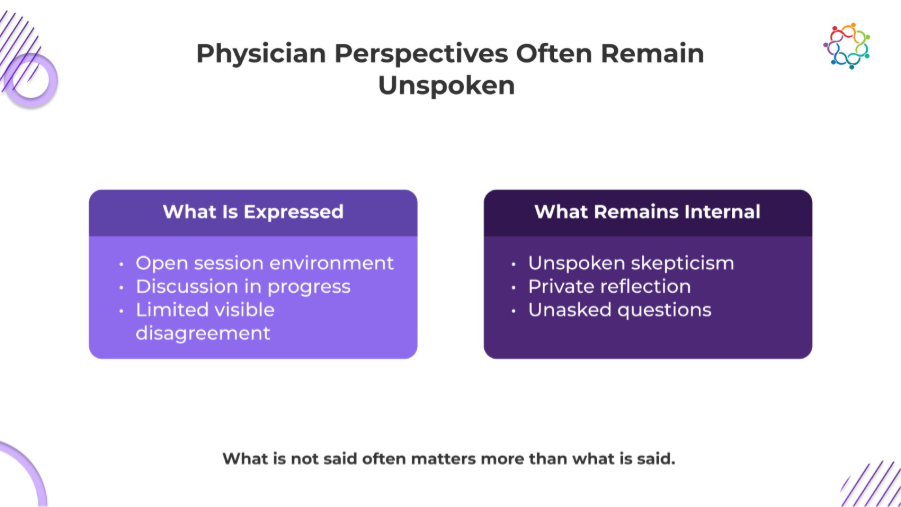
There are constraints in a healthcare context that don’t exist in other marketing situations. Clinical obligation, professional hierarchy and regulatory sensitivity influence physician communication in public.
This has a direct impact on what is said at gatherings.
“Sometimes doctors don’t question concepts in public. They do not always disagree in front of the specialist or colleagues. They often ponder things through in their own minds, process information internally, or only speak freely in informal trusted settings.
Silence, in this context, is not neutral. Silence can mean hesitation. It can mean skepticism. It can mean disagreement that is never expressed in the room.
Yet silence is frequently interpreted as acceptance.
This is where Insight Blindness becomes structurally embedded. The environment itself suppresses visible feedback, while the reporting system assumes that visible signals are sufficient. The absence of objection is treated as alignment. The absence of questions is treated as clarity.
Both assumptions are flawed.
Healthcare professionals are trained to evaluate carefully and respond selectively. What they choose not to say publicly is often more important than what they say.
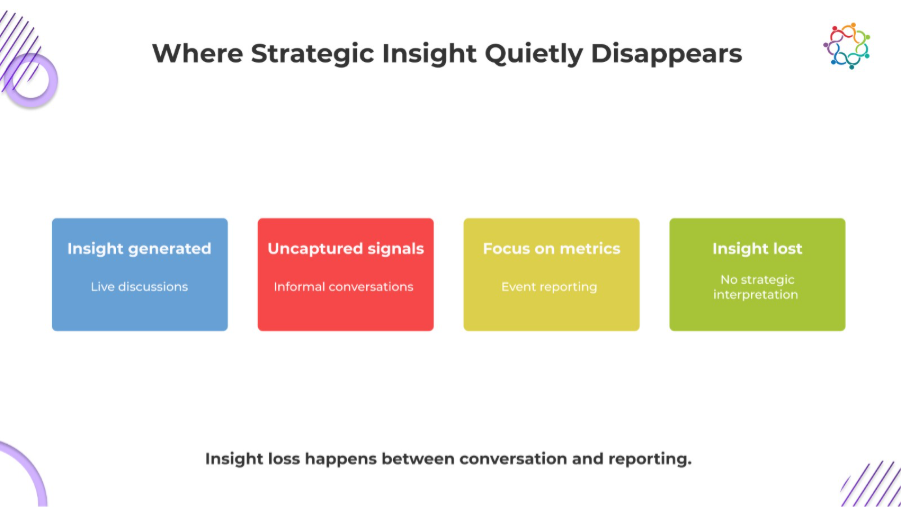
The loss of physician insight does not happen in one obvious moment. It happens across multiple points in the event lifecycle, each one quietly stripping away context that could have informed strategy.
5.1 Conversations Stay Informal
During medical conferences and physician engagement events, the most honest perspectives often emerge outside formal sessions. Hallway discussions, small group conversations, and peer exchanges carry nuanced views that never enter official records.
These conversations reveal hesitation, disagreement, and real-world challenges. Yet they remain invisible to the organization.
5.2 Event Reporting Focuses on Logistics
Post-event reports are structured around execution. Attendance numbers, session flow, and participation rates dominate the narrative.
This confirms that the event happened successfully. It does not explain what physicians took away from it.
5.3 Interpretation Never Happens
Even when fragments of feedback exist, they are rarely connected. Comments remain isolated. Observations are not synthesized into patterns. No clear view of physician sentiment emerges.
The system captures fragments, not meaning.
What you are left with is a record of activity without interpretation. The event generated signals. The organization failed to translate them into insight.
That is not a data problem. It is a strategic failure.
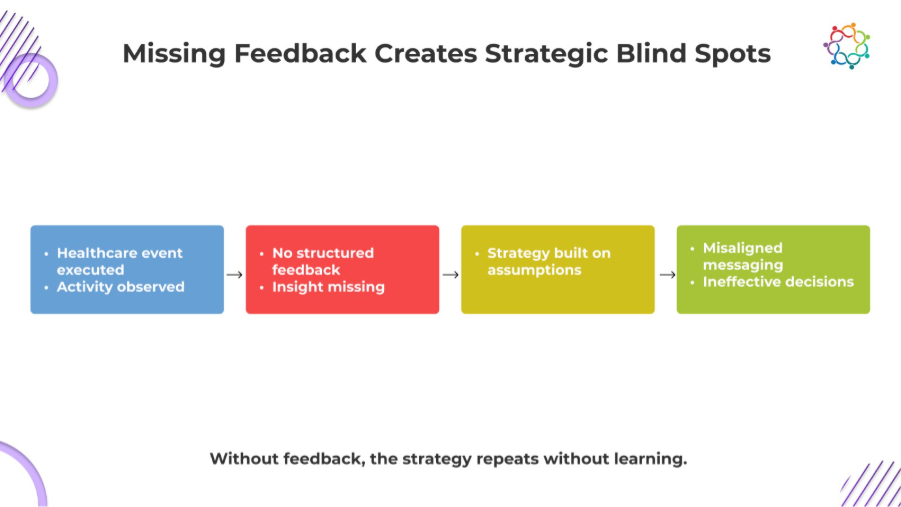
When healthcare organizations operate without clear visibility into physician thinking, decision-making does not stop. It continues. It simply becomes detached from reality.
This is where Insight Blindness turns into a strategic blind spot.
Marketing teams begin to assume alignment. They interpret engagement as agreement. They believe their clinical positioning resonates because nothing visibly contradicts it.
But physicians may have left the event with:
Without insight into these perspectives, leadership has no way to detect the gap.
You are not operating with partial clarity. You are operating blindly.
The most dangerous part is that the system reinforces itself. Positive metrics validate decisions. Decisions lead to similar events. Similar events produce similar metrics.
At no point is the underlying assumption challenged. This creates a closed loop where strategy is continuously refined without ever being corrected.
Healthcare events are not just engagement platforms. They are concentrated environments of real-world clinical thinking. You bring together physicians who actively treat patients, interpret evidence, and make decisions that directly impact outcomes. That density of perspective is rare.
In these settings, signals emerge constantly. Not in formal sessions, but in reactions, side conversations, hesitation points, and the types of questions that surface. These are early indicators of resistance, confusion, and adoption barriers.
If you are not extracting that, you are not just missing insight. You are actively wasting access to it.
Every event already contains answers to questions your strategy is trying to solve. Why is adoption slow? Where messaging breaks. What physicians do not trust.
If those signals leave the room with the audience, your event delivered activity but retained nothing of strategic value.
When you do not understand the physician’s thinking, the strategy does not pause. It continues, just without correction. That is where the risk compounds.
You repeat messaging because it appeared to work. You scale programs based on engagement signals that never reflect real alignment. You invest more into narratives that may already be breaking down in the minds of physicians.
This is how inefficiency becomes embedded.
Budgets get allocated to reinforce assumptions. Clinical communication drifts away from actual concerns. Opportunities to address skepticism are missed before they are even identified.
The result is not immediate failure. It is slower adoption, weaker influence, and increasing reliance on tactics to compensate for misalignment.
At that point, the issue is no longer execution. It is direction.
You are not optimizing the strategy. You are reinforcing errors with confidence.
Healthcare event marketing continues to expand in scale and sophistication, but the core flaw remains unchanged. It measures what is visible and assumes it reflects what matters. Attendance, engagement, and satisfaction create a convincing story, but not an accurate one.
If you are not capturing how physicians actually think, you are not refining strategy. You are reinforcing assumptions.
This is where most organizations get it wrong. They do not lack data. They lack truth.
And when strategy is built on signals that only look right, healthcare event marketing stops being an advantage.
It becomes a confident, well-funded misdirection.