Samaaro + Your CRM: Zero Integration Fee for Annual Sign-Ups Until 30 June, 2025
- 00Days
- 00Hrs
- 00Min


Key Takeaways (TL;DR)
1
2
3
→
Bottom Line:
events restore speed by forcing concentrated, time-bound interactions that drive alignment and accelerate decisions.
Digital-first strategies have expanded B2B engagement at scale. Buyers now have unlimited access to content, constant touchpoints, and the ability to evaluate solutions on their own terms. On the surface, this looks like progress. More activity, more visibility, more informed buyers.
But this is where the Digital Velocity Trap takes hold.
More content does not just slow down decisions. It gives buyers structured reasons to delay them. Every new asset adds another comparison, another angle, another layer of doubt. Instead of moving forward, buyers expand their evaluation.
There is no pressure to commit. No moment that forces a decision. Only continuous access that keeps the process open.
The execution impact is immediate. Sales inherits buyers who are informed but not ready. Conversations restart instead of progressing.
The revenue consequence follows. Pipeline builds, but velocity drops. Deals stretch without clear timelines.
Digital channels increase access. They do not enforce movement toward decisions.
This blog explains why digital-first strategies fail to maintain decision speed and why events continue to exist as a mechanism to force buyer movement.
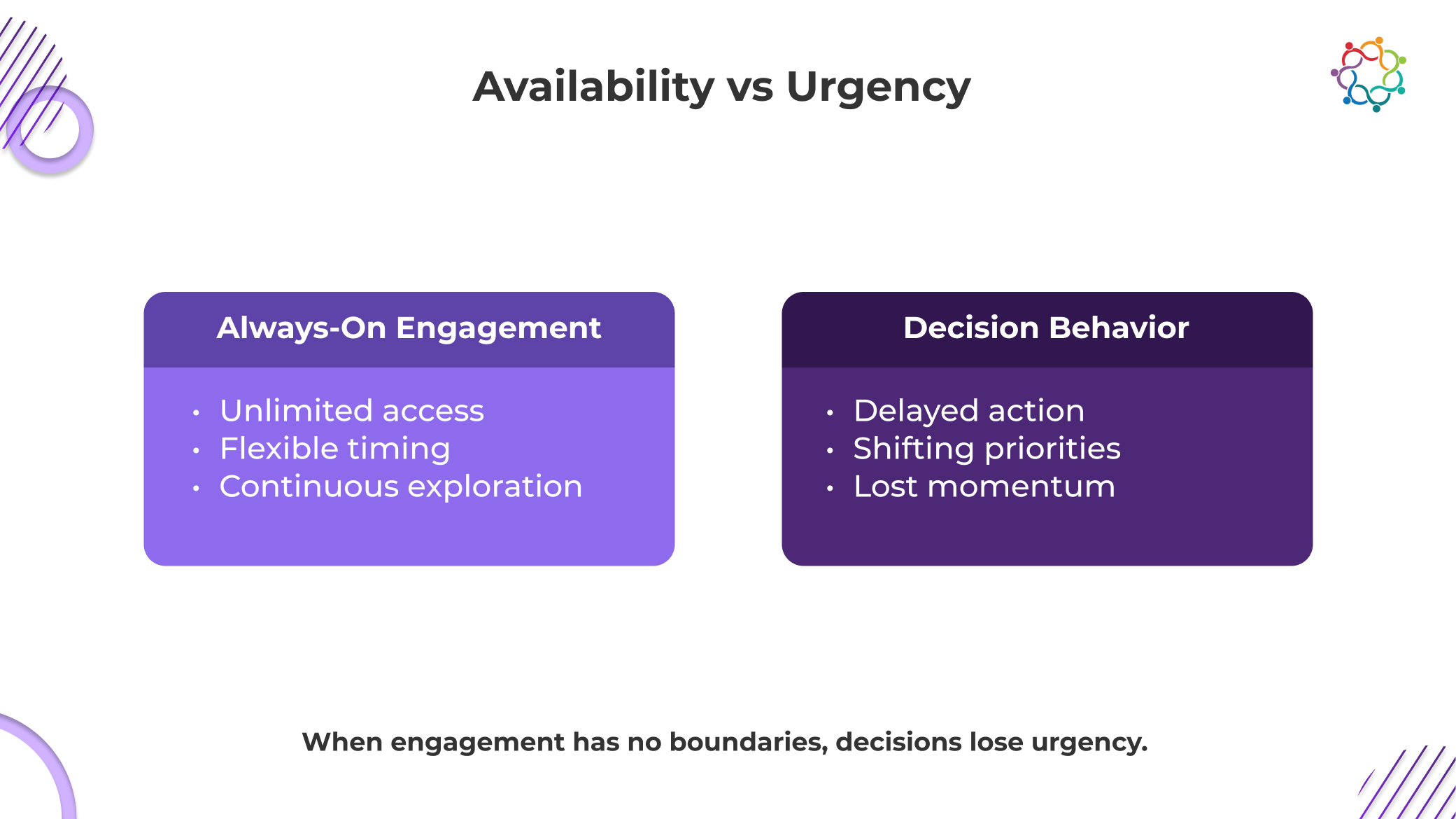
Digital-first marketing is built on availability. Buyers can engage anytime, from anywhere, at any stage of their journey. This flexibility is positioned as a strength. In reality, it removes the very thing that drives decisions.
Urgency.
The digital velocity trap deepens here because nothing forces a buyer to act. There is no deadline, no constraint, no moment of commitment. Evaluation becomes open-ended.
This is not inefficiency. It is rational behavior. When risk feels distributed over time, there is no incentive to compress decisions.
The execution impact is severe. Demand generation programs continue to produce engagement, but that engagement lacks direction. Sales teams chase activity, not intent. Conversations lose urgency because buyers do not feel compelled to resolve uncertainty.
The revenue consequence follows. Sales cycles extend. Opportunities linger in mid-funnel stages. The pipeline becomes inflated but inactive.
Digital marketing optimizes for constant access. Revenue depends on forced progression. Always-on engagement does not accelerate decisions. It eliminates the conditions required to make them.
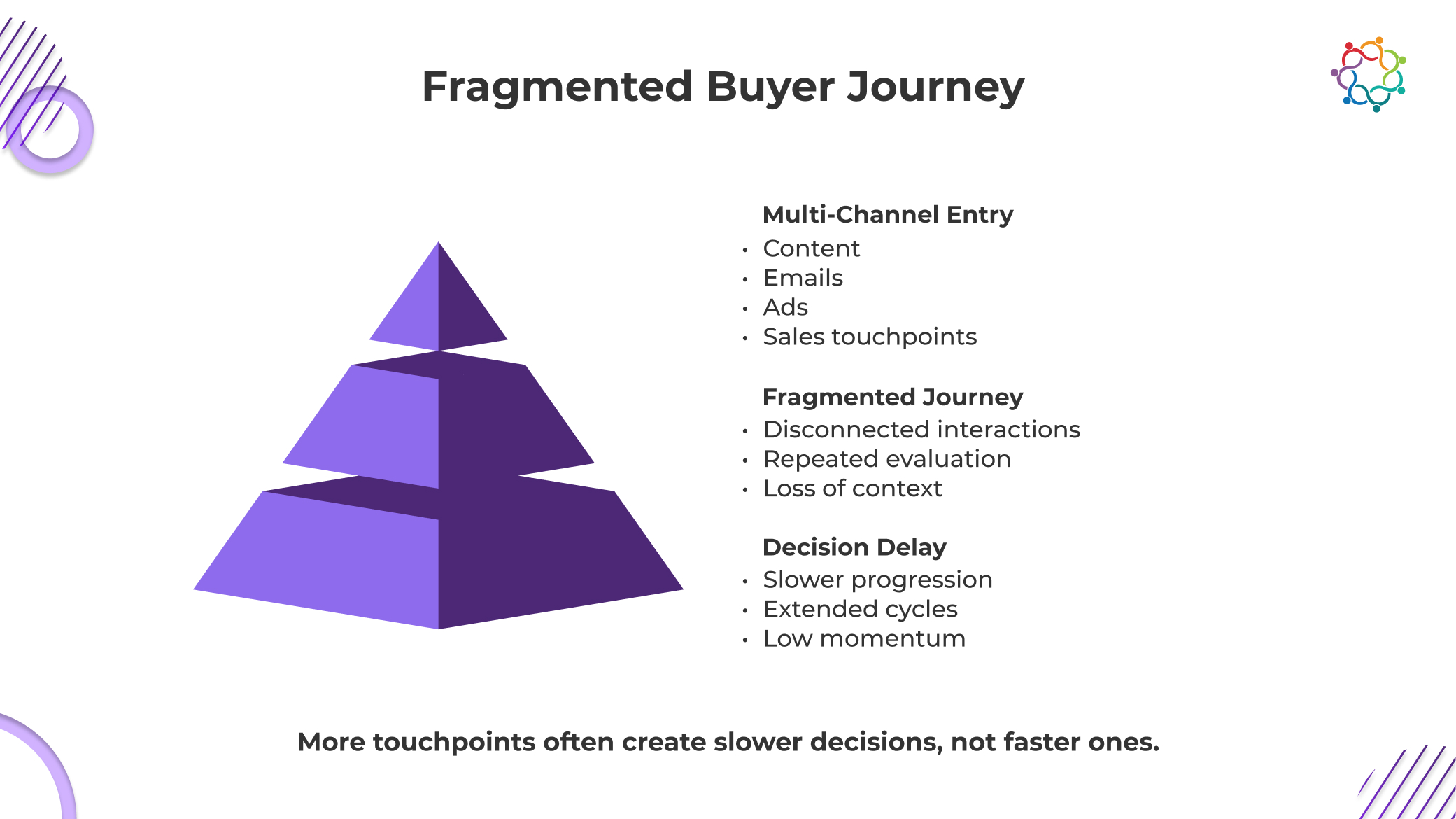
Digital-first strategies create more touchpoints than ever before. Content hubs, email nurtures, paid campaigns, sales outreach, and product demos. Each interaction is designed to move the buyer forward.
In reality, they rarely do.
When misalignment happens, these touchpoints do not connect into a single progression. They exist as isolated moments. Buyers move between them without continuity, which fundamentally alters how decisions are made.
The critical issue is not fragmentation itself. It is what fragmentation causes. Buyers do not build momentum. They restart the evaluation.
Every new interaction becomes a fresh entry point rather than a continuation. A new stakeholder joins and asks questions that have already been answered. A new piece of content reframes the problem. A new comparison introduces doubt.
The execution impact becomes clear quickly. Sales teams repeat conversations. Context is lost between interactions. Alignment across buying groups takes longer because no shared progression exists.
From a buyer psychology perspective, this makes the delay feel safe. When decisions are spread across multiple channels and timelines, the perceived risk of waiting decreases. There is always another input to consider. Another perspective to validate.
The revenue consequence compounds over time. Deals cycle through extended evaluation loops. Pipeline stages become less predictive. Movement slows, even as engagement increases.
More touchpoints do not accelerate decisions. They multiply the opportunities to hesitate.
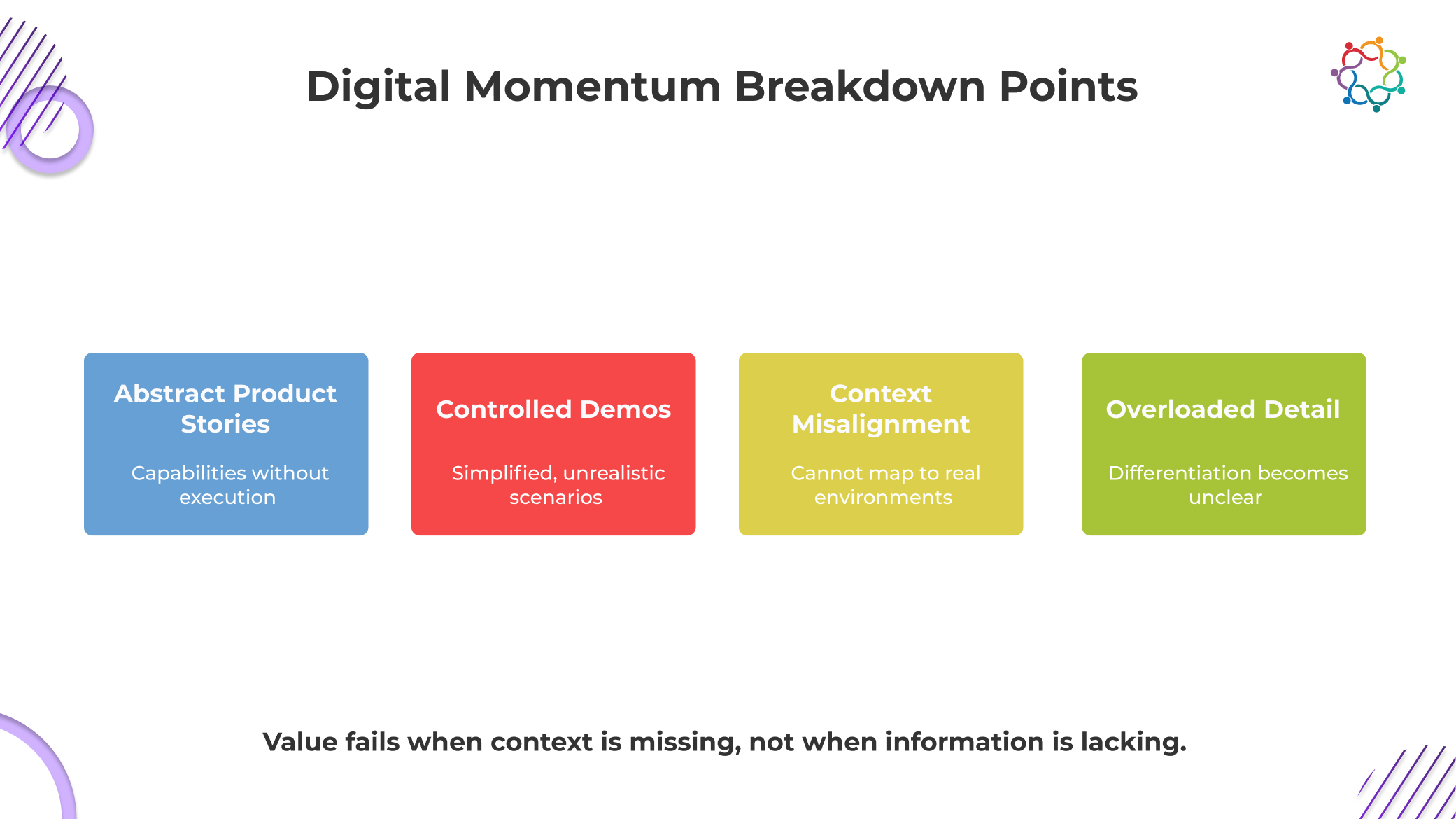
The slowdown in decision speed is not random. It is structural. Digital-first environments are not designed to create commitment. They are designed to sustain engagement.
The Digital Velocity Trap becomes visible at specific points in execution where momentum consistently breaks.
No single interaction carries enough weight to drive commitment. Buyers split attention across content, platforms, and conversations. Focus is diluted, and no moment stands out as decisive.
Digital interactions tend to remain surface-level. Initial engagement happens through content or asynchronous communication. Deep conversations require scheduling, alignment, and follow-ups. By the time they happen, momentum has already weakened.
Stakeholders interact in various contexts, at various times, and via various channels. Instead of being a decision-making process, alignment turns into a coordinating issue.
Evaluation goes on forever in the absence of clear situations that compel advancement. Because there is no incentive to stop, buyers continue to explore.
The sharper insight here is simple. In digital environments, no single moment forces a decision.
The execution impact is prolonged indecision. Sales teams operate in a reactive mode, trying to pull buyers forward without leverage.
The revenue consequence is predictable. Pipeline slows, forecasting weakens, and deal velocity declines. Digital systems optimize for continuity. Decisions require interruption.
This is where the role of B2B events marketing becomes clear. Not as a legacy channel, but as a structural counterweight to digital slowdown.
Events operate outside the Digital Velocity Trap because they introduce something that digital environments cannot replicate. Constraint.
Time is limited. Attention is focused. Access to stakeholders is immediate. These conditions change buyer behavior instantly.
Events do not just accelerate understanding. They force decisions into a bounded timeframe. Buyers cannot defer indefinitely because the opportunity to engage is finite.
This creates a high-intent interaction environment where decision-making accelerates naturally.
The revenue consequence is not theoretical. Decision timelines compress. Opportunities move faster through the pipeline. Alignment happens in hours or days instead of weeks.
B2B events marketing does not replace digital programs. It compensates for their inability to create urgency.
Without these moments of forced interaction, buyers remain in extended evaluation cycles. With them, decisions regain structure and speed.
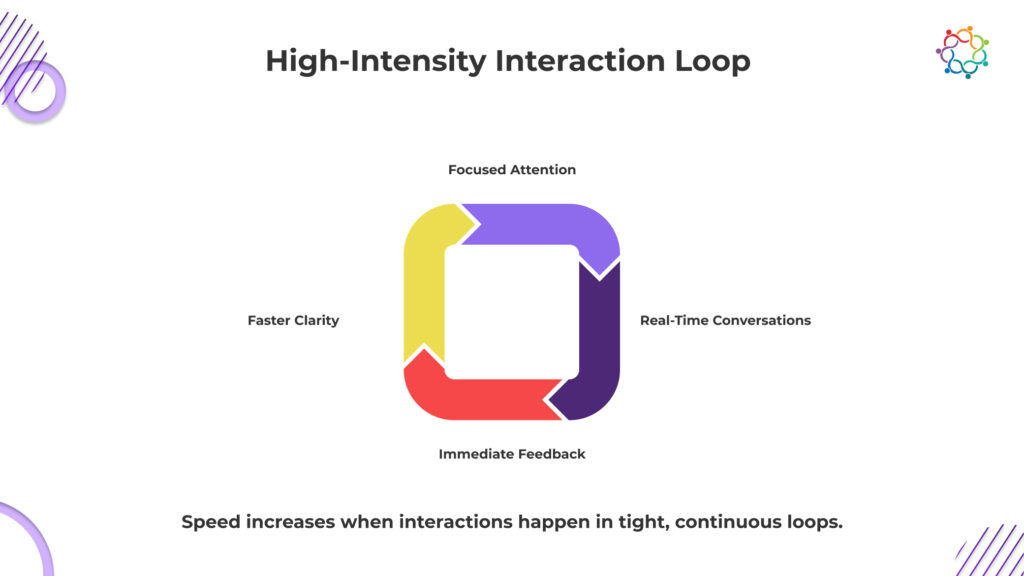
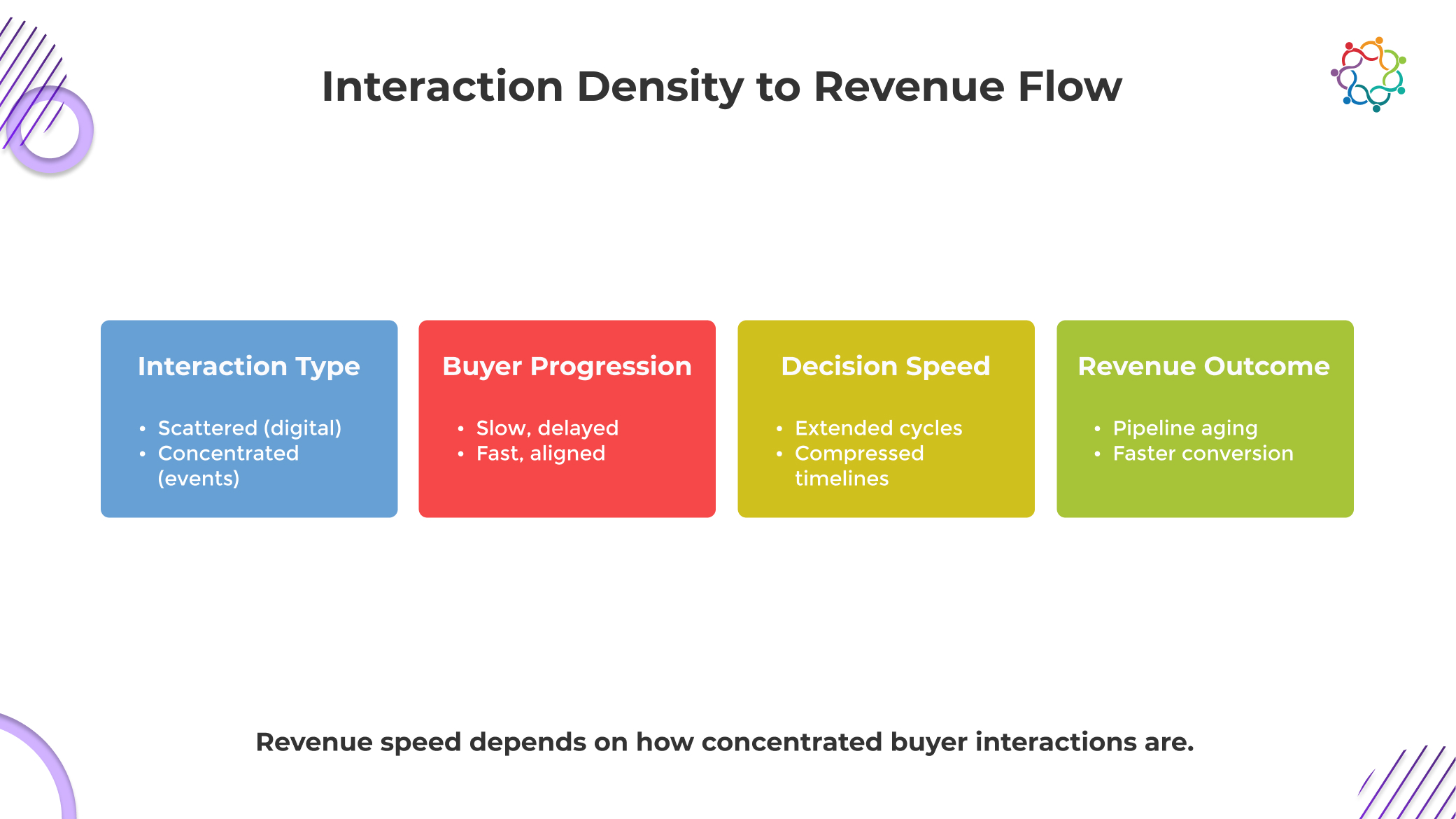
Speed in B2B does not come from how often buyers engage. It comes from how tightly those interactions are packed together. This is where the digital velocity trap quietly breaks your pipeline. Digital systems stretch conversations across days, sometimes weeks, creating gaps where momentum fades and priorities shift.
Every delay between interactions forces buyers to recontextualize the problem. They revisit earlier questions, reopen internal discussions, and dilute urgency. What should be progression becomes repetition.
Concentrated interaction changes this dynamic completely. When conversations happen back-to-back, decisions build on continuity. Questions are resolved before doubt compounds. Stakeholders align while context is still shared.
If your interactions are spread out, your deals will slow down. There is no workaround.
The execution impact is simple. Either you control the pace of interaction, or the buyer defaults to delay.
Speed is not about maintaining engagement. It is about removing the time gaps that allow decisions to drift.
When decision speed drops, the damage does not stay in the pipeline. It shows up directly in revenue performance. The digital velocity trap turns what looks like a healthy funnel into an inefficient one.
Opportunities accumulate but do not convert at the expected rate. Pipeline volume increases, but movement stalls. This creates a misleading sense of growth while actual revenue realization slips further out.
Longer sales cycles drive up acquisition costs. More touchpoints, more follow-ups, more time from sales and marketing teams. You are spending more to close the same deal, often with lower certainty.
Missed timing becomes the real cost. Deals that should close within a defined window drift, pushing revenue into future periods or losing it entirely. Forecasting becomes guesswork because timelines are no longer dependable.
If decisions are slow, revenue is slow. It is that direct.
You are not facing a demand problem. You are operating with a speed problem that compounds across every stage of the funnel.
Despite clear signs of slowing decision velocity, most organizations continue to prioritize digital-first strategies. Not because they perform better, but because they are easier to justify.
The misalignment persists because digital success is measured through activity. Reach, engagement, and lead volume create visible proof of performance. These metrics are immediate, scalable, and easy to report upward.
Speed is none of those things. It is harder to isolate, harder to attribute, and harder to defend in reporting structures. So it gets ignored.
This leads to a predictable outcome. Teams double down on what looks efficient on paper while overlooking whether deals are actually moving faster. More campaigns are launched, more leads are generated, and more content is produced.
But none of it forces decisions.
Digital is prioritized because it is cheaper to run and easier to measure, not because it accelerates revenue.
If your strategy rewards activity over movement, you are not optimizing for growth. You are systematically slowing it down.
Digital-first strategies have earned their place by scaling awareness, engagement, and demand. But scale alone does not move deals forward. When buyers have unlimited access to information, no defined timelines, and fragmented interactions, decisions slow down. Engagement increases, but progression weakens.
Events continue to matter because they reintroduce what digital lacks. Focus, immediacy, and shared decision moments. They compress conversations, align stakeholders, and force clarity within a fixed window.
If your strategy generates activity but delays decisions, it is not driving growth.
Revenue does not follow engagement. It follows decisions made on time.