Samaaro + Your CRM: Zero Integration Fee for Annual Sign-Ups Until 30 June, 2025
- 00Days
- 00Hrs
- 00Min


Key Takeaways (TL;DR)
1
2
3
→
Bottom Line:
events can clarify product value, but unless they reduce buyer doubt around execution, decisions will not move forward.
Martech companies do not fail to communicate value because channels are weak. They fail because those channels fragment value.
Product pages isolate features. Sales decks simplify workflows. Demos present controlled scenarios. Content assets explain capabilities without showing real execution. Each touchpoint delivers a partial view, never the full system.
This creates the Product Value Translation Gap.
Buyers see what the product does, but not how it actually works inside their environment. They understand components, not outcomes. They compare features, not impact. Differentiation becomes unclear because value is never experienced as a whole.
The issue is structural. When value is split across disconnected interactions, buyers are forced to assemble meaning themselves. Most cannot do this with confidence.
And without confidence, decisions stall.
Traditional channels do not fail because they lack depth. They fail because they break the continuity required to believe the product will work.
This blog explains why that gap exists and how events attempt to close it.
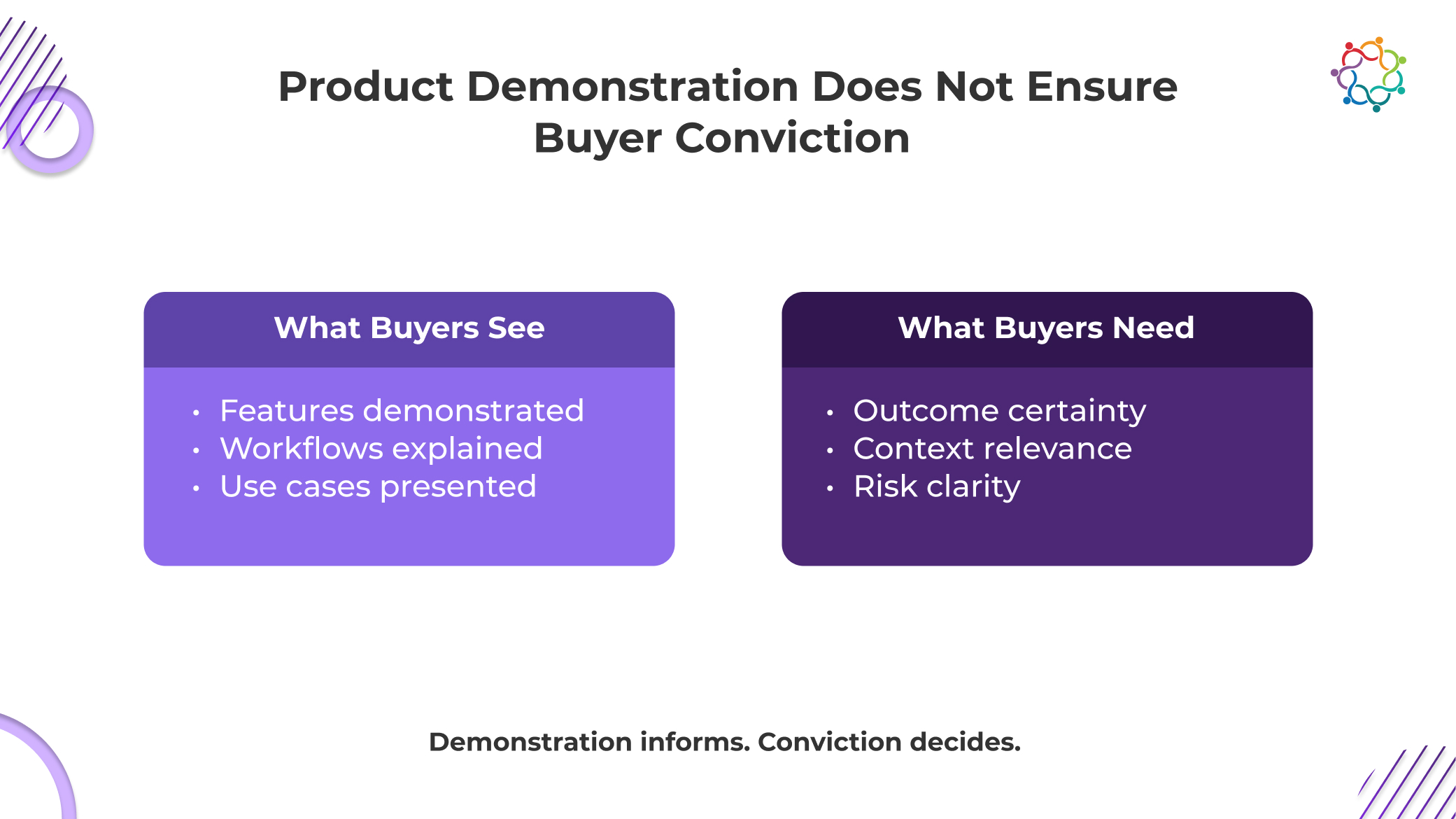
The assumption that better demos lead to better decisions is flawed.
Demos and event interactions increase exposure, not conviction. Buyers leave with a clear view of features, workflows, and use cases. They can explain what the product does. But they still hesitate when it comes to committing.
This is where deals lose momentum.
Demonstration answers what is possible.
Conviction answers what will actually work in their environment.
And that second question remains unresolved.
During martech events, engagement is high. Conversations are active. Interest feels strong. But beneath that, buyers are assessing risk, not capability.
They are asking:
These are not product questions. They are execution concerns.
When buyers understand features but do not trust outcomes, progress stalls. Visibility increases, but decisions do not move forward.
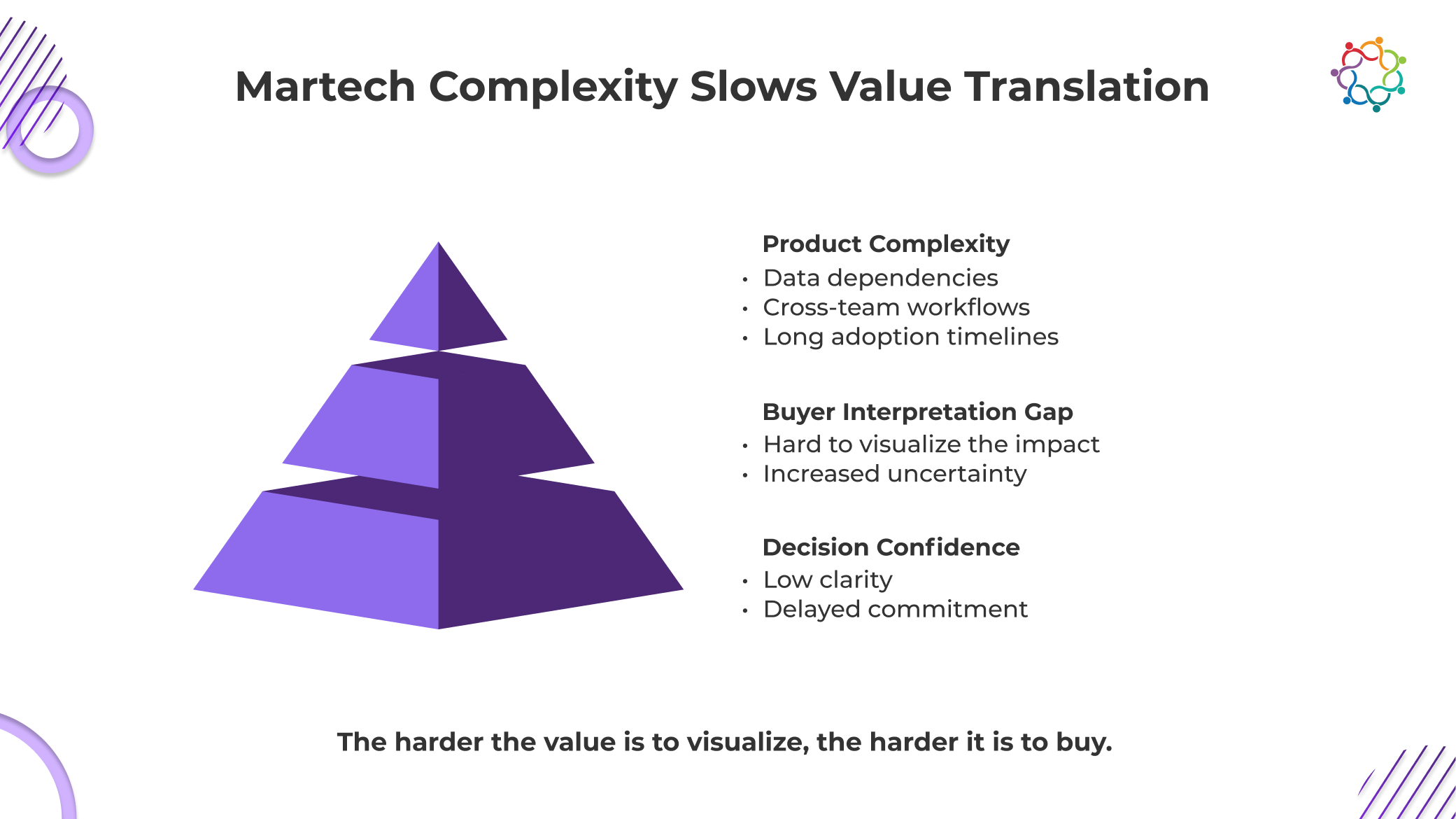
Martech products are not consumed instantly. They are implemented, integrated, configured, and adopted over time.
That reality introduces friction that no demo can fully resolve.
Complexity is often framed as a communication challenge. It is not. It is a risk amplifier.
Every integration dependency, every data flow, every cross-functional touchpoint increases uncertainty. Buyers are not just evaluating the product. They are evaluating their ability to make it work.
This is where the Product Value Translation Gap deepens.
The more complex the product, the harder it becomes for buyers to simulate success in their own environment. They cannot easily visualize end-to-end execution. They cannot confidently predict outcomes. And when prediction fails, hesitation begins.
This is why martech buying cycles expand even when interest is high.
Buyers are not delaying because they are unconvinced of the potential. They are delaying because they are unconvinced of execution.
And execution is where most martech investments fail.
Until buyers believe that implementation will succeed within their messy systems, no amount of product demonstration will convert into decision confidence.
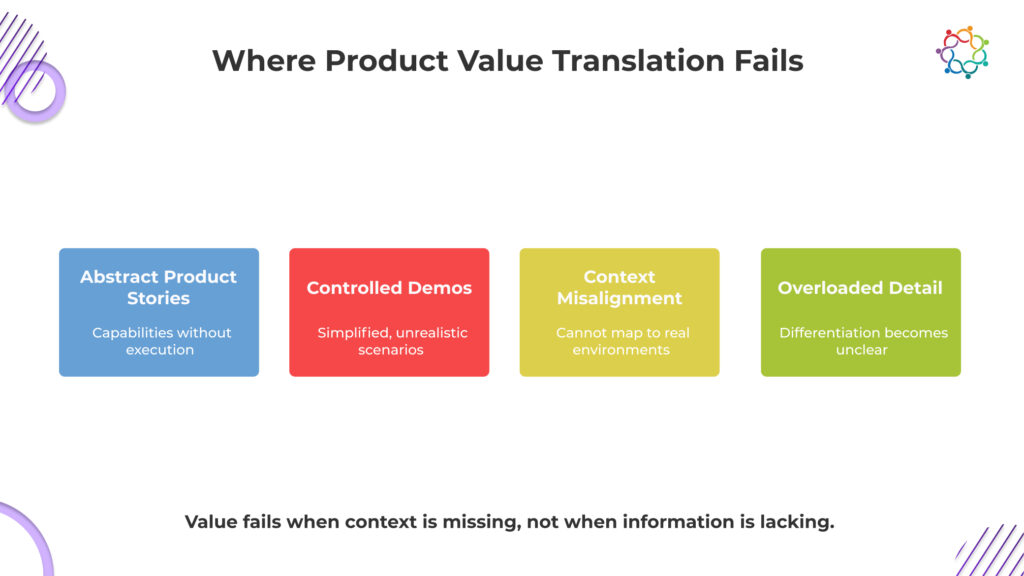
The breakdown is not random. It happens at predictable points, but most teams fail to confront how severe the impact actually is.
Messaging explains capability but avoids operational reality. It highlights what the product enables without showing what it demands. Buyers are left with a clean narrative that does not reflect real execution.
This creates a dangerous mismatch between expectation and reality.
Demos are controlled environments. They remove friction, simplify workflows, and eliminate edge cases. But real usage is messy.
When buyers realize this gap, confidence drops. The demo becomes a best-case scenario, not a reliable indicator of success.
Every organization has unique systems, data structures, and team dynamics. Generic demonstrations fail to translate because they do not account for this variability.
Buyers are forced to mentally adapt the product to their context. Most cannot do this accurately.
More information does not create clarity. It reduces it.
This is the uncomfortable truth most teams avoid: clarity decreases as information increases when that information lacks structure.
Buyers are overwhelmed with features, integrations, and use cases. Instead of identifying what matters, they lose the ability to prioritize.
The result is paralysis.
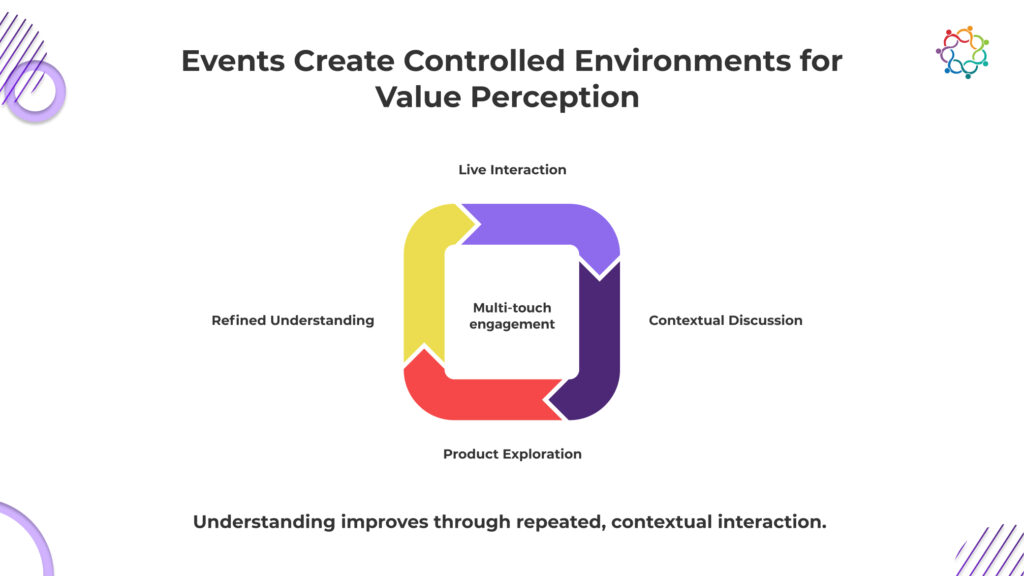
Martech events are not valuable because they are interactive. They are valuable because they compress understanding into a shorter window.
Unlike traditional channels, events allow multiple layers of value to be explored in rapid succession. Conversations evolve. Questions deepen. Context builds. Buyers engage with the product from different angles within a limited timeframe.
This compression is what makes such events effective.
This is not about better storytelling. It is about accelerated sense-making.
Events force buyers to confront the product more directly. They reduce the distance between exposure and evaluation.
But this does not eliminate the Demo-to-Decision Gap. It only narrows it temporarily.
Because even in compressed environments, the same underlying issue remains. Buyers still need to believe the product will work in their reality. And compression without validation can create false confidence.
This is why many martech events generate strong engagement but inconsistent outcomes. Understanding improves, but belief still lags.
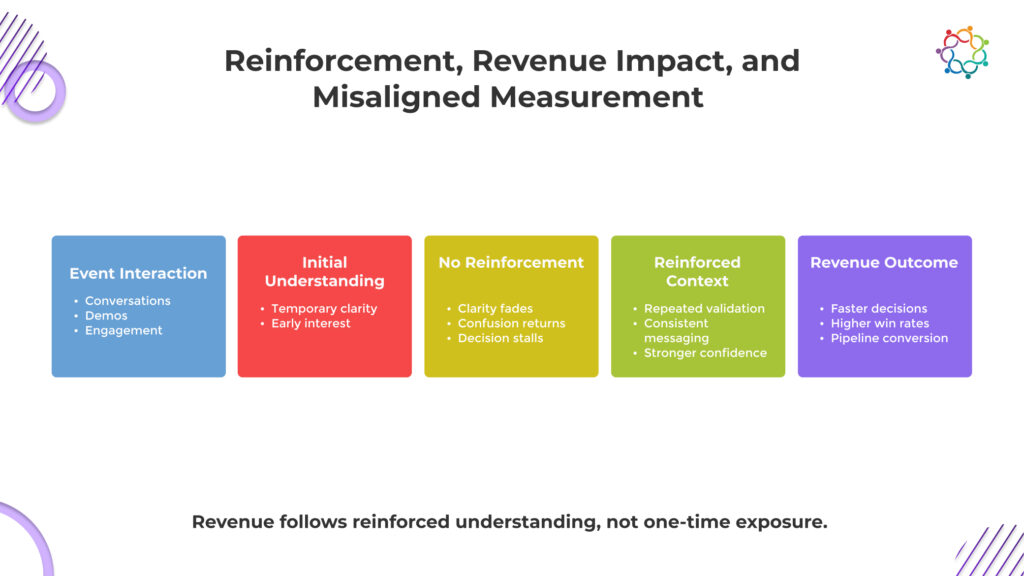
Initial understanding is fragile. It decays quickly when it is not reinforced.
This is where most martech strategies collapse.
Events create a moment of clarity. Buyers connect features to use cases. They begin to see potential. But once they return to their environment, that clarity is tested against reality.
And reality is more complex than any event interaction.
This is not the same as demonstration failure. This is reinforcement failure.
Value does not disappear because it was poorly explained. It disappears because it was not validated repeatedly against real-world conditions.
Without this reinforcement, doubt resurfaces. And when doubt resurfaces, decision confidence collapses.
This is why post-event momentum often fades. Not because interest was weak, but because belief was never stabilized.
The Product Value Translation Gap is not closed in a single interaction. It requires consistent alignment between what was demonstrated and what is actually possible.
If that alignment breaks, buyers default to caution. And caution delays revenue.
When buyers are not fully confident in how a product will perform in their environment, revenue impact shows up immediately. Deals do not collapse. They slow down and become harder to close.
Evaluation stages stretch as more stakeholders get involved to reduce uncertainty. Procurement cycles extend. Internal alignment takes longer. What should have been a clear decision turns into prolonged validation.
This delay creates direct commercial pressure. Sales teams rely more on discounting to push deals forward. Margins shrink. Customer acquisition costs rise because more time and effort are required per opportunity.
At the same time, payback periods extend, weakening overall revenue efficiency. Pipeline may look strong, but conversion weakens underneath.
Martech companies continue investing in martech events, expecting acceleration. Instead, they often get volume without velocity.
Product value is not proven when it is presented. It is proven that buyers are willing to move forward without hesitation.
Most organizations continue to treat events as lead engines because measurement systems demand it. Performance is judged by leads generated, meetings booked, and pipeline created.
These metrics are easy to track and easy to report. They create a sense of progress, even when actual buying decisions remain unchanged.
As a result, marketing tech events are optimized for activity, not understanding. More attendees are targeted. More conversations are initiated. More opportunities are logged into the system.
But none of this guarantees that buyers have gained enough clarity to make a decision.
This creates a disconnect between reported success and actual revenue impact. Events look productive on dashboards while deals continue to stall in later stages.
The problem is not execution effort. It is what teams are incentivized to measure.
As long as volume defines success, events will prioritize acquisition over real product evaluation.
Martech companies rely on martech events because product value is difficult to communicate in fragmented environments. Standard channels distribute information but fail to create belief. Buyers see the product, but they cannot trust it within their own systems.
Events provide a temporary solution by compressing understanding. They create moments where value becomes clearer, faster.
But clarity is not enough.
If that clarity does not translate into decision confidence, the impact is limited. The role of marketing tech events is not to showcase the product. It is to reduce buyer uncertainty to the point where a decision feels safe.
Because that is the real barrier. Not awareness. Not features. But belief.
Martech events exist because buyers don’t struggle to see the product. They struggle to believe it will work in their reality.
If your events increase visibility but fail to reduce that doubt, you are not accelerating revenue. You are just making hesitation more informed.