Samaaro + Your CRM: Zero Integration Fee for Annual Sign-Ups Until 30 June, 2025
- 00Days
- 00Hrs
- 00Min


Key Takeaways (TL;DR)
1
2
3
→
Bottom Line:
Pharma events create exposure, but without feedback intelligence, they cannot strengthen engagement, trust, or long-term scientific influence.
Healthcare professionals no longer attend events because access is rare. They attend because access is abundant. Congresses, medical education events, digital symposia, and pharmaceutical briefings now compete continuously for their attention. Attendance has become routine. Presence no longer guarantees impact.
This is where pharma organizations misread success.
Within pharma event marketing, participation metrics create early reassurance. Large HCP audiences attend. Scientific sessions are delivered. Internal dashboards confirm scale. From the outside, engagement appears strong.
But participation does not reveal what actually happened inside the HCP’s mind.
Organizations cannot clearly see what was understood, what was questioned, or what was dismissed. They cannot confidently determine whether perception strengthened or remained unchanged.
This blog examines why that visibility gap exists. It explains how pharmaceutical events structurally fail to generate engagement intelligence, how that failure weakens long-term healthcare professional engagement, and why events must evolve into feedback-driven learning systems rather than remaining exposure-driven communication channels.
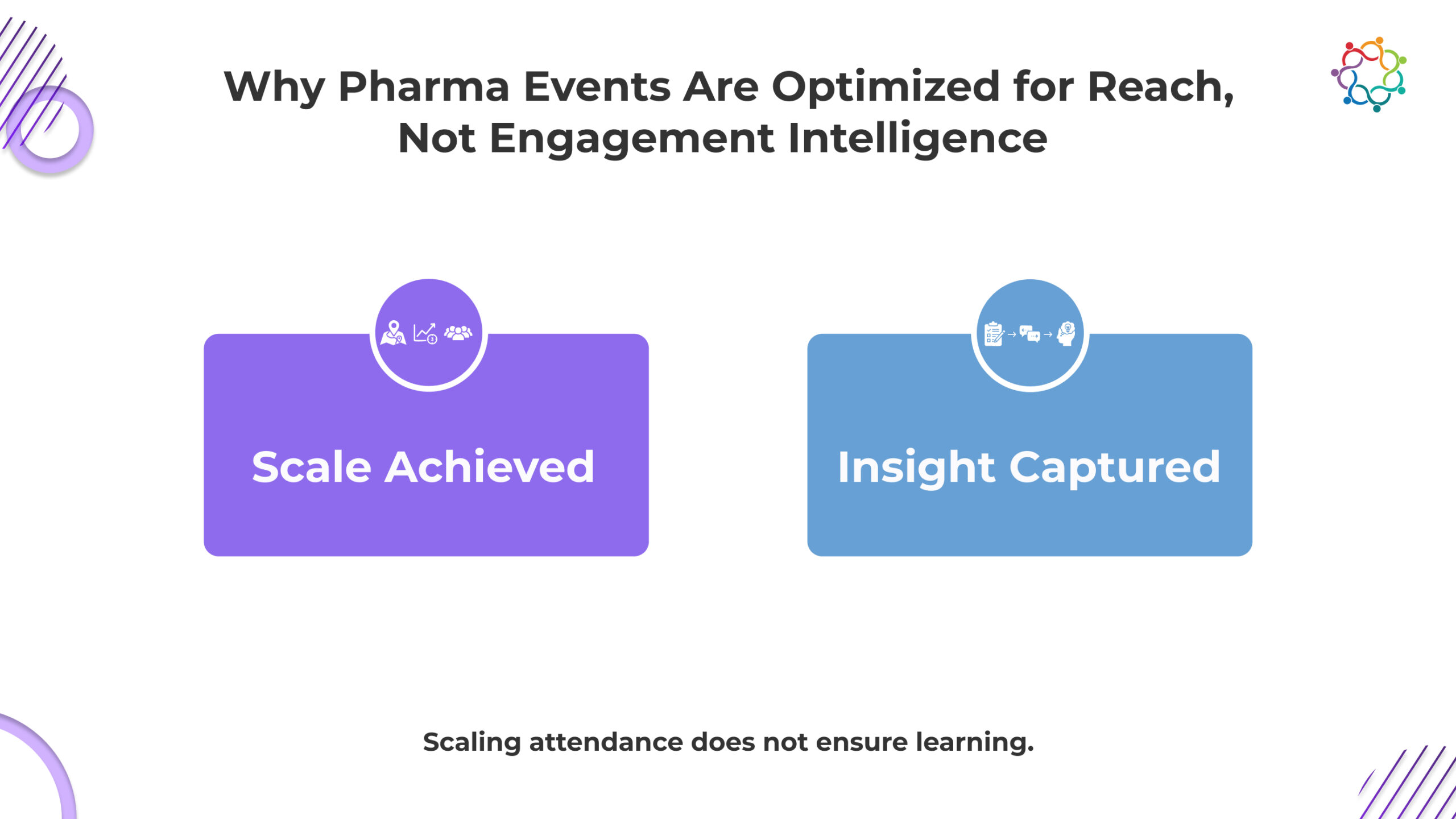
Most pharmaceutical organizations do not lack events. They lack engagement intelligence architecture.
Engagement intelligence architecture is the structured system that captures, interprets, and connects HCP feedback, perception signals, and engagement progression across interactions. It makes engagement visible beyond attendance. It shows not just who participated, but what changed because they participated.
Within pharma event marketing, this architecture is often missing or underdeveloped.
Instead, organizations rely on operational indicators that feel sufficient but are strategically incomplete:
This creates a dangerous illusion of understanding.
You assume engagement happened because the event happened.
But without engagement intelligence architecture, you have no structural mechanism to prove whether HCP perception evolved, whether scientific communication resolved uncertainty, or whether engagement moved forward at all.
The consequence is unavoidable. Strategy continues without verified learning.
You are not refining engagement. You are repeating it.
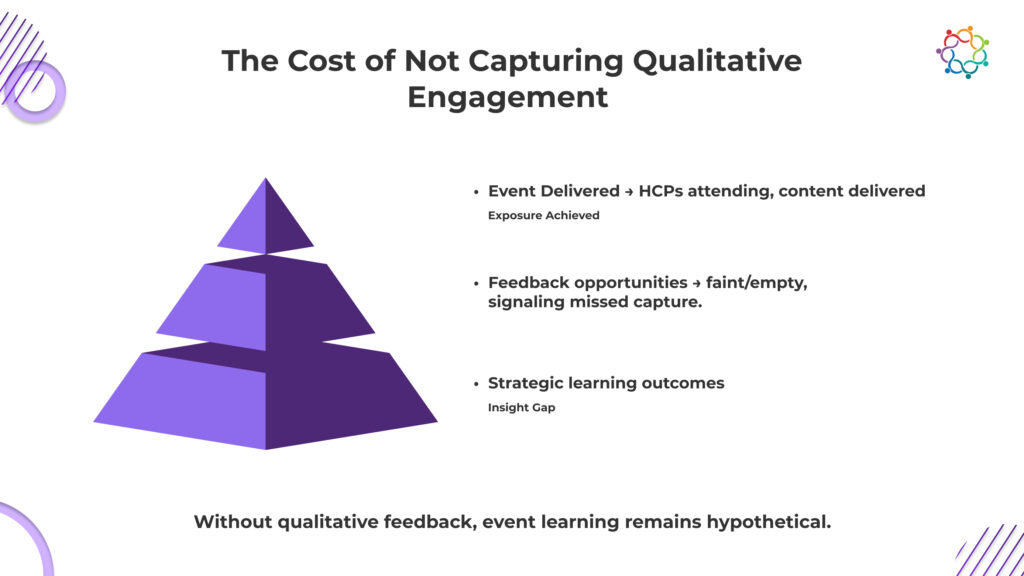
You are making decisions about HCP engagement without knowing what HCPs actually took away from your events.
That is the uncomfortable truth.
You know how many attended. You know which slides were presented. You know the agenda was completed. But you do not know whether the science clarified thinking or created silent doubt. You do not know whether your message strengthened confidence or exposed gaps in credibility.
This is the Engagement Blind Spot. It exists between what you delivered and what they internalized.
You repeat the same formats. You reinforce the same narratives. You continue investing in engagement you cannot validate.
You are not managing engagement strategy. You are hoping it worked.
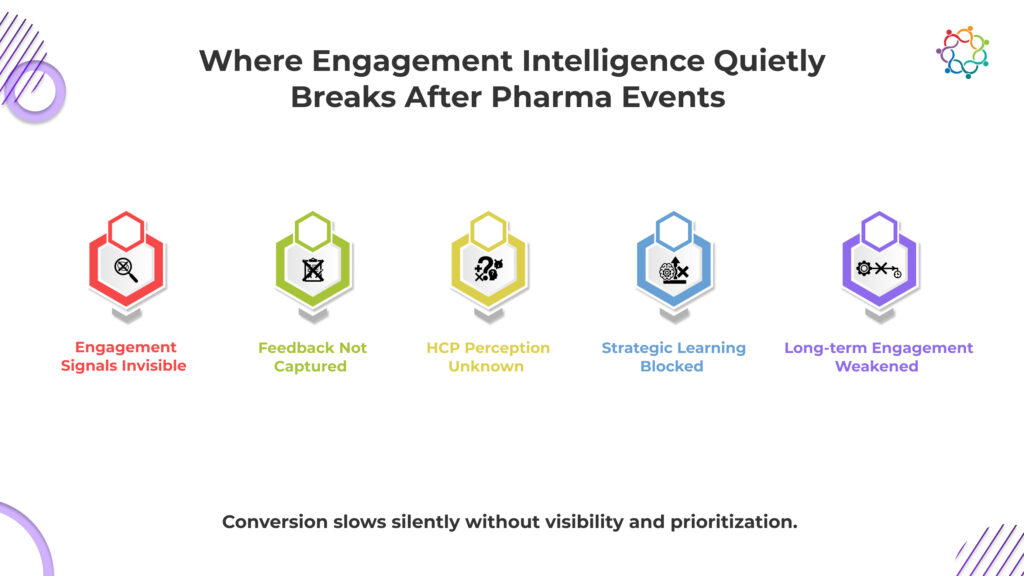
Feedback failure rarely occurs in a single moment. It unfolds in a sequence of small structural gaps that compound over time.
You assume participation equals engagement because it is the only thing you can see. HCPs attend, listen, and move through the agenda. But you have no structural visibility into who was intellectually engaged and who was mentally absent. Passive attendance and active scientific evaluation look identical in your reports.
This means you cannot identify which HCP relationships actually progressed. You leave the event with a list of attendees, not a map of engagement depth. The most valuable engagement signals disappear while you convince yourself the event worked.
The moment the event ends, your visibility collapses. HCP perception begins to fade, and you have no reliable system to capture it while it still exists. You do not know what created clarity, what created resistance, or what created indifference.
This forces you into retrospective guesswork. Scientific exchange feels complete internally, but you have no evidence of its effectiveness externally. You lose the only window where honest engagement signals exist. Once that window closes, the learning opportunity is permanently gone.
You cannot recover insight you never captured.
Your future engagement strategy depends on learning from past interactions. But without feedback, there is nothing real to learn from. So you default to repetition. The same formats. The same messaging. The same assumptions. You call it consistency, but it is actually stagnation.
You are not refining engagement based on evidence. You are preserving familiarity because it feels safe.
This guarantees that weaknesses remain uncorrected. Over time, your engagement strategy stops evolving. It becomes a cycle of activity without progress, sustained by belief instead of proof.
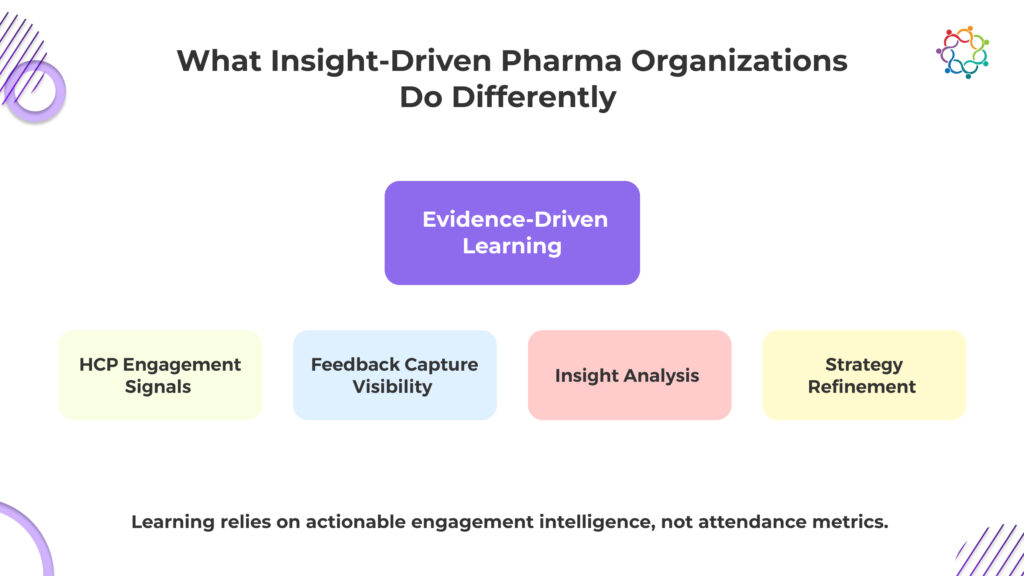
Not all pharmaceutical organizations operate within this blind spot. Some recognize that participation metrics alone cannot sustain long term engagement strategy. They evaluate events through a different strategic lens.
Instead of asking how many HCPs attended, they focus on understanding how engagement progressed.
This creates a fundamental structural contrast.
Insight-driven organizations optimize for something far more strategically valuable.
They focus on engagement visibility. They prioritize understanding how scientific exchange influenced perception. They measure engagement progression across interactions.
This shift changes the role of events entirely.
Events are no longer endpoints. They become input sources for strategic learning. The engagement consequence is transformative. Scientific exchange effectiveness improves over time because engagement insight informs future engagement design.
This dynamic of continuous interaction has been explored deeply in the context of how trusted pharma brands maintain engagement before, during, and after events.
Medical education events evolve based on real HCP response rather than internal assumptions. Strategically, this strengthens long-term healthcare professional engagement.
Organizations build a feedback-informed engagement ecosystem rather than a participation-driven activity cycle. This distinction determines whether events remain operational programs or become strategic intelligence assets.
The value of pharmaceutical events is not defined by attendance volume alone. It is defined by the learning they generate.
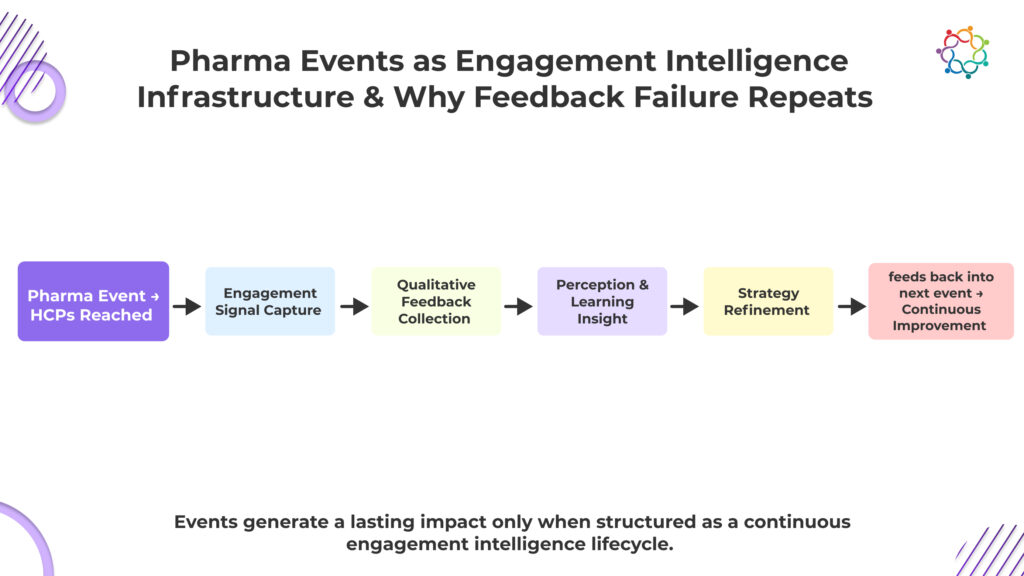
Pharmaceutical events are one of the few controlled environments where HCP attention is fully available. Yet most organizations treat them as isolated communication moments instead of intelligence collection points.
This is a structural failure.
Pharma event marketing must operate as an engagement intelligence infrastructure that connects each event to a larger engagement system. Every interaction should contribute to a longitudinal view of HCP engagement, not remain trapped within a single event cycle.
Without this structural layer, events remain disconnected. Leadership sees participation snapshots, not engagement trajectory. There is no continuity between what happened before, during, and after the event.
This breaks strategic momentum.
Engagement becomes episodic instead of cumulative.
When events function as an intelligence infrastructure, they create continuity. They allow organizations to track engagement movement, identify momentum shifts, and make engagement strategy responsive to real HCP behavior rather than static planning assumptions.
Feedback failure persists because it is structurally reinforced.
Within pharma event marketing, organizational evaluation systems reward visible operational success. Attendance metrics are reported. Participation is celebrated. Geographic expansion is recognized.
Engagement intelligence is rarely evaluated with the same rigor. This creates a powerful institutional incentive. Organizations prioritize what is rewarded. If scale is rewarded, scale becomes the focus. If engagement intelligence is not rewarded, feedback systems remain underdeveloped.
The engagement consequence is systemic repetition. Events continue to optimize for participation visibility rather than perception visibility. Strategically, this creates an engagement system that produces activity but not insight.
This cycle continues because it does not produce immediate failure.
Events appear successful. Participation remains strong. Scientific programming continues. The absence of feedback intelligence remains hidden beneath operational success. This creates institutional comfort with an incomplete understanding.
Organizations continue investing in engagement channels that they cannot fully evaluate.
This is not a tactical oversight. It is a structural outcome of institutional measurement priorities. Until feedback intelligence becomes a core success indicator, feedback failure will continue to repeat.
Exposure will continue to be measured. Understanding will continue to be assumed.
Strategic erosion rarely announces itself immediately. It accumulates slowly as engagement intelligence remains invisible.
Pharmaceutical events often demonstrate operational success. Attendance is strong. Scientific sessions are delivered. Participation targets are achieved.
These indicators create the appearance of justified investment.
But investment justification at leadership levels requires more than activity visibility. Leadership must understand strategic impact.
Without engagement intelligence, organizations cannot demonstrate:
The engagement consequence is budget vulnerability. Event investment appears active but strategically ambiguous.
Leadership begins to question whether investment produces measurable strategic returns.
Over time, events risk being categorized as operational expenses rather than strategic infrastructure.
Budget strength depends on engagement intelligence visibility. Without it, investment justification weakens.
Healthcare professionals evaluate engagement quality based on responsiveness.
Scientific exchange is not defined solely by information delivery. It is defined by mutual learning. When organizations do not visibly incorporate feedback, engagement begins to feel one-directional.
HCPs attend events. They receive information. They participate in discussions. But they do not see how their perspective influences future engagement.
This creates relational stagnation.
Engagement continues operationally, but relational depth does not progress. The engagement consequence is subtle but critical. Trust does not actively decline. It simply does not strengthen.
Scientific exchange effectiveness depends on progressive trust development. Without visible responsiveness, trust progression slows.
Scientific leadership depends on perception, not presence alone. Pharmaceutical organizations invest heavily in communicating evidence and advancing scientific understanding.
But without engagement intelligence, perception remains partially invisible.
Organizations cannot confidently determine:
This creates positioning fragility. Scientific leadership becomes assumed, not validated. Without perception visibility, differentiation weakens, and repetition replaces proven influence.
Scientific positioning depends on perceived value, and without engagement intelligence, your strategy is built on assumptions, not confirmed impact or defensible competitive strength.
Pharma events succeed at assembling HCP audiences. They succeed at delivering scientific content. They succeed at creating visible activity. But none of that guarantees that engagement actually be advanced.
What determines strategic value is not what was delivered. It is what was learned.
If you cannot see how HCP perception shifted, you cannot refine engagement. If you cannot refine engagement, you cannot strengthen scientific influence. And if influence does not strengthen, your events are not building a strategic advantage.
They are maintaining motion.
A pharma event that does not produce engagement intelligence does not strengthen positioning, trust, or future effectiveness. It sustains presence while leaving progress uncertain.
Transforming participation into actionable learning requires integrating platforms that track, analyze, and make engagement intelligence immediately usable.
That is not strategic engagement. That is strategic stagnation.
Engagement intelligence architecture means systems that capture and interpret HCP engagement signals across events. Most pharma programs only count attendance, so genuine insight never gets collected.
Showing up does not mean minds changed. Perception shifts appear in questions asked, content engagement, and follow-up behavior, none of which attendance volume captures.
The Engagement Blind Spot is the gap where HCP reactions during events go completely uncaptured, leaving pharma teams guessing which content and formats actually resonated.
Without insight into what works, budgets keep funding ineffective formats and content. Returns quietly decline year after year while spend stays the same or grows.
Participation-driven strategies chase headcount and reach. Insight-driven strategies use engagement intelligence to continuously refine content, targeting, and spend based on what actually changes HCP perception.